
Rachel Neumeier's Blog
November 27, 2025
Ah, those clever scammers
I realize this may not be of the very broadest general interest, but —
Here is a post from Anne R Allen: Update on those Flattering AI Book Marketing Scams
Love your work! You are a genius, so I want to feature your (usually unnamed) book at my book club, which has over 5000, 10,000, 100,000, 500,000, or whatever members who will all write you glowing reviews. Just tip each one $25.
Many variations, including a brand-new one that seems to be aimed at somehow scamming authors out of money from the Anthropic lawsuit settlement.
And, in case you’re interested, these scams mostly (not quite all of them) seem to be the responsibility of a specific group of Nigerian Princes: Return of the Nigerian Prince: A New Twist on Book Marketing Scams
The most horrifying part is that the Nigerian Princes want access to your KDP account … and at least a few authors are giving them that access. The ameliorating detail here is that KDP has contacted authors in at least some cases, saying, “Someone from Nigeria is trying to change your information, do you want to change your passwords?” and Amazon may be somewhat evil, but this is decidedly non-evil, and I’m glad to hear KDP is at least somewhat on top of this.
And here: Return of the Nigerian Prince Redux: Beware Book Club and Book Review Scams
It’s the book club version I see the most. Heaps of them. The number has died down a bit, so I’m no longer seeing five to ten per day, at least not this week. I did get two today, though, and a couple yesterday. That’s why these posts are interesting to me, I expect. Since the number appears to be declining for me personally, maybe the Nigerian Princes are moving on to someone who isn’t deleting their emails as fast as they appear.
Incidentally, the names of real authors are used as a come on. Here’s one we’ll all recognize:
One poster mentions fake testimonials from real authors; I [Victoria Strauss] heard from author T. Kingfisher, who confirmed that her name was falsely used as a reference by the club scammer in the first email example above, with a fake email address that, when contacted, provided a predictably glowing and entirely bogus review.
Victoria does think that the HUGE number of spam emails made authors suspicious and got authors talking and therefore the Nigerian Princes shot themselves in the foot by going so over the top with these scams. Anne thinks that the fact that these emails are still appearing implies that some authors are falling for them. I think they’re both probably right, and I think scammers with brains will do their best to come up with something that sounds more plausible. Maybe ChatGPT will help them with that …
… and as always, the rule will be:
Very few people contact you out of the blue to offer services. It can happen — I’ve had it happen twice — but it’s really, really rare compared to scammers contacting you out of the blue. I think it might help to read some of the scam emails and get a feel for those. I hope that might help sort out the general “smells like a scammer” from “I think this is real” gestalt impression.
Please Feel Free to Share:


The post Ah, those clever scammers appeared first on Rachel Neumeier.


November 26, 2025
Poetry Thursday: Happy Thanksgiving!
If you’re in the US, I hope you’re having a great Thanksgiving! Obviously poetry automatically has a theme today:
The Harvest Moon by Longfellow
It is the Harvest Moon! On gilded vanes
And roofs of villages, on woodland crests
And their aerial neighborhoods of nests
Deserted, on the curtained window-panes
Of rooms where children sleep, on country lanes
And harvest-fields, its mystic splendor rests!
Gone are the birds that were our summer guests,
With the last sheaves return the laboring wains!
All things are symbols: the external shows
Of Nature have their image in the mind,
As flowers and fruits and falling of the leaves;
The song-birds leave us at the summer’s close,
Only the empty nests are left behind,
And pipings of the quail among the sheaves.
***
***
A Song for Merry Harvest by Eliza Cook
Bring forth the harp, and let us sweep its fullest, loudest string.
The bee below, the bird above, are teaching us to sing
A song for merry harvest; and the one who will not bear
His grateful part partakes a boon he ill deserves to share.
The grasshopper is pouring forth his quick and trembling notes;
The laughter of the gleaner’s child, the heart’s own music floats.
Up! up! I say, a roundelay from every voice that lives
Should welcome merry harvest, and bless the God that gives.
The buoyant soul that loves the bowl may see the dark grapes shine,
And gems of melting ruby deck the ringlets of the vine;
Who prizes more the foaming ale may gaze upon the plain,
And feast his eye with yellow hops and sheets of bearded grain;
The kindly one whose bosom aches to see a dog unfed
May bend the knee in thanks to see the ample promised bread.
Awake, then, all! ’tis Nature’s call, and every voice that lives
Shall welcome merry harvest, and bless the God that gives.
***
***
Thanksgiving by Ella Wheeler Wilcox
We walk on starry fields of white
And do not see the daisies;
For blessings common in our sight
We rarely offer praises.
We sigh for some supreme delight
To crown our lives with splendor,
And quite ignore our daily store
Of pleasures sweet and tender.
Our cares are bold and push their way
Upon our thought and feeling.
They hand about us all the day,
Our time from pleasure stealing.
So unobtrusive many a joy
We pass by and forget it,
But worry strives to own our lives,
And conquers if we let it.
There’s not a day in all the year
But holds some hidden pleasure,
And looking back, joys oft appear
To brim the past’s wide measure.
But blessings are like friends, I hold,
Who love and labor near us.
We ought to raise our notes of praise
While living hearts can hear us.
Full many a blessing wears the guise
Of worry or of trouble;
Far-seeing is the soul, and wise,
Who knows the mask is double.
But he who has the faith and strength
To thank his God for sorrow
Has found a joy without alloy
To gladden every morrow.
We ought to make the moments notes
Of happy, glad Thanksgiving;
The hours and days a silent phrase
Of music we are living.
And so the theme should swell and grow
As weeks and months pass o’er us,
And rise sublime at this good time,
A grand Thanksgiving chorus.
***
***
Image from Pixabay
Please Feel Free to Share:

The post Poetry Thursday: Happy Thanksgiving! appeared first on Rachel Neumeier.
November 25, 2025
Who Wants to Live Forever?
I personally hear this question as a voiceover from the movie The Lost Boys, but in this case, it’s the title of a post by Judith Tarr at Reactormag: Who Wants to Live Forever?
Lists of “immortal” animals, such as this one, stretch the definition of immortality to include animals that live significantly longer than humans, including my favorite, the Greenland shark. By that definition, a human is immortal compared to a mouse or a fruit fly. What about genuine immortality? Actual deathlessness? … there are animals that, as far as we can tell, actually do not die. They’re not vertebrates. In human terms, they’re downright alien.
Tell me more!
One way to live forever is to reach a certain point in the life cycle and then start over. Reach maturity, and then, under certain conditions, become a larva again. A tiny jellyfish, Turritopsis dohrni, does exactly this. Scientists call it the immortal jellyfish. The process is called transdifferentiation. The mature animal reverts to its immature form. It’s not like an adult human becoming a child again; the two forms are quite different. As the article puts it, it’s as if a butterfly could change back into a caterpillar.
All right, tell me that isn’t a great idea for an alien species for an SF novel. The whole novel would exist for the purpose of showcasing this fantastic alien species. I’m immediately inclined to go with a winged morph and a non-winged “caterpillar” morph and let this species switch back and forth repeatedly.
Why would a species do this, though? Well, with the jellyfish, the article Judith Tarr linked to says this:
When the medusa of this species is physically damaged or experiences stresses such as starvation, instead of dying it shrinks in on itself, reabsorbing its tentacles and losing the ability to swim. It then settles on the seafloor as a blob-like cyst. Over the next 24-36 hoursopens in a new window, this blob develops into a new polyp – the jellyfish’s previous life stage – and after maturing, medusae bud off. This phenomenon has been likenedopens in a new window to that of a butterfly which, instead of dying, would be able to transform back into a caterpillar and then metamorphose into an adult butterfly once again. …
Okay, so that would be like a butterfly that got nabbed by a bird, but got away with half a wing missing. Instead of being easy prey, it flutters awkwardly to some protected location and forms a cocoon, reverts to caterpillar form within the cocoon, emerges to recuperate and recover, then forms another cocoon and turns back into a butterfly.
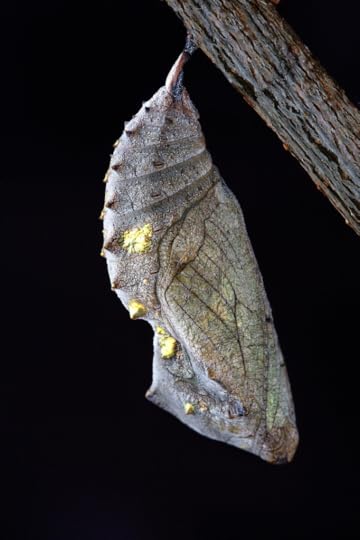
Image from Pixabay
Let’s say the terrestrial form is juvenile in the sense of non-reproductive, but it’s a perfectly functional form. It recovers and, when sufficiently vigorous, turns once again into the winged reproductive form. It’s damage — lack of vigor — that triggers the ability to change back to the terrestrial form. Maybe the change is involuntary.
Let’s say both forms are fully sapient. Although I’d be inclined to make the winged form less sapient, or more focused on reproduction so they are difficult to interact with. I could change my mind about that if I wanted to, of course, but if you’ve got a reproductive phase, than I’d expect reproduction to be the actual focus of that phase, to the exclusion of basically all else. If the winged form isn’t reproductive, why is it there at all?
Given this is one genetic individual through each and every morphological change, is memory conserved? I vote for yes. It could be yes-but-not-exactly.
What does social life and civilization look like for this species?
Whatever decisions you make about fundamental biology, then you can go from there. If you want human-esque aliens, the terrestrial form can look like humans, more or less. The winged form probably doesn’t. The terrestrial form interacts with our human characters. The winged form doesn’t, or interacts differently. If you don’t want human-like aliens, then fine, go with the Raksura model, where the focus is not on human characters.
Beats me what the plot is about. This is all worldbuilding and setting. The plot gets layered on top.
Please Feel Free to Share:

The post Who Wants to Live Forever? appeared first on Rachel Neumeier.
November 24, 2025
Recent Reading: Snake-Eater by T Kingfisher
All right, so I didn’t actually read a short horror novel this past Halloween, though, I mean, I thought about it and looked at some and downloaded a couple. I was, however, busy, so it didn’t happen.
Then, somehow, T Kingfisher’s Snake-Eater came to my attention – I don’t recall how, exactly, because nobody mentioned it specifically. Maybe Amazon put it in front of me. I’m not sure. But I was still thinking, short horror novel, not too horrific, all right, fine, let’s take a look.
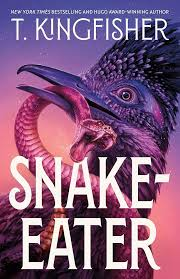
With only a few dollars to her name and her beloved dog Copper by her side, Selena flees her past in the city to claim her late aunt’s house in the desert town of Quartz Creek. … in Quartz Creek, there’s a strange beauty to everything, from the landscape to new friends, and more blue sky than Selena’s ever seen. But something lurks below the surface …
And I read the first few paragraphs and those paragraphs worked for me, so I wound up reading the whole novel, though not in a single day. Here are the opening paragraphs:
***
Selena picked her new home for no better reason than the dog laid down on the porch.
The dog was a middle-aged black Lab, though her Labrador-ness had been diluted by a fence-jumping father of questionable ancestry. Whatever he had been, his genes had helped temper the breed’s boundless energy. She still worshipped chasing tennis balls as the highest form of canine endeavor but wanted a long nap afterward, and ideally a long nap beforehand as well.
Selena named her Copper, which Walter said was a stupid name because there was nothing copper-colored about her. Selena felt guilty when he pointed that out, but Copper had already learned her name by that point, so she put a collar on the dog with bright copper tags. Walter rolled his eyes, but Selena was pleased with herself for having set things right again.
The dog, it must be said, never seemed to mind either way.
Selena had ridden out on the train, two and a half days to get there, and she’d been afraid the whole time that somebody’d tell her she couldn’t have a dog on board. She didn’t know what she’d do. Fortunately, Copper had excellent travel manners and mostly lay under her seat and let out the long sighs of an old dog at peace with the world. The rocking of the train seemed to agree with her. She squatted obediently at every stop and was extremely pleased to share the sandwiches that Selena passed down to her.
At the second-to-last stop, the conductor bent down and scratched Copper behind the ears, and Selena was so relieved she nearly cried.
When they reached the final stop, Copper stood up and stretched. Her muzzle had begun to go white, but her eyes were clear. She glanced around the train platform and then up at Selena, as if expecting orders.
QUARTZ CREEK was painted on the platform wall, in faded blue. The train platform was cinder block and adobe. It could have been ten years old or two hundred.
***
What do you think? Does the grammatical mistake in the first sentence bother you? From a new-to-me author, that would probably be the kiss of death. Why did T Kingfisher do that? Is it conceivable she didn’t realize that it should be “lay,” not “laid”? That doesn’t seem all that likely. Is it even vaguely possible that her copyeditor did not point to that? The book came out through 47 North, which (I looked this up) is Amazon’s very own SFF imprint. They handle this imprint as a traditional publisher, says Google, with editors and all the trimming. So … surely someone pointed to this error and T Kingfisher deliberately stetted it. Not sure why. Nothing else in this novel struck me as folksy in tone, which would fit that usage.
So … moving on with this minor mystery unsolved.
I’m now leaving behind this unimportant quibble to address the actual novel:
I liked it a lot, and it’s just barely horror, so if you don’t like horror, I honestly think this book would be perfectly fine. There is one very brief moment that would have freaked me out completely if it had happened to me, and one slightly longer scene that would have been scary but in which no one was harmed, and that’s basically it. No characters are badly hurt in this story except Merv the peacock, and I’m sorry for him, but he’s a very minor character and, I mean, I’m not that crazy about peacocks, as a rule. On the Horror Novel spectrum, from one to ten, where Very Light Humorouos Horror is one and Intense Creepiness is ten, I’d rate this book about a one an a half, maaaaybe as high as a two. Please weigh in if you’ve read it.
The desert scenery is fantastic. It’s just fantastic. It comes to life right there on the page: the white caliche soils, the hard blue sky, the saguaro and cholla, the scorpions, and the terrifying roadrunner, which is brilliantly described, and I will now forever think of roadrunners as rather small and quite vicious velociraptors. I expect T Kingfisher used the name snake-eater nearly all the time to avoid too many Meep Meep Whoosh blue ostrich outwits Wile E Coyote associations. As it happens, I know what real roadrunners look like, so I had no trouble visualizing the vicious little dinosaur-style bird.
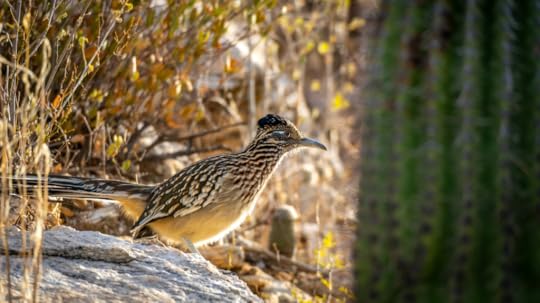
Photo by JC Cervantes on Unsplash
The characters are fun. The dog was excellent, though I did have a very minor problem with her*. Basically, she was excellent. I’ve seen authors add a good dog to a novel, apparently not figure out what to do with the dog, and the dog therefore really could have and should have been removed from the story. Not this time. Copper was an important character all the way through.
I liked all the secondary characters, who were mostly drawn rather briskly, and was deeply entertained by how DJ Raven turned up toward the end.
This is a simple story, so other than Copper, only two secondary characters are developed at all — Grandma Billy and Father Aguirre — and both are excellent. Selena herself is fine, and wow, does she demonstrate the concept of Out of the Frying Pan Into the Fire. One can understand exactly how she wound up with Walter, horrifying as that relationship was. Actually, what’s the word for that – for someone persuading you that you’re the crazy one? Gaslighting? Great example of that. We don’t see anything of that relationship in action, thank heaven, because ugh. I appreciate T Kingfisher starting the story where she did. Walter does appear very briefly at the end, and this something that’s worth noting structurally. He had to appear at the end, so that Selena could reject him and see the community reject him. This provided a kind of closure that nothing else could have provided, so his brief appearance was highly predictable.
Speaking of predictability, just about everything in this novel is predictable. I don’t mean details. I didn’t quite see that coming about Father Aguirre, for example, though it was clearly set up, so I should have. I didn’t expect Yellow Dog, though I certainly did expect the encounter he presaged. There are wonderful details everywhere. It’s those details and the description that lift this book to a higher level than it’s extremely predictable plot, where practically everything is clearly foreshadowed and/or set up far in advance. (“Oh, good morning, Mr. Chekov; just set that gun anywhere,” was a recurring thought.)
Honestly, many things are a revelation to Selena while most likely being quiiiiiite obvious to the reader, including, in broad terms, just about everything important. And you know what? That’s fine. It’s especially fine in a novel positioned adjacent to horror. The predictability reduces the tension to about the level I prefer. Who wants to actually worry about the dog? Raise your hand. Anyone? Right, no one, that’s what I thought. If this novel had been less predictable – like, for example, The Twisted Ones, about a six on the Creepiness scale – I might have enjoyed it, but in a different way and probably not as much.
***
* Here’s the quibble about the dog:
T Kingfisher comes across as knowing a lot about dogs and writes excellent dogs, so why does she have Copper, a bitch, mark stuff by peeing on it? Because all female dogs mark when in season, but not at all the way a male dog marks — they never pee on vertical objects, and they don’t in general lift their legs at all. A very small proportion of female dogs do list their legs, but even they don’t mark the same objects males do, or for the same reasons, or in the same way, plus Copper doesn’t have the temperament of that kind of female (very dominant).
Is it possible that T Kingfisher / Ursula Vernon has never had a bitch as a pet and – this seems inconceivable – has never realized that bitches don’t mark shrubs and other vertical items, even when they mark at all? Or – this seems even less likely – did she once have a bitch who did urine-mark like a male, something I have literally never seen or even heard of? So that’s a puzzle that probable few other readers will wonder about, but I do wonder about it.
Please Feel Free to Share:

The post Recent Reading: Snake-Eater by T Kingfisher appeared first on Rachel Neumeier.
Update: Still moving along
Not much to say except that I ought to break 100,000 words for Bereket this afternoon, or maybe tomorrow, depending. Thus, we had better be well over halfway. And I think we are!
Generally, I have some vague notion how long a novel will go, then overshoot that idea by 40% to (sigh) 80%. This time, oddly, I had no real expectation or feeling about the overall probable length except that it wouldn’t be short. By the time I’m this far in, as a rule I have a better idea about the ultimate length, though I may be ridiculously optimistic and continue to underestimate by kind of a lot.
But certain signs are good. We hit an important chapter over the weekend and now half the characters have some basic idea about what is going on. Various obstacles have been surmounted, or pulled out of the way, which clears the path for those characters to move toward the endgame — this requires physical travel, but not like a thousand miles. A few days’ travel, some of which is likely to be elided.
Then the other important characters are also learning something about what is actually going on, so they’ll be in position to move forward pretty soon as well, so that everyone is in the same place when they need to be. This probably implies a braided narrative, which is accurate. Bereket himself takes 3/4 of the chapters. Every fourth chapter — at this point, and I think that’s how it’s going to stay — is carried by an Ugaro we have met before, but not recently. That may be enough for you to guess who this is. It’s not really a secret, and will be less of one given the chapter headings will tell you who’s carrying the pov in that chapter.
Ryo and Aras haven’t shown up yet. No one here knows they’re on their way, but they probably are. They have a lot farther to travel, so they’d better have started moving west a week or two ago, even if they’re moving fast. They’ll be around the edges, mostly. They have to be, especially Aras, who told Sekaran that they were peripheral to these events. The definition of “peripheral” is not firm, but obviously neither of them can actually be central. Nor will they be.
Anyway, though we’re not that close to the end, I do think we’re over the halfway mark and should now move fairly briskly. I’m hoping for a length of 140K to 150K for the draft, then probably a bit of trimming.
Six days left in November! Seven counting today! That’s likely to bring the draft to about 120,000 words, or just about exactly 100,000 words in November. That may not finish this book — I don’t think that’s at all likely — but it sure puts it in a good position. I should easily finish this draft before Christmas. That should almost guarantee a release date early next year. Not January. March. That will allow lots of time to polish it up, work on something else, schedule a preorder, drop Bereket early at Patreon, etc etc, So unless things change in a major way, March 2.
AND
This gives me room to work on something else over Christmas Break, yay! My best guess — this is a guess — is that my schedule for 2026 will be: Bereket, Adamantine (Invictus III), Hedesa II, Unforgiving Sky (NFS II). I really want to stress that I’m not sure! That’s truly a guess!
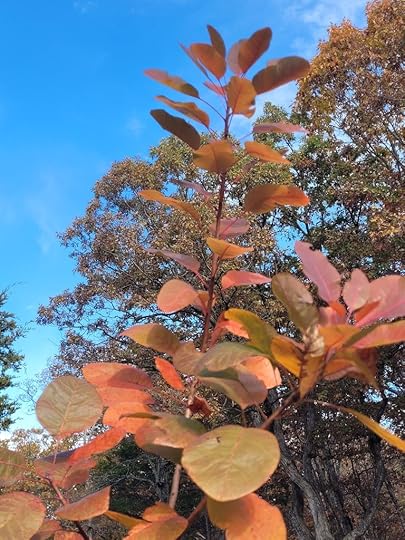
Meanwhile, gray gray gray with intermittent drizzle, ugh. Here’s a memory of a recent-ish fall day that was prettier than today. This is a smoke tree, Cotigus, but I don’t recall the variety.
 Please Feel Free to Share:


The post Update: Still moving along appeared first on Rachel Neumeier.
November 20, 2025
The Current State of “Hybrid” Publishing
An interesting post over at Jane Friedman’s blog: The Current State of Hybrid Publishing: Q&A with David Wilk
I find Wilk an honest broker; while he runs a hybrid publishing company, he’s not proactively trying to persuade anyone on the merits of that particular path. He serves on the board of the Council of Literary Magazines and Presses and offers consulting to all sorts of people who need expert publishing guidance. What I appreciated most about our conversation was his perspective as someone who’s been in the business for decades, plus he offers context and nuance around what can be a divisive issue: paying to publish.
Hybrid publishing refers to real, non-scammer options for publishing that are not do-it-all-yourself but also not aimed at getting an agent and a Big Five contract. These options generally involve paying a fee for real services of some sort, meaning not crazy fees to obvious scammers, but significant fees for real services. There are lots of options, the field is changing all the time, and Jane Friedman obviously tries to keep an eye on what is going on in this area. Thus, this interview.
Let me pull out some bits that seem interesting or useful. I’ll italicize everything from the linked post, as usual. Anything not italicized is from me. Also as usual, but I wanted to be specific about it because I pulled whole paragraphs from this post. Everything from Jane Friedman herself is in bold italics. Everything from the person she’s interviewing is regular italics.
***
Okay, here’s something. I bet “stratification” here means “layers of pricing to fit every budget.”
Stratification in the hybrid publishing business reflects the stratification in the client base. Just because a publisher charges $100,000 for a book project doesn’t mean they’re predatory—because the people who will pay that kind of fee can afford it. On the other hand, it would be unethical if a publisher allowed someone to pay $100,000 knowing that the client was taking out a mortgage on their home to cover it, thinking that somehow their book would be a bestseller, which we all know is wishful thinking. To me, that is an ethical breach. In a sense that is a financial crime. And I’m sure it’s happened; there are unethical companies out there. But those that are aboveboard are selling a service and pricing it to the market they serve.
This is interesting to me. I don’t think it’s really possible for a publisher to ethically charge $100,000 for any book project, actually. I don’t think it matters whether the client can afford that. I don’t think it’s conceivable that the publisher can provide anything that is worth that much. Except ghostwriting services, possibly, in which case … fine, I guess … but the client should be up front about the fact that they are buying a ghostwriter’s services and the publishing company should acknowledge that this is what they are providing, among whatever much less valuable services they are also providing.
Here’s a comment Jane Friedman makes:
I find it really difficult to talk about hybrid publishing without making some group of people upset. If I talk about it as a legitimate option, I hear from self-publishing authors saying these companies are scams, or I hear from authors who feel they overpaid for what they received. Or if I talk critically, I hear from the hybrid publishers and hybrid published authors who say that I just don’t get it.
I can understand this. Wilk responds, and I think his response is reasonable. He uses the analogy of hiring someone to build a garage. I agree. I think, personally, that it’s fine to pay someone a lot of money to do something for you because you don’t want to do it yourself or you can’t do it yourself. The analogy I have used is this: You can hire someone to build a fence around a parcel of land, build raised beds, till up the soil, add plenty of topsoil, plant roses, and install a watering system. That will cost quite a lot, after which you will have this nice rose garden, which is what you paid for, and you did not do any of the work for it. You can then hire a gardener if you want to, and sit back and enjoy the roses without ever doing any work at all. And this is perfectly fine.
In the same exact way, you can decide you have plenty of money, so you can hire one of these hybrid publishing services to do everything. Including, maybe, write the book. But if not that, then serve as your book coach, provide every layer of editing, design the cover, do the formatting, publish the book, and do the marketing. And if you have the money to do that and want to do it, why not? Except for the ghostwriting part, which I will NEVER UNDERSTAND, at least not for fiction. For memoir, sure, why not? It’s understandable to work with a ghostwriter for memoir. But for fiction, no, I don’t understand that at all.
Then you’re going to have people who self-publish and take it seriously, and all those people are going to look blankly at the client who paid for all that and say, “But you could have done so much of that yourself! It’s not hard!”
To which the appropriate answer would be — it seems to me — “But I didn’t want to do it. It was fine with me to spend money so that someone else would do it for me.” I don’t mean the actual writing of a novel. I mean everything else, all the rest of it. It seems to me this client could easily say, “Did you build that sunroom extension on your house yourself? Do you do your own taxes? Did you fix your car yourself last time you had car trouble? Why not? It’s not hard! You could learn to do it yourself!” Because it’s always true that your fundamental choice is to do something yourself or pay someone else to do it for you, and either is perfectly fine.
And then if someone thinks they overpaid, well, they chose to pay that much, and that was their decision, exactly as though they paid one landscaper to put in a rose garden and then realized they could have hired a different landscaper who might have done a better job for less money. They should have shopped around. But if the publishing service does a good job providing the services they contracted to provide for the price both parties agreed to up front, the service is not a scammer, even if the author realizes later they could have gotten a better value for their money elsewhere.
So basically, I think hybrid publishing is fine and reasonable and you should know what you’re going to get for what you pay, and then whatever, it’s fine and there’s no problem with it.
Oh ho, THIS is an interesting comment:
At this point, though, I think it’s going to become more difficult for hybrid publishers. I don’t think it’s a long-term growth piece of business.
And why is that?
Just as traditional commercial publishing appears to be (very) slowly (but surely) dying, I think hybrid publishing will be buffeted by coming demographic and cultural dynamics. … The biggest challenge for hybrid publishers is that it’s actually a pretty straightforward process to publish a book. We know how to do this. But it’s really difficult to market and sell books. … And every single toolset that you think works, or did work in the past, doesn’t seem to work anymore. What might have worked last year doesn’t work today. And unfortunately, when there are activities that do work, they are not codifiable or repeatable.
… [T]he vast abundance of books published and the decline in overall book readership means that the chance for a sales success decreases daily. … While not every book’s success or failure is measured by book sales, how many authors are going to be willing to spend their hard-earned dollars to produce books that sell fewer than 200 copies?
***
All right, let’s pause right there. Quick, KDP, show me lifetime sales for all my books. … Okay, everything but the omnibus print volumes has sold more than 200 copies. That doesn’t count KU pages read. If a book publisher tells me that most books self-published today sell fewer than 200 copies, I would wonder what categories of unreadably terrible, utterly unpromoted books that publisher is including in the estimate, because including unpromoted, unreadable books is the only way to get that figure. And if a “book publisher” is not promoting books, fine, because that’s not their job, but if they are bringing out unreadably terrible books without telling the author those books are unreadably terrible, they are a scammer or very close to it.
***
Wilk then continues: none of this applies to the book categories where self-publishing authors are being successful publishing on KDP and other digital platforms where true communities of readers and authors have formed an ecosystem that operates completely outside of traditional publishing formats and processes.
Well then, NAME THOSE CATEGORIES and be specific about what you are talking about, because that is kind of relevant! It’s absolutely nuts to make a statement like that and then just go on without specifying which categories you think are dead and which categories are doing fine because of “an ecosystem that operates outside of traditional publishing,” because I think that is surely ALL the fiction authors who are succeeding to ANY DEGREE at all as self-publishing authors. This is ALL OF SELF-PUBLISHING, or all that I pay attention to! It’s not some trivial category to be ignored!
Here is the actual useful, practical take-home message for anybody considering hiring a hybrid publishing service:
[M]aybe the only way that authors can protect themselves is to look at the other books from the hybrid publisher, and actually read some of them. Are they good enough? Will you, as an author, feel good to be in their company?
That is basically the only question that matters when you’re sorting out legitimate services from any flavor of scammer. Go take a look at the books they produced. Are those genuinely good books? Are they presented genuinely well? If so, then if you personally want to spend money to have that publishing service do a lot of work for you, fine. And just be aware that publication does not equal promotion, so if a publication service doesn’t do promotion, then that’s fine, but in that case the author is going to have to do something at least minimally useful in that regard. And if the service does do promotion, then this statement:
It’s really difficult to market and sell books. … And every single toolset that you think works, or did work in the past, doesn’t seem to work anymore. What might have worked last year doesn’t work today. And unfortunately, when there are activities that do work, they are not codifiable or repeatable.
is a concern, and I would want not want to pay a lot for promotion without some basic feeling that the promotion service — which might well be quite separate from the publishing service — had some basic clue about what they’re doing.
Please Feel Free to Share:
The post The Current State of “Hybrid” Publishing appeared first on Rachel Neumeier.
CHIRP IS EVIL, in a good way
I can’t believe how tempting Chirp deals can be. But, in case you would like to join me in fretting about the expanding size of your audio library:
The Faded Sun trilogy by CJC, whole thing, $3.99
No doubt lots of other things. I just happened to check Cherryh’s books on Chirp, and there these were, just sitting there, calling my name.
Please Feel Free to Share:
The post CHIRP IS EVIL, in a good way appeared first on Rachel Neumeier.
November 19, 2025
Poetry Thursday: William Blake
Just skimming through poets born in November, and here we are: William Blake. Fine. No tygers burning, however; let’s look for something less well known. Hmm. How about this one? It seems appropriate for November. It also reminds me of this other “mad song.” Possibly the whole concept of “mad songs” strikes me as appropriate for November!
The wild winds weep
And the night is a-cold;
Come hither, Sleep,
And my griefs infold:
But lo! the morning peeps
Over the eastern steeps,
And the rustling birds of dawn
The earth do scorn.
Lo! to the vault
Of paved heaven,
With sorrow fraught
My notes are driven:
They strike the ear of night,
Make weep the eyes of day;
They make mad the roaring winds,
And with tempests play.
Like a fiend in a cloud,
With howling woe,
After night I do crowd,
And with night will go;
I turn my back to the east,
From whence comforts have increas’d;
For light doth seize my brain
With frantic pain.
***
***
And, as we move toward winter, perhaps this one:
***
***
O Winter! bar thine adamantine doors:
The north is thine; there hast thou built thy dark
Deep-founded habitation. Shake not thy roofs,
Nor bend thy pillars with thine iron car.’
He hears me not, but o’er the yawning deep
Rides heavy; his storms are unchain’d, sheathèd
In ribbèd steel; I dare not lift mine eyes,
For he hath rear’d his sceptre o’er the world.
Lo! now the direful monster, whose 1000 skin clings
To his strong bones, strides o’er the groaning rocks:
He withers all in silence, and in his hand
Unclothes the earth, and freezes up frail life.
He takes his seat upon the cliffs,–the mariner
Cries in vain. Poor little wretch, that deal’st
With storms!–till heaven smiles, and the monster
Is driv’n yelling to his caves beneath mount Hecla.
The post Poetry Thursday: William Blake appeared first on Rachel Neumeier.
November 18, 2025
Recent Reading: Greenglass House by Kate Milford
All right, I’ve used the beginning paragraphs of Greenglass House several times as an example of a nice opening. This has kept the novel in my awareness — lots of novels just settle gently, sinking lower and lower into the virtual abyss that is the infinite number of books and samples I’ve picked up over the years. This one has stayed up kinda toward the top. Here’s the first paragraph:
There is a right way to do things and a wrong way, if you’re going to run a hotel in a smuggler’s town. You shouldn’t make it a habit to ask too many questions, for one thing. And you probably shouldn’t be in it for the money. Smugglers are always going to flush with cash as soon as they find a buyer for the eight cartons of fountain pen cartridges that write in illegal shades of green, but they never have money today.
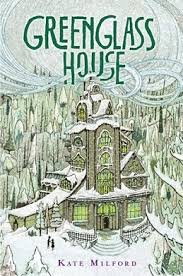
So, although the world is sort of similar to our world, you can see it’s not exactly our world, because … illegal shades of green?
I picked this book up originally because someone here recommended. For a change, I remember who that was, so thanks for the recommendation, Mona, and yes, you were right, this is a charming, fun, easy-to-read story. It’s also a MG story, by the way, so this is MG week, I guess.
Overall impression: This story is like a breath of fresh air.
That’s how I felt as I settled into the story. I’m trying now to sort out why.
I think it’s fundamentally probably simple: I spend a surprising amount of time not reading. I also spend a surprising amount of time looking at the first paragraphs of novels, many of which aren’t very good. When I do read a novel, sometimes I’m beta reading and don’t like the novel, or sometimes I get halfway into the novel and then just sort of peeter out for one reason or another and don’t quite go back to it. The writing’s okay but not great, and the plot isn’t interesting enough to compensate. The plot’s okay, but extremely predictable and the writing isn’t good enough to compensate. Something happens that seems just silly, or I’m fairly sure I’m watching the author set up an element of the plot that I’m not going to like, or some element of the plot actually occurs and I flinch, or nobody is ever nice to anybody else, or SOMETHING.
And then I read this story and it was just … like a breath of fresh air. It’s smooth. It’s fun. It’s light and witty without being silly or shallow. I’m not saying there aren’t silly moments – there are a couple – but the quality of the writing means this wasn’t painful. An important plot element is predictable, but an ENORMOUS plot element took me completely by surprise. There’s this tremendous clutter of characters, a HUGE clutter, but the author handles them skillfully and I didn’t get lost. And a whole bunch of people are nice to each other, especially Milo, who’s a really nice kid.
As far as I’m concerned, the only kid in fiction named Milo is the kid in The Phantom Tollbooth, so this isn’t a name I would personally give a kid in a MG novel, but fine. Milo was adopted as a baby. He wonders about his birth parents, but he’s not traumatized. Thank heaven the author didn’t subscribe to the notion that every protagonist should have an emotional wound and be broken. He has a great relationship with his parents, who are competent and nice and thank you, author, for presenting a solid family that is not traumatized or traumatizing.
They are expecting to spend the Christmas holidays quietly as a family because Greenglass House, the inn, is never busy at this time of year. Then a whole bunch of guests arrive, mostly not smugglers (five) and Milo’s parents call in some people to help run the inn (three), and a couple smugglers do in fact arrive (two), and thus we have, altogether, counting Milo and his parents, THIRTEEN characters cooped up in the inn, and lots of them have secret agendas, and they get snowed in, and the power goes off, and my goodness, there’s a lot. The author handles this beautifully, and she handles it beautifully in a MG type of way. Let me see. All right:
–She doesn’t EXPLAIN stuff. Ink cartridges that write in illegal shades of green? Just go with it. This is the kind of barely-there worldbuilding that works beautifully in MG fiction.
–She keeps the characters simple. She gives each of the five guests one important goal and one important identifying characteristic, and she makes the names distinctive. This makes it possible for the reader to keep them straight without going nuts. They are not complex. They don’t need to be complex. She lets two of the people recruited to help with the sudden influx of guests fade completely into the background. She keeps the parents busy (very, very busy), so they can stay mostly out of the way. This allows Milo to stay in the foreground, along with Meddie, a kid who is also staying at the inn and who is by far the most important secondary character.
–She keeps the plot moving. Almost everyone is searching for something. There are treasure maps. There are mysterious thefts. The guest at the inn tell stories in the most utterly classic fashion of travelers-stranded-together-in-an-inn, and of course all those stores mean something. Is there a name for this classic storytelling structure? It seems like there should be a name for this.
–Meddie pulls Milo into, basically, a LARPG that involves the treasure hunt and figuring out what everyone else is up to, and the author invents her own fictional version of D&D for this purpose, which is clever and fun, and of course this intersects with Milo being adopted, and gosh, here we are, adding subtext about identity and choosing who we want to be. But gently! There’s nothing heavy-handed about it.
–And then there is a fairly remarkable plot twist that I personally did not see coming at all.
–And on top of all this, Milo’s parents are both competent and nice, the grumpy guests who seem like they’re unpleasant turn out to be nice, lots of stories intersect, and lots of people choose to do nice things for each other without a lot of fuss or any preachiness whatsoever. Did I mention this story is like a breath of fresh air?
There’s a bit of semi-believable violence because, I mean, there’s a bad guy who is, I’m sure this will surprise you, up to no good. This is why I question those suggested criteria for MG (no sex, no profanity, no violence). It’s true that the reader cannot possibly believe that anyone is going to get killed, but that doesn’t mean the violence is quite as cartoonish as I think that post implied. I think the six criteria I listed better reflect what this story is like. Plus one more that is most certainly not true of all MG, but is true of this novel:
–It’s very well-written. It’s delightful. It’s delightful for adult readers as well as young readers. It reminds me of DWJ, and if you like a large percentage of her books, I expect you would probably like this one as well.
I picked up the next book in the series at once, though I haven’t read it yet.
Please Feel Free to Share:

The post Recent Reading: Greenglass House by Kate Milford appeared first on Rachel Neumeier.
November 17, 2025
What is MG?
Here’s a post at Kill Zone Blog: MG is for Middle Grade
I think a novel is MG if:
–The protagonist is under fourteen or so.
–The protagonist is a child at the beginning and still a child at the end.
–The novel is shortish and relatively tightly plotted, with relatively little worldbuilding.
And I am at the moment reading a stellar MG fantasy novel, which I will finish soon and then write a post about. But meanwhile, what does this post — which seems sort of out of place at Kill Zone Blog — say about MG?
Most authors define “middle grade fiction” as being written for ages 8 – 12 (third grade through sixth grade), and containing no sexual content or realistic violence. I think that another way to look at it is the intelligence and information processing skills of the reader. “Children” of this age are reaching the age where they can understand adult logic and reasoning. And they are not yet filled with the adolescent hormone-driven physical and sexual attraction that is found in young adult material, and that clouds their thinking.
They differ from books for younger readers in that they are more like adult books, longer, with plot and structure. And they differ from books for YA and adult in that they usually contain no profanity, sex, or overt violence.
This is all very well, but I think “no profanity, sex, or overt violence” is (a) not really true, and (b) not nearly as important as the three points I laid out. It’s the violence that I think is least true. Think of Patrick Lee’s MG thriller Wild Night, which I have mentioned before and in fact discussed at some length. There is considerable violence in this story and it is at least semi-realistic violence. Lee tones the violence down in a bunch of ways, but nevertheless.
It also irritates me no end to have people insist that YA is all about hormones and sexual attraction, but that’s a different issue, so never mind. It’s true, I think, that you aren’t likely to see explicit scenes in a MG novel. Also, I recall Merrie Haskell mentioning that she had to remove a little bit of profanity from The Princess Curse when it was placed with a MG imprint. So I’m mostly thinking about the violence, I suppose. I will just say that there is some violence in the MG novel I’m reading and it’s not all that unrealistic, either, though the tone is reassuring. I mean the overall tone of the story. No one can seriously expect the protagonist or his parents to die, and I think that’s actually the thing about violence in MG novels: whatever violence may occur, the tension is reduced via the tone of the story.
Meanwhile, the linked post says 30,000 to 80,000 words for MG novels, which I guess, but technically The Floating Islands is a MG novel — PRH shows the age range as a tremendously silly and restrictive 12-15 years and one does wonder how reasonable that can possibly be — and I can tell you that this book is over 100,000 words. However, I guess at the very youngest end of MG, 30,000 words is perhaps reasonable. This is about 100 pages, incidentally, and I wouldn’t call it a novel no matter how young the readers might be.
The age ranges given for the novels I’m mentioning seem kind of crazy, by the way. Eight to twelve for The Princess Curse; twelve to fifteen for Islands; twelve to eighteen for Wild Night. Raise your hand if you think any of these ranges actually makes sense when you think about actual real-world kids who like to read. They all seem strange to me. I’d say any age for the first, any age for the second, and twelve and up for the third — depending on how sensitive the kid is. Contemporary setting, kids dropped in a death trap by a murderer who wants to play games, strikes me as a lot more intrinsically disturbing than the other two books, which is why it seems more reasonable to me to put a lower limit on Lee’s book.
But I grew up reading whatever I wanted, pretty much. Age categorization wasn’t nearly as much of a thing at the time as it is now.
Ah, here’s one point that I think is perhaps reasonable:
–As romance isn’t really a thing in MG, close friendships move to center stage.
This is a big plus for MG over YA, which … I wouldn’t say YA has ever been ENTIRELY subsumed into Ansty Romance For Girls, but it sure tends to lean pretty heavily in that direction, and has for at least fifteen or twenty years now. In fact, this leads me to remember another criterion … that’s too strong … another tendency that we see more in MG compared to YA fantasy:
–The main plot in MG is about saving the world.
This is because, once you remove the angsty romance, you have room for something else. That something is very frequently a heroic saves-the-world plotline. Or, I mean, not necessarily the actual world, but something. Something worth saving, and it is indeed successfully saved, because as a rule MG is also upbeat.
–Upbeat or positive in tone.
Nihilistic, grim, ineffectual failure is either rare or essentially nonexistent in MG. I’m striving not to say something really snarky here, but I’m going to give up and say it: Young readers probably have to be trained to reject heroism and favor self-absorption, ineffectuality, despair, and self-destructive narcissism combined with a conviction of one’s superiority. I’m thinking of the Young Werther attitude, which is either really common today or at least seems that way to me. Anyway, MG is far more likely to be positive in tone than any other marketing category, and no doubt this is one reason the best MG novels appeal to vast hordes of readers of all ages. It’s highly noticeable how beloved MG classics can be, and often are. A Little Princess. Five Children and It. Howl’s Moving Castle. The Lion, the Witch, and the Wardrobe. The list is endless, and every single MG classic has a positive tone. I’m pretty sure that’s true.
Oh, interesting — the linked post winds up with practical considerations. Self-publishing is difficult for MG authors — the post doesn’t actually say that, but it lays out reasons why this has to be true: Teachers want books that have won awards; young readers can’t easily buy their own books; young readers can’t leave reviews at Amazon.
Ouch. I don’t know how MG authors handle any of this. I guess I’d suggest taking a real stab at traditional publishing for a good while while investigating possible ways to market MG … and writing MG novels that readers of every age can and will enjoy.
Regardless, six more-or-less strict criteria:
–The protagonist is under fourteen or so.
–The protagonist is a child at the beginning and still a child at the end.
–As romance isn’t really a thing in MG, close friendships move to center stage.
–The novel is shortish and relatively tightly plotted, with relatively little worldbuilding.
–The main plot in MG is about saving the world.
–Upbeat or positive in tone.
Please Feel Free to Share:
The post What is MG? appeared first on Rachel Neumeier.


