
Rachel Neumeier's Blog, page 2
November 16, 2025
Update: Well, So Far, So Good
All right, so, in the first half of November, I wrote 48,000 words, so I’m on track to quote win unquote my personal NaNoWriMo goal of more or less writing the complete Tuyo #12 in November.
Am I actually at the halfway mark, you may ask, and the answer is, I have no idea. It depends on whether stuff happens more quickly as we move toward the denouement. I don’t feel I’m quite halfway, but could be. Might be less. Honestly, who knows?
Also, I’m not actually 48,000 words in. I’m actually 72,000 words in because I had approximately 20,000 sitting here waiting. So if I’m at the halfway mark, that means the draft will hit about 140,000 words, which is fine. Knowing me, it’ll go longer. I will probably trim, because while I enjoyed writing the slogging-through-unpleasant-scenery part, you may not need to spend quite so much time with that. We’ll see. I’m not worrying about that yet.
As I am this far, I guess I will start calling the novel by name, meaning Bereket. This book takes place two years before Rihasi, and obviously I will include a note about timing and series chronology in the front. Maybe a short note in the front and a link to series chronology in the back. Bereket’s arc is nearly flat. It’s like the arc of the hero in a Western: he’s in the same place at the end as he was when he started. The reader will know where he is heading and will now have a much better idea about the choices he makes later, which should be very fun — I hope it is! I intend it to be! I intend for these two books to work perfectly read in either order. That’s the plan.
Meanwhile! Magdalene is fine and has been fine for 12 days, but there’s an awful lot of Doxycyline left in the bottle. It’s like the infinite bottle of Doxycyline. I feel like it’s the sort of miraculous bottle that could cure malaria for a whole continent. I’m pretty sure Magdalene agrees with me about the Neverending Torment of Doxycyline. I tried the yogurt thing, but we both vote for the faster syringe method.
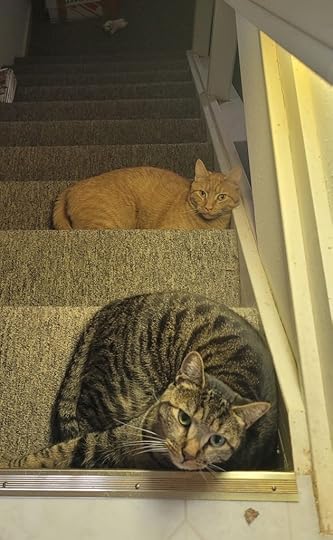
Also, the cats are unhappy to shift to winter-indoor mode. As you see, Maximilian is pining for the warmth of summer more than Magdalene.
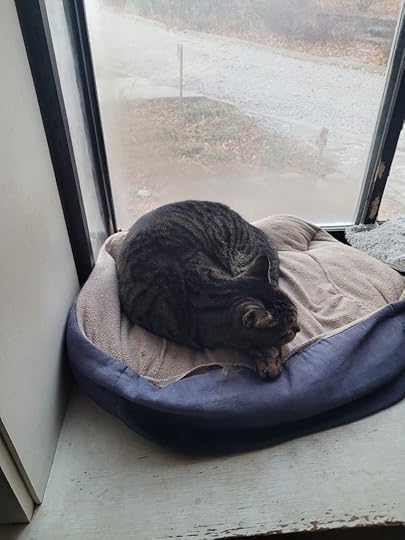
Sleeping away chilly weather
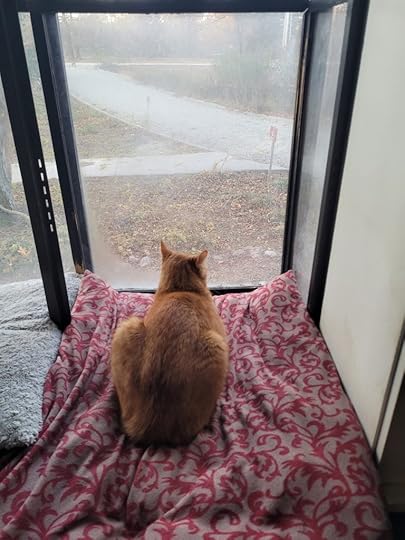
Wishing for warmth
Please Feel Free to Share:


The post Update: Well, So Far, So Good appeared first on Rachel Neumeier.


November 13, 2025
Real History for Fantasy Worlds
From Fantasy Book Cafe: Real History for Fantasy Worlds
Which can you imagine more clearly: Middle Earth or ancient Mesopotamia? Which feels more real?
I’m guessing a lot of us (including me!) answer Middle Earth. Because a lot of the time, real world history is a dry, distant land populated by a few important dates and a few powerful kings.
This is a great idea for a post — I think a basic awareness of real history is a fine, fine thing for an author, especially in fantasy. And maybe SF too. This post is actually not defending that idea. It’s about some of the books this guest author found especially helpful.
This reminds me of a Great Courses course I listened to a few years ago: The Other Side of History: Daily Life in the Ancient World.
However, I do want to add, I think an author can learn a ton about history AND absorb storytelling craft by reading good historical novels. By good, I mean both well-researched, brings the era to life, AND good stories, stories that are well put together as stories. So — here are a handful of my personal favorite historical authors and novels:
Gillian Bradshaw, as for example the stellar Cleopatra’s Heir.
Hild, and no doubt the sequel, which I admit I have not read, by Nicola Griffith, who is such a tremendously gifted author.
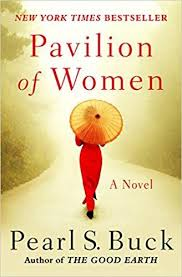
All sorts of novels by Pearl Buck, such as Pavilion of Women.
The Benjamin January historical mysteries by Barbara Hambly, and these are frequently quite grim, by the way, so be warned.
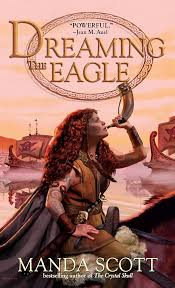
And I’ll wind up with one I’d like to read and have recently added to my TBR pile: Dreaming the Eagle by Manda Scott.
If any of you have a favorite Historical, drop it in the comments! Personally, I prefer back a good distance; anything set in, say, the 1920s, doesn’t strike me as historical enough, even though — shockingly — that’s suddenly become a hundred years ago.
Please Feel Free to Share:

The post Real History for Fantasy Worlds appeared first on Rachel Neumeier.
November 12, 2025
Poetry Thursday: Steen Steensen Blicher
Another poet I’ve never heard of: Steen Steensen Blicher.
The time approaches for me to part!
Now winter’s voice is compelling;
A bird of passage, I know my heart
In other climes has its dwelling.
I have long known that I cannot stay;
Though this is no cause for grieving,
So free from care as I wend my way
I sing at times before leaving.
I should at times have perhaps sung more –
Or should perhaps have sung better;
But dark days crowded oft to the fore,
And gales my feathers did scatter.
In God’s fair world I would fain have tried
To spread my wings out in freedom;
But I’m imprisoned on every side
And can’t escape from my thralldom.
From lofty skies would I fain have tried
To blithely sing and not fretted;
But for my shelter and food must bide
A jailbird poor and indebted.
At times I make the consoling choice
To let my gaze outward wander:
And sometimes send my poor mournful voice
Through prison bars yearning yonder.
Then listen, traveller, to this song;
To pass this way please endeavour!
It might, God knows, not last very long
Before this voice fades for ever.
This coming evening, I can foretell,
May see my prison bars breaking;
For I will sing now a fond farewell,
Perhaps my final leave-taking.
***
Surprisingly, I don’t see an entry at Poetry Foundation. Here’s a Wikipedia page instead.
Blicher was the son of a literarily inclined Jutlandic parson whose family was distantly related to Martin Luther. He grew up in close contact with nature and peasant life in the moor areas of central Jutland. After trying his hand as a teacher and a tenant farmer, he at last became a parson like his father and from 1825-1847 served in the parish of Spentrup.
Steen Steensen Blicher never enjoyed international interest on the scale of Hans Christian Andersen or Karen Blixen, but in Denmark he is almost as well-known. In 2006, his novel Præsten i Vejlbye was adopted in the Danish Culture Canon, which means, officially one of the 10 Order of Merit novels in Danish literature of all time.
I see he was a novelist as well as a poet. The novels sound rather grim. Possibly the poem above might strike a reader as grim as well.
Please Feel Free to Share:

The post Poetry Thursday: Steen Steensen Blicher appeared first on Rachel Neumeier.
November 11, 2025
Negative reviews
A rather facile post at Writer Unboxed: Good News About Bad Reviews
There is so much that a post with this title could do, which this post doesn’t do. This is a trivial post that declares, “A review that expresses a negative opinion might make your book appeal to other readers.” This is true, but if that’s all you’re going to say, why even bother? Let’s try to do a little more with this basic topic. How about –>
Top Ten Reasons Bad Reviews Could Be Good:
1) Just as the linked post points out, one person’s negative opinion could of course make the book sound appealing to other prospective readers. This is common, as I think we all know. It works like this:
“I couldn’t get into this book because the sentences were beautiful, but the pace was far too slow” = Response: Oh, I usually like books described as slow-paced.
“Literally nothing happens” = Response: Great, I’m totally in the mood for slice-of-life.
“Not nearly enough spice” = Response: Thank heaven, finally, a romance that doesn’t insist on describing in excruciating detail what goes where! Worth another look.
And so on. This is basically always going to happen with practically any review that includes any thought at all from the reviewer. Anything other than “Cover was torn, one star.” (Which I have in fact seen; I think most authors have a couple one-star reviews in this basic category.)
2) The occasional negative review makes the rest of the reviews look honest.
If a novel has quite a lot of reviews that are all very brief and all glowing and all vague, that looks fake. Incidentally, Amazon will come down hard on anybody they suspect of review manipulation, so I’m not sure exactly how easy it is to get away with buying fake reviews these days. Buying real reviews is not rare, but it sure seems like a bad idea to me. If you google “Where can I buy book reviews?”, you find quite a few services that will be happy to charge you a shockingly large fee in exchange for, quote, honest reviews, unquote.
Speaking as someone who picked up several starred reviews from Kirkus and Booklist for traditionally published books, I personally feel that the reviews Kirkus sells to self-publishing authors are, basically, a scam. Or at best entirely too scam-adjacent. There are lots of reasons for this, beginning with the huge fee, but not stopping with that.
Oh, I think I drifted off topic there. Never mind. My point was, negative reviews make the whole set of reviews look more honest, ALTHOUGH really solid, thoughtful positive reviews over 50 words (or so) do the same thing and are even better for the purpose.
3) If a review says a book is “too dark” or “too graphic,” some readers may take that as a challenge and therefore pick it up.
4) If a review says, “I loved it, but the author REALLY NEEDS to learn how to use lay and lie,” then the author might read that and learn how to use lay and lie, thus improving the reading experience for all her readers forever.
As a side note, the review will sit there forever, so the kinder method would be to email the author and say, “I love your books, but for crying out loud, can’t you sort out lay vs lie?” I personally am too inhibited to do that. If I knew the reader personally, I might, but otherwise, probably not.
As a side-side note, there’s a “report” option for Amazon ebooks via which a reader can report typos and other errors. I HEAR that sometimes Amazon will unpublish the book and this would be bad for the author, but I don’t know how often that sort of thing happens? I’ve only had the “fix something” panel light up once at KDP personally, when an exceptionally alert reader spotted a typo in Tuyo after the book had been out for four years. I fixed it and that was it, no problems.
5) “I can’t believe a book THIS BAD is even possible” can obviously cause readers to buy the book to see just how terrible it is.
I don’t recommend this as a sales strategy, but I mean, it’s a possible way negative reviews might get readers to buy a book.
6) The review specifically mentions a trope that is a draw for a significant number of readers. That is, the words “prison break” or “ghost story” appear in the review, and at once a certain number of potential buyers perk up.
I’m pretty sure this has happened for me, but I can’t think of the specific instance.
7) There’s a “Team A” vs “Team B” dynamic of some sort, this appears in the reviews, and some number of readers become curious about which team they’ll wind up rooting for.
I grant, plenty of readers are tired of love triangles, but I bet plenty aren’t. Also, there are probably other sorts of “Team A vs Team B” things that would work, although love triangles are certainly what spring to mind.
8) A negative review mentions a different author in a way that is intriguing to potential readers. That is, “Reminds me of Patricia McKillip, but with too many talking cats.” Then readers who don’t mind talking cats and do like McKillip think, “Great!” and pick it up.
9) Negative reviews boost the number of reviews just as much as good reviews. Sheer numbers of reviews produce a credibility all their own.
10) A negative review strikes other readers as unfair or off-base, and inspires those other readers to write their own reviews contradicting the negative one.
***
Whew, fine, ten turned out to be a lot. I was trying to think of actual plausible reasons without repeating myself too much or getting too silly. I was starting to think I wasn’t going to get there, but then I thought of a few more after all.
While on this topic, a few related posts certainly spring to mind, so:
Why authors shouldn’t read reader reviews
Why Authors Should Listen to Readers: About the importance of reading reader reviews
Why Every Writer Should Be Writing Book Reviews
I used to post more reviews at Goodreads and Amazon. I gradually stopped because of concerns about the appearance of tit-for-tat review swaps and review manipulation. The thing is, if authors genuinely like each other’s books and review each other’s books at all frequently, I don’t see how to avoid the appearance that you’re swapping reviews. I don’t know, maybe it would be safe to go through my “recent reading” posts and adapt some of those to post as reviews — but only for authors who haven’t ever reviewed my books. Not like such authors are in short supply.
However, I do believe that I become FAR more analytical when I’m writing a review. I see TONS of stuff I wouldn’t have consciously noticed if I hadn’t written the review. I think that alone is at least interesting and possibly useful, so I lean toward agreeing with the third of the linked posts above: Writers ought to be writing reviews.
I used to visit and read FAR more book review blogs than I do now because, as my TBR pile threatened to implode and become a black hole, the last thing I really wanted was a lot of reviews of great-sounding books. I used to visit Charlotte’s Library routinely — she reviews MG books, especially novels involving time travel, of which there are A LOT, apparently. Glad to see her site is still going. So is Fantasy Book Cafe, another one I used to visit a lot. I should glance in at both of these sites from time to time.
If you’ve got a favorite book review site, how about dropping it in the comments?
Please Feel Free to Share:
The post Negative reviews appeared first on Rachel Neumeier.
November 10, 2025
Propulsive Fiction
From Writer Unboxed: The Art of Propulsive Fiction
I like this post a lot. It’s by someone named Cathy Yardley, who is a book coach and an author. Checking Amazon, it looks like she’s written lots of contemporary romance in the basic category of “short romance novels, priced low, published fast.” That’s something of a guess because I only glanced at a few of her titles, but I know that can be a highly successful strategy for authors who have a knack that way.
Anyway, I do like this post. The reason is: Yardley isn’t declaring she is Promoting The Truth or declaiming that This Is The Secret. She’s saying this: plot and character intersect. Generally speaking, you will probably be focused on both. But maybe not, and that’s also fine.
Yardley says: For fiction to be propulsive, you need fully fleshed characters, pursuing something the reader becomes personally invested in, that changes that character as a result (for better or worse) through the crucible of addressing the story’s conflict.
When I teach, I always advise starting with character, because no matter what theme you want to explore or premise you want to set up, the protagonist is the vehicle through which the reader experiences the story. … Because the ongoing action is going to result from your character’s choices in pursuing their goal and the logical and increasing conflict you introduce as the story progresses, the resulting responses and new decisions will be organic and engaging, forming a natural and immersive plot.
This seems like a good way to put that.
She also adds that some writers don’t want to follow three-act structure because they think it’s too cliched and predictable. She says, Pride & Prejudice and Fight Club (the novel) both use three act structure. Few are going to say “Wow, those are basically the same book.”
I agree. The concept of three-act structure is so broad and so vague that it’s not possible for it to be either cliched or predictable, because it barely exists at all.
Most importantly, Yardley winds up by saying essentially: What if you don’t want to make your story propulsive? Then don’t, because it’s your book and that’s fine. I’m glad to see that because nothing irritates me more than The One True Way style of writing advice.
AND, she actually intersects with a post here from last week, thus:
Literary fiction quite often abandons what would be considered classic three act structure, because it isn’t the aim of the piece. The same could be said of experimental structures like slipstream, some kinds of microfiction, or the very real rise of LitRPG (which I am devouring like potato chips at the moment! Although that actually is very propulsive, but compressed, and by its nature not broken into “acts.” That’s a different post, though!)
And that caught my eye because of the LitRPG post last week, and I’m starting to feel like I should read something in the general neighborhood of LitRPG just to see what Yardley means by “very propulsive but compressed” and “not broken into acts.” I think that latter probably means “neverending episodes,” but I’m not sure.
Anyway, good post, click through if you’d like to read the whole thing.
Please Feel Free to Share:
The post Propulsive Fiction appeared first on Rachel Neumeier.
November 9, 2025
Update: Progess
Okay, so progress is progressing! With a few unanticipated bobbles provided by life.
So far, I’m managing 2000 to 3000 words per workday, 4000 to 5000 per day on weekends, for an average that is about where I’d hoped. No super annoying slowdowns, as I mostly know what I’m doing. SO FAR. I’m likely to hit something I’m not as sure about eventually.
Quite a few characters, but relatively few super-cluttered crowd scenes, so that’s not as bad.
Two plot lines, plainly related but very separate so far. A vague notion how to get them to converge, which is, of course, taking longer than I hoped, but I’m moving toward the convergence. A much clearer idea of what happens when they do converge. I mean broadly clear, not crystal clear. A reasonably good idea of the roles Aras and Ryo will play, which need to be peripheral and might be semi-off-screen. Not sure. The dramatic ending, yes, that’s all set and has been since I realized I could set up something neat for Tathimi’s second book. Not her first. I’m thinking incredibly far ahead. Far for me, I mean.
***
Also, last week Magdalene, my gray tabby, abruptly got sick.
Very sick, very abruptly. I whisked her to my vet for the day, they worked her in and called me to discuss her excitingly high fever (nearly 106F).
Wow, I said. Abrupt onset, very high fever, that sure sounds like Connor a few years ago, and we decided that was a tick-borne disease. Maggie was bitten by a tick a week or ten days ago; I made a mental note when I took the tick off her.
Hmm! said my vet, and immediately added delicious liver-flavored Doxycyline to Maggie’s daily schedule.
Two days later, Magdalene was much better; two more days, back to normal. She gets to finish the whole bottle of Doxycyline, which seems enormous at one cc per day. She does not agree that it is delicious, but she is thankfully The Cooperative Kitty. If this were Maximilian, it’d be awkward. Ticks were just absent during the drought, but I Frontlined the dogs after it rained and ticks once more appeared. Now the kitties have been Frontlined as well, for this last month before cold zaps the ticks again for the winter.
This was not dramatically distracting, in fact. There wasn’t a lot to do for Maggie except coax her to eat and wait to see whether the antibiotic worked. I now have a list of treats she especially likes, which no doubt she will enjoy for the rest of her life.
I know of two Cavaliers who developed seizures that were clearly, obviously caused by flea preventatives, by the way. (Application of flea treatment on the first of the month, seizures only during the first week of the month, seizures stopped after flea preventative was discontinued.) This is conclusive, full stop, and that’s why I don’t want my guys continually on anything when that’s unnecessary, despite the risk of erlichiosis (probable culprit). Frontline Plus has the best safety record I know of, which is why I use it.
MEANWHILE
Magdalene is now just fine, this is a four-day weekend for me, and therefore I’m going back to work. We are breaking out of a prison. It’s not a huge part of the story, but I have always wanted to do a prison break, and now here we are.
Please Feel Free to Share:

The post Update: Progess appeared first on Rachel Neumeier.
November 7, 2025
Sorcery and Slang
Commenter Heather requested a table of sorcery and slang terms for sorcery. Here you go, and I hope you all find this useful and/or interesting.
Name SlangMinor forms of varying strengthTrue sorceryPerceptionGetFleetingly perceiving thoughtsPerceiving strong, clear thoughts
Perceiving glimpses of emotions
Impressions of presence and distance You can see almost anything you want to see. People can block you, but if you don’t mind exercising overt sorcery, you can break through almost any defense. CharismaPullPeople admire you and want to impress you and earn your approval, leading them to take your orders.
Stronger, but similarAllure PullPeople like you and want to please you; they want you to like them; they want to be close to you.
People want to be friends with you, but friendship tends to shift toward devotion.
Stronger, but similarPersuasionPullPeople find you persuasive, obviously. But the effect, as with any kind of minor pull wears off when people aren’t near you.
Stronger, but similar
False memories might fall into something like this category.Coercion NudgeInfluencing people to do things they might have been inclined to do anyway.
Influencing people who are on the fence about something to decide one way or the other.
Causing people who are moving fast and depending on reflexes to take actions you want them to take, especially if they have no strong contradictory motivation.
You can force people to do things they don’t want to do, even act in ways they despise, even when they know exactly what you’re doing.
You can impose your will on people for an extended period even if you’re asleep or they leave your immediate vicinity; eg, setting people to guard yu while you sleep or forbidding people to speak about you.
Minor forms of sorcery can be nebulous and hard to define even for Lau. Anything in the ballpark of “people like you and want you to like them” or “people want to be close to you” or “people generally listen to your advice” is going to fall into the general category of pull.
Nudge doesn’t require people to like you or want to please you, though the edges between pull and nudge can be blurry.
Pure nudge is easiest and most effective when people simply aren’t paying attention, or aren’t making conscious choices, or are moving fairly briskly and thinking about other things. It’s easy to use nudge to make someone glance momentarily away from something or keep walking the way they’ve been going and miss turning down a side street.
Please Feel Free to Share:
The post Sorcery and Slang appeared first on Rachel Neumeier.
November 6, 2025
Apples
Chuck Wendig at Terrible Minds is doing lots of apple reviews right now — meaning no, really, reviews of apples. Here’s his review of Esopus Spitzenburg.
BIG CRONCH, then crazy juice damming the mouth. And no delay on flavor — the flavor is a wave crashing hard against the seawall of your tongue. This is a big-flavored apple. Unfuckwithable. Unquestioning sweetness lands at the same time as the flash-bang of tartness. Dense flesh. Nice skin. (This is also how I advertise myself on the dating apps. Dense flesh. Nice skin. Hey ladies. And by dating apps, I mean iNaturalist.) This is also… a pretty appley-apple. There are some complex flavors — a bit of strawberry and guava, and lavender that I found present when I ate the skin, not present when I didn’t. I’ve read reports from folks where this was a mushy, sloppy apple — even mealy. But mine was toothsome, almost to the point of being chewy. That and a lingering tobacco aftertaste are the only things from having me rate this higher and maybe even ending up the best apple of the batch so far.
I tried an Esopus once and I got a mushy one, so this is definitely a try at your own risk apple.
Here’s his review of Ruby Mac, which I’ve never tried.
The color of the Ruby Mac — and many of the McIntoshes I’ve eaten — is this kind of muddy sangria red color that I really love. The shape and color of it often remind me less of an apple and more of an heirloom tomato like a Cherokee Purple or a Tommy Parmesan or a River-Drowned Winelump and okay only one of those is real I didn’t feel like Googling a bunch of tomato variants, I already have too much apple information inside my head to be healthy and sane.
Lots of others.
My favorite apple this year is Honeycrisp, by which I mean the ones I picked off my tree. I basically don’t buy apples, like, ever, because I know that in a good year I will get a surfeit of apples coming off my trees and in a bad year the squirrels get them all and I’m too mad to even want to look at apples. Anyway, Honeycrisp are too sweet for me a few weeks after they’ve been picked, but they’re great just off the tree.
Those are an early-season apple. Here are the ones I just picked yesterday:
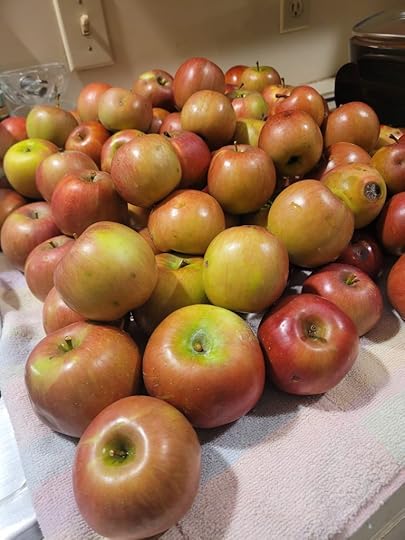
This is an apple that is not that great, in SOME ways. It’s called Liberty, meaning it’s free of various diseases that plague apples, and yes, fine, it’s highly resistant to lots of things AND it does not get damaged by bugs a lot. I mean, a few apples are damaged, but very few, comparatively. The skin is really tough, which I suspect explains a lot of its resistance to this and that. The flavor is okay. As a cooking apple, it’s just fine. Holds its texture and shape. It bears every other year, more or less. It’s the least good of the apples I grow — Honeycrisp, Pink Lady, Fuji, Liberty, Goldrush, and and apple called Hokuto that is better some years than others and bears about every third year, so not impressive overall.
However, Liberty is one of the most practical of the apples I grow, because it is pretty resistant to everything and stores very well. The most practical apple, which is also just a better apple, is Pink Lady. It bears every single year — it does have to be thinned hard because it’s way too enthusiastic — it is resistant to pests, it stores VERY well, and it’s far better after a month in storage, which is fantastic compared to the apples that are fine for a week or too and then overly sweet. I mean Fuji and Honeycrisp.
The varieties I would actually recommend for normal people who just want to grow a few apples in Missouri include Pink Lady, Liberty, and Goldrush, and of the three, Pink Lady is by far the most dependable.
You’re going to need a squirrel-proof fence or you will not get any apples. An electric wire along the top of the fence does the trick for me. At the moment a specific young opossum has figured out how to get over the wire and into the orchard, I believe. He has gradually eaten most of the remaining Fujis. I mean, they’re gradually disappearing, and it’s not squirrels, so I think it’s this opossum. I could shoot him at any time because the dogs tree him on top of the fence nearly every evening, but he’s not doing that much damage, so I am just letting him have the Fujis. The Pink Lady are apparently too tart for him as long as Fujis are an alternative.
Please Feel Free to Share:

The post Apples appeared first on Rachel Neumeier.
November 5, 2025
Poetry Thursday: Thomas Hood
No sun–no moon!
No morn–no noon!
No dawn–no dusk–no proper time of day–
No sky–no earthly view–
No distance looking blue–
No road–no street–no “t’other side this way”–
No end to any Row–
No indications where the Crescents go–
No top to any steeple–
No recognitions of familiar people–
No courtesies for showing ’em–
No knowing ’em!
No traveling at all–no locomotion–
No inkling of the way–no notion–
“No go” by land or ocean–
No mail–no post–
No news from any foreign coast–
No Park, no Ring, no afternoon gentility–
No company–no nobility–
No warmth, no cheerfulness, no healthful ease,
No comfortable feel in any member–
No shade, no shine, no butterflies, no bees,
No fruits, no flowers, no leaves, no birds–
November!
***
This made me laugh, and I scheduled it WAY ahead of time, because obviously the right time for this poem is now.
Hood was a prominent figure in the Romantic literary movement, which emphasized emotion, imagination, and individualism. His works often displayed a keen observation of the natural world and a deep empathy for human suffering. While his humorous poems are perhaps the most widely remembered, he also wrote serious and moving pieces that dealt with themes of loss, grief, and the transience of life.
Would you call this a humorous poem? I would, but with a serious tone under the humor. Let me look for another of Hood’s poems I like … okay, how about this one: similar theme, different tone.
***
Ode to AutumnI saw old Autumn in the misty morn
Stand shadowless like Silence, listening
To silence, for no lonely bird would sing
Into his hollow ear from woods forlorn,
Nor lowly hedge nor solitary thorn;
Shaking his languid locks all dewy bright
With tangled gossamer that fell by night,
Pearling his coronet of golden corn.
Where are the songs of Summer?—With the sun,
Opening the dusky eyelids of the south,
Till shade and silence waken up as one,
And Morning sings with a warm odorous mouth.
Where are the merry birds?—Away, away,
On panting wings through the inclement skies,
Lest owls should prey
Undazzled at noon-day,
And tear with horny beak their lustrous eyes.
Where are the blooms of Summer?—In the west,
Blushing their last to the last sunny hours.
When the mild Eve by sudden Night is prest
Like tearful Proserpine, snatch’d from her flow’rs
To a most gloomy breast.
Where is the pride of Summer,—the green prime,—
The many, many leaves all twinkling?—Three
On the moss’d elm; three on the naked lime
Trembling,—and one upon the old oak tree!
Where is the Dryad’s immortality?—
Gone into mournful cypress and dark yew,
Or wearing the long gloomy Winter through
In the smooth holly’s green eternity.
The squirrel gloats on his accomplish’d hoard,
The ants have brimm’d their garners with ripe grain,
And honey been save stored
The sweets of summer in their luscious cells;
The swallows all have wing’d across the main;
But here the Autumn melancholy dwells,
And sighs her tearful spells
Amongst the sunless shadows of the plain.
Alone, alone,
Upon a mossy stone,
She sits and reckons up the dead and gone,
With the last leaves for a love-rosary;
Whilst all the wither’d world looks drearily,
Like a dim picture of the drownëd past
In the hush’d mind’s mysterious far-away,
Doubtful what ghostly thing will steal the last
Into that distance, gray upon the gray.
O go and sit with her, and be o’ershaded
Under the languid downfall of her hair;
She wears a coronal of flowers faded
Upon her forehead, and a face of care;—
There is enough of wither’d everywhere
To make her bower,—and enough of gloom;
There is enough of sadness to invite,
If only for the rose that died, whose doom
Is Beauty’s,—she that with the living bloom
Of conscious cheeks most beautifies the light:
There is enough of sorrowing, and quite
Enough of bitter fruits the earth doth bear,—
Enough of chilly droppings from her bowl;
Enough of fear and shadowy despair,
To frame her cloudy prison for the soul!
The post Poetry Thursday: Thomas Hood appeared first on Rachel Neumeier.
November 4, 2025
What Causes A Novel Opening to Fail?
I’m going to show you an excerpt that a commenter, Allan, sent me. This is the opening of Book 1 of an LitRPG book called Primal Hunter, which didn’t work for Allan. (Spoiler: it doesn’t work for me either). I’m not familiar with this series OR with LitRPG at all. It turned out, I wasn’t even sure what LitRPG was, so I googled it:
LitRPG is defined here like this: the story features some sort of RPG element that is similar to what you’d find in a video game. In some cases this means the main character literally gets pulled into a video game, but the genre is a lot more expansive than that. While all LitRPG will feature some sort of game-like elements, not every book will necessarily be exactly like a video game. What you will find in each of the books I’ve featured below is some sort of leveling system and power hierarchy the main character must overcome through experience.
And there are recommendations at the link, of which Primal Hunter is not one. Hmm. Of the ten series described at the linked post, the one that sounds most interesting to me is The Wandering Inn. (They actually all sound at least somewhat intriguing, by the way.) The description for this one from the linked post says:
As of book five, the story so far has largely centered around Erin Solstice and Ryoka Griffin, two humans who have found themselves sucked into some dangerous fantasy world with an interesting leveling system. Their knowledge from Earth helps them survive and thrive in this new world as they discover more about this new world filled with magic and monsters. What I love about this series so far is how well it unravels the universe through various points of view. There are entire chapters and sections dedicated to just the viewpoints of the surrounding characters. There’s so much depth here that it’s hard to believe there are 17 books in this series after only reading five of them. You can purchase each book on Kindle or read them for free directly from the website.
This whole idea basically seems like it should be fun.
This LitRPG thing also reminds me of various books, including, for example, A Point of Honor by Dorothy Heydt, which was published in 1998; and also the new book by Ilona Andrews, The Inheritance. AND ALSO, Starfighter Invitation by AKH, which I loved and I wish Andrea had gone on with that series. Also, the fanfic Cultivating the Slow Life, which someone here recommended and which I read, which all by itself constitutes four of the few books I’ve read this year, basically, because it’s enormous even by my standards. I do recommend it, even though it’s incredibly slow slice-of-life for a very long time. Everybody lives happily ever after. Very soothing.
However, let’s go back to the putative topic of this post and take a look at the beginning of Book 1 of Primal Hunter by “Zogarth,” and I do think it’s a bad idea to use a “name” like this, but on the other hand the series is up to fifteen books or something, so whatever, I guess it’s fine.
***
It was just another boring Monday morning. The sparse rays of sunlight that found their way through the blinds’ narrow gaps did little to disturb the man sleeping deeply on the bed. However, the serene peace was short-lived as the accursed sound of his alarm began its daily ritual of ruining a good dream.
Jake, who had previously been enjoying the sweet embrace of his blankets, was startled awake, fumbling around until his hand finally found his phone. Grumbling, he rolled out of bed and started his usual morning routine, preparing for yet another day at work.
He went for a warm shower, ate a quick breakfast, and got himself dressed before he finally grabbed his stuff and headed out the door. The entire morning routine was done in less than half an hour.
Walking down the stairs to his car, he had an intuition that the day was going to be interesting. He didn’t know why, as everything was as usual so far, but he couldn’t entirely dispell the feeling. Maybe someone brought donuts?
***
So, what is not working here? Here’s what I see:
Someone is waking up. This is an enormously cliched type of opening, which doesn’t mean you can’t do it, but it does mean that if you default to that scene for no special reason, well, maybe reconsider?
The Breach by Patrick Lee is a great book, a super-fast-paced plot-forward thriller, and at the time I am writing this post, the Kindle ebook is also on sale for $0.99, by the way. You know how it opens? With somebody waking up. But it works! It’s fine! Let me contrast the opening of The Breach with the one above:
***
On the first anniversary of his release from prison, Travis Chase woke at four in the morning to bright sunlight framing his window blinds. He put his backpack in his Explorer, left Fairbanks on State Route 2, and an hour later was on the hard-packed gravel of the Dalton Highway, running north toward the Arctic Circle and the Brooks Range beyond. From the crests of the highest hills, he could see the road and the pipeline snaking ahead for miles, over lesser ridges and through valleys blazing with pink fireweed.
The trip was not a celebration. Far from it. It was a deliberation on everything that mattered: where he stood, and where he would go from here.
The console showed an outside temperature of fifty-nine degrees. Travis lowered the windows and let the moist air rush through the vehicle. The height of summer here smelled like springtime back in Minneapolis, the sent of damp grass just freed from snow cover.
He reached Coldfoot at ten o’clock and stopped for lunch. The town, with a few buildings and a population of less than twenty, survivid entirely on commerce from travelers on the Dalton. Mostly truckers bound for the oil field at Prudhoe Bay, 250 miles north. Coldfoot was the last glimpse of humanity along the highway, before the elevation divide and the long, downslope run to the sea.
***
Starting with someone driving is also a big no-no cliche, by the way, so this is an impressive two-fer, fundamentally beginning with two of the most classic cliched things you’re not supposed to do in opening scenes. It’s a two-fer for both books, as in Primal Hunter, the protagonist is also heading for his car.
What do you think? Does either opening work for you? Lee’s works for me. Zogarth’s does not and Lee’s does. What is going on that makes the difference?
–It’s REALLY hard to make the morning routine sound the least bit interesting. Zogarth mentions all sorts of utterly banal, uninteresting bits of the morning routine. This is the exact reason that “protagonist wakes up” has a bad rap as a way to open a novel. Patrick Less simply skips all that. Travis wakes up, and the very next sentence puts him in the car.
–It’s usually a bad idea to start with “the man” or “a man.” Generally speaking, it’ll work better to start with the name of the protagonist. It’s not that beginning with “a man” never works, but I do think it’s harder to pull that off. I may feel that way because starting with “a man” is simply more common in amateurish work. These two openings demonstrate the difference, so you can see what you think.
–In the very first sentence, Lee reveals something interesting about Travis, while Zogarth does not reveal anything remotely interesting about Jake.
–Travis is carrying the pov. Jake is not carrying the pov. A narrator is telling the reader about Jake. This has to be true because the reader is seeing Jake before Jake wakes up. He had an intuition, he didn’t know why, even after Jake wakes up, he does not pick up the pov. These are comments the narrator is making about Jake. This is the exact problem with Terry Brooks’ writing style. This style imposes distance between the reader and the story.
Does this mean it’s wrong to give the pov to an invisible narrator? No; that can work just fine. But in my opinion, it’s easy to push the reader away too far, and that’s happening here. And why is it happening? Because –>
–Zogarth’s style is just painfully amateurish, and it’s amateurish in a really common way. The style is supposed to be breezy, but it’s boring and silly at the same time.
Jake, who had previously been enjoying the sweet embrace of his blankets = boring because all this means is he was asleep, AND it’s over the top and silly as a way of saying that he was asleep.
The entire morning routine was done in less than half an hour. = “was done” is actually not correct here. It sounds awkward. If you try to rephrase this, what do you come up with? I bet you want to put Jake in the front, don’t you? Because there’s no reason for “the morning routine” in the front of this sentence.
This is actually a passive voice sentence: The entire morning routine was done BY JAKE in less than half an hour. By shifting to passive voice here, the narrator is demoting Jake in importance and promoting the morning routine in importance, and this sounds strange. I think this is the kind of thing that the reader will not notice explicitly, but I think a lot of readers would say “This sounds off somehow” or “this sounds amateurish” or “I don’t find the style interesting or engaging.” Almost any sentence that puts Jake in the front would be better, not because passive voice is wrong, but because passive voice is wrong here. Jake whipped through his entire morning routine in less than half an hour, and then consider deleting the sentence entirely, but if you keep it, I think it would now work better.
Writing passive voice sentences for no reason is, I think, one of the reasons that this opening sounds amateurish. Not the only reason, but one that I think is easy to miss.
–The world does not exist around Jake. We have no sense of place, despite the sun and the shutters. Lee draws the world around Travis, and he does this even though he mentions even less about the hotel room than the glimpses we were offered of Jake’s house.
***
How about The Wandering Inn? Here’s the opening:
The inn was dark and empty. It stood, silent, on the grassy hilltop, the ruins of other structures around it. Rot and age had brought low other buildings; weather and wildlife had reduced stone foundations to rubble and stout wooden walls to a few rotten pieces of timber mixed with the ground. But the inn still stood.
It was waiting. Not in a sentient, thinking way, but in the way all buildings wait. It was waiting for someone to find it. For wasn’t that the purpose of an inn? And someone did find it.
A young woman stumbled through the grass, up the hill. Her knees were shaking and she was gasping for air. Her lungs burned. Her right arm was burned. Smoke was still rising from the charred fabric on one shoulder, and her legs were bleeding. Several shallow cuts had torn open her pants at the back of the legs.
But still she climbed the hill. Because of the inn. After all, there was no mistaking it. Despite the years, the building stood among the rest of the ruins, mostly untouched by the passage of time.
***
All right, what do you think?
–We’re opening with scenery. Personally, I often like this. It’s interesting scenery. Posts like this make me hyper-critical, so I’ll say that I don’t like “mixed with the ground.” That sounds wrong in two different ways. If you’re going to say “mixed with,” it should be “earth” or “soil,” not ground, and “mixed” seems like strange choice regardless. On the other hand, the rest of the scene works for me.
–And someone did find it. = a great sentence, a sentence that’s doing exactly what it’s supposed to do.
–The opening features “a woman.” How does this strike you? It doesn’t irritate me here. We’re seeing her from outside. A narrator is seeing her. That doesn’t irritate me either. Why does this work for me when the opening of Primal Hunter didn’t work for me? Because (a) we started outside the woman, with the inn, so it seems more natural to see the woman from the outside. I don’t feel that the author doesn’t realize we’re outside the woman’s pov. And also, (b) because her situation is tremendously more interesting. This is the exact opposite of a banal, boring, “She woke up, turned off her alarm clock, and brushed her teeth” opening.
–The world exists. The woman, whoever she may be, has a big, big problem, and she is moving through a world that is really there.
Overall, to me, this last one is a dramatic improvement on the first. It’s not as subtle or skillful as Patrick Lee’s opening. It’s not going for subtlety in any way, which is why it works.
Please Feel Free to Share:
The post What Causes A Novel Opening to Fail? appeared first on Rachel Neumeier.


