
Heather King's Blog, page 9
November 9, 2024
TENDING THE HEART OF VIRTUE WITH CLASSIC CHILDREN’S STORIES
Here’s how this week’s arts and culture column begins:
Twenty-five years ago, Vigen Guroian, Ph.D., a theologian and professor of religious studies, wrote a book called “Tending the Heart of Virtue: How Classic Stories Awaken a Child’s Moral Imagination” (Oxford University Press, $33.33).
His goal was to build moral character, teach values, and instill important virtues in children.
The book gained a devoted following. Dozens of lectures, workshops, and requests to write another book of its kind ensued.
In the interim, Guroian’s children Rafi and Victoria became adults with children of their own.
READ THE WHOLE PIECE HERE.


November 6, 2024
FUN IN LA
Continuing with my whirlwind life, I drove from Tucson to LA last Friday and have been nonstop with people, eating, gabbing, exchanging info, walking, planning.
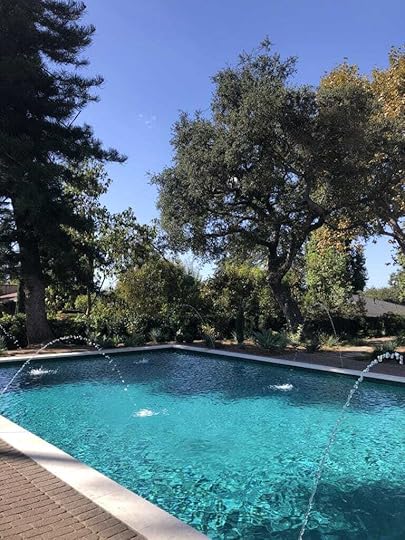
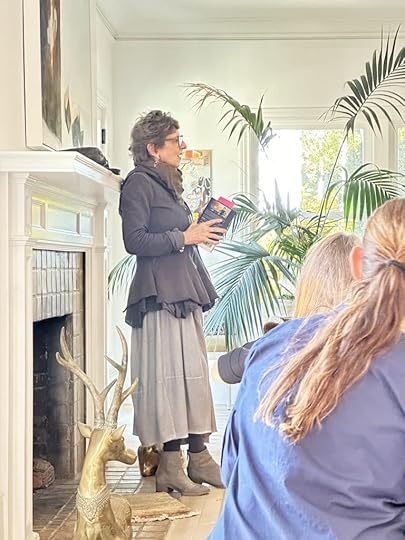
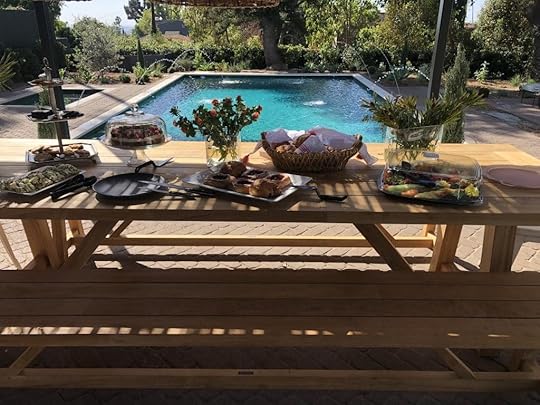
SCENES FROM MAH FANCY BOOK PARTY!
My friend Lori has a beautiful home and hosted a book party for CONSUMED over the weekend. I got to see a ton of DEAR old friends, and to meet some new people, and to read a passage from the book about one of my favorite activities: walking. (It says quite a bit about my limited abilities that I am still exclaiming, 70 years after the fact, about a skill most humans master by the age of 2).
Every day has been chock full wiith more to come, including–if all goes well–a trip to Dr. Nadjee, DDS, in Beverly Hills (don’t ask).
The Writing Workshop I’m offering in January-February is full. Tomorrow I plan to visit the Getty Museum. Tonight I plan to go to bed early.
In between, I’ve had several chances to duck into St. Andrews in Pasadena, one of my old haunts.
The church is open all day.
Heaven.
 MURAL ON CEILING ABOVE ALTAR, ST. ANDREW’S CHURCH, PASADENA
(Light) chores at my current place include chicken feeding. That’s right. I give them a large scoop of feed mixed with a pinch of oyster shells, and a bowl of special fermented “mash,” and pray they don’t peck at me. I’m also in charge of a salamander.
November 2, 2024
ALL SAINTS, SUNG AND UNSUNG
Here’s how this week’s arts and culture column begins:
When I told a lapsed friend several years ago that I’d published a book about St. Thérèse of Lisieux, she rather pointedly inquired, “But you don’t have to be inside the Church to be a saint, do you?”
I understood her concern; one of my abiding obsessions is the “unsung saint”: the person who is never noticed.
In fact, I write a monthly column for Magnificat Magazine called Credible Witnesses that celebrates a notable Catholic who has died but has not yet, and may never be, canonized. But here’s why saints are compelling: Saints are exceptional. Saints are extreme. As William James observed in “The Varieties of Religious Experience” (CreateSpace Independent Publishing Platform, $7.85): “There can be no doubt that as a matter of fact a religious life, exclusively pursued, does tend to make the person exceptional and eccentric … It would profit us little to study this second-hand [i.e. conventional, ordinary] religious life. We must make search rather for … individuals for whom religion exists not as a dull habit, but as an acute fever rather.”
READ THE WHOLE PIECE HERE.
October 31, 2024
WHAT I’VE BEEN READING
“[I]n nature there is a far better balance of work and rest than I normally follow in my day. There are seasons of great fruitfulness, and seasons when all lies fallow. I sense that much the same might be true in the rhythms of my social and spiritual life. Several years ago I noticed that evern in my service to others, I normally started with what I thought ought to be done, and later found myself exhausted with very little to show for it. So instead I began to ask this question first: What is already beginning to bloom that needs nurture in order to continue its growth? Then I would seek to cooperate with what I noticed was already underway. Gradually I realized that I was finally aksing: Where is the Holy Spirit already at work? And cooperating there with God.”
–Norvene Vest, from Preferring Christ: A Devotional Commentary on the Rule of St. Benedict
“Because there is not just one silk, there is not just one story of silk. Not one road, not one people who found it, nor one nation that made it. Not one country can lay claim to its source. In silk is science and history, mythologies and futures. Through accounts of scientists who have studied silk, and the animals from which it has been drawn, what follow are stories from its many metamorphoses: caterpillar to moth; cocoon to commodity; simple protein chains to threads with very extraordinary capabilities.”
–Arathi Prasad, from Silk: A World History
“Were a naturalist to announce to the world the discovery of an animal…which for the first five years of its life existed in the form of a serpent; which then penetrating into the earth, and weaving a shroud of pure silk of the finest texture, contracted itself within this covering into a body without external mouth or limbs, and resembling more than anything else an Egyptian mummy; and which, lastly, after remaining in this state without food and without motion for three years longer, should at the end of that period burst its silken cerements, struggle through its earthy covering, and start into day a winged bird—what would you think would be the sensation excited by this strange piece of intelligence?”
–William Kirby and William Spence, An Introduction to Entomology, 1828 (quoted in Silk: A World History)
I like this Free Press piece from Lionel Shriver, decrying the scolding, hectoring literary mobs (and to my mind, by extension all scolding mobs) who purport to bully the rest of us into one same-thinking, mindless bloc. Everything in me rises up against this kind of surge.
If we see injustice in the world, the writer’s job is to write.
I’m also reading a biography of the late British writer Dennis Potter, semi-forgotten today, best known in his own day for the BBC serial drams “Pennies from Heaven” and “The Singing Detective.” Potter suffered from psoriatic arthorpathy, an affliction one would not wish on one’s worst enemy. He was apparently not an easy man to get close to. He had many faults. He also had an incandescent gift which he fought till his last breath to honor.
Potter was not a churchgoer but he was deeply formed by the hymns (his father was a collier) and Bible stories from his childhood. Molested by an uncle when he was 10, he was conflicted all his life about sex, God, good and evil.
This YouTube, an interview with well-known broadcaster Melvyn Bragg, was taped three months before Potter’s death. In it, he chain-smokes, drinks, brandishes his clenched, paw-like hands, and offers a stirring example of the artistic vocation and the suffering human spirit.
“At the end he was all but exhausted,” Bragg later noted. “Frankly, all in the studio felt drained, and yet there was a feeling of relief and even exhilaration that the job had been done properly by him. After he had left, one of the cameramen came up to me and said,'”That was a privilege.'”
The psoriasis was so severe that at times Potter could not open his eyes, sit up, or move his hands. The skin over every inch of his body was cracked and bleeding. He strapped a pen to his hand and continued writing anyway.
With all that, and for the seeming darkness of his stories, at the National Film Theater in October, 1980, he averred that he was propagating an essentially Christian message:
“I believe absolutely and without qualification in a loving creation, in a loving God…I think of myself as a religious writer. I know people don’t pick that up, they don’t see it, they don’t understand the two poles, they don’t understand either the disgust for a soiled, brutalized and diminished world, or the hope in it that we have a duty and an obligation to make that world–to make the Kingdom, if you like–to make that world more just, more beautiful, more perfect, and fill it with more mercy and more light than we bother to do.”
October 29, 2024
MY NEW BOOK, CONSUMED: ON A LIFE ORDERED TO ART
CHECK OUT MY NEW BOOK!
Part memoir, part guidebook, CONSUMED is an eccentric gathering of reflections that have emerged during my thirty years as a writer on process, craft, vocation, and the avoidance of despair.
The book includes thirty profiles of artists who I admire and of whom I’ve written over the years.
And it has been many years in the making. I’m thrilled to offer it at last.
Available in PAPERBACK and KINDLE EBOOK.
October 26, 2024
TRAVELS IN VENICE
Here’s how this week’s arts and culture piece begins:
Venice is a city founded in A.D. 421 that exists entirely on water, whose streets and alleys have hardly changed in centuries, and is navigated either on foot or by little boats called vaporettos that zip along the canals.
It’s as if a tiny corner of the world had been dipped in resin around the turn of the 16th century and has been slowly, picturesquely deteriorating ever since.
Whole libraries have been written about its history, buildings, art, palace intrigues, and near hallucinatory effect on visitors.
READ THE WHOLE PIECE HERE.
October 24, 2024
MY WINTER WRITING WORKSHOP: HERE AT LAST
Many of you have asked over the past few years when I might be offering another 8-week Writing Workshop.
Well, here it is, folks.
LET’S START 2025 BY IGNITING OUR CREATIVITY!
October 22, 2024
FIRING UP THE FUN
“Indeed, we know that when the earthly tent in which we dwell is destroyed we have a dwelling provided for us by God, a dwelling in the heavens, not made by hands but to last forever. We groan while we are here, even as we yearn to have our heavenly habitation envelop us…While we live in our present tent we groan; we are weighed down beause we do not wish to be stripped naked but rather to have the heavenly dwelling envelop us, so that what is mortal may be absorbed by life.” 2 Cor. 5:1-8.
Something to think about vis-a-vis a possible move!
Also, the weather in Tucson has finally turned cooler, which makes everything kind of heavenly. When you’re in the middle of a desert summer, you just put your head down and keep plodding. It’s only afterward you start to realize how much energy goes into the putting down of the head, and the plodding.
I am already on the move a lot, and that suits me. Nov. 2 I’m driving to LA and will be staying with friends and house-sitting through the 13th. I’ll return to California the week of December 9 and, at St. Andrew’s Abbey, will take my final Benedictine Oblate vows on December 12, the Feast of Our Lady of Guadalupe.
Christmas in New York! December 22 I fly into LaGuardia and will stay near my beloved St. Vincent Ferrer church for a week, then down to the apartment of a friend who lives in Chelsea and will be out of town till January 21.
Mardi Gras I fly to Mexico and will be in San Miguel de Allende for Ash Wednesday and the first two weeks of Lent, then if all goes well at this monastery, connected with New Mexico’s Christ in the Desert, for several days.
So that is a bit of my upcoming itinerary.
Meanwhile October 29 is the release date of my new book, CONSUMED: The Joys, Sorrows and Debacles of a Life Ordered to Art!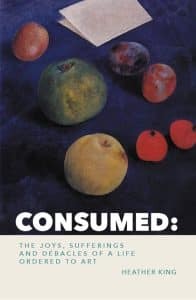
You can order the kindle version already. Will introduce it more fully down the line a bit.
I talked to my “wealth manager,” who looks after my nest egg, the other day. Turns out I’m supposed to live till 94 and can “retire” in 10 years, at 82. And then I’ll have a large sum of money (because it will have just been sitting there for years and years) when I croak, to which my first question is Why can’t I just spend it now?
I just follow along. Everything is fine for today! And I would keep working in any case.
Speaking of which, thanks again so much for the full-throated, wonderfully generous response to the Fall Fundraiser. I heard from so many people I hadn’t connected with in a while, and a bunch of new people, and many people who as I said I had no idea were readers.
My favorite moment during the Book Sale/Fundraiser may have been this:
One lovely woman ordered five books (the Book Sale has a 10-book minimum), adding “I’m happy to support you; I’ll send the full amount and just keep the remainder.” Then it turned out I was out of the one of the five books she wanted, so I emailed to ask if she would like for me to substitute another. She responded that no extra book was necessary, but instead she would ask my prayers for a beloved relative who is strugglng with ill health.
Granted, I’ve been a little overwrought as of late–but I simply burst into tears. It is good to have a business plan, and to enlist the aid of a website designer and marketing person who can help “get my work out there,” and to try to be a good steward of my gifts.
But at the end of the day, the personal connection has always, always been the most important thing for me, in my life, in my work. That’s what will endure. That’s what I’ll have to offer when the sheep are separated from the goats.
“Humility encompasses both inability and eager longing. And it does lead us to new life.”
–Norvene Vest, Preferring Christ: A Devotional Commentary on the Rule of St. Benedict
October 18, 2024
THE VENICE BIEANNALE
Here’s how this week’s arts and culture column begins:
Several months ago, I received a text from an Angelus reader who loves Venice and thought I might, too. The Biennale, the once-every-two-years art extravaganza, was in session. She offered to underwrite the entire trip.
So of course I went.
The Biennale’s two main sites are the Giardini (Garden) — a giant garden built by Napoleon at the beginning of the 19th century —and the Arsenale, a huge complex of construction sites dating back to 1104 that symbolize Venice’s economic, political, and military power.
In addition, myriad exhibits were scattered around the city in churches, galleries, and performance spaces.
READ THE WHOLE PIECE HERE.
October 16, 2024
DIVINE RESTLESSNESS
Wow, that was fun, the Fall Fundraiser! I tried to thank every contributor individually–if not, forgive me, and let me here express my profound gratitude.
What’s interesting is how many names I didn’t recognize, and how many people said that they’d never left a comment but have been reading me and appreciating the work for years.
So that was gratifying–and reminds me that when the dust settles and all is said and done–I have always just wanted to make enough money to support my writing. My first love, my deepest desire, is always simply to write…whatever moves me on any particular day.
To that end, I want to share this piece that I began several weeks ago while in Europe and that has a couple of lines that make me laugh and that I therefore can’t resist putting out there.
Also it kind of sums up what’s been going on in my head and heart.
Perhaps on some level you can relate.
LET’S BE UNEXTINGUISHED SOULS!“The dawn from on high shall break upon us, to shine on those who dwell in darkness and the shadow of death, and to guide our feet into the way of peace” [Luke 1:78-79].
I watched dawn break this morning, from my window at a religious house on the coast of Ireland.
With seven others, I’m on a week-long silent retreat. The first night we had dinner together, then gathered with our director, with whom we’ll meet separately once a day. We introduced ourselves with a maybe two-minute bio, then went in to Adoration.
In silence you develop a deep affection for your fellows. Tuesday Sr. Muireann passed me the brown bread in the tenderest way and then whispered Did I want butter?
The next morning Fr. Seamus, from County Kerry, crept over, held a tiny packet of preserves aloft over the middle of the table, and whispered: “I found an orange marmalade! Does anyone want it?”
In silence, such seemingly small gestures are like benedictions.
Meanwhile this afternoon I walked along the coast and down the hill to the secret though not-so-secret beach where a couple of small groups of laughing Irish people had doffed their clothes and were swimming in suits and trunks, gamboling about, the pudgy torsos of the men proud and shining.
Usually, I am all for silence, all the time, and would have scrupulously observed it–especially during a retreat built around silence!
But for whatever reason, I was edgy. The leaf blower guys had come every day, fouling the quiet with their infernal machines.
But my unrest went deeper than leaf blowers. A movement was afoot in my psyche that I couldn’t quite parse.
I made my way two-thirds the length of the beach, flopped on the sand in a semi-reclining position, and dialed my NYC friend Patrick on whatsapp. A professional actor, Pat is also a fastidious (way more fastidious than me) housekeeper.
“Oh wow, hon,” I brayed, “you would die at this place! It’s like a turn-of-the-century—and I mean 20th century—abandoned sanitarium. Mounds of dirty laundry in the hallway, overflowing wastebaskets in the bathroom. And the food is just awful! Like Dinty Moore beef stew with a mound of mashed potatoes. I haven’t seen a vegetable in days! Last night was chicken curry with rice AND flatbread. Two starches but…oh for something green! Or a bowl of raspberries”…
Patrick shuddered, not so much at the visual, no doubt, as at the realization that I was poised to spew my usual litany of daily minutiae and exaggerated-for-effect complaints.
“The worst thing is, I dragged my friend Raye here, and told her how great the FOOD was! Last year, it was! Lavish buffets of Irish yogurt, cheese, home-made preserves, lovely salads with fresh greens, eggs, thinly sliced ham (I remembered too late that Pat is vegan). I’ve been dying to text her to commiserate, and apologize, but we’re supposed to be in silence.”
“Aw I bet that’d be okay,” Pat ventured.
“I don’t know. Unlike me, she’s probably not trolling twitter and reading up on that lady from France whose husband drugged her and brought his friends in to rape her. She’s probably praying. She’s probably communing with God.”
The fact is I was communing with God, too. And I was pissed. After 30 years in LA, I’d moved mid-pandemic to the Arizona desert and now felt like those Israelites who, having been delivered from slavery in Egypt, whined to the Lord, “Eh, why did you bring us to this wasteland? At least back home we had melons and cucumber and leeks! The food here is horrible! The culture’s meh. Let’s have some bright lights, some energy, some LIFE!”
My ostensible demographic—the people who lived in over-55 trailer parks—to my shock simply weren’t that interested in me! I couldn’t get over it. For my own part, I wasn’t much moved to go out for fish tacos or Chinese (in Tucson?!), nor to plan trips to the Casino and discuss the best way to eliminate backyard ground squirrels.
I’d tried. The Lord knows I’d tried. I’d gone with my 12-step people on two day-long outings to Mount Lemmon, a local landmark that’s 9000 feet high and goes through five climate zones and is basically the only place you can go in summer to escape the blinding, baking, heat.
The first outing I’d left my phone in the car of the woman who’d given me a ride and realized I had no way of contacting her to ask—a ghastly 24-hour interlude. The second time I’d offered to drive and, en route, helpfully buzzed down the side window so my passenger wouldn’t roast to death. A sound like gravel being crushed ensued, the window became stuck fast, and the repair ended up costing seven hundred dollars.
I constantly schlepped to Mass and, at the local campus ministry, had offered to give free talks on conversion, recovery from addiction, St. Thérèse of Lisieux, the vocation of the artist, writing a weekly arts and culture for the Archdiocese of LA, food, nature, life—you tell me what you want me to speak on: I’ll come up with something!: not interested.
Instead, a priest there finally asked if I’d be willing to write announcements for the weekly bulletin and when I showed up at his behest to discuss what he wanted (anything to contribute; to feel I belonged!), ghosted me.
Everywhere I went, people gave me the once-over with that held-in, glazed-eye look that signifies the thought balloon, Where on God’s green earth did you get that OUTFIT?
“Haven’t you ever seen a garment by the German designer Rundholz?” I wanted to snap. “This shapeless, cement-gray hooded shroud, larded with zippers, would be considered stylish in Berlin. So would my Trippen sandals, modeled on the kind of stout footgear worn by Teutonic prison matrons.”
“It is solved by walking,” said St. Augustine, but I’d started to ask: WHAT is solved?
Up and down the residential streets of my “historic neighborhood” I traipsed, the unfriendly dog owners allowing their hateful beasts to lunge and snarl; the faces of the passersby into which I hopefully peered uncomprehending and dead.
Interestingly, my spiritual director had picked up on my malaise right away. In fact, I hadn’t even known I had a malaise until I’d jokingly, or so I thought, observed in our first session, “Well I moved to the desert three years ago and it’s a bit more a desert than I bargained for!”
“Really?” she replied. “Tell me about it. Who, for example, are your friends there?”
I thought for a second, then bark-laughed. “Unh…Felicia and Johnny?”
Felicia and Johnny were a married couple young enough to be my children who I loved dearly and with whom I got together maybe once every three months.
“I think God wants us to be in a place, insofar as possible,” my director continued, “where we’re appreciated. Where people are interested and able to respond to us.”
“Oh!” I said. “He does?”
I realized I had come to think I was offering myself up to be immolated in the desert! To die once and for all to my ego! To pray for the world in solitude! To follow in the footsteps of Charles de Foucauld!
If I was lonely (and sad, and restless), as St. Paul had observed: “Here we have no lasting city, we seek a home that is yet to come.”
How lucky could a person be? I asked myself often: in good health, following my vocation, seeking. If anything was wrong, the wrongness was certainly in me, not in the place I lived (nor, obviously, in the place where I was on retreat).
Tons of people in the desert had been absolutely lovely and welcoming. Tons of good, iinteresting people had made their own homes and lives there for decades. Still…
In Cry of the Heart: On the Meaning of Suffering, the late Monsignor Lorenzo Albacete wrote that the most important aspect of human life is a “divine restlessness,” a divine “lack of peace” within our hearts.
He quoted Emmanuel Mounier, the founder of the French “personalist” philosophical movement:
“It is a permanent search for the meaning of life, an interest imprinted on ‘un-extinguished souls,’ on those who are not paralyzed by temporary satisfactions or ideological answers to all human questions. Indeed what makes our lives truly human is the ceaseless questioning before Mystery, before ‘something greater,’ whether we are three or ninety-three years old. This questioning allows us to see even everyday sights with the same amazement and wonder we felt the first time we saw them and to keep our hearts awake to the world around us.”
I thought I’d moved to the desert to die. But as the week progressed, and I walked up and down the trail gazing out at the Northern Atlantic, I started to think: Could it be I was being called to yet another awakening? Another unknown?


