
Heather King's Blog, page 8
December 13, 2024
CHAPEL IKONS
Here’s how this week’s arts and culture column begins:
“Chapel Ikons” (Treaty Oak Publishers, $25.29), a book of photographs and meditations, is a collaboration between Austin-based iconographer, landscape and portrait artist John Patrick Cobb and William Y. Penn Jr., Ph.D.
After a series of personal tragedies in 1977-1978 and in existential despair, Cobb moved to the Gulf Coast island of Port Aransas. He structurally and artistically restored an old seaman’s chapel there — known as The Chapel in the Dunes — that, in spite of several subsequent hurricanes, still stands.
A turning point occurred with his arrival in the early 1980s at Austin’s St. Edwards University and the connections he formed there with the Brothers of the Holy Cross. He discovered a spiritual community and a way of living that continues to shape him to this day.
READ THE WHOLE PIECE HERE.
IKONS.MISS-ROSE

December 12, 2024
DEAR MAKER OF THE STARRY SKIES
First line of another great old-timey hymn…
We sang it here at St. Andrew’s Abbey the other day at Mass…
Blessed Feast of Our Lady of Guadalupe.I make my final promises as a Benedicine Oblate at today’s Mass. They give you a piece of “parchment” and you hand-write out the pertinent passage of the oblation–“I offer myself to almighty God, through the Blessed Virgin Mary and our Holy Father Benedict…and I do promise before God and all his saints the reformation of my life, and the service of God and humanity…This I do on the 12th day of December, in the year of our Lord, 2024″…
Then apparently you sign it on the altar and then the Abbot signs. Information, instructions, and preparations have been slightly scattershot. The former Oblate Director, the good Fr. Francis, died last summer and I’m sure the transition has been difficult. I prevailed upon the good Br. Sixtus, Oblate Director at Portsmouth Abbey in Rhode Island, and he took time out of his busy schedule for a zoom chat a few weeks ago and that was a great gift and a balm. And one of the dear monks here will hear my Confession later this morning before Mass.
One of my beloved brothers will drive out to the Abbey from his home in the desert about 40 minutes away, and my treasured friends Tensie and Dennis drove down yesterday, 3 1/2 hours, from Santa Maria, where they live, on the Central Coast. Having people take so much trouble makes me feel unworthy and vulnerable. But it’s kind of a big deal, a formal commitment that ups the ante, calls my bluff, invites me to ask how serious I am, really, about this life. “Do you love me?” “Yes, Lord, you know that I love you.” “Feed my sheep”…
And grow up. Quit frittering away time on activities that don’t matter and morbid self-reflection. Quit obsessing .Quit counting the cost, keeping score, and holding grudges. Get up off your mat and walk.
I have the Surrender Novena Sacred Heart of Jesus prayer card and scoff all you want, the older I get, the more I love and use these again old-timey (seemingly) prayer aids. Basically the text runs: Why do you ask me for this and that and then proceed to fret, angst and obsess over the results? Why leave it all to me and it will all work out! Then you pray ten times, “Jesus, I surrender myself to You: You take care of everything.”
Well, why not? One thing this shows me is how very much I am NOT surrendered. I do live with probably if you could measure these things a fairly high level of base anxiety. Such has it always been and no doubt always will be. I have chosen, for better or worse, not to take medication. Thus, the Great Physician…
And thus as well, the many people I know pray for me. The older I get, the more I also see those people (along with many others) have kept me, and continue to keep me, alive…
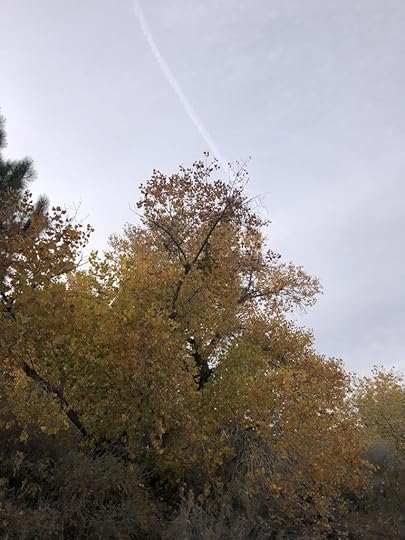
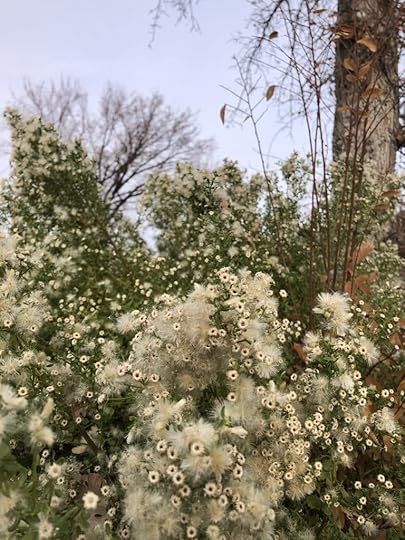
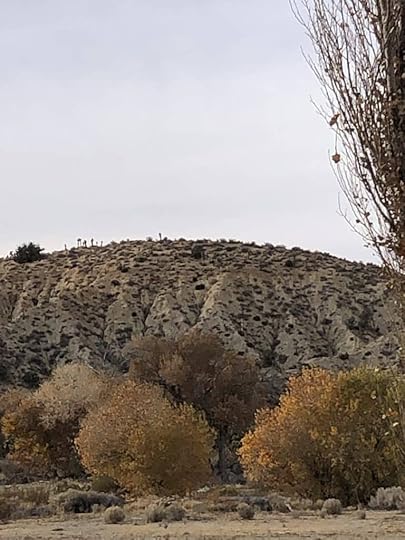
Anyway, it is beyond beautiful here in the high (Mojave) desert with the sycamores and maybe cottonwoods all deep golden with leaves, and yuccas, agaves, Joshua trees, and the fragrant California chaparral dear to my heart. It’s pretty darn cold at night and in the morning (colder yesterday by about six degrees in fact than in NYC) and pitch black still when you leave your cozy room at 5 minutes of 6 (or earlier if you want to sit in the darkened chapel for a while before Vigils) and traverse the frosty path down to the church.
So many beautiful touches around the monastery: the spotlight outside the chunky stained-glass windows so that in the darkened sanctuary one shows a pale milky underlain-by-gold green and the other touches of orange and blue. The candle above the icon of the Blesed Virgin to whom we turn and sing the Salve Regina after Compline. The vase of creamy white and blood-red flowers (roses, maybe) beside the tabernacle yesterday at noon Mass. The dispensers with food pellets for the ducks in the duck pond. The space heater in the public women’s bathroom. The light sensor outside my room so I don’t have to fumble around in the dark for my key.
If you walk before 5:30 Vespers, you can hear the owls hooting. And the skies, true to form, are starry, starry, starry.
December 6, 2024
SOLZHENITSYN’S MASTERPIECE “MATRYONA’S HOUSE”
Here’s how this week’s arts and culture column begins:
In February 1945, Soviet dissident Alexander Solzhenitsyn was sentenced to eight years in the Russian prison camps. Passages in letters to a friend had been found by military censors to be insufficiently respectful of Stalin.
After his “rehabilitation,” in 1959 he wrote perhaps his best-known and most well-loved story: “Matryona’s House.”
It begins like this:
“For at least six months after the incident took place every train used to slow down almost to a standstill at exactly a hundred and eighty-four kilometres from Moscow. The passengers would crowd to the windows and go out onto the open gangway at the end of the carriages to find out whether the track was under repair or if the train was ahead of schedule. But these were not the reasons for the delay.
READ THE WHOLE PIECE HERE.
December 4, 2024
YOUR LIGHT WILL COME, JERUSALEM
Oy. Do you ever go through one of those periods where all you seem to do is admin, maintenance, schedule appointments, do things over, be interrupted every two seconds, suffer insomnia, and everything seems to be breaking down at once?: cars, teeth, phone, garbage disposal, bathroom plumbing?…
I think, as always, of mothers: HOW DO THEY DO IT? And comfort myself with the realization that we can sleep when we’re dead.
Meanwhile, life is in session and how incredibly lucky am I to be more or less up and running?
Lacking coherent thought and devoid of compelling reflection, I offer a smattering of quotes from recent reading:
“Obedience for contemplatives is like the inner compulsion of an artist drawn to hours of hard work by a fever of love for creating things of beauty. No grue artisst will say he trudges to work in reluctance and distaste, forcing his soul to the task. Contemplatives are similar in their response. In a sense they recognize the cross almost like their chosen art: no more to be evaded or refused than an artist running from the sight of beauty rising before his eyes.”
–Fr. Donald Haggerty, Contemplative Enigmas: Insights and Aid on the the Path to Deeper Prayer
“The mirror, orginally created to give pleasure, had become an instrument of anxiety like the clock.”
–Robert Musil
“Real human bodies are the opposite of capitalism though they are its material: they are not liquid, they wear out and decay.”
–Joanna Walsh
“One part of us is sane, the other half of us is nearly mad…and wants to die in a catastrophe that will set life back to its beginnings and leave nothing of our house save its blackened foundations.”
–Rebecca West
“Everything in excess: food, sex, drink, drugs, cigarettes; but also work. Fassbinder gives the lie to the idea that productivity is in itself a ”healthy’ thing. There is nothing necessarily ‘healthy’ about the pursuit of any demanding or difficult or very personal art. There may be cruelty involved. It throws into question what we might consider a ‘healthy’ productive life at all. The line between self-medication and lethal dose become increasingly thin. The same thing that cures you of one malady exacerbates another. Suddenly crying jags, mad hungers, humid sweats. Sleep now a grand prix or slalom; a shark chasing its own turbulence. Un-health as its own form of exercise or momentum. Life life at a hurtling rate: beyond a certain point impossible to tell whether it’s speeding up or skidding down or whether finally these amount to the same thing.
By the time of his death he didn’t seem young or old; he had entered some kind of shamanic or bodhisattav or saint-like state of beyond caring.”
“What ultimately defines our own personal ideas of failure and success? How deep are the roots of all the bad decisions we make? Was there, perhaps, some unlikely moment in our childhood when something resembling failure made an indelible impression upon us? And seemed vastly preferable to then prevalent notions of success?”
–Ian Penman, from Fassbinder: Thousands of Mirrors
“[Rich and powerful do-gooders think] We must–we must endeavor to make a difference, to win, to change the world, to get things right. What is difficult to see is that such thinking, even if it originates in real compassion, is ultimately patronizing or even tyrannical. It begins from a hidden fantasy of divine power, that the poor and their poverty depend on me, that benefit to others flows out from me, while I remain impassive and impermeable, receiving nothing. Mere words might be fruitlless to break the spell of our imagined superiority. But it dissolves like wax before the fire in real life with poor people.”
–Zena Hitz, The Religious Life
“When I’m writing, I don’t like there to be daylight at the window.’ He usually starts at about 11 p.m., when the rest of the house is asleep, and keeps at it ‘as long as the thread is coming.’ When exhaustion sets in, at noon or so the next day, he’ll stop, pour a Scotch, open his fourth pack of cigarettes, slip in a disc into the compact disc player, perhaps ‘Creole Love Call,’ and lie on the settee until sleep comes. When he wakes, it’s back to the desk again. His daughter or his wife will carry food up on a tray–quietly, so as not to have their heads snapped off.”
–Description of a 1988 interview by Dennis Potter with The New York Times Magazine, from the Potter biography by Humphrey Carpenter
“Death is not extinguishing the light; it is only putting out the lamp because the dawn has come.”
–Bengali poet Rabindranath Tagore
“How often do we consider the fact that the treasures and riches of the world were created from time immemorial by slaves? From the irrigation systems of Mesopotamia, the Great Wall(s) of China, the pyramids of Egypt, and acropolis of Athens, to the plantations of sugar on Cuba and of cotton in Louisiana and Arkansas, the coal mines on Kolyma and Germany’s highways? And wars? From the dawn of history they were waged in order to capture slaves. Seize them, chain them, whip them, rape them, feel satisfaction at having another human being as one’s property. The acquisition of slaves was an important, and frequently sole, cause of wars, their powerful and even undisguised motivation.”
–Ryszard Kapuściński, Travels with Herodotus
“All this calm, all this peace, this sober equilibrium that underlies the works of Giorgio Morandi and found in [works of] Max Ernst and Giorgio di Chirico masks the uneasiness that something threatening is about to explode.”
–Salvador Dali
“It was not easy to obtain a painting from Morandi. He rarely allowed buyers to choose; instead, Morandi himself would decide which work would be sold to which buyer. Moreover, when he finished a painting he would not immediately turn it over to the eager collector. Instead Morandi would hang it on the wall over his bed with others that explored the same theme and observe the sequential development of that particular series.At that time he would often write the name of the future owner on the wooden stretchers of the finished painting, but the canvas would remain on Morandi’s wall until he felt he had studied it sufficiently.”
–Janet Abramowicz, Giorgio Morandi: The Art of Silence
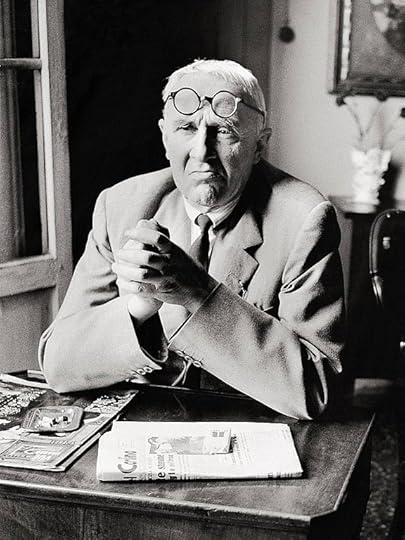 GIORGIO MORANDI (1890-1964), ITALIAN PAINTER
HE LIKED BOTTLES
“As I’ve gone through life, I’ve found that your chances for happiness are increased if you wind up doing something that is a reflection of what you loved most when you were somewhere between nine and eleven years old.”
–Walter Murch, from The Conversations: Walter Murch and the Art of Editing Film with Michael Ondaatje
Here’s a video, even more amateurish than usual, that I worked up for Advent, when we’re both superaware of time, and somehow outside of time…
November 30, 2024
FESTIVAL OF BROKEN NEEDLES
I am so not one of those people who sit around decrying the commercialism of Christmas. If buying gifts for your friends and family seems wrong or obligatory or like an empty gesture to you, or wasteful, or over-the-top, or show-offy and competitive or like a weaponized version of love, don’t do it.
I don’t–but I also don’t begrudge or much pay attention to what anyone else does.
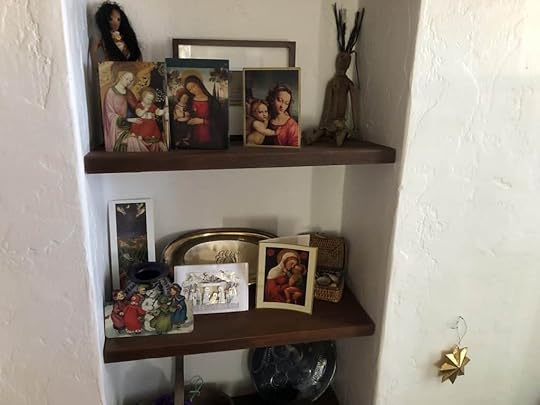
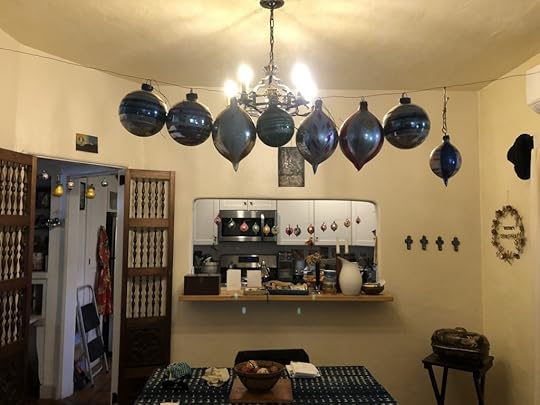
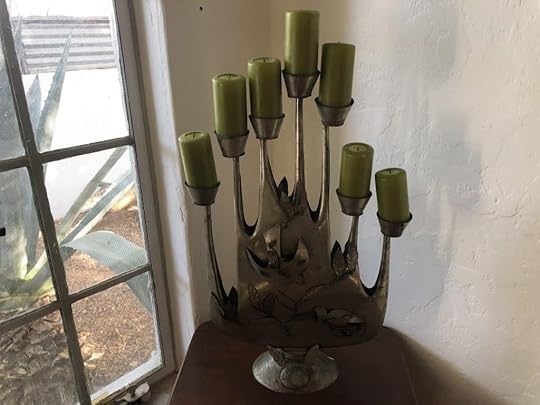
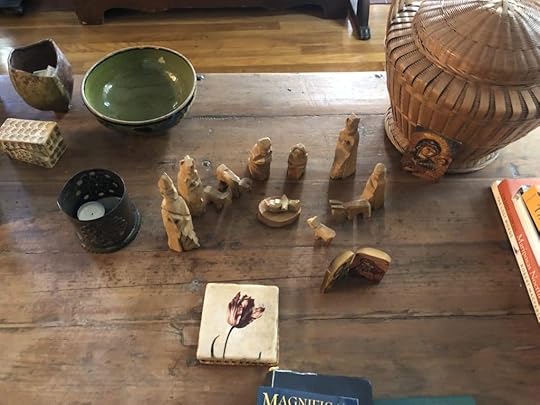
My old friend from Maine sends me a Gustave Baumann calendar each year: I send her a book. I contribute to a few of my favorite charities. I hand-address and hand-write a message and send out Christmas cards. And I deck out my living space with old cards I’ve saved often for years, vintage mercury bulbs, Advent calendars, string lights and candles.
But mostly for me Christmas is about the mystery, the liturgy, the Sacraments. I love switching out my Ordinary Time Weeks 18-34 breviary, which I bought used decades ago and is swathed in dark green imitation plastic, for the Advent and Christmas season one, bound in dark blue leather.
Christmas is about getting quiet, sitting in the early morning dark, contemplating the shortness of our time on earth, giving thanks. Preparing for the birth of a baby…
To that end, I just learned of the Japanese festival of laying broken pins and needles to rest. It’s called Hari Kuyō, and it is held on February 8th [for us, the Solemnity of the Immaculate Conception] in Kanto region and on December 8th in Kyoto and Kansai regions.
The idea is to give thanks for the needles: the work they’ve done, the people they’ve served. The broken needles are laid to rest by being ceremoniously stuck into a block of soft tofu. Participants may also pray for the improvement of their seamstress or tailoring skills in the coming year.
From a post on the site KHG Arts: Textile Arts, Education, Care:
“The ideas that are so central to this festival day struck me as ones I already held dear—that there is joy to be found in small things, practices of economy v. wastefulness, and cultivating respect for the everyday tools that allow us to do so much. In Japan, this is known as Mottainai—the concept of expressing regret towards wasteful behavoir and, in turn, valuing small everyday objects by using them and disposing of them in an economical and respectful way.”
I love that. Mottanai doesn’t mean criticizing everyone else’s supposedly wasteful behavior and meanwhile going around with a carping, Scrooge-like heart. That’s a waste of a heart, which is surely just about the worst kind of waste possible.
For my own part, almost every one of my little Christmas items has a story. I can tell you where I lived when I bought it, or who gave it to me, or why it delights me so much that I’ve hauled it around from place to place year after year, decade after decade. These small everyday objects, all the more precious for being brought out but once a year, symbolize part of the meaning of Christmas for me and they also nurture my child-like heart.
So whatever nurtures your own child-like heart this season, go for it. If it’s driving you crazy that everyone else is out buying presents, maybe it’s because you feel deprived and lonely and unloved (a feeling I myself know well!).
In that case, maybe buy YOURSELF a present.
Coda to a recent post, “How Can I Keep From Singing”:
In today’s Office of Readings, the Second Reading, again from St. Augustine, ends like this:
“So, then, my brothers, let us sing now, not in order to enjoy a life of leisure, but in order to lighten our labors. You should sing as wayfarers do — sing, but continue your journey. Do not be lazy, but sing to make your journey more enjoyable. Sing, but keep going. What do I mean by keep going? Keep on making progress. This progress, however, must be in virtue; for there are some, the Apostle warns, whose only progress is in vice. If you make progresss, you will be continuing your journey, but be sure that your progress is in virtue, true faith and right living. Sing then, but keep going.”
BLESSED ADVENT!November 26, 2024
EGG BLOOM
I know I mentioned that in a recent week of house-sitting in LA. one of my chores was feeding and watering three chickens.
I may have also mentioned the conversation that ensued between me and my friend Patrick as I contemplated the prospect.
“Patrick: So will they wake you in the morning with their crowing?
Me: Um…I think that’s guys. Aren’t chickens female? Yeah, they have to be, cause they lay eggs. I don’t think they make noise.
P: But how do they lay eggs without a male?
Me: Good question! I’m not sure…Do they lay the egg and then the male…I don’t know, injects something into the egg and that’s how it’s fertilized? Or are some of the eggs fertile and some not?…Wouldn’t that be gross if you cracked an egg and there was an embryo in there?”…
It went on in this pathetic fashion for a while as we cracked up at our vast ignorance Then I went to LA, and watched the chickens (who were not “broody”, i.e. not laying at the time) and thought no more about it.
Then I took a book out of the library called Infinite Life: The Revolutionary Story of Eggs, Evolution and Life on Earth by Howard Jules. Which was engagingly written and had to have required masses of research, and that I kind of skimmed.
What grabbed me there was an episode called “The Great Dying” (again, who knew?) that took place approx. 251.9 million years ago, the most severe of the the “Big Five” mass extinctions of the Phanerozoic era. Wiped out were 57% of biological families, 83% of genera, 81% of marine species and 70% of terrestrial vertebrate species. Also a TON of insects. Isn’t that sad??
The whole notion of eggs, though, got me thinking about those chickens. How DO they make eggs and how ARE they fertilized? I wondered.
Well! Does everyone know this but me? It is a TOTAL MIRACLE!
I learned about it from a Purina feed page about caring for your poultry called “How Do Chickens Lay Eggs? Understanding Your Egg-Laying Chickens.”
I mean read it for yourself but suffice it to say that an egg, a whole gorgeous perfectly-formed egg with a thick protective shell, is formed in a mere 24 hours within the body of a chicken!
This was my favorite part: “Egg bloom is added and egg emerges (seconds):
The formed egg travels to the vaginal area where egg bloom is added to the shell as the egg passes through. Egg bloom, or the cuticle, is a protective coating that works with strong shells to protect the egg from bacteria. A natural lubricant is also added to the shell for a safe exit through the cloaca.”
(FYI, the chicken doesn’t have a separate vagina and anus like some people we know but just the one opening, the cloaca, through which as well the rooster does his thing (let’s not picture this too closely) and that is how an egg is fertilized).
All of which stands to reason as even I know that human females of child-bearing age produce eggs each month and if they don’t hook up with a spermatazoa they just kind of dissolve. Or something like that.
Whoops: wrong again! “Current knowledge indicates that females are born with their entire lifetime supply of gametes. At birth, the normal female ovary contains about 1-2 million/oocytes (eggs). Females are not capable of making new eggs, and in fact, there is a continuous decline in the total number of eggs each month. By the time a girl enters puberty, only about 25% of her lifetime total egg pool remains, around 300,000. Over the next 30-40 years of a female’s reproductive life, the entire egg supply will be depleted. Although no one can know with absolute certainty the number of eggs remaining within the ovaries at any given time, most women begin to experience a significant decrease in fertility (the ability to conceive a child) around the age of 37. At the time of menopause, virtually no eggs remain.”
Like I said–miracle. Think of the mysteries we carry about in our bodies (never mind our minds, nervous systems, spirits, and souls)–and that our whole lives, are veiled from sight.
November 24, 2024
HOW CAN I KEEP FROM SINGING
Friday, November 22, was the feast day of St. Cecilia, patron saint of music. (Unbeknownst to my brother Joe, who heads up a punk bank, I have assigned her as HIS patron saint as well).
A virgin martyr, she suffered one of those grisly deaths beloved (in memory) by us Catholics.
This deeply moving statue of her is housed at the St. Cecilia Basilica in Rome.
 ST. CECILIA BY STEFANO MODERNO, 1599
From wiki: “The statue of St. Cecilia can be found lying on her right side, in a simple dress tucked between her knees. The contours of her body are visible through the implication of light fabric. The folds on her dress creating spots of light and shadow are characteristic of Baroque style. Her hands are located in front of her legs, as if her arms were bound in front. Her right index finger extends off the marble breaking the barrier between the statue and the pilgrims. St. Cecilia has her face turned away from the viewers and straight down to the earth.] Her face being turned away helps display the cuts shown on the back of her neck that were made by the executioner. Even after the executioner hit her neck three times, St. Cecilia stayed alive for three days before bleeding out.”
Anyway, in the Second Reading of the Office of Readings for her feast, St. Augustine exhorts us to sing to the Lord with joy.
“But how is this done? You must first understand that worlds cannot express the things that are sung by the heart. Take the case of people singing while harvesting the fields or in the vineyards or when any other strenuous work is in progress. Although they begin by giving expression to their happiness in sung words, yet shortly there is a change. As if so happy that words can no longer express what they feel, they discard the restricting syllables. They burst out in a simple sound of joy, of jubilation. Such a cry of joy is a sound signifying that the heart is bringing to birth what it cannot utter in words.”
I found it interesting to try to picture this segue from sung words into a simple sound of joy, of jubilation. I figure it is kind of like the same sound I make–a kind of incoherent croaking–when I raise my voice in jubilant song, or try to, at church.
I grew up in the Congregational Church with the old hymns–Breathe on Me, Breath of God, There is a Balm in Gilead, Crown Him with Many Crowns, How Great Thou Art, The King of Lord My Shepherd Is–that still make me want to bust out. My voice is nothing to write home about and deteriorates with age.
Don’t worry, I don’t sing too loudly, so as not to disturb the other parishioners, or try to pretend my voice is anything other than low mediocre. But I always stay till the last word of the last verse of the closing hymn. And it slays me that at the end of the Easter Vigil, the whole congregation doesn’t rise up en masse, raise our tear-stained faces to the rafters, and ring out to heaven, “Christ the Lord is risen today–ALLELUJIA!!!!” Come on, people! Do not our joy and gratitude compel us to raise our voices in song!
Especially as we end the liturgical year with the Solemnity of CHRIST THE KING! OF THE UNIVERSE!!
Anyway, lately I’ve taken to listening to Evening Prayer on Sing the Hours, then praying the Rosary, then listening to Benedictine chant or other sacred choral type sung music as I take my vespers walk.
The other night I came across this hymn which I had of course heard before but to which I’m now memoriizing the lyrics. It’s kind of a beautiful way to sum up our day and to conclude our evening reflection.
¡Viva Cristo Rey! Pray for, Blessed Miguel Agustin Pro.
November 22, 2024
“LUMEN” AT THE GETTY
Here’s how this week’s arts and culture column begins:
Run, don’t walk, to “Lumen: The Art and Science of Light” at the Getty through Dec. 8. You could easily spend the whole day contemplating this beautifully curated, fascinatingly thought-provoking exhibit.
“Lumen” is part of the “PST ART: Art and Science Collide” series currently mounted at various sites around LA. Special installations by Pasadena-based Helen Pashgian and Charles Ross, both artists who explore light and space, extend “Lumen” throughout the museum.
An essay entitled “A Curatorial Perspective on Two Objects” sets the tone:
“To be human is to crave light. We rise and sleep according to the rhythms of the sun, and have long associated light with divinity.”
READ THE WHOLE PIECE HERE.
November 20, 2024
TAKING THE BEAM FROM OUR EYE FOR THE HOLIDAYS
The other day a friend sent me a clip from 77-year-old musician, avant-garde artist and filmmaker Laurie Anderson (formerly married to Lou Reed).
She offered three rules for a simple life:
“The first one is don’t be afraid of anyone. Now can you imagine living your life so that you are afraid of no one? And second is get a really good bullshit detector and learn how to use it. And third is be really, really tender.”I don’t know Anderson or her work well and don’t have much feeling one way or another toward her as an artist. But over the last week, I’ve thought a lot about these three ideas and how they apply this time of year.
The unhealthy closed-circle family system, for example, consisting of codependence, dishonesty, enmeshment,and distorted versions of love is all too familiar to many of us—especially with the holidays approaching!
We get enmeshed with friends or family members, for example, who we’re convinced are direly mentally ill and start trying to force them, one way or another, to admit to their sickness with zero cognizance of our own! We become engaged in a pitched battle to “win” while CONSTANTLY maneuvering behind the scenes, creating fresh crises and drama, sucking in the rest of our circle or whoever will listen into the drama, and casting ourselves as rueful martyr/saviors while in fact we have often been the prime motivators in generating and sustaining the system we purport to abhor.
In a supposed sign of love and support, the circle (also codependent, often because we’ve trained it to be), rallies around, listens, agrees, shores up, is drawn into the drama, shows love and concern by demonizing the supposedly ill person who gets talked about (nothing delights us more than when the circle joins us in spying upon and reporting the wrongdoing of the other), dissected, lied to and manipulated to within an inch of his or her life, while all the while we, the supposedly well, loving, recovered people, profess to hunger for Truth and Love.
Our version of Love of course goes BEYOND the normal run of the mill love and WAY beyond any distasteful, unfeeling kind of “tough” love. Our kind of love requires constant surveillance, hovering, unsolicited advice, and intrusion, often trying to do for others what they should—and would if we’d get out of the way—do for themselves.
While meanwhile our own lives, passions, desires, and growth get neglected.These kinds of generational prison systems can keep us forever in their grip—I speak from experience! Because to surrender them strips us so thoroughly of our false scaffolding that without fellowship and a real God we simply couldn’t handle the nakedness, the reality (this, to my mind, is the beauty of 12-step groups and principles).
Our whole idea that we are special and different and follow a different, higher star than everyone else has to be shattered!: the hypocrisies attendant upon our (self-styled) “creed,” the hubris that prevents us from seeking or being open to outside help or ideas. (I do think those of us who are Catholic may be especially prey to such thinking).
Not because we need to suffer more, or feel worse about ourselves than we perhaps already do—but so that we can see how thoroughly fear has us in its grip. We’re afraid others in our circle might not think we’re “nice,” that we might not get straight As on the martyr report card, that someone might be freaked out by new behavior (they probably will be; Jesus is with us) and get mad at us or explode.
Fear has such a stranglehold on our psyches that everything must remain within the closed system because no-one else would “understand.” An outsider might reveal an uncomfortable truth.
No-one was more aware of the nearly satanic strength and power of these family-and-friend systems than Christ. Of course we love and support our circle, but if the system is our god we’re in trouble. Christ himself—while his beloved Mother, the Blessed Virgin Mary!—was waiting outside, said “Who is my mother and my brothers? Those who do the will of God.” The neighbors thought he was crazy. He was tortured to death because people couldn’t bear such integrity, such fearlessness, such single-minded devotion to the will of the Father.
The truth is that in our conflict with a difficult person, we tend to become absolutely convinced that we are the “well,” forbearing, generous, sane, one and that the other, in his or her “sickness,” has wronged us at every turn. But in my own (admittedly limited experience in having my “sight” restored) the very fact that we think we are “better” than the other turns out to be the whole problem!
As is our blindness to our own neediness, our own lack of wholeness, our own desperate desire to see ourselves as useful, as people to be depended upon, loved. That doesn’t mean the other’s behavior is “perfect”—it may be objectively insufferable and/or beyond annoying–far from it. Still, the whole relationship is built upon a falsehood, a delusion on our parts.
So they’re insufferable. That’s settled. But the solution isn’t to keep going over and over their insufferability, waiting for the OTHER person to see the light. We don’t have such power. It’s for us to let go of our pride, to beg like the blind man for Christ to take pity on us and restore OUR sight.
When that happens, and with a ton of unmerited mercy and grace, the questions and obsessive concerns either drop away or realign. We’re simply no longer in battle and thus are free. We’ve released the other person from the leash we had wrapped around their neck and were either jerking or allowing ourselves to be jerked by (by their slightest word, comment etc) every second. We realize that, LIKE US, the other is somewhat spiritually sick. How can we help?
In freedom, we can cultivate a general tenderness of heart toward the person while also making healthy boundaries (say, 20 minutes on the phone once a week). When they start in on their own litany of unresolvable complaints we can say, “That must be really hard. I know you’ll find your way,” and change the subject to flowers, or the weather, or what we had for breakfast.
We can quit being afraid of people, keep fresh batteries in our BS detector (for others AND for ourselves!) and we can above all–again again and always–pray for tenderness.
“Thou hypocrite, first cast out the beam out of thine own eye, and then shalt thou see clearly to cast out the mote out of thy brother’s eye” (Matthew 7:5).November 12, 2024
PERSONAL COST
“For it is always true that God never invites us closer to himself unless this invitation comes with a personal cost.”
–Fr. Donald Haggerty, Contemplative Enigmas
Just thinking to check in, after twelve or so days in LA, each packed to the gills with people, walking, talking, eating, prayer…
I will head up to one of my brothers in the high desert up the I-15 tomorrow, and then leave early Thursday for the long drive home badk to Tucson.
Where do we come from? Where are we going? Where do we belong? How can we best serve?
This morning I wrote in my journal that I call myself both to be a contributing 12-step member and a faithful follower of Christ/member of the Church (fellowships with, in general, very little overt overlap). And a working writer. And 72 years of age.
It’s a lot. And I do answer to a different Master than the world. I am doing no more and no less than anyone else but, as Coventry Patmore once said, for (possibly) an entirely different reason.
Here’s a little YouTube I worked up today!: Callling Things By Their Right Names


