
Jimmy Akin's Blog, page 3
January 2, 2012
Today in the Church Year: Jan. 2, 2012
Today is a Monday in Christmas. The liturgical color is white.
Saints & Celebrations:
Today, January 2, in the Ordinary Form, we celebrate St.s Basil the Great and Gregory Nazianzen, bishops and doctors of the Church. It is a memorial.
In the Extraordinary Form, it is Most Holy Name of Jesus.
If you'd like to learn more about St. Basil, you can click here.
If you'd like to learn more about St. Gregory Nazianzen, you can click here.
For information about other saints, blesseds, and feasts celebrated today, you can click here.
Readings:
To see today's readings in the Ordinary Form, you can click here.
Or you can click play to listen to them:
Devotional Information:
According to the Holy See's Directory on Popular Piety:
11. History shows that, in certain epochs, the life of faith is sustained by the forms and practices of piety, which the faithful have often felt more deeply and actively than the liturgical celebrations. Indeed, "every liturgical celebration, because it is an action of Christ the Priest and of his Body, which is the Church, it is a sacred action surpassing all others. No other action of the Church can equal its efficacy by the same title or to the same degree." Hence, the ambivalence that the Liturgy is not "popular" must be overcame. The liturgical renewal of the Council set out to promote the participation of the people in the celebration of the Liturgy, at certain times and places (through hymns, active participation, and lay ministries), which had previously given rise to forms of prayer alternative to, or substitutive of, the liturgical action itself.
The faithful should be made conscious of the preeminence of the Liturgy over any other possible form of legitimate Christian prayer. While sacramental actions are necessary to life in Christ, the various forms of popular piety are properly optional. Such is clearly proven by the Church's precept which obliges attendance at Sunday Mass. No such obligation, however, has obtained with regard to pious exercises, notwithstanding their worthiness or their widespread diffusion. Such, however, may be assumed as obligations by a community or by individual members of the faithful.
The foregoing requires that the formation of priests and of the faithful give preeminence to liturgical prayer and to the liturgical year over any other form of devotion. However, this necessary preeminence is not to be interpreted in exclusive terms, nor in terms of opposition or marginalization.


January 1, 2012
Today in the Church Year: Jan. 1, 2012
Today is the 8th day in the octave of Christmas. The liturgical color is white.
This is a holyday of obligation (Holy Mary, Mother of God). Be sure to go to Mass if you didn't go yesterday evening.
Saints & Celebrations:
Today, January 1, in both the Ordinary and the Extraordinary Form, we celebrate the Octave Day of the Nativity of the Lord. In the Ordinary Form, it is a solemnity, and in the Extraordinary Form, it is a Class I day.
In addition, in the Ordinary Form, this day is also styled Mary, the Holy Mother of God.
If you'd like to learn more about this celebration, you can click here.
For information about other saints, blesseds, and feasts celebrated today, you can click here.
Readings:
To see today's readings in the Ordinary Form, you can click here.
Or you can click play to listen to them:
Devotional Information:
According to the Holy See's Directory on Popular Piety:
115. On New Year's Day, the octave day of Christmas, the Church celebrates the Solemnity of the Holy Mother of God. The divine and virginal motherhood of the Blessed Virgin Mary is a singular salvific event: for Our Lady it was the foretaste and cause of her extraordinary glory; for us it is a source of grace and salvation because "through her we have received the Author of life."
The solemnity of the 1 January, an eminently Marian feast, presents an excellent opportunity for liturgical piety to encounter popular piety: the first celebrates this event in a manner proper to it; the second, when duly catechised, lends joy and happiness to the various expressions of praise offered to Our Lady on the birth of her divine Son, to deepen our understanding of many prayers, beginning with that which says: "Holy Mary, Mother of God, pray for us, sinners."
116. In the West, 1 January is an inaugural day marking the beginning of the civil year. The faithful are also involved in the celebrations for the beginning of the new year and exchange "new year" greetings. However, they should try to lend a Christian understanding to this custom making of these greetings an expression of popular piety. The faithful, naturally, realise that the "new year" is placed under the patronage of the Lord, and in exchanging new year greetings they implicitly and explicitly place the New Year under the Lord's dominion, since to him belongs all time (cf. Ap 1, 8; 22,13).
A connection between this consciousness and the popular custom of singing the Veni, Creator Spiritus can easily be made so that on 1 January the faithful can pray that the Spirit may direct their thoughts and actions, and those of the community during the course of the year.
117. New year greetings also include an expression of hope for a peaceful New Year. This has profound biblical, Christological and incarnational origins. The "quality of peace" has always been invoked throughout history by all men, and especially during violent and destructive times of war.
The Holy See shares the profound aspirations of man for peace. Since 1967, 1 January has been designated "world day for peace."
Popular piety has not been oblivious to this initiative of the Holy See. In the light of the new born Prince of Peace, it reserves this day for intense prayer for peace, education towards peace and those value inextricably linked with it, such as liberty, fraternal solidarity, the dignity of the human person, respect for nature, the right to work, the sacredness of human life, and the denunciation of injustices which trouble the conscience of man and threaten peace.

December 31, 2011
TEMP IGNORE
xxgeneralToday is the 8th day in the octave of Christmas.
xxholydayIt is a holyday of obligation (Holy Mary, Mother of God). Be sure to go to Mass if you didn't go yesterday evening. The liturgical color is white.
xxgenxf
xxmoveable
xxmovexf
xxSAINT
xxothersaint
For more information about saints, blesseds, and feasts celebrated today you can click here.
xxreadings
Click here for today's readings in the Ordinary Form.
Or you can click play to listen to them here:
xxend
qqdate0102
xxgeneralToday is a Monday in Christmas.
The liturgical color is white.
xxgenxf
xxmoveable
xxmovexfIn the Extrordinary Form, it is Most Holy Name of Jesus.
xxSAINT
xxothersaint
For more information about saints, blesseds, and feasts celebrated today you can click here.
xxreadings
Click here for today's readings in the Ordinary Form.
Or you can click play to listen to them here:
xxend

December 29, 2011
Should Catholic Sex Abuse Documents Be Withheld from Courts?
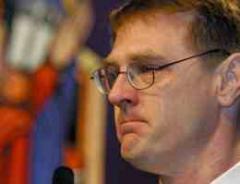 That's a very good question, isn't it?
How many times during the course of various sex abuse news cycles have we read about lawyers using various legal maneuvers to try to keep official, confidential documents pertaining to priestly sex abuses cases out of the hands of courts?
These instances only reveal what scoundrels both the lawyers are—*and* their clients. I mean, the *only* reason to try to keep a document out of the court's hands is if you have something to hide, and that shows that you are acting in bad faith, trying to stop justice from being done.
Consider this story on the web site of the National Catholic Register (*not* Reporter):
SNAP director may be forced to testify in abuse case
KANSAS CITY, Mo.—The leading advocacy group for child victims of clergy sex abuse may be compelled to turn over 23 years of internal documents, correspondence and email to the attorneys of an accused priest unless Missouri state courts act to quash a court-ordered deposition.
David Clohessy, head of the Survivors Network of those Abused by Priests, known as SNAP, has been ordered to appear for deposition in a county court case involving allegations of sexual misconduct against Kansas City diocesan priest Fr. Michael Tierney.
Victims' advocates say if Clohessy is compelled to appear, it could have wide-ranging impact on the ability of victims of clergy sex abuse to identify their accusers and tell their stories without revealing their names in public.
A law professor noted for her decades of work with clergy sex abuse victims said the "end result" of Clohessy's deposition would be "a huge chilling effect on helping child sex abuse victims at every stage."
Also at stake is the confidentiality of emails between reporters and victims' advocates that may reveal sensitive information and names of sources. In a court filing, the Missouri Press Association said Clohessy's deposition would "eviscerate the free-press guarantee" of journalists.

The TWENTY-PLUS Days of Christmas???
 As many are aware, it's still Christmas. The Christmas season only begins on Christmas.
But when does it end?
If you go by the famous phrase "the twelve days of Christmas"—immortalized in the well-known song (which really *is not* a crypto-catechism after all; sorry.)—then you might guess they end on January 5, the eve of Epiphany, counting Christmas Day as the first day. Or if, according to some versions, you count the day *after* Christmas Day as the first day then the twelfth turns out to be January 6, the traditional day of Epiphany.
Ahhh. . . . Things were so uncomplicated in former centuries. Twelve days. Two options. Easy!
But as the Church's liturgical cycle get modified over the years, things become a little more complicated.
You know, like how Lent *originally* started out as a 40 days celebration, but if you look up its technical definition in the Church's official documents today, it turns out that the number "40" is only approximate, and it's really more than 40 days? (Extra penance, folks!)
Well, it turns out the same thing is true of the Christmas season. Here is the current, official definition of its length, taken from the brand, spanking new translation of the Universal Norms on the Liturgical Year and the Calendar:

December 28, 2011
Herod the Baby-Killer
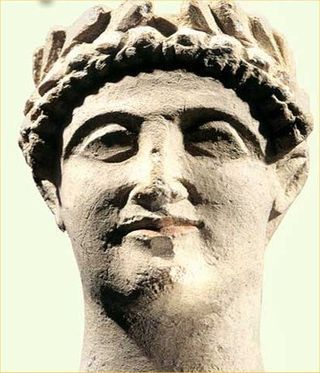 Today is the feast of the Holy Innocents—the baby boys that Matthew records were slain on the orders of Herod the Great in his attempt to kill the infant Jesus.
Did he really?
Sometimes we hear skeptics dismiss the idea by saying that we have no record of him doing so.
But it's not exactly like we have the complete records of what Herod did in his reign. So much has been lost that this kind of argument from silence is the logical fallacy they teach it to be in beginning philosophy classes. Just because we don't have a record of Herod doing something doesn't mean he didn't do it.
And, after all, don't we have a record in this case? Matthew mentions him doing it. That's a record, right? Only if Matthew were a systematically untrustworthy source would one be warranted in summarily dismissing what he says, and judged by the ordinary standards applied to evaluating other first century historical works—even apart from the perspective of faith—Matthew must surely be reckoned as far more trustworthy than that.
Further, what Matthew says fits with what we know about Herod's character. The man was ruthless, from the beginning of his reign to the end. As he got closer to the end, he became intensely paranoid and cruel, and even if we don't have a second record of the slaughter of the innocents, anyone who has studied Herod's life recognizes how in keeping this is with what we know of him.
Consider these excerpts from his biography in the Anchor Yale Bible Dictionary:
Herod's conquest of Jerusalem in 37 did not bring his problems to an end. Inheriting a divided city, he moved swiftly and decisively to thwart all opposition. Forty-five leaders of the pro-Antigonus faction in the city were executed (Ant 15 §5) and others were forced into hiding (Ant 15 §264). The wealthy were despoiled, and the revenue gained was used to pay Herod's debts to his Roman patrons and his army.
In the years following his ascension, Herod was almost obsessively concerned about the security of his rule.

December 25, 2011
Merry Christmas! (Pictures from Bethlehem)
I'm not in Bethlehem, but like everyone, Bethlehem is in my thoughts these days.
I wanted to share with you a couple of pictures from Bethlehem, from the Church of the Nativity, and explain their significance.
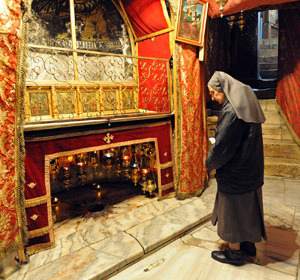
A few days ago I ran across the following picture, which is of a nun praying in front of the shrine in the grotto of the Nativity in Bethlehem.
Although we often imagine Jesus being born in a barn, that image comes more from Christmas cards. In ancient Israel, animals were often sheltered in caves, and since extremely early times it was held that Jesus was actually born in a grotto. St. Jerome had his study in a neighboring grotto (so close it's part of the same church complex), and in his writings he talks about the reasons to think that the grotto of the Nativity is, in fact, where Christ was born.
Today a silver star marks the spot on the floor where the very moment of the Nativity is commemorated. The center of the star is empty, so pilgrims can touch the undressed rock at this point. A similar star marks the top of Golgotha, where Christ was crucified, in the Church of the Holy Sepulcher in Jerusalem, just six miles to the north of Bethlehem.
In this image of the nun praying, you can see behind her steps leading up to the surface level of the Church of the Nativity, which is above the grotto.
I found this picture particularly moving. It expresses both humbleness and holiness, two elements that marked Our Lord's entry into the world.
In his Christmas Day Urbi et Orbi ("To the City and the World") address, Pope Benedict commented on this grotto, saying:
Dear Brothers and Sisters, let us turn our gaze anew to the grotto of Bethlehem. The Child whom we contemplate is our salvation! He has brought to the world a universal message of reconciliation and peace. Let us open our hearts to him; let us receive him into our lives. Once more let us say to him, with joy and confidence: "Veni ad salvandum nos!" ("Come to save us!")
In his homily at Midnight Mass, he also noted another feature of the Church of the Nativity at Bethlehem--its main entrance, which is very short and known as the Door of Humility:
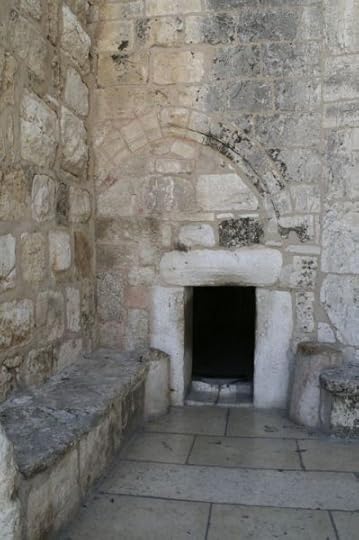
Pope Benedict explained:
Today, anyone wishing to enter the Church of Jesus' Nativity in Bethlehem will find that the doorway five and a half metres high, through which emperors and caliphs used to enter the building, is now largely walled up. Only a low opening of one and a half metres has remained. The intention was probably to provide the church with better protection from attack, but above all to prevent people from entering God's house on horseback. Anyone wishing to enter the place of Jesus' birth has to bend down.
It seems to me that a deeper truth is revealed here, which should touch our hearts on this holy night: if we want to find the God who appeared as a child, then we must dismount from the high horse of our "enlightened" reason. We must set aside our false certainties, our intellectual pride, which prevents us from recognizing God's closeness. We must follow the interior path of Saint Francis – the path leading to that ultimate outward and inward simplicity which enables the heart to see.
We must bend down, spiritually we must as it were go on foot, in order to pass through the portal of faith and encounter the God who is so different from our prejudices and opinions – the God who conceals himself in the humility of a newborn baby.
In this spirit let us celebrate the liturgy of the holy night, let us strip away our fixation on what is material, on what can be measured and grasped. Let us allow ourselves to be made simple by the God who reveals himself to the simple of heart. And let us also pray especially at this hour for all who have to celebrate Christmas in poverty, in suffering, as migrants, that a ray of God's kindness may shine upon them, that they – and we – may be touched by the kindness that God chose to bring into the world through the birth of his Son in a stable. Amen.
MERRY CHRISTMAS TO ALL!
--Jimmy Akin
Read Pope Benedict's homily from Midnight Mass.
Read Pope Benedict's Christmas Day address.
Learn more about the Church of the Nativity in Bethlehem.

December 23, 2011
Prequel to This Year's Doctor Who Christmas Special
Here's the prequel to this year's Doctor Who Christmas Special.
The prequel is basically spoiler-free except that at the very end it reveals the title of the special (already well-known to many). It seems that, as with last year's special, this one is inspired by a beloved work of English literature.

I'm Now in the Amazon.Com App Store!
 Cool!
Cool!
I just got word that my Android App is now available in the Amazon.com App Store.
This app is based on my podcast, and makes it easy for you to download the podcast to your Android device (phone, Kindle Fire, etc.). It adds additional bonus features, such as easy, integrated ways to contact the show, favoriting, and additional exclusive material that I will be producing just for the app (so I'd, like, better get started on that).
The name of the app is "Jimmy Akin Cast" (they wouldn't let me use the word "podcast" in the title), and I was interested to see that Amazon ranked it ages 9 and up.
The app should also be coming to the Google's Android Marketplace very soon.In the meantime,
CLICK HERE TO LEARN MORE ABOUT THE APP!


December 22, 2011
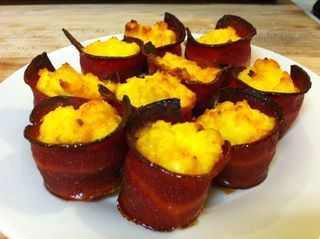
Low Carb Bacon Flowers
Because everything's better with bacon!
Want to make these? Sign up for the Jimmy Akin ULTIMATE Low Carb Club before midnight Friday and get the recipe!

Jimmy Akin's Blog

- Jimmy Akin's profile
- 166 followers

