
Kenneth C. Davis's Blog, page 93
August 21, 2013
Game What You Don’t Know Can Be Thrilling!
[image error]
[image error]
BRING KENNETH C. DAVIS and the DON’T KNOW MUCH ABOUT® QUIZ
TO YOUR SCHOOL OR OTHER EVENT
Treat your audience to a
Don’t Know Much About® Quiz
with New York Times bestselling author Kenneth C. Davis
The Don’t Know Much About® Quiz is an interactive game modeled on TV quiz shows, with wide appeal to students, parents and teachers. Bestselling author Kenneth C. Davis sets the tone for the event by briefly introducing himself and describing the Don’t Know Much About® series, which is aimed at making learning fun. Then Davis chooses “contestants” using a variety of easy questions thrown out to the audience. (Example: Name the first 13 states.)
The contestants are then divided into two teams of 3 or 4 players, who stand at tables on which there are lights and buzzers. In game-show style, Davis asks a question and the players must buzz first for the chance to answer the question. The first team to reach five correct answers is the winner. (That number can be adjusted, but works well in order to accommodate as many players as possible.)
The questions are usually drawn from all of Davis’s books; however, they can be tailored to a specific event. Some of the questions are straightforward (Who was the first president born in the United States?). But Davis also uses riddles, jokes and puns. Following a correct response, Davis then elaborates on the answers to turn this game into a real teaching session as well as a lively, fast-paced game.
Davis has taken this game to the American Museum of Natural History, the Smithsonian Museum and the New-York Historical Society. He has performed in bookstores, science centers, classrooms, school gymnasiums and teacher and librarian meetings. He has done it with groups as small as ten or fifteen and as large as 200, and he has worked with students from elementary grades through middle school and high school. The reaction is always extremely exciting, as the kids clamor for a chance to be a game show contestant. Adults also love to play and Davis has brought the game show to groups of teachers and parents and book festivals in Boston and Chicago.
The simplicity of the setup and the range of questions that can be drawn from Davis’s many books make this a very flexible event suitable for many audiences and venues. For more information, please contact us.


August 20, 2013
Don’t Know Much About® Benjamin Harrison
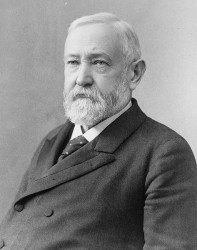
Benjamin Harrison (c1896)– 23rd President of the United States (Source: Library of Congress Prints and Photographs Div.)
Benjamin Harrison, the twenty-third President of the United States, was born in North Bend, Hamilton County, Ohio, on Aug. 20, 1833. His father, John Scott Harrison, was the third son of William Henry Harrison, ninth President of the United States and the grandson of Benjamin Harrison of Virginia, who was one of the signers of the Declaration of Independence.
You may know him as the answer to a presidential trivia question about the only president who was the grandson of a president. “Little Ben” Harrison is one of those somewhat faceless Ohio-born Republican presidents of the late 19th century. A Civil War veteran –almost a requisite for the office at the time– he was the beneficiary of the controversial 1888 election tainted by accusations of fraud and ballot box stuffing. Harrison lost the popular vote to the incumbent Grover Cleveland, but won the electoral vote.
Fast Facts:
-More states were admitted under Harrison than any president since Washington: North Dakota, South Dakota, Montana, Washington, Idaho and Wyoming.
-Electric lights were installed in the White House during Harrison’s term. The Harrisons, like many people of the time, did not trust electricity as early wiring often led to shocks.
-First Lady Caroline Harrison died of tuberculosis on October 25, just weeks before Harrison lost the 1892 election to Cleveland.
-Among Harrison’s appointments was a young Theodore Roosevelt as civil service commissioner.
-During Harrison’s terms, the Oklahoma Land Rush opened nearly two million acres of land once ceded to Indians to white settlers in 1889. And in 1890, the massacre at Wounded Knee took place.
-The period also saw some of the most violent labor strife at such places as the Homestead steel plant in Pennsylvania and the Coeur d’Alene silver mine in Idaho, where federal troops were used to break a strike.
-Following the overthrow of Hawaii’s Queen Liliuokalani, Harrison sent Marines to Hawaii in January 1893 to protect the new government established under Sanford Dole.
-During the 1892 campaign, the Populist, or People’s Party, sprang up. Its candidate, running on the slogan that “Wall Street owns the country,” was James B. Weaver. In a surprising show of strength, he won more than one million votes and twenty-two electoral votes.
Benjamin Harrison died on March 13, 1901. (New York Times obituary.)
Read more about Benjamin Harrison’s life and presidency in Don’t Know Much About® the American Presidents and Don’t Know Much About® History.

Don’t Know Much About the American Presidents (2012)
(From Hyperion and Random House Audio)
Don’t Know Much About History (Revised, Expanded and Updated Edition)
August 19, 2013
Don’t Know Much About® President Clinton
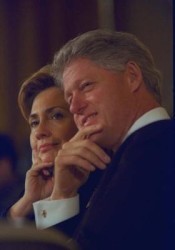
President Clinton and First Lady Hillary Clinton-October 22, 1999 (Source: Clinton Library & Museum)
Born on August 19, 1946 in Hope, Arkansas, William Jefferson “Bill” Clinton, 42nd President of the United States.
The first Democratic president to be elected to two terms in office in his own right since Franklin D. Roosevelt, Bill Clinton had a story that was as compelling as it was sometimes tawdry. In the face of private controversies and partisan infighting of blowtorch intensity, he was able to rebound repeatedly –the self-styled “Comeback Kid”– to win the presidency in 1992 and a second term in 1996.
He then survived the second impeachment of a president in American history. That proceeding was prompted by his denial of a sexual relationship with a White House intern during a legal deposition related to a suit by a woman who had accused Clinton of sexual harassment while he was governor of Arkansas. Clinton was acquitted in the Senate impeachment trial on February 12, 1999.
Fast Facts:
*Clinton is the only president who was a Rhodes Scholar.
*Inaugurated at age forty-six, Clinton was the third youngest president (after Theodore Roosevelt and John F. Kennedy) and the first “baby boomer” president.
*His wife, Hillary Clinton, was the first First Lady to ever run for public office, becoming a U.S. Senator from New York. After campaigning for president in 2008, she lost the Democratic nomination to Barack Obama, who then selected Hillary Clinton as his secretary of state.
President Clinton’s attempt to introduce a major health care reform, with his wife Hillary leading the task force that created the legislation, was a political disaster. His campaign promise to end discrimination against homosexuals in the military led to creation of the much-criticized “Don’t Ask, Don’t Tell” policy. That was followed in 1996 by the passage of the “Defense of Marriage Act (DOMA)” which denied federal recognition of same sex marriages or civil unions.
But with 22 million jobs created, a balanced budget and budget surplus when he left office, and a brief but largely successful military intervention in Serbia, Clinton’s popularity, based on approval polls, was high when he departed the White House. In spite of the impeachment proceedings, the American public seemed willing to separate his private life from his public performance.
The Clinton Library & Museum offers resources and information on Clinton’s life, his presidency and his unique partnership with his wife — a story that is not yet complete.
Read more about the Clinton years in Don’t Know Much About the American Presidents and Don’t Know Much About History.
[image error]
Don’t Know Much About the American Presidents (Hyperion Books and Random House Audio)
Don’t Know Much About History (Revised, Expanded and Updated Edition-Harper Collins and Random House Audio)
Who Said It? (8-19-2013)
President Bill Clinton. “Address on Health Care Reform” (September 22, 1993)
So tonight I want to talk to you about the principles that I believe must embody our efforts to reform America’s health care system: security, simplicity, savings, choice, quality, and responsibility.
When I launched our Nation on this journey to reform the health care system I knew we needed a talented navigator, someone with a rigorous mind, a steady compass, a caring heart. Luckily for me and for our Nation, I didn’t have to look very far.
Over the last 8 months, Hillary and those working with her have talked to literally thousands of Americans to understand the strengths and the frailties of this system of ours.
President Clinton had campaigned on 1992 on pushing through a comprehensive health care reform package and placed his wife, First Lady Hillary Clinton, at the head of the task force that was supposed to produce the legislation. It was a political and legislative disaster. The final package was complicated and prompted criticism that it was created in secret without public input.
Clinton’s September 1993 speech on national health care made the case for for reform, But Republican opponents lashed out at the plan and a series of sophisticated, negative TV ads featuring “Harry and Louise,” and created by a consortium of health care companies, effectively killed public support for the program and the legislation was doomed.
William Jefferson Clinton was born on August 19, 1946 in Hope, Arkansas.
Read more about Clinton’s presidency in Don’t Know Much About® the American Presidents and Don’t Know Much About® History
Don’t Know Much About the American Presidents (Hyperion and Random House Audio)
Don’t Know Much About History (Revised, Expanded and Updated Edition-Harper Collins and Random House Audio )
August 12, 2013
Who Said It (8/12-2013)
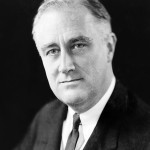
President Franklin D. Roosevellt-1933 (Courtesy Library of Congress)
President Franklin D. Roosevelt, “PRESIDENTIAL STATEMENT SIGNING THE SOCIAL SECURITY ACT” (August 14, 1935)
Today a hope of many years’ standing is in large part fulfilled. The civilization of the past hundred years, with its startling industrial changes, has tended more and more to make life insecure. Young people have come to wonder what would be their lot when they came to old age. The man with a job has wondered how long the job would last.
This social security measure gives at least some protection to thirty millions of our citizens who will reap direct benefits through unemployment compensation, through old-age pensions and through increased services for the protection of children and the prevention of ill health.
We can never insure one hundred percent of the population against one hundred percent of the hazards and vicissitudes of life, but we have tried to frame a law which will give some measure of protection to the average citizen and to his family against the loss of a job and against poverty-ridden old age.
This law, too, represents a cornerstone in a structure which is being built but is by no means complete. It is a structure intended to lessen the force of possible future depressions. It will act as a protection to future Administrations against the necessity of going deeply into debt to furnish relief to the needy. The law will flatten out the peaks and valleys of deflation and of inflation. It is, in short, a law that will take care of human needs and at the same time provide the United States an economic structure of vastly greater soundness.
I congratulate all of you ladies and gentlemen, all of you in the Congress, in the executive departments and all of you who come from private life, and I thank you for your splendid efforts in behalf of this sound, needed and patriotic legislation.
If the Senate and the House of Representatives in this long and arduous session had done nothing more than pass this Bill, the session would be regarded as historic for all time.
(Source: Social Security Administration)
The Social Security Act [H. R. 7260] was signed into law by FDR on August 14, 1935. It read:
“An act to provide for the general welfare by establishing a system of Federal old-age benefits, and by enabling the several States to make more adequate provision for aged persons, blind persons, dependent and crippled children, maternal and child welfare, public health, and the administration of their unemployment compensation laws; to establish a Social Security Board; to raise revenue; and for other purposes.
Be it enacted by the Senate and House of Representatives of the United States of America in Congress assembled,”
(Source: Social Security Administration)
August 10, 2013
Don’t Know Much About® Geography-Revised and Updated Edition
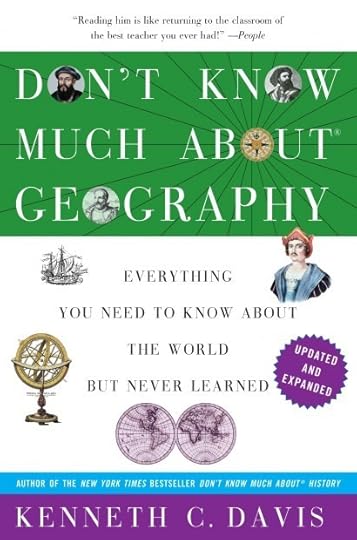
Don’t Know Much About® Geography
Revised & Updated
Now available in a revised and updated edition: DON’T KNOW MUCH ABOUT® GEOGRAPHY: Everything You Need to Know About the World but Never Learned
by KENNETH C. DAVIS
•Who killed the Dead Sea?
•Why did Columbus think the world was shaped like a pear?
•Does the World Bank have ATMs?
•Is all the talk of global warming just a lot of hot air?
In a world of Google maps, “checking in,”and smartphones that tell us where we are, does Geography still matter?
Of course! Because Geography is more than simply knowing where you are and memorizing state capitals.
Understanding geography is to understand that WHERE something happens has so much to do with WHY it happens. Geography is about looking at the world and asking questions. It is the reason humanity moved from one place to the next and eventually off the planet in search of new worlds. As this recent New York Times story makes clear, Geography has everything to do with climbing the income ladder in America.
But Geography is also about curiosity — Where am I? What’s on the other side of that mountain? How do I get from here to there? And what and who will I find there?
Geography is also about the way people “discovered” the world. And, as usual, the real story is a lot more interesting than the simplistic version we got in grade school. Remember they told you that Columbus proved the world was round?
Wrong. People knew that the world was spherical by the time Columbus sailed in 1492. But Columbus actually thought the world was shaped like a pear. That’s what he wrote in his logbooks when he saw a river that he thought might even be one of the biblical rivers that flowed around the Garden of Eden. They left that out of my schoolbooks. (He also wrote that the world was shaped like a woman’s breast. But that’s another story!)
Even as technology shrinks time and distance, thinking “geographically” –looking at the world with wonder and asking Why?– is the key to understanding the things that make us all different. Technology may shorten distances, but the differences remain. If we ever hope to completely bridge those distances and honor those differences, we’re going to have lo learn the lessons of Geography.
Enjoy the journey!
Don’t Know Much About® Herbert Hoover
European Children Fed by Hoover’s Relief Efforts (Photo Courtesy of The Herbert Hoover Presidential Library and Museum)
”We are challenged with a peace-time choice between the American system of rugged individualism and a European philosophy of diametrically opposed doctrines— doctrines of paternalism and state socialism. . . . Our American experiment in human welfare has yielded a degree of well- being unparalleled in all the world. It has come nearer to the abolition of poverty, to the abolition of fear of want than humanity has ever reached before.”
–Herbert Hoover, “Campaign Speech” (October 22, 1928)
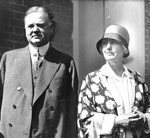
Herbert and Lou Henry Hoover in their Washington, DC home the morning after he was nominated to run for president (1928). (Courtesy: The Herbert Hoover Presidential Library & Museum)
Born on August 10, 1874, Herbert Clark Hoover, the 31st president of the United States.
Herbert Hoover was born into a Quaker family in Iowa, and orphaned at nine. He went to live with relatives in Oregon. A college education at Stanford led to a career in the mining industry and a great personal fortune.
You may know that he was the Republican president when the Stock Market crashed in 1929 and he attempted to lead the country through the first years of the Great Depression. Hoover was defeated by Democrat Franklin D. Roosevelt in 1932.
But you may not know that Hoover was considered a hero and savior to millions of people. First during World War I, he had organized food relief programs in war-torn Belgium. Later, in the aftermath of World War I, Russia was in the throes of Europe’s greatest calamity since the days of the Black Plague . More than five million died in the new Soviet Russia when famine struck. In 1921, Herbert Hoover led America’s response to the “Great Famine,” subject of this PBS documentary and is credited with saving millions of lives.
Hoover gets hard knocks for the hard times of the Depression and his flawed response to the problems confronting America. But others assess him more generously. Historian Richard Norton Smith once noted:
“Herbert Hoover saved more lives through his various relief efforts than all the dictators of the 20th century together could snuff out. Seventy years before politicians discovered children, he founded the American Child Health Association. The problem is, Hoover defies easy labeling. How can you categorize a ‘rugged individualist’ who once said, ‘The trouble with capitalism is capitalists; they’re too damn greedy.’ ” (“Remembering Herbert Hoover,” New York Times, August 10, 1992)
President Hoover died on October 20, 1964 in New York City. He was 90 years old. This is his New York Times obituary.
The Herbert Hoover Presidential Library & Museum offers archival materials and online exhibitions.
Some Fast Facts about Herbert Hoover:
✱ Hoover was the first president born west of the Mississippi.
✱ His wife, Lou, was the only female geology major at Stanford when they met. They later collaborated on a translation from Latin of a mining and metallurgy text, De Re Metallica, published in 1912. While they lived in China, the Hoovers lived through the 1900
Boxer Rebellion and both learned Chinese, and they sometimes spoke to each other in Chinese at the White House.
✱ Hoover’s inaugural in 1929 was the first to be recorded on talking newsreel.
✱ Hoover was the first of two Quaker presidents. (The other was Richard M. Nixon.)
You can read more about Hoover in Don’t Know Much About® the American Presidents (Hyperion Books/Random House Audio)

Don’t Know Much About the American Presidents
(Hyperion Books/Random House Audio)
August 6, 2013
August 6-”Hiroshima Day”

The Atomic Bomb Dome-Hiroshima (Photo Courtesy of Hiroshima and Nagasaki Remembered)
On August 6, 1945, the New York Times asked:
“What is this terrible new weapon?”
(Source, New York Times, August 6, 1945: “First Atomic Bomb Dropped on Japan”)
The story followed the announcement made by President Truman:
“SIXTEEN HOURS AGO an American airplane dropped one bomb on Hiroshima, an important Japanese Army base. That bomb had more power than 20,000 tons of T.N.T. It had more than two thousand times the blast power of the British “Grand Slam” which is the largest bomb ever yet used in the history of warfare.”
August 6, 1945
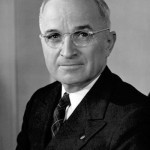
President Harry S. Truman
(Photo: Truman Library)
(“Statement by the President Announcing the Use of the A-Bomb at Hiroshima”-Source: Truman Library & Museum)
The first atomic bomb was exploded in a test at Alamogordo, New Mexico, on July 16, 1945. President Truman, who had taken office upon the death of President Roosevelt on April 12 without knowledge of the Manhattan Project or the atomic bomb’s existence, was alerted to the success of this test at a meeting with Churchill and Stalin at Potsdam, a city in defeated Germany. (See this recent post on Potsdam)
The atomic bomb was detonated over Hiroshima on August 6, 1945. A second device, a plutonium bomb, was used on the city of Nagasaki on August 9. Japan surrendered on August 14.
Almost since the day the first bomb was dropped on Hiroshima, critics have second-guessed Truman’s decision and motives. A generation of historians have defended or repudiated the need for unleashing the atomic weapon.
What history has confirmed is that the men who made the bomb really didn’t understand how horrifying its capabilities were. Of course, they understood the destructive power of the bomb, but radiation’s dangers were far less understood. As author Peter Wyden tells it in Day One, an account of the making and dropping of the bomb, scientists involved in creating what they called “the gadget” believed that anyone who might be killed by radiation would die from falling bricks first.
In less than one second, the fireball had expanded to 900 feet. The blast wave shattered windows for a distance of ten miles and was felt as far away as 37 miles. Over two-thirds of Hiroshima’s buildings were demolished. The hundreds of fires, ignited by the thermal pulse, combined to produce a firestorm that had incinerated everything within about 4.4 miles of ground zero.
The estimated death toll was eighty thousand people killed instantly in Hiroshima; as many as 90 percent of the city’s nurses and doctors also died instantly. (By 1950, as many as 200,000 had died as a result of long-term effects of radiation.) The death toll in Nagasaki also reached 80,000 by the end of 1945.
Today should not be a day to argue about the politics of the bomb. It should be a day of solemn remembrance of these victims. And of contemplating the horrific power of the weapons we create.
The City of Hiroshima Peace Memorial Park and Museum offers an English language website with a history of Hiroshima and the effects of the bombing.
You can read more about Hiroshima and the dropping of the atomic bombs in Don’t Know Much About History and more about President Truman in Don’t Know Much About the American Presidents.
Don’t Know Much About the American Presidents (2012)
(From Hyperion and Random House Audio)
Don’t Know Much About History (Revised, Expanded and Updated Edition)
August 5, 2013
Who Said It? (8-5-2013)
37th President Richard M. Nixon (1913-1994) “Resignation Speech” (August 8, 1974)
From the discussions I have had with Congressional and other leaders, I have concluded that because of the Watergate matter I might not have the support of the Congress that I would consider necessary to back the very difficult decisions and carry out the duties of this office in the way the interests of the Nation would require.
I have never been a quitter. To leave office before my term is completed is abhorrent to every instinct in my body. But as President, I must put the interest of America first. America needs a full-time President and a full-time Congress, particularly at this time with problems we face at home and abroad.
To continue to fight through the months ahead for my personal vindication would almost totally absorb the time and attention of both the President and the Congress in a period when our entire focus should be on the great issues of peace abroad and prosperity without inflation at home.
Therefore, I shall resign the Presidency effective at noon tomorrow. Vice President Ford will be sworn in as President at that hour in this office.
Source: PBS Newshour (NOTE: The President spoke at 9: 01 p.m. in the Oval Office at the White House. The address was broadcast live on radio and television.)
Nixon’s resignation, the first in presidential history, took effect at noon the next day. The New York Times account of the resignation speech under the banner headline “NIXON RESIGNS”
On August 9, 1974, Gerald R. Ford was sworn in as the 38th President. Ford, who had been appointed vice president in the wake of the resignation of Spiro Agnew, became the first president who was not elected either president nor vice president.
Read more about Nixon, his life and presidency in Don’t Know Much About® the American Presidents.
Don’t Know Much About the American Presidents (2012)
(From Hyperion and Random House Audio)
August 2, 2013
Who Said It? (8/2/2013)
29th President Warren G. Harding “Second Annual Message” (State of the Union) December 8, 1922
It would be folly to ignore that we live in a motor age. The motor car reflects our standard of living and gauges the speed of our present-day life. It long ago ran down Simple Living, and never halted to inquire about the prostrate figure which fell as its victim. With full recognition of motor-car transportation we must turn it to the most practical use. It can not supersede the railway lines, no matter how generously we afford it highways out of the Public Treasury. If freight traffic by motor were charged with its proper and proportionate share of highway construction, we should find much of it wasteful and more costly than like service by rail. Yet we have paralleled the railways, a most natural line of construction, and thereby taken away from the agency of expected service much of its profitable traffic, which the taxpayers have been providing the highways, whose cost of maintenance is not yet realized.
The Federal Government has a right to inquire into the wisdom of this policy, because the National Treasury is contributing largely to this highway construction. Costly highways ought to be made to serve as feeders rather than competitors of the railroads, and the motor truck should become a coordinate factor in our great distributing system.
Source: The American Presidency Project Warren G. Harding: “Second Annual Message,” December 8, 1922. Online by Gerhard Peters and John T. Woolley, The American Presidency Project. http://www.presidency.ucsb.edu/ws/?pi...
President Warren G. Harding died on August 2, 1923. Read his obituary from the New York Times. Calvin Coolidge became the 30th President. He was given the oath of office by his father in Plymouth Notch, Vt at 2:30 am on August 3, 1923.
Read more about Harding and Coolidge in Don’t Know Much About the American Presidents
Don’t Know Much About the American Presidents (2012)
(From Hyperion and Random House Audio)


