
Kenneth C. Davis's Blog, page 7
June 14, 2024
Juneteenth: The “Other” Independence Day
[June 14, 2024: Revise of a post first published June 2015]
Wednesday June 19, 2024 will mark “Juneteenth National Independence Day.” On Thursday, June 17, 2021, President Biden signed a Juneteenth holiday into law.
Since then, the subject of American History and the role slavery played in the nation’s past–and present–have become an ugly partisan issue. As various states, governors, other politicians, and commentators attempt to diminish the place of slavery in American History, we cannot allow an erasure or whitewashing of this stain on the nation’s soul.
That is why celebrating and understanding “Juneteenth” is more important that ever. We cannot allow it to become just another holiday with sales falling between Memorial Day and July 4th.

The official Juneteenth Committee in East Woods Park, Austin, Texas on June 19, 1900. (Courtesy Austin History Center, Austin Public Library)
I have been writing and speaking about Juneteenth for many years. And I must admit when I wrote about the origins of the event back in 2011 in Smithsonian and again in a New York Times oped in 2015, I honestly did not envision a day when this celebration of freedom would become a federal holiday. So for those still uncertain, here is the background.
Each year, JUNE 19 is a day to mark “Juneteenth” –a holiday celebrating emancipation at the end of the Civil War in 1865. The word, formed from “June” and “nineteenth,” is a portmanteau –one word formed from two, like “brunch” (breakfast and lunch). It marks the date that a Union Army general informed the enslaved people of Texas that they were free.
“SOME two months after Gen. Robert E. Lee surrendered on April 9, 1865, effectively ending the Civil War, Maj. Gen. Gordon Granger steamed into the port of Galveston, Tex. With 1,800 Union soldiers, including a contingent of United States Colored Troops, Granger was there to establish martial law over the westernmost state in the defeated Confederacy.
“On June 19, two days after his arrival and 150 years ago today, Granger stood on the balcony of a building in downtown Galveston and read General Order No. 3 to the assembled crowd below. ‘The people of Texas are informed that, in accordance with a proclamation from the Executive of the United States, all slaves are free,’ he pronounced.”
Read more of the complete story of Juneteenth in my 2015 New York Times Op-ed, “Juneteenth is for Everyone”.
TO the emancipated people of Texas, the day would be celebrated as “Juneteenth,” a festive holiday marking liberation. It would become a widely shared day of picnics, barbecue, singing, and joy in the African-American community, gradually spreading across the former Confederacy and eventually moving north.
I believe that we have two histories in this country — one white, one black — and they have largely been separate and unequal. The story of Juneteenth is a perfect example of how one of these histories has largely been hidden when we teach American history.
For centuries, slavery was the dark stain on America’s soul, the deep contradiction to the nation’s founding ideals of “Life, liberty and the pursuit of happiness” and “All men are created equal.”
When Abraham Lincoln issued the Emancipation Proclamation on January 1, 1863, he took a huge step toward erasing that stain. But the full force of his proclamation would not be realized until June 19, 1865—Juneteenth, as it was called by enslaved people in Texas freed that day.
“Juneteenth: Our Other Independence Day” My article in Smithsonian (June 15, 2011)

The question of how we teach and talk about enslavement is also the subject of my article in Social Education, the Journal of the National Council for the Social Studies. (NCSS). Read: The American Contradiction: Conceived in Liberty, Born in Shackles.

Foods on the Juneteenth altar include beets, strawberries, watermelon, yams and hibiscus tea, as well as a plate of black-eyed peas and cornbread. Credit Jim Wilson/The New York Times
So how will you celebrate?
The holiday and its rich food traditions are highlighted in these New York Times articles: “Building a Juneteenth Menu for the 21st Century” and “Hot Links and Red Drinks”.
The post Juneteenth: The “Other” Independence Day first appeared on Don't Know Much.


June 4, 2024
Who Said It?
On the night of June 6, 1944, President Roosevelt went on national radio to discuss the invasion of Normandy — D-Day — with the American people.
 President Franklin D. Roosevelt, “D-Day Prayer” (June 6, 1944)
Almighty God: Our sons, pride of our Nation, this day have set upon a mighty endeavor, a struggle to preserve our Republic, our religion, and our civilization, and to set free a suffering humanity.
Lead them straight and true; give strength to their arms, stoutness to their hearts, steadfastness in their faith.
They will need Thy blessings. Their road will be long and hard. For the enemy is strong. He may hurl back our forces. Success may not come with rushing speed, but we shall return again and again; and we know that by Thy grace, and by the righteousness of our cause, our sons will triumph.
They will be sore tried, by night and by day, without rest-until the victory is won. The darkness will be rent by noise and flame. Men’s souls will be shaken with the violences of war.
His address took the form of this prayer. (Full text from Franklin D. Roosevelt Presidential Library and Museum)
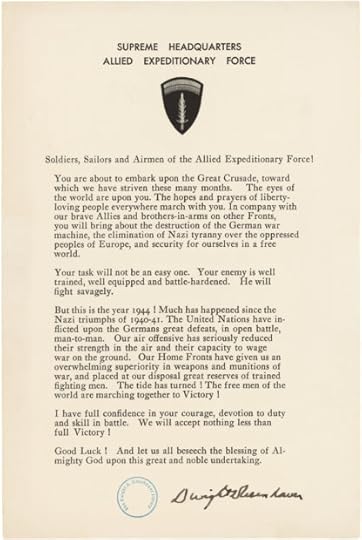
The day before, future president Dwight D. Eisenhower, addressed the troops of the Allied Expeditionary Force and told them,
The hopes and prayer of liberty-loving people everywhere march with you.
00763_2003_001.tif
The post Who Said It? first appeared on Don't Know Much.
May 20, 2024
Don’t Know Much About Memorial Day
(Post updated May 20, 2024)
Some governors would have us teach “the basics.” So here goes:
LET’S SET THE RECORD STRAIGHT— Memorial Day is about Slavery
It is not about swimsuit sales, the start of summer, or the hot dogs on the barbie.
Memorial Day, the most solemn occasion on the national calendar now honors the nation’s war dead. But it was born out of the the Civil War, which was fought because of slavery, America’s original sin. Memorial Day is about a nation “conceived in liberty” but born in shackles.
In these fraught times, when teaching history has become so contentious, we must tell it straight when we observe the history behind the holiday. Here are some basic facts:
1) Memorial Day was conceived as Decoration Day, first marked in May 30, 1868 by a proclamation of General John Logan, leader of a powerful Civil War veterans group. His original proclamation –“General Orders, No. 11”– read, in part: “Their soldier lives were the reveille of freedom to a race in chains and their deaths the tattoo of rebellious tyranny in arms.”
The day was an occasion for visiting the cemetery and decorating the graves of fallen Union soldiers who died in the Civil War.
2) The Civil War was fought over slavery. The “states rights” argument was put forward by “Lost Cause” apologists and eventually accepted by educators who wanted to diminish the significant role of slavery both in American history and in bringing about the war.

The Hidden History of America At War (paperback)
Read more about the divisive history of Memorial Day in an earlier post.
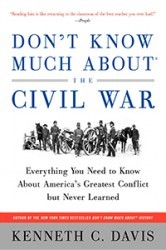
Don’t Know Much About the Civil War (Harper paperback, Random House Audio)
The truth matters. Now more than ever. So, once and for all, we must set the record straight.
As we observe Memorial Day, a day for honoring our nation’s war dead, let us emphasis these truths about America’s deep history of slavery.
Here are five important points that illustrate the through-line of slavery in American history, from the founding through the Civil War:
Enslaved people were in America before the Mayflower PilgrimsThomas Jefferson condemned slavery in drafting the Declaration of Independence but other Founders scrubbed the language from the nation’s “birth certificate”Slavery was “baked in” the U.S. Constitution in the three-fifths compromiseSlavery made the Civil War inevitableThe abolition of slavery after the Civil War did not end the stark divisions that continue to plague the United States todayREAD MORE in my article “Conceived in Liberty, Born in Shackles” (Social Education, March-April 2020)
The post Don’t Know Much About Memorial Day first appeared on Don't Know Much.
The Divisive & Partisan History of “Memorial Day”
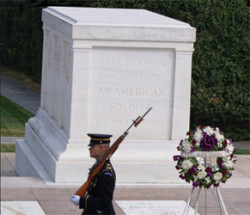
Tomb of the Unknown Soldier (Photo: Arlington National Cemetery) This memorial was created after the great losses of World War I.
(Post updated May 20, 2024)
America’s most solemn holiday should be free of rancor. But it never has been.
Army The Confederate Monument in Arlington Cemetery has been removed. A contentious statue of Robert E. Lee in Richmond–onetime capital of the Confederacy– has been relocated. The heated arguments over removing the Confederate flag and monuments to heroes and soldiers of the Confederacy provide reminders of the birth of Memorial Day.
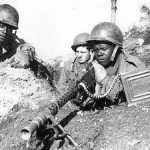
In the Korean War, the U.S. military was integrated. (Source: Library of Congress)
Waterloo, New York claimed that the holiday originated there with a parade and decoration of the graves of fallen soldiers in 1866. But according to the Veterans Administration, at least 25 places stake a claim to the birth of Memorial Day. Among the pack are Boalsburg, Pennsylvania, which says it was first in 1864.( “Many Claim to Be Memorial Day Birthplace” )
And Charleston, South Carolina, according to historian David Blight, points to a parade of emancipated children in May 1865 who decorated the graves of fallen Union soldiers whose remains were moved from a racetrack to a proper cemetery.
Born out of the Civil War’s catastrophic death toll as “Decoration Day,” Memorial Day is a day for honoring our nation’s war dead. A veteran of the Mexican War and the Civil War, John A. Logan, a Congressman and leader of the Grand Army of the Republic, established the first somber commemoration on May 30, 1868, in Arlington Cemetery, the sacred space wrested from property once belonging to Robert E. Lee’s family.( When Memorial Day was No Picnic by James M. McPherson.) The Grand Army of the Republic was a powerful fraternal organization formed of Civil War Union veterans and Logan issued “General Order N.11” calling for a day to decorate the graves of the fallen Union soldiers with flowers.
What can aid more to assure this result than cherishing tenderly the memory of our heroic dead, who made their breasts a barricade between our country and its foes? Their soldier lives were the reveille of freedom to a race in chains, and their deaths the tattoo of rebellious tyranny in arms. We should guard their graves with sacred vigilance.

Abraham Lincoln (November 1863) Photo by Alexander Gardner
From its inception, Decoration Day (later Memorial Day) was linked to “Yankee” losses in the cause of emancipation. Calling for the first formal Decoration Day, Union General John Logan wrote, “Their soldier lives were the reveille of freedom to a race in chains…”
In other words, Logan’s first Decoration Day was divisive— a partisan affair, organized by northerners.
In 1871, Frederick Douglass gave a Memorial Day speech in Arlington that focused on this division:
We are sometimes asked, in the name of patriotism, to forget the merits of this fearful struggle, and to remember with equal admiration those who struck at the nation’s life and those who struck to save it, those who fought for slavery and those who fought for liberty and justice.
I am no minister of malice. I would not strike the fallen. I would not repel the repentant; but may my “right hand forget her cunning and my tongue cleave to the roof of my mouth,” if I forget the difference between the parties to that terrible, protracted, and bloody conflict.

But the question remains: what inspired Logan to call for this rite of decorating soldier’s graves with fresh flowers?
The simple answer is—his wife.
After the war, while visiting Petersburg, Virginia – which fell to General Grant in 1865 after a deadly, year-long siege – Mary Logan learned about the city’s women who had formed a Ladies’ Memorial Association. Their aim was to show admiration “…for those who died defending homes and loved ones.”
Choosing June 9th, the anniversary of “The Battle of the Old Men and the Young Boys” fought in 1864, a teacher had taken her students to the city’s cemetery to decorate the graves of the fallen.
General Logan’s wife wrote to him about the practice. Soon after, he ordered a day of remembrance. Despite all the other claims of credit –which are somewhat besides the point– Petersburg’s celebration inspired the “first” Decoration Day.
The teacher and her students, it is worth noting, had placed flowers and flags on both Union and Confederate graves.As America wages its partisan wars at full pitch, this may be a lesson for us all.
More resources at the New York Times Topics archive of Memorial Day articles
The story of “The Battle of the Old Men and the Young Boys” is told in THE HIDDEN HISTORY OF AMERICA AT WAR (Now in paperback)
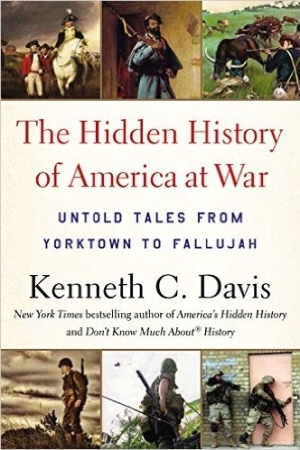
Now In paperback THE HIDDEN HISTORY OF AMERICA AT WAR: Untold Tales from Yorktown to Fallujah
The post The Divisive & Partisan History of “Memorial Day” first appeared on Don't Know Much.
May 18, 2024
The World in Books-Coming in October 2024
I am very excited to announce the publication of my latest work:
THE WORLD IN BOOKS:
52 Works of Great Short Nonfiction
Coming from Scribner Books on October 8, 2024. Read more and preorder copies here.
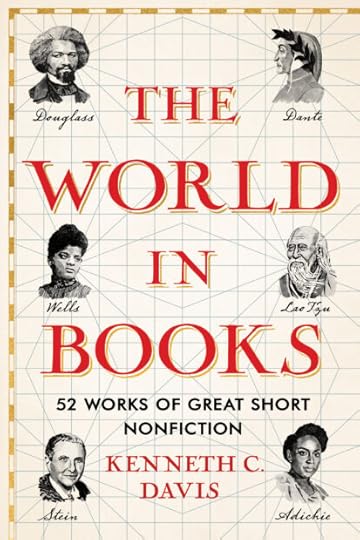
Among the 52 titles I have included are The Epic of Gilgamesh, Genesis, the poetry of Sappho, Meditations by Marcus Aurelius, and such profoundly influential writers as Frederick Douglass, Henry David Thoreau, Virginia Woolf, Helen Keller, James Baldwin, Susan Sontag, and Timothy Snyder.
The essential message of this book is that books matter–now more than ever. We must continue to educate ourselves. I believe that Open Books Open Minds.
I look forward to talking about this book in the coming months and sharing my fundamental belief that books can change us and the world.
In the meantime, please read and enjoy Great Short Books: A Year of Reading–Briefly
The post The World in Books-Coming in October 2024 first appeared on Don't Know Much.
May 15, 2024
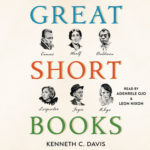
GREAT SHORT BOOKS: A Year of Reading–Briefly
NOW IN PAPERBACK
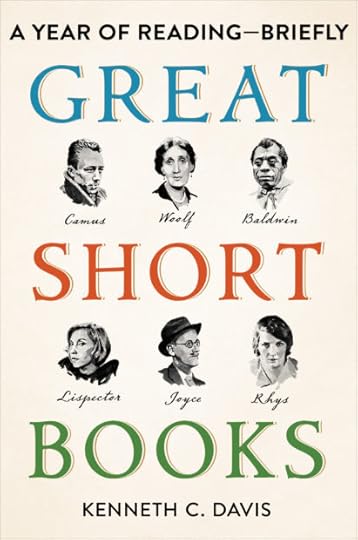
GREAT SHORT BOOKS:
A YEAR OF READING — BRIEFLY
Scribner/Simon & Schuster and Simon Audio (Unabridged audio download)
“An exciting guide to all that the world of fiction has to offer in 58 short novels — from ‘The Great Gatsby’ and ‘Lord of the Flies’ to the contemporary fiction of Colson Whitehead and Leïla Slimani — that, ‘like a first date,’ offer pleasure and excitement without commitment.” New York Times Book Review
Booklist “Editors’ Choice Adult Books 2022″
“…The most exceptional of the best books of 2022 reviewed in Booklist…”
“Delightfully accessible, Great Short Books: A Year of Reading–Briefly presents 58 fact-filled reviews of short books, a smorgasbord of titles sure to entice readers.” –Cheryl McKeon, Shelf Awareness
“I consider Davis’ ‘Great Short Books’ a gift to readers, a true treasure trove of literary recommendations.” —Sue Gilmore, SFGate
“Anyone who’s eternally time-strapped will treasure Kenneth C. Davis’ Great Short Books. This nifty volume highlights 58 works of fiction chosen by Davis for their size (small) and impact (enormous). Each brisk read weighs in at around 200 pages but has the oomph of an epic.” —Bookpage Full Review
“An entertaining journey with a fun, knowledgeable guide…. “ Kirkus Reviews
“A must-purchase for public and school libraries.” ALA Booklist
FIRST TRADE REVIEWS FROM KIRKUS, PUBLISHERS WEEKLY, BOOKLIST
“Davis feels that novels of 200 pages or less often don’t get the recognition they deserve, and this delightful book is the remedy…A must-purchase for public and school libraries.” *Starred Booklist review
“An entertaining journey with a fun, knowledgeable guide…. His love of books and reading shines through. From 1759 (Candide) to 2019 (The Nickel Boys), he’s got you covered.” –Kirkus Reviews
Full KIRKUS review here
“Davis’s conversational tone makes him a great guide to these literary aperitifs. This is sure to leave book lovers with something new to add to their lists.” FULL PUBLISHERS WEEKLY REVIEW here
During the lock-down, I swapped doom-scrolling for the insight and inspiration that come from reading great fiction. Inspired by Boccaccio’s “The Decameron” and its brief tales told during a pandemic, I read 58 great short novels –not as an escape but an antidote.
“A short novel is like a great first date. It can be extremely pleasant, even exciting, and memorable. Ideally, you leave wanting more. It can lead to greater possibilities. But there is no long-term commitment.”
–From “Notes of a Common Reader,” the Introduction to Great Short Books
Read “The Antidote to Everything,” an excerpt from the Introduction published on Lit Hub
The result is a compendium that goes from “Candide” to Colson Whitehead, and Edith Wharton to Leïla Slimani. And yes, Maus and many other Banned Books and Writers.

What “A Year of Reading–Briefly” looks like

Voltaire in Great Short Books
Art © Sam Kerr

Edith Wharton in Great Short Books
Art © Sam Kerr
Advance Praise for Great Short Books: A Year of Reading—Briefly
“GREAT SHORT BOOKS is a fascinating, thoughtful, and inspiring guide to a marvelous form of literature: the short novel. You can dip into this book anywhere you like, but I found myself reading it cover-to-cover, delighting in discovering new works while also revisiting many of my favorites. GREAT SHORT BOOKS is itself a great book—for those who are over-scheduled but want to expand their reading and for those who will simply delight in spending time with a passionate fellow reader who on every page reminds us why we need and love to read.”
–Will Schwalbe, New York Times bestselling author of THE END OF YOUR LIFE BOOK CLUB
“This is the book that you didn’t know you really needed. I began digging into this book as soon as I got it, and it was such a delight to read beautiful prose, just a sip at a time, with Kenneth Davis’ notes to give me context and help me more fully appreciate the stories. Keep this book near your bed or on your coffee table. It will be read and loved.”
–Celeste Headlee, journalist and author of WE NEED TO TALK and SPEAKING OF RACE

Recording audio book of Great Short Books (Sept. 2022) Photo by Katherine Cook
From hard-boiled fiction to magical realism, the 18th century to the present day, Great Short Books spans genres, cultures, countries, and time to present a diverse selection of acclaimed and canonical novels—plus a few bestsellers. Like browsing in your favorite bookstore, this eclectic compendium is a fun and practical book for any passionate reader hoping to broaden their collection— or anyone who is looking for an entertaining, effortless reentry into reading.
Listen to a sample of the audio book of Great Short Books
And Indie booksellers weigh in:
“Need something grand, something classic, uh…. something short to read, but don’t know where to start? Check out Kenneth Davis’s guide to Great Short Books and you’ll soon find just the right tale to delight your literary palate. For each suggestion, Davis gives us first lines, a plot summary, an author’s bio, a reason for reading it, and, finally, what you should read next from the author’s canon. Pick up a copy… you’ll be glad you did. You’re welcome!”—Linda Bond, Auntie’s Bookstore (Spokane, WA)
“Kenneth Davis has presented the perfect solution for too many books, not enough time—a collection of exceptional short books perfect for reading in a society seemingly without any free time. Many of the books may be familiar by name, some are obscure, some even forgotten, but all belong in the canon of superb literature. He teases with a brief synopsis and explains why each book deserves attention. An absolutely intriguing bonus is a short biographical sketch of each author, many of whom had fascinating but traumatic lives. It is the perfect book to provide comfort literature for busy readers.”—Bill Cusumano, Square Books (Oxford, Miss.)
More early reviews from readers at NetGalley.com
“GREAT SHORT BOOKS is a wonderful, breezy but deep look at the outstanding short books of the last 150 years. Kenneth C. Davis is a genius at summarizing each book and making the reader want to read said book post haste. This is a book I didn’t know the world needed but the world did.” –Tom O., reviewer
“…an incredibly valuable tool for book clubs and readers everywhere! Some authors/titles are well-known and others will be new discoveries….HIGHLY RECOMMENDED for any book group looking to find new titles or any reader who wants to know what to read next.” –Ann H. reviewer
“I found over a dozen new authors or titles I want to now read that were included in his main list, and the Further Reading at the end of each chapter and at the end of the volume itself.
As others have suggested, this is a great tool for Book Clubs!
Not Lit Crit, it is mostly focused on necessary, just-the-facts-mam information on one person’s reading of short books over a year. Well worth a read, and great for browsing!” –Stephen B., Librarian
“What better way to introduce new readers to more than 50 ‘short’ books. This handy book is full of non-spoiler descriptions and cultural context that situate these stories within our world.” –Kelsey W., librarian
S0urce: Great Short Books via NetGalley
I can’t wait to start talking about this book with readers everywhere.
Teachers, Librarians, Book Clubs and Other Learning Communities:
Invite me for a visit to your school, classroom, library, historical group, book club or conference.
The post GREAT SHORT BOOKS: A Year of Reading–Briefly first appeared on Don't Know Much.
May 8, 2024
Don’t Know Much About® Harry S. Truman
(Previous post updated 8 May, 2024)
Happy 140th Birthday!
Harry Truman, 33rd President of the United States, was born on May 8, 1884.
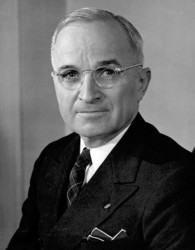
President Harry S. Truman
(Photo: Truman Library)
It was on his birthday in 1945 that Truman was able to tell Americans that the war in Europe was over with the surrender of Germany.
THIS IS a solemn but a glorious hour. I only wish that Franklin D. Roosevelt had lived to witness this day. General Eisenhower informs me that the forces of Germany have surrendered to the United Nations. The flags of freedom fly over all Europe. For this victory, we join in offering our thanks to the Providence which has guided and sustained us through the dark days of adversity.
Described as “a minor national figure with a pedestrian background,” Truman was a World War I veteran and a Senator from Missouri when Franklin D. Roosevelt chose him to become his running mate in the 1944 election. Truman became vice president when FDR won his fourth term and then took office on April 12, 1945 when FDR died.
When he took office, Truman had been largely left “out of the loop” by Roosevelt as World War II entered its final months. Truman did not know of the existence of the “Manhattan Project” and the development of the atomic bomb until he became president. Then he had to make the decision to use it against the Japanese.
Fast Facts
•Truman was a member of the Sons of the Revolution and the Sons of Confederate Veterans
•He wanted to attend West Point but poor eyesight kept him out. He enlisted in the Missouri National Guard and served as the commander of an artillery battery in World War I.
•Before entering politics, he was a farmer, bank clerk, insurance salesman and owner of a failed haberdashery store.
•As president he once threatened to punch the nose of a newspaper critic who had given his daughter a poor review after her debut singing recital. Margaret Truman went on to greater fame as a mystery novelist, beginning with Murder in the White House published in 1980.
•After Grover Cleveland, Truman is the only president who did not attend college. He attended law school briefly but dropped out.After the end of World War II, Truman had to shift America’s attention to the new “Cold War” with the Soviet Union and his policies of “containment” and the Marshall Plan to rebuild war-torn Europe were hallmarks of his presidency.Harry S. Truman died on December 26, 1972.
The Truman Library and Museum is located in Independence, Missouri
Read more about Truman, his life and administration in Don’t Know Much About® the American Presidents. Truman is also featured in the Berlin Battle chapter of The Hidden History of America at War.
Don’t Know Much About History (Revised, Expanded and Updated Edition)

THE HIDDEN HISTORY OF AMERICA AT WAR: Untold Tales from Yorktown to Fallujah
Don’t Know Much About® the American Presidents (Hyperion paperback-April 15, 2014)
The post Don’t Know Much About® Harry S. Truman first appeared on Don't Know Much.
Who Said it
President Harry S. Truman
(Photo: Truman Library)
“This is a solemn but glorious hour. General Eisenhower informs me that the forces of Germany have surrendered to the United Nations. The flags of freedom fly all over Europe.”
–President Harry S. Truman, May 8, 1945
(Source: Harry S. Truman: “The President’s News Conference on V-E Day,” May 8, 1945. Harry S. Truman, The President’s News Conference on V-E Day Online by Gerhard Peters and John T. Woolley, The American Presidency Project)
Truman made the announcement on his birthday. Read more about Truman in this post, “Don’t Know Much About Harry S. Truman”
Read more about the Fall of Berlin and the end of World War II in THE HIDDEN HISTORY OF AMERICA AT WAR: Untold tales from Yorktown to Fallujah
Read about the end of World War II and the Cold War that followed in Strongman: The Rise of Five Dictators and the Fall of Democracy.
The post Who Said it first appeared on Don't Know Much.
April 1, 2024
The World in Books-Coming in October 2024
I am very excited to announce the publication of my latest work:
THE WORLD IN BOOKS:
52 Works of Great Short Nonfiction
Coming from Scribner Books on October 8, 2024. Read more and preorder copies here.
Among the 52 titles I have included are The Epic of Gilgamesh, Genesis, the poetry of Sappho, Meditations by Marcus Aurelius, and such profoundly influential writers as Frederick Douglass, Henry David Thoreau, Virginia Woolf, Helen Keller, James Baldwin, Susan Sontag, and Timothy Snyder.
The essential message of this book is that books matter–now more than ever. We must continue to educate ourselves. I believe that Open Books Open Minds.
I look forward to talking about this book in the coming months and sharing my fundamental belief that books can change us and the world.
In the meantime, please read and enjoy Great Short Books: A Year of Reading–Briefly
The post The World in Books-Coming in October 2024 first appeared on Don't Know Much.
March 22, 2024
Don’t Know Much About® the Triangle Shirtwaist Fire
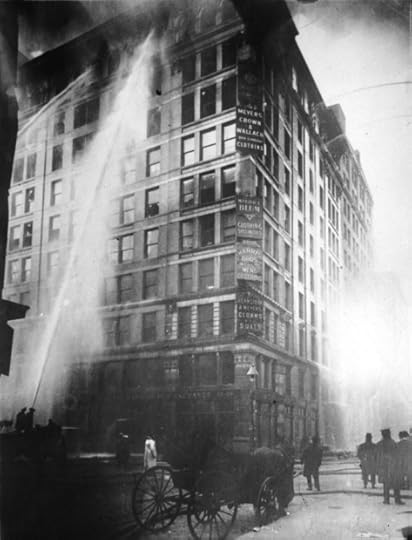
Triangle Shirtwaist Factory fire on March 25, 1911 from front page of The New York World (Source: [Post revised from original on 3/25/2011]Cornell University ILR School Kheel Center © 2011)
[Reposted from original on 3/25/2011]Can anything positive or hopeful emerge from a terrible tragedy? That is a question we are all pondering as we still contend with a pandemic that swept across the United States and the world.
We are also asking about the human costs of “business as usual.”
So it is a moment to consider of one of the greatest tragedies of modern American history.
On March 25, 1911, the Triangle Shirtwaist Factory in New York caught fire and 146 people died, most of them women between the ages of 16 and 23, many were Jewish and Italian immigrants. They had been trapped inside the building, its doors chained shut.
It was a disaster that shook the American conscience and sparked the nation’s Labor movement.
“Look for the union label.”
If you are of a certain generation, you may recognize those words instantly. They are the first line of a song that became a 1970s advertising icon.
Sung by a swelling chorus of lovely ladies (and a few men) of all colors, shapes and sizes, it was the anthem of the International Ladies Garment Workers Union.
Airing as American unions began to confront the long, steady drain of jobs to cheaper foreign labor markets, the song implored us to look for the union label when shopping for clothes (“When you are buying a coat, dress or blouse”).
Seeing these earnest women, thinking of them at their sewing machines, made us race to the closet and check our clothes for that ILGWU tag. (“It says we’re able to make it in the USA.”)
The International Ladies Garment Worker Union was born in 1900, in the midst of the often-violent period of early 20th century labor organizing when brutal working conditions and child labor were the norm in America’s mines and factories.
One of the companies the union attempted to organize was the Triangle Shirtwaist Factory at what is now Greene Street and Washington Place in New York’s Greenwich Village.
A walkout against the firm in 1909 helped strengthen the union’s rolls and led to a union victory in 1910. But the Triangle Shirtwaist Company –which would chain its doors shut to control its workers— earned infamy when a fire broke out on March 25, 1911 and 146 workers were trapped in the flaming building and died. Some jumped to their deaths.
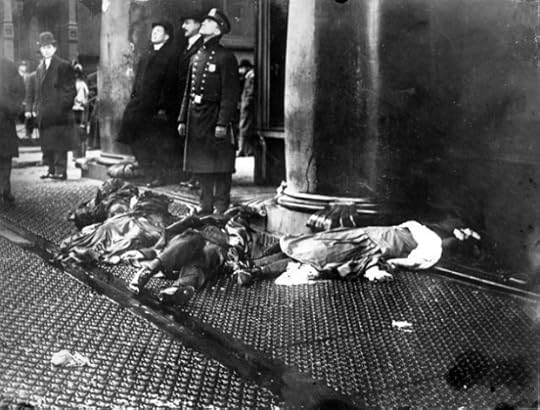
A police officer and others with the broken bodies of Triangle fire victims at their feet, look up in shock at workers poised to jump from the upper floors of the burning Asch Building. (Credit: Cornell University ILR School Kheel Center ©2011)
The two owners of the factory were indicted but found not guilty. The tragedy helped galvanize the trade union movement and especially the ILGWU.
On this anniversary of that dreadful event, it is worth remembering that American prosperity was built on the sweat, tears and blood of working men and women. Immigration and jobs are the issue again today, just as they were more than a century ago.
Cornell University’s Kheel Center for Labor-Management Documentation offers a web exhibit on the Triangle Factory Fire. The Library of Congress also offers numerous resources on the tragedy.
On February 28, 2011, American Experience on PBS aired a documentary film about the tragedy and the period.
The site is part of New York University and a National Historic Landmark.
The post Don’t Know Much About® the Triangle Shirtwaist Fire first appeared on Don't Know Much.


