
Linda Holeman's Blog, page 4
August 3, 2014
July 2014
With The Devil on Her Tongue sitting firmly on bookstore shelves across Canada this month, I was still busy with a variety of promotional activities. One that was fun and very tongue-in-cheek was answering questions for The Hazlitt Offensive. Following the lead of Inside the Actor’s Studio, where James Lipton fires his trademark index-card questions – fashioned after the Proust Questionnaire – at guests, the answers authors come up with on The Hazlitt Offensive are not meant to be taken too seriously!
The National Post does a weekly book page called “The Afterword Reading Society”. What’s different and very cool about this page is that it’s not a review, but is made up of questions readers ask the author. There are also stats generated about the book, and, finally, the readers get to rate it (scary). The book is also compared to others of a similar topic – all in all it’s a pretty interesting and innovative take for highlighting a new book. The online National Post Afterword Reading Society site also lets the readers sum up the book in a tweet (I can’t escape it).
This month I was warmly welcomed back to my hometown of Winnipeg for some media. Even though it was way too early in the morning, I had fun at with Derek Taylor at Global Television and with Holly Bernier at CTV.
I also had a launch of The Devil on Her Tongue at the amazing McNally Robinson Booksellers. John Toews and his staff do a stellar job of creating a professional and yet highly personal event for the authors lucky enough to find themselves a guest in one of their stores.

Always nice to go “home” where one is appreciated…!!!


June 2014
What a whirlwind month! With The Devil on Her Tongue being launched June 24th, I was talked into tweeting – against my wishes – and I’m still not convinced that I’m the right kind of person to be on Twitter. Hopefully I’ll improve both my skills and my attitude! On a more positive note (for me) I had a great time reading and answering questions onstage at Harbourfront with the talented Emma Healey and Tom Rachman. The International Festival of Authors does a blog post with participating authors; here’s mine.
I took part in Open Book Ontario, in the Fiction Craft category. Shaun Smith’s question this month was “How do you know if there is a novel in a story idea?” My answer looked like this. (Please scroll down to see my response)
Random House Canada has a fluid and entertaining site, called Retreat by Random House. They asked me to talk about and illustrate, through photos, how I was inspired to write The Devil on Her Tongue, then they posted it here.
And then there was the good time of signing copies of The Devil on Her Tongue at Indigo Bookstores, as well as Book City, around Toronto, escorted by the charming Rachel and Jennifer from Random House. I’ve always wanted to sign a book on a grand piano!!

June 24, 2014
The inspiration behind THE DEVIL ON HER TONGUE
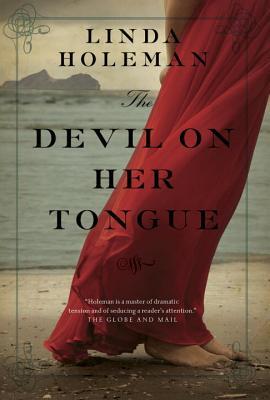 My love and life of travel is closely connected to the worlds I create. A story can come to me through spontaneous discoveries in books, or through old photos. I can be inspired by a character recurring in my thoughts, or by my interest in a historical period. Or I can be inspired through a country itself, as it draws me in with its current pulse and its whispering ghosts.
I didn’t know I was going to write this novel set in Portugal until I was travelling through it. For me, the joy in exploring a country is to have few plans, instead traversing its roads and exploring its cities and towns and countryside without expectations, looking, listening, tasting, touching. Dreaming.
Driving along the coastline of the Algarve, I steered in the direction of the most southwestern tip of Europe, the town of Sagres and, just beyond, Cabo de São Vicente – the cape that was known, to Portuguese sailors in earlier centuries, as the End of the World. Their ships set sail from here across the Atlantic, heading west to the New World or rounding the Horn of Africa and sailing east to Mozambique, to Goa or Macau. I stood on the edge of the cliff at Cabo de São Vicente, looking out.
It was a place of peace and wonder, with only the smell of the ocean, the soft taste of the salty wind on my lips, and the evocative sound of seabirds circling restlessly overhead. I felt a kind of reverence as I stared at the sea…and in those moments the first nudging images of my next story came to me.
I stood there for a long time, and tried to imagine what long-ago sailors might have felt as they sailed away. The only certainty for them was uncertainty. Would they ever return, ever see those they loved, or would they perish, victims of disease and piracy, mutiny and murder?
Would they become victims of the sea itself?
May 5, 2014
French edition of Lost Souls

France-Loisirs has released a cool edition of The Lost Souls of Angelkov, with a magnetic wrap-around cover designed to represent a journal. I’m honoured that they’ve chosen it as their Spring Exclusive novel, complete with my signed dedication inside each book. You can read their French interview with me here: http://goo.gl/JQt06H
May 4, 2014
May 2014
France-Loisirs has released a cool edition of The Lost Souls of Angelkov, with a magnetic wrap-around cover designed to represent a journal. I’m honoured that they’ve chosen it as their Spring Exclusive novel, complete with my signed dedication inside each book. You can read their French interview with me here:
France-Loisirs Interview
April 29, 2014
A few weeks ago at the London Book Fair!
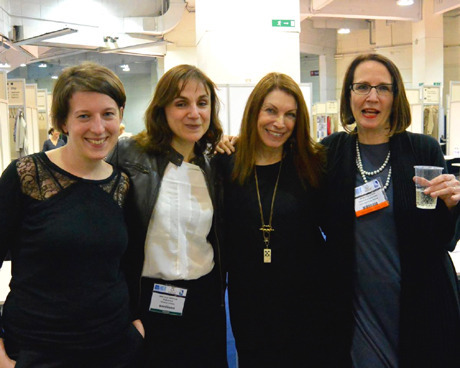
In this photo: my French team from Plon and France Loisirs.
On April 9, it was fun to finally make it to the London Book Fair I’ve heard about for years, and be so warmly welcomed by my agents and publishers. The LBF started in 1971 as a very small event, but is now called a “mecca for European publishers, booksellers, rights agents and media trendspotters”.
Currently held at Earl’s Court Exhibition Centre in West London, it attracts more than 25,000 attendees from over 100 countries. Pretty cool to wander around amidst all those books and book-lovers. An added perk was that the Duchess of Cornwall (yes, Camilla) happened to be on an official visit to the Book Fair that coincided with my own “official visit”.
Thanks to my UK agents of the Marsh Agency for arranging a great event. I also raised a glass with my Portuguese editor from Planeta Manuscrito.
March 31, 2014
The Gift of Silence
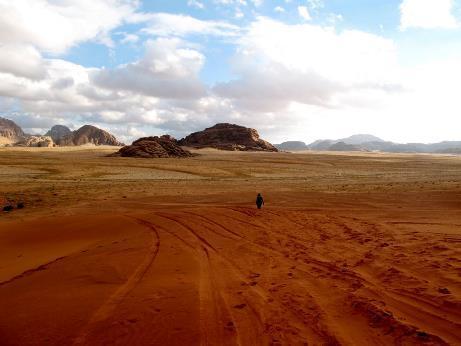 I love London, with its thrumming streets and endless activity, but I’m too easy over-stimulated. My attempts to gather my thoughts about my next book were dampened, perhaps flattened, as I was drawn into living with London’s lovely noise and high energy every day. When I had the opportunity to go to Jordan, I took it. And it was in Jordan’s southern desert – Wadi Rum – that I found the deep silence and peace I realized was missing, and was the reason I couldn’t gather my thoughts about the writing.
 Wadi Rum is a misshapen desert landscape, nicknamed the Valley of the Moon for its towering, lunar-like rock formations and wind-swept dunes. It’s a place of Bedouins with their goats, of snakes and scorpions and shy mountain creatures hiding in the landscape, of falcons, kestrels and eagle owls wheeling overhead with dramatic soundless swoops. Wadi Rum is where T.E. Lawrence fought in the Arab Revolt of 1917 and was romanticized as Lawrence of Arabia.
In my time exploring Wadi Rum, clambering about in the chiselled canyons and trekking up violently hewn hills, I noticed that the Bedouin guides spoke to each other in soft tones, barely above a whisper. I watched little boys passing with their herds of rustling, plodding goats, singing in low, melodic voices that floated thinly in the still air. There was sometimes the steady barking of a dog, its voice muted by distance and space as though it, too, did not want to destroy the serene aura of the mountainous desert.
The absolute silence came at night. I’ve slept in other remote places: on the unforgiving ice amidst hooting penguin rookeries in the Antarctic, in a Borneo rain forest shrilling with huge insects and the screeching of nocturnal animals, in a ger in Outer Mongolia, with the pounding hooves of passing wild horses. The closest I’ve come to absolute silence was in the Moroccan Sahara, but free-roaming camels constantly wandered by our enclosure, snuffling and hissing, nosing at our tent flaps with loud groans, sounding dangerous, although surely merely curious. It’s hard to find complete silence, even in isolation.
But in Wadi Rum, in the sudden biting cold as the sun disappeared, I sat outside my tent, feeling the absolute stillness that came with the darkness. Eventually I lay on my back on the hard sand – hoping the resident snakes and camel spiders and scorpions were elsewhere - and looked at the wonder of the stars that spread like a thick blanket over the desert. I know it’s a cliché, and impossibly banal to say I felt part of the universe that night. But I can’t think of any other way to describe feeling alone and yet at the same time part of something very large. I heard the stars pulsing. But then I realized it wasn’t the stars drumming with a faint rhythm, but my own heartbeat. When had I last quieted myself long enough to hear my own heart, or even thought about its steady, reliable beat?
From Wadi Rum I would move on to the rosy glory of Petra, and eventually make my way into the chaos of Amman. But in that cold night, lying under the stars, the images and voices came to me – the shape of the story I had been waiting for - and I knew that I’d finally found what I’d left home hoping to uncover.
March 5, 2014
Friendly Hauntings
 In my last post I talked about searching for the resting place of Enid Blyton’s ashes. This isn’t a strange thing for me to do. Confession: like a surprising number of people, I love cemeteries.
I find something immensely soothing in slowly wandering through old graveyards, reading the headstones. I discovered this love when I was about twelve, and my mother took me and my younger siblings to St. Andrews on the Red, a Gothic Revival Anglican church built between 1845-1849. It stands beside the winding road that runs along Red River just outside of Lockport, about fifteen miles north of Winnipeg. My mother had heard the church was haunted, and wanted to see if she could feel any vibrations or see any auras. Perhaps not the most conventional outing for a mother and her children, but my mother was not conventional. It was a steamy summer day, mid-week, when the church was empty. She had my younger brothers and sister wait outside, perhaps worried about the state of the old steps to reach the open wooden belfry of the tower, or perhaps concerned that their noisy presence might discourage a visitation. But she took me with her; it was not an option. As I silently climbed up that dim, cobwebby stairway behind her, I was trembling with dread, awaiting the poke of a bony finger or a cold breath in my ear, petrified at the thought of coming upon a ghostly presence – or perhaps, more aptly, it coming upon us. Reaching the belfry, we stood, waiting. I looked out at the curve of the quietly-flowing Red River and the silent cemetery below and the prairie fields around us. Finally, my mother expressed disappointment at nothing happening. I agreed with her, a lie, because I didn’t want her to think me weak. An outing with her – even a ghost-hunt – was a rare and special occasion for me.
Back outside, I was calmed by walking through the solemn dignity of that old cemetery, where some of Manitoba’s first Red River settlers were buried. Reading what was still visible on the crumbling headstones, I discovered so many babies dead at a few weeks or months, so many children my age or younger dead of influenza, dead of smallpox, dead by drowning or by fire. On the drive home I imagined what it would have been like to live on the Manitoba prairies a century earlier. I suddenly understood that graveyards can tell us how people died, but also, in some ways, how they lived.
Since that long-ago experience, I have made the opportunity to visit a number of historic cemeteries: Pere Lachaise in Paris, the Jewish Cemetery in Prague, La Recoleta in Buenos Aires, Okunoin on Mount Koya, and the St. Louis in New Orleans, to name but a few. Every inscription and statue and tribute is, in some way, a source of inspiration for my imaginings of past lives. And it happened again a few days ago, although this visit was unplanned, and the cemetery unknown to me.
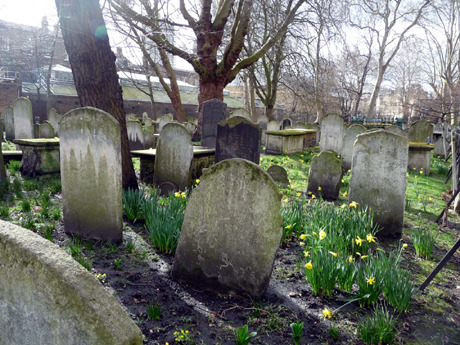
Quickly walking up bustling City Road in London, I almost walked right past Bunhill Fields. It’s a glorious little garden cemetery of tilting, moss-covered stones, surrounded by the first daffodils (daffodils in February! Thinking of my snow-blanketed Canadian home, I was thrilled). Bunhill Fields, originally known as Bone Hill, was first recorded as a burial ground during the Great Plague of 1665. But what I found most interesting was that it was unconsecrated ground, and as such, was the final resting place for Nonconformists, banned from churchyards because they refused to use the Church of England prayer book. And so everyone buried in Bunhill Fields is, in effect, a rebel of his or her time, like John Bunyon who wrote The Pilgrim's Progress, Daniel Defoe of Robinson Crusoe and Moll Flanders fame, and the poet and visionary William Blake. They were buried, respectively, in 1688, 1731, and 1827.
I stood in the sunshine, sharing, for that unexpected moment, the calm oasis among the remains of courageous dissenters, savouring the unexpected glory of the daffodils, and reliving a few of my own friendly hauntings.
February 24, 2014
The Island of Adventure
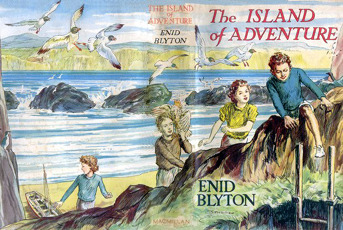 I’m often asked if a teacher or mentor encouraged or inspired me to write, but it was books that were my inspiration. That first whisper of the muse came to me at age nine, while reading the eight novels in Enid Blyton’s Adventure series, written between 1944 and 1955. The four children and their talkative parrot Kiki dealt with forgers, gun-runners, Nazis, traitors, and mad scientists, solving mysteries with very little adult assistance. They had extraordinary adventures not only in England, Scotland and Wales, but also in Austria, Greece, the Middle East, and the fictional but exotic Tauri-Hessia. As well as instilling a love for adventure, those eight books also planted the first longing to travel to places far from my Canadian home. Jack, Philip, Dinah, Lucy-Ann and Kiki were my constant imaginary companions, and in the safety of my secretly scribbled stories, I could be brave and confident as I didn’t feel in real life.
 On a grey, wintry November afternoon, my grade five teacher, Mrs. Bean, brought in a little radio, and we listened to a broadcast about story writing, and were instructed to write our own. Mine was, predictably, “An African Adventure”. It involved three children - and a dog - stealing a plane and flying it on a search mission. They crashed into the deep darkness of Africa, and how they survived their ordeal was the big adventure. Unbeknownst to me, Mrs. Bean sent it in to the CBC, and on another snowy Winnipeg day the radio was again brought in and Mrs. Bean announced that my story would be read. Painfully shy, I was so uncomfortable with the attention of everyone watching me as a man’s rather sonorous voice read my African adventure that I couldn’t look up from my desk. After she switched off the radio, Mrs. Bean set a little booklet containing the stories selected to be read on-air on my desk, and that was that. Nothing more was said about it at school, or at home.
But it was astounding to me: I had written the words I heard in my head, and a stranger somewhere had found those words exciting enough to choose to read on the radio and print in a book for other strangers to hear and read. Although the unfamiliar attention had made me uneasy, it also made me feel special in a way I had never known. And I wanted to do it again. I decided I would be a writer.
Poking around in an antique bookstore last week, I found a first edition of The Island of Adventure, the initial novel in Blyton’s adventure series. Standing in front of the crammed, delightful shelves of Marchpanes, holding that beautiful little book, I remembered running home from St. John’s Library on Salter Street in the North End, the book protected against my chest. I remember being so anxious to begin it that I couldn’t wait to get home, but leaned against the window of Rosenblatt’s grocery store and started reading.
Although that gorgeous first edition at Marchpane’s was not to be mine, I did find a 2014 Annual of Blyton’s – a compilation of some of her famous stories - in a shop on Charing Cross Road. I bought it as a nod to my first inspiration for both writing and travelling, then thought it would be interesting to visit Enid Blyton’s grave; she died in 1968 after writing over 600 books for children. I read that she had been cremated, and phoned the crematorium outside Hampstead where her ashes were reported to be.
“Enid?” the woman who answered the phone said - Enid Blyton being so well known in England that many feel the right to be on a first-name basis. “Oh no, Enid’s ashes aren’t here. We’re not certain, but we think they were scattered from a plane somewhere.” As I hung up I thought of my own childish, long-ago story with its plane over Africa, and I’m not sure why, but I felt strangely pleased.

February 13, 2014
Behind the Blue Door
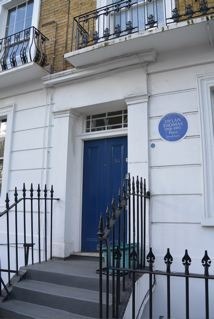
I came to London at the end of January to spend a few months on British soil, finishing my editing on the next book and experiencing London life as much as possible. England is rife with the ghosts of writers past, and I’m hoping to follow the paths some of them left on London’s streets. My first choice is Dylan Thomas, because I’ve always loved the beauty of his language and the images he creates for me. Is there anyone who hasn’t at one time been moved by his classic villanelle, written to his dying father, ‘Do not go gentle into that good night’?
But love for his father aside, Dylan was such a bad boy, along with so many of history’s writers and artists. It creates the difficulty in separating the artist from the art.
I went to Camden Market, and walked to 54 Delancey Street. It was there that Thomas, his wife Caitlin and their three children lived in a three-room basement flat for a short while in the early 1950s. It’s an innocent-looking row house, its door now painted a bright blue. But within the house there existed a simultaneously marvellous and terrible life. Thomas called it, at one time, the “house of horrors.” During daylight hours he wrote in a Romany caravan in the back garden, escaping the family chaos of impoverished domesticity. But when evening fell...I could imagine him, with his “cut-glass” Welsh voice and slightly angelic face - before it was ruined by alcohol – walking to the high street for nights of endless bouts of drinking and public brawls. He drank away the pittance he was paid for his work at the time, forcing him and Caitlin to beg and borrow (and occasionally steal) from friends and family to feed their children as well as their shared drinking habit. Dead at only 39, he left a long legacy of beautiful words and bitter memories for many who knew and loved him. It was poignant to stand on that sunny street and gaze at the blue door, envisioning the dramas and sorrows that had played out behind it.


