
Linda Holeman's Blog, page 2
June 26, 2016
June 2016
For the Love of Libraries…
I have a photo of my mother reading to my older brother and me. I don’t remember it – I was two in the photo – nor any other time of being read to at home. I’m sure, as my next three siblings came along, and my mother helped my father run his radio and television repair business out of our home, that she simply didn’t have any time for what she would have considered the luxury of reading – to her children, or herself.
From the minute I learned to read I was hungry for books, and spent as much time as I could in St. John’s Library on Salter Street, in Winnipeg’s North End. I must have been about six years old when I first went on my own: I have a clear memory of crossing that busy street by myself when I was in Grade One.
I loved the library. It felt huge, with massive stone steps leading to a set of grand wooden doors. Inside there were gleaming hardwood floors and dark woodwork shelves and reading tables graced with softly glowing lamps. The library was the first branch of the Winnipeg Public Library system, and celebrated its centennial in 2015.
In the downstairs children’s department, wonder of wonders, on Saturday mornings there was a “Story Lady” who sat on a small chair with a handful of children pressing up against her legs as she read to us. Even though I could read the books she chose, I simply liked the sensation of someone reading to me. I felt as if nothing bad could ever happen in such a magical place, and my first “what I want to be when I grow up” dream was of working in a library. Not like the lady behind the desk, with her little date stamp and inkpad, but as a Story Lady. I practiced at home with my dolls and little brothers.
When I was eleven we left the North End, moving to the new suburb of East Kildonan across the Red River. I was relieved to discover there was a brand new library at the top of our street. But unlike the dignified grandeur of St. John’s, the Henderson Regional Library was in a strip mall, part of it still under construction. The library was down a set of tiled steps into the basement, and directly across from Loomer Lanes Bowling Alley. The floors of the library were linoleum, the ceilings perforated tiles. The shelves were grey metal, open on the back and sides. There were a few square, blond wood tables and folding chairs. And because of the bowling alley, there was the steady crash of the pins being felled, the following cheers of the players, and the thick fug of cigarette smoke wafting across the hall.
My new best friend and I stopped at the library every day on our way home from school. We took out a book, and when I got home I read it, laying on the grass in the yard or on the floor of the bedroom I shared with my baby sister. The next morning, walking to school, my friend and I talked about what we’d read, and how it made us feel. We had marvelous bookish discussions: our own little book club of two. This idyllic time lasted only one year. After that came Junior High – grade seven – and everything changed. My friend went to another school, and there were no more leisurely morning walks discussing books. I suddenly had a lot more homework. My mother expected more of my help with the housework and meals, as well as keeping an eye on my sister. There was no more time for lying under the sky and dreaming. I still went to the library and took out books, but I didn’t talk about what I’d read with anyone. I waited anxiously for Saturday mornings, when my time was my own, and I could read for a few hours before I was pulled into my chores. But that changed, too. My mother made me join a Saturday morning bowling league at Loomer Lanes, telling me I spent too much time alone, reading, which she didn’t think was good for me.
I didn’t like anything about my enforced sentence at Loomer Lanes: the cacophony, the smell of the spray used to sanitize the rented shoes, and the outcome of my final score, whatever it was. I felt embarrassed when I lost badly, and somehow uncomfortable the few times I surprisingly won a game. I have never had a competitive nature. And I didn’t seem to be able to make friends with any of the kids on my team. I now dreaded Saturday mornings. But after one soul-crushing month came respite.
A neighbor offered me a Saturday morning baby-sitting job. My mother, forever the practical soul (and likely tired of hearing me complain about the bowling) agreed it would be a better use of my time to make a dollar and fifty cents for the three hours. I can only surmise that she thought a three-year old would take over as the company I was supposedly missing.
The baby-sitting turned out to be a blessing. After a perfunctory walk around the neighbourhood, the little boy, Terry, only wanted to play with his collection of trucks in his sandbox or in the cluttered basement playroom. I sat near him, reading. I obviously can’t profess to being a very involved twelve-year old baby-sitter, but Terry was safe and happy, his busy mother had a break, and I was back to spending my Saturday mornings in my favourite pursuit.
Libraries never lost their charm for me, whether it was continuing to borrow wonderful novels, or researching for high school and then university papers, or introducing my children to the joys of libraries, and then, when I began writing – before the advent of the Internet – doing research for the books I was creating.
And while I didn’t become a Story Lady, I did, for a glorious nine months, work in the Winnipeg Centennial Library as a Writer-in-Residence. I spent a few days a week in the hushed, papery atmosphere of the sunny downtown library, was paid to meet with emerging writers to discuss their work, and had the time and space to work on my own novel. It really was a dream job.
Pretty amazing when one of our childhood dreams come true – even if it takes over thirty years!


March 12, 2016
March 2016
The Busyness of the Business of a Full-Time Writer…
One of the things that wakes me up at night is the panic of being behind in my life. I know that’s familiar to most of you.
When I was raising three kids and living in an old house that needed a lot of maintenance and had a large, overgrown yard and garden (ditto for maintenance), I despaired at keeping up with both the responsibilities of a homeowner and the kids and all their school and extra-curricular activities. And, more or less involuntarily, I was caregiver to a menagerie, which included our beloved Lewis, with his doggy requirements, and all the cage/aquarium needs for the birds, dwarf rabbits, hamsters, guinea pigs, fish and other semi-aquatic creatures that regularly came and went, due to their fairly short life spans. Oh, except for the dinner-plate size turtles, Cookie and Caramel, who, it appeared, could live forever under the right circumstances.
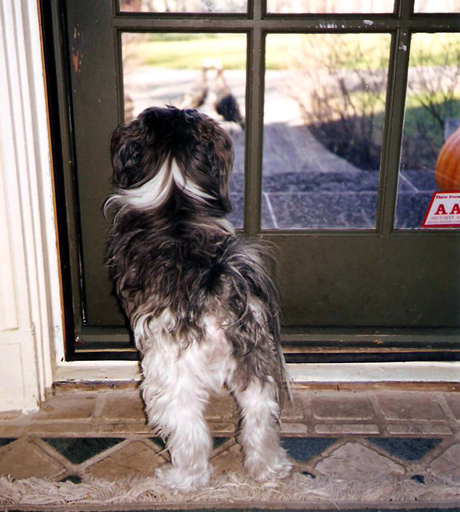
Lewis eyeing wild turkeys in our front yard
I also had the job of writing full-time. This is not unusual or unexpected: how many of you reading this are full-time parents with full-time careers?
While the above was going on – the stuff of life – and I was writing short-story collections and novels for both young adults and adults, the other part of my job as an author included a variety of commitments to the writing world. This was in the earlier days of my career, and none of the commitments were forced upon me. I said yes, often eagerly, when approached and offered a job or assignment, because I knew it could help me learn more about the craft, get my own work more recognized, meet other established and emerging writers, and, hope of hopes, bring in a few extra sou. I conducted school workshops for young adults, and spoke about my books and the writing life at libraries and bookstores. I was a guest at many wonderful and supportive book clubs reading my work. I taught creative writing for Adult Education courses at one of my city’s universities, and acted as guest editor for an edition of a literary journal, and took on the task of writer-in-residence at the city’s main library. I also sat on a board for a writers’ guild, acted as representative for a children/young adult writing society, was a mentor for emerging writers within a writing organization, and read and recommended manuscripts while on the editorial advisory board of a literary press. I wrote blurbs – the brief endorsements on book jackets – and reviewed books and wrote articles for local newspapers and for journals and magazines. I sat on juries for literary awards for local schools and writing organizations as well as for provincial and national grants and prizes. I travelled nationally and internationally to be a presenter at writing conferences.
I want to stress, whole-heartedly, that I am absolutely grateful I was able to be part of all those wonderful aspects of the writer’s life. It was always enriching, and I learned something with every venture.
The above was a long preamble to the fact that my life as a full-time writer has changed. I no longer own a house with a yard, nor do I have pets, and my children are adults with their own lives – and homes. I have cut back drastically on the number of additional “jobs” I take on. And yet – and here is the conundrum: why do I feel as though I am still as behind, and often as panicked about the business/busyness of a full-time writing career as I was while still a young(ish) mother trying to keep a household of five humans and up to six pets afloat?
I have tried to pinpoint what, exactly, accounts for my current state of feeling too busy, which leads to anxiety. I could blame social media, but I’m terrible at it. I have a Twitter account, but rarely tweet or even retweet, and then wonder why I don’t seem to be acquiring followers. I do not have Instagram or Facebook. Not to say you won’t see me there at some point soon, because I understand – trust me – I do understand that social media is very, very important for all of us, and let’s say, oh, number six on my long office to-do list is to generate a professional Facebook page. So I spend a lot of my “worry time” on what I’m not doing: I worry about my website, and how behind I am on keeping it up-to-date. I worry about my computer programs being current and running smoothly, and making sure my iPad and my iPhone are uploading and updating all the apps I am endlessly reminded about. I should be doing more on Goodreads. I should be getting new author photos taken, and I should be scheduling a dreaded meeting with my accountant. My inbox should not be so crammed with all those unanswered emails pertaining to my career. And, although unrelated to my work, let’s not bring up my avoidance of the treadmill.
But in spite of all the things I’m not doing, here’s the positive – what I am doing: writing and reading and travelling. While reading a book that inspires me, or writing a few lines I feel positive about, or travelling to a country that fills me with awe, my blood courses faster and my heart rattles in its cage. That troika that makes up my creative life keeps me open and learning, which makes me more understanding about the human condition, which should, hopefully, make the writing more…well, just more.
So since my last post in October (even typing October gives me a twinge), I finished writing what had been, for quite a while, a novel-in-progress, and I read some books that blew me away, and I experienced a month and a half of foreign travel. I won’t be talking about the novel yet, because it’s too new. But the next post might be about how writing is, for the most part, rewriting. Or how libraries and/or bookstores have influenced my entire life. Or some of the humbling and heart-breaking and awe-inspiring parts of the world I have travelled through recently.
Now that I have made this promise in writing, I can’t back down…so the next post will show up when I can stop feeling I’m wasting too much energy worrying about it – and just do it.
I’d love to hear from any of you who also struggle to keep up – and how you cope!
March 2015
The Busyness of the Business of a Full-Time Writer…
One of the things that wakes me up at night is the panic of being behind in my life. I know that’s familiar to most of you.
When I was raising three kids and living in an old house that needed a lot of maintenance and had a large, overgrown yard and garden (ditto for maintenance), I despaired at keeping up with both the responsibilities of a homeowner and the kids and all their school and extra-curricular activities. And, more or less involuntarily, I was caregiver to a menagerie, which included our beloved Lewis, with his doggy requirements, and all the cage/aquarium needs for the birds, dwarf rabbits, hamsters, guinea pigs, fish and other semi-aquatic creatures that regularly came and went, due to their fairly short life spans. Oh, except for the dinner-plate size turtles, Cookie and Caramel, who, it appeared, could live forever under the right circumstances.
Lewis eyeing wild turkeys in our front yard
I also had the job of writing full-time. This is not unusual or unexpected: how many of you reading this are full-time parents with full-time careers?
While the above was going on – the stuff of life – and I was writing short-story collections and novels for both young adults and adults, the other part of my job as an author included a variety of commitments to the writing world. This was in the earlier days of my career, and none of the commitments were forced upon me. I said yes, often eagerly, when approached and offered a job or assignment, because I knew it could help me learn more about the craft, get my own work more recognized, meet other established and emerging writers, and, hope of hopes, bring in a few extra sou. I conducted school workshops for young adults, and spoke about my books and the writing life at libraries and bookstores. I was a guest at many wonderful and supportive book clubs reading my work. I taught creative writing for Adult Education courses at one of my city’s universities, and acted as guest editor for an edition of a literary journal, and took on the task of writer-in-residence at the city’s main library. I also sat on a board for a writers’ guild, acted as representative for a children/young adult writing society, was a mentor for emerging writers within a writing organization, and read and recommended manuscripts while on the editorial advisory board of a literary press. I wrote blurbs – the brief endorsements on book jackets – and reviewed books and wrote articles for local newspapers and for journals and magazines. I sat on juries for literary awards for local schools and writing organizations as well as for provincial and national grants and prizes. I travelled nationally and internationally to be a presenter at writing conferences.
I want to stress, whole-heartedly, that I am absolutely grateful I was able to be part of all those wonderful aspects of the writer’s life. It was always enriching, and I learned something with every venture.
The above was a long preamble to the fact that my life as a full-time writer has changed. I no longer own a house with a yard, nor do I have pets, and my children are adults with their own lives – and homes. I have cut back drastically on the number of additional “jobs” I take on. And yet – and here is the conundrum: why do I feel as though I am still as behind, and often as panicked about the business/busyness of a full-time writing career as I was while still a young(ish) mother trying to keep a household of five humans and up to six pets afloat?
I have tried to pinpoint what, exactly, accounts for my current state of feeling too busy, which leads to anxiety. I could blame social media, but I’m terrible at it. I have a Twitter account, but rarely tweet or even retweet, and then wonder why I don’t seem to be acquiring followers. I do not have Instagram or Facebook. Not to say you won’t see me there at some point soon, because I understand – trust me – I do understand that social media is very, very important for all of us, and let’s say, oh, number six on my long office to-do list is to generate a professional Facebook page. So I spend a lot of my “worry time” on what I’m not doing: I worry about my website, and how behind I am on keeping it up-to-date. I worry about my computer programs being current and running smoothly, and making sure my iPad and my iPhone are uploading and updating all the apps I am endlessly reminded about. I should be doing more on Goodreads. I should be getting new author photos taken, and I should be scheduling a dreaded meeting with my accountant. My inbox should not be so crammed with all those unanswered emails pertaining to my career. And, although unrelated to my work, let’s not bring up my avoidance of the treadmill.
But in spite of all the things I’m not doing, here’s the positive – what I am doing: writing and reading and travelling. While reading a book that inspires me, or writing a few lines I feel positive about, or travelling to a country that fills me with awe, my blood courses faster and my heart rattles in its cage. That troika that makes up my creative life keeps me open and learning, which makes me more understanding about the human condition, which should, hopefully, make the writing more…well, just more.
So since my last post in October (even typing October gives me a twinge), I finished writing what had been, for quite a while, a novel-in-progress, and I read some books that blew me away, and I experienced a month and a half of foreign travel. I won’t be talking about the novel yet, because it’s too new. But the next post might be about how writing is, for the most part, rewriting. Or how libraries and/or bookstores have influenced my entire life. Or some of the humbling and heart-breaking and awe-inspiring parts of the world I have travelled through recently.
Now that I have made this promise in writing, I can’t back down…so the next post will show up when I can stop feeling I’m wasting too much energy worrying about it – and just do it.
I’d love to hear from any of you who also struggle to keep up – and how you cope!
The Busyness of the Business of a Full-Time Writer
One of the things that wakes me up at night is the panic of being behind in my life. I know that’s familiar to most of you.
When I was raising three kids and living in an old house that needed a lot of maintenance and had a large, overgrown yard and garden (ditto for maintenance), I despaired at keeping up with both the responsibilities of a homeowner and the kids and all their school and extra-curricular activities. And, more or less involuntarily, I was caregiver to a menagerie, which included our beloved Lewis, with his doggy requirements, and all the cage/aquarium needs for the birds, dwarf rabbits, hamsters, guinea pigs, fish and other semi-aquatic creatures that regularly came and went, due to their fairly short life spans. Oh, except for the dinner-plate size turtles, Cookie and Caramel, who, it appeared, could live forever under the right circumstances.
Lewis eyeing wild turkeys in our front yard
I also had the job of writing full-time. This is not unusual or unexpected: how many of you reading this are full-time parents with full-time careers?
While the above was going on – the stuff of life – and I was writing short-story collections and novels for both young adults and adults, the other part of my job as an author included a variety of commitments to the writing world. This was in the earlier days of my career, and none of the commitments were forced upon me. I said yes, often eagerly, when approached and offered a job or assignment, because I knew it could help me learn more about the craft, get my own work more recognized, meet other established and emerging writers, and, hope of hopes, bring in a few extra sou. I conducted school workshops for young adults, and spoke about my books and the writing life at libraries and bookstores. I was a guest at many wonderful and supportive book clubs reading my work. I taught creative writing for Adult Education courses at one of my city’s universities, and acted as guest editor for an edition of a literary journal, and took on the task of writer-in-residence at the city’s main library. I also sat on a board for a writers’ guild, acted as representative for a children/young adult writing society, was a mentor for emerging writers within a writing organization, and read and recommended manuscripts while on the editorial advisory board of a literary press. I wrote blurbs – the brief endorsements on book jackets – and reviewed books and wrote articles for local newspapers and for journals and magazines. I sat on juries for literary awards for local schools and writing organizations as well as for provincial and national grants and prizes. I travelled nationally and internationally to be a presenter at writing conferences.
I want to stress, whole-heartedly, that I am absolutely grateful I was able to be part of all those wonderful aspects of the writer’s life. It was always enriching, and I learned something with every venture.
The above was a long preamble to the fact that my life as a full-time writer has changed. I no longer own a house with a yard, nor do I have pets, and my children are adults with their own lives – and homes. I have cut back drastically on the number of additional “jobs” I take on. And yet – and here is the conundrum: why do I feel as though I am still as behind, and often as panicked about the business/busyness of a full-time writing career as I was while still a young(ish) mother trying to keep a household of five humans and up to six pets afloat?
I have tried to pinpoint what, exactly, accounts for my current state of feeling too busy, which leads to anxiety. I could blame social media, but I’m terrible at it. I have a Twitter account, but rarely tweet or even retweet, and then wonder why I don’t seem to be acquiring followers. I do not have Instagram or Facebook. Not to say you won’t see me there at some point soon, because I understand – trust me – I do understand that social media is very, very important for all of us, and let’s say, oh, number six on my long office to-do list is to generate a professional Facebook page. So I spend a lot of my “worry time” on what I’m not doing: I worry about my website, and how behind I am on keeping it up-to-date. I worry about my computer programs being current and running smoothly, and making sure my iPad and my iPhone are uploading and updating all the apps I am endlessly reminded about. I should be doing more on Goodreads. I should be getting new author photos taken, and I should be scheduling a dreaded meeting with my accountant. My inbox should not be so crammed with all those unanswered emails pertaining to my career. And, although unrelated to my work, let’s not bring up my avoidance of the treadmill.
But in spite of all the things I’m not doing, here’s the positive – what I am doing: writing and reading and travelling. While reading a book that inspires me, or writing a few lines I feel positive about, or travelling to a country that fills me with awe, my blood courses faster and my heart rattles in its cage. That troika that makes up my creative life keeps me open and learning, which makes me more understanding about the human condition, which should, hopefully, make the writing more…well, just more.
So since my last post in October (even typing October gives me a twinge), I finished writing what had been, for quite a while, a novel-in-progress, and I read some books that blew me away, and I experienced a month and a half of foreign travel. I won’t be talking about the novel yet, because it’s too new. But the next post might be about how writing is, for the most part, rewriting. Or how libraries and/or bookstores have influenced my entire life. Or some of the humbling and heart-breaking and awe-inspiring parts of the world I have travelled through recently.
Now that I have made this promise in writing, I can’t back down…so the next post will show up when I can stop feeling I’m wasting too much energy worrying about it – and just do it.
I’d love to hear from any of you who also struggle to keep up – and how you cope!
October 16, 2015
Like An Old Sweet Song
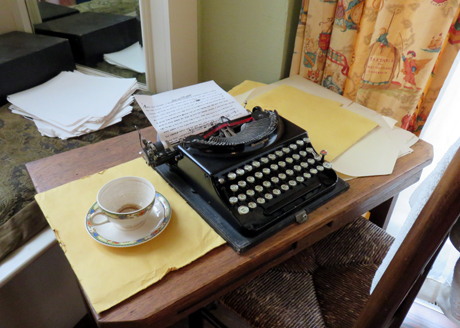 I grew up steeped in Southern writers, cutting my adolescent reading teeth on Truman Capote, Harper Lee, Carson McCullers, Flannery O’Connor, Tennessee Williams, William Faulkner, and, of course, good old Mark Twain. From my Manitoba home, with its geographical isolation and long, long winters, I learned about an environment opposite from mine. It wasn’t just the weather, but the mind-set that was so different and intriguing.
In those younger days I dreamed of travelling the Southern Literary Trail, which includes thirty sites of famous Southern authors who lived and wrote in Georgia, Alabama, and Mississippi. Although that didn’t happen, when I had the opportunity to spend some time in Georgia in September, I thought I’d see what I could find on some of my old literary gurus in that state.
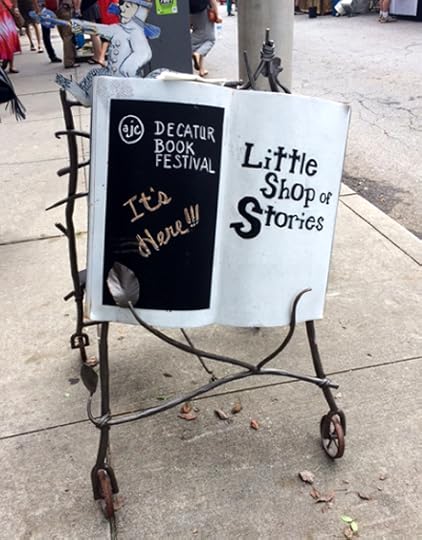
My timing in Georgia was perfect to take in the Decatur Book Festival in DeKalb County. Decatur has the most amazing children’s bookstore, Little Shop of Stories, its name a cute twist on the horror-comedy film and musical. Too see a small, independent bookstore crammed with kids sitting on the floor reading, adults and teenagers lined up at the counter buying real books, and a long row of children waiting to have their book signed by a local author was absolutely heart-warming – it’s hard to find such personal “book” interaction these days.
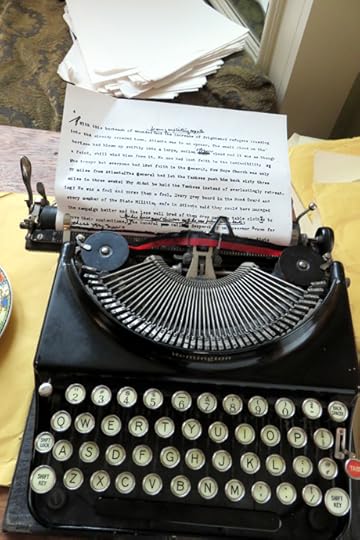
In Atlanta I toured Margaret Mitchell’s tiny apartment, where she spent most of ten years writing Gone with the Wind. She started writing it while bored at home after breaking her ankle and unable to get to her job at The Atlantic Journal, and there are lots of amusing anecdotes about Mitchell’s lack of interest in publishing her only novel. Gone with the Wind became the second most widely bought book by American readers, surpassed only by the Bible. Mind-boggling.
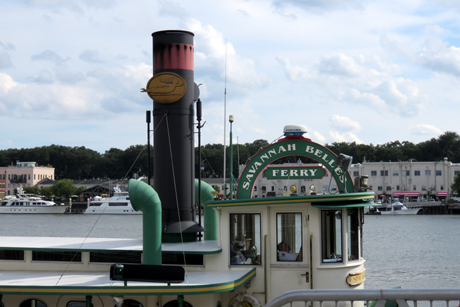
I spent time in Savannah, lovely Savannah, with Spanish moss hanging from trees lining the quiet streets, gracious old graveyards that are part of nightly ghoulish tours, and the Savannah River with its cargo ships heading to every part of the world. Sitting on a balcony overlooking the river, I watched ships destined for Panama and Japan and Malta as I ate a dinner featuring one of Savannah’s specialities, catfish, and taste-testing the city’s wide assortment of craft beer.
The powerful Midnight in the Garden of Good and Evil: A Savannah Story was set in and around Savannah, and I mentally revisited John Berendt’s highly successful work. Holding a place on the New York Times Best-Seller list for 216 weeks gave it the distinction of being among the most popular non-fiction releases of all times. Based on true events, somehow it reads like a novel, with its southern Gothic tone and cast of bizarre personalities. I love that the title alludes to the notion of midnight as the period between the time for good magic and the time for evil magic. The Bonaventure Cemetery in Savannah is what Berendt used as the actual “garden of good and evil.” Feeling a little spooked, I decided to visit it in bright sunlight.
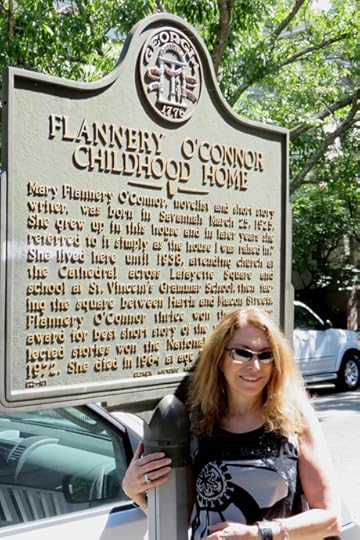
And I also made time to visit Flannery O’Connor’s Savannah childhood home; next time I’m in Georgia I’ll head to Andalusia Farm in Millegeville, where she lived and wrote as an adult until her untimely death at 39. She’s been hailed as one of American’s best short story writers. With my much younger and naïve take on the world, her grotesque characters, struggling with morality and ethics, made for mesmerizing and at times disturbing reading. And speaking of grotesque characters, she said: “Whenever I’m asked why Southern writers particularly have a penchant for writing about freaks, I say it is because we are still able to recognize one.” Good one, Flannery.
Also an important reason to head to the Milledgeville area is to visit Alice Walker’s childhood home. Walker has long been one of my literary heroes. I was initially introduced to the struggle of black women in racist, sexist and violent societies while reading Walker’s The Colour Purple, Possessing the Secret of Joy, and The Temple of My Familiar, to name only a few.
Last but not least: Carson McCullers explored the isolation of misfits and outcasts in novels like The Heart is a Lonely Hunter and Reflections in a Golden Eye, and Erskin Caldwell’s Tobacco Road and God’s Little Acre created earthy and candid depictions about America’s rural poor I’ve never forgotten. Both these writers taught me not only about the south, but also about writing “real”.
Georgia has so much to offer besides lazy, steamy weather, Spanish moss, and, of course, peaches. It’s a playground of all things literary, and I had a great time playing. Thanks, Georgia!
October 10, 2015
October 2015
Like An Old Sweet Song… I grew up steeped in Southern writers, cutting my adolescent reading teeth on Truman Capote, Harper Lee, Carson McCullers, Flannery O’Connor, Tennessee Williams, William Faulkner, and, of course, good old Mark Twain. From my Manitoba home, with its geographical isolation and long, long winters, I learned about an environment opposite from mine. It wasn’t just the weather, but the mind-set that was so different and intriguing.
In those younger days I dreamed of travelling the Southern Literary Trail, which includes thirty sites of famous Southern authors who lived and wrote in Georgia, Alabama, and Mississippi. Although that didn’t happen, when I had the opportunity to spend some time in Georgia in September, I thought I’d see what I could find on some of my old literary gurus in that state.
My timing in Georgia was perfect to take in the Decatur Book Festival in DeKalb County. Decatur has the most amazing children’s bookstore, Little Shop of Stories, its name a cute twist on the horror-comedy film and musical. Too see a small, independent bookstore crammed with kids sitting on the floor reading, adults and teenagers lined up at the counter buying real books, and a long row of children waiting to have their book signed by a local author was absolutely heart-warming – it’s hard to find such personal “book” interaction these days.
In Atlanta I toured Margaret Mitchell’s tiny apartment, where she spent most of ten years writing Gone With the Wind. She started writing it while bored at home after breaking her ankle and unable to get to her job at The Atlantic Journal, and there are lots of amusing anecdotes about Mitchell’s lack of interest in publishing her only novel. Gone With the Wind became the second most widely bought book by American readers, surpassed only by the Bible. Mind-boggling.
I spent time in Savannah, lovely Savannah, with Spanish moss hanging from trees lining the quiet streets, gracious old graveyards that are part of nightly ghoulish tours, and the Savannah River with its cargo ships heading to every part of the world. Sitting on a balcony overlooking the river, I watched ships destined for Panama and Japan and Malta as I ate a dinner featuring one of Savannah’s specialities, catfish, and taste-testing the city’s wide assortment of craft beer.
The powerful Midnight in the Garden of Good and Evil was set in and around Savannah, and I mentally revisited John Berendt’s highly successful work. Holding a place on the New York Times Best-Seller list for 216 weeks gave it the distinction of being among the most popular non-fiction releases of all times. Based on true events, somehow it reads like a novel, with its southern Gothic tone and cast of bizarre personalities. I love that the title alludes to the notion of midnight as the period between the time for good magic and the time for evil magic. The Bonaventure Cemetery in Savannah is what Berendt used as the actual “garden of good and evil.” Feeling a little spooked, I decided to visit it in bright sunlight.
And I also made time to visit Flannery O’Connor’s Savannah childhood home; next time I’m in Georgia I’ll head to Andalusia Farm in Millegeville, where she lived and wrote as an adult until her untimely death at 39. She’s been hailed as one of American’s best short story writers. With my much younger and naïve take on the world, her grotesque characters, struggling with morality and ethics, made for mesmerizing and at times disturbing reading. And speaking of grotesque characters, she said: “Whenever I’m asked why Southern writers particularly have a penchant for writing about freaks, I say it is because we are still able to recognize one.” Good one, Flannery.
Also an important reason to head to the Milledgeville area is to visit Alice Walker’s childhood home. Walker has long been one of my literary heroes. I was initially introduced to the struggle of black women in racist, sexist and violent societies while reading Walker’s The Colour Purple, Possessing the Secret of Joy, and The Temple of My Familiar, to name only a few.
Last but not least: Carson McCullers explored the isolation of misfits and outcasts in novels like The Heart is a Lonely Hunter and Reflections in a Golden Eye, and Erskin Caldwell’s Tobacco Road and God’s Little Acre created earthy and candid depictions about America’s rural poor I’ve never forgotten. Both these writers taught me not only about the south, but also about writing “real”.
Georgia has so much to offer besides lazy, steamy weather, Spanish moss, and, of course, peaches. It’s a playground of all things literary, and I had a great time playing. Thanks, Georgia!
August 27, 2015
Spain Then and Now…
 I realize that while this is a writing website, it’s also a travel website. I can’t deny it. The time I spend travelling is as important to me as the time I spend writing: I absorb writing inspiration while I’m travelling, and travel inspiration while I’m writing. As I’ve stated elsewhere on this website, those two aspects of my life are hard to separate. I don’t want to write about the daily slog of sitting at my desk, writing and deleting, writing and rewriting, writing and editing, and then deleting and writing again. It’s as tedious as that sentence. Right now I’d rather concentrate on the thoughts about writing I have while travelling.
Once I was home from San Miguel de Allende in February, I had a quiet six weeks of working steadily. And then I had to leave again. I don’t know how to explain this wanderlust to anyone who doesn’t have it. For those of you who also know it, no explanation is necessary. Of course, travel doesn’t just happen. It requires a lot of planning, and the knowledge that there will be lost work time, and being away from loved ones and friends, and the big one: the financial stress. Long ago I made the decision that should I be lucky enough to be able to put aside a small vacation fund whenever possible, I would not spend it on vacation, per se, but on travel, which for me is invigorating and mind-expanding. Lest anyone think I’m sounding high-handed… hey, I love sitting on sandy beaches or beside refreshing pools, rum or tequila-based drink in hand, as much as anyone. I just keep thinking I can do that later. I’m not sure what later means. When, exactly, is later? I just know that a supposedly relaxing holiday doesn’t satisfy me for longer than a day or two.
So my next creatively inspirational trip was in May, to Spain’s Andalucía, the only European region with both Mediterranean and Atlantic coastlines.
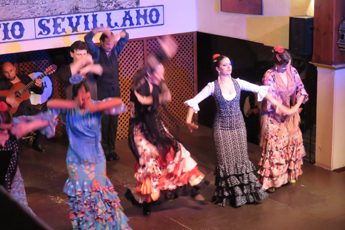
When I think of Spain, I realize that many of my images come from Andalucía, with its lilting flamenco guitar, the sweet smell of oranges and church incense, the taste of bone-dry sherry and flaky fish. There is its complex combination of Christianity and Islam, with ruined palaces and Moorish monuments created by the Berbers and Arabs who crossed into Spain from Morocco and North Africa and occupied the regions for over seven centuries. Seven centuries sounds like a long time when we think of Canada as having its centennial in 1967.
I landed in Madrid. The city is mind-blowing, art everywhere: the Prada and Museo Thyssen-Bornemisza and Museo de Arte Reina Sofia, to name the most famous galleries. For great food and drink there are endless restaurants, and the lively and charming Mercado de San Miguel. There is flamenco, and for some there is bullfighting. That blood sport strikes me as a terrible gladiator or Christians-against-the-lions scenario, when you know going in you will be witnessing death. I’ll take flamenco, thank you.
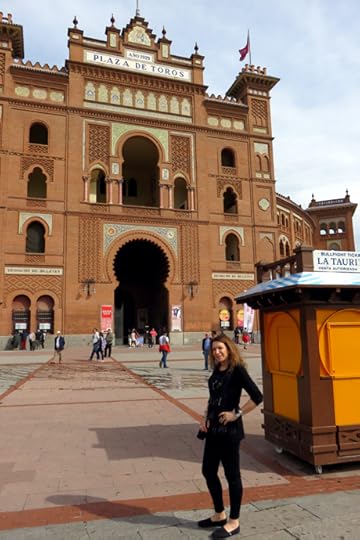
Outside Plaza de Toros de las Ventas in Madrid – with no intention of entering!
I was really anxious to revisit the cities of Andalucía I’d seen decades earlier, when I was a far younger and much different person. I was more impressionable but less involved as I travelled all of Europe and parts of the Middle East back in the 1970s. It truly is the old adage – I think it was Einstein who said it – the more you learn, the more you realize you don’t know. In the seventies I hadn’t had time to learn enough to realize how much more there was.
And so after Madrid we headed directly south, into the Iberian Peninsula and the dream journey through Andalucía’s Golden Triangle of Seville, Cordoba, and Granada. I knew that each of these cities possessed ancient mosques now masquerading as churches after the Catholic take-over by Ferdinand and Isabella, as well as vast palace complexes with the same Moorish influenced architecture – and I wanted to see them all again, with new eyes.
Seville is alive and bustling from early morning to far into the night. Its old city boasts the Seville Cathedral, the grandest of all Gothic cathedrals – where I saw the resting place of Christopher Columbus’s bones – and the Cathedral’s Giralda tower. I did climb all the way to the top, made easier by the fact that the massive bell tower is on a circular ramp, built so that donkeys could carry up elderly bell ringers in the past. In spite of that ramp, there were times I longed for my own donkey. But the view over all of Seville from the top was worth the climb.
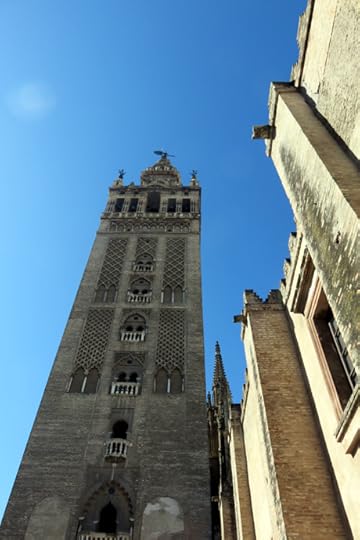
Giralda Tower
As well as the Cathedral and Giralda, while in Seville a visit to the lushly decorated Alcazar is a must, and afternoons wandering the plant-decked, tangled alleyways of Barrio de Santa Cruz, the medieval Jewish quarter, stopping for cool libations in the shade.
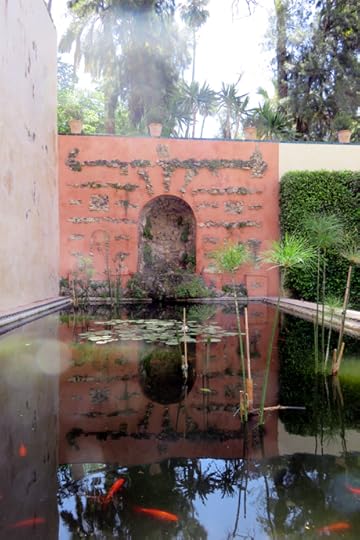
Alcazar
From Seville we pushed on to Cordoba, with its amazing Mezquita, the grandest and most brilliant mosque constructed by the Moors. Its peaceful, spacious interior was designed to let the spirit roam free and communicate easily with God. There is a definite mystical – or perhaps magical – element. With its labyrinth of stone palm trees and bi-coloured arches I definitely felt a sense of the miraculous.
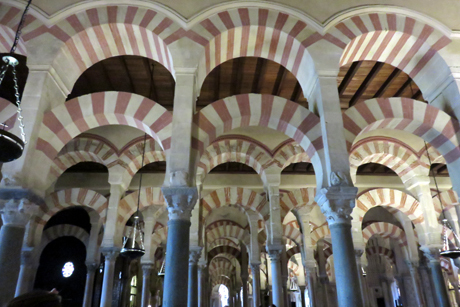
Mezquita
The third major city in Andalucía is Granada, built on the slopes of three hills, and lying in the shadow of the Alhambra. There’s a sensuality to the Alhambra, a glorious Moorish palace filled with reflective pools and hidden gardens and broad pillars which create the perfect spots for a secret rendezvous: it’s easy to imagine trysts in the flower-scented atmosphere.
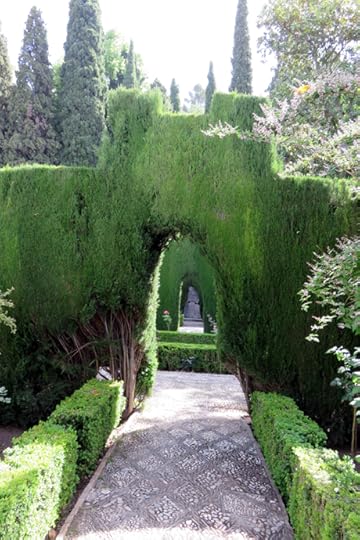
Outside the Alhambra
American author, historian, and diplomat Washington Irving travelled to Granada in 1828, researching a book about the city’s history. He fell in love with the Alhambra, and due to his celebrity status was granted access to write in a room within the palace. He was so inspired by his experiences there that he wrote Tales of the Alhambra, a book combining description, myth and narrations of real historical events. Washington did not believe his writing would ever do the Alhambra justice, saying, “How unworthy is my scribbling of the place.” Published in 1832, the book was instrumental in reintroducing the Alhambra to Western audiences. I find it so cool to discover these small but unexpected stories about the influence of place. In my historic novels, I have always focused on place as one of the characters.
There’s an inexplicable romantic broodiness to Granada that spoke to me as we wandered through the Albaicín. The old Moorish town is a fascinating quarter, full of deserted, narrow alleyways with the Alhambra a glorious backdrop seen through each lane running down to Paseo de los Tristes – Promenade of the Sad – so named because funeral corteges used to pass through here on their way up to the cemetery behind the Alhambra.
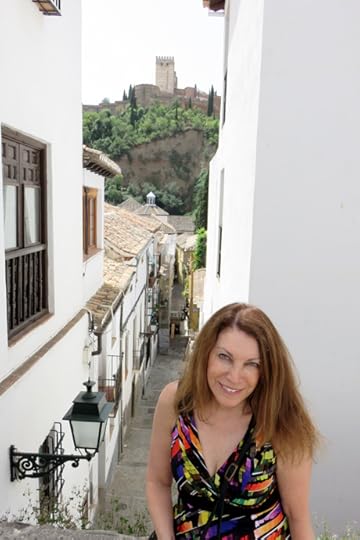
In the Albaicín, with the Alhambra visible
Away from the major cities, travelling the roads connecting smaller towns, I understood the huge, unyielding scale of Andalucía, with its chain of white towns scattered like pebbles through the dry, craggy landscape. It seemed that in these sun-bleached villages life hasn’t changed much since playwright and poet Federico García Lorca envisioned his play, Bodas de Sangre – Blood Wedding – a tragedy of choice, deception, and fate, all culminating at a wedding. And Lorca described his poetry about southern Spain as a “carved altar piece” of Andalucía…“that hardly expresses visible Andalucía at all, but where the hidden Andalucía trembles”. Lorca never stopped searching for the elements of Andalucía culture, trying to write about its essence without cliché.
We explored Carmona, with its grand if ruinous fortified gateway, Puerto de Sevilla, leading into the historic old city. Within the walls, narrow streets meander past Mudejar – a particular style of Iberian architecture and decoration – churches and Renaissance mansions.
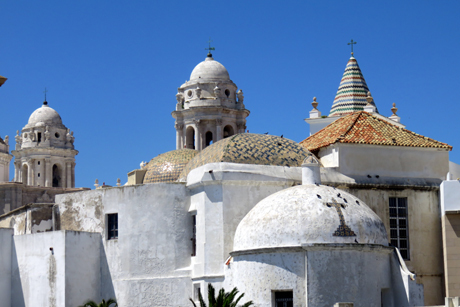
Another day found us in Cadiz – a breezy, visually compelling city on the edge of the sea, although with the slight edginess that is part of a port town.
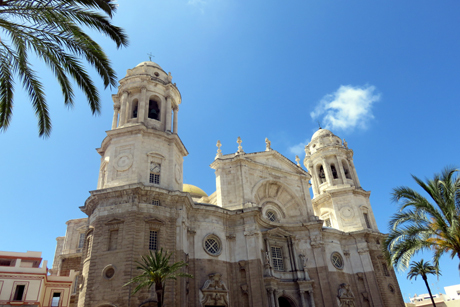
Cathedral in Casco Antiguo, Cadiz
And there was a stop for sherry tasting at the world-famous Sandeman Winery in Jerez de la Frontera, a town known not only for its sherry, but as the capital of Andaluz horse culture. And it’s also known for the writer Manuel Moreno Barranco, whose extensive work ended abruptly when, at age thirty, he died violently in the prison of Jerez in 1963. The most compelling part to this story is that there was never a real reason for his imprisonment, apart from the suggestion he was a communist, and there is no evidence that he actually died by throwing himself over a balustrade, as the prison maintained. This in itself sounds like a story worthy of being written!
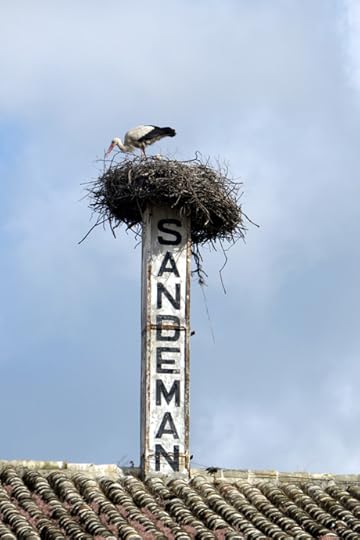
A stork nesting on the chimney is always good luck.
So much of Andalucía did have mystery and intrigue and a kind of unearthly presence. In every city and town I could envision life as it had been all those centuries ago. Although much has changed, much is still close to how some things must have always been. The Moorish architecture of the buildings is still the same. The narrow, twisting passages in all the barrios are still the same. Incense and roses still smell the same; garlic and oranges still taste the same. The purple blossoms of the jacaranda lining the streets of Seville and the restless, tossing green sea of Cadiz and the brilliant blue of the sky over all of Andalucía are still the same. The only real thing I know with certainty to have changed since I was last here so many years ago is me.
As it should be.
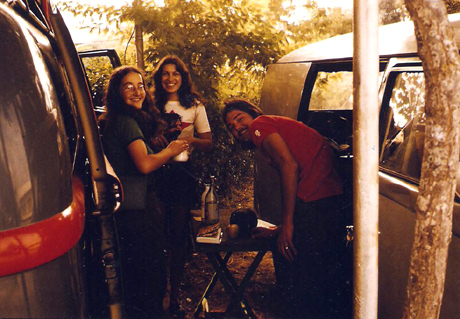
Me in Frank Zappa t-shirt – with friends outside of Cadiz, October 1973
August 18, 2015
May 2015
Spain Then and Now…
I realize that while this is a writing website, it’s also a travel website. I can’t deny it. The time I spend travelling is as important to me as the time I spend writing: I absorb writing inspiration while I’m travelling, and travel inspiration while I’m writing. As I’ve stated elsewhere on this website, those two aspects of my life are hard to separate. I don’t want to write about the daily slog of sitting at my desk, writing and deleting, writing and rewriting, writing and editing, and then deleting and writing again. It’s as tedious as that sentence. Right now I’d rather concentrate on the thoughts about writing I have while travelling.
Once I was home from San Miguel de Allende in February, I had a quiet six weeks of working steadily. And then I had to leave again. I don’t know how to explain this wanderlust to anyone who doesn’t have it. For those of you who also know it, no explanation is necessary. Of course, travel doesn’t just happen. It requires a lot of planning, and the knowledge that there will be lost work time, and being away from loved ones and friends, and the big one: the financial stress. Long ago I made the decision that should I be lucky enough to be able to put aside a small vacation fund whenever possible, I would not spend it on vacation, per se, but on travel, which for me is invigorating and mind-expanding. Lest anyone think I’m sounding high-handed…hey, I love sitting on sandy beaches or beside refreshing pools, rum or tequila-based drink in hand, as much as anyone. I just keep thinking I can do that later. I’m not sure what later means. When, exactly, is later? I just know that a supposedly relaxing holiday doesn’t satisfy me for longer than a day or two.
So my next creatively inspirational trip was in May, to Spain’s Andalucía, the only European region with both Mediterranean and Atlantic coastlines.
When I think of Spain, I realize that many of my images come from Andalucía, with its lilting flamenco guitar, the sweet smell of oranges and church incense, the taste of bone-dry sherry and flaky fish. There is its complex combination of Christianity and Islam, with ruined palaces and Moorish monuments created by the Berbers and Arabs who crossed into Spain from Morocco and North Africa and occupied the regions for over seven centuries. Seven centuries sounds like a long time when we think of Canada as having its centennial in 1967.
I landed in Madrid. The city is mind-blowing, art everywhere: the Prada and Museo Thyssen-Bornemisza and Museo de Arte Reina Sofia, to name the most famous galleries. For great food and drink there are endless restaurants, and the lively and charming Mercado de San Miguel. There is flamenco, and for some there is bullfighting. That blood sport strikes me as a terrible gladiator or Christians-against-the-lions scenario, when you know going in you will be witnessing death. I’ll take flamenco, thank you.
Outside Plaza de Toros de las Ventas in Madrid – with no intention of entering!
I was really anxious to revisit the cities of Andalucía I’d seen decades earlier, when I was a far younger and much different person. I was more impressionable but less involved as I travelled all of Europe and parts of the Middle East back in the 1970s. It truly is the old adage – I think it was Einstein who said it – the more you learn, the more you realize you don’t know. In the seventies I hadn’t had time to learn enough to realize how much more there was.
And so after Madrid we headed directly south, into the Iberian Peninsula and the dream journey through Andalucía’s Golden Triangle of Seville, Cordoba, and Granada. I knew that each of these cities possessed ancient mosques now masquerading as churches after the Catholic take-over by Ferdinand and Isabella, as well as vast palace complexes with the same Moorish influenced architecture – and I wanted to see them all again, with new eyes.
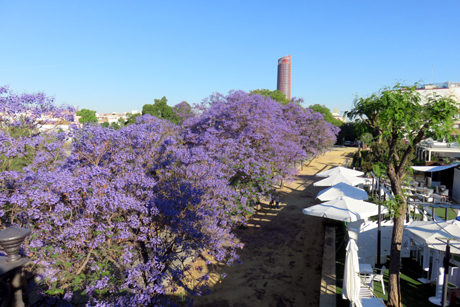
Jacaranda trees in Seville
Seville is alive and bustling from early morning to far into the night. Its old city boasts the Seville Cathedral, the grandest of all Gothic cathedrals – where I saw the resting place of Christopher Columbus’s bones – and the Cathedral’s Giralda tower. I did climb all the way to the top, made easier by the fact that the massive bell tower is on a circular ramp, built so that donkeys could carry up elderly bell ringers in the past. In spite of that ramp, there were times I longed for my own donkey. But the view over all of Seville from the top was worth the climb.
Giralda Tower
As well as the Cathedral and Giralda, while in Seville a visit to the lushly decorated Alcazar is a must, and afternoons wandering the plant-decked, tangled alleyways of Barrio de Santa Cruz, the medieval Jewish quarter, stopping for cool libations in the shade.
Alcazar
From Seville we pushed on to Cordoba, with its amazing Mezquita, the grandest and most brilliant mosque constructed by the Moors. Its peaceful, spacious interior was designed to let the spirit roam free and communicate easily with God. There is a definite mystical – or perhaps magical – element. With its labyrinth of stone palm trees and bi-coloured arches I definitely felt a sense of the miraculous.
Mezquita
The third major city in Andalucía is Granada, built on the slopes of three hills, and lying in the shadow of the Alhambra. There’s a sensuality to the Alhambra, a glorious Moorish palace filled with reflective pools and hidden gardens and broad pillars which create the perfect spots for a secret rendezvous: it’s easy to imagine trysts in the flower-scented atmosphere.
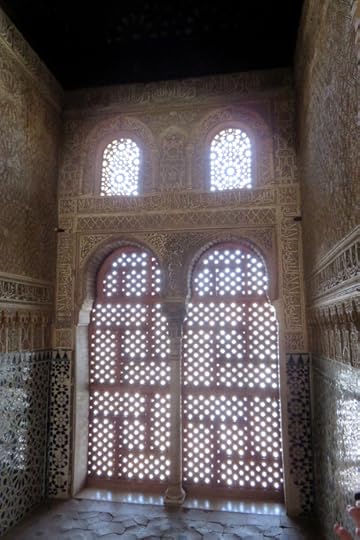
The Alhambra
American author, historian, and diplomat Washington Irving travelled to Granada in 1828, researching a book about the city’s history. He fell in love with the Alhambra, and due to his celebrity status was granted access to write in a room within the palace. He was so inspired by his experiences there that he wrote Tales of the Alhambra, a book combining description, myth and narrations of real historical events. Washington did not believe his writing would ever do the Alhambra justice, saying, “How unworthy is my scribbling of the place.” Published in 1832, the book was instrumental in reintroducing the Alhambra to Western audiences. I find it so cool to discover these small but unexpected stories about the influence of place. In my historic novels, I have always focused on place as one of the characters.
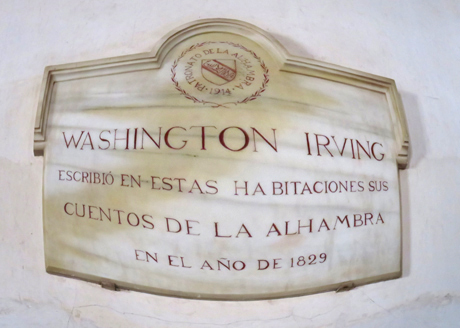
Translation: “Washington Irving wrote his Tales of Alhambra in these rooms in 1829.”
There’s an inexplicable romantic broodiness to Granada that spoke to me as we wandered through the Albaicín. The old Moorish town is a fascinating quarter, full of deserted, narrow alleyways with the Alhambra a glorious backdrop seen through each lane running down to Paseo de los Tristes – Promenade of the Sad – so named because funeral corteges used to pass through here on their way up to the cemetery behind the Alhambra.
In the Albaicín, with the Alhambra visible
Away from the major cities, travelling the roads connecting smaller towns, I understood the huge, unyielding scale of Andalucía, with its chain of white towns scattered like pebbles through the dry, craggy landscape. It seemed that in these sun-bleached villages life hasn’t changed much since playwright and poet Federico García Lorca envisioned his play, Bodas de Sangre – Blood Wedding – a tragedy of choice, deception, and fate, all culminating at a wedding. And Lorca described his poetry about southern Spain as a “carved altar piece” of Andalucía…“that hardly expresses visible Andalucía at all, but where the hidden Andalucía trembles”. Lorca never stopped searching for the elements of Andalucía culture, trying to write about its essence without cliché.
We explored Carmona, with its grand if ruinous fortified gateway, Puerto de Sevilla, leading into the historic old city. Within the walls, narrow streets meander past Mudejar – a particular style of Iberian architecture and decoration – churches and Renaissance mansions.
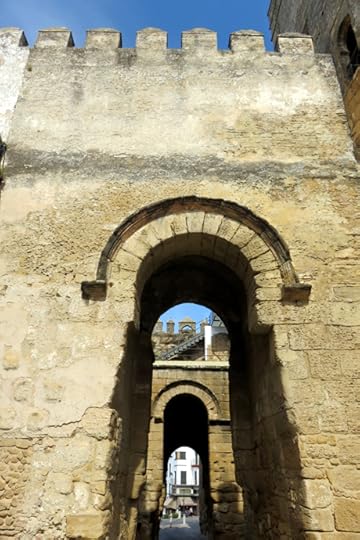
Gateway into Carmona
Another day found us in Cadiz – a breezy, visually compelling city on the edge of the sea, although with the slight edginess that is part of a port town.
Cathedral in Casco Antiguo, Cadiz
And there was a stop for sherry tasting at the world-famous Sandeman Winery in Jerez de la Frontera, a town known not only for its sherry, but as the capital of Andaluz horse culture. And it’s also known for the writer Manuel Moreno Barranco, whose extensive work ended abruptly when, at age thirty, he died violently in the prison of Jerez in 1963. The most compelling part to this story is that there was never a real reason for his imprisonment, apart from the suggestion he was a communist, and there is no evidence that he actually died by throwing himself over a balustrade, as the prison maintained. This in itself sounds like a story worthy of being written!
A stork nesting on the chimney is always good luck.
So much of Andalucía did have mystery and intrigue and a kind of unearthly presence. In every city and town I could envision life as it had been all those centuries ago. Although much has changed, much is still close to how some things must have always been. The Moorish architecture of the buildings is still the same. The narrow, twisting passages in all the barrios are still the same. Incense and roses still smell the same; garlic and oranges still taste the same. The purple blossoms of the jacaranda lining the streets of Seville and the restless, tossing green sea of Cadiz and the brilliant blue of the sky over all of Andalucía are still the same. The only real thing I know with certainty to have changed since I was last here so many years ago is me.
As it should be.
Me in Frank Zappa t-shirt – with friends outside of Cadiz, October 1973
June 8, 2015
Good news for summer reading!
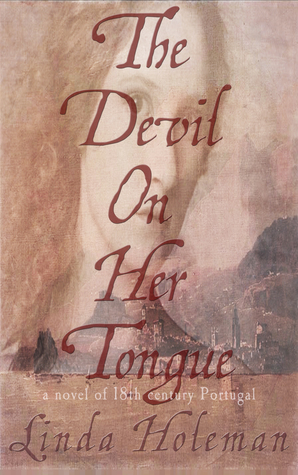
The ebook is published via Traverse Press and will be available for download from Amazon and iTunes in approximately ten days time!
I've been excited to announce it on Goodreads and also reveal the cover...
For more updates, you can find me on Twitter! @LindaHoleman. Look forward to connecting over there too!
April 13, 2015
A fun Q&A!
I'll admit I had to really think before answering a number of them. Let me know if you're curious about any of my responses, here or tweeting @LindaHoleman - or have any of your own questions.


