Jamie Parsley's Blog, page 24
December 26, 2021
The Feast of St. Stephen/1 Christmas
December 21, 2021
+ Well, I have to say that today is actually a pretty sad day.
I
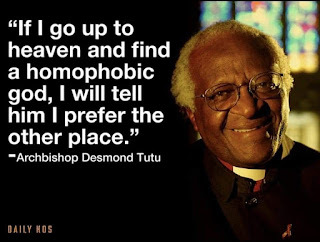
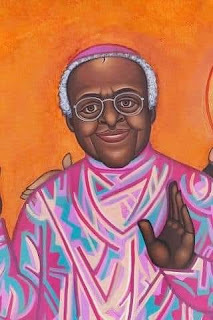
n case you haven’t heard, Archbishop Desmond Tutu, the great former Archbishop of Capetown, South Africa, died this morning at age 90.He was of course, a great leader, not only in the Church, but also in the non-violent movement that helped to topple the Apartheid Government of South Africa.
But he was so much more than that.
But more than that, he was a towering figure in the Anglican Church, and especially among the more Catholic minded Anglicans and Episcopalians.
And he was a prophet—a true modern prophet.
As I have mentioned many times over the years, Archbishop Tutu was one of my heroes.
And the world and the Church are a bit more empty today without his presence among us.
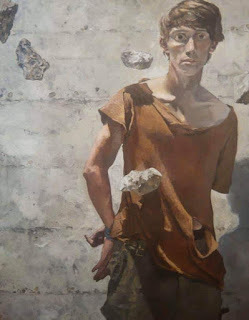
It’s appropriate that Archbishop Tutu died today, on the feast of Sty. Stephen.
St. Stephen was a person who could look into the future, who held strongly to his Christian faith, who was loudly able to proclaim that faith and live that faith out by his very life, very much like Archbishop Tutu did.
Those first founders of our church were a smart bunch.
They also were a prophetic bunch.
Naming our church after St. Stephen was a smart thing.
Of course, the reason they came to this name was because St. Stephen’s Episcopal Church in Casselton, ND had just closed in 1956.
And we inherited much of their furnishings.
But St. Stephen was a great saint for us to have as our patron.
In the Orthodox and Roman traditions of the Church, the patron saint of a church is viewed as more than just a namesake.
They are seen as special guardians of that congregation.
And so, it is especially wonderful to celebrate a saint like St. Stephen, who is our guardian and who is, no doubt, present among us this morning, with that whole communion of saints, who is always present with us at worship, along with Desmond Tutu as well.
St. Stephen, of course, was the proto-martyr of the Church
“Proto” is the important word here.
Proto means, essentially, first.
He was the first martyr of the Church.
He was the first one to die for his open proclamation of Christ.
He also is considered a proto deacon in the church.
He is a special patron saint of deacons—and of all people who share a ministry of servitude to others.
What better saint can we claim as our patron that St. Stephen?
He was the first to do many things.
Just like we, as a congregation, have been the first in doing many things.
St. Stephen, in his stance on a few issues, was not always popular obviously.
There is a reason they dragged him out and stoned him.
Archbishop Tutu as well was outspoken.
He too stood up and spoke out against injustice and racism and homophobia and all the things we at St, Stephen’s have stood up and spoken out against.
Archbishop Tutu once said,
"If you are neutral in situations of injustice, you have chosen the side of the oppressor. If an elephant has its foot on the tail of a mouse and you say that you are neutral, the mouse will not appreciate your neutrality."
Well, we certainly have never been shy here at St. Stephen’s for speaking out against injustice in our own Diocese or in the world.
And speaking out and making the stance we have in the past and the reaction we have received from others, let me tell you, I can feel for both St. Stephen and Archbishop Tutu.
So, again, talk about two perfect saints for us to celebrate today.
So yes it’s appropriate that this congregation that has been the first to do many things, is named after St. Stephen.
When we look back at our 60 year history, just think for a moment about all those people who came through the doors of this church.
Think about how many of those people who have been hurt by the larger Church.
Think about how many were frustrated with the Church.
And more often than not, their relationship with God suffered for it.
But they came here searching.
Searching for true religion.
Searching for a welcoming and open community.
So what this true religion?
I see the Episcopal Church, as specifically St. Stephen’s, as making a real solid effort at true religion.
For me, St. Stephen’s personifies in many ways, what true religion is.
The Church should be like a dinner party to which everyone is invited.
And St. Stephen’s has always been the place that knows this one blunt fact: The only thing there is no room for in true religion is for those who cannot love each other.
St. Stephen’s is a place very much like a family.
We don’t always choose the people God has brought into our lives, but we always—ALWAYS—have to love them.
So what is true religion?
True religion begins and ends with love.
We must love one another as God loves us.
True religion begins with the realization that, first and foremost, God loves each and every one of us.
When we can look at that person who drives us crazy and see in that person, someone God loves wholly and completely, then our relationship with that person changes.
We too are compelled to love that person as well.
Love is the beginning and end of true religion.
Certainly, St. Stephen’s has always been a place of love.
Love has never been a stranger here.
Love has been offered to God not only on this altar, but among the pews and in the undercroft and in the narthex and in the parking lot.
And most importantly in the lives of our members out in the larger world.
That Love that God has commanded us to share has went out from here into all the world.
We who are gathered here have been touched in one way or the other by the love that has emanated from this place and these people.
We are the fortunate ones—the ones who have been transformed and changed by this love.
We are the lucky ones who have—through our experiences at St. Stephen’s—been able to get a glimpse of true religion.
But our job now is not to cherish it and hold it close to our hearts.
Our job now is to turn around and to continue to share this love with others.
Our job is take this love and reflect it for everyone to see.
So, in a very real sense, we, at St. Stephen’s, are doing what that first St. Stephen did.
We are striving to do what Archbishop Tutu did.
We have set the standard.
We have embodied who and what both St. Stephen the Martyr and Desmond Tutu stood for.
Even when it was not popular.
Even when people felt it wasn’t time.
We have stood up again and again for what we have felt is our mission to accept all people in love.
We have journeyed out at times into uncharted territory.
And most importantly, we have, by our love, by our compassion, by our acceptance of all, been a reflection of what the Church—capital C—is truly capable of.
We do all we do as St. Stephen and Archbishop Tutu did it—with our eyes firmly set on Christ, with our lips singing and praying, with our head held high, with love in heart, even if stones and rocks are falling around us.
We do so affirmed in our many ministries.
It is an amazing time to be at St. Stephen’s.
Those poor founders of our church would only be amazed at what this congregation they envisioned in 1956 would one day be.
As we begin another year of ministry, let us do with gratitude to God and one another in our hearts.
Let us shake off the negativity and those nagging doubts that may plague us.
And let us, like St. Stephen and Desmond Tutu, be strong and firm in our faith in God and our convictions of serving others in love.
And may our God—that source of all love, that author and giver of all good things—continue to bless us with love and goodness.
May we continue to flourish and grow.
And may we continue to venture bravely forward in all that we continue to do here among us and throughout the world.
Let us pray.
Holy God, when St. Stephen looked up, he saw you, seated in glory and majesty on your throne with Jesus your Son at your right hand of God; when Desmond Tutu spoke out against the powers of darkness that prevailed, he was sustained and strengthened by you; we are grateful for Stephen and Desmond and the vision they gave us of what awaits us in your Kingdom. Help us to embody their spirit of strength and vision as we do the ministry you call us to do in this world, and let us, like them, come to that heavenly Kingdom that you have allowed us to see today. We ask this in Jesus' holy Name. Amen.


December 25, 2021
Christmas
December 25, 2021
+ Last night at Mass, I mentioned that I’m a church geek.
You know how you know I’m a church geek?
Because one of my greatest pleasures in life is doing the Christmas morning Mass.
Yes, I know.
Christmas Eve is beautiful.
Really beautiful.
But Christmas morning.
I don’t know.
It’s just just…something so very special.
I think that is what Christmas Day is all about.
This sense of it all being just…a bit more holy and complete.
For me, that captures perfectly this strange feeling I have experiencing this morning how I LOVE a Christmas Day mass
And now—this morning— Christmas is here.
This morning, we celebrate the Light.
And we celebrate the Word.
Our Gospel reading for today is one of my favorites.
In it we hear:
I n the beginning was the Word, and the Word was with God, and the Word was God.
In the beginning, God was at work in our lives.
God was speaking to us form the beginning
And God continued to speak to us.
Today, we celebrate this Word that has been spoken to us—this Word of hope.
This Word that God is among us.
When we think long and hard about this day, when we ponder it and let it take hold in our lives, what we realized happened on that day when Jesus was born was not just some mythical story.
It was not just the birth of a child under dire circumstances, in some distant, exotic land.
What happened on that day was a joining together—a joining of us and God.
God met us half-way.
God came to us in our darkness, in our blindness, in our fear—and cast a light that destroyed that darkness, that blindness, that fear.
God shed Light on us.
And God—in the Word—spoke to us.
In both ways, God reached out to us.
God didn’t have to do what God did.
But by doing so, God showed us a remarkable intimacy.
But, how do we respond to God’s reaching out to us?
We respond by being the ones through whom God is born again and again in this world.
We need to bring God into reality in this world again and again.
We need to be the conduits through which God comes to this world.
We need to be God’s Light
We need to speak God’s Word of love.
Why?
Because God is a God of love.
Because we are loved by God.
Because we are accepted by God.
Because we are—each of us—important to God.
We are, each of us, broken and imperfect as we may be some times, very important to God.
Each of us.
And because we are, we must love others.
We must give birth to our God so others can know this amazing love as well.
Knowing this amazing love of God changes everything.
When we realize that God knows us as individuals.
That God loves us and accepts each of us for who we are, we are joyful.
We are hopeful of our future with that God.
And we want to share this love and this God with others.
That is what we are celebrating this morning.
Our hope and joy is in a God who comes and accepts us and loves us for who we are and what we are—a God who understands what it means to live this sometimes frightening uncertain life we live.
This is the real reason why we are joyful and hopeful on this beautiful morning.
This is why we are feeling within us a strange sense of longing.
This is why we are rushing toward our Savior who has come to visit us in what we once thought was our barrenness.
Let the hope we feel tonight as God our Savior draws close to us stay with us now and always.
Let the joy we feel tonight as God our Friend comes to us in love be the motivating force in how we live our lives throughout this coming year.
God is here.
God is in our midst today.
God is so near, our very bodies and souls are rejoicing.
And God loves us.
That is what we are experiencing this day.
In Christ, God’s Love came to us.
In Christ, God’s Love became flesh and blood.
In Christ, God’s Love became human.
And in the face of that realization, we are rejoicing today.
We are rejoicing in that love of God personified.
We are rejoicing in each other.
We are rejoicing in the glorious beauty of this one holy moment in time.
So, let us rejoice.
And let us be glad.
God is with us.
And it is very good!
Let us pray.
Holy God, you are with us. You are present in our midst. And we rejoice in the Presence for which we have longed for for so long. Fill us this morning with true joy, with true hope, so that we can share this joy and hope with others. In Jesus' name, we pray. Amen.
December 24, 2021
Christmas Eve
December 24, 2021
+ Most of us, throughout our lives, find ourselves clinging to life’s little pleasures.
Occasionally, something fills us with such joy and happiness, that we find ourselves just wanting to savor that moment, cling to it, hope it will never end.
They don’t happen often.
And we can’t make those moments happen by own concentrated will, even if we try really hard.
Even more often, we don’t ask for those special moments.
They just happen when they’re meant to happen and sometimes they come upon us as a wonderful surprise.
Now, having said this, I’m going to admit something to you that will come as no surprise I’m sure.
I really am a church geek.
I love being in church.
I always have.
And the best times to be in church were always Christmas Eve and Christmas morning.
One of life’s pleasures for me has always been Christmas Eve.
And more specifically a Christmas Eve Mass.
Some of my most pleasant memories are of this night and the liturgies I’ve attended on this night.
Another of life’s small pleasures is Christmas morning.
I especially enjoy going to church on Christmas morning.
The world seems to pristine, so new.
And one of my greatest pleasures as a priest, is to celebrate the Eucharist with you on this evening that is, in its purest sense, holy.
And tomorrow morning I am looking forward to celebrating the Eucharist right here.
I also understand the tendency we all have of getting caught up in society’s celebration of Christmas.
It’s easy to find ourselves getting a bit hypnotized by the glitz and glamour we see about us.
I admit I enjoy some of those sparkly Christmas displays.
And you know what I really enjoy?
I sometimes really enjoy a good Christmas commercial on TV.
I’ve probably shared this before at Christmas, but there’s one old commercial that instantly put me back into my childhood Christmases.
I’m sure you’ll remember it too.
If not, just look it up on Youtube.
It begins with the Ink Spots are singing “I Don’t Want To Set The World On Fire”
Two very attractive people are in a very modern (by 1980s standards), sparsely decorated office overlooking the Transamerica Building in San Francisco.
The man introduces himself as “Charles,” the woman as “Catherine.”
Charles asks Catherine: “Do you mind if I ask you a personal question?”
“No,” Catherine says. “What is it?”
We never find out what that question is because, just then, the shadow of a Leer jet flies across the Transamerica building.
Then announcer comes says: “Share the fantasy. Chanel no. 5”
For some reason, that commercial was synonymous with Christmas for me as a child.
So much so, that later, I had to buy my mother a bottle of Chanel no. 5.
That might sound sweet, but every since then, guess what she wants ever few years?
Chanel no. 5.
Let me tell you, that stuff’s expensive!
Now, I know that that commercial had nothing at all to do with Christmas.
There wasn’t a Christmas tree in sight in that commercial.
Nothing about it spoke of Christmas.
And yet, for me, it WAS Christmas.
And I remember the joy I felt that first time I bought my mother that bottle of Chanel No. 5.
So, yes, I understand how easy it is to fall to the temptations of what the world tells us is Christmas.
But what I think happens to most of us who enjoy those light and airy aspects of Christmas is that we often get so caught up in them, we start finding ourselves led astray into a kind of frivolousness about Christmas.
We find ourselves led off into a place where Christmas becomes fluffy and saccharine and cartoonish.
Christmas becomes a kind of billboard.
That, I think, is what we experience in the secular understanding of Christmas time.
The glitz and the glamour of the consumer-driven Christmas can be visually stunning.
It can capture our imagination with its blinking lights and its bright wrapping, or, as in the case of the Chanel No. 5 commercial, it can do it without any bright lights and wrapping.
But ultimately it promises something that it can’t deliver.
It promises a joy and a happiness it really doesn’t have.
It has gloss.
It has glitter.
It has a soft, fuzzy glow.
But it doesn’t have real joy.
The Christmas we celebrate here tonight, in this church, is a Christmas of real joy.
But it is a joy of great seriousness as well.
It is a joy that humbles us and quiets us.
It is a joy filled with a Light that makes all the glittery, splashy images around us pale in comparison.
The Christmas we celebrate here is not a frivolous one.
It is not a light, airy Christmas.
Yes, it has a baby.
Yes, it has angels and a bright shining star.
But these are not bubblegum images.
A birth of a baby in that time and in that place was a scary and uncertain event.
Angels were not chubby little cherubs rolling about in mad abandon in some cloud-filled other-place.
They were terrifying creatures—messengers of a God of Might and Wonder.
And stars were often seen as omens—as something that could either bring great hope or great terror to the world.
The event we celebrate tonight is THE event in which God breaks through to us.
And whenever God beaks through, it is not some gentle nudge.
It is an event that jars us, provokes us and changes us.
For people sitting in deep darkness, that glaring Light that breaks through into their lives is not the most pleasant thing in the world.
It is blinding and painful.
And what it exposes is sobering.
That is what God does to us.
That is what we are commemorating tonight.
We are commemorating a “break through” from God—an experience with God that leaves us different people than we were before that encounter.
What we experience is a Christmas that promises us something tangible.
It promises us, and delivers, a real joy.
The joy we feel today, the joy we feel at this Child’s birth, as the appearance of these angels, of that bright star, of that Light that breaks through into the darkness of our lives, is a joy that promises us something.
It is a teaser of what awaits us.
It is a glimpse into the life we will have one day.
It is a perfect joy that promises a perfect life.
But just because it is a joyful event, does not mean that it isn’t a serious event.
What we celebrate is serious.
It is an event that causes us to rise up in a joyful happiness, while, at the same time, driving us to our knees in adoration.
It is an event that should cause us not just to return home to our brightly wrapped presents, but it should also send us out into the world to make it, in some small way, a reflection of this life-changing joy that has come into our lives.
Tonight, is one of those moments in which true joy and gladness have come upon us.
That’s what makes this a holy time.
So, cling to this holy moment.
Savor it.
Hold it close.
Pray that it will not end.
And let this joy you feel tonight be the strength that holds you up when you need to be held.
T
onight, when we gaze upon this Christ Child, God own very Son, we realize, God has reached out to us.In Christ, God has touched us.
In Christ, God has grasped our hands.
With Christ, our hands have been laid on God’s heart.
This is what it is all about.
God is here, among us.
This feeling we are feeling right now is the true joy that descends upon us when we realize God has come to us in our collective darkness.
And this joy that we are feeling is because the Light that has come to us will never, ever darken.
Let us pray.
Holy God
, you are with us. You are present in our midst. And we rejoice in the Presence for which we have longed for for so long. Fill us this evening with true joy, with true hope, so that we can share this joy and hope with others. In Jesus' name, we pray. Amen.
December 19, 2021
4 Advent
Dec. 19, 2021
Luke 1:39-49 (50-56)
+ A few weeks ago, our very own Jean Sando preached a sermon about the Blessed Virgin Mary at one of our Wednesday evening Advent Masses.
It was a wonderfully defiant sermon (I don’t know if Jean viewed it as defiant, but it was).
In it, she addressed some very important issues regarding Mary, especially the Church’s continued view of her as “meek and mild.”
We are definitely being inundated by “meek and mild” Marys right now!
Jean also preached about the view of Mary as some perfected virginal being that is held as an unattainable ideal of what good Christian women should be.
I agreed entirely with Jean’s sermon because she and I shared many of the same frustrations about Mary.
But I do have to say that my frustrations might even be deeper, especially since, as you all know, I have a very deep devotion to the Blessed Virgin Mary.
She has always been a major presence in my spiritual life.
And I know the psychologists here will have a field day with this, but since my mother died, my devotion to Mary has definitely deepened.
In fact, for me, Mary has always represented much, much more than just the meek and mild image the Church sometimes saddles upon her.
For me, I think my devotion and love for Mary actually encompasses seeing her as a symbol of feminine aspects of divinity—of God.
Which I think is also very much a reason the Church does the whitewash they sometimes like doing on Mary.
To approach the feminine aspects of divinity is frightening to the Church.
As you know, I have been studying Judaism for the last several years, and for my it has definitely deepened my own Christian faith.
I have found that to truly understand the Gospels and the life of Jesus, I need to sometimes to see what was happening not through Greek, Hellenistic eye (which we as Westerners tends to do all the time), but rather to look at all scripture through a Hebrew lens.
At times it’s hard to do so.
But it has also been revolutionary for me, as a Christian and as a priest.
Seeing the Gospel stories through a Hebrew lens is sometimes difficult.
But one aspect of doing so has been the approach to the scriptures we find about viewing representatives of God as divine beings.
For early Hebrews people it was not uncommon for them to see the people who they believed were sent to them from God as being divine.
We find this most profoundly in the story of Jacob and the Angel.
The angel, of course, is not God, but God’s representative.
But for Jacob, as he wrestled with angel, he felt he was truly wrestling with God.
Certainly, for the followers of Jesus, who saw him as a very unique representative of God, they saw him as divine.
And in him, they saw God.
More importantly, they saw in Jesus a loving, compassionate and wildly inclusive God.
It did not take much of a leap for the Greeks to take this Hebrew view of God’s representative and formulate something as complex and mysterious as the Trinity.
We’re not going to get into all of that today.
But we can see God’s divinity in other people in scripture as well.
And when we start seeing that divinity in someone like Mary, we are offered a glimpse of something particularly unique.
We are offered a glimpse of the feminine aspects of God, which we find in the story of Mary.
This is important, because, as Jean pointed out in her sermon, there are not many opportunities in scripture for women to act in the capacity of representative of God.
But we do see it uniquely in Mary.
Bear with me.
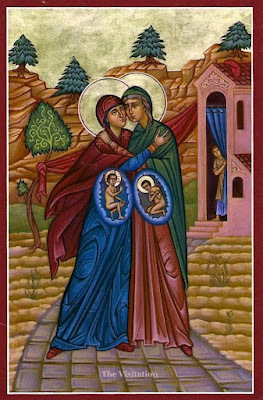
In our Gospel reading for today, we find Mary and Elizabeth rejoicing in the ways in which God was working their lives.
Mary, carrying within her flesh God’s very Son—the Messiah made flesh, this very unique representative of God—carrying divinity within her— and Elizabeth, carrying within her flesh John, who would later be the Baptist calling to us from the Jordan River (and also, might I add, a representative of God to many people as well), meet and there is a spark between them.
What is that spark?
That spark is God’s energy at work in them.
What I have always loved about this story from scripture is that neither Mary nor Elizabeth probably can fully comprehend what is going on within them.
How could they?
How could any of us?
But what they do know is that something strange and wonderful and HOLY has happened.
God is happening. And in a big way!
Mary, the young virgin, has conceived under mysterious and certainly scandalous circumstances and is about to give birth.
And Elizabeth, the barren elderly woman, also is also about to give birth.
Neither should be having a child.
Yet, somehow, they both are.
These sort of things don’t happen in ordinary life.
Certainly nothing even remotely like this happened before in the lives of these two Jewish women.
But now, here they were, greeting each other, both of them pregnant with children that came to them by miraculous means.
And, although they might not fully understand why or how, they feel real hope and joy at what has happened to them.
The full expression of this hope and joy finds it voice in the words of Mary’s song.
“My soul glorifies the LORD
and my spirit rejoices in God my Savior.”
And in doing so, Mary truly does embody God.
The divine dwells within her in a very unique and beautiful way.
And because God does, she becomes something more.
She becomes a unique representative of God.
Certainly she is a representative of God to Elizabeth.
And certainly she continues to be to many of us even today.
But, of course, it can’t just end there.
It is isn’t enough that we simply look to others a representatives of God.
Essentially this is our goal as well.
It is our goal to embody God’s Light and Love and Presence within each of us as well.
We are—each of us—called to be unique representatives of God in this world.
We, like Mary, we are called to carry within us Jesus.
Wherever we go, we should bear Jesus within us.
Like Mary, God’s own gift to us dwells within us.
Like Mary, God’s very Word dwells within us!
And like Mary, we should be able to rejoice as well, at this fact that Jesus dwells within us.
We too should sing to God, in joy and hope:
“My soul glorifies the LORD
and my spirit rejoices in God my Savior.”
Now, we have been hearing the Magnificat quite a bit this morning, as we should.
This “Song of Mary” is one of my beautiful scriptures we have.
But before we think this is some nice little song to God from innocent teenage girl, I would like you to remember how radical it really is.
How defiant it is.
And how political it is.
Oh, you didn’t catch Mary’s political jab?
It’s right there:
“…[God] has scattered the proud in their conceit.
[God] has cast down the mighty from their thrones, *
and has lifted up the lowly.”
This is no meek and mild teenager!
For her, living there, in that time, that says a lot.
And it’s echoing pretty loudly for us here and now.
God, we realize from this Song of Mary, does not let the “proud” in their conceit last long in that place.
We know that God has no problem casting down the mighty from their thrones.
Mary’s song of defiance is our song of defiance today as well.
And that, even in our defiance, we are full of hope in a God truly does do these things.
Like both Mary and Elizabeth, this hope and joy we are experiencing later this week should be coming up from our very centers.
This is really how we should approach the miracle that we commemorate on Friday evening and Saturday.
Like Mary and Elizabeth, we will never fully understand how or why Jesus—God’s very Son made flesh, Gods divinity—has come to us as this little child in a dark stable in the Middle East, but it has happened and, because it happened, we are a different people.
Our lives are different because of what happened that evening.
That is how God works.
God loves us enough that everything we have feared will be taken from us.
And that is what we are rejoicing in, along with Mary and Elizabeth, this morning.
Our true hope and joy is not in brightly colored lights and a pile of presents until a decorated tree.
Our true hope and joy is not found in the malls or the stores.
Our hope and joy is not found in Amazon or Etsy (though I really love both Amazon and Etsy)
Our true hope and joy does not come to us with things that will, a week from now, be a fading memory.
Our hope and joy is in that Baby who, as he draws near, causes us to leap up with joy at his very presence.
Our hope and joy is in that almighty and incredible God has send us the Messiah, the anointed One, the One promised in the prophecies of scripture, in this innocent child, born to a defiant teenager in a dusty distant land.
Our hope and joy is in a God who send us this amazing gift—who has sent us LOVE—real and abiding LOVE--with a face like our face and flesh like our flesh.
LOVE embodied.
This is the real reason why we are joyful and hopeful on this beautiful winter morning—on this last Sunday of Advent.
This is why we are feeling within us a strange leaping.
This is why we rushing toward God’s very Messiah who has come to visit us in what we once thought was our barrenness.
Let the hope we feel today as Jesus draws close to us stay with us now and always.
Let the joy we feel today as Jesus comes to us in love be the motivating force in how we live our lives throughout this coming year.
Let us greet God’s chosen One with all that we have within us and let us welcome him into the shelter of our hearts.
And, with Mary, let us sing to the God who sends Jesus to us with all our hearts,
“My soul glorifies in you, O Lord,
and my spirit truly rejoices in you, O God, my Savior.”
Let us pray.
Our souls glorify you, O God. Our spirits truly do rejoice in you. Visit us, here in this place in which we dwell, and live within us. Let us carry your Presence with us wherever we may go. And go with us wherever we may go. Let us be your representatives to those who need your love, your light, your radical, all-inclusive love, now and always. We ask this in the Name of Jesus our Messiah who is about to dawn like the Sun into the night of our souls. Amen.
December 12, 2021
3 Advent
Gaudete
December 12, 2021
Zephaniah 3.14-20; Philippians 4.4-7; Luke 3.7-18
+ In the name of God, Creator+ Redeemer and Sanctifier. Amen.
You know what day it is…
It’s one of those rose Sundays of the Church year.
And you all know: I love the rose Sundays.
And I really LOVE Gaudete Sunday!
Today, of course, we light our pink candle on the Advent wreath
We bedeck the church—and your priest and deacon—in rosy pink.
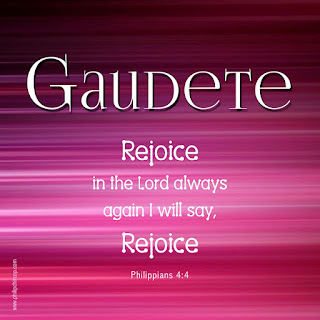
It’s so called because in our reading from Paul’s letter to the Philippians, we hear this:
“Rejoice in the Lord always; I will say rejoice”
That word, “Rejoice,” in Latin is Gaudete.
As we draw closer and closer to Jesus’ birth, we find ourselves with that strange, wonderful emotion in our hearts—joy.
It is a time to rejoice.
It is a time to be anxious and excited over the fact that, in just a few weeks time, that Messiah, God’s chosen One, will come to us.
“Rejoice” is our word for the day today.
We are joyful because, as Paul says today, “the Lord is near”
Or, in Latin (since we’re on kind of a Latin kick this Gaudete Sunday) Dominus propus est.
Now that scripture that we just hear from Paul in his letter to the Philippians is just chock full of Gaudete goodness.
Doesn’t that sound like a great vegan candy bar – Gaudete Goodness?
Every line of that reading is filled with joy and hope.
“Do not worry about anything, but in everything by prayer and supplication let your request be made known to God.”
When I was teenager, my mother gave me as a present a leather scroll with this scripture from Philippians chapter 4 written on it.
Now, not a lot of people know this about me, but I was a worry wart as a kid—a fact that, in turn, worried by mother tremendously.
I have shared with some of you how even as an 8 year old, I had terrible stomach ulcers.
Well, that’s what worrying does to people, even 8 year olds.
Actually, I think, it wasn’t so much the worrying that was the issue.
It was the anxiety, which is all bound up in that whole sense of worrying.
And anxiety, as I have shared with many of you, is still an issue in my life.
Any of you who served with me as a Warden know firsthand the strange world of Fr. Jamie’s Anxiety.
So, back then, my mother chose this scroll specifically for me.
Do not worry, that scroll reminded me over and over again.
I still have that scroll on my wall.
And every time I read the scroll, and as I pondered it again for today, I realize how powerful this scripture really is:
Do not worry about anything.
But pray.
And if we do, if we release all our anxieties to God, God will reward us with a peace beyond all understanding.
Now that sounds very easy.
That sounds wonderful.
But let me tell you; it’s a harder than you think.
A LOT harder than it seems.
To live into that sense of trust of God takes hard, hard work.
And it takes a lot of hard personal work to get beyond one’s own anxiety and worry.
But we can do it.
The problem with most of us however is that we hear this scripture so much that we forget it’s real meaning.
But it IS powerful.
And important.
And if we truly take it to heart, if we truly live it out, we realize it captures incredibly the spirit of this Sunday.
Don’t worry.
God is in control.
God is here, with us.
All will be well.
Or as Blessed Julian of Norwich tells us again and again,
“All will be well and all will be well and all manner of things will be well.”
Now, of course, we love Advent.
Everybody seems to love Advent.
But, today, we get something just a bit different.
Advent is a time for us to slow down, to ponder, to think.
And… to wait.
It is a time to be introspective, as well—to think about who are and where we are in our lives.
So, in the midst of pondering and waiting and introspection, we also find ourselves looking forward.
Now, for some of us, that doesn’t seem all that exciting.
The future can be a scary place.
And what it holds may not be some wonderfully hopeful thing.
Many people have a real fear of the future.
Yesterday, my dear friend Leslie Rorabeck was ordained to the Priesthood at St. Andrew’s-on-the-Sound Episcopal Church in Wilmington, NC.
And this morning she is celebrating her first Mass.
I was supposed to be there as a presenter, but of course I’m grounded due to my perforated lung (thanks, Covid).
But 20 or so years ago, when I was enduring a very difficult time in my life, when I had just been laid off from a job and was about diagnosed with cancer, Leslie was there for me.
And one thing we often did as we ate lunch together at the Plains Art Museum (remember the great cafeteria they had back in the day?) or at the Radisson, was look forward.
I was not yet ordained, and when I was sick there were many moments when I was not sure I would be a priest.
But Leslie and I would talk hopefully about the future even despite the present ugliness of life, and look forward to the days when those current issues would be behind us.
I looked forward in those days to being a priest.
And Leslie too often talked about one day becoming a priest.
At the time she had two small girls (she would later have a son too) and the priesthood for her seemed like some very distant mirage.
She too would endure some very difficult situations in the years to come.
But here we are, 20 years later, being the priests we imagined ourselves being way back in those seemingly endlessly dark days.
That is how God works in our lives sometimes.
It is important to remember that, as followers of Jesus, that in doing such introspection, in looking forward, we do not despair.
We do not lose heart.
To go back to what Paul says to us today in our Epistle reading:
“Do not worry about anything…”
And in that incredible reading we hear this morning from the Hebrew scriptures, we hear so many truly wonderful and hopeful things from the prophet Zephaniah.
“Do not fear, O Zion [we are Zion];
Do not let your hands grow weak.”
Why should we not fear?
Because, according the prophet, God is in our midst.
God is with us.
And God “will rejoice over you with gladness,
[God] will renew you with [God’s] love.”
But God is even clearer in this reading about how well cared for we are by God.
God exults over us “with loud singing.”
God will “remove every disaster” from us, so that we will not bear reproach.
God will deal with all our oppressors, and the lame will saved and the outcast gathered in.
God will change whatever shame we have to praise
These words of God are being spoken to each of us today:
God says, “I will bring you home at the time when I gather you:
for I will make you renowned and praised
among all the peoples of the earth
when I restore your fortunes
before your eyes, says the Lord. “
Those words are being spoken to us this morning, by the God who loves us and cares for us.
We are well taken care of by our God.
And if that doesn’t give you a true reason to rejoice today, I hate to say it: nothing will.
So, rejoice today.
God loves you.
God cares for you.
God exults in you with loud singing and rejoices over you with gladness.
This is why we rejoice today.
See, the future is nothing to fear.
Our future in God is a future of joy.
Joy in the simple fact that God really does love us and delights in us and rejoices as well in us.
That real and beautiful joy is why we are decorated in rose this morning.
That is why, in our pondering, we are pondering joy—even joy in the midst of sadness or loneliness or depression, or pandemics.
That is why, even despite all that happened in our lives, all that is happening at the moment and that will happen, we can still rejoice.
Gaudete.
So, do not fear but do good in this world, even if you’re depressed or lonely or sad or not feeling well.
Do good in this world even if you have a perforated lung.
Do good even if the world does not, at times, do good to us.
Do good always.
Because in doing good, we are doing what God wants us to do in this world.
In doing good, we embody true joy.
This is what Gaudete Sunday is all about—rejoicing.
Living in joy.
Letting joy reign supreme in us.
Letting joy win out over fear and uncertainty.
Being joyful in our love for God and for others.
We—followers and disciples of Jesus—bear good fruit when we are joyful in our God.
How can’t we?
That joy that we carry within us fertilizes the good things we do.
It motivates us.
It compels us.
It gives us purpose and meaning in our lives.
We, as Christians, must embody that joy.
We must live that joy in all we do and say and are.
Today, we must, in all honesty, proclaim:
“Gaudete!”
Rejoice.
And live that Gaudete out in our very existence, in the ministries we do, in how we deal with others.
So, let Gaudete be more than just what we say or do one Sunday a year.
Let it be our way of life as we await the Messiah’s presence coming to us.
St. John and St. Paul are both right:
The Lord is near!
The Lord is near.
God has sent the Messiah to us to redeem us.
So…let us do good.
And when we do we will truly know that “peace of God which surpasses all understanding….”
We too, as embodied joy, will be bearing good fruits.
Let us pray.
Holy God of promise, God of expectation and longing, we look forward with expectation to your coming among us. We look forward to your presence in our midst. Help us in our loving. Help us as we anxiously await you so that we do not fall victim to anxiety and worry. Remind us again and again in our lives that we ultimately have nothing to fear or to worry about for you are in control and your goodness, in the end, is always triumphant. Help us as we joyously wait, and reward us well for our loving; in Jesus’ Name we pray.
November 28, 2021
1 Advent
November 28, 2021
Luke 21.25-36
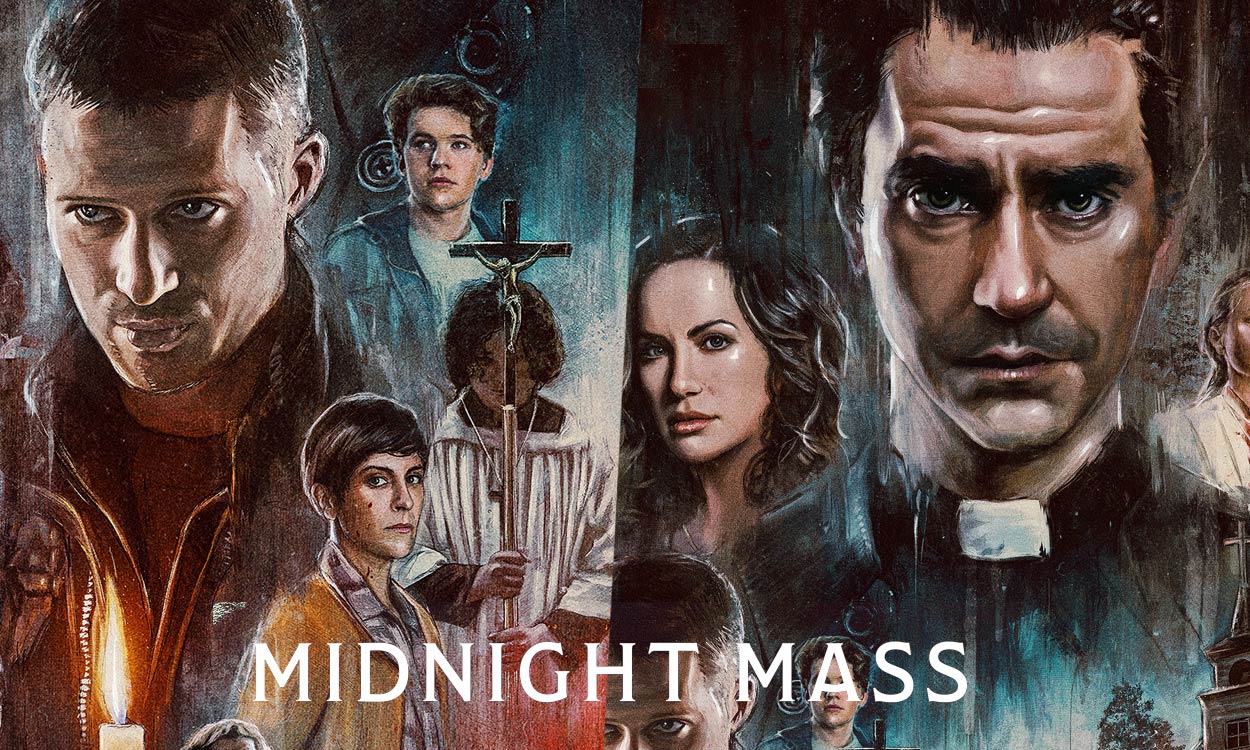
+ So, recently I have had several people ask me about a recent series on Netflix called Midnight Mass.
It’s an interesting series—not one that I recommend to everyone.
If you like vampires, then I would recommend it.
But it’s a series that deals with a lot more than just vampires.
There’s whole lot going on in it.
Essentially the story is this:
There’s a Catholic Church on a small island off the coast of what may possibly be New England (though it was actually filmed off the coast of British Columbia).
A mysterious young priest comes to the church, and soon there are miracles being performed.
But also there are strange incidents of another sort.
Hundreds of dead cats wash up on the shore.
Well, as the series goes on, it becomes clear that the priest is actually some kind of vampire.
And that he is actually the old priest who had served the parish for decades, but who, while in the Holy Land, got bit by this demon-like vampire and became young again.
Are you still with me?
Anyway, he comes back and soon promises everyone in the village eternal life.
He does this as he presents the demon to them.
The demon by the way is wearing a chasuble.
Most of the people enthusiastically choose this supposed “eternal life” the priest offers.
But to have it they must drink from a chalice, which if full or rat poison.
This causes them to die—briefly—but when they “resurrect” they are vampires who then feast on those who choose not to drink from the chalice.
While this is all going on, a few of the survivors go around the island and set fire to all the buildings and cut ropes to the boats, essentially trapping the vampires on the island.
Spoiler alert here.
The sun begins coming up, and the vampires all realize they have been trapped with nowhere to hide from the sun, which if course will kill them.
When they realize that there is nowhere to go to hide from this light, they suddenly start realizing what they have done.
They begin apologizing to each other.
They realize the choice they made was a wrong one.
They realize that they have, in their blood hunger, killed their own loved ones.
They despair over their choice of darkness.
And they know that they haven’t chosen immortality at all.
They have chosen eternal death.
And so, as they await in in a very literal hell, with flames of fire burning behind them with nowhere to go, they turn toward the horizon and wait.
As the sun starts rising, they stand around on the shore looking toward the dawning light, while singing “Near My God to Thee,” which is then cut off abruptly in mid-verse as the sun rises into the sky and the vampires all burn into ashes.
The end.
It’s a very bleak series.
It deals with faith and doubt and atheism and bad Christians.
The director Mike Flanagan actually wrote the series as a way to deal with his own upbringing as a Catholic and his later atheism.
But…
And here’s my take on it…
I think it also deal with the our society as it is right now.
People who purposely choose the darkness, clothed as Christianity, even when a demon in a chasuble stands before them.
They drink from the cup of the perverse, false, bastardized version of Christianity, and for a moment, feel powerful.
They have, for a moment, what they have been promised.
But it’s an empty promise.
In the dark it seems good,
But with the light, it is seen for what it is—darkness and evil.
And the exactly opposite of true Christianity.
Now, I take it one step further—being the priest I am.
The sun, for me, as a Christian, represents Christ and Christ’s Light.
As a Christian I see that most uniquely God and creation coming together.
But, seen through the eyes of the Muslim sheriff and his son, who seen making their prostrations on the beach as the sun comes up, it is the Light of Allah.
It is the Light of God.
It is the Light of Divinity.
It is the Light of all that is good and true and beautiful.
It is this divine Light that shines on them in their vulnerability.
And they cannot escape this true Light.
And, although their darkness, their evil choice is destroyed in the process, they themselves are redeemed by the Light.
And to me, what seems like a bleak and horrible ending is actually one that is redemptive and weirdly glorious.
It is a microcosm of the paradox of Christianity.
And it is a microcosm of the choice so many of our fellow Christians have made in our recent history.
To me, even though this series takes place over Lent and Easter (appropriately enough), it also speaks loudly to us on this first Sunday of Advent.
Because Advent is all about that waiting.
It is all about that looking into the dark.
It is all about living in the dark.
It is about sometimes choosing the dark.
But realizing, as we do, that the Light is about dawn into our lives.
And that light will burn away not only the darkness of the world, but also the very darkness of our hearts and souls.
And that burning is, we know, oftentimes painful and brutal.
But ultimately it is purifying and redemptive.
In Advent, we recognize that darkness we all collectively live in without God.
But we realize that darkness doesn’t hold sway.
Darkness is easily done away with what?
With light!
And so, in Advent, we are anticipating something more—we are all looking forward into the gloom.
And what do we see there? We see the first flickers of light.
And even with those first, faint glimmers of light, darkness already starts losing its strength.
We see the first glow of what awaits us—there, just ahead of us.
That light that is about to burst into our lives is, of course, for us as Christians Christ’s divine Light.
The Light that came to us—that is coming to us—is the sign that the Kingdom of God is drawing near, as Jesus says in today’s Gospel.
It is near.
Yes, we are, at times, stuck in the doom and gloom of this life.
Yes, sometimes we have actually chosen the darkness and gloom over the Light and Beauty of our faith.
But, we can take comfort today in one thing: as frightening as our life may be, as terrible as life may seem some times and as uncertain as our future may be, what Advent shows us more than anything is this: we already know the end of the story.
We might not know what awaits us tomorrow or next week.
We might not know what setbacks or rewards will come to us in the weeks to come, but in the long run, we know how our story as followers of Jesus ends.
Jesus has told us that we might not know when it will happen, but the end will be a good ending for those of us who hope and expect it.
God has promised that, in the end, there will be joy and happiness and peace.
In this time of anticipation—in this time in which we are waiting and watching—we can take hope.
To watch means more than just to look around us.
It means to be attentive.
It means, we must pay attention.
It means waiting, with held breath, for that redemptive Light of Christ to break upon us.
So, yes, Advent is a time of waiting and it is this waiting—this expectant anticipation—that is so very important in our spiritual lives.
Advent is a time of hope and longing.
It is a time for us to wake up from our slumbering complacency.
It is a time to turn from the darkness.
It is a time to wake up and to watch.
The Light of Christ is close at hand.
And we should rejoice in that fact.
We, like those people in Midnight Mass, should be standing here, awaiting that Light.
Or as we hear Jesus tell us in today’s Gospel,
“Now when these things begin to take place, stand up and raise your heads, because your redemption is drawing near.”
We must stand up and raise our heads, even if we know what the reality of that Light is.
Even if we know what the Light will do to us who sometimes live in darkness.
It is near.
The Light of Christ is so close to breaking through to us that we can almost feel it ready to shatter into our lives.
So, in this anticipation, let us be prepared.
Let us watch.
Christ has come to us and is leading us forward.
This dazzling Light of Christ is burning away the fog of our tears and hunger and

violence and is showing us a way through the darkness that sometimes seems to encroach upon us.
This is the true message of Advent.
As hectic as this season is going to get, as you’re feeling overwhelmed by all the sensory overload we’ll all be experiencing through this season, remember, Watch.
Take time, be silent and just watch.
For this anticipation—this expectant and patient watching of ours—is merely a pathway on which the Divine Light can come among us as one of us.
This morning, instead of a final prayer I’m going to do something else.
Last Wednesday evening at our Thanksgiving Eve Mass Deacon John opened and closed his sermon with a hymn.
It was so beautiful!
Well, in honor of the series Midnight Mass, we too are going to close my sermon today with a hymn.
As we stand here, waiting either joyously or apprehensively for the Light of Christ to dawn, let us also sing, “Nearer My God to Thee.”
Nearer, my God, to thee, nearer to thee!
E'en though it be a cross that raiseth me,
still all my song shall be,
nearer, my God, to thee;
nearer, my God, to thee, nearer to thee!
2 Though like the wanderer, the sun gone down,
darkness be over me, my rest a stone;
yet in my dreams I'd be
nearer, my God, to thee;
nearer, my God, to thee, nearer to thee!
3 There let the way appear, steps unto heaven;
all that thou sendest me, in mercy given;
angels to beckon me
nearer, my God, to thee;
nearer, my God, to thee, nearer to thee!
4 Then, with my waking thoughts bright with thy praise,
out of my stony griefs Bethel I'll raise;
so by my woes to be
nearer, my God, to thee;
nearer, my God, to thee, nearer to thee!
5 Or if, on joyful wing cleaving the sky,
sun, moon, and stars forgot, upward I fly,
still all my song shall be,
nearer, my God, to thee;
nearer, my God, to thee, nearer to thee!
November 21, 2021
Christ the King
November 21, 2021
Daniel 7.9-10, 13-14; Revelation 1.4b-8; John 18.33-37
+ In the name of God, Creator, Incarnate Word and Holy Spirit. Amen.
I think I’ve shared this confession with you before.
If not, I’m sure it doesn’t come as a great surprise to any of you who know me.
I love horror movies.
And not just any horror movies.
I’m not fond of the slasher, violence-for-the-sake-of-violence kind of horror film.
(I’m vegan, after all).
My favorite kind of horror films are the apocalyptic ones.
You know the ones.
The ones like the M. Night Shyamalan film Signs, which deals with an Episcopal priest, played by Mel Gibson, who has lost his faith just before aliens invade the earth and attempt to wipe out the human race.
Or another Shyamalan’s film (which was universally panned by critics), The Happening, about a neurotoxin released by plants and carried by wind that caused people to commit suicide in mass numbers and in very gruesome ways.
I also really love zombie films (I LOVE The Walking Dead).
I have a whole theological system of thought worked out regarding the zombie genre.
I won’t inflict that on you today, but I really believe these zombie films and give voice to the fear we all have inherently of death.
All of these deal with the issue of (as the old R.E.M. song proclaimed) it’s-the end-of-the-world-as-we-know-it kind of situation.
These films took on greater meaning for me during the pandemic than they ever did at any other time in my life.
In fact, some of you might remember, in the midst of the darkest days of the pandemic, that R.E.M. song I just references, “it’s the end of the world” was actually being played quite a bit.
Because it kind of felt like it.
And it was weird.
And it was nothing at all like these films.
I was expecting zombies and aliens.
Instead I got weeks and weeks of quarantine.
Now, for me, I know, that my love of this genre has its roots firmly in my faith life as a Christian.
I know that sounds weird, but…
In the secular world, these films and books are called apocalyptic, or post-nuclear, or whatever.
But we Christians have a term for this kind of genre as well.
It’s a wonderful Greek word, eschatology.
Eschatology, to quote my trusty old Westminster Dictionary of Theological Terms, is defined as: the study of the “last things” or the end of the world.
It goes on to further define it in this way: Eschatology means “Theological dimensions including the second coming of Jesus Christ and the last judgment.”
These films, seen, for me, through the lens of my being a Christian and as a priest, are very eschatological.
But for others they might not seem so.
At first glance, there is a bleakness to them—a hopelessness to them.
For the most part, these films and movies show a kind of evilness—whether it be supernatural evilness or natural evilness, or even extraterrestrial evilness—as prevailing.
In most of the films that deal with these issues, the perspective is almost always from a seemingly non-Christian perspective.
This world of bleakness and purposelessness it seems, on the surface anyway, wholly void of God or Christ.
Which actually makes them even more bleak and horrendous.
But for me, I don’t see it as clearly.
For me, I love them because they jar me.
They jolt me out of my comfort zone and make me imagine—for a few hours anyway—what the end of the world might be like.
These films also make me ponder and think about God’s place in these situations.
For most of us here this morning, we feel fear and shock over situations that have actually happened—in our own lives, in our collective lives.
For those of us who never gave eschatology a second thought, we found ourselves at times in our lives wondering, even for a moment, if this might actually be the end of the world.
I’m sure many of us felt this way at times during the pandemic.
Certainly we, in the Church, get our glimpses of the end of the world in our liturgical year.
As you probably have guessed, I always love preaching about beginnings.
Beginnings are always a time of hope and joy.
They hold such promise for everything that can possibly happen.
But occasionally, we all must face the fact that, in the Church and in our lives, we also must confront the ending.
Now for most people, the ending is a time to despair.
Certainly that is where I think so much of the darkness in those zombie films come from.
That is where we are when really horrible, bad things happen in our lives.
Despair reigns.
And when despair reigns, it is a bleak time.
The ending is a time to dig in one’s heels and resist the inevitable.
But for us—for Christians—we don’t have that option.
For us, the ending is not the ending at all.
It is, in fact, the beginning.
For us, what seems like dusk to others, is actually dawn, though we—and they— sometimes can’t recognize it.
Today is an ending as well, in our Church calendar,
Today, of course, is Christ the King Sunday.
It is the last Sunday in that very long, green season of Pentecost.
Last Wednesday, after Mass, I hung up the beautiful green chasuble Jean Sando made and my green stole with a bit of sadness.
It will be a while before I wear them again.
But, it’s not so bad.
Next week, Deacon John and I get to wear the Sarum blue (which I really enjoy wearing).
Today, for the Church, it is New Year’s Eve.
The old church year of Sundays ends today.
The new church year begins next Sunday, on the First Sunday of Advent.
So, what seems like an ending today is renewed next week, with the coming of Advent, in that revived sense of longing and expectation that we experience in Advent.
So even then, at that beginning, we are still forced to look ahead.
We are forced to face the fact that the future does hold an ending that will also become our beginning—a beginning that will never end.
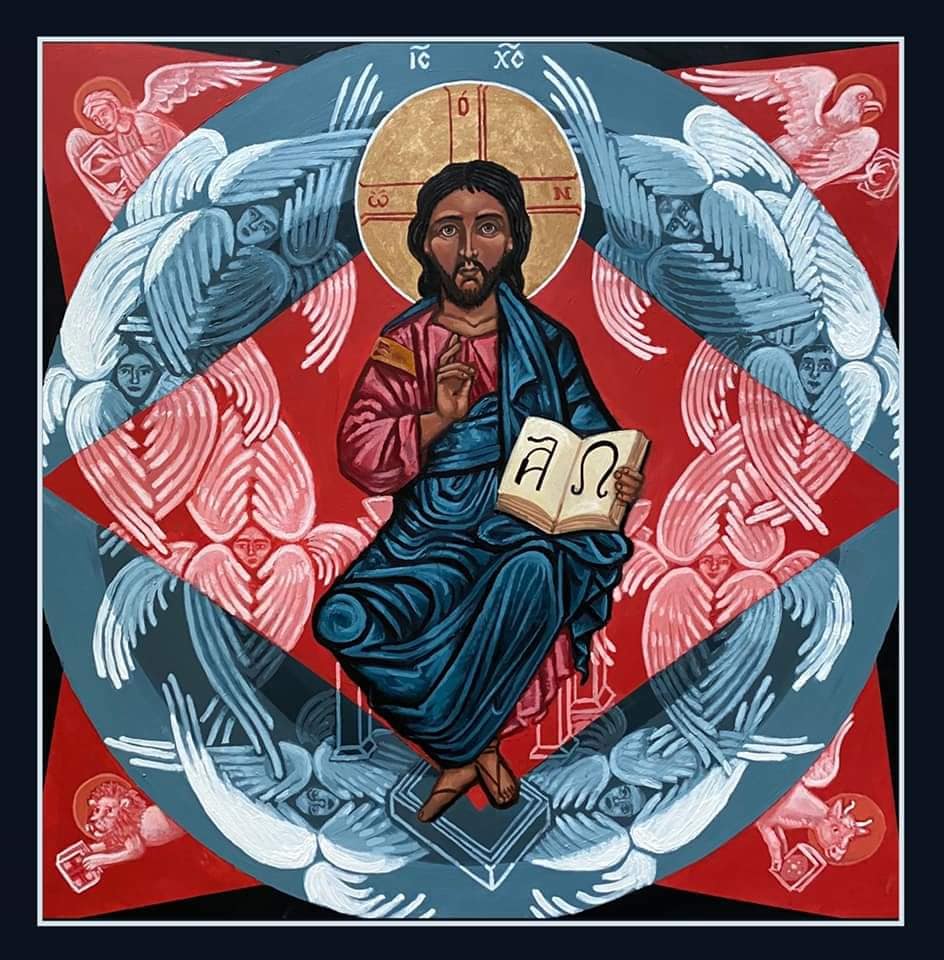
And as we face that future, we do so on a Sunday in which we proclaim Christ to be King.
That is very important!
But this feast, strangely, is not an ancient feast by any sense of the word.
This past week Nadia Bloz-Weber, one of the great contemporary Christian writers, posted this on her Twitter account:
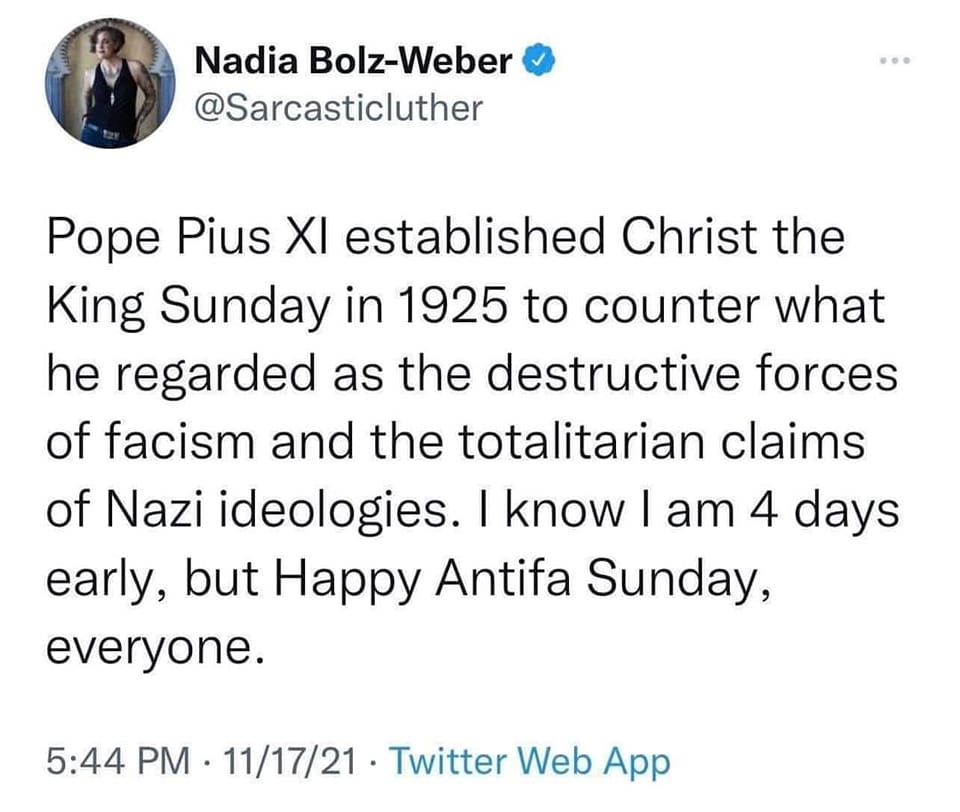
And that is very important to us on this Sunday for those of us who stand up and speak out against fascism again and again.
Because what do we hear Jesus say to us in our Gospel reading for today?
He says,
For this I was born, and for this I came into the world, to testify to the truth. Everyone who belongs to the truth listens to my voice
Everyone who belongs to the truth listens to my voice.
Well, in an age when we are told that truth doesn’t matter, when facts don’t matter, when truth can be manipulated, and when facts are twisted to suit conspiracy theories and fascist agendas, when people believe that JFK jr, is going to return and become our new Vice President,when someone can short 3 people and say it was self-defense while claiming to be an EMT, then yes, these words speak loudly to us on this Sunday.

When we are told that we must put one nation first over all other nations, we are ignoring who our King is.
We are ignoring where our loyalties lie.
Because what we know and celebrate on this Christ the King Sunday is that, yes, Christ is King.
And his Kingdom—that Kingdom that we, as his followers and children of his God, are citizens of before any other nation, what we are called to bring forth into this world, is not a kingdom of the privileged.
It is not a Kingdom of those in power—of those who use power and abuse power.
It is not a Kingdom ruled by people who have purposely deceived themselves, who have deliberately wanted to believe lies rather than the truth, because the lies fit their own agendas.
Christ’s Kingdom is a Kingdom of real truth.
Christ himself is the Way, the TRUTH and the Life
It is, in fact, a kingdom of the outcasts, the marginalized, the downtrodden.
It is a kingdom of those people, uplifted by their King.
It is a celebration of not only who Jesus was, but who Jesus is and will be.
It is a celebration of the fact that, although it seems, at times, as though this Kingdom of God is not triumphant, at times it seems, in fact, to have failed miserably, we know that ultimately, in all that we do, in our ministries, it does break through into this world again and again.
Which causes me to return to those horror moves I love so much.
I said earlier that it seems they are absent of God.
But that isn’t entirely true.
In many of those films, there always comes a moment of grace.
There is always a moment when it seems evil prevails—when darkness has encroached on the earth and human kind is about to be obliterated.
In the case of the zombie films, it is more profound.
It seems as though death—symbolized by these walking “living dead”—has prevailed over life itself
It is in that moment, that there is a turning point.
The heroes of these films, at this point, usually recollect themselves.
They find an inner strength.
They find some kind of renewed hope that motivates them to rise up and to fight back.
And, in the end, they are able to push back—or, at the very least, hold at bay—the forces of darkness, death and evil.
For us with eyes that see and ears that hear, that hope is very Christ-like.
For those of us who are afraid or despairing, we find Christ in those rays of hope that break through into our lives.
It is very similar to the hope we are clinging to in this moment as we enter Advent—that time in which the light of Christ is seen breaking into the encroaching darkness of our existence.
At moments it seems that the Majesty of God is over and done with.
But, as we know, in our ending is our beginning.
And the Kingdom of God always triumphs, again and again.
Goodness always prevails over evil and darkness.
Always!
We—the inheritors of that Majesty—are the ones who, in turn, birth that Majesty.
We bring that Kingdom into our midst whenever we love radically, we welcome radically, when we accept radically, when we serve radically in the Name of Jesus.
We do so when we become the conduits of hope.
That’s why we celebrate this incredible day on this last Sunday before Advent begins.
Advent, after all, is that time for us to look toward the future, and to hope, even if that future might seem bleak.
It is a time for us to gaze into the dark and the haze and all that lies before us and to see that it is not all bleak, it is not all frightening and scary, but that, in the midst of that darkness, there is a glimmer of light.
This Sunday and the season we are about to enter, is all about the future and hope.
We, on this Christ the King Sunday, are looking forward into the darkness of the future and eternity, and we are seeing the rays of light shining through to us.
For us, as followers of Jesus the King, as inheritors of the Kingdom of Jesus’ God, it is a hope.
It is a time to remind ourselves that we must continue bringing about that Kingdom of God into our midst.
So, let us rejoice on this Christ in Majesty Sunday.
Let us move forward into our future together.
Let go together into that future with confidence and joy and gladness at all the blessings we have been given and that we are able to give to others.
And let us to do all that we do, as Paul tells us today in his letter to the Colossians, “made strong with all the strength that comes from [God’s] glorious power…”
Let us pray.
God of majesty, we rejoice today in your Kingdom, which is about to dawn upon us. You who rule our hearts, who reign over our souls, give us hope and a true and living joy for the future. Even as lies and half-truths and conspiracy theories overwhelm us at times, help us to see the truth in all things, and help us to live into the truth required of us to be followers of Jesus your Son, the King of Kings and Lord of Lords. May your Light break into our midst and, by doing so, break the powers of darkness that encroach upon us and let us live, now and always, in that Light in which you live and reign, through Jesus our King. Amen.
November 14, 2021
25 Pentecost
November 14, 2021
Daniel 12.1-3; Mark 13:1-8
+ Today is, of course, Stewardship Sunday, as you have heard many times already.
And yes, it is a time for us to pray about and ponder and seriously consider giving.
That is what the “theme” of Stewardship Time is.
Giving.
It is time to give money.
It is time to give of our time and talent and selves.
And yes, it’s never exciting for us to think about the fact that we need these things.
We do need money.
We need people helping out—stepping up to the plate.
And we do need people in general.
We need the presence of people in our midst. In the pews.
After all, we do have much to celebrate here.
I don’t think any of us—myself included—can fully appreciate what has happened and what is happening here at St. Stephen’s. Even now. Even as we struggle through the end of the pandmeic.
We are a unique and amazing congregation.
There is no getting around that fact.
There are not many places quite like St. Stephen’s.
We are eclectic.
We are a bit outside the norm.
I often call our congregation the Island of Misfit Toys.
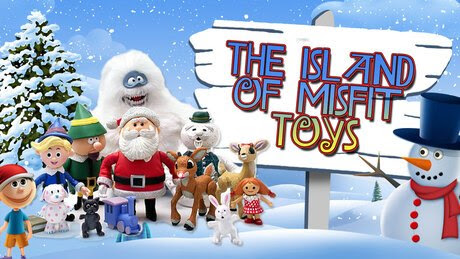
Because, let’s face it—we are!
Most of us have come here from other congregations in which we have experienced some hardship or oppression or some very unchristian-like behavior.
For most of us, that is why we are here at St. Stephen’s.
Many came here because this is a refuge from the difficulties of other religious communities.
And I am very grateful today for us being that place.
We are also a place in which people are not only welcomed but included because of who they are.
This is who we are and who we always have been.
We are the ones always, it seems, on the forefront.
We were on the forefront of women being fully included in the Church back in the 1970s—the first parish in this diocese to have women Lay Readers, women wardens, women acolytes and w0men clergy.
We were on the forefront of the LGBTQ+ movement, being the first to welcome and include queer people, to marry queer people, to fight for the ordination of queer people. (Sadly, we didn’t win some of those battles at the time)
And we are still on the forefront.
We are on the forefront of liturgical reform.
We are the first parish in this diocese to be officially granted permission to use gender-neutral language in our liturgy in reference to God.
(even though we had been doing at our Wednesday night Mass for twelve years).
For some that might not seem very important, or even all that radical.
But it is.
It is important to see that to move forward we sometimes have to change the way we speak about God, that we need to recognize that male-only references to God are not only theologically incorrect, but painful to many people in our pews.
This is who St. Stephen’s has always been.
But, as we all know, sometimes being the ones who are in the forefront of the battle is not a pleasant place to be.
Guess who gets shot at first?
Being the mavericks, being the rebels, being the prophets means that we are going to be ostracized.
We are going to be mistreated.
We are going to shunned and rejected.
Even by our friends, by our colleagues, by our fellow followers of Jesus.
It shouldn’t be that way.
But, sometimes, it just is.
And we have known that here at St. Stephen’s.
And that is why we are working so hard for reconciliation with a diocese that often turned its back on us.
Often we have felt that we are alone in our battles.
But, we knew, in our core, that we were only leading the way, and sometimes doing so means it takes a while for others to catch up.
In that interval, it can be lonely.
But we knew.
We saw.
We believed.
I have asked you many times over the years to trust.
Trust me.
Trust our leadership.
And you know what?
You really have.
And you can see that we were not led down the wrong path.
We were following the right path all along.
That is why we need this Stewardship time.
It is a time for us to look long and hard at what it means to be a part of our parish of St. Stephen’s.
It means supporting it with our financial resources, so we can continue to stand up, to speak out, to be the place we have always been.
For some that means tithing—giving from the 10% of one’s income.
For others it means giving from what you can give.
But it is knowing full well that we can’t do these things—like being a vital, vibrant and outspoken parish in this community, in the Church and the world especially in the days that are to come following this pandemic, without financial resources.
We as a parish need to be prepared for serving a post-pandemic world, whatever that might be.
But it means more than that to.
It means giving of our time and our talents.
It means that we don’t just get to sit on our hands and let others do the work.
Or just let Fr. Jamie do the work.
It means we also stand up and speak out.
It means we also roll up our sleeves and make sure the day-to-day stuff still happens.
It means even...(hint, hunt) learning how to work the Livestream so it’s not only Fr, Jamie doing it all the time????
It means serving as an acolyte, or on altar guild, or in coffee hour, or singing as cantor, or playing music with James, or finding ways to make the church beautiful.
It means giving of our artistic talents.
Or it means being a loud and proud representative of St. Stephen’s in the community and the world.
It means serving on our annual Pride in the Park, or speaking out against unfair treatment of refugees, or protesting racists and white supremacists.
It means going to the mosque and help clean up after hate crimes are committed against our Muslim sisters and brothers.
Because all of that is who we are too.
And have always been.
In our reading from the book of Daniel we hear,
“Those who are wise shall shine like the brightness of the sky, those who lead many to righteousness, like the stars forever and ever.”
We, this congregation, are wise and we have led the way.
This is where we are on this Stewardship Sunday in 2021.
When anyone asks me what the “secret” of our success at St. Stephen’s is, I always say, two things.
First, the Holy Spirit.
We do need to give credit where credit is due.
Without God’s Spirit at work here among us, we would not be where we are and doing what we’re doing.
And second, it is because we welcome and accept radically and we love radically.
Now, there are a lot of churches that are “welcoming.”
I actually don’t know of very many churches that aren’t “welcoming” in some way.
But it’s not enough just to welcome.
We must take it one step further.
In welcoming, we must include.
We must be without judgement in our welcoming and in our including.
This is not rocket science.
This is not quantum physics.
This is basic Christianity that we are doing here at St. Stephen’s.
Basic Christianity, as we live it out here at St. Stephen’s, is nothing more than following Jesus in his commandment to love God and love one another as we love ourselves.
To love God.
And to love others.
Love here means what?
It means treating people well.
It means respecting one another.
It means not treating some people differently than others just because they are not like us.
It’s just that.
It is a matter of living out our Baptismal Covenant.
It is a matter of saying that all people deserve the rites of this Church fully and completely.
It is a matter of LOVE.
I know. I preach it all the time. And you’re probably sick of hearing me preaching about love all the time. But…you know what?
That’s tough.
You knew what you were getting when you hired me.
I’m not gonna stop preaching about love.
Because it DOES make a difference.
To love—fully and completely.
To love—radically and inclusively.
I personally don’t see that as all that radical.
I see that being as fairly basic.
In today’s Gospel, we hear Jesus saying, “you will hear of wars and rumors of wars.”
These words of Jesus are especially poignant for us on this particular Sunday, as we find our selves still living with a pandemic that’s should be behind us.
But the pandemic IS coming to an end.
And we need to be prepared for a post-pandemic world that looks different than the world we knew before the pandemic.
There is a lot of talk about people not coming back to church.
In fact, I hear stories of congregations that are truly struggling right now, that are truly despairing over their losses.
We, luckily, have not had that issue.
Nobody has left us.
And we still have new people coming, new people joining, new people wanting to be a part of this amazing place we are here.
We are still doing baptism and weddings and welcoming new members.
But the warm bodies in the pews are not what they were before the pandemic.
And for some people that is a reason to despair.
Jesus uses a very interesting description of these fears and pains—images of war and their rumors.
He calls them “birth pangs.”
And I think “pang” is the right word to be using here, for us at this moment.
Yes, it may be painful to be going through what we may be going through as a congregation when we face an uncertain future and when we stand up for what we believe is right.
The future may seem at times bleak.
But it is not war.
And it is not death throes.
It is merely the birth pangs of our continued growth.
It is change.
As I said, we continue to have new members and new faces in our pews.
We continue to grow.
So, yes there will be wars and rumors of wars.
There may be moments when even our congregation may seem to be going through lean times.
It sure felt like that in April 2020!
There may be times when people just simply want to avoid that Island of Misfit Toys.
But the words we cling to—that we hold on to and find our strength in to bear those pangs—is in the words “do not be alarmed.”
Do not be alarmed.
There is a calmness to Jesus’ words.
This is all part of our birth into new life, he is explaining to us.
Because in the end, God will always triumph.
And God always provides!
If we place our trust—our confidence—in God, we will be all right.
Yes, we will suffer birth pangs, but look what comes after them.
It is a loving and gracious God who calms our fears amidst calamity and rumors of calamity.
Our job is simply to live as fully as we can.
Our job is to simply do what we’ve always been doing here at St. Stephen’s.
To welcome, to accept, to love. To not judge.
We have this moment.
This holy moment was given to us by our loving and gracious God.
This Stewardship Sunday is about us doing our part as a congregation that does the things St. Stephen’s does.
Yes, it means giving money to this congregation—it is about something as simple as tithing—of giving that 10%
Or whatever we can give.
That is important.
It also means giving of our time and energy.
On Stewardship Sunday, we are being asked to serve as well.
To serve in love.
To serve fully as Jesus calls us to serve and love.
So, let us, on this Stewardship Sunday, continue to do what we’ve been doing.
Let us welcome radically and love radically.
Let us give of ourselves fully, so that we can serve fully.
Let us, in our following of Jesus, continue to strive to be a powerful and visible conduit of the Kingdom of God in our midst.
It’s already happening.
Right now.
Right here.
In our midst.
It is truly a time in which to be grateful and joyous.
Let us pray
Lord God, surround us with your love. Be present in this congregation of St. Stephen’s as you have been since our beginning. Let us know your presence among us—in the sacrament, in your Word and in those who have gathered here in your name. Let your Spirit be present with us and in all we do. Open our hearts and our minds to the goodness you are doing here through us. And let us respond appropriately. Bless St. Stephen’s with abundance and with the resources needed to do the ministries we do here. Let us, in turn, do good. Let peace reign here with us, even as wars and rumors of wars rage about us. And let your words of assurance to us to not be alarmed calm our hearts and souls so that we can do what you have called us to do. In the name of Jesus your Son, we pray in confidence. Amen.
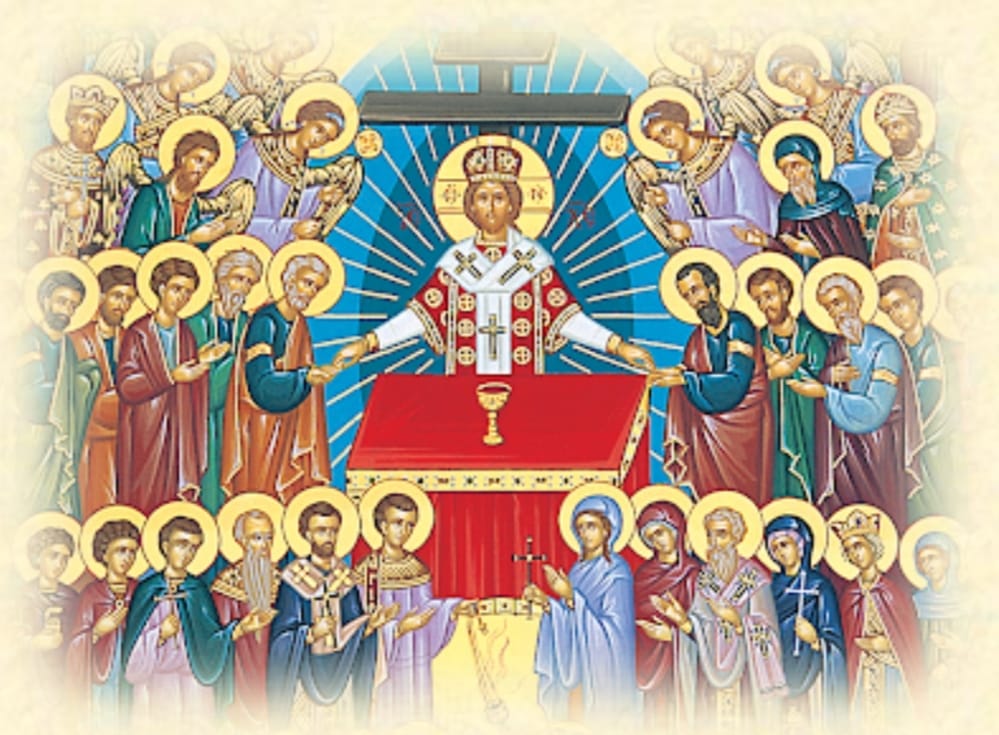
November 7, 2021
All Saints Sunday
November 7, 2021
Revelation21.1-6a
+ I don’t make any secret about it.
I love this feast day of All Saints.
After all, from the very earliest days of the Church, this has been one of the highpoints of the Church year.
It’s an important feast.
And it’s important not just because we honor saints like St. Stephen, or Mary the mother of Jesus, or St. Joseph or any of the other saints.
It’s an important days because it is a day in which we honor also those loved ones in our own lives who have gone before us.
This feast and the onewe celebrate on November 2, All Souls, are very important feast days for me.
And because both of them came this week, I am going to touch on both.
Actually, I’m kind of guilty of combing the two.
One is about the SAINTS.
One is about all the rest.
I’m just going to talk about everyone because, let’s face it: you know I’m an unapologetic Universalist.
So, this is a time for us to honor our departed loved ones, as well as those we might not know about.
Honoring and praying for those who have departed this life has always been an important part of the Church.
But, there are some branches of the Church that do not honor saints in this manner.
Being brought up Lutheran, we didn’t make a big deal about the saints.
If you come from a Methodist or a Presbyterian background, there have been some honoring of those who have gone before, but prayers are usually not prayed forthem.
After all, the departed are where they are, and our prayers aren’t going to make much of a difference.
But, for us, as Anglicans and Episcopalians, honoring saints and praying for those who have died has always been a part of our tradition.
You will hear us as Episcopalians make a petition when someone dies that you won’t hear in the Lutheran Church, or the Methodist Church or the Presbyterian Church.
When someone from our parish dies, you will probably get a prayer request from me that begins, “I ask your prayers for the repose of the soul of…”
Praying in such a way for people who have passed has always been a part of our Anglican tradition, and will continue to be a part of our tradition.
And I can tell you, I like that idea of praying for those who have died.
But, and this is important: we don’t pray for people have died for the same reasons other branches of Christianity do, like Roman Catholicism.
In other words, we don’t pray to free them from “purgatory,” as though our prayers could somehow change God’s mind.
(Prayer does NOT change God’s mind)
So, why do we Episcopalians pray for the departed?
Well, let’s see what the Book of Common Prayer says.
I am going to have you pick up your Prayer Books and look in the back, to the Catechism.
There, on page 862 you get the very important question:
Why do we pray for the dead?
The answer (and it’s very good answer): We pray for them, because we still hold them in our love, and because we trust that in God's presence those who have chosen to serve him will grow in his love, until they see him as he is.
Now, that is a great answer.
We pray that those who have chosen God will to grow in God’s love.
So, essentially, just because we die, it does not seem to mean that we stop growing in God’s love and presence.
But, if you’re still not convinced, here’s an answer from no greater person than one of the treasures of the Anglican Church—none other than C.S. Lewis.
Lewis wrote,
"Of course I pray for the dead. The action is so spontaneous, so all but inevitable, that only the most compulsive theological case against it would deter me. And I hardly know how the rest of my prayers would survive if those for the dead were forbidden. At our age, the majority of those we love best are dead. What sort of intercourse with God could I have if what I love best were unmentionable to [God]?”
I think that is wonderful and beautiful.
And certainly worthy of our prayers.
But even more so than this definition, I think that, because we are uncertain of exactly what happens to us when we die, there is nothing wrong with praying for those who have crossed into that mystery we call “the nearer Presence of God.”
After all, they are still our family and friends.
They are still part of who we are.
This morning we are commemorating and remembering those people in our lives who have helped us, in various way, to know God.
As you probably have guessed from the week-long commemoration we have made here at St. Stephen’s regarding the Feasts of All Saints and All Souls, I really do love these feasts.
What this feast shows me is what you have heard me preach in many funeral sermons again and again.
I truly, without a doubt, believe that what separates those of us who are alive here on earth, from those who are now in the “nearer presence of God” is truly a very thin one.
And to commemorate them and to remember them is a good thing for all us.
I do want us to think today long and hard about the saints we have known in our lives.
And we have all known saints in our lives.
We have known those people who have shown us, by their example, by their good, that God really does work through us.
And I want us to at least realize that God still works through us even after we have departed from this mortal coil.
Ministry in one form or the other, can continue, even following our deaths.
That quote from Lewis is a prime example.
Even now, almost 60 years after his death, Lewis can still preach to us.
His words still reveal God’s truths to us.
He is still doing ministry, even now.
Hopefully, we can still, even after our deaths, do good and work toward furthering the Kingdom of God by the example we have left behind.
For me, the saints—those people who have gone before us—aren’t gone.
They haven’t just disappeared.
They haven’t just floated away and dissipated like clouds out of our midst.
No, rather they are here with us, still.
They join with us, just as the angels do, when we celebrate the Eucharist.
For, especially in the Eucharist, we find that “veil” lifted for a moment.
That belief comes to us from the Eastern Orthodox Church.
In this Eucharist that we celebrate together at this altar, we find the divisions that separate us are gone.
We see how thin that veil truly is.
We see that death truly does not have ultimate power over us.
That is the way Holy Communion should be.
It’s not just us, gathered here at the altar.
It’s the Communion of all the saints.
In fact, before we sing that glorious hymn, “Holy, Holy Holy” during the Eucharistic rite, you hear me say, “with angels and saints and all the company of heaven we sing this hymn of praise.”
That isn’t just sweet, poetic language.
It’s what we believe and hope in.
In these last few years, after losing so many people in my family and among myclose friends, I think I have felt their presence most keenly, at times, here at this altar when we are gathered together for the Eucharist than at any other time.
I have felt them here with us.
And in those moments when I have, I know in ways I never have before, how thin that veil is between us and “them.”
You can see why I love this feast.
It not only gives us consolation in this moment, separated as we are from our loved ones, but it also gives us hope.
We know, in moments like this, where we are headed.
We know what awaits us.
No, we don’t know it in detail.
We’re not saying there are streets paved in gold or puffy white clouds with chubby little baby angels floating around.
We don’t have a clear vision of that place.
But we do sense it.
We do feel it.
We know it’s there, just beyond our vision, just out of reach and out of focus.
And “they” are all there, waiting for us.
They—all the angels, all the saints, all our departed loved ones.
So, this morning—and always—we should rejoice in this fellowship we have with them.
We should rejoice as the saints we are and we should rejoice with the saints that have gone before us.
In our collect this morning, we prayed that “we may come to those ineffably joys that you have prepared for those who truly love you.”
Those ineffably joys await us.
They are there, just on the other side of that thin veil.
They are there, in that place we heard about in our reading today from Revelation.
That place in which God “will dwell with them as their God;”
Where we will be God’s peoples
They are there were God wipes “every tear from their eyes.”
Where “Death will be no more;
mourning and crying and pain will be no more,
for the first things have passed away."
Let us pray.
God of eternity, you are nearer to us than we sometimes realize; help us to see with the eyes of our faith that the division between this world and eternity is in fact a thin one, and that around us we are surrounded by the host of witnesses who have faithfully run their race and are now rejoicing in their reward; and may we too come to enjoy that place of light and peace, where signing and pain are no more but life everlasting; in Jesus’ name, we pray. Amen.
October 31, 2021
23 Pentecost

October 31, 2021 Deuteronomy 6:1-9; Mark 12:28-34
+ In the name of God, Creator, Redeemer and Sustainer. Amen.
I know that I have preached many times here about my frustration with scriptures with which we must engage on a Sunday morning.
You have seen me approach this pulpit with a weary shuffle sometimes.
Or, worse…when there is a scripture I just don’t want to preach about…well, I don’t.
And that’s all right.
I can do that, as a preacher.
After all, sometimes that’s exactly what the Holy Spirit seems to be telling me.
But…today…
Oh, glorious day!
Today! Today!
What do we get?
We get IT.
Capital I.
Capital T.
THIS is what it’s all about.
These scriptures are the penultimate scriptures.
And these scriptures are where the rubber meets the road in our journey as followers of Jesus.
You don’t believe me?
If you don’t, you have not been listening to me over these last 13 years.
Because, the message we find in our reading from both the Hebrew scriptures and the reading we hear in our Gospel reading…well, this is the summation of it all.
This is the point I keep coming back to, again and again.
And if you take nothing else away from all those sermons I’ve shared from this pulpit, please, PLEASE! take this away.
What we find in our Gospel reading for today is everything I believe as a Christian, as a priest, as loved Child of God and as a passionate follower of Jesus.
That question I am asked, again and again, is what must I do to be “saved.”
And right here, right there in our readings today, is the answer.
Let’s examine the story.
A scribe comes before Jesus after listening to the Sadducees arguing amongst themselves.
Now, a scribe, as we know by now, was important in Jesus’ day.
They are the ones who transcribed the scriptures by hand.
There were no printing presses.
There was no publisher of scriptures.
And scribes took their job very seriously.
Every word they inscribed, every jot and dash, was sacred, and they treated it as such.
In the process of their transcribing, they also became somewhat of experts on scripture.
How could you not?
Day after day of transcribing these words and commandments and sacred stories.
So, this scribe comes to Jesus and asks which of the commandments is foremost.
And Jesus, seemingly without hesitation, says,
“The first is, ‘Hear, O Israel: the Lord our God, the Lord is one; you shall love the Lord your God with all your heart, and with all your soul, and with all your mind, and with all your strength.’ The second is this, ‘You shall love your neighbor as yourself.’ There is no other commandment greater than these.”
Now, Jesus is not just a cherry-picked scripture, mind you.
Jesus and every good, loyal Jewish male there on that day—including the scribe and those Sadducees— was required to pray a prayer every day.
Jesus no doubt prayed that prayer that morning, as did every devout Jewish male (and no doubt many Jewish females) listening to him that day.
The prayer is a recitation of the scripture from Deuteronomy.
It’s called the Shema
“Hear, O Israel, the Lord our God is one Lord; and you shall love the Lord your God with all your heart, and with all your soul, and with all your might.”
The Shema is, of course, the summary of the Law.
It is a summary of all belief for a Jew.
But Jesus doesn’t just leave it there in regards to what is the foremost commandment.
Because let’s face it.
If it was just that—just loving God with all our hearts—well, we could do that right now, right at home. All the time.
But no.
Jesus doesn’t let it stand there.
He then adds the second commandment.
‘To love one’s neighbor as oneself,’
The scribe is impressed with this answer, and tells him that this is more important than burnt offerings and sacrifices.
That’s a big statement from a scribe.
It is then that Jesus makes a huge statement hidden right inside a seemingly simple statement.
“You are not far from the kingdom of God.”
In fact, they were all so amazed by this, they didn’t even bother to question him anymore.
So, what must we do to be saved, according to Jesus?
Nowhere in our scriptures, nowhere in this discourse or in any other, do we find that all too familiar answer from the televangelists and others to our big question:
“One must accept Jesus Christ as our personal Lord and Savior.”
It’s not in the Bible. Anywhere.
But what must we do to be saved, to draw near to the Kingdom of God, according to Jesus?
We must love God with everything that is in us.
And we must love others.
That’s it.
Anything else we add to that is just filler.
It really is just that simple.
Love God.
Love others.
Do those two things, and you will draw near to the Kingdom of God.
If you do these two things—if you strive to do these two things—in your life, you are a follower of Jesus.
You are doing what Jesus himself did.
You are living out your faith.
This is what it means to be a Christian.
It means to love fully.
It means loving God fully.
It means loving others fully.
It means loving ourselves fully.
It means living that love out in our lives.
I know.
It sounds so simple.
It sounds so basic.
We wonder why we ever thought it was hard or why others thought it was hard.
Well, it actually is.
It is a lot harder than it sounds.
Loving God sometimes is not easy.
Loving someone we don’t see with our eyes, or hear with our ears is not easy.
Loving others is definitely not easy.
People can be jerks. People sometimes ARE jerks.
Or worse.
They can be monsters.
It is hard to be a Christian in every aspect of our lives.
It’s hard to love God in all things.
It is hard to love our neighbors in all things.
It is hard, very often to love even ourselves.
Because, sometimes we are the jerks.
Sometimes we are the monsters.
And sometimes our ego prevents us from seeing that fact.
But that is what it means to be a follower of Jesus.
When we do those things—when we love fully and completely—we draw near to the Kingdom of God.
And not just after we die.
Not only when we have left our bodies behind.
Right here.
Right now.
When we do these things, we become conduits of that all-loving, all-accepting God.
We become bearers of that radical, all-powerful love of God.
Now, do you understand now why everything I preach and believe and do as a priest, as a Christian, is based on this scripture, on this belief?
As you know, I, like you, struggle with doubt and skepticism sometimes.
I get frustrated by the world, by the larger Church, by those in authority, by the unfairness and injustice of this world.
But one thing I do not doubt is the inherent truth that is contained in the summation of the Law.
Love God.
Love others.
Love yourself.
Do these things, and you will gain the Kingdom of God, both here and in the next life.
Knowing this, believing this with every ounce of my body, fills me with a strange, but very real joy.
I am so passionate in my belief in this that if I could do nothing else but preach this, over and over again, I would be content.
You, on the other, no doubt weary of your priest going on and on about this.
Well, that’s just the way it is sometimes.
You knew what you were getting when you hired me.
This priest doesn’t hide his flame under a bushel.
But, even so, let us truly take to heart what Jesus is telling us clearly today in our Gospel reading.
Let us truly love God.
Let us live out our lives in the love we have received from God.
Let us live fully in this holy and all-consuming love, sharing what we are nourished on here with everyone.
And let us love others.
Even those terrible people who turn on us and make our lives miserable.
And let us love ourselves.
We are, after all, truly loved children of God.
Let us love ourselves as God loves us.
And with God’s love within us in this way, let us be that radical Presence of love and acceptance to all those we encounter.
And when we are, it is then that we are bringing the Kingdom of God near.
Let us pray.
You, O God of Israel, are One. May we truly love you with all hearts, all our souls, and all our might; and may we truly love one another as you love us. And when we do this, help us to truly see your Kingdom drawing near to us. Amen.