Jamie Parsley's Blog, page 20
September 4, 2022
13 Pentecost

September 4, 2022
Luke14.25-33
+ At each Wednesday night Mass here at St. Stephen’s, we always commemorate a saint of some sort in the Church.
And more often than not, these saints are amazing people who have fascinating things.
Well, this week we will be commemorating several fascinating people, in addition to also commemorating the birth of the Blessed Virgin Mary (which is commemorated on Thursday, the 8th)
Today, is the feast day of the person commemorated in our Peace and justice

window, Bishop Paul Jones.
Bishop Jones was the Bishop of Utah, and with the outbreak of World War I, he spoke out against the war, being a committed pacifist.
Making that statement set him apart from the rest of the Bishops in the Episcopal Church at that time, and he was forced out of the House of Bishops and forced to resign as Bishop.
But through it all, he never once recanted his statements or his belief that war was inherently evil and anti-Christian.
Also this week, on September 9 in the Episcopal Church’s Calendar of saints, we commemorate a group of truly remarkable people.
We will commemorate Blessed Constance and the so-called “Martyrs of Memphis.”
I have always been fascinated by these so-called “Martyrs.”
And since our own experience with a pandemic, their story takes on such deeper meaning.
The Martyrs of Memphis are a fascinating group of saints in the church.
Dr. Scott Morris summarizes the Martyrs of Memphis in this way:

In 1878, a yellow fever epidemic struck Memphis and killed 5,150 people in a brief period of time. The city’s rich fled to St. Louis, leaving the poor and middle class to fend for themselves. A notable exception was a group of Episcopal nuns known as the Sisterhood of St. Mary. They were led by a brave woman named Constance. Five women with little medical training cared for thousands of people because they believed that it was God's will for them to stay and comfort the sick and dying. In the end they, too, succumbed to yellow fever. Today, they are known as the Martyrs of Memphis.
Constance and her companions were all Episcopal nuns—members of the Community of St. Mary.
Yes, of course, there are Episcopal nuns, as well as Episcopal monks in this world.
And some of them were quite extraordinary.
Like Constance and her companions.
Now, they might not be martyrs in the traditional sense of the word.
They didn’t get murdered for their faith.
But they did pay a price for their faith, and in service of their following of Jesus.
And the word Martyr simply means “witness.”
In this sense, they were truly witnesses for the faith in Christ.
And in that sense Bishop Jones himself could be considered a kind of martyr, for standing up and paying a price for his own witness in this world.
But no matter how we might try to make sense of it, it’s a fascinating story.
And some of us might say, foolish, especially when we consider that at any time, those sisters could have left the city.
But they made the choice to stay and to serve, knowing full-well that staying would’ve meant almost certain death.
Bishop Jones could’ve just went along with his fellow bishops without saying a thing.
This is what sacrifice is all about.
In today’s Gospel, we find Jesus at his most blunt.
This is not the nice, sweet Jesus we have come to idealize.
This Jesus uses some harsh language to make clear that following him is not some pleasant, sweet, Sunday drive.
Following Jesus means sacrifice and the continued call to sacrifice.
Most of us don’t want to believe that following Jesus involves such sacrifice.
Many people think that following Jesus means going to church on Sunday and acting nice and maybe occasionally helping the homeless or the needy, which are all good things.
But following Jesus sometimes means following Jesus to the edge.
Following Jesus sometimes—in fact, more often than not—involves hefting that cross on our backs and trekking off after him, despite the fact that we are tired and drained.
This past week, I thought I had just about reached my own personal limit.
I have been dealing with several situations, both professionally and personally, that really pushed me to my limits recently.
And these situations have exhausted me to my core.
I have been feeling very weary lately.
But the fact is, as I preach all the time, sometimes this is what it means to follow Jesus.
It means sometimes that, while bearing a cross, we must also endure the gauntlet as well.
It means that although we are close to burning out, we must still go on.
We must shoulder our burdens, brace ourselves for the gauntlet and move on.
That doesn’t mean there weren’t moment when I, at least privately, pray: “I don’t now if I can keep on following Jesus.”
But somehow, even in those low, dark moments, we find the strength to go on.
We find the encouragement to put one more step in front of the other and we just do it.
One other insight in all of this: following Jesus does not mean we are slaves to Jesus.
We have free will through all of this.
As I look back on this past week and throughout my years of being a Christian and a priest, I realize there have been plenty of opportunities to simply turn away and say that I will not or cannot follow Jesus.
There have been opportunities to simply walk away and go along another path.
There is no sacrifice in following Jesus if there’s no free will.
For Bishop Jones, he could simply have remained quiet and not stirred the waters.
He could have chosen not to speak out and to make a stand.
And probably nothing would’ve happened.
He could’ve lived out his days quietly as just another Bishop in the Church.
But he spoke out, and stood up for what he knew what was right.
He knew that to do anything else was not following the way Jesus led for him.
For the martyrs of Memphis, they had the opportunity to leave.
The sisters could simply have left and went back to their convent in New York state and lived a full life of further service.
But they chose to stay, knowing full well what staying meant.
They knew that staying probably meant their own death.
But they also knew they were needed and this was where Jesus was leading.
For us, hopefully, Jesus isn’t leading us to quite that difficult of a sacrifice.
But still we are being led and often that place to which we are being led is a difficult and painful place.
It is probably not an actual cross.
However, Jesus is asking us a very important request today.
Give up your possessions, he says.
Don’t let anything come between you and God, he is saying, as difficult as it is to do.
Because those possessions—even those relationships—that get in the way are often things we cling and cherish more than anything else.
Following Jesus means putting the God of Jesus first and foremost.
It means making God the center of our lives and nothing else.
And it means following Jesus even when we would rather be doing something else.
It means sometimes even giving up relationships that hinder us in our following.
And that it very difficult.
But following Jesus, we know that ultimately all path lead to victory.
All the sacrifices we make in that following will be repaid to us in ways we can’t even fully fathom or imagine.
So, let us take up the cross we have been given—whatever it might be in our own lives—and let us follow Jesus wherever he might lead.
Let us take the cross and bear it with strength and dignity.
And let us shed ourselves of anything that might come between us and God who leads us along what seems at times like uncertain paths.
Let us follow Jesus.
Because we know he will not lead us on uncertain paths, nor will he lead us to a place of desolation.
Rather Jesus will lead, as we know in our heart of hearts, home to our true home.
Let us pray.
Loving God, give us strength to take up our cross and follow Jesus your Son that we may go where he leads and do what he did, and in doing, so may we inherit what he gained and become your children today and always; in Jesus’ name, we pray. Amen.


August 21, 2022
11 Pentecost

August 20, 2022
Isaiah 58.9b-14; Hebrews 12.18-29
+ As we prepare for our new Baptism window, which will be installed within the next few weeks, and as we all prepare for yet another baptism on September 11th, it’s good to take a look at some things.
In anticipation of that window, we have been working hard at making our baptismal space in the narthex look good.
We now have those beautiful art pieces from Sue Morrissey there.
It has been eight years since we dedicated and blessed our new font.
I am so happy we did it.
It is a beautiful addition to our church.
And I hear so many compliments on the beautiful baptismal bowl from people who visit.
In these either years, we’ve had a lot of people baptized already in that font.
The baptismal font is a very important symbol for all of us who live out our baptismal covenant on a daily basis.
As you all know, no doubt, one my personal heroes in the Church is one of the greatest (no, I would say the GREATEST) Archbishop of Canterbury, Michael Ramsey.
One of my favorite stories about Ramsey is how, when, after he had become a Bishop in the Church, visited St. Andrew’s church in Horbling in England in which we was baptized in 1904.
There, he asked to see the baptismal font.
Standing there, he began to cry and was heard to murmur:
“O font, font, font, in which I was baptized!”
As Geoffrey Rowell wrote of that incident: “[Ramsey’s] deep sacramental sense and understanding of baptism as being plunged into the death and Resurrection of Christ, which was [and is] at the heart of the Church’s life, comes out in that moment of time.”
As you know, baptisms are one of those events in my life as a priest that I particularly rejoice in.
Last week in our Gospel reading, we heard Jesus talking about a baptism by fire, and how fire is a sign to us of God’s amazing and all-inclusive love for each and every one of us.
In my sermon last week, I mentioned that when were baptized in those waters, we were also baptized in the fire of God’s spirit, into the fire of God’s all-consuming love.
And what do you know? Today, in the Letter to the Hebrews, we hear another fire reference to God. We hear,
“indeed our God is a consuming fire.”
In baptism, we realize how much of a consuming fire God actually is.
As paradoxical as it seems, we realize that in those waters, a fire was kindled in us. God’s fire was kindled in us.
And, to be a Christian, to be a follower of Jesus, means being aflame with the fires of our baptism.
But if we left it there, we might still not understand the true ramifications of our baptism.
One thing you all know I enjoy doing here at St. Stephan’s is inviting people to explore other areas of the Book of Common Prayer, other than just our section concerning Holy Communion.
So, let’s do so again today.
Let’s take a look at the Catechism again.
There we get the answer to the question:
“What is Holy Baptism?”
If you look on page 858—there you will find the somewhat definitive answer.
On page 858, we find this answer:
"Holy Baptism is the sacrament [a sacrament is an outward sign of God’s inward grace—the outward grace in this sense being the water] by which God adopts us as his children and make us members of Christ’s Body, the Church, and inheritors of the kingdom of God.”
It’s a really great definition.
Holy Baptism is not then just a sweet little service of sprinkling water on a baby’s head and dedicating them as we would a boat.
It is a service in which we are essentially re-born.
If anyone ever asks you, “Are you a born-again Christian?” you can tell them, in no uncertain terms, that yes you are.
You were re-born in the waters of baptism.
It is the service in which we recognize that we are truly children of a loving God—a God who truly loves us.
We have been washed in those waters and made alive in the fire of God’s love and made new—specifically we have become Christians in being baptized.
But, the one point I really want to drive home this morning is that last part of the definition from the Catechism. In baptism we become “inheritors of the kingdom of God.”
We are given a glimpse of this Kingdom of which we, the baptized, are inheritors in our readings from both Isaiah and Hebrews today.
In Isaiah, we hear the prophet saying to us:
“If you remove the yoke from among you, the pointing of the finger, the speaking of evil, if you offer your food to the hungry and satisfy the needs of the afflicted, then your light shall rise in the darkness and your gloom be like the noonday.”
Now, that’s some beautiful poetry, if you ask me.
“…your gloom [shall] be like the noonday.”
But more than that, it’s just so wonderfully practical.
When we follow Jesus—when we love God and love our neighbors—we are truly saying, “Yes, we are inheritors of the Kingdom of God.”
But, what does it mean to be an “inheritor of the kingdom of God?”
Being an inheritor of God’s kingdom means living out those promises we make in our baptismal covenant.
It means proclaiming by word and example the Good News of Christ—that good news being Love God/love others.
It means seeking and serving Christ in all persons and loving everyone as we desire to be loved.
And it means striving for justice and peace.
And it means respecting the dignity of the every human being.
And by doing those things, we are truly being the inheritors of that kingdom. This is what it means to be a Christian.
It is not just saying, “I accept Jesus Christ as my personal Lord and Savior”
It is not just saying, “I belong to the one true Church, and that there is no salvation outside of this Church.”
It not denying people the Body and blood of Jesus in the Eucharist because they don’t believe what we believe.
It is not doing terrible things in this world over and over again, then thinking we can just say, “oooops, sorry” and then go back and do it again.
It does not mean just being nice and thinking good thoughts all the time.
Being a Christian means both believing and then acting like one.
Being a follower of Jesus means that we understand fully that something truly wonderful and amazing happened to us when we were baptized.
In that baptismal font in which we were baptized we were truly “buried with Christ in his death.”
In those waters, we shared “in his resurrection.”
And through those waters—and that fire of God’s love that was kindled in us in those waters—we were “reborn by the Holy Spirit.”
This is not light and fluffy stuff we’re dealing with here in baptism.
It is not all about clouds and flowers and sweet little lambs romping in the meadow.
It is not just “feel good” spirituality.
It is the greatest event in our lives.
It was a life-changing moment in our lives.
And this God we encounter today and throughout all our lives as Christians, as inheritors of the God’s Kingdom is truly, as the author of the letter to the Hebrews tells us today, “a consuming fire.”
God doesn’t let us sit back and be complacent.
God is not all right with us when we do bad things in this world, when we don’t respect the “worth and dignity” of others.
God is like a gnawing fire, kindled in that holy moment, deep within us.
God shakes us up and pushes us out into the world to serve others and to be the conduits through which God’s kingdom—God’s very fire of love—comes into this world.
Baptism is a radical thing.
I don’t think we fully realize that sometimes.
It changes us and it transforms us.
And it doesn’t just end when the water is dried on our foreheads and we leave the church.
It is something we live with forever.
In Baptism, we are marked as Christ’s own forever.
Forever.
For all eternity.
And nothing we can do can undo that.
That’s why I love baptism so much.
That’s why it’s so important to remember our baptism.
My hope is that when we look at the font here at St. Stephen’s (whether we were baptized in it or not) we will see it with special appreciation and will be able to recognize, in some way, the beauty of the event that happens here on a regular basis.
My hope is that, when we dip our fingers into that bowl of water and bless ourselves with that blessed water, it will remind us of that incredible day in which we too were baptized.
I hope we can all look at that place in which baptism happens here at St. Stephen’s with a deep appreciation of how, we too, on the day of our baptism, were changed, how God’s consuming fire was kindled in us and how we became children of a loving, inclusive God and “inheritors of the kingdom of God.”
We are inheritors of that unshakable Kingdom of God.
All of us are inheritors of that Kingdom.
No matter who we are.
For that fact let us be truly thankful.
Let us, as the author of Hebrews says to us today, “give thanks, by which we offer to God, an acceptable worship with reverence and awe; for indeed our God is a consuming fire.”
And let us, in turn, share that consuming fire we have inherited from our God with others.
Let us pray.
Holy God, Consuming Fire, instill in us the fire of your love. Let us burn brightly in this world, emboldened by the fire you instilled in us at our baptism. Make us the equals of what we promised when were baptized, that we may set the world on fire with your love; in Jesus’ name we pray. Amen.
August 14, 2022
10 Pentecost

August 14, 2022
Jeremiah 23.23-29; Hebrews 11:29-12.2; Luke 12.49-56
+ As most of you know, I have wanted to be a priest since I was 13 years old.
The really amazing part of that is that I had no idea at 13 what it meant to be a priest.
I don’t think I was particularly all that religious before that calling.
I went to church and Sunday School because I had to.
But it wasn’t always something that appealed to me.
And I could never imagine actually “doing” church.
And yet, somehow, into my life came this calling.
And I will admit that I was pretty green about church when I first started to responding that calling.
I guess, in some way, I thought, it was going to be blue skies and cool breezes all the time.
And most naively of all, I truly believed that everyone in church got along with each other.
Any of us who have been in the church for any period of time, know that is not quite the reality of the Church.
I hate to break this news to you, but… Every day in the Church is definitely not a love feast.
We don’t all sit around agreeing with each other on this and that.
In fact, it’s almost never like that.
Yes, there are divisions in the Church—the big Church
And we have experienced those divisions here as a parish when we decided many years ago to be a place where all people are treated equally—including lesbian, gay, transgender and queer people.
It was not a popular decision in the larger Church.
But we did it.
And because we did it, made a difference in countless lives.
And I know there are many people who are members here because the Church has been a terrible place for them—a place of judgement and exclusion and meanness.
And because it has been, we, as a parish, need to continue to do what we do and be what we are.
As Steve Bolduc said today, people were coming up to him and others at Pride in the Park yesterday and saying that it is important that there are churches like ours, who welcome and include all people.
Again, doing so means we will run up against a larger Church that does not support that.
And because of that, the Church will still have its divisions.
Issues of biblical interpretation and personal convictions continue to divide the Church.
I get pretty firm about such things, as many of you know.
Although I am patient when it comes to people telling me there are certain things about the Church they might not like personally—trust me there are many things I too personally don’t like about the Church and the way things are—even then, you have no doubt heard me say, “this is not an issue of any one of us.”
We, as the Church, are a collective.
And when one of us stiffens and crosses our arms and stands aloof off to the side, the divisions begin, and the breeches within the Church widen, and the love of God is not proclaimed.
And the rest of us, in those moments, must simply go on.
We must proclaim what needs to be proclaimed.
We love what needs to be loved—fully and completely. .
We move forward.
And when it happens to me—and it happens to me quite a lot—I will occasionally speak out.
But for the most part, I realize: this is the Church.
And we must plow forward together because that is what Jesus intends us to do as his followers.
He makes this quite clear.
Jesus tells us today in our Gospel reading that he did not come to bring peace, but rather he came to bring division.
What?
What did he say?
He didn’t come to bring peace?
The Price of Peace didn’t bring peace??
Not a nice thing to hear from Jesus.
We want Jesus to bring peace, right?
But the message of loving God and loving ALL people is a divisive one.
It will, and trust me, has split families and societies and even the Church.
Let’s be honest: his message, of loving God and loving one another, is a message that does divide.
We, who inwardly stiffen at it, we rebel.
We say, “no.”
We freeze up.
But, Jesus makes this very clear to us. It is not our job, as his followers, to freeze up.
It not an option for us to let our blood harden into ice.
For, he came to bring fire to the earth.
To us, his followers.
When we were baptized, we were baptized with water, yes.
But we were also baptized with fire! With the fire of God’s Holy Spirit that came to us as we came out of those waters.
And that fire burned away the ice within us that slows us down, that hardens us, that prevents us from loving fully.
That fire that Jesus tells us he is bringing to this earth, is the fire of his love.
And it willburn.
Now, for most of us, when we think of fire in relation to God, we think of the fires of hell.
In fact, if I believed in an eternal hell, which I do not, I think it would be a place of ice, far removed from the fire of God’s love.
Again and again in scripture, certainly for our scriptures for today, fire in relation to God is seen as a purifying fire, a fire that burns away the chaff of our complacent selves.
Fire from God is ultimately a good thing, although maybe not always a pleasant thing.
The fire of God burns away our peripheral nature and presents us pure and spiritually naked before God.
And that is how we are to go before God.
But this fire, as we’ve made clear, is not a fire of anger or wrath.
It is a fire of God’s love.
God’s love for ALL people—not just those who we think God should love.
It the fire that burns within God’s heart for each of us.
And that fire is an all-consuming fire.
When that consuming fire burns away our flimsy exteriors, when we stand pure and spiritually exposed before God, we realize who we really are.
The fact remains, we are not, for the most part, completely at that point yet.
That fire has not yet done its complete job in us.
While we still have divisions, while we allow ourselves to stiffen in rebellion, when we allow our own personal tastes and beliefs to get in the way of the larger beliefs of the Church, we realize the fire has not completely done its job in us.
The divisions will continue.
The Church remains divided.
For us, as followers of Jesus, we are not to be fire retardant, at least to the fire of love that blazes from our God.
As unpleasant and uncomfortable it might seem at times, we need to let that fire burn away the chaff from us.
And when we do, when we allow ourselves to be humbled by that fire of God’s love, then, we will see those divisions dying.
We will see them slowly dying off.
And will see that the Church is more than just us, who struggle on, here on this side of the veil.
We will see that we are only a part of a much larger Church.
We will see that we are a part of a Church that also makes up that “great cloud of witnesses” Paul speaks of in today’s Epistle.
We will see, once our divisions are gone and we have been purified in that fire of God’s love, that that cloud of witnesses truly does surround us.
And we will see that we truly are running a race as the Church.
Paul is clear here too: that the only way to win the race is with perseverance.
And perseverance of this sort if only tried and perfected in the fire of God’s love.
Yes, this is the Church. This is what we are called to be here, and now, as followers of Jesus.
This is what we, baptized in the fire of God’s love, are compelled to be in this world.
So, let us be just that.
Let us be the Church, on fire with the love of God, fighting to erase the divisions that separate us.
Let us be the prophets in whom God’s Word is like a fire, or a hammer that breaks a rock—or ice—in pieces.
And when we are, finally and completely, those divisions will end, and we will be what the Church is on the other side of the veil.
We will—in that glorious moment—be the home of God among God’s people.
Let us pray.
Holy and loving God, we thank you for this strange, jumbled, very human institution called the Church. We thank for its foibles and its attempts to do good, we thank for when it works well, and when it makes a difference in the world; and when it fails, we ask you to help us correct it and built it up. Be with us, your Church, as we attempt in our limited way, to live our faith, to be prophets of your Word, and to be on fire with your Spirit in our proclamation of your love; in Jesus’ name, we pray.
August 13, 2022
The Requiem Mass for Barbara Farrar Thene

Gethsemane Cathedral
Fargo, North Dakota
August 13, 2022
+ It is a true honor to be a part of this service in which we give thanks to God for the wonderful life of Barbara Farrar Thene.
I actually have known Barbara for many years.
And I certainly greatly enjoyed greatly those years I knew her, though it had been some times since we had actually been in touch, certainly not as often after I became the Priest at St. Stephen’s in north Fargo.
And I can say, this afternoon, that, like everyone here I will miss Barbara dearly.
When I went over last Sunday to anoint her and pray the Prayer at the Tioem of Death with her family, we knew then that we were bidding her goodbye.
It is a goodbye, yes, today as well.
But I do need to stress this today; it is only a temporary goodbye.
It is a goodbye until we see each other again.
Barbara had a very deep faith and belief that we would, one day, all see each other again.
She had a deep faith in her God, who was with her and remained with her until the end.
And she is a great example to us of a Christian who truly lived her faith, rather than just telling other people about her faith.
She was a good Episcopalian after all.
Most Episcopalians don’t feel the need to go on too strongly about their faith.
But I can assure you, her faith was strong.
And I don’t think she never once lost her faith, certainly not in these last years.
She was someone who truly believed that “through God all things are possible.”
She knew that her God sustained her and held her up.
She was always, to the very end, a good Episcopalian and a faithful follower of Jesus.
And certainly, she loved this particular church, Gethsemane Cathedral.
It is very appropriate that her ashes will lie within the walls of this church building, alongside David’ ashes.
I actually officiated at David’s Committal way back in August of 2011.
And I would say that she also had a deep love for The Book of Common Prayer.
Now, people often ask me, “so, what is it you Episcopalians believe?”
And I say, “We believe what we pray.”
We’re not big on dogmas.
But we are big on prayer and worship.
Our liturgy—what we find contained in our Book of Common Prayer—encompasses our beliefs very well.
And, I can tell you, that it certainly did for Barbara.
If you asked her, “Barbara, what do you believe?”
She would no doubt be quick to point you to the Book of Common Prayer.
So, for some one who believed that, who believed what she prayed the Episcopal Church was the right place to be.
Inf act, in your bulletin for today, you will see printed a prayer that Barbara herself wrote out and prayed every day.
That prayer comes from the book of Common Prayer.
It is a beautiful prayer.
Give us grateful hearts, our Father, for all thy mercies, and make us mindful of the needs of others; through Jesus Christ our Lord. Amen.
It is actually a grace prayed at meals.
It can also be found on page 835 in our current Book of Common Prayer.
And it was first introduced in the 1928 version of the American Book of Common prayer.
But it is a prayer that in so many ways encompasses what it means to be a Christian.
It is about asking God to give us true gratitude for life and all the beautiful things that life gives us, and it is about being mindful of the needs of others.
It all about the two great commandments, on which Jesus based his entire message.
Love God.
Love others.
And by praying that prayer every day, Barbara lived into that faith.
Barbara sought to do that in her own life.
That prayer is a prayer I encourage you, like Basbrara to take from here, clip from the bulletin, and pray every day.
And I will guarantee that if you do, your awareness of God and the needs of others will change.
You will notice God at work in this world in ways you might not have before.
She also had a deep love for Scritpure.
As we were planning this service, it was actually fairly easy to find the scriptures we just heard today, because we do so by using Barbara’s own Bible.
That Bible was very well used.
It was filled with highlights and annotations.
And she wrote personal notes throughout.
Scripture sustained her.
So, as a result of that deep love for the scripture, we have these scripture readings today that we found in Barbara’s Bible.
Our reading from Romans speaks very clearly to us today:
Paul writes, “I consider that the sufferings of this present time are not worth comparing with the glory about to be revealed to us. ”
If those words don’t speak to us loudly and clearly today, nothing else does.
And a bit later in Romans, we hear this:
“
For in hope we were saved. Now hope that is seen is not hope. For who hopes for what is seen? But if we hope for what we do not see, we wait for it with patience.”It is in hope that we are saved.
For those of us who hope, we will be find what we hope for.
Barbara knew that strong hope.
She waited for that hope patiently.
And last Monday, that glory which the Apostle Paul spoke about earlier in that reading, that glory was revealed to Barbara.
At the end of our service today, I will lead us in what is called “The Commendation.”
The Commendation meant the world to Barbara, as it does to all of us who hear it, and more importantly, believe it.
Now for many of us, we have heard the words of the Commendation hundreds of times.
But that, as Barbara would no doubt would tell us, is no excuse to not pay attention.
Because if you do pay attention, you will find the heart in which Barbara Thene’s faith was found.
In the Commendation, we will say,
Give rest, O Christ, to your servant with your saints,
where sorrow and pain are no more,
neither sighing, but life everlasting.
And it will end with those very powerful words:
All of us go down
to the dust; yet even at the grave we make our song: Alleluia,
alleluia, alleluia.
Alleluia is a word of praise. It means “Praise Fod.”
It is a word of joy.
Now, it might seems strange that we are using words of praise and joy at the grave, so to speak.
But that is how our faith works.
Those are words are defiant words.
Words in defiance of death.
We know Barabara would love that.
These words seem to say to us that no matter what life—or yes, even death—throws at us, we, like her, can hold up our heads even then, with integrity, bolstered by our faith in God and we can definatly stare death down. .
Even in the face of whatever life may throw at me, we can almost hear her say, I will not let any of those bad things win, not even death.
“…yet even at the grave we make our song: Alleluia,
alleluia, alleluia.”
Even you, death, will not win out over me.
Even in the face of these awful things, I will hold up my head and I will face you with strength.
And, because I have faith in my God, you, death, will not defeat me.
That is how Barbara faced the death and the glory that was revealed to her following that death.
Today, all the good things that Barbara Farrar Thene was to us—this truly amazing woman who was so full of strength and character and integrity—all of that is not lost.
It is not gone.
Death has not swallowed that up.
Rather all of that is alive and dwells now in Light inaccessible.
All of that dwells in a place of peace and joy, where sorrow and pain are no more, neither sighing, but life everlasting.
In a place in which, there never again be any more tears.
Except, maybe, tears of joy.
And for us who are left, we know that that place awaits us too.
That place of light and joy awaits each of us as well.
And we to will have the opportunity to dwell there.
I will miss Barbara.
We will all miss her and will feel her loss for a long time to come.
But, on this day in which we bid her this temporary goodbye, let us also be thankful.
Let us be thankful for this woman whom God has been gracious to let us know and to love.
Let us be thankful for her example to us.
Let us be thankful for all that she has taught and continues to teach us.
And let us be grateful for all she has given us in our own lives.
Into paradise may the angels lead you, Barbara.
At your coming may the martyrs receive you, and bring you into the holy city Jerusalem.
Amen.
August 12, 2022
Karma (a poem)
“Someone,” in their pathetic trailer park existence,
sits in extreme despair
and ponders truths far greater than they---
in their sad intellectual limits—
can fully comprehend.
Truths like karma---
truths that the Buddha pondered
and wrestled with
and expounded upon
and gave insight for.
“Someone” wonders why their tokens---
an insignificant North Shore agate,
an oxidized dime---
left to appease some unresolved guilt to the dead
is impermanent,
raptured from the place “someone” placed them---
on property upon which they have no claims,
no rights.
So, let us set “someone” straight.
Let us help “someone” to din the enlightened path
and shine the exultant light of truth
upon “someone’s” mind, clouded
by the toxicity of pot and alcohol
and make-believe trauma.
Karma is this:
Karma happens when greed drives “someone” to wonder
in their greed
why the inheritance they thought they were owed
was never theirs in the first place.
Karma is what happens when gluttony dominates “someone’s” life
and their body expands and expands
and the weight balloons
and yet none of it can cushion them
from the starkness of their existence,
and the rawness of their bitterness.
Karma happens when,
in their extreme darkness,
they get so sick from Covid
that they are left bareheaded and stripped
of every last visage of their former beauty.
Karma happens when the toxicity of their life
turns them away from family, from former friends,
from the world “someone” once knew
Karma happens---
without a single doubt---
when “someone”
is convicted of a felony.
And karma happens when “someone”
rises from their bed in the middle of the night
and terrorizes bereaved old women in their sleep
with bells and whistles
so they can blame others
and further divide and conquer.
THAT is how karma works.
So, let us sit back and watch its effects.
Let us wait, as we do for the police
when neighbors rise against their “spouses”
and violence rears its ugly bandanaed head.
“Someone” always pays the prize.
and those chickens who left so confidently in the morning
always come home to roost.
August 7, 2022
9 Pentecost

August 7, 2022
Luke 12:32-40
+ I hate to even say this.
I really don’t want to say this.
But…it’s already starting to feel like we can see the end of the summer.
Yes, I know it’s still hot, but it feels like summer is on the down-turn.
It’s been a very busy, busy summer, with funerals and baptisms and weddings and all the other issues.
I remember when I first came to St. Stephen’s.
Summers were very quiet.
Nothing much happened, it seemed.
Not so anymore.
And let’s not even get started on what this summer was on a larger scale.
Politically and socially, and on the level of equal rights, we are all dealing with so much anger and division raging around us this summer.
It is enough to make one almost despair.
As I was thinking about all of this, I found myself this past week really hearing our Gospel reading for this morning anew.
I really let the Gospel reading sink in and I realized that, in it, Jesus was telling us
me—and all of us—two things that strike us at our very core:
First, he tells us something that is essential.
It is, by far, the most important thing we can hear.
He begins with those essential words:
“Do not be afraid.”
With all the uncertainty going on in this nation, with our collectively uncertain future, those words never sounded sweeter in my ears, and hopefully in yours as well.
Those are the words we want Jesus to say to us and those are the words he tells us again and again in the Gospels.
And those are words I love to preach about.
If I could peach on nothing else but Jesus’ commandment of “Do not be afraid” I would be a very happy priest.
(Actually, I am a pretty happy priest anyway)
Do not be afraid.
Second, he tells us something else that is so vital.
He says, “where your treasure is, there you heart will be also.”
Now, at first, we might find ourselves nodding in agreement with this.
But let’s not nod too quickly here.
Let’s listen very closely to what he is saying.
“Where your treasure is, there your heart will be also.”
When we hear him talking today of where your heart is there is your treasure, he isn’t talking so much of our material treasure.
He is saying that where your heart is, that is where your passion will be.
There is where your attention and your fulfillment will be found.
So that poses a very hard question in all of our lives this morning, that really does cut through all the political uncertainty in this world.
Where is your heart this morning?
Where is your treasure?
Where is your passion?
Now, for me, I will tell you where mine are.
I have two passions in this life.
They are not secrets.
The first, of course, is my vocation to the Priesthood.
And, of course, my other passion is poetry.
And…yes, there’s a third…midcentury century furniture.
“Where your treasure is, there your heart will be also.”
So, where is yourtreasure?
This might not be as easy for us to answer.
And few of us can say with all honesty that our treasures are built up enough in heaven that there too is our heart.
Our treasures, for the most part, are here on earth.
But I’m not going to let you off the hook this morning.
I really want you to carry this with you.
I want you to truly ask yourself these questions.
Where is your treasure?
Or maybe the questions should be: what is your treasure? What is your passion?
What is it that drives you and motivates you?
Is it money?
Is it fame?
Is it your job?
Or is it family or spouse?
It’s important to be honest with ourselves in regard to this question and to embrace and accept the answer.
They are hard questions to ask and they are hard questions to answer.
Jesus is clear here that we shouldn’t beat ourselves up about what our treasure is.
Rather, he says, we should simply shift our attention, shift our focus, and center ourselves once again on the treasure that will never disappoint, that will never be taken away.
And what is that, for Jesus?
God.
And all that God stands for.
Now, either that sounds really good to you or really bad to you.
But bear with me for a moment.
When we find our treasure in God, we find that that treasure is more than just some sweet, pious, God-and-me kind of relationship.
Recognizing God as our treasure means making all that God loves and holds dear our treasure as well—
I’m going to repeat that:
Recognizing God as our treasure means making all that God loves and holds dear our treasure as well
To love God means to love what God loves as well.
And striving to see that and do that is where our real treasures lie.
It seems that when do that—when we love as God loves—it all does truly fall into place.
I don’t mean that it falls into place in a simple, orderly way, like Tetras or a puzzle.
It definitely does not ever seem to do that.
God does not work in that way.
(Sometimes I wish God did!)
More often than not, when we recognize all that God loves, it only frustrates us and makes our lives more difficult.
You mean, God loves that person I can’t stand?
You mean God loves that person I think is vile and despicable?
God loves even those people we think God shouldn’t love?
Yes, it’s a lot harder than we thought.
Because that’s what it’s all about.
Loving God means loving allthat God loves.
And God loves fully and completely and wholly.
And realizing this is truly the greatest treasure we will ever find.
“Where our treasures are , there our hearts will be also.”
For us here at St. Stephen’s, we know how to build up that treasure in heaven.
We do it by following Jesus, and in following Jesus, we love God and strive—honestly—to love all that God loves.
We try to make that our goal.
Sometimes we fail, but we always keep on trying.
We build up our treasures by doing what we do best.
We do it by being a radical presence of love and peace and hospitality in an crazy world or in an uncertain political environment or in a Church—capital C— that sometimes truly does ostracize.
We do it even when it’s really hard.
We do it even when we don’t feel like it.
We do it even when we would rather be doing our own thing, sitting by ourselves over here, all by ourselves.
For us a St. Stephen’s, we are a place of radical love and acceptance, because Jesus, the One we follow, was the personification of radical love and acceptance.
And because the God he represents and loved and stood for is our treasure, we know we are heading in the right direction in what we do.
God and God’s radical, all-encompassing love is where we should find our treasure—our heart.
And not just a private treasure, we hoard and keep to ourselves.
No.
But a treasure we share.
A treasure we freely give and share to others.
But even if we are not there yet spiritually, it’s all right.
We should simply cling to that command that God continues to make to us again and again, when the world around us rages, when violence flares, when racism and white supremacy makes its ugly come-back, and our futures seem uncertain and frightening:
“Do not be afraid.”
Do not be afraid.
Do not be afraid of where our passions lead us and where our treasures lie.
Do not get all caught up in the things of this earth.
Do not think that we can do nothing at all in the face of evil and violence and white supremacy and Nazism and transphobia and homophobia and sexism and all those horrible things in this world.
Do not think you or I are completely helpless.
Because we are not.
We are powerful because it is God’s love within us—this treasure we share with others—that we have as our secret weapon in the face of all those dark, vile things in this world.
In the face of darkness and violence and fear, love as God loves.
Love your neighbor as you would love yourself.
Love your enemy, even when that enemy is the most disgusting thing you can even imagine.
And love your God who loves you in return.
By doing so, we defeat fear.
We drive out hatred.
We outshine the darkness.
So, let us build up our treasure.
Let us embrace our passions.
Let us move forward so we can build up our treasures, even when we’re tired, even when we are weary, even we are wounded and bleeding and beaten by this world.
Jesus tells us in no uncertain terms, “It is your Father’s good pleasure to give you the kingdom.”
The Kingdom is yours.
The Kingdom is here, in our midst.
Right here.
Right now.
We are bringing it forth, increment by increment.
Step by step.
Loving act after loving act.
Truly, the Kingdom is just that close.
And within it, all our real treasures lie.
Let us pray.
Loving God, even amidst the darkest storms, remind us of your commandment to not fear anything; let us live boldly into this commandment, that we may go where you call us to go and do what you call us to do; in Jesus’ name we pray. Amen.
July 28, 2022
The Memorial Service for Gerene Mayer and Greg Mayer

The Memorial Service for
Gerene Mayer
October 28, 1928-June 9, 2022
Gregory Mayer
December 10, 1948 – Dec. 3, 2021
July 28, 2022
Emmanuel Episcopal Church
Alexandria, Minnesota

+ I am very honored to be here.
For those who might not know, I have had a very long and wonderful history with this family.
For over 16 years, I have married and baptized and buried members of the family.
In fact, just the other day was thinking about the wedding of Kelly and Chris way back in July of 2006.
That beautiful wedding on that stifling hot day in Plymouth. Was it at the Millennium Gardens?
In fact, I am wearing the same alb and stole today that I wore that day.
And way back on June 28, 2014, I officiated at the memorial service for Wally at my own parish, St. Stephen’s in Fargo.
I of course have known all of you longer than that.
And I think I may have known Greg longest of all.
Back when I was a parishioner at Gethsemane Cathedral in Fargo, Greg was often in what was then called Foyers, a group that would meet at each other’s homes for supper.
And I remember him well at Alpha which was a Bible study, or just simply at church.
And I remember knowing Gerene and Wally way back when they were members of Grace Church, Jamestown.
So, we have known each other in way or the other for over twenty years.
So I am truly honored to be here, to officiate at this service, and to remember and commend both Gerene and Greg to God.
Gerene of course was very special to me.
She was truly ana amazing person.
She always seemed to carry herself with a sense of dignity and inner strength that amazed me at times.
I was always impressed by that and by her.
I genuinely liked her.
I remember so well how she carried herself after Wally’s death, and how she enjoyed seeing those great-grandchildren baptized.
She had a strength and purpose to her that I admired.
And I’m happy she liked me too.
I don’t know if Greg liked me, though I think he did.
But I have to say that every time I saw him, every time he was present, he brought, in his own way, his own sense of humor, even when he might not have been feeling well.
Both Gerene and Greg were, to the very end, good Episcopalians and faithful followers of Jesus.
The church was important to them.
And like any good Episcopalian, they loved The Book of Common Prayer, the book from which we are doing this service today.
Now, people often ask me, “so, what is it you Episcopalians believe?”
And I say, “We believe what we pray.”
We’re not big on dogmas.
We not big on telling people what to do.
But we are big on prayer and worship.
Our liturgy—what we find contained in our Book of Common Prayer—encompasses our beliefs very well.
And, I can tell you, that it certainly did for Gerene and Greg, and Wally too.
No doubt if you asked any of them, “what do you believe?”
They would probably point you to the Book of Common Prayer, or at least encompass the belief found there.
Well, Greg would probably say more.
Greg had a deep love of scripture, and he knew his Bible well.
And I have no doubt he would point us all in that direction.
But still, through and through, they were all good Episcopalians.
And I think that’s why so many of us feel kind of comfortable in the Episcopal Church.
And that’s also why we’re here today.
In this beautiful church.
Gerene’s parents were married here.
And, in moments like this, it just feels right that we are here, commending these great people to God.
This service we are celebrating together today is packed from its very beginning to its end with some amazing words and images.
It’s a simple service, it’s a down-to-earth service.
But it is a service that has so much meaning and purpose within it.
This Burial service we are celebrating today is chock full of meaning.
Probably some of the best of it is at the end of our service.
At that time, I will lead us in what is called “The Commendation.”
Now for many of us, who are long-time Episcopalians, we have heard the words of the Commendation hundreds of times.
But it’s important to pay attention to what it says to us.
Because if you do pay attention, you will find the heart in which Gerene and Greg’s faith was found.
In the Commendation, it will end with those very powerful words:
All of us go down
to the dust; yet even at the grave we make our song: Alleluia,
alleluia, alleluia.
Those words show us that despite all that life—and yes, even death—throw at us, we can still hold up our heads with integrity, bolstered by our faith in God.
Even in the face of whatever life may throw at us we will not let those bad things win.
“…yet even at the grave we make our song: Alleluia,
alleluia, alleluia.”
For both Gerene and Greg, that has some deep meaning today.
I know that these last years were hard for Gerene.
She knew some hardships in her life.
And Greg.
Well, we all know the hardships that Greg endured in his own life.
He was someone who truly suffered at times in his life.
Sometimes I could see it in his eyes.
And I always felt bad for the pain that he carried with him.
Today, we take consolation in the fact that for both of them, all of that is over now.
For them, all that pain that they endured in this life is over.
And in this holy moment they are whole.
They are who they are meant to be.
They are complete.
Today, all the good things that Gerene and Greg were to us—all of that is not lost.
It is not gone.
Death has not swallowed that up.
Rather all of that is alive and dwells now in Light inaccessible.
All of that dwells in a place of peace and joy, where sorrow and pain are no more, neither sighing, but life everlasting.
In a place in which, there never again be any more tears.
Except, maybe, tears of joy.
And for us who are left, we know that that place awaits us as well.
That place of light and joy awaits each of us as well.
And we to will have the opportunity to dwell there.
We will miss Gerene. And we will miss Greg.
The more we love someone, the deeper the pain we feel at their loss.
That is just the cost we must pay for love.
We will all miss them and will feel their loss for a long time to come.
But, on this day in which we bid them this temporary goodbye, let us also be thankful.
Let us be thankful for these people whom God has been gracious to let us know and to love.
Let us be thankful for all they were to us.
Let us be thankful for all that they taught us and continue to teach us.
And let us be grateful for all they have given us in our own lives.
And let us be truly thankful that Gerene and Wally and Greg are now all together.
And let us look forward to the day when we too will join them in that place of unending life and peace.
Into paradise may the angels lead you, Gerene and Greg.
At your coming may the martyrs receive you, and bring you into the holy city Jerusalem.
Amen.
July 24, 2022
7 Pentecost

July 24, 2022
Luke 11.1-13
+ Tomorrow, July 25—the feast of St. James the Greater—I will be observing the 19th anniversary of my ordination as a Deacon.
When I think about such a thing—19 years—it is very humbling.
The other day, I was sharing the fact I would be observing this day with a friend of mine, and she said to me: “So, I’m really curious, as an ordained person, do you really pray when people ask you for prayers, or do you just say you’ll pray and forget?”
It was one of the best questions I’ve ever been asked.
And it’s an important question.
I said this to her:
“I used to say I would and then would often forget and feel guilty for forgetting. So, now, what I do is when anyone asks for prayer from me, I immediately pray for them. Even if it’s a short, interior prayer, I will pray for them, ‘please, dear God, I pray for so-and-so’ and whatever issue they have. And when I do, I usually find that when I pray more fully, usually at Evening Prayer, and in a more focused way, that request is still there.”
And I can say this, prayer isas essential of a part of my ministry at St. Stephen’s as anything I do.
And I know it is for many of you as well.
For me, as an ordained person, I can tell you, I took very seriously the vow I first made 19 years ago tomorrow night, when Bishop Andy Fairfield asked me,
“Will you be faithful in prayer…?”
With that in mind, I can also say that one of the most common questions I have been asked in my 19 years of ordained ministry has been: “how should I pray?” Or “Am I praying correctly?”
And I think that is one of the most important questions anyone who is a Christian can ask me.
And I love to answer that question.
It is essential.
Prayer is essential to us as Christians.
It is in praying, that we not only seek God, but come to knowGod.
And it is from knowing God that that true prayer comes.
And that we get to truly experience God.
For those of us seeking God and striving after God, and God, in return, coming to us and revealing God’s self to us, we do find the need to respond in some way.
That response is, of course, prayer.
In our Gospel for today, we find Jesus talking about this response.
We find him talking about prayer.
The disciples ask Jesus to teach them to pray.
Jesus responds by teaching them the prayer we know as the Lord’s Prayer, or the Our Father, which is a beautiful.
I love the Lord’s Prayer.
So many of us take for granted.
But if you ever really study it, you will see it really is the very perfect prayer.
And it definitely has its roots in classic Judaism.
I will talk about the Lord’s Prayer in detail at another point.
Then he goes on to share a parable about a friend asking another friend for a loan.
In the midst of this discourse on prayer, Jesus says those words we find quite familiar:
“For everyone who asks receives, and everyone who searches finds, and for everyone who knows, the door will be opened.”
Now, pay attention to some key words there:
-Asks
-Searches
-Knows.
I can’t tell you how many times I have heard the complaint from people about unanswered prayers.
“I prayed and I prayed and nothing happened,” I will hear.
And I am definitely not going to tell you how many times I have complained about so-called “unanswered” prayer in my own life.
But when we talk of such things as unanswered prayers, no doubt we are zeroing in on the first part of what Jesus is saying today:
“For everyone who asks receives.”
And before we move on from this, I just want to make clear—there is no such thing as unanswered prayer.
All prayers are answered, as you’ve heard me say many times.
The answer however is just not always what we might want to hear.
Our God is not Santa Claus in heaven, granting gifts to good children, nor is our God the god of Sigmund Freud’s Moses and Monotheism—a projection of our own parental expectations (to which many of us act like spoiled children).
God grants our prayers, but sometimes the answer is “Yes,” sometimes is “not yet,” and, sadly—and we have to face this fact as mature people in our lives—sometimes the answer is “No.”
And I can tell you from my own experience, the greatest moment of spiritual maturity is accepting that “no” from God.
But, that is, of course, the petitionary aspect of prayer, and very rarely do most of us move beyond asking God for “things,” as though God is some giant gift-dispenser in the sky.
(I am telling you this morning, in no uncertain terms, that God is not a giant gift-dispenser in the sky. Sorry!)
Jesus shows us that prayer also involves seeking and knocking—searching and knowing.
Oftentimes in those moments when a prayer is not answered in the way we think it should, we just give up.
We shake our fists at God and say, “God does not exists because my prayers weren’t answered.”
And that’s all right.
I’ve known a lot of people have done that.
That’s an honest and valid response to God.
I’ve certainly done it in my past.
And I understand people who do it.
But if we seek out the reasons our prayers are not answered in the way we want them to, we may truly find another answer—an answer we might not want to find, but an answer nonetheless.
And if we keep on knocking, if we keep on pushing ourselves in prayer, we will find more than we can even possibly imagine.
The point of all of this, of course, is that when God breaks through to us, sometimes we also have to reach out to God as well.
And somewhere in the middle is where we will find the meeting point in which we find the asking, the seeking and knocking presented before us in a unique and amazing way.
In that place of meeting, we will find that prayer is truly our response to God “by thought and deed, with or without words.”
And in that place of meeting, we come to “know” God.
Jesus is clear that prayer needs to be regular and consistent and heart-felt.
I have found that prayer is essential for all of us as Christians.
If we do not have prayer to sustain us and hold us up and carry us forward, then it is so easy to become aimless and lost.
As some of you know, I lead a very disciplined prayer life.
I’m not saying that to brag or to pat myself on the back.
I lead a disciplined prayer because I can be a lazy person.
I pray the Daily Office every day—the services of Morning and Evening Prayer

found in the Book of Common Prayer—because I need to.
Actually, I’m supposed to.
All ordained clergy in the Anglican tradition are supposed to pray the Daily Office every day.
But I also do it because I need to.
For myself.
See, kind of selfish.
But I do need it.
The late, great Archbishop Desmond Tutu, who also prayed the Daily Office every day, said that when he didn’t pray the Office, he felt off, like he hadn’t brushed his teeth.
That’s what it’s like for me as well.
After 25 years of praying the Office day in and day out, on good days and bad days, that’s what it’s like.
And I pray it because it is a way for me to pray for everyone at St. Stephen’s by name through the course of the week.
And, in addition to the Offices, I take regular times during the day to just stop and be quiet and simply “be” in the Presence of God, to just consciously open myself to God’s Presence and just “be” there with God.
No petitions.
No asking for anything.
Not fist-shaking or complaints.
Just being there.
That’s essentially what prayer is.
It is us opening ourselves to God, responding to God, seeking God and trying to know God.
Roberta Bondi is one of the best contemporary theologians alive today.
She is an expert in the so-called Desert Spirituality of the early Christian Church.
In her excellent spiritual autobiography, Memories of God, she writes this abut prayer:
“I abandoned the notion that prayer is basically verbal, petition and praise, and came to see that prayer is sharing of the whole self and an entire life with God. With a great wrench I set aside the conviction that the process of moving closer to God in prayer should also be a process by which we discard the damaged parts of ourselves of which we are most ashamed. I learned instead that just the opposite is true, that prayer is a process of gathering in and reclaiming the lost and despised and wounded parts of ourselves…”
I love that!
“…prayer is a process of gathering in and reclaiming the lost and despised and wounded parts of ourselves.”
So, essentially, prayer is not something formal and precise.
It does not have to perfect or “formulaic.”
We do not do it only when we are pure and holy and in that right spiritual state of mind.
We pray honestly and openly and when it is the last thing in the world we feel like doing.
We pray when life is falling apart and it seems like God is not listening.
And we pray when we are angry at God or bitter at life and all the unfair things that have come upon us.
I actually have no problem praying in those situations.
You know when I do have a problem praying?
When things are going well.
When all is well.
In those moments, I sometimes forget to open myself to God.
I sometimes forget just to say “thank you” for those good things.
I forget sometimes just to be grateful for the good things.
But even then we need to pray as well.
We pray to know God and to seek God.
And if we do so, if we stick with it, there will be a breakthrough.
I know, because I’ve experienced it.
And many of you know it too because you’ve experienced it.
There will be a breakthrough.
Of course, we can’t control when or how it will happen.
All we can do is recognize that it is God breaking through to us, again and again.
We see the breaking through fully in Jesus.
He shows us how God continues to break through into this world.
We see it in our own lives when, after struggling and worrying and despairing over something, suddenly it just “lifts” and we are filled with a strange peace we never thought would ever exists again.
In those moments, God does break through.
In response to that breaking through, we can each find a way of meeting God, whenever and however God comes to us, in prayer.
In that place of meeting, we will receive whatever we need, we will find what we’re searching for, and knocking, we will find a door opened to us.
That is how God responds to us.
So, let us go out.
Let us go to meet God.
Let us seek God.
Let us know God.
God is breaking through to us, wherever we might be in our lives.
Let us go out to meet the God who asks of us first, who seeks us out first, who knocks first so that we may open the door.
Let us pray.
Holy and loving God, we do ask, we do seek, we do knock; open the door of your Presence to us. Break through to us and meet here, where are, so that may truly know you, and serve in the world. In Jesus’ name we pray. Amen.
July 17, 2022
6 Pentecost

The Baptism of Hadlee Broten
July 17, 2022
Colossian 1.15-28, Luke 10.38-42
+ Yesterday we had, between downpours of rain, the interment for the ashes of Marie and Samuel Phillips, the parents of Amy Phillips.
As we hunkered down in the church before the service, waiting for the rain to clear so we could go out to do the committal in the memorial garden, it was a pleasure for me to show Amy’s brother and sister-in-law our church.
I love showing off our beautiful stained-glass windows, which always impresses everyone.
And this past week, we were gifted with the beautiful pieces of art from Sue Morrissey that grace the wall by the baptismal font, which also impressed our visitors.
We should be grateful for Gin and Sue and Lily and all of our visual artists here at St. Stephen’s.
And we should be proud of our beautiful church.
I know some people might appreciate a bare, white –walled church, which is what St. Stephen’s was a few decades ago.
Back in those days, we didn’t have frontals on our bare, butcher-block altar.
We didn’t have images of Mary and St. Stephen and the ikons that we utilize now.
We didn’t have our beautiful windows or our beautiful Stations of the Cross.
But most of us here at St. Stephen’s, I know, appreciate that fact that we worship with all our senses here.
We worship with our ears—with music and bells.
We worship with smell, with the incense we use at our Wednesday evening Mass.
We worship with taste, with the bread and wine of the Eucharist.
We worship with sight, with the beauty of the art on our walls and in our altar and in the hangings here.
Even in the baptism of Hadlee today we will use our sense—with those basic elements of water and fire (in the candles) and oil.
And in our icons and religious art.
And in this way, we are paying specially homage to the Eastern Orthodox roots within our church.
In Eastern Orthodoxy, icons take special place in the worship service.
In the Eastern Orthodox Church, ikons are pictures which are sacred because they portray something sacred.
They are a “window,” in a sense, to the sacred, to the otherwise “unseen.”
They often depict Jesus or Mary or the saints.
But they are seen as something much more than art.
They are seen as something much more than pictures on the wall.
They are also “mirrors.”
And that is important to remember
That term Ikon is important to us this morning because we encounter it in our reading from Pauls’ Letter to the Colossians.
In that letter, in the original Greek, Paul uses the word “eikon” used to describe the “image” of Christ Jesus.
Our reading this morning opens with those wonderful words,
“Jesus is the image of the invisible God…”
Image in Greek, as I said, is eikon.
But eikon is more than just an “image”.
Ikons also capture the substance of its subject.
It captures the very essence of what it represents.
For Paul, to say that Jesus is the ikon of God, for him, he is saying that Jesus is the window into the unseen God.
In fact, the way ikons are “written” (which is the word used to described how they’re made), God is very clearly represented.
But not in the most obvious way.
God is represented in the gold background of the ikon, which is the one thing you might not notice when you look at an ikon.
That gold background represents the Light of God.
And that light, if you notice permeates through the faces of the subjects in the ikon.
So, when we look at any ikon, it our job to see God in that ikon.
God shining through the subject whose face we gaze upon.
God, who dwells always around us and in us.
For me personally, I do need things like icons in my own spiritual life.
I need help more often than not in my prayer life.
I need images.
I need to use the senses God gave me to worship God.
All of my senses.
I need them just the way I need incense and vestments and bells and good music and the bread and wine of the Eucharist.
These things feed me spiritually.
In them, I am actually sustained.
My vision is sustained.
My sense of smell is sustained.
My sense of touch is sustained.
My sense of taste is sustained.
My sense of hearing is sustained.
And when it all comes together, I truly feel the holy Presence of God, here in our midst.
I have shared with you many times in the past how I have truly felt the living presence of God while I have stood at this altar, celebrating Holy Communion.
I have been made aware in that holy moment that this truly is God is truly present and dwelling with us.
The Sacred and Holy Presence of God is sometimes so very present here in our midst.
I can’t tell you how many times I have gazed deeply into an icon and truly felt God’s Presence there with me, present with a familiarity that simply blows me away.
And for those of us who are followers of Jesus, who are called to love others as we love our God, when we gaze deeply into the eyes of those we serve, there too we see this incredible Presence of God in our midst.
In other words, sometimes the ikons of God in our lives are those who live with us, those we serve, those we are called to love.
This, I think, is what Paul is getting at in his letter.
We truly do meet the invisible God in this physical, visual, sensory world—whether we experience that presence in the Eucharist, in the hearing of God’s Word, in ikons or the art of the church or in incense or in bells or in those we are called to serve.
For years, I used to complain—and it really was a complaint—about the fact that I was “searching for God.”
I used to love to quote the writer Carson McCullers, who once said, “writing, for me, is a search for God.”
But I have now come to the realization—and it was quite a huge realization—that I have actually found God.
I am not searching and questing after God, aimlessly or blindly searching for God in the darkness anymore.
I am not searching for God because I have truly found God.
I found God in very tangible and real ways right here.
I found God in these sensory things around me.
Certainly in our Gospel reading for today, Mary also sees Jesus as the eikon of God.
Martha is the busybody—the lone wolf.
And Mary is the ikon-gazer.
And I think many of us have been there as well.
It’s seems most of us are sometimes are either Marthas and Marys,
But, the reality is simply that most of us are a little bit of both at times.
Yes, we are busybodies.
We are lone wolves.
But we are also contemplatives, like Mary.
There is a balance between the two.
I understand that there are times we need to be a busybodies and there are times in which we simply must slow down and quietly contemplate God.
When we recognize that Jesus is truly the image of God, we find ourselves at times longingly gazing at Jesus or quietly sitting in his Presence.
But sometimes that recognition of who Jesus is stirs us.
It lights a fire within us and compels us to go out and do the work that needs to be done.
But unlike Martha, we need to do that work without worry or distraction.
When we are in God’ presence—when we recognize that in God we have truly found what we are questing for, what we are searching for, what we are longing for—we find that worry and distraction have fallen away from us.
We don’t want anything to come between us and this marvelous revelation of God we find before us.
In that way, Mary truly has chosen the better part.
But, this all doesn’t end there.
The really important aspect of all of this is that we, too, in turn must become, like Jesus, ikons of God to this world.
In that way, the ikons truly become our mirrors.
When we gaze at an ikon we should see ourselves there, reflected there.
We should see ourselves surrounded by the Light of God.
We should see the light of God permeating us and shining through us.
We should become living, breathing ikons in this world.
Because if we don’t, we are not living into our full potential as followers of Jesus.
So, let us also, like Mary, choose the better part.
Let us be Marys in this way.
Let us balance our lives in such a way that, yes, we work, but we do so without distraction, without worry, with being the lone wolf, without letting work be our god, getting in the way of that time to serve Jesus and be with Jesus and those Jesus sends our way.
Let us also take time to sit quietly in that Presence of God.
Let us sit quietly in the presence of God, surrounded by the beauty of our senses.
Let us be embodied ikons in our lives.
Let us open ourselves to the Light of God in our lives so that that Light will surrounded us and live within us and shine through us.
And, in that holy moment, we will know: we have chosen the better part, which will never be taken away from us.
July 10, 2022
5 Pentecost
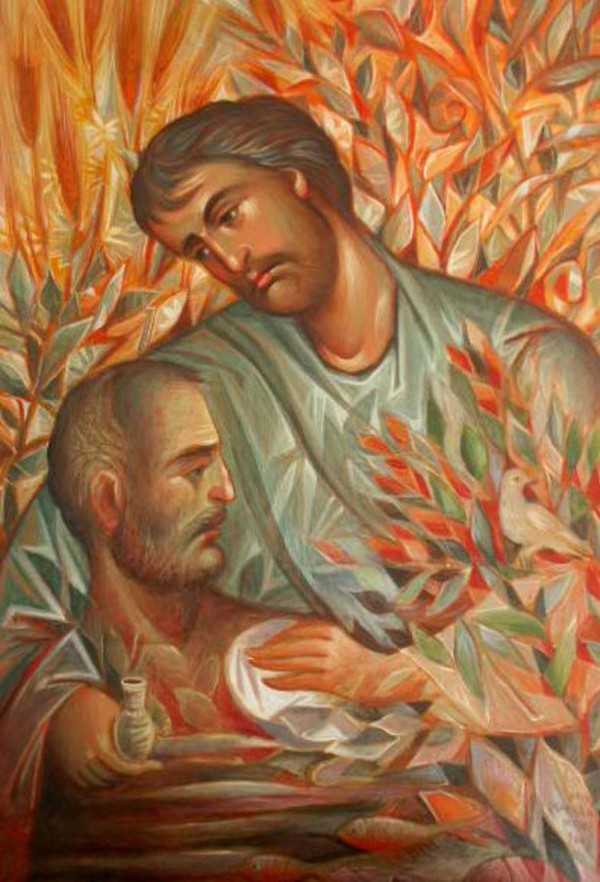
Good Samaritan Sunday
July 10, 2022
Luke 10.25-37
+ For those of you who listen or read my sermons week in and week out, you know that my “themes” are pretty basic and consistent.
Yes, there might be variations on those “themes,” but, in their core, there is really only one main “theme” to everything I preach.
Love God. Love others. That’s pretty much it.
Which is why our Gospel reading this morning is an important reading.
No, I’m not being emphatic enough.
It’s not just an important reading.
It is, in my opinion, the single most important reading for us as Christians.
And, for those of you who have known for me for any period, you know how I feel about what is being said in today’s Gospel.
For me, this is IT.
This is the heart of our Christian faith.
This is where the “rubber meets the road.”
When anyone has asked me, “What does it mean to be a Christian?” it is this scripture I direct them to.
When anyone asks me, must I do this or that to be “saved,” I direct them to this reading.
This is what it is all about.
So, why do I feel this way?
Well, let’s take a look this all-important reading.
We have two things going on.
First, we have this young lawyer.
He comes, in all earnestness, to seek from Jesus THE answer.
“What must I do to inherit eternal life?”
What must I do to be saved?
This, after all, is the question we are ALL asking, isn’t it?
And, guess what?
He—and all of us too—gets an answer.
But, as always, Jesus flips it all around and gives it all a spin.
Jesus answers a question with a question.
He asks the lawyer, “what does the law say?”
The answer is a simple one.
And, in Jewish tradition, it is called the Shema.
The Shema is heart of Jewish faith.
It is so important that it is prayed twice a day, once in the morning, once at night.
Jesus himself would have prayed the Shema each morning upon awakening and again before he went to sleep at night.
It is important, because it is the heart of all faith in God.
So, what is the answer?
The answer is, “You shall love the Lord your God with all your heart, , and with all

your soul, and with all your strength, and with all your mind;”
And additionally, “and [love] your neighbor as yourself.”
Then, Jesus says this:
“do this, and you will live.”
I repeat it.
Do this—Love God, love your neighbor—and you will live.
This is what we must do to be saved.
Now that sounds easy.
But Jesus then complicates it all with a parable.
And it’s a great story.
Everyone likes this story of the Good Samaritan.
We even commemorated it in our very first stained glass window.
After all, what isn’t there to like in this story?
Well…actually…in Jesus’ day, there were people who would not have liked this story.
In Jesus’s day, this story would have been RADICAL.
The part of this story that most of us miss is the fact that when Jesus told this parable to his audience, he did so with a particular scheme in mind.
The term “Good Samaritan” would have been an oxymoron for those Jews listening to Jesus that day.
Samaritans were, in fact, quite hated.
They were viewed as heretics, as defilers, as unclean.
They were seen as betrayers of the Jewish faith.
So, when Jesus tells this tale of a Good Samaritan, it no doubt rankled a few nerves in the midst of that company.
With this in mind, we do need to ask ourselves some very hard questions.
Hard questions we did not think we would be asked on this Good Samaritan Sunday.
You, of course, know where I am going with this.
So, here goes:
Who are the Samaritans in our understanding of this story?
For us, the story only really hits home when we replace that term “Samaritan” with the name of someone we don’t like at all.
Just think about who it is in your life, in your political understanding, in your own orbit of people who you absolutely despise.
Think of that person or persons or movements that simply makes you writhe with anger.
Those are your Samaritans!
It’s not hard to find the names.
Now, try to put the word “good” in front of those names.
It’s hard for a good many of us to find anything “good” in any of these people.
For us, to face the fact that these people we see as morally or inherently evil could be “good.”
We—good socially-conscious Christians that we are—are also guilty sometimes of being complacent.
We too find ourselves sometimes feeling quite smug about our “advanced” or “educated” ways of thinking about society and God and the Church.
And we too demonize those we don’t agree with sometimes.
I, for one, am very guilty of this
It is easy for me to imagine God living in me personally, despite all the shortcomings and negative things I know about myself.
I know that, sometimes, I am a despicable person and yet, I know that God is alive in me, and that God loves me.
So, why is it so hard for me to see that God is present even in those whom I dislike, despite those things that make them so dislikeable to me?
For me, this is the hard part.
The Gospel story today shows us that we must love and serve and see God alive in even those whom we demonize—even if those same people demonize us as well.
Being a follower of Jesus means loving even those we, under any other circumstance, simply can’t stand.
And this story is all about being jarred out of our complacent way of seeing things.
It’s also easy for some of us to immediately identify ourselves with the Good Samaritan.
We, of course, would help someone stranded on the road, even when it means making ourselves vulnerable to the robbers who might be lurking nearby.
Right?
But I can tell you that as I hear and read this parable, I—quite uncomfortably—find myself sometimes identifying with the priest and the Levite.
I am the one, as much as I hate to admit it, who could very easily, out of fear or because of the social structure in which I live, find myself crossing over to the other side of the road and avoiding this person.
And I hate the fact that my thoughts even go there.
See, this parable of Jesus is challenging and difficult.
But…
Something changes this whole story.
Something disrupts this story completely.
Love changes this whole story.
When we truly live out that commandment of Jesus to us that we must love God and love our neighbor as ourselves, we know full-well that those social and political and personal boundaries fall to the ground.
Love always defeats our dislike of someone.
Love always defeats the political boundaries that divide us.
Love always softens our hearts and our stubborn wills and allows us see the goodness and love that exists in others, even when doing so is uncomfortable and painful for us.
Now I say that hoping I don’t come across as naïve.
I know that my love of the racist will not necessarily change the racist.
I know that loving the homophobe will not necessarily change the homophone.
I know that loving the Nazi and the Fascist are definitely not going to change the Nazi and the Fascist.
Trust me, I know that loving certain politicians (whose names I will not mention) is not going to change those politicians!
But you know what?
It does change me.
It does cause me to look—as much as I hate to do so—into the eyes of that person and see something more.
It does cause me to look at the person and realize that God does love this person despite their failings and their faults—just as God loves me despite my failings and my faults.
These are the boundaries Jesus came to break down in us.
And these are the boundaries Jesus commands us to break down within ourselves.
“What must I do to inherit eternal life?” the lawyer asks Jesus.
And what’s the answer?
Love is the answer.
We must love—fully and completely.
“Do this,” Jesus says, “and you will live.”
It not only about our personal relationship with Jesus.
It not about accepting Jesus as our “personalLord and Savior.”
That’s not what saves us.
He nowhere says that is what will save us.
What will save us?
Love will save us.
Love of God.
Love of one another.
Loving ourselves.
Loving what God loves.
Love will save us.
Love will liberate us.
Love will free us.
Jesus doesn’t get much clearer than that.
Because let’s face it.
We are the Samaritan in this story.
We are—each of us—probably despised by someone in our lives.
We, to someone, represent everything they hate.
The fact is, God is not expecting us to be perfect.
God worked through the Samaritan—the person who represented so much of what everyone who was hearing that story represents as wrong.
If God can work through him, let me tell God can work through you and me.
We do not have to be perfect.
Trust me, we’re not perfect.
And we will never be perfect.
But even despite this, God’s light and love can show through us.
So let us reflect God’s love and light.
Let us live out the Shema of God—this commandment of God to love—in all aspects of our lives.
Let us love.
Let us love fully and radically and completely.
Let us love God.
Let us love each other.
Let us love ourselves.
Let us love all that God loves.
Let us love our neighbor.
Who is our neighbor?
Our neighbor is not just the one who is easy to love.
Our neighbor is also the one who is hardest to love.
Love them—God, our neighbor—and yes, even ourselves.
And you and I--we too will live, as Jesus says.
And we will live a life full of the light we have reflected in our own lives.
And that light that will never be taken from us.