
Steve Hely's Blog, page 30
August 7, 2022
They don’t know you’re lying.
They didn’t know what it took to sell tickets to young people, and I remember Francis Coppola saying to me, “Just go in there and tell them you know the answer. Just tell them. They don’t know. They don’t know you’re lying. You walk in there and you say, “This is your lucky day because you want to make money in movies, and I want to make money in movies, and I know how to get money.”
Paul Schrader talking about the studios in the early ’70s.
A whole dozen or fifteen filmmakers came in that gap with that sort of braggadocio, and they got empowered, and some of them actually did make money.
from Rock Me On The Water: 1974 The Year Los Angeles Transformed Movies, Music, Television and Politics by Ronald Brownstein, which we got at Chevalier Books on Larchmont.


August 5, 2022
deer showers
sad situation on dry Catalina Island:
The famed Catalina Island fox, as well as the island’s non-native deer and bison, are “suffering mightily” due to the lack of moisture, which is tied closely to their food supply, according to Deni Porej, senior conservation director with the Catalina Island Conservancy. Lately, he said, deer have been appearing on the island’s golf course in the evenings, when they know the sprinklers will turn on and provide them with a spot of relief.
from this LA Times piece by Hayley Smith
August 3, 2022
Where is Hollywood?

Hollywood and Highland, 1907. Source.
There was a municipality called Hollywood. It existed from 1903 to 1910. This Hollywood gave up its independence to Los Angeles in exchange for water. Los Angeles was about to arrange for a steady supply via William Mulholland’s Los Angeles Aqueduct, and thirsty Hollywood needed in. (Will this happen to other cities? Countries?)
What is the definition of Hollywood? Here is a map that appears to show the old municipality, I found it on Pinterest (barf) and cannot trace it to a source, this is the closest I get:

Here’s how the LA Times defines Hollywood:

Also seems to be a dead link, I found it here.
AboutHollywood.com tells us this:
Although it is not the typical practice of the City of Los Angeles to establish specific boundaries for districts or neighborhoods, Hollywood is a recent exception. On February 16, 2005, Assembly Members Goldberg and Koretz introduced a bill to require the State to keep specific records on Hollywood as though it were independent. For this to be done, the boundaries were defined. This bill was unanimously supported by the Hollywood Chamber of Commerce and the LA City Council. Assembly Bill 588 was approved by the Governor on August 28, 2006, and now the district of Hollywood has official borders. The border is shown at the right, and can be loosely described as the area east of Beverly Hills and West Hollywood, south of Mulholland Dr., Laurel Canyon, Cahuenga Blvd. and Barham Blvd., and the cities of Burbank and Glendale, north of Melrose Avenue, and west of the Golden State Freeway and Hyperion Avenue.
But how to explain this sign, found on Melrose and Flores (the southwest corner, in fact!) which would push the boundary of Hollywood further west than anyone is prepared to acknowledge?

August 1, 2022
Beach cottage books
During a stay at a beach cottage recently I picked some books off the shelf.

Paperback version of a beloved classic. But is this even readable?

Yeah I dunno…
Recalling that I read a section of All The King’s Men at a high school speech and debate contest. “Interpretive Reading” was not my strongest event.

Does this lady ever miss? Check out this plot:

Quinn Blackwood, Sugar Devil Swamp, Goblin. YES! How about:

This sounds like a bodice ripper but for men:

I put these books back and didn’t read any of them. If I had to pick I’d read about Goblin!
July 31, 2022
Eutychus

Next time I have to give a sermon I’m going to choose as my text Chapter 20, verses 7-13 of the Book of Acts, in which Paul gives a sermon so long a guy falls asleep, falls out the third floor window and is knocked cold:
On the first day of the week, when we were assembled for the breaking of bread, Paul, since he intended to leave on the following day, began to speak to them and prolonged his address until almost midnight. There were a great many lamps burning in the upper room where we met, and a young man called Eutychus who was sitting on the window sill fell fast asleep as Paul’s address became long and longer. Finally, completely overcome by sleep, he fell to the ground from the third story and was picked up as dead. But Paul went down, bent over him and holding him gently in his arms, said,
“Don’t be alarmed; he is still alive.”
Then he went upstairs again and, when he had broken bread and eaten, continued a long earnest talk with them until daybreak, and so finally departed. As for the boy, they took him home alive, feeling immeasurably relieved.
The Book of Acts, Praxis Apostolōn, has a couple long sermons from Paul. As a character, I find it hard to get into Paul. Just feels like he makes it all about himself?
July 29, 2022
Kate Corbaley, Storyteller
Another staff writer with a rather unconventional but valued talent was Kate Corbaley. At $150 a week, Corbaley was one of the few staffers whose salary was in the same range as Selznick’s…
Her specialty was not in editorial but rather as Louis Mayer’s preferred “storyteller.” Mayer was not a learned or highly literate man, and he rarely read story properties, scripts, or even synopses. He preferred to have someone simply tell him the story and he found Mrs. Corbaley’s narrational skills suited him. She never received a writing credit on an MGM picture, but many in the company considered her crucial to Mayer’s interest in stories being considered for purchase or production at any given time.
That’s from Thomas Schatz, The Genius of the System: Hollywood Filmmaking in the Studio Era.
Corbaley’s brother was Admiral S. C. Hooper, “the father of naval radio,” if The New York Times is to be believed. What a family of communicators!
Storytelling is a current obsession in business. A few days ago I searched “storyteller” under Jobs on LinkedIn and found 35,831 results. Amazon, Microsoft, and Pinterest are all hiring some version of “storyteller,” as are Under Armor, Eataly and “X, the Moonshot Factory.” The accounting firm Deloitte is hiring Financial and Strategic Storytellers (multiple listings, financial and strategic storytellers are sought in San Diego, Miami, Chicago, Charlotte, Tampa, Las Vegas, and Phoenix).
Cool job.
It’s reported in City of Nets: A Portrait of Hollywood in the 1940s that one afternoon in May, 1936, Kate Corbaley summarized a novel that was already perceived as hot property. She told Louis B. Mayer
a new story about a tempestuous southern girl named Scarlett O’Hara.
Mayer wasn’t sure what to think, so he sent for Irving Thalberg, who declared:
Forget it, Louis. No Civil War picture ever made a nickel.
(This seems improbable: in 1936 Birth of A Nation would’ve held the record as one of if not the biggest movie of all time? Must track this tale to its source, will report.)
July 27, 2022
The patience of the pursuer
The subject is Warren Beatty:
“You’d go up to his penthouse at the Beverly Wilshire two to three hours a day and go through a whole argument,” recalled writer and director Paul Schrader. “You’d go back the next day and start at zero until, finally, you realized we will have the same argument over and over until he wins, and that’s when I realized why he was such a successful lothario. [He had] the infinite patience of the pursuer.”
from Rock Me On The Water: 1974 The Year Los Angeles Transformed Movies, Music, Television and Politics by Ronald Brownstein. I bought it over at Chevalier Books in Larchmont.
The patience of the pursuer reminded me of this, from The Man Who Ran Washington: The Life and Times of James A. Baker III by Peter Baker and Susan Glasser:

July 26, 2022
Tahoe

Finally had a chance to explore Lake Tahoe. The place has power, for sure. The whole lake’s contained in a high altitude basin. You’re 6000 feet above sea level on the beach. Aside from the southeastern corner where Nevada and California meet, and again on the northwestern corner, same thing, there’s not much development. Can’t be, the walls are too steep. The lake is deep, spooky deep: 1,644 feet or half a kilometer, at deepest. And cold.
Scuba diving in a lake at high altitude is a particular challenge. In July, 2011, two divers were exploring the lake using a “mixed gas” method:
Mixed gas divers can safely descend to about 350 feet without suffering nitrogen narcosis, or “rapture of the depths,” among other problems. Conventional scuba divers have to stop at about 100 feet.
While exploring, the mixed-gasers found a well-preserved body just kinda sitting there, underwater. It was a diver who’d died while diving in the lake seventeen years before in 1994.
Byers said those in the diving group were startled to see [the deceased’s] motionless form. “It was pretty scary for them. They were wondering, ‘What’s this person doing down here?’” he said. He did not identify members of the group.
The surprising condition of the body is attributable to the 35-degree water and the increased pressure at the 265-foot depth, Byers said.
All that from a 2011 LA Times article by Bob Pool, who notes some other myths of the lake:
Some Tahoe locals insist that bodies of boaters and swimmers who drowned in Lake Tahoe have turned up Pyramid Lake and vice versa. They insist the tunnels are the result of volcanic activity.
“Lava tube connections between Lake Tahoe and other lakes are an urban myth,” Byers said.
Other stories about oddities beneath Lake Tahoe have been debunked by experts. Some in the region insist that famed diver and naturalist Jacques Cousteau explored the lake in a mini-submarine in the mid-1970s and emerged pale and shaken.
Asked what he’d seen and filmed on the lake bottom, Cousteau reportedly replied, “The world isn’t ready for what’s down there.”
Depending on who is telling the story, Cousteau either encountered a Loch Ness-type monster that locals have dubbed “Tahoe Tessie” or came upon a bunch of dead people.
and:
Tales persist that a “longtime Tahoe fire chief” responded to a drowning call and found the body of a well-preserved Native American girl, fully clothed in a 19th century ceremonial dress, floating in the lake.
However:
Cousteau never explored the lake. Some say his grandson, Philippe Cousteau Jr., visited there, but only for a 2002 speaking engagement. And authorities say they have used sonar and mini-subs to map the lake’s bottom and never found such a graveyard. Nobody knows the name or affiliation of the supposed “longtime Tahoe fire chief.”

On Emerald Bay is the grand and tragic house of Vikingsholm, built with local materials in a single summer by 200 craftsmen.

Here is Mark Twain, in Roughing It, on Tahoe:
Three months of camp life on Lake Tahoe would restore an Egyptian mummy to his pristine vigor, and give him an appetite like an alligator. I do not mean the oldest and driest mummies, of course, but the fresher ones. The air up there in the clouds is very pure and fine, bracing and delicious. And why shouldn’t it be?—it is the same the angels breathe. I think that hardly any amount of fatigue can be gathered together that a man cannot sleep off in one night on the sand by its side. Not under a roof, but under the sky; it seldom or never rains there in the summer time. I know a man who went there to die. But he made a failure of it. He was a skeleton when he came, and could barely stand. He had no appetite, and did nothing but read tracts and reflect on the future. Three months later he was sleeping out of doors regularly, eating all he could hold, three times a day, and chasing game over mountains three thousand feet high for recreation. And he was a skeleton no longer, but weighed part of a ton. This is no fancy sketch, but the truth. His disease was consumption. I confidently commend his experience to other skeletons.
Others report difficulty sleeping, perhaps due to the altitude. But they were sleeping indoors.
Seen from the lake, the casinos at Stateline, Nevada look like Chernobyl or something from The World Without Us, like they got abandoned and a forest grew around them.

Shouldn’t there be a dock there? Maybe the focus is gambling only on that part of the shore. Still, the Encore in Chelsea, Mass has a nice casino boat that’ll take you to/from Boston’s Long Wharf. Could be an idea for Stateline.
You get the sense the Lake Tahoe Basin Management Unit of the Forest Service keeps it tight on development.
Larry Ellison has, I’m told, purchased the old Cal Neva in Crystal Bay, once part owned by Frank Sinatra. He’s also buying the currently running casino-hotel Hyatt Regency in Incline Village, a town famous as a tax haven.
July 25, 2022
Pari-Mutuel

Saratoga and Del Mar seasons are underway, a worthy time to consider pari-mutuel wagering.
While some might think that pari-mutuel wagering has been around ever since organized horse racing started, this is hardly the case. There is a clear history to pari-mutuel wagering, and there is one actual and acknowledged inventor in Joseph Oller. The invention of pari-mutuels was not even Oller’s major contribution to cultural history. He was probably better known as the founder and manager of Moulin Rouge, probably the most famous nightclub of all time.
The pari-mutuel story dates from Paris in 1862. Oller pioneered a sweepstakes game based on horse racing results. This was a system based on total chance. The bettor paid for a chance and was randomly assigned a horse on a given race.
This was however illegal in France. Betting wasn’t illegal, but lotteries were. So:
In place of the system under which the bettors were assigned their designated horse by pure chance, Oller devised a system under which the bettors selected the horses themselves. “By this scheme each investor selected the horse he desired to bet on, and if his favorite proved successful, he became entitled to all the money in the pool, less the commission exacted by Mr. Oller.
Meanwhile, in the US:
Before 1870, the main form of wagering at the American tracks – which were reopening after the Civil War – was the auction pool, also known as the Calcutta pool. Under this system, bettors bid on the right to choose horses in a race. The highest bidder got to pick the horse of his choice, usually the favorite.
In time, an engineer named Harry Straus devised a machine that would issue a printed ticket, and update bettors on the odds.
Straus developed the totalizer – a system of rotary switches and relays based on the principles of automatic dial telephone.
Straus founded a company, American Totalisator, which is now owned by Stronach Group, which owns Santa Anita, Pimlico, Gulfstream, and few other racetracks.
All that from an illuminating article, “Pari-Mutuels: What Do They Mean and What is at Stake in the 21st Century?” by Bennett Liebman in Marquette Sports Law Review, Vol. 27 Issue 1, Fall 2016.
It’s illuminating to know that bettors were once assigned a horse at random. Liebman’s writing on the legal meanings of “pari mutuel” is thrilling intellectual history.
Many state constitutions exempt or have unusual rules for different kinds of wagering like lotteries and “pari mutuel betting.” Struggles over the definitions have meaningful consequences.
Take the case of “historical racing machines.” These are pretty much just slot machines but technically (maybe) their outcomes are generated on the results of horse races, and the betting is arguably “pari mutuel.” Liebman’s article offers good examples of the law being whatever convinces the judge.
Choosing a horse at random may not be a terrible method, especially given that the pari mutuel market as a whole tends to be pretty sharp. Many a study has looked for inefficiencies, and though they exist, I do not know of a study that’s found an enduring profitable angle. Bill Benter’s work took advantage of inefficiencies in Hong Kong racing, combined with sophisticated modeling developed over painful trial and error. Dr. Z might be onto something but who wants to do all that math?
Horse handicapping is more art than science. I’ve found Brad Free’s book to be the most readable and clear-eyed. Steven Crist (whose own memoir Betting On Myself is fantastic) recommends Davidowitz, which is indeed full of insight. My copy of James Quinn’s Complete Handicapper is thoroughly marked up. Tom Ainslie writes with a style that makes the whole game seem amusing, for example his choice use of the word “animal”:

These books I bought at the Gambler’s Book Shop in Las Vegas all brought me some delight and in a limited way insight.

Andy Beyer’s books are all quite fun. Even the heroes of the great 1970s era of horse race betting, when Beyer discovered his E=mc^2 (“six furlongs in 1:13 equals seven furlongs in 1:26 and a fifth”) tell that it’s near impossible to make money these days. Certain trainer patterns can be exploited from time to time. The dominance of Bob Baffert in southern California can’t be ignored as an example.
Remember that the takeout is sometimes as high as 25%, even higher once you factor in rebates given to high rollers. Something like 40% of the money in competition might be from syndicates working with advanced computer modeling. And note, in the case of the Stronach Group, the track owners are themselves invested in one of the syndicates! Should be illegal but isn’t.
Liebman quotes the UK’s Chief Justice Cockburn, making a ruling in 1871:
experience shews that there is nothing about which there is so much uncertainty as the event of a horse race.
But when that rainbow shines over the racetrack, and you’ve got the Form open, and you think Forbidden Kingdom might be for real? Nothing better.
July 19, 2022
The Doors of Perception by Aldous Huxley
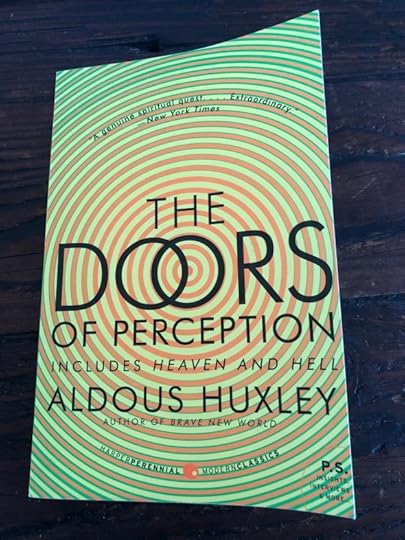
It’s 1953, Aldous Huxley’s in California. He’s close to sixty, a literary man who’s also made a good living as a screenwriter. A friend, one of the “sleuths – biochemists, psychiatrists, psychologists” – has got some mescaline, the active ingredient in peyote. He gives four-tenths of a gram to Aldous and we’re off.
What if you could “know, from the inside, what the visionary, the medium, even the mystic were talking about?” That’s what he’s after.
The mescaline kicks in. Aldous looks at flowers, and the furniture. He looks at a book of Van Gogh paintings, and then a book of Botticelli. He ponders, in particular, the folds of drapery in the pictures.
I knew that Botticelli – and not Botticelli alone, but many others too – had looked at draperies with the same transfigured and transfiguring eyes as had been mine that morning. They had seen the Istigkeit, the Allness and Infinity of folded cloth and had done their best to render it in paint and stone.
Cool. He lies down and his friend hands him a color reproduction of a Cezanne self-portrait.
For the consummate painter, with his little pipeline to Mind at Large by-passing the brain valve and ego-filter, was also just as genuinely this whiskered goblin with the unfriendly eye.
Huxley feels an experience of connecting to “a divine essential Not-self.” Vermeer, Chinese landscape painting, the Biblical story of Mary and Martha, all pass through his mind. William Blake comes up, from him Huxley took his title. Huxley listens to Mozart’s C-Minor Piano Concerto but it leaves him feeling cold. He does appreciate some madrigals of Gesauldo. He finds Alban Berg’s Lyric Suite kind of funny. He’s offered a lunch he’s not interested in, he’s taken for a drive where he “sees what Guardi had seen.”
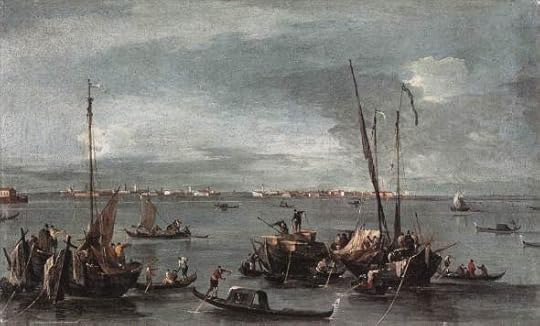
this?
he comes down.
OK, says Huxley, ideally we’d have some kind of better mescaline that doesn’t last this long and doesn’t cause a small percentage of takers to really spin out. But: we’ve got something here. A possible help on the road to salvation. A substance which allows you to perceive the Mind at Large, to feel the connection to the divine superpower, what he calls in the next essay “out there.”
However, once you go through the Door In The Wall (Huxley credits this phrase to H. G. Wells) you’re not gonna come back the same. You’ll come back “wiser but less cocksure, happier by less self-satisfied,” humbler in the face of the “unfathomable Mystery.”
My friend Audrey who works at the bookstore tells me she sells a lot of copies of this book, mostly to young dudes. The edition I have comes with an additional essay, “Heaven and Hell,” which considers visionary experiences both blissful and appalling, and tries to sort out what we can from them. There’s also an appendix:
Two other, less effective aids to visionary experience deserve mention – carbon dioxide and the stroboscopic lamp.
Huxley finds these less promising.


