
Rod Dreher's Blog, page 570
June 11, 2016
The (Oregon) Law Is An Ass
Courts invite contempt upon themselves for decisions like this:
An Oregon judge ruled Friday that a transgender person can legally change their sex to “non-binary” rather than male or female in what legal experts believe is a first in the United States.
Multnomah County Circuit Court Judge Amy Holmes Hehn legally changed 52-year-old Jamie Shupe’s sex from “female” to non-binary.
Nancy Haque, a co-executive director for Basic Rights Oregon, called the ruling a “momentous day for genderqueer Oregonians.”
“It’s really exciting for the courts to actually recognize what we know to be true: gender is a spectrum,” Haque said. “Some people don’t identify as male or female.”
Yes, that’s really exciting. The basic institutions of American society, having deconstructed marriage, are now deconstructing gender. What could it hurt, right?
Here’s the plaintiff who won the case:
Shupe, an Army veteran who retired in 2000 a sergeant first class, began transitioning in 2013 while living in Pittsburg. Shupe knew then that neither male nor female fit. Shupe chose “Jamie” as a new first name primarily because it is a gender-neutral name. Shupe prefers to be called “Jamie,” rather than by a pronoun.
“I was assigned male at birth due to biology,” Shupe said. “I’m stuck with that for life. My gender identity is definitely feminine. My gender identity has never been male, but I feel like I have to own up to my male biology. Being non-binary allows me to do that. I’m a mixture of both. I consider myself as a third sex.”
In Oregon, everything has to change to accommodate this disturbed person’s desires. If the law is sometimes an ass, it is always a teacher. Therefore, in Oregon, the law instructs the society that male and female are mere options among many that the autonomous individual might choose.
Who consulted the American people about this? Something as fundamental to humanity as gender is being redefined by judicial fiat. This is what American liberalism means in 2016.


June 10, 2016
View From Your Table

Le Bourg d’Oisans, France
M. l’Avocat écrit:
Cuisses de grenouille
Lawyer dude’s eating frog legs with his missus.
The Rich Hippie Paradox
Krista Tippett’s On Being radio show recently featured a fascinating discussion between biological anthropologist Melvin Konner and social psychologist Jon Haidt, who is one of this blog’s favorite public intellectuals. This jumped out at me:
MS. TIPPETT: But this is what we have. But your analysis that there are different stages of capitalism. Would you say a little bit about that? Because I think it gets at Mel’s question of — it kind of shakes up the scenario if we think that capitalism itself, as it grows, as we have more people who are living in these societies, also begins to change, and change us differently.
DR. HAIDT: Right. So, when I was in college, I first read Richard Dawkins’ book, The Selfish Gene. And like many people, it just blew my mind. And Darwin’s ideas are so simple. From a few principles, you can explain all the diversity of life on earth, and that was a really transformative experience for me. And then when I started reading about the history of capitalism, I had the same experience. I just happened to buy a set of lectures from The Teaching Company by an intellectual historian named Jerry Muller. I highly recommend it, M-U-L-L-E-R. He has a book on the history of capitalism, but he has a set of lectures there on the history of capitalism.
And in listening to them, I had the same experience that I had reading Richard Dawkins. I was about 48 years old at the time. I’m well educated. And I knew nothing about the system that explains why everything is here, including this microphone, this glass, our clothing, us, the transportation — everything. And so capitalism is as powerful and important as Darwinian evolution. And in fact, it’s very much the same thing. When you have variation and competition and selection, you get this incredible energy, you get this incredible adaptability. So I guess what I’m saying is that I wish everybody in high school — here’s what I wish we could do.
Let’s cancel two years of math for all of our high school students, everything beyond basic algebra, you don’t need, even if you’re a scientist you don’t need it. So, cancel most of the math, and put in statistics, basic economics, and I think introductory psychology. But, anyway, the point is everybody should learn about capitalism and evolution by the time they’re 18. And at present we don’t. And that means we have stupid discussions about policy.
MS. TIPPETT: And here’s just a very simplistic sentence, but a sentence of yours: “As people become richer and safer, their values change.”
DR. HAIDT: Yep.
MS. TIPPETT: And there’s kind of an ironic thing that happens that Marx did not foresee, that the beneficiaries of capitalist wealth, younger people, begin to demand more socially and environmentally responsible behavior from each other and from their governments.
DR. HAIDT: That’s right. This is what we see in all of these rapidly emerging nations. The generation that — and you see this all over, you see it all over Asia, especially. The simple way to put it is that almost everybody in Asia has grandparents that grew up at times of either famine, war, disease. They could not count on a long future. The transition is particularly clear in Korea, which went from poverty and Japanese oppression to the Korean War.
And that generation of Koreans, including my wife’s family — they have these incredible virtues about family and saving and hard work. And they don’t really care that much about human rights, and gender rights, and all these other sorts of things. But their kids, who were not raised with kind of privation and fear, their kids begin to care about all these things. And you see it all over Asia. The young generation begins to care more about animal rights, human rights, gay rights, women’s rights. So here’s the irony: the left generally hates capitalism, but capitalism changes everybody’s values to be more leftist. [Emphasis mine — RD]
Here’s a link to the page that contains audio of the conversation, as well as a transcript and more.
But I believe that cultural leftism, insofar as it’s about liberating the individual from religion and tradition, will undermine the moral and social basis for successful, sustainable capitalism. What do you think?
Trump As GOP Comeuppance
Writing in TAC today, Matthew Sheffield says he doesn’t feel sorry for establishment Republicans who are vexed by Trump. Excerpt:
The time to stop Trump was in the 1990s, when the movement’s intellectuals were busy prostrating themselves before Pat Robertson and Jerry Falwell as they sought to remake the GOP into a party for white Christians. The time to stop Trump was during the George W. Bush administration, when Republicans swallowed the nonsense that deposing secular dictators was a great way to promote moderate Islam. The time to stop Trump was in 2009, when Sarah Palin was dumbing down conservatism into an alternative lifestyle that glorified anti-intellectualism. The time to stop Donald Trump was in 2013, when Ted Cruz was opportunistically telling Republican voters that obstreperousness was the equivalent of conservative philosophy.
2016 was far too late to stop the Trump Train.
I would quibble with his Falwell/Robertson point, but overall I agree. Sheffield’s broader point is that the Republican Party elites were fine stoking the Trumpish sentiments within the base, thinking they could control them. A good piece to look at is John Derbyshire’s 2009 essay for TAC, talking about how talk radio is ruining conservatism. Excerpts:
Much as their blind loyalty discredited the Right, perhaps the worst effect of Limbaugh et al. has been their draining away of political energy from what might have been a much more worthwhile project: the fostering of a middlebrow conservatism. There is nothing wrong with lowbrow conservatism. It’s energizing and fun. What’s wrong is the impression fixed in the minds of too many Americans that conservatism is always lowbrow, an impression our enemies gleefully reinforce when the opportunity arises. Thus a liberal like E.J. Dionne can write, “The cause of Edmund Burke, Leo Strauss, Robert Nisbet and William F. Buckley Jr. is now in the hands of Rush Limbaugh, Sean Hannity. … Reason has been overwhelmed by propaganda, ideas by slogans.” Talk radio has contributed mightily to this development.
It does so by routinely descending into the ad hominem—Feminazis instead of feminism—and catering to reflex rather than thought. Where once conservatism had been about individualism, talk radio now rallies the mob. “Revolt against the masses?” asked Jeffrey Hart. “Limbaugh is the masses.”
In place of the permanent things, we get Happy Meal conservatism: cheap, childish, familiar. Gone are the internal tensions, the thought-provoking paradoxes, the ideological uneasiness that marked the early Right. But however much this dumbing down has damaged the conservative brand, it appeals to millions of Americans. McDonald’s profits rose 80 percent last year.
More:
I repeat: There is nothing wrong with lowbrow conservatism. Ideas must be marketed, and right-wing talk radio captures a big and useful market segment. However, if there is no thoughtful, rigorous presentation of conservative ideas, then conservatism by default becomes the raucous parochialism of Limbaugh, Savage, Hannity, and company. That loses us a market segment at least as useful, if perhaps not as big.
Conservatives have never had, and never should have, a problem with elitism. Why have we allowed carny barkers to run away with the Right?
And now the barkiest carny of them all is going to be the GOP standard bearer this fall.
It’s interesting to contemplate who, and what, lost the Republican Party to Trump. Was it too much dependence on crude talk-radio populism? Yes, that was part of it. It was cringeworthy to listen to the way leading Republican politicians kowtowed to talk radio over the years. And not only politicians, but conservative public intellectuals too often ballyhooed radio talkers, or at least greatly tempered their criticism, probably because it made them feel connected to the People.
Was it a failure of intellectual leadership? I mean, was it the case that the party’s elites were incapable of admitting error and learning from their errors, and failed to come up with new ideas for a changing nation? Certainly that’s right.The No-Enemies-To-The-Right tribalism dominant in GOP circles in the 1990s and 2000s prevented any dissent from being taken seriously. The GOP leadership became bound to outdated dogmas, and remained deaf to the sources of discontent among their own voters. Trump has no ideas, only slogans, but his greatest asset is that he’s Not Them.
His greatest defect is that he’s Donald Trump.
You know what I would like to see in the comments thread? A dispassionate discussion of the Who Lost The GOP To Trump? topic. No shrieking, just plain talk. Please?
What Is ‘Consent’ To A Drunk?
I heard an interesting archived interview on Fresh Air yesterday, via podcast. Writer Sarah Hepola was on talking about her memoir of alcoholism. Hepola — with whom I once had a drink at the Old Monk in Dallas — was talking about how she often would black out while drinking (“blacking out” is not the same as passing out; blacking out is getting so drunk you have no idea what you’re doing, or any memory of it) and wake up the next morning in some guy’s bed, not knowing how she got there. Excerpt from the interview:
GROSS: Yeah, but you point out in your book that if you’re in a blackout, the man you’re with doesn’t know you’re in a blackout, and so he thinks that you’re operating with full intentionality…
HEPOLA: Yeah.
GROSS: …And you’re not even going to remember what happened. And it’s questionable how much consciousness you have at that moment.
HEPOLA: I think this is a really important point. And this is something that – really when I started to think about this was when the conversation around campus sexual assault exploded about three or four years ago. And we’d been going through a national conversation, and a lot of the things we’ve talked about is alcohol and consent. It was really striking to me, by the way, that I drank for 25 years and I don’t remember anybody ever saying to me during those 25 years, were you too drunk to give consent? Like, I don’t – I just – I don’t remember that question ever being asked of me. It was like, yeah, hell yeah. You rocked it – or whatever. Like, there were always – these stories were always kind of spun as triumphs.
Then when this conversation about campus sexual assault came up and I was reading these stories about alcohol and consent, I started to think about how blackout plays out in that. It’s a really gray area of consent. And I think it’s something that all of us would do better to understand a little bit better, you know? And you’ve already put your finger on one of the most important things, which is the person that you’re with doesn’t necessarily know that you’re in a blackout.
Keep in mind that a blackout is not the same thing as passing out. A person having a blackout may look like they know what they’re doing. How the hell is a man, who might be drinking to excess himself, supposed to know that the woman he takes to bed is too drunk to consent? What if she accuses him of rape?
A friend of mine told me not long ago that at his university, a woman came into the room of an athlete, climbed into bed with him naked, then later accused him of rape. My friend’s point was that these situations are a lot more complicated than many people understand, and that women have a lot of power over the lives and fate of men that they consented to bed — if they later regret it, and want to punish the man. My friend, who is a Christian, was not defending rape culture, but saying that the sexual free-for-all on campus today not only leaves women vulnerable to unscrupulous men, but men vulnerable to unscrupulous women. This seems obviously true to me.
Thinking back on my own highly boozy, highly irresponsible undergraduate days, I … am glad I went to college in the 1980s.
‘I’m Gay. Help Me Kill Myself’
If you believe in abortion on demand for any reason at all, on what grounds do you condemn a woman who chooses to abort her unborn child because the child is a girl, and she wants a boy? I’ve always wondered how liberals deal with that question. But here’s a more up-to-date one: a gay Belgian man has requested euthanasia to escape the mental self-torment of his unwanted homosexuality. More from the BBC:
Each death as a result of euthanasia in Belgium is reviewed after the event by a committee of lawyers and doctors.
For Gilles Genicot, lecturer in medical law at the University of Liege, and member of the euthanasia review committee, Sébastien’s case does not fulfil the legal criteria for euthanasia.
“It’s more likely he has psychological problems relating to his sexuality. I cannot find a trace of actual psychic illness here.
“But what you cannot do is purely rule out the option of euthanasia for such patients.
“They can fall within the scope of the law once every reasonable treatment has been tried unsuccessfully and three doctors come to the conclusion that no other option remains.”
Sébastien’s request for euthanasia has been accepted initially, he now faces further assessments to determine whether his case fits within the law.
Asked whether there is any chance he will reconsider, or take a different path, he is sceptical.
“If someone could give me some kind of miracle cure, why not? But for now, I really don’t believe it any more. And I’m too exhausted also, whatever may be out there.”
Reader Stefan de Pooter, who sent in this link, writes:
What most troubling though, as far as I’m concerned, is that Belgium will be damned either way. If he is denied euthanasia, we will be portrayed as a nation of horrible savages for having denied someone the realization of his project of the willed self. If they grant his request for euthanasia, we’ll be even more horrible savages for having implicitly condoned a person’s view of his homosexuality as a mental illness, since in the hard-leftist view of things condoning speech is active speech.
Whether “Sebastien” ought to be mentally tormented by his sexuality to the point of wanting to die is beside the point. Of course he should not be. But that’s not how things work in Belgium. From a chilling story about Belgian euthanasia in The New Yorker:
In the past five years, the number of euthanasia and assisted-suicide deaths in the Netherlands has doubled, and in Belgium it has increased by more than a hundred and fifty per cent. Although most of the Belgian patients had cancer, people have also been euthanized because they had autism, anorexia, borderline personality disorder, chronic-fatigue syndrome, partial paralysis, blindness coupled with deafness, and manic depression. In 2013, Wim Distelmans euthanized a forty-four-year-old transgender man, Nathan Verhelst, because Verhelst was devastated by the failure of his sex-change surgeries; he said that he felt like a monster when he looked in the mirror.
More:
De Wachter believes that the country’s approach to suicide reflects a crisis of nihilism created by the rapid secularization of Flemish culture in the past thirty years. Euthanasia became a humanist solution to a humanist dilemma. “What is life worth when there is no God?” he said. “What is life worth when I am not successful?” He said that he has repeatedly been confronted by patients who tell him, “I am an autonomous decision-maker. I can decide how long I live. When I think my life is not worth living anymore, I must decide.” He recently approved the euthanasia of a twenty-five-year-old woman with borderline personality disorder who did not “suffer from depression in the psychiatric sense of the word,” he said. “It was more existential; it was impossible for her to have a goal in this life.” He said that her parents “came to my office, got on their knees, and begged me, ‘Please, help our daughter to die.’ ”
De Wachter told me, “I don’t want to kill people—I don’t think psychiatrists should kill people—but when the suffering is so extreme we cannot look the other way.” When he gives lectures, he tries to appeal to Christian audiences by saying, “If Jesus were here, I think he would help these people.”
So there is precedent for Sebastien’s politically incorrect request.
The Sebastien case is easy for people like me who oppose all euthanasia. But what about people who believe in euthanasia?
UPDATE: I should have anticipated this before I posted, but I didn’t, so let me say in this update: I’m not interested in you using your answer to complain about how the evil, evil Catholic Church is responsible for this man’s self-hatred. It could well be that his mother was a religious fanatic, in which case, shame on her. Or not. We don’t know. Answer the question I pose if you want to, but spare us all the anti-Christian polemics, or I will spare us myself by not approving your comment.
Anti-Christian California
Two troubling episodes from California about the state of Christian higher education and religious liberty in the LoveWins™ era.
First, Robert Oscar Lopez, a Cal State Northridge English professor who is gay but chaste Christian, resigned his tenured position after years of harassment by gay colleagues and their allies. Excerpt:
I didn’t want leave without pay. I didn’t want leave with pay. I just wanted to leave. The liberal academy is a place full of secular activists channeling their own unhappiness into interminable hostilities against whichever conservative Christian they can find within a three-mile radius. I had served for eight years under a dean trained in Women’s Studies, surrounded in her executive suite by lesbians and feminists, who hated me for celebrating the beauty and glory of chastity and Biblical love. I could not have my relationship with Jesus Christ and this job simultaneously. The choice was not that difficult.
More from an interview he gave subsequently:
While they couldn’t block my tenure legally because I’d made the requirements, they ended up harassing me at every turn with false accusations and veiled threats. I was accused of inciting racist screams at the 2012 graduation, then accused of being lewd and having erections while teaching in 2013, then accused of not giving students a rubric in 2014, accused of disappearing for two weeks without telling my chair in 2014, and accused of forcing students to attend a conference against their will in 2014.
Each of these accusations was false and I proved them false, but to defend myself took so much time and documentation, it really drives you insane and makes it impossible to do your work.
Then in 2015, the accusations escalated, with students claiming I took them to an anti-gay conference like a KKK rally, passed out hate-filled brochures, insulted someone’s ovaries, lied about funding, tried to stop students from “reporting” me for sexism, and withheld an award against a feminist student for her views. The accusations started getting more numerous, vaguer, and more based on hearsay that I couldn’t disprove no matter how much documentation I kept.
More:
Then I realized a colleague had sent me emails with booby-trap links to homosexual pornography, and that, had I clicked on them, those emails would have placed cookies on my work computer. I frantically tried to scan my computer to see if any such tricks had placed anything scary on my PC, but the university said they would not provide a forensic expert to review the computer with me there.
People had gone into my office unannounced when I had called in sick, and I realized at any time they could frame me for anything and I might end up in more serious trouble than tenure was worth. I realized at some point that my fear of losing tenure was forcing me to play their games by their illogical rules, and I risked becoming as crazy as they were. Also, I began to fear that I might be so overwhelmed that I might actually fumble, or I might get accused of something that would be impossible to disprove.
And this:
Have we reached the point where public institutions require us to silo off into our Christian corners?
Robert Oscar Lopez: If you have means and if Christian communities can gather resources, I think investing in Christian education and getting out of state education is a good idea. So yes.
Second, a bill has passed the California Senate, and is headed to the Assembly (the lower house), that would make it very difficult for some of the state’s Christian colleges and universities to continue to operate — this, under the pretense of protecting LGBTs from discrimination.
Biola University characterizes it this way:
The proposed legislation seeks to narrow a religious exemption in California only to those institutions of higher learning that prepare students for pastoral ministry. This functionally eliminates the religious liberty for students of all California faith-based colleges and universities who integrate spiritual life with the entire campus educational experience. Prayer or requiring chapel services, spiritual formation groups and ministry service are an integral part of the educational experience for faith-based campuses, and they are at risk if SB 1146 is passed. In addition, it would eliminate religious liberty in California higher education, as we know it today, and deprive tens of thousands of students of their access to a distinctly faith-based higher education.
The AICCU (Association of Independent California Colleges and Universities) and Biola President Barry H. Corey have engaged with Sen. Lara and his staff on a number of occasions to voice concerns and to propose amendments to SB 1146 that would both preserve the existing religious exemption and satisfy Sen. Lara’s primary concerns about protecting LGBT students who attend Christian colleges. We remain hopeful that Sen. Lara with be a However, there have been no resulting amendments.
If passed as is, this bill would significantly challenge Biola University’s ability to continue in the mission that has guided us for 108 years.
As many as 42 faith-based institutions of higher education in California could be impacted. Some examples of how the bill would impact faith-based institutions include:
Faith-based institutions in California would no longer be able to require a profession of faith of their students.
These institutions would no longer be able to integrate faith throughout the teaching curriculum.
These institutions would no longer be able to require chapel attendance for students, an integral part of the learning experience at faith-based universities.
These institutions would no longer be able to require core units of Bible courses, nor offer students spiritual direction or pastoral care.
Athletic teams would no longer be able to lead faith-based community service programs.
More details from the Daily Signal:
A California state bill its sponsors say will prevent discrimination based on sexual orientation and gender identity at private universities is threatening to expose faith-based schools to enormous legal threats, school officials warn.
SB 1146, introduced in February by state Sen. Ricardo Lara, D-Bell Gardens, which passed the state Senate May 26, is designed to close “a little-known loophole” in California law under which private colleges can make admission, housing, and faculty decisions based on gender identity, gender expression, and sexual orientation, according to a press release from Lara’s office.
Lara is part of the state Legislature’s seven-member California Legislative Lesbian, Gay, Bisexual, and Transgender Caucus, which advocates for LGBT rights.
“Under state law, at least 34 California universities are exempt and do not have to comply with state nondiscrimination laws, leaving thousands of students open to discrimination based on their sexual orientation or gender identity,” Lara said in a statement provided to The Daily Signal. “These universities have a license to discriminate and students have absolutely no recourse. Addressing this issue is long overdue.”
But the bill, if it become law, would dramatically affect the ability of religious colleges to be religious:
This is because SB 1146 dramatically tightens the criteria under which a school can cite freedom of conscience in making curricular and administrative decisions.
California’s education code already explicitly prohibits discrimination on the basis of gender identity, gender expression, and sexual orientation, but exempts “an educational institution that is controlled by a religious organization if the application would not be consistent with the religious tenets of that organization.”
Under Lara’s legislation, that exemption would shrink dramatically, covering only “certain educational programs and activities of a postsecondary educational institution that is controlled by a religious organization.” The exception would apply to programs that “prepare students to become ministers of the religion, to enter upon some other vocation of the religion, or to teach theological subjects pertaining to the religion.”
As a result, administrators at faith-based colleges worry that they will soon have no legal recourse to make decisions based on their religion.
“The problem is that it provides a course of legal action for any student that feels they’ve been discriminated against in any other setting,” Jackson said, adding:
So if this bill passes, and a student comes to our school and says, ‘I feel really uncomfortable that chapel was mandatory, or that the professor opened class in prayer, or with community service’—that is a required part of our faith commitments—the bill as written creates a private right of action, meaning that the student would have the right to sue a school over what faith-based schools consider a core part of our spiritual life.
You might say, “If you don’t like the principles under which a Christian college operates, why choose to go there?” But that is not enough for the LGBT lobby:
Erin Green, a senior at Biola and executive director of Biola Equal Ground, an unofficial LGBT student support group, said it’s a common misconception that students who are LGBT wouldn’t choose to attend an evangelical Christian college.
“Here’s the thing – who’s paying for college?” Green said. “Parents are paying for college and if they’ve grown up in an evangelical environment, a parent is choosing the college. A lot of students have no choice.”
So the religious liberty of scores of Christian colleges must be taken away or at least severely curtailed.
The handwriting is on the wall in California. And what starts in California doesn’t stay in California. The LGBT lobby and Democratic legislators will continue this persecution of Christian colleges wherever they are given the opportunity, making it impossible for them to exist unless they kowtow to LGBT demands, no matter how much it would compromise their religious liberty. Robert Oscar Lopez advises Christians to consider retreating to Christian colleges, but as California shows, the gay lobby will not content itself to let that happen.
Fortunately, California isn’t the rest of America. Christian colleges in the South, at least, should be safe for a while. The thing to worry about the most, though, is similar action at a federal level. Can there be any doubt that if President Hillary Clinton thought she could get away with something like this, she would try it? And that a US Supreme Court packed with her justices would approve of it, First Amendment be damned?
Remember the Law of Merited Impossibility: It will never happen, and when it does, you bigots will deserve it.
June 9, 2016
Of Broken Ankles & Blessings
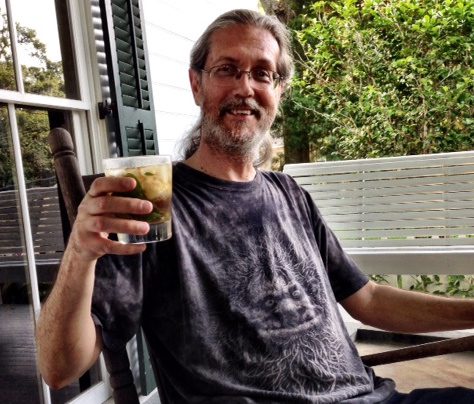
Franklin Evans on my front porch, with mint julep, Walker Percy Weekend 2014
A lovely note from our friend Franklin Evans, back home in Philly and healing the ankle he broke at the Walker Percy Weekend:
I am a physically awkward person. Many will have observed me in various situations, where I’m quite capable of moving gracefully and even a sort of artistry, but it is all very hard-won and very much a conscious effort. Therein lies the briefest description and explanation of my mishap. I was simply not paying attention as I should, and paid the price of a broken ankle.
Rod invited me to write about my experience, in light of my emphatic statement to him that he lives in a blessed place. It starts and ends with my heartfelt wish to be surrounded by such people and circumstances, and more accurately stated is that we all seek out such blessedness, though we give it very different labels in different circumstances.
I’m not going to jump with both feet into a personal treatise on all of that… though you know I really want to. Instead, I wish to point out to everyone that we already are surrounded by blessedness, but the trick is to uncover it without sullying it or scaring off those who represent it.
In short, all we need to do is look around us with a slightly different sight. All that we see, especially the most ordinary and mundane, is at the same time the very sacred we crave with our hearts and souls.
In my case, it was people.
First, there was [Dr.] Lee Burnett. He was my guardian in the most mundane sense, keeping me from further injuring myself, asking me questions not so much to get information but to judge my state of mind. He helped me realize that for the first couple of minutes I was in fact in shock.
Then there was Bernie, our beloved Bernie. She thought she was out of my sight and in the background, but I could clearly see her — well, “see” her right through walls and other people — like a force of nature, moving about, orchestrating my “rescue”.
Tremaine was one of the ambulance techs, the other a nice lady whose name I never got. Tremaine stayed with me in the back of the ambulance, and by chance or design was also my “escort” to my final destination in Zachary. He went about his responsibilities with efficiency and a certain grace of his own; his demeanor and simple presence were soothing. I am a very balanced and level-headed person, but it must be noted and disclosed that no matter how balanced I can be, people like Tremaine were there to catch me and support me. I looked calm and collected, as the saying goes, but he and others made that possible.
[Dr.] Adam Whatley [the orthopedist] was the most forceful person of that day, but in ways one will not perhaps understand. He took over my care, issuing instructions, but what I remember him for was the driest wit I’ve ever encountered on either side of the Mississippi, coupled with showing up with his son in tow at one point. I can’t put my finger on it exactly, but that’s got to be the clearest combination of mundane and sacred. His wit kept me focused. Seeing his son kept me grounded.
The list is much longer than just those few. I have a sieve-like memory at the best of times, so I’ll let those others reside in my thoughts, knowing that they were just as important to me as those I’ve named.
I have one final thought to put out there. I intend it as a gift of perception, not as commentary of any kind. I had a very bad incident; there were people there to help me and heal me. People have incidents all the time, and such people who help and heal are there to step in and do what they do. It is the rest of you for whom I have this concern, especially those who are cynical or even just pessimistic about our society and where things seem to be headed. It is for you I have this observation:
You witnessed a play of sorts, a performance. The blessings were not intended just for me, but for you to see. This is the reality of life, not the horrific and bizarre which Rod and others focus on with sometimes morbid intensity. We are surrounded by the sacred at all times, in all things… and my one admonition is to not wait for a friend to break an ankle to make the effort to see it.
Thanks, Franklin. I hope the rest of you will come down to St. Francisville for next year’s Walker Percy Weekend, and can experience some of the goodness Franklin describes here, though without having to break a bone!
View From Your Table

Col d’Ournan, near Alpe d’Huez, France
My consigliere continues his 20th anniversary tour with his lovely bride. Here’s what they ate on the side of an Alp:
Melon and jambon cru, followed by pork with mustard cream sauce, a quick break from Alp-biking.
I can solemnly promise you readers that you will never, ever see my name associated with “Alp-biking.”
Trump’s Personal Jesus
Did you read the transcript of Cal Thomas’s interview with Donald Trump? You should. Especially these parts:
CT: My grandparents used to play a parlor game. It went like this: Tell me who you are without telling me your name or what you do. We have seen your tough exterior, but who are you at your core and what is your basic philosophy and worldview?
DT: I am a person who grew up with two wonderful parents and a wonderful family and a person who has done well in life. I went to great schools. Wharton School, a lot of great places. Education is very important. I think I understand education. I think I can straighten out our mess in education. And I’m a person who has, to a certain extent, redefined where I should be. I started off in Brooklyn and Queens and I wasn’t supposed to come to Manhattan. My father didn’t want to go to Manhattan for me, and I came to Manhattan and I have done a great job in Manhattan. And then I wrote a best-seller and I wrote numerous best-sellers. I wrote ‘The Art of the Deal’ and numerous other books. Some were number one best-sellers. I guess ‘The Art of the Deal’ is the best-selling business book of all time. I had a TV show called ‘The Apprentice’ and it’s one of the most successful reality shows in the history of television. And now I’m doing something else.
He doesn’t even pretend that there’s anything to him other than worshiping himself. There’s no there there, just ego. I know this is not exactly news, but it still astonishes me that he can’t even fake it.
There’s idiocy, non sequiturs, and sloganeering throughout. But here is the most glorious part:
CT: Every president has called upon God at some point. Lincoln spoke of not being able to hold the office of the presidency without spending time on his knees. You have confessed that you are a Christian …
DT: And I have also won much evangelical support.
CT: Yes, I know that. You have said you never felt the need to ask for God’s forgiveness, and yet repentance for one’s sins is a precondition to salvation. I ask you the question Jesus asked of Peter: Who do you say He is?
DT: I will be asking for forgiveness, but hopefully I won’t have to be asking for much forgiveness. As you know, I am Presbyterian and Protestant. I’ve had great relationships and developed even greater relationships with ministers. We have tremendous support from the clergy. I think I will be doing very well during the election with evangelicals and with Christians. In the Middle East — and this is prior to the migration — you had almost no chance of coming into the United States. Christians from Syria, of which there were many, many of their heads … chopped off. If you were a Muslim from Syria, it was one of the easiest places to come in (to the U.S.). I thought that was deplorable. I’m going to treat my religion, which is Christian, with great respect and care.
CT: Who do you say Jesus is?
DT: Jesus to me is somebody I can think about for security and confidence. Somebody I can revere in terms of bravery and in terms of courage and, because I consider the Christian religion so important, somebody I can totally rely on in my own mind.
Whole thing here. I hope Jerry Falwell Jr. and Mike Huckabee are proud of themselves.
The prospect of four years of this stuff. Just think about it.

Rod Dreher's Blog

- Rod Dreher's profile
- 509 followers

