Jennifer R. Hubbard's Blog, page 95
July 1, 2011
Required reading
I'm a big fan of reader choice. I think that one of the best ways to get kids enthusiastic about books is to let them choose their own reading material (allowing for some parental guidance of young children). I read tons of books when I was growing up, mostly books I selected myself. The only time reading was a chore was when I had to read what I didn't want to: textbooks, mostly. I loved some of the assigned novels we read in school (Catch-22, The Sound and the Fury) and despised others (All Quiet on the Western Front, Babbitt). I barely made it through A Tale of Two Cities when I was required to read it.
Seeing how reading could flip from delight to chore when I, a book addict, was forced to read something, I can only imagine how hard it is to promote literacy in children who have nothing but long lists of required reading. Who are dosed with books as if they're medicine. Whose only exposure to books is compulsory. And so I hope there's always room for reader choice--if we hope to have a literate society, that is.
Yet, I do see the value of occasionally having to read something you wouldn't have chosen for yourself, of slogging through a difficult text. I still challenge myself now sometimes, perhaps as a leftover lesson from the days of required reading. I reread All Quiet on the Western Front, Babbitt, and A Tale of Two Cities as an adult. I wanted to give them another chance--to see how my view of them might have changed (or not!).
The verdict:
I ended up enjoying Babbitt a lot, rereading it, and moving on to Sinclair Lewis's other books--a couple of which (Main Street and Fresh Air) have become real favorites.
I didn't like All Quiet on the Western Front much better the second time around. I'm not sure what it is--the hopelessness? The narrative distance? I conclude that it just isn't my cup of tea.
I had mixed feelings about A Tale of Two Cities. I still found it to be slower going and less fun than much of Dickens's other work. But it's worth reading because of Madame Defarge. I had completely forgotten the whole bit about the knitting, and when the meaning of her knitting was revealed, it knocked me sideways and upside down. If Dickens had been in the room then, I would've applauded him.
How we feel about books isn't just about the books, of course--it's about who we are. That's why people can disagree so much about a book, why one person can love it and another hate it. And since we change throughout our lives, our feelings about books can change over time, too.
Has required reading brought any gems into your life? Have you read a book that you really didn't want to read, but later were glad that you did?
Seeing how reading could flip from delight to chore when I, a book addict, was forced to read something, I can only imagine how hard it is to promote literacy in children who have nothing but long lists of required reading. Who are dosed with books as if they're medicine. Whose only exposure to books is compulsory. And so I hope there's always room for reader choice--if we hope to have a literate society, that is.
Yet, I do see the value of occasionally having to read something you wouldn't have chosen for yourself, of slogging through a difficult text. I still challenge myself now sometimes, perhaps as a leftover lesson from the days of required reading. I reread All Quiet on the Western Front, Babbitt, and A Tale of Two Cities as an adult. I wanted to give them another chance--to see how my view of them might have changed (or not!).
The verdict:
I ended up enjoying Babbitt a lot, rereading it, and moving on to Sinclair Lewis's other books--a couple of which (Main Street and Fresh Air) have become real favorites.
I didn't like All Quiet on the Western Front much better the second time around. I'm not sure what it is--the hopelessness? The narrative distance? I conclude that it just isn't my cup of tea.
I had mixed feelings about A Tale of Two Cities. I still found it to be slower going and less fun than much of Dickens's other work. But it's worth reading because of Madame Defarge. I had completely forgotten the whole bit about the knitting, and when the meaning of her knitting was revealed, it knocked me sideways and upside down. If Dickens had been in the room then, I would've applauded him.
How we feel about books isn't just about the books, of course--it's about who we are. That's why people can disagree so much about a book, why one person can love it and another hate it. And since we change throughout our lives, our feelings about books can change over time, too.
Has required reading brought any gems into your life? Have you read a book that you really didn't want to read, but later were glad that you did?


June 30, 2011
Saying no
Writers who seek a readership wider than their own circle of family and friends usually go through the rejection mill, one way or another. In traditional publishing, the first hurdle is finding an agent and/or publisher, and the writer usually hears a lot of "no" before getting to "yes." During the long drought when yesses are scarce, the writer becomes conditioned to pursue every opportunity. During this stage, it's usually other people who say no; the writer doesn't get to say no to much.
Therefore, when offers and opportunities start coming, the writer says yes. And yes, and yes again. The writer's been seeking these very chances for so long that the word "no" may not even come up as an option.
But there really are choices.
Sometimes writers kick themselves for turning down an agent that they didn't quite click with, or an offer that didn't sit well, or a promotional opportunity that would conflict with family obligations / writing time / simple emotional needs. They are especially likely to second-guess themselves if the next opportunity is a long time in coming. It takes practice to learn to pronounce the word "no," and courage to use it. In every writer lurks that fear: What if I turn down something that turns out to have been the brass ring? What if this was my big break, and I missed it?
But we all have our limits. And I believe that saying no when we need to, and listening to the gut, ultimately won't lead us astray. In fact, it can help us avoid trouble.
I once heard Laurie Halse Anderson speak at a writers' conference about what she called "the power of no." She long ago became successful enough that she can't possibly say yes to every request for her time and attention, even if she wanted to. At the time I heard her give this speech, I was still in the opportunities-are-scarce-and-I-have-my-eyes-out-for-every-one stage, and I found it hard to believe I would ever need to use her advice. Yet I've seen writer after writer reach this point. It doesn't just happen to bestselling, household-name authors. There comes a point where it's impossible to say yes to everything. And even when only one opportunity is on the table, that still doesn't require the writer to say yes. If it doesn't feel right, it's okay to say no.
It's okay not to do everything, not to try everything. It's okay to leave some stones unturned. Nobody can do it all, so it's more important to do what's best for ourselves.
Therefore, when offers and opportunities start coming, the writer says yes. And yes, and yes again. The writer's been seeking these very chances for so long that the word "no" may not even come up as an option.
But there really are choices.
Sometimes writers kick themselves for turning down an agent that they didn't quite click with, or an offer that didn't sit well, or a promotional opportunity that would conflict with family obligations / writing time / simple emotional needs. They are especially likely to second-guess themselves if the next opportunity is a long time in coming. It takes practice to learn to pronounce the word "no," and courage to use it. In every writer lurks that fear: What if I turn down something that turns out to have been the brass ring? What if this was my big break, and I missed it?
But we all have our limits. And I believe that saying no when we need to, and listening to the gut, ultimately won't lead us astray. In fact, it can help us avoid trouble.
I once heard Laurie Halse Anderson speak at a writers' conference about what she called "the power of no." She long ago became successful enough that she can't possibly say yes to every request for her time and attention, even if she wanted to. At the time I heard her give this speech, I was still in the opportunities-are-scarce-and-I-have-my-eyes-out-for-every-one stage, and I found it hard to believe I would ever need to use her advice. Yet I've seen writer after writer reach this point. It doesn't just happen to bestselling, household-name authors. There comes a point where it's impossible to say yes to everything. And even when only one opportunity is on the table, that still doesn't require the writer to say yes. If it doesn't feel right, it's okay to say no.
It's okay not to do everything, not to try everything. It's okay to leave some stones unturned. Nobody can do it all, so it's more important to do what's best for ourselves.
June 28, 2011
Spreading the virus of my inspiration
Nothing I can say today is as good as these gems I've culled from elsewhere, so here they are.
--First, if you're hungry for a thorough post on an aspect of writing craft, Natalie Whipple covers everything you need to know about repetition:
"Repetition is your novel's worst nightmare. Your readers', too. It's like water torture, that little drop plink, plink, plinking on your forehead over and over until you want to scream 'YES I KNOW HE LIKES HER EYES IF YOU TELL ME AGAIN I WILL HURT SOMETHING.'
There are so many ways to get rid of repetition ..."
--For your amusement, Jon Gibbs pretends that the Beatles song "Paperback Writer" is a real query letter, and writes a tongue-in-cheek reply:
"All I could glean from it was that you’ve written a somewhat smutty story about an ill-groomed, unkempt man whose wife won’t give him space and doesn’t appreciate him (or his ambitions, I couldn’t tell which). ... It’s too vague. Give me a reason to care. Give me a reason to ask for more."
If you check out this link, by all means scroll down through the comments to read the one by![[info]](https://i.gr-assets.com/images/S/compressed.photo.goodreads.com/hostedimages/1380451598i/2033940.gif) asakiyume
, who wrote an entire song-parody reply (to the tune of "Paperback Writer," natch): "I don't need the rights, you can have it back / I'm shipping it to you a burlap sack ..."
asakiyume
, who wrote an entire song-parody reply (to the tune of "Paperback Writer," natch): "I don't need the rights, you can have it back / I'm shipping it to you a burlap sack ..."
--And, as food for thought, this quote that could apply to book bloggers everywhere:
"The great irony of literature is that our inability to describe what happens to us when we read a book is compounded by our intense desire to do just that, to share the experience with another as soon as we've had it. Books are private experiences, but we never want to leave them private. ... we stumble after one another, inarticulate, hypnotized, hoping to spread the virus of our inspiration."--J.C. Hallman, "Lost and Found: review of The Journal of Albion Midnight," Tin House No. 41.
--First, if you're hungry for a thorough post on an aspect of writing craft, Natalie Whipple covers everything you need to know about repetition:
"Repetition is your novel's worst nightmare. Your readers', too. It's like water torture, that little drop plink, plink, plinking on your forehead over and over until you want to scream 'YES I KNOW HE LIKES HER EYES IF YOU TELL ME AGAIN I WILL HURT SOMETHING.'
There are so many ways to get rid of repetition ..."
--For your amusement, Jon Gibbs pretends that the Beatles song "Paperback Writer" is a real query letter, and writes a tongue-in-cheek reply:
"All I could glean from it was that you’ve written a somewhat smutty story about an ill-groomed, unkempt man whose wife won’t give him space and doesn’t appreciate him (or his ambitions, I couldn’t tell which). ... It’s too vague. Give me a reason to care. Give me a reason to ask for more."
If you check out this link, by all means scroll down through the comments to read the one by
asakiyume
, who wrote an entire song-parody reply (to the tune of "Paperback Writer," natch): "I don't need the rights, you can have it back / I'm shipping it to you a burlap sack ..."--And, as food for thought, this quote that could apply to book bloggers everywhere:
"The great irony of literature is that our inability to describe what happens to us when we read a book is compounded by our intense desire to do just that, to share the experience with another as soon as we've had it. Books are private experiences, but we never want to leave them private. ... we stumble after one another, inarticulate, hypnotized, hoping to spread the virus of our inspiration."--J.C. Hallman, "Lost and Found: review of The Journal of Albion Midnight," Tin House No. 41.
June 27, 2011
Love your genre
Pretty much every category in our literature has its detractors: Those who frown on literary fiction as being too obscure, or too depressing, or too open-ended. Readers who shun historical fiction, or romance, or science fiction, or true crime, or graphic novels, or poetry. Those who find YA fiction trivial (at one extreme) or corrupt (at the other).
And nobody has to like everything. I say: read what you want, although it doesn't hurt anyone to stretch a bit and try something new now and then. I believe that a person who has contempt for a genre ought not to take on a tone of expertise when writing publicly about it, but hey, I'm not suggesting that this be legislated. I love the First Amendment even when it gives me a noogie.
I do suggest that when a person writes in a certain genre, it's extremely helpful for the writer to love that genre and respect the audience. It's not essential. I know there are those who have written pieces solely for money, who hated every minute of the assignment. But for the most part, I think the books that receive the greatest love and attention are books that respect their audiences.
It's difficult to create suspension of disbelief if the author doesn't believe. It's hard for a reader to love characters that the author doesn't love. It's difficult to put the necessary sweat into sharpening prose and raising craft to the next level if one is secretly sure that the audience won't notice anyway. Writing takes energy and patience, the kind of energy and patience that are driven by a sort of love. (I suppose an artist could create a cult following out of expressing brazen contempt for an audience, but even then, there can be subtle flattery there, a coded message: I know that you, my cult following, are smart enough to get what I'm really doing here. You know why I'm spitting and cursing at you; you are the select few who GET it.)
Sometimes it takes a while for a writer to find a genre or form in which s/he feels at home. For anyone struggling with that, I would ask: What kind of writing do you love? It's the question that led me to YA myself.
It's much harder to fake it. And much less rewarding. So I'm not even being sentimental or artsy-fartsy when I say: Love your genre, love your audience. I'm being as hard-headed and practical as I can be, because we are only given a limited amount of time in this world.
June 26, 2011
The Truth About Mary Rose
Recently, I posted about Laura's Luck by Marilyn Sachs, and it got me thinking about Sachs's books, which were some of my favorites growing up. I'm convinced that my reading habits influenced the purchasing decisions at the tiny public library I patronized back then. The librarians noticed that I checked out the Sachs books over and over (those were the days when they had to hand-write my library-card number on the check-out card, and stamp the due date on another card that fit into an envelope in the back of the book). They would tell me whenever a new Sachs book came in, and they said they recommended the books to other girls my age, based on my zeal.
Sachs wrote a series of books about linked characters: Amy Moves In; Amy and Laura, about the original Amy and her sister; Laura's Luck, about the two sisters at summer camp; Veronica Ganz, about a girl who had bullied Amy and Laura; Peter and Veronica, about Veronica and her friend Peter Wedemeyer; and Marv, about a friend of Peter's. All of these books took place in New York shortly before World War II. It would be interesting for writers to look at this chain of books, because it's not quite a series, but rather a set of stand-alone books whose enjoyment is enhanced if you recognize the overlapping characters from book to book. From an author's standpoint, it's a way of building an audience and using a consistent fictional world without doing a formal series.
The character Veronica Ganz had a sister, Mary Rose, whom I liked because she had built an imaginary world out of magazine pictures. It was much like the imaginary world that I, a budding writer, had constructed for myself. (Also, I liked the character's name). Mary Rose was only a minor character in those books, so I was thrilled to find Sachs's book The Truth About Mary Rose in the library one day, because it promised to give a whole book to Mary Rose. In fact, this is the cover that my library's version had:
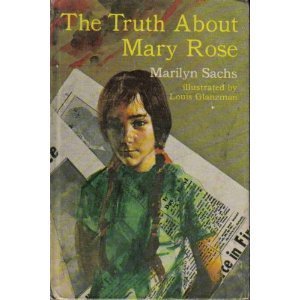
But The Truth About Mary Rose is set a couple of decades after all the other books. Veronica Ganz is grown now, married with three children, one of whom is named Mary Rose after her sister. It turns out that the original Mary Rose perished in a fire while still a young girl.
The book revolves around the second Mary Rose's quest to find out as much as she can about the girl for whom she was named. She hunts for a mysterious box that belonged to the first Mary Rose--the only thing that survived the deadly fire. Thus, Sachs uses the mystery box device I blogged about recently. A device that works wonderfully, I might add. Along with the box, the second Mary Rose uncovers unexpected truths about the fire that killed her aunt, and she has to accept a certain amount of ambiguity about the events of that night.
For many reasons, this was my favorite of Sachs's books. It takes some familiar characters and shows them in a new light. It also differs from the previous books because it is told in first person, which helps eliminate the confusion of having two characters with the same name, and shortens the narrative distance. It covers family conflict in a humorous way. But mostly, it revolves around a mystery and a tragedy. It's about a passion to know the truth, and an acceptance that sometimes we can't know the full truth. It's about realizing that different people see us differently, that there is no one "true view" of ourselves in the eyes of other people.
This book was first published in 1973, and it's interesting to see how short middle-grade books were back then--this book is only 159 pages. (In the pre-Harry-Potter era, MG books were about that long, and YA books were about 175 to 250 pages). Since it's also set around 1973, some of the references in it may puzzle today's readers--does anyone still know what a peignoir set is? But if you can find a used copy of this book floating around, it's worth checking out because it is, quite simply, an example of a darn good story: a story that has stuck in my head for years.
source of recommended read: first library, later bought
Sachs wrote a series of books about linked characters: Amy Moves In; Amy and Laura, about the original Amy and her sister; Laura's Luck, about the two sisters at summer camp; Veronica Ganz, about a girl who had bullied Amy and Laura; Peter and Veronica, about Veronica and her friend Peter Wedemeyer; and Marv, about a friend of Peter's. All of these books took place in New York shortly before World War II. It would be interesting for writers to look at this chain of books, because it's not quite a series, but rather a set of stand-alone books whose enjoyment is enhanced if you recognize the overlapping characters from book to book. From an author's standpoint, it's a way of building an audience and using a consistent fictional world without doing a formal series.
The character Veronica Ganz had a sister, Mary Rose, whom I liked because she had built an imaginary world out of magazine pictures. It was much like the imaginary world that I, a budding writer, had constructed for myself. (Also, I liked the character's name). Mary Rose was only a minor character in those books, so I was thrilled to find Sachs's book The Truth About Mary Rose in the library one day, because it promised to give a whole book to Mary Rose. In fact, this is the cover that my library's version had:
But The Truth About Mary Rose is set a couple of decades after all the other books. Veronica Ganz is grown now, married with three children, one of whom is named Mary Rose after her sister. It turns out that the original Mary Rose perished in a fire while still a young girl.
The book revolves around the second Mary Rose's quest to find out as much as she can about the girl for whom she was named. She hunts for a mysterious box that belonged to the first Mary Rose--the only thing that survived the deadly fire. Thus, Sachs uses the mystery box device I blogged about recently. A device that works wonderfully, I might add. Along with the box, the second Mary Rose uncovers unexpected truths about the fire that killed her aunt, and she has to accept a certain amount of ambiguity about the events of that night.
For many reasons, this was my favorite of Sachs's books. It takes some familiar characters and shows them in a new light. It also differs from the previous books because it is told in first person, which helps eliminate the confusion of having two characters with the same name, and shortens the narrative distance. It covers family conflict in a humorous way. But mostly, it revolves around a mystery and a tragedy. It's about a passion to know the truth, and an acceptance that sometimes we can't know the full truth. It's about realizing that different people see us differently, that there is no one "true view" of ourselves in the eyes of other people.
This book was first published in 1973, and it's interesting to see how short middle-grade books were back then--this book is only 159 pages. (In the pre-Harry-Potter era, MG books were about that long, and YA books were about 175 to 250 pages). Since it's also set around 1973, some of the references in it may puzzle today's readers--does anyone still know what a peignoir set is? But if you can find a used copy of this book floating around, it's worth checking out because it is, quite simply, an example of a darn good story: a story that has stuck in my head for years.
source of recommended read: first library, later bought
June 25, 2011
Taming the TBR Pile
Today, I guest blogged at Author2Author on the topic of taming the mighty TBR pile. A sample:
"About a month ago, I faced the fact that my TBR (to-be-read) book pile, if unchecked, stood a good chance of taking over the house. (I assume the only reason it hasn’t already is that the prospect of ruling two middle-class adults and one self-important cat isn’t particularly compelling, as coups and takeovers go.) I couldn’t shake the thought that there’s a certain silliness to buying more books when I have dozens of perfectly good unread books at home. ..."
The thrilling conclusion, in which I reveal my Seekrit Plan to dent my TBR pile, is here. (In fact, I've even made a little more progress since I originally wrote the guest post!)
"About a month ago, I faced the fact that my TBR (to-be-read) book pile, if unchecked, stood a good chance of taking over the house. (I assume the only reason it hasn’t already is that the prospect of ruling two middle-class adults and one self-important cat isn’t particularly compelling, as coups and takeovers go.) I couldn’t shake the thought that there’s a certain silliness to buying more books when I have dozens of perfectly good unread books at home. ..."
The thrilling conclusion, in which I reveal my Seekrit Plan to dent my TBR pile, is here. (In fact, I've even made a little more progress since I originally wrote the guest post!)
June 24, 2011
Let them get together now (one way of writing romance)
On the Eve's Fan Garden chat last night, the question arose of how to sustain that will-they-get-together-or-won't-they tension in a novel's romance. People mentioned different kinds of obstacles, but some of us (and I'm sorry to be so vague about attribution here, but it was a big chat and the words were flying by!) preferred to let the couple get together and then throw problems at them. As a reader, I sometimes get impatient when I can tell that a couple is going to get together, and it can be frustrating to see that delayed too long. (Especially if the obstacles are more nuisances than big, important differences.)
If the couple gets together before the book's end, different kinds of tension arise: Will they stay together? How intense will they let the relationship get? How will they handle any obstacles or differences, challenges or distractions? Will the relationship really turn out to be everything they hoped, or will there be surprises along the way? Couples can be challenged in many, many ways: Disapproving friends or parents. Competing demands on their time. Different interests. The reappearance of an old flame, or the entrance of an attractive new one. The decision of how far to go physically, and the consequences of that decision. The threat of separation (e.g., moving away, college). Different moral or ethical codes. The decision of whether to share painful secrets, and when.
Getting together isn't always the ending: it can be the middle, or even the beginning.
If the couple gets together before the book's end, different kinds of tension arise: Will they stay together? How intense will they let the relationship get? How will they handle any obstacles or differences, challenges or distractions? Will the relationship really turn out to be everything they hoped, or will there be surprises along the way? Couples can be challenged in many, many ways: Disapproving friends or parents. Competing demands on their time. Different interests. The reappearance of an old flame, or the entrance of an attractive new one. The decision of how far to go physically, and the consequences of that decision. The threat of separation (e.g., moving away, college). Different moral or ethical codes. The decision of whether to share painful secrets, and when.
Getting together isn't always the ending: it can be the middle, or even the beginning.
June 23, 2011
Unexpected
This book was so much more than I expected:
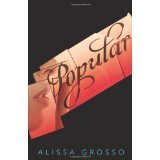
Popular, by Alissa Grosso. It starts out as a contemporary novel with multiple narrators: high-school girls, all members of the most popular clique in their school. At first, it seems that this is a book about a power struggle between the clique members, a straightforward drama about friendship and ambition and back-stabbing.
As it turns out, it's anything but straightforward. Early on, there are hints of strangeness, of things that don't quite add up. The character Alex--boyfriend to the most popular girl--seems so inconsistent that it's hard to get a handle on who he truly is and what he truly wants. And, it turns out, there's a good reason for this. As the truth unfolds, this story turns out to be something else altogether. It's not really about a competition for popularity. It goes to a much deeper darker place, and the weird little pieces that at first didn't make sense fall into place.
The other day on Twitter, I asked people to recommend books that had done something original with character, plot, or form. I got good suggestions, such as Blythe Woolston's The Freak Observer. But now I could add this book to the list, with kudos to Alissa Grosso, because it's been a long time since a book surprised me this much.
source of recommended read: bought
Popular, by Alissa Grosso. It starts out as a contemporary novel with multiple narrators: high-school girls, all members of the most popular clique in their school. At first, it seems that this is a book about a power struggle between the clique members, a straightforward drama about friendship and ambition and back-stabbing.
As it turns out, it's anything but straightforward. Early on, there are hints of strangeness, of things that don't quite add up. The character Alex--boyfriend to the most popular girl--seems so inconsistent that it's hard to get a handle on who he truly is and what he truly wants. And, it turns out, there's a good reason for this. As the truth unfolds, this story turns out to be something else altogether. It's not really about a competition for popularity. It goes to a much deeper darker place, and the weird little pieces that at first didn't make sense fall into place.
The other day on Twitter, I asked people to recommend books that had done something original with character, plot, or form. I got good suggestions, such as Blythe Woolston's The Freak Observer. But now I could add this book to the list, with kudos to Alissa Grosso, because it's been a long time since a book surprised me this much.
source of recommended read: bought
June 21, 2011
Messages in books
Quick note: I'll be chatting with other writers, and with readers who want to join in, about romance in YA at Eve's Fan Garden on Wednesday, June 22, at 8:30 PM Eastern (5:30 Pacific).
There's been a lot of discussion around the blogosphere about whether children's and YA books have, or should have, a message.
For me, this isn't a yes-or-no question. I would say that books don't have to have a message--for example, they could be pure entertainment--but I don't think it's out of the question either. And I'm not talking about being heavy-handed or didactic. I suppose that my idea of a "message" is what some people would just call a "point." I don't write any story just hoping that the reader will say, "Huh," and shrug and move on. I hope a reader says, "Yes!" or even, "No!" That he or she responds to some idea in the book, recognizes something that is true about the world. And maybe asks, "Should the world be this way?" But I think of the message as a natural outgrowth of the story.
I will also say that a writer is only responsible for this message up to a point, because something magical happens between reader and writer. Arguably, stories are jointly constructed between reader and writer. Writers often talk about letting go of their work, of losing ownership once it's out in the world (not in the legal sense, but in the spiritual or emotional sense). Readers don't always agree with one another about what the point of a book is; and they may find more or less of a message than the writer intended. They may find a message altogether different--or they may find nothing. Readers may say, "Huh," and shrug no matter what the author intended.
I believe this is one of the purposes of art: to highlight ideas. To show the world to one another in new and interesting ways--or in ways that simply allow us to recognize and share our common experiences. There isn't just one reason for writing a book, nor is there just one reason for reading it. And the complicated discussion about what art means to us is one of the joys of creating in the first place.
There's been a lot of discussion around the blogosphere about whether children's and YA books have, or should have, a message.
For me, this isn't a yes-or-no question. I would say that books don't have to have a message--for example, they could be pure entertainment--but I don't think it's out of the question either. And I'm not talking about being heavy-handed or didactic. I suppose that my idea of a "message" is what some people would just call a "point." I don't write any story just hoping that the reader will say, "Huh," and shrug and move on. I hope a reader says, "Yes!" or even, "No!" That he or she responds to some idea in the book, recognizes something that is true about the world. And maybe asks, "Should the world be this way?" But I think of the message as a natural outgrowth of the story.
I will also say that a writer is only responsible for this message up to a point, because something magical happens between reader and writer. Arguably, stories are jointly constructed between reader and writer. Writers often talk about letting go of their work, of losing ownership once it's out in the world (not in the legal sense, but in the spiritual or emotional sense). Readers don't always agree with one another about what the point of a book is; and they may find more or less of a message than the writer intended. They may find a message altogether different--or they may find nothing. Readers may say, "Huh," and shrug no matter what the author intended.
I believe this is one of the purposes of art: to highlight ideas. To show the world to one another in new and interesting ways--or in ways that simply allow us to recognize and share our common experiences. There isn't just one reason for writing a book, nor is there just one reason for reading it. And the complicated discussion about what art means to us is one of the joys of creating in the first place.
June 20, 2011
Artistic ambitions
Recently, I've re-watched two movies, both made in "mockumentary" style by Christopher Guest et al.: For Your Consideration and Waiting for Guffman. These movies record the fictional misadventures of hopeful actors: in the former case, professional actors; in the latter case, amateurs. The aspirations and setbacks for both groups are strikingly similar, because artistic endeavors are fraught with certain unavoidable issues.
I say "artistic endeavors" because I think these issues are common not only to actors, but to musicians, and visual artists, and dancers, and writers. Anyone who creates something that is meant to be enjoyed by others has a built-in goal, and the possibility of not reaching that goal.
While the ambitions of some of the characters in these films are obviously--shall we say, beyond their reach--it's hard not to root for them, to find their stories touching underneath the laughter. Especially if you're a writer who has had those dreams, who has faced the rejection machine. I suspect there are very few writers who could not identify with the characters in For Your Consideration, whose heads are turned by Oscar buzz, by the tantalizing possibility of winning that golden honor. I suspect there are writers who fear ending up like Harry Shearer's character in the same movie, when he ends up taking just about any role and plugging just about anything because he needs the work. There must be writers who understand why Catherine O'Hara's character in that movie (winkingly named "Marilyn Hack") gets a face-lift that gives her a frozen expression, and packs herself into a dress so tight that it looks like she might burst out of it if she breathes the wrong way. There are writers who wonder if their dreams of bestsellerdom are as unlikely as the Broadway dreams of the community theater group in Waiting for Guffman.
One thing I like about these movies is that even those characters who fall on their faces don't dissolve in a puddle of despair and self-pity. The epilogues show them moving on, spending time on things they care about. Living a dream, even if it isn't the same dream they started out with.
My take-home lessons from these movies: Don't take that Oscar buzz too seriously. It's okay to laugh at yourself. And it's still okay to dream.
In fact, it's necessary.
I say "artistic endeavors" because I think these issues are common not only to actors, but to musicians, and visual artists, and dancers, and writers. Anyone who creates something that is meant to be enjoyed by others has a built-in goal, and the possibility of not reaching that goal.
While the ambitions of some of the characters in these films are obviously--shall we say, beyond their reach--it's hard not to root for them, to find their stories touching underneath the laughter. Especially if you're a writer who has had those dreams, who has faced the rejection machine. I suspect there are very few writers who could not identify with the characters in For Your Consideration, whose heads are turned by Oscar buzz, by the tantalizing possibility of winning that golden honor. I suspect there are writers who fear ending up like Harry Shearer's character in the same movie, when he ends up taking just about any role and plugging just about anything because he needs the work. There must be writers who understand why Catherine O'Hara's character in that movie (winkingly named "Marilyn Hack") gets a face-lift that gives her a frozen expression, and packs herself into a dress so tight that it looks like she might burst out of it if she breathes the wrong way. There are writers who wonder if their dreams of bestsellerdom are as unlikely as the Broadway dreams of the community theater group in Waiting for Guffman.
One thing I like about these movies is that even those characters who fall on their faces don't dissolve in a puddle of despair and self-pity. The epilogues show them moving on, spending time on things they care about. Living a dream, even if it isn't the same dream they started out with.
My take-home lessons from these movies: Don't take that Oscar buzz too seriously. It's okay to laugh at yourself. And it's still okay to dream.
In fact, it's necessary.