Jennifer R. Hubbard's Blog, page 94
July 15, 2011
Quality time
Different writing tasks require different amounts of time and levels of concentration. There are the simple promotional tasks: addressing postcards, sending out bookmarks. There are the slightly more technical tasks: updating websites, planning signings. There are the I-need-a-break moments: checking in on Twitter, commenting on a blog post.
Then there are the tasks that require quiet, concentration, and uninterrupted blocks of time: preparing a critique, answering a thoughtful email, drafting a new book, revising on a deep level. This week I worked on an editing task that didn't take much time overall, but that time had to be spacious and unhurried. I needed to go over the kind of changes that require me to pay attention to rhythm, repetition, and consistency. I needed to concentrate, without the feeling of a ticking clock or the expectation of interruptions.
I work tasks into my schedule according to the quality of the time as well as the quantity. Five minutes on my computer before I have to rush out the door is not the same as five unhurried minutes of quiet in my office, or five minutes in a doctor's waiting room, or five minutes on the commuter train.
This is why I set aside certain days where I don't accept social invitations or chore-like appointments (medical check-ups, having the furnace guy come for the annual maintenance, etc.). Knowing that I have to be somewhere at a certain time affects the quality of the rest of the day, so I am careful to give myself free time that really is free in quality, whenever I can.
Then there are the tasks that require quiet, concentration, and uninterrupted blocks of time: preparing a critique, answering a thoughtful email, drafting a new book, revising on a deep level. This week I worked on an editing task that didn't take much time overall, but that time had to be spacious and unhurried. I needed to go over the kind of changes that require me to pay attention to rhythm, repetition, and consistency. I needed to concentrate, without the feeling of a ticking clock or the expectation of interruptions.
I work tasks into my schedule according to the quality of the time as well as the quantity. Five minutes on my computer before I have to rush out the door is not the same as five unhurried minutes of quiet in my office, or five minutes in a doctor's waiting room, or five minutes on the commuter train.
This is why I set aside certain days where I don't accept social invitations or chore-like appointments (medical check-ups, having the furnace guy come for the annual maintenance, etc.). Knowing that I have to be somewhere at a certain time affects the quality of the rest of the day, so I am careful to give myself free time that really is free in quality, whenever I can.


July 13, 2011
Moments of change
You've probably heard that characters have to change over the course of a book. Usually, characters will reach a turning point in which they learn a lesson, or conquer a fear, or accept the inevitable, or break out of a pattern, etc. The challenge is to write such moments without leading readers to roll their eyes and say, "It never happens that way in real life!"
And yes, few of us have apocalyptic battles with villains over the fate of the world. But people do have life-changing moments in which they decide where to go to college, whether to marry, or when to leave an abusive person behind. They decide to have babies, or stop drinking, or compete in the Iditarod, or join the Peace Corps, or enlist in the Army. Some of these changes are about taking the next steps in life, and some of them are about facing inner demons.
The question is, how do those moments come about? Sometimes they're the result of a sudden shock: the death of someone close to us, for example. Sometimes they creep up on us gradually, as when an unpleasant job or relationship becomes unbearable. Sometimes a person changes in order to get something he wants.
I can tell you the moment when I decided to apply to graduate school. I was talking to a friend about how I was "thinking" of doing it "someday," and she said, "You talk about this a lot. It sounds like you really want to do it." And I realized that yes, I did talk about it a lot, and it was time to stop talking and do something about it. My friend's remark was the trigger, but it was built on research and interest that had built over time.
Much fictional change is like that: a desire whispers in the main character's ear, and grows through the course of the novel. The reader sees it building, like a pile of kindling. At the peak of the story, someone lights a match, and the change is both sudden and an inevitable culmination of everything that came before. In a book, the inciting event will usually be a little more exciting than a friend's comment. But sometimes, the drama is not so much in the event as in what happens to the character as a result.
And yes, few of us have apocalyptic battles with villains over the fate of the world. But people do have life-changing moments in which they decide where to go to college, whether to marry, or when to leave an abusive person behind. They decide to have babies, or stop drinking, or compete in the Iditarod, or join the Peace Corps, or enlist in the Army. Some of these changes are about taking the next steps in life, and some of them are about facing inner demons.
The question is, how do those moments come about? Sometimes they're the result of a sudden shock: the death of someone close to us, for example. Sometimes they creep up on us gradually, as when an unpleasant job or relationship becomes unbearable. Sometimes a person changes in order to get something he wants.
I can tell you the moment when I decided to apply to graduate school. I was talking to a friend about how I was "thinking" of doing it "someday," and she said, "You talk about this a lot. It sounds like you really want to do it." And I realized that yes, I did talk about it a lot, and it was time to stop talking and do something about it. My friend's remark was the trigger, but it was built on research and interest that had built over time.
Much fictional change is like that: a desire whispers in the main character's ear, and grows through the course of the novel. The reader sees it building, like a pile of kindling. At the peak of the story, someone lights a match, and the change is both sudden and an inevitable culmination of everything that came before. In a book, the inciting event will usually be a little more exciting than a friend's comment. But sometimes, the drama is not so much in the event as in what happens to the character as a result.
July 10, 2011
Lessons from trunk novels
There are writers who've sold the first book they ever wrote. And I suppose there are writers who have sold every book they ever wrote. But it's far more common for writers to have several unpublished manuscripts lying about the house. Or stuffed away in a trunk--hence the name "trunk novels."
Trunk novels remain unpublished for several reasons. These reasons fall into two categories: 1) the quality of the novel, or 2) the state of the universe market at the time the manuscript is submitted. The second category includes books that are esoteric, or out of fashion, or cover a subject that the market's already saturated with. It includes books that don't have a wide enough audience, or don't stand out enough from other books, even though they may be perfectly good reads in themselves. It includes works that just never find an enthusiastic enough champion to publish them. It also includes works of genius that are so innovative that publishers just don't quite know how to market them. Sometimes, projects that fall into the second category end up coming out of the trunk and having a new life when trends change, when editors turn over, or when the author finds self-publishing success.
We all want to believe that our rejected manuscripts fall into the second category. This is natural, because nobody in her right mind sends out a manuscript unless she really believe that it's of publishable quality. And yet, I realize that the majority of my trunk novels fall into the first category. I wouldn't be surprised if many writers find, in retrospect, they have a project or two that wasn't as ready as they thought at the time. I have projects that never left the privacy of my own computer, because I didn't even need anyone else to tell me they didn't work.
If a first-category trunk novel isn't worth reworking, it can still be valuable for what it teaches us about writing. Looking back over my discarded projects, I find these lessons:
A book needs a plot.
Bad stuff has to happen to the main character.
The main character's friends shouldn't have more interesting problems than she does.
A book needs conflict.
If my book is just a blatant rip-off of an already-successful book, people are probably going to prefer the already-successful book.
A setting should feel realistic.
If a plot is contrived, it shows.
A novel written from atop a soapbox is off-putting.
Lots of stuff can happen to the main character, but at some point he or she has to take action.
Language counts.
A story needs a beginning, a middle, and an end. At least one of those parts will be extremely difficult to write.
I don't have to write what I know, but I'd better be able to fake it really well.
(For YA) Stay true to the inner teen.
Don't hide so much. Be brave. Don't worry so much about what people think.
What have your trunk novels taught you?
Trunk novels remain unpublished for several reasons. These reasons fall into two categories: 1) the quality of the novel, or 2) the state of the universe market at the time the manuscript is submitted. The second category includes books that are esoteric, or out of fashion, or cover a subject that the market's already saturated with. It includes books that don't have a wide enough audience, or don't stand out enough from other books, even though they may be perfectly good reads in themselves. It includes works that just never find an enthusiastic enough champion to publish them. It also includes works of genius that are so innovative that publishers just don't quite know how to market them. Sometimes, projects that fall into the second category end up coming out of the trunk and having a new life when trends change, when editors turn over, or when the author finds self-publishing success.
We all want to believe that our rejected manuscripts fall into the second category. This is natural, because nobody in her right mind sends out a manuscript unless she really believe that it's of publishable quality. And yet, I realize that the majority of my trunk novels fall into the first category. I wouldn't be surprised if many writers find, in retrospect, they have a project or two that wasn't as ready as they thought at the time. I have projects that never left the privacy of my own computer, because I didn't even need anyone else to tell me they didn't work.
If a first-category trunk novel isn't worth reworking, it can still be valuable for what it teaches us about writing. Looking back over my discarded projects, I find these lessons:
A book needs a plot.
Bad stuff has to happen to the main character.
The main character's friends shouldn't have more interesting problems than she does.
A book needs conflict.
If my book is just a blatant rip-off of an already-successful book, people are probably going to prefer the already-successful book.
A setting should feel realistic.
If a plot is contrived, it shows.
A novel written from atop a soapbox is off-putting.
Lots of stuff can happen to the main character, but at some point he or she has to take action.
Language counts.
A story needs a beginning, a middle, and an end. At least one of those parts will be extremely difficult to write.
I don't have to write what I know, but I'd better be able to fake it really well.
(For YA) Stay true to the inner teen.
Don't hide so much. Be brave. Don't worry so much about what people think.
What have your trunk novels taught you?
July 9, 2011
Daily goals
I've said this before, but every now and then I need to remind myself of it: I am not a word-count writer.
I need to remind myself of this from time to time because the word-count mindset is so tempting. Word count is an easy way to measure progress. It's a number, hard and fast. Many writers do use word count to track their progress, or to serve as a goal. That's great, but it's not for me.
I find that when I focus on getting a certain number of words down, I write crap. Also, since I revise so much, a day on which I've made good progress is often a day when my total word count decreases. I may add 50 good words and delete 175 lousy ones, and that's a step forward for the book even if it's a step back for the word count.
I do pay attention to my total word count in a general way, just to make sure that what I'm writing will be long enough to qualify as a novel. I tend to write short (45-60K), and I like my first draft to be at least 40K, and my final draft to be at least 45K. But beyond that, daily word count doesn't matter.
Examples of goals that do work for me:
I'm going to write for an hour.
I'm going to revise chapters three and four.
I'm going to write the party scene and the thunderstorm scene.
Do you set daily goals? What are they like?
I need to remind myself of this from time to time because the word-count mindset is so tempting. Word count is an easy way to measure progress. It's a number, hard and fast. Many writers do use word count to track their progress, or to serve as a goal. That's great, but it's not for me.
I find that when I focus on getting a certain number of words down, I write crap. Also, since I revise so much, a day on which I've made good progress is often a day when my total word count decreases. I may add 50 good words and delete 175 lousy ones, and that's a step forward for the book even if it's a step back for the word count.
I do pay attention to my total word count in a general way, just to make sure that what I'm writing will be long enough to qualify as a novel. I tend to write short (45-60K), and I like my first draft to be at least 40K, and my final draft to be at least 45K. But beyond that, daily word count doesn't matter.
Examples of goals that do work for me:
I'm going to write for an hour.
I'm going to revise chapters three and four.
I'm going to write the party scene and the thunderstorm scene.
Do you set daily goals? What are they like?
July 7, 2011
Characters in company
I came across this gem while reading Peter Cameron's The Weekend. Although it says something to me about getting to know people in real life, it's also food for thought when it comes to building fictional characters:
"It was strange to see someone you have only known alone begin interacting with other people, for that somebody known to you disappears and is replaced by a different, more complex, person. You watch him revolve in this new company, revealing new facets, and there is nothing you can do but hope you like these other sides as much as you like the side that seemed whole when it faced only you."
"It was strange to see someone you have only known alone begin interacting with other people, for that somebody known to you disappears and is replaced by a different, more complex, person. You watch him revolve in this new company, revealing new facets, and there is nothing you can do but hope you like these other sides as much as you like the side that seemed whole when it faced only you."
July 6, 2011
Milestone: Try Not to Breathe
The Penguin spring 2012 catalog is online, so this cover is now in the public realm. I thought I'd do a little show and tell, because so much of this blog is about works in progress, and struggles, and the neverending writing process, and it's just nice to have a finished product to show you every now and then. This book is indeed finished--although it won't be appearing for another six months, so this is the last I'll say about it until sometime in the fall. But for now, thank you all for sharing this ride with me.

I like the way the designer incorporated rainwater, glass, and the waterfall, all of which are important elements in the story. This is another contemporary YA novel with a male narrator, although he's different from the narrator of The Secret Year. Although he's outwardly more privileged, inwardly he's in much more trouble, I think.
The short synopsis: In the summer after his suicide attempt, 16-year-old Ryan struggles with guilty secrets and befriends a girl who’s visiting psychics to try to reach her dead father.
The preorder pages have started to creep out there onto the internet: Amazon, Barnes & Noble, Borders, Powell's (couldn't find it on IndieBound yet). But I'll put up complete links later. This book will now return to the wings, waiting for its cue to come back on stage, while I fuss with the manuscript that will hopefully become its younger sibling.
I like the way the designer incorporated rainwater, glass, and the waterfall, all of which are important elements in the story. This is another contemporary YA novel with a male narrator, although he's different from the narrator of The Secret Year. Although he's outwardly more privileged, inwardly he's in much more trouble, I think.
The short synopsis: In the summer after his suicide attempt, 16-year-old Ryan struggles with guilty secrets and befriends a girl who’s visiting psychics to try to reach her dead father.
The preorder pages have started to creep out there onto the internet: Amazon, Barnes & Noble, Borders, Powell's (couldn't find it on IndieBound yet). But I'll put up complete links later. This book will now return to the wings, waiting for its cue to come back on stage, while I fuss with the manuscript that will hopefully become its younger sibling.
July 4, 2011
Opening lines
Opening lines. Writers obsess over them, redraft them, searching for that perfect combination of introduction, hook, and stage-setting. I've analyzed eight openers from YA novels, below.
It hit me when I was power walking on the treadmill at home, watching a Friends rerun for about the ninetieth time.
--Randa Abdel-Fattah, Does My Head Look Big in This?
We don't know what hit her, but something did. Something is about to change in this character's life. And since she's watching old reruns repeatedly, it sounds like she needs a change. The tone in this sentence is closer than comedic to tragic.
It is my first morning of high school. I have seven new notebooks, a skirt I hate, and a stomachache.
--Laurie Halse Anderson, Speak
Firsts and beginnings are a great place to start. And already this character has trouble. She is not rushing into high school with joy and anticipation. Is it just first-day jitters, or something more significant? We're about to find out.
I raise my mini golf club and try to focus on the clown's chomping mouth. Other lips are on my mind, though--Bryan's, to be honest.
--Lauren Bjorkman, My Invented Life
Nothing wrong with romance! And there's humor, too, with the "clown's chomping mouth," especially juxtaposed with some (presumably) hot guy's mouth.
The third time I tried to kill myself I used a rope.
--Albert Borris, Crash Into Me
This is a classic lay-it-on-the-table opening. We know exactly what this book is going to be about: suicide.
Maybe it's just a scratch. Willow Randall stares at the girl seated opposite her.
--Julia Hoban, Willow
Here's a more subtle opening, starting with a small mystery. A girl is curious about a small detail, an injury. We are being eased into a story in which the details will prove significant.
Leah Greene is dead. Before my mother even answers the ringing telephone downstairs, I know.
--Jo Knowles, Lessons from a Dead Girl
Another high-impact opening, with the second line introducing a mystery: how does the narrator know?
There is no lake at Camp Green Lake.
--Louis Sachar, Holes
Another opening with a slower build. But right away, we get the sense of absurdity, paradox, and puzzlement that characterizes the whole book.
"There are places you can go," Ariana tells him, "and a guy as smart as you has a decent chance of surviving to eighteen."
--Neal Shusterman, Unwind
I sometimes hear people say you can't start a book with dialogue, and I don't know where that advice came from, but I disagree. Of course you can, and Shusterman does. This opener tells us someone is looking to escape from something--and it's a matter of survival. So we have conflict, mystery, and high stakes right away.
Some of these openers plunk us right in the middle of conflict, while others hint at it more subtly. Most of them provoke questions. All of them introduce us to the narrator's voice, and to the book's tone. The beginning can be fast or slow, loud or quiet. Mostly, the first sentence just needs to make us read the next sentence. (Which needs to make us read the next ...)
It hit me when I was power walking on the treadmill at home, watching a Friends rerun for about the ninetieth time.
--Randa Abdel-Fattah, Does My Head Look Big in This?
We don't know what hit her, but something did. Something is about to change in this character's life. And since she's watching old reruns repeatedly, it sounds like she needs a change. The tone in this sentence is closer than comedic to tragic.
It is my first morning of high school. I have seven new notebooks, a skirt I hate, and a stomachache.
--Laurie Halse Anderson, Speak
Firsts and beginnings are a great place to start. And already this character has trouble. She is not rushing into high school with joy and anticipation. Is it just first-day jitters, or something more significant? We're about to find out.
I raise my mini golf club and try to focus on the clown's chomping mouth. Other lips are on my mind, though--Bryan's, to be honest.
--Lauren Bjorkman, My Invented Life
Nothing wrong with romance! And there's humor, too, with the "clown's chomping mouth," especially juxtaposed with some (presumably) hot guy's mouth.
The third time I tried to kill myself I used a rope.
--Albert Borris, Crash Into Me
This is a classic lay-it-on-the-table opening. We know exactly what this book is going to be about: suicide.
Maybe it's just a scratch. Willow Randall stares at the girl seated opposite her.
--Julia Hoban, Willow
Here's a more subtle opening, starting with a small mystery. A girl is curious about a small detail, an injury. We are being eased into a story in which the details will prove significant.
Leah Greene is dead. Before my mother even answers the ringing telephone downstairs, I know.
--Jo Knowles, Lessons from a Dead Girl
Another high-impact opening, with the second line introducing a mystery: how does the narrator know?
There is no lake at Camp Green Lake.
--Louis Sachar, Holes
Another opening with a slower build. But right away, we get the sense of absurdity, paradox, and puzzlement that characterizes the whole book.
"There are places you can go," Ariana tells him, "and a guy as smart as you has a decent chance of surviving to eighteen."
--Neal Shusterman, Unwind
I sometimes hear people say you can't start a book with dialogue, and I don't know where that advice came from, but I disagree. Of course you can, and Shusterman does. This opener tells us someone is looking to escape from something--and it's a matter of survival. So we have conflict, mystery, and high stakes right away.
Some of these openers plunk us right in the middle of conflict, while others hint at it more subtly. Most of them provoke questions. All of them introduce us to the narrator's voice, and to the book's tone. The beginning can be fast or slow, loud or quiet. Mostly, the first sentence just needs to make us read the next sentence. (Which needs to make us read the next ...)
July 3, 2011
Across media
My last entry included a playlist for a short-story anthology. This has gotten me thinking about the media cross-over we're undergoing. For years now, books have been turned into movies (and vice versa). We've had fanfiction and audiobooks. But now we also have book trailers, apps, playlists, blogs, and interactive media. For me, the book is still the best part. But I have to admit, when a reader sent me a trailer she'd made for The Secret Year, it was an honor and a thrill.
Sometimes cross-media connections instantly suggest themselves. For example, I have long cherished a vision of Jack Kerouac's On the Road as a black-and-white movie, with its opening song being "King of the Road." I hear they're making a movie of it now, and I know some little part of me will be playing backseat director. Have you ever read a book and had an instant vision for a playlist, or a movie, or a trailer for it?
Sometimes cross-media connections instantly suggest themselves. For example, I have long cherished a vision of Jack Kerouac's On the Road as a black-and-white movie, with its opening song being "King of the Road." I hear they're making a movie of it now, and I know some little part of me will be playing backseat director. Have you ever read a book and had an instant vision for a playlist, or a movie, or a trailer for it?
July 2, 2011
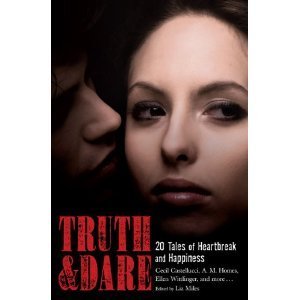
Playlist - Truth & Dare
This entry is just for fun: it's the playlist for the YA anthology
Truth & Dare
, edited by Liz Miles. I want to thank Christin, Louise, Pamela, Harmony, and Kari for their help with my part of the playlist.
GIRL JESUS ON THE INBOUND SUBWAY by Matthue Roth
Sick to Death – Atari Teenage Riot Matthue says: One of the most hard-to-listen-to bands EVER. They're so loud and aggressive and straight-up furious. Not to generalise, but the only people I've known who like them are incredibly quiet, thoughtful, beautiful girls. This is probably the song that Jupiter's crush is listening to when he meets her.DatSkat - The Roots Matthue says: When I was in high school, the Roots were two a band with black guys and a white Jewish guy playing keyboards. This is the song that I always listen to when I'm walking down Market Street, past all the industrial bus terminals and the Gallery mall, and I start wanting really badly to dance.In Between Days – The Cure Matthue says: ...really this song is about a day like the day in this story. It's ordinary, it's boring, and then all of a sudden you're in a different universe.
THE YOUNG STALKER’S HANDBOOK by Sarah Rees BrennanOne Way Or Another – Blondie
LOST IN TRANSLATION by Michael LowenthalDo You Believe in Love – Huey Lewis Gary says: This was high on the charts during the months described in my story.
CONFESSIONS AND CHOCOLATE BRAINS by Jennifer R. HubbardThe Scientist – Coldplay
Two is Better than One – Boys Like Girls (feat. Taylor Swift)Mr. Brightside – The Killers
I'll Run – The CabNever Say Never – The Fray
THE LAST WILL AND TESTAMENT OF EVAN TODD by Saundra MitchellThe songs that drive Evan Todd: Water – Holly McNarland Live!
I Will Follow You into the Dark – Death Cab for Cutie
HEADGEAR GIRL by Heidi R. KlingRaindrops Keep Fallin' on My Head – B.J. Thomas
NEVER HAVE I EVER by Courtney GilletteDig Me Out – Sleater-Kinney
DIRTY TALK by Gary SotoTalk to Me – Sonny & the Sunglows
ABSTINENCE MAKES THE HEART GROW FONDER by Jennifer Knight
Today was a Fairytale – Taylor Swift (Opening scene when Chris asks Liv out)
Bubbly – Colby Caillat (Beach scene when they kiss for the first time)You and Me – The Dave Matthews Band (the big final scene)
Annie – Safetysuit (Chris's song to Liv)
SOMEBODY’S DAUGHTER by Shelley StoehrAsking for It – Hole
MARGO FERKEL’S TWO-HOUR BLITZ OF BADNESS by Jill WolfsonMashed Potato Time – Dee Dee Sharpe Jill says: I picked this song because Dee Dee is a Philly girl, where the story is set and her big hit happened around the time of the story. Plus, I won a Mashed Potato contest while vacationing with my family in Miami Beach that year. (I just know that my protagonist is an awesome dancer)
SCRAMBLED EGGS by Liz MilesI See You Baby (Shakin That Ass) – Fatboy Slim
Bad Romance – Lady GagaFrontier Psychiatrist – The Avalanches
RULES FOR LOVE AND DEATH by Ellen WittlingerPaint It Black – Rolling Stones
Catch the Wind – DonovanGhost – Indigo Girls
Angel – Sarah McLachlanI Will Remember You – Sarah McLachlan
Yesterday – The Beatles
COOL CATS AND MELTED KISSES by Luisa PlajaThe Sweetest Thing – Skunk Anansie
Left of Center – Suzanne VegaChocolate – Snow Patrol
Just for Tonight – Groove ArmadaOur Lips are Sealed – Fun Boy Three
ORANGE TOOTSIE POP by Cecil CastellucciGirl's Room – Liz Phair
PENCILS by Sara WilkinsonThe Helikopter-Streichquartett (Helicopter String Quartet) – Karlheinz Stockhausen
TEAM MEN by Emma DonaghueTubthumping - Chumbawumba
IRIS AND JIM by Sherry ShahanHunger Strike - Temple of the Dog
GIRL JESUS ON THE INBOUND SUBWAY by Matthue Roth
Sick to Death – Atari Teenage Riot Matthue says: One of the most hard-to-listen-to bands EVER. They're so loud and aggressive and straight-up furious. Not to generalise, but the only people I've known who like them are incredibly quiet, thoughtful, beautiful girls. This is probably the song that Jupiter's crush is listening to when he meets her.DatSkat - The Roots Matthue says: When I was in high school, the Roots were two a band with black guys and a white Jewish guy playing keyboards. This is the song that I always listen to when I'm walking down Market Street, past all the industrial bus terminals and the Gallery mall, and I start wanting really badly to dance.In Between Days – The Cure Matthue says: ...really this song is about a day like the day in this story. It's ordinary, it's boring, and then all of a sudden you're in a different universe.
THE YOUNG STALKER’S HANDBOOK by Sarah Rees BrennanOne Way Or Another – Blondie
LOST IN TRANSLATION by Michael LowenthalDo You Believe in Love – Huey Lewis Gary says: This was high on the charts during the months described in my story.
CONFESSIONS AND CHOCOLATE BRAINS by Jennifer R. HubbardThe Scientist – Coldplay
Two is Better than One – Boys Like Girls (feat. Taylor Swift)Mr. Brightside – The Killers
I'll Run – The CabNever Say Never – The Fray
THE LAST WILL AND TESTAMENT OF EVAN TODD by Saundra MitchellThe songs that drive Evan Todd: Water – Holly McNarland Live!
I Will Follow You into the Dark – Death Cab for Cutie
HEADGEAR GIRL by Heidi R. KlingRaindrops Keep Fallin' on My Head – B.J. Thomas
NEVER HAVE I EVER by Courtney GilletteDig Me Out – Sleater-Kinney
DIRTY TALK by Gary SotoTalk to Me – Sonny & the Sunglows
ABSTINENCE MAKES THE HEART GROW FONDER by Jennifer Knight
Today was a Fairytale – Taylor Swift (Opening scene when Chris asks Liv out)
Bubbly – Colby Caillat (Beach scene when they kiss for the first time)You and Me – The Dave Matthews Band (the big final scene)
Annie – Safetysuit (Chris's song to Liv)
SOMEBODY’S DAUGHTER by Shelley StoehrAsking for It – Hole
MARGO FERKEL’S TWO-HOUR BLITZ OF BADNESS by Jill WolfsonMashed Potato Time – Dee Dee Sharpe Jill says: I picked this song because Dee Dee is a Philly girl, where the story is set and her big hit happened around the time of the story. Plus, I won a Mashed Potato contest while vacationing with my family in Miami Beach that year. (I just know that my protagonist is an awesome dancer)
SCRAMBLED EGGS by Liz MilesI See You Baby (Shakin That Ass) – Fatboy Slim
Bad Romance – Lady GagaFrontier Psychiatrist – The Avalanches
RULES FOR LOVE AND DEATH by Ellen WittlingerPaint It Black – Rolling Stones
Catch the Wind – DonovanGhost – Indigo Girls
Angel – Sarah McLachlanI Will Remember You – Sarah McLachlan
Yesterday – The Beatles
COOL CATS AND MELTED KISSES by Luisa PlajaThe Sweetest Thing – Skunk Anansie
Left of Center – Suzanne VegaChocolate – Snow Patrol
Just for Tonight – Groove ArmadaOur Lips are Sealed – Fun Boy Three
ORANGE TOOTSIE POP by Cecil CastellucciGirl's Room – Liz Phair
PENCILS by Sara WilkinsonThe Helikopter-Streichquartett (Helicopter String Quartet) – Karlheinz Stockhausen
TEAM MEN by Emma DonaghueTubthumping - Chumbawumba
IRIS AND JIM by Sherry ShahanHunger Strike - Temple of the Dog
The joys of deletion
I've been pruning out adverbs and crutch words in my book. Crutch words are those phrases we rely on excessively without realizing it: maybe your character rolls her eyes every five pages, or shrugs constantly, or sighs like it's going out of style. Or maybe you've developed an unnatural attachment to the word "azure," and you find yourself using it describe the sky, the sea, the main character's eyes, his father's car, his girlfriend's tattoo, and the rug in his room. Or maybe it's the common words that spew forth from your fingertips with abandon: really, very, just.
I use the latter words as emphasis, or to keep my rhythm going, but I overuse them in first drafts. During editing, I often cut out half of them (or more). I love cutting a word and finding it makes the sentence stronger. Yes, I find my joy in strange things, but I am a writer, and we are a strange crew.
I find it fascinating to comtemplate the difference among these sentences:
Give me just a little bit of time to deal with how I feel about that.
Give me just a little time to deal with how I feel.
Give me a little time to deal with that.
Give me time.
Some of those words are unnecessary padding, and some of them may be right or not depending on the characters and the context. "Give me time," might be beautifully succinct or it might be terse. But the first sentence there is probably overdressed for any occasion.
I use the latter words as emphasis, or to keep my rhythm going, but I overuse them in first drafts. During editing, I often cut out half of them (or more). I love cutting a word and finding it makes the sentence stronger. Yes, I find my joy in strange things, but I am a writer, and we are a strange crew.
I find it fascinating to comtemplate the difference among these sentences:
Give me just a little bit of time to deal with how I feel about that.
Give me just a little time to deal with how I feel.
Give me a little time to deal with that.
Give me time.
Some of those words are unnecessary padding, and some of them may be right or not depending on the characters and the context. "Give me time," might be beautifully succinct or it might be terse. But the first sentence there is probably overdressed for any occasion.