Jennifer R. Hubbard's Blog, page 105
February 9, 2011
Tasty assortment
Today I have one of those linky posts, collecting wisdom from around the blogosphere ...
Okay, well, this first one's actually still me, guest blogging at![[info]](https://i.gr-assets.com/images/S/compressed.photo.goodreads.com/hostedimages/1380442897i/1319734.gif) tracy_d74
about the joys of traveling alone, and the importance of stepping outside one's comfort zone.
tracy_d74
about the joys of traveling alone, and the importance of stepping outside one's comfort zone.
In case anyone needs an etiquette reminder--or a laugh--here's a link via
kimberleylittle
about the strangest places editors have been pitched by aspiring authors.
Erin Murphy visits the Shrinking Violets, to discuss the true meaning of success.
Ever had a series canceled before the last book? Stacey Jay solves the problem by finishing her Megan Berry zombie series with an indie novella. But if the novella does well enough, Megan Berry's adventures just may continue.
Laurel Garver posts about finding a use for all those character sketches, deleted scenes, and extinct subplots that are the inevitable byproduct of revision.
And Elissa Cruz reveals The Secret to Successful Revision!
Okay, well, this first one's actually still me, guest blogging at
tracy_d74
about the joys of traveling alone, and the importance of stepping outside one's comfort zone.In case anyone needs an etiquette reminder--or a laugh--here's a link via
kimberleylittle
about the strangest places editors have been pitched by aspiring authors.Erin Murphy visits the Shrinking Violets, to discuss the true meaning of success.
Ever had a series canceled before the last book? Stacey Jay solves the problem by finishing her Megan Berry zombie series with an indie novella. But if the novella does well enough, Megan Berry's adventures just may continue.
Laurel Garver posts about finding a use for all those character sketches, deleted scenes, and extinct subplots that are the inevitable byproduct of revision.
And Elissa Cruz reveals The Secret to Successful Revision!


February 7, 2011
I've been to the Trevi fountain, but not like this
The bloggers' exchange continues with another guest post. While I don't recommend getting yourself chased by someone with a shotgun (!), the lesson of using our 3-D experiences in our 2-D worlds is always a great one to remember. And I would love to see the color festival ...
The Importance of Being Interesting
by Teralyn Pilgrim
We learn how to write while sitting at a desk: in a classroom, at home with a notebook, in a critique group, at a café table with your computer. More than any other art, writing is about sitting in one place and doing the work.
More than any other art, writing is also about life. Without life, there is no writing. Every experience you have, every person you meet, every scent you smell, and every food you taste contributes to the intricate web of who you are and what you write.
Reading is not enough; if you only write about what you’ve read, you’ll only reiterate what’s already been said. There’s no substitute for a good life.
One of the coolest things I’ve ever done was go to an Indian color festival. Everyone bought bags of colored flour and threw them at each other until hundreds of people were drenched in rainbow slashes under a cloud of stunning color. I’ve never seen anything like it.
Here’s another example of a cool experience: Once my best friend was deathly ill on a sight-seeing trip in Rome. By the time she got to the Trevi fountain, she couldn’t go any farther. She curled up in one of the crevices in the rock and fell asleep for half an hour until a security guard made her move. She’s probably one of the few people in the world to sleep on the Trevi fountain.
When my husband was a teenager, he and his friends liked to cover other people’s houses in toilet paper. Once an owner chased them out with a shot gun and called the police. They spent several hours running through the woods away from the cops, and at one point, my husband lay face down in the dirt while a cop stood only a foot away and shined his flashlight right over him.
Even if we don’t write about these experiences, they’re valuable experiences that will bleed into our writing. I learned about dazzling color, my friend learned about spontaneity, and my husband learned about adrenaline. We can use all of this.
My challenge to every writer is to go out and live. Fall in love. Get in a fight. Do something dangerous. Learn a new skill. Listen. These are the building blocks of our work, and the more incredible the building blocks are, the more incredible the writing will be.
Teralyn Rose Pilgrim is the author of the unpublished novel Sacred Fire, historical fiction about the Vestal Virgins of ancient Rome. She blogs at http://teralynpilgrim.blogspot.com/ .
The Importance of Being Interesting
by Teralyn Pilgrim
We learn how to write while sitting at a desk: in a classroom, at home with a notebook, in a critique group, at a café table with your computer. More than any other art, writing is about sitting in one place and doing the work.
More than any other art, writing is also about life. Without life, there is no writing. Every experience you have, every person you meet, every scent you smell, and every food you taste contributes to the intricate web of who you are and what you write.
Reading is not enough; if you only write about what you’ve read, you’ll only reiterate what’s already been said. There’s no substitute for a good life.
One of the coolest things I’ve ever done was go to an Indian color festival. Everyone bought bags of colored flour and threw them at each other until hundreds of people were drenched in rainbow slashes under a cloud of stunning color. I’ve never seen anything like it.
Here’s another example of a cool experience: Once my best friend was deathly ill on a sight-seeing trip in Rome. By the time she got to the Trevi fountain, she couldn’t go any farther. She curled up in one of the crevices in the rock and fell asleep for half an hour until a security guard made her move. She’s probably one of the few people in the world to sleep on the Trevi fountain.
When my husband was a teenager, he and his friends liked to cover other people’s houses in toilet paper. Once an owner chased them out with a shot gun and called the police. They spent several hours running through the woods away from the cops, and at one point, my husband lay face down in the dirt while a cop stood only a foot away and shined his flashlight right over him.
Even if we don’t write about these experiences, they’re valuable experiences that will bleed into our writing. I learned about dazzling color, my friend learned about spontaneity, and my husband learned about adrenaline. We can use all of this.
My challenge to every writer is to go out and live. Fall in love. Get in a fight. Do something dangerous. Learn a new skill. Listen. These are the building blocks of our work, and the more incredible the building blocks are, the more incredible the writing will be.
Teralyn Rose Pilgrim is the author of the unpublished novel Sacred Fire, historical fiction about the Vestal Virgins of ancient Rome. She blogs at http://teralynpilgrim.blogspot.com/ .
The third rail
I've blogged a fair amount about the need to write what we need to write, regardless of its reception in the world. And yet, writers can't help thinking about that reception, especially if the topic that calls to them is controversial. Some of the voices of inhibition include:
This will never sell.
Bookstores/libraries will never carry this.
People will send me hate mail about this.
What is my mother/son/wife going to think when they read this?
This isn't politically correct.
What if I offend people?
What if nobody wants to read about this?
The inhibiting voices buy into the notion that there are only some subjects that can be talked about, and they can only be talked about in certain ways, within certain guidelines. And yet, human experience is so vast. Are we really so fragile that we must limit what we read or discuss? And does it make sense to shut off entire spheres of human experience from our literature?
Sometimes, the writer reaches a point where silence becomes more painful than speech, no matter what consequences arise from speech.
People who imagine that writers tackle difficult subjects out of a desire to shock or get attention are, so often, 180 degrees from the truth.
This will never sell.
Bookstores/libraries will never carry this.
People will send me hate mail about this.
What is my mother/son/wife going to think when they read this?
This isn't politically correct.
What if I offend people?
What if nobody wants to read about this?
The inhibiting voices buy into the notion that there are only some subjects that can be talked about, and they can only be talked about in certain ways, within certain guidelines. And yet, human experience is so vast. Are we really so fragile that we must limit what we read or discuss? And does it make sense to shut off entire spheres of human experience from our literature?
Sometimes, the writer reaches a point where silence becomes more painful than speech, no matter what consequences arise from speech.
People who imagine that writers tackle difficult subjects out of a desire to shock or get attention are, so often, 180 degrees from the truth.
February 4, 2011
Poetry challenge
On this Poetry Friday, I'm issuing a challenge:
Buy a poetry book. (Or a magazine full of poetry, or a verse novel.)
Although there is tons of free poetry floating around the internet, and you may have poetry books sitting on your shelves now that are ripe for rereading, I'm encouraging you to buy. The point is to show the kind of economic support that poetry doesn't often get. Of course, if you really can't afford to buy, then I suggest checking out some poetry from your local library, because library circulation statistics are also helpful in supporting poets.
I issue this challenge to all readers and writers, even if you don't think of yourself as a poet or a poetry reader. There are three reasons:
--There are wonderful experiences waiting for you in poetry. And if you've never tried a verse novel, they are so much fun to read--it's an exciting format right now, especially in YA.
--Poetry changes the way we look at language.
--Poetry changes the way we look at the world.
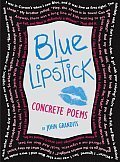
My choice for the challenge (because of course I am taking my own challenge!) is Blue Lipstick by John Grandits, which is on its way to me right now.
Happy reading.
Buy a poetry book. (Or a magazine full of poetry, or a verse novel.)
Although there is tons of free poetry floating around the internet, and you may have poetry books sitting on your shelves now that are ripe for rereading, I'm encouraging you to buy. The point is to show the kind of economic support that poetry doesn't often get. Of course, if you really can't afford to buy, then I suggest checking out some poetry from your local library, because library circulation statistics are also helpful in supporting poets.
I issue this challenge to all readers and writers, even if you don't think of yourself as a poet or a poetry reader. There are three reasons:
--There are wonderful experiences waiting for you in poetry. And if you've never tried a verse novel, they are so much fun to read--it's an exciting format right now, especially in YA.
--Poetry changes the way we look at language.
--Poetry changes the way we look at the world.
My choice for the challenge (because of course I am taking my own challenge!) is Blue Lipstick by John Grandits, which is on its way to me right now.
Happy reading.
Open-ended
I've been having an email exchange with someone about "open" endings in books. They can be tricky for readers to accept, since human beings generally like two things in story endings: justice and resolution. But some readers are open to endings that are unhappy, or uncertain, or ambiguous. The world is in short supply of justice and resolution, and while many readers want those things in books as an antidote to that harshness, other readers hunger to see that truth reflected in their literature. They find comfort in the fact that literature can say: Yes, this is difficult; no, it's not fair or right. Or, I don't have all the answers either, but here is what I know to be true.
In the case of an an ambiguous ending, I think it works if the whole rest of the book supports that uncertainty, and if the reader has enough clues to go on with. I think any book should leave some unanswered questions, things for the reader to wonder about, even if all the main questions are answered. But where the main questions are not answered, then the readers should at least receive the tools to build a satisfactory ending for themselves--even if they all build different endings. (The power of being able to tailor the ending to their own ideas is part of the attraction of an ambiguous ending.)
An "open" ending shouldn't drop the reader off a cliff, and shouldn't be based on the writer flinging up her hands and saying, "I've run out of ideas; I don't know what happens next." An open ending should be as carefully planned as any other part of a book.
In the case of an an ambiguous ending, I think it works if the whole rest of the book supports that uncertainty, and if the reader has enough clues to go on with. I think any book should leave some unanswered questions, things for the reader to wonder about, even if all the main questions are answered. But where the main questions are not answered, then the readers should at least receive the tools to build a satisfactory ending for themselves--even if they all build different endings. (The power of being able to tailor the ending to their own ideas is part of the attraction of an ambiguous ending.)
An "open" ending shouldn't drop the reader off a cliff, and shouldn't be based on the writer flinging up her hands and saying, "I've run out of ideas; I don't know what happens next." An open ending should be as carefully planned as any other part of a book.
February 3, 2011
Book news
Dear The Secret Year:
I have great news for you. I mean, I hope that you will think it's great news.
You will be getting some company on the bookshelves! This May, a YA anthology called Truth & Dare will come out in the UK and the US with one of my stories in it. It's especially exciting because the book also includes stories by many other authors I like and admire, including Ellen Wittlinger, Sarah Rees Brennan, Saundra Mitchell, Heidi R. Kling ...
And then, early next year, Viking will publish another of my novels. It's another contemporary, realistic YA, currently titled Try Not to Breathe.
Now, don't get that worried look. You are my first published book, and you will always be special to me. I loved you in hardcover and I love you in paperback, and I will love you when your electronic version appears. But you must know, I was always planning to have other books, too. It doesn't mean I love you any less. That's the great thing about an author's love: it doesn't lessen, but grows to encompass every new book. And you can be a good big sibling--take the new books around, show them the ropes. They will look up to you. You won't even have to change any diapers!
Thanks for understanding.
Sincerely,
Your author
I have great news for you. I mean, I hope that you will think it's great news.
You will be getting some company on the bookshelves! This May, a YA anthology called Truth & Dare will come out in the UK and the US with one of my stories in it. It's especially exciting because the book also includes stories by many other authors I like and admire, including Ellen Wittlinger, Sarah Rees Brennan, Saundra Mitchell, Heidi R. Kling ...
And then, early next year, Viking will publish another of my novels. It's another contemporary, realistic YA, currently titled Try Not to Breathe.
Now, don't get that worried look. You are my first published book, and you will always be special to me. I loved you in hardcover and I love you in paperback, and I will love you when your electronic version appears. But you must know, I was always planning to have other books, too. It doesn't mean I love you any less. That's the great thing about an author's love: it doesn't lessen, but grows to encompass every new book. And you can be a good big sibling--take the new books around, show them the ropes. They will look up to you. You won't even have to change any diapers!
Thanks for understanding.
Sincerely,
Your author
February 2, 2011
Dreams
I appreciate all the comments on yesterday's guest post. If you haven't read it yet, please treat yourself to Becky Levine's wise words about how we never stop learning.
In other blogger exchange news, I'm over at Teralyn Pilgrim's blog today, talking about fancy notebooks and why one should write in them, instead of saving them for a special occasion.
Today's topic here on the blog is dreams ... not writer dreams, but character dreams. I was thinking about the dream as a plot device, and how fictional dreams seem to serve a few main purposes:
--Memory. The memory may be triggered in a very obvious and literal way--that is, the character dreams about something that actually happened. The memory may be something of which the character has always been consciously aware, or it may be a forgotten experience that resurfaces in the dream. On the other hand, the memory dream could be cryptic, requiring interpretation. Mary Anderson's Step on a Crack is a good example of the cryptic memory dream as a plot device.
--Revelation. The dream may reveal something to the character about herself (this sort of dream occurred in Alicia Thompson's Psych Major Syndrome). Often it reveals even more to the reader about the character's true state of mind. For example, you could have a character who insists her life is sunny and smooth, but she has horrifying dreams that signal something is really bothering her. I used a variant of the "revelation" dream in The Secret Year: the main character has a couple of dreams about the girl he was involved with, dreams in which the shock of her death is expressed more overtly than he can do when he's awake.
--Prophecy. This is more common in paranormal literature: the character predicts future events in dreams. In a variant of this, the character may receive messages or clues in a dream. Often, the dreams are cryptic and the character must figure out what they mean.
--Control. Carrying the prophetic dream even further, the character actually changes and controls the environment through his dreams. Right off the bat, this concept has a lot of potential for a fascinating story.
In all cases, the dream--like any other scene--has to advance the plot or deepen the characterization (or ideally, do both). It should also arise organically, rather than as a device of convenience (not, "How should I have her find out about the key? I guess I'll just have her dream about finding it in the toilet tank, and then when she looks--there it is!"). The dream should introduce material that can't easily be conveyed some other way, or wouldn't be as interesting or natural if it were conveyed in another way. Of course, even as I suggest these guidelines, I know there must be a million exceptions, as always. Have you ever used dreams in a story, or seen another writer use them effectively? If so, how?
In other blogger exchange news, I'm over at Teralyn Pilgrim's blog today, talking about fancy notebooks and why one should write in them, instead of saving them for a special occasion.
Today's topic here on the blog is dreams ... not writer dreams, but character dreams. I was thinking about the dream as a plot device, and how fictional dreams seem to serve a few main purposes:
--Memory. The memory may be triggered in a very obvious and literal way--that is, the character dreams about something that actually happened. The memory may be something of which the character has always been consciously aware, or it may be a forgotten experience that resurfaces in the dream. On the other hand, the memory dream could be cryptic, requiring interpretation. Mary Anderson's Step on a Crack is a good example of the cryptic memory dream as a plot device.
--Revelation. The dream may reveal something to the character about herself (this sort of dream occurred in Alicia Thompson's Psych Major Syndrome). Often it reveals even more to the reader about the character's true state of mind. For example, you could have a character who insists her life is sunny and smooth, but she has horrifying dreams that signal something is really bothering her. I used a variant of the "revelation" dream in The Secret Year: the main character has a couple of dreams about the girl he was involved with, dreams in which the shock of her death is expressed more overtly than he can do when he's awake.
--Prophecy. This is more common in paranormal literature: the character predicts future events in dreams. In a variant of this, the character may receive messages or clues in a dream. Often, the dreams are cryptic and the character must figure out what they mean.
--Control. Carrying the prophetic dream even further, the character actually changes and controls the environment through his dreams. Right off the bat, this concept has a lot of potential for a fascinating story.
In all cases, the dream--like any other scene--has to advance the plot or deepen the characterization (or ideally, do both). It should also arise organically, rather than as a device of convenience (not, "How should I have her find out about the key? I guess I'll just have her dream about finding it in the toilet tank, and then when she looks--there it is!"). The dream should introduce material that can't easily be conveyed some other way, or wouldn't be as interesting or natural if it were conveyed in another way. Of course, even as I suggest these guidelines, I know there must be a million exceptions, as always. Have you ever used dreams in a story, or seen another writer use them effectively? If so, how?
February 1, 2011
The Learning Never Stops
The bloggers' exchange continues! Today's guest post is by Becky Levine, who visited the blog previously to talk about
revising from critique.
I always enjoy Becky's smart, sensible, inspiring posts about the
"writing path,"
and her topic today is:
I’m Pretty Sure the Learning Never Stops
by Becky Levine
Years ago, I submitted some short stories to magazines. Redbook. Cosmopolitan. Good Housekeeping. In return, I received some very simple, standard rejection notes.
I was twelve.
Honestly, I don’t blame the editors.
One thing I know for sure is that I am a (much!) better writer today than I was all those decades ago. I am a better writer than I was one decade ago, five years ago, one year ago. I can list several reasons this fact is true.
• My critique group, all members of which are the height of awesomeness
• Writing books by people like James Scott Bell, Donald Maass & Les Edgerton, who all set off light-bulb moments in my brain
• Various workshops and conferences I’ve gone to, where I’ve learned scattered bits & pieces of the writing craft
But...reason number one that I believe I am a better writer than before is [...drum roll...] I have kept writing.
I know—obvious. Here’s the thing, though. Every time I work through a new stage of a book, or start one of those stages all over again on another project, I can see it happening. The things I learned earlier have stuck, and they’re with me as I write—reminding me, encouraging me, pushing me.
We talk a lot about the evil editor—the one who tells us we can’t do something: we can’t write an interesting setting; we can’t draw a believable antagonist; we can’t create strong dialogue. What we don’t hear as much about is the good editor, the one who sits on our other shoulder. That’s the editor who has stored all our experience, all our understanding, and is offering it to us on a beautiful, silver platter (with chocolate on the side) as we write. It’s this editor who tells us what we can do: we can start this scene further into the action; we can pull the point of view in closer to the hero; we can write dialogue funny enough to make our readers laugh out loud. In public.
This belief that, every day I write, I am adding to my ability—to my toolbox, as Jenn said in her guest post the other day—is one of the things that keeps me going. I may or may not be “good enough” today, but I have a chance to be that tomorrow. Or the next day. And even then, I’m guessing there’ll be plenty more to learn.
As long as I keep writing.
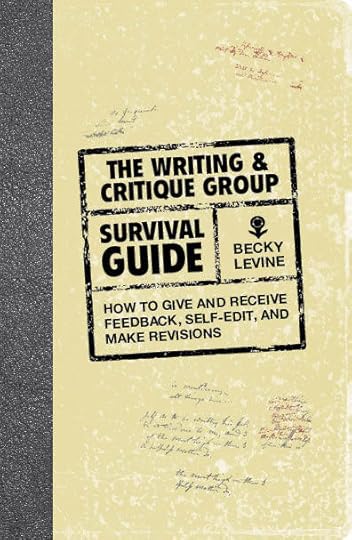
Becky Levine is the author of The Writing & Critique Group Survival Guide, as well as a speaker & freelance editor. Becky writes fiction for children and teens and is currently working on a historical novel set in 1912 Chicago. She blogs at http://beckylevine.com/.
I’m Pretty Sure the Learning Never Stops
by Becky Levine
Years ago, I submitted some short stories to magazines. Redbook. Cosmopolitan. Good Housekeeping. In return, I received some very simple, standard rejection notes.
I was twelve.
Honestly, I don’t blame the editors.
One thing I know for sure is that I am a (much!) better writer today than I was all those decades ago. I am a better writer than I was one decade ago, five years ago, one year ago. I can list several reasons this fact is true.
• My critique group, all members of which are the height of awesomeness
• Writing books by people like James Scott Bell, Donald Maass & Les Edgerton, who all set off light-bulb moments in my brain
• Various workshops and conferences I’ve gone to, where I’ve learned scattered bits & pieces of the writing craft
But...reason number one that I believe I am a better writer than before is [...drum roll...] I have kept writing.
I know—obvious. Here’s the thing, though. Every time I work through a new stage of a book, or start one of those stages all over again on another project, I can see it happening. The things I learned earlier have stuck, and they’re with me as I write—reminding me, encouraging me, pushing me.
We talk a lot about the evil editor—the one who tells us we can’t do something: we can’t write an interesting setting; we can’t draw a believable antagonist; we can’t create strong dialogue. What we don’t hear as much about is the good editor, the one who sits on our other shoulder. That’s the editor who has stored all our experience, all our understanding, and is offering it to us on a beautiful, silver platter (with chocolate on the side) as we write. It’s this editor who tells us what we can do: we can start this scene further into the action; we can pull the point of view in closer to the hero; we can write dialogue funny enough to make our readers laugh out loud. In public.
This belief that, every day I write, I am adding to my ability—to my toolbox, as Jenn said in her guest post the other day—is one of the things that keeps me going. I may or may not be “good enough” today, but I have a chance to be that tomorrow. Or the next day. And even then, I’m guessing there’ll be plenty more to learn.
As long as I keep writing.
Becky Levine is the author of The Writing & Critique Group Survival Guide, as well as a speaker & freelance editor. Becky writes fiction for children and teens and is currently working on a historical novel set in 1912 Chicago. She blogs at http://beckylevine.com/.
January 30, 2011
The point
In life, things often happen by chance, or for reasons we can't determine. They strike suddenly and unpredictably.
We can write about such things. But overall, a story is not a verbatim record of life. It's a distillation of life. It's edited and organized, arranged to illustrate a particular point or capture a certain idea. The lightning bolt from the blue must, in a story, serve some purpose other than relieving the writer's exhausted imagination.
I suppose one could write an experimental piece in which things happen randomly, to make the point that nothing has a point. But in general, each component of a story has to earn its keep. "Why are you telling me this?" the reader says, or rather, "I assume you have a good reason for telling me this."
We can write about such things. But overall, a story is not a verbatim record of life. It's a distillation of life. It's edited and organized, arranged to illustrate a particular point or capture a certain idea. The lightning bolt from the blue must, in a story, serve some purpose other than relieving the writer's exhausted imagination.
I suppose one could write an experimental piece in which things happen randomly, to make the point that nothing has a point. But in general, each component of a story has to earn its keep. "Why are you telling me this?" the reader says, or rather, "I assume you have a good reason for telling me this."
January 29, 2011
Storm of words
Here was the story on Wednesday: We were supposed to have a cloudy day, with a chance of snow flurries or snow showers, or maybe a bit of rain or sleet. This would then taper off. About 5-8 inches' worth of snow would fall later that night.
Here's what really happened.
When I awoke shortly after 5 AM on Wednesday, there were already a couple of inches of snow on the ground. It snowed steadily until noon, then turned to sleet, then freezing rain. By that time, we already had about 5 inches of snow, with the real snowfall still to come. And that night, another 9 or 10 inches fell.
It transformed the land, as snow does, blanketing everything in white, smoothing the landscape, frosting the bushes and buildings.
It makes me think of story-telling. A good book organizes and smooths over life's experiences, transforming them into something startling and unfamiliar. The landscape we've been staring at, day after day, until we no longer see it, is changed and new.
A good story has a couple of surprises. You peek out the window, expecting darkness and cloud, and instead you see a white velvet carpet. The snow intensifies until it's part of a thunderstorm, complete with a cracking and crashing in the sky.
A good story is built one word at a time, the same way that snow--with its power to bring major cities to a halt--falls as one tiny snowflake at a time.
Here's what really happened.
When I awoke shortly after 5 AM on Wednesday, there were already a couple of inches of snow on the ground. It snowed steadily until noon, then turned to sleet, then freezing rain. By that time, we already had about 5 inches of snow, with the real snowfall still to come. And that night, another 9 or 10 inches fell.
It transformed the land, as snow does, blanketing everything in white, smoothing the landscape, frosting the bushes and buildings.
It makes me think of story-telling. A good book organizes and smooths over life's experiences, transforming them into something startling and unfamiliar. The landscape we've been staring at, day after day, until we no longer see it, is changed and new.
A good story has a couple of surprises. You peek out the window, expecting darkness and cloud, and instead you see a white velvet carpet. The snow intensifies until it's part of a thunderstorm, complete with a cracking and crashing in the sky.
A good story is built one word at a time, the same way that snow--with its power to bring major cities to a halt--falls as one tiny snowflake at a time.