
Lea Wait's Blog, page 76
November 21, 2022
Yet Another Writer Platform?
Those of you paying attention to social media know that things have gotten a touch weird online. Facebook has mainly become a way to stay connected to old friends and family members you’d maybe rather not see at Thanksgiving. Twitter, after its acquisition by Elon Musk, is slowly degenerating into fingerpointing, snarky memes about the new owner, and general crabbing about what it used to be. I’m mostly interested in social media as a way to keep in touch with writer friends who don’t live close enough to lunch with and to keep up with publishing news. I hadn’t given much thought, beyond the monthly blog post, to actually presenting my writing online.
I ran across Substack  by following Heather Cox Richardson’s Letters from an American, an invaluable source of sane commentary about American history and elections in the context of everything that has gone before. If you haven’t run into it, I highly recommend a sane voice that also makes serious points about the seriousness of what we’ve been going through.
Poking around the site, I got interested in the potential of Substack as a two-pronged approach for my work: first, as a single place to archive the writing I wanted to preserve, and second, as a venue for presenting that writing to the world.
Substack is a free service, at least at the moment. You create an account, which allows you to post items and build your subscription list by supplying email addresses. You can make some or all of your postings free to your subscription list and, if you like, you can put certain items behind a paywall. I know several romance writers who are using the Substack platform to serialize novels and present them to their subscription lists (as paid posts). As a subscriber, you receive an email every time I put a new piece of writing online.
If the notion interests you, you can look at my (skinny at the moment) Substack, called The Far Northeast. Subscribe, if you like—there’s no cost—and follow as I build up a library of material that I thnk is suitable for the outside world. I’ll also be writing about my experiences with the platform as I get more comfortable with it. And coming in January, I plan to pull a Dickens and serialize a new novel.  I’d love to hear what you think about it.
So if you see me disappear from Twitter (and I’ve already been disappeared once from Facebook), come look for me on Substack. Comments encouraged . . .


November 20, 2022
Never, Ever … Buy or Eat the Big, Tasteless Ones
Sandra Neily here.
My family and friends have given me a reputation for quick or novel fixes to more create strategies that add “yum!” to food. My sisters still call me in the middle of gravy-making as that’s always a daunting thing. I love that. (Scroll down for gravy and more tips.)
(And right now, I am writing a character …Patton … who’s hiding out in a hunting tree stand, eating moose jerky and drinking rainwater, so I get no vicarious food-joy from the keyboard.)
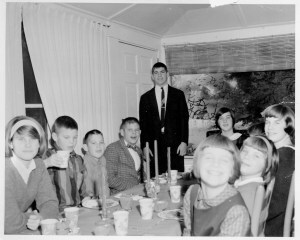
The kids Thanksgiving table with siblings and cousins. Long ago. I am in the headband front left. High school.
I’ve collected some of my go-to tips to share with you during feasting season. And below, look for more info on Maine berries and how to find them.
***********************
Better cornbread, muffins, even brownies. Put a couple of very heaping tablespoons of yogurt in all muffin and cornbread recipes (mashed banana too; I keep ‘dead’ ones in the freezer in their skins). Makes everything wonderfully moist: cornbread is fabulous this way.

Bob will eat fruit salad. Except for bananas, cut up fruit works for most of them. Stuff is camouflaged.
Quick Fruit Salad. Well, there’s a prerequisite. Always have Wyman’s Wild Blueberries and unsweetened whole strawberries in the freezer. (Big, non-Maine, or generic-brand blueberries not allowed. Tasteless.) I combine the frozen fruit with fresh: apples cut into small bite-size pieces, orange or Clementine sections (cut up if large). Great way to use up sad-looking fruit. My guilty pleasure are fresh raspberries (can be frozen if not used in a few days). I heat, cut up, and mash strawberries to create more juice. Add some fruit juice of any kind for more moisture. (Juice acid keeps fruit from going brown.) I sweeten with bit of real maple syrup, but you don’t need to. Done in 10-15 minutes; lasts about a week. Is it getting a big old? Toss in a blender with yogurt for a yum smoothie. Eat on Giffords Vanilla ice cream. (More berry uses: warm strawberries on waffles or pancakes. Blueberries get tossed into yogurt or into pan drippings from chicken, turkey, or pork for a yummy sauce.)
Muffins as matrix. I cannot eat most commercial muffins as they do not apply this mantra: the flour stuff should never overcome the guts of a muffin. I like 3-berry muffins (2 will do but Wyman’s has a great 3 berry frozen product). Add about a good cup of frozen blueberries (dust w flour before adding). Add raspberries and whole cranberries.
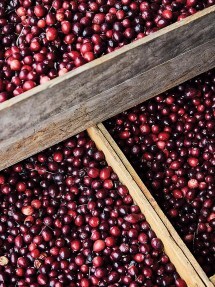
just harvested cranberries at LYNCH HILL FARMS, Harrington, ME
(I buy whole cranberries in the fall and freeze them. Good for years! Craisins too sugary.) Of course, I add some yogurt (any kind) and a mashed banana, sometimes a handful of oatmeal (any kind). I don’t always add all this, but sometimes I live dangerously. And there’s always chocolate chips for grandkids. Or Bob.
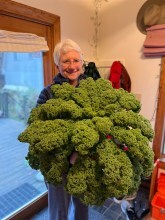
My dear friend Leslie is very excited about this ONE (one!) kale plant from her garden. It’s headed into her freezer so she can trick me this winter. She knows I am not excited.
Impress ‘em salad dressing. Take any Italian or Balsamic dressing. Add a bit of soy sauce, lumps of Grey Poupon mustard and mix vigorously. Heat a couple of generous spoons of honey until it bubbles. Add and mix forcefully. (Finely minced garlic is welcome, too.) Pour on. Got bitter lettuce? Add warm honey to whatever you dressed it with, just before serving. (I think I could eat kale salad if folks used honey.)
Fast coleslaw. Buy a bag of undressed mixed slaw of any kind. Add bit of mayonnaise (not much!), warmed-up raisins or Craisons, bit of maple syrup (honey), and use mostly any kind of Italian dressing. Should not be a mayo-fest; use only a little bit as a binder. Even folks who hate coleslaw seem to like this. Is my go-to camping salad; undressed, vacuum-packed slaw lasts pretty long in coolers.
Homemade duck sauce. Heat good-brand marmalade with soy sauce and a bit of butter (just a bit for a binder). Yummy for a dip or add-in for anything Asian. I think it’s better than any store brand.
Revive your rotisserie chicken (or poultry). Marmalade again. In a fry pan, some marmalade again with some soy sauce and a bit more butter this time. Add slices of leftover (and usually dry) chicken/turkey.
Quick potatoes. Keep a few cans of whole, white potatoes in the pantry. When stuck for a side dish, drain, slice them angular and a bit chunky, and fry in butter with generous salt and pepper until getting a bit brown. Hide the cans, no one will know … (Also a camping go-to thing.)

I will never, ever top my daughter’s cranberry coffee cake. Looks like she was well aware of that. Yum.
OK, the gravy. Have a lemon on hand in case your bird is stingy. The trick is to cook the flour so it does not taste starchy. Make a roux by leaving a couple of tablespoons of juice/fat in the pan. Reserve the rest. Add 1 tablespoon of flour for each tablespoon of pan juice (1/1 ratio). Stirring vigorously over good heat, cook the flour mixture even as you scrape bird bits off the sides of the pan. After a few minutes of cooking (bubbling a bit), when it looks like brown/tan waffle batter (will be thick), add back the rest of the juices and stir. I slowly add in liquid (and also a bit of milk … not much) to get the sauce consistency I want. If the juices are kind of tasteless, very slowly add a bit of lemon and a bit of soy sauce (just bits!) until you get a flavor you can live with. During one desperate TDay, I also used orange juice to save the gravy. It turned out to be kind of elegant and delicious.
Camping no-fridge tips: cucumbers, sliced very thin replace lettuce in sandwiches. The long wrapped ones last better. Vacuum-packed, sliced deli ham lasts forever even in wet cooler bottoms so sandwiches can happen after many days. And vacuum-packed thick, dinner ham is still great even if floating in cooler’s bottom: great on the grill. I fry up a few apples and add raisins picked out of the gorp to make a compote to go on top of the ham.
Canned French-cut beans on grill: arrange big double pieces of tin foil. Drain beans. Spread in a thick line down middle of the foil. Add salt, pepper, butter, and I use lots of fresh Parmesan cheese. Roll up, tuck ends up (up!) carefully. Heat, always folded side up … do not turn … at end of the grill, moving package around a bit. (I always grate Parmesan before a trip and put in an airtight jar. Lasts in cooler. Makes everything better: eggs/omelets, soups, noodles, old bread on the grill….be inventive. (Ick on the prepared parm; has cellulose.)
************************
 BERRIES, BERRIES …Maine ones of course. (Wyman’s will be in your store’s freezer section.)
Get Maine berries from Lynch Hill Farms.
Find the famous Wyman’s brand selling more blueberry products here.
Here’s the Wyman’s story. And an amazing how-they-do-it video. The company has flourished over 148 years, growing from a scrappy little fish cannery to the largest brand of frozen fruit in the U.S. Wyman’s processes up to 2.3 million pounds of wild blueberries a day. The company employs 200 people year-round, and more than 500 during the summer harvest. More than a third of employees have a tenure of more than a decade ….
 A Sandy note about finding Wyman’s home: In October, during our last camper outing to check out Donnell Pond public lands (just inland from Acadia), we drove through many small Maine towns. They look like the towns of my Boothbay youth. We found Milbridge, a very small, small Maine town where the Narraguagus River meets the sea.
  The Wyman’s sign just outside of town had us stopping in the unassuming parking lot filled with well-used trucks and well-used family cars. We were amazed by the size of the building and left with a new appreciation of how berries in our freezer … the ones that would fill muffins, pancakes, and fruit salads … the berries sent all over the world … came from this tucked-away part of Maine. Treat yourself and watch the factory video.
Sandy’s debut novel, “Deadly Trespass, A Mystery in Maine”  won a national Mystery Writers of America award, was a finalist in the Women’s Fiction Writers Association “Rising Star” contest and was a finalist for a Maine Literary Award. The second Mystery in Maine, “Deadly Turn,” was published in 2021. Her third “Deadly” is due out in 2023. Find her novels at all Shermans Books (Maine) and on Amazon. Find more info on Sandy’s website.
November 18, 2022
Weekend Update: November 19-20, 2022
 Next week at Maine Crime Writers there will be posts by Sandra Neily (Monday), Dick Cass (Tuesday), and Matt Cost (Wednesday).
In the news department, here’s what’s happening with some of us who blog regularly at Maine Crime Writers:
An invitation to readers of this blog: Do you have news relating to Maine, Crime, or Writing? We’d love to hear from you. Just comment below to share.
And a reminder: If your library, school, or organization is looking for a speaker, we are often available to talk about the writing process, research, where we get our ideas, and other mysteries of the business, along with the very popular “Making a Mystery” with audience participation, and “Casting Call: How We Staff Our Mysteries.” We also do programs on Zoom. Contact Kate Flora
November 17, 2022
Stealing a Memory From My Mom
Kate Flora: With the holidays on the horizon, I’ve been thinking about holidays past.
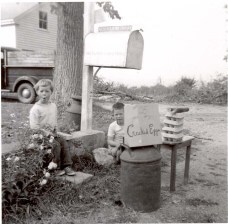
Kate begins to learn about marketing beside the orange mailbox
These days, there are far fewer people around the table, yet I still enjoy making all the food I grew up with. A too-big turkey with lots of stuffing, mashed potatoes. Creamed onions–because my dad required them. Squash and peas and gravy. Two or three kinds of cranberry sauce. Today, as I was feeling sentimental (and stuck on a short story I promised to write for an anthology) I was browsing through my late mother, A Carman Clark’s book of her collected columns: From the Orange Mailbox: Notes from a Few Country Acres.
I landed on a column from November about our dining room table, and I thought I’d share it with you.
The leaves which extend my old oak table are reminders of the important part this piece of furniture has played in country living. Closed, this drop leaf table measures only 2 feet by 3 1/2 feet, but, with four leaves added, a dozen people can dine together with comfortable elbow room.
Stripped of the table cloth its seven-foot surface stirs creative projects. It’s splendid for cutting and pasting wallpaper, making Christmas wreaths, laying out patterns for sewing, or organizing a bean factory to see how many quarts might be canned on a summer day.
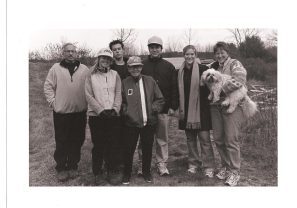
Family Thanksgiving on the farm
About thirty years ago I received a phone call asking if I could us an old oak table–not beautiful but serviceable–and set forth in the farm truck to pick it up. Ida Hughes had sold her house and was negotiating with several dealers to dispose of her furniture. When one dealer offered her $2 for the kitchen table, Ida declared, “Before I would sell that table for $2, I’d give it to a good woman. My volunteer work at the elementary school where Ida was principal apparently earned me the opportunity.
Since Ida Hughes was born in 1899 and the table had belonged to her mother, it can be classified as an antique. When the white paint was sanded from the top, the golden oak turned out to be stained with ink. Several bottles must have spilled in those years when Ida corrected papers and wrote reports.
The extension leaves were missing. Ida had loaned them to someone years before and they
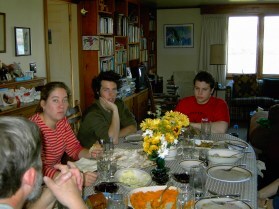
Gathered around the old oak table
had never been returned. The search for oak leaves with four pegs led us into second-hand shops and country auctions where–if the price was right–we picked up leaves of many shapes and sizes with a plan for splendid bookshelves. Eventually, during our annual family “apple stealing” event, when we drove back roads picking apples at abandoned farms, we found a neat rack holding four-pegged leaves, and an old iron bed with gargoyles grinning down down from the head of the bed. Applesauce and an extended table followed.
Over the years, the table has served some function in every room, even the bathroom when it was being papered. The summers when we hosted exchange students, it was moved to the shed where it could be opened full length to accommodate a steady stream of guests. The summer I gambled on turning down teaching jobs and gambled on earning the same amount of money by writing, the table became a desk in my bedroom.
The table accommodated an extended family for Thanksgiving. There were years when the disappearing taillights of those Thanksgiving guests gave way to the rattling of bowls as we used the table to make the Christmas cookies that would be mailed in tins to friends and relatives. When college years brought a need for evening gowns, lengths of red velvet and bolts of silver-flecked white were spread over the table as soon as the holiday meal was finished.
Around this old table 4-H girls learned to make yeast bread where eight could knead in harmony. Woman’s Day magazine published my article “Bowl Breads for Beginners” based on these many aspiring cooks, and many cooks who had never tried making break before started baking using these recipes.
Digital StillCamera
Evergreens snipped from woodland walks were woven into wreaths and ropes on this table. Smooth stones collected from beach walks were built into a crèche and driftwood from Moosehead Lake was polished and shaped as a background for Christmas figures to decorate the mantel. Scissors and paste covered the table surface for completing school projects. One art assignment, requiring originality, incorporated colored lint from the dryer.
Shaggy Turkish towels worked as a base for stringing necklaces from collections of broken beads. Designs could be tried and changed before the fishline was threaded through to hold them.
My dog, Miss Badger, escaped to the shelter of the table when too many people disturb her doggy privacy and the grandchildren climb under to pat her soft ears. There’s room for all of them.

View from where the table sits now
Christmas gifts are wrapped on the spacious surface and puzzles sorts to check for missing pieces. Here we enjoy Thanksgiving as a family and the grandchildren spread their papers and markers for drawing dragons. When I join them, my efforts always produce dragons that resemble fat goats.
As I put two leaves away and change the table pad and tablecloth size for a smaller supper party, reminders flow in. This old drop leaf table is probably the most practical article of furniture any country house could have.
KF note: The table now lives in an oceanside cottage in Maine, where it lends its surface to other projects. Following in my mother’s footsteps, several novels have been written on its venerable surface.
One lucky commenter on this post will receive a copy of my mother’s first mystery, The Maine Mulch Murder.
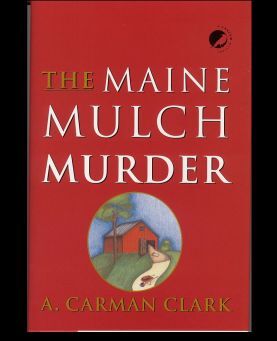
The Maine Mulch Murder by A. Carman Clark
November 14, 2022
The Eyes Have It
Kaitlyn Dunnett/Kathy Lynn Emerson here, today recounting my recent (and continuing) experience with cataract surgery. I’m extremely grateful that this surgery exists. Even a quarter of a century ago, cataracts meant, at the least, coke-bottle glasses and permanently impaired vision.
 That said, it hasn’t been all sunshine and roses, especially for someone who normally spends most of her time either reading or writing. Like so many people over 65, my vision was getting worse. My right eye was doing most of the work, since the left was both blurry and extremely nearsighted. Even so, I put off having cataract surgery for years, mostly because the description of the process gave me the willies. I’d still prefer not to think about that part of things. Anyway, since it was getting harder and harder to focus properly, even with bifocals, I finally decided it was time to bite the bullet. Because my husband had his cataracts fixed a couple of years ago, just pre-Covid, I thought I had some idea what to expect.
Wrong.
 For one thing, where he opted for the super surgery that would remove his need for glasses altogether, I wanted to keep wearing glasses. I’m also cheap. I went with the standard surgery, which is completely covered by Aetna Medicare. This was not a mistake, but it was undertaken while under a major misconception concerning how much time would have to pass before I would actually get new glasses and be able to see at all distances once again.
My first surgery was back on October 12. I don’t even get my eyes tested for the new specs until November 21. Since that’s Thanksgiving week, I doubt I’ll have them before November 28. That’s a looooong time not to see properly.

obviously, I’ve worn glasses for a long time
For those of you who may not know much about cataract surgery, it’s a pretty simple process, but since it does involve making a laser incision at the side of the eye, it isn’t trifling and it takes time for the eye to heal afterward. The surgery itself lasts about seven minutes, and the patient has to be awake in order to focus the relevant eye on a rather bright light. There’s no pain—numbing eyedrops take care of that. And there isn’t a lot of nervousness during surgery, thanks to the wonderful world of pharmaceuticals. However, there is more than an hour of prep time (instilling drops into the eye multiple times) and since we live where we do, there was also an hour’s drive to get to Eye Care of Maine in Waterville—entirely too much time to wonder whether I really wanted to go through with it.
Obviously, I didn’t chicken out. With the left eye (the worst one) done, I had a follow-up visit in Waterville the next morning and then, a week later, an appointment with my own eye doctor in Farmington. All was good. I could actually see stuff with that eye again. And everything was brighter—glaringly so! Two weeks after the first surgery, it was time to get my right eye fixed. Again, there was a follow up the next day and a visit to my eye doctor the next week. After each surgery, I had to put steroid eye drops in the affected eye: four times a day for a week, then three times a day for a week, then two, then one. For each eye, for a week, I had to wear a eye shield taped to my face to protect that eye from random contact with, well, anything.
All that was as I expected. I also knew going in that I’d end up farsighted instead of nearsighted, and that’s certainly true. Within a day of the second surgery, I could see well enough to legally drive without glasses. Watching TV was no problem. I could even, a little more than a week after the second surgery, work on the PC without glasses, although the screen still seems awfully bright.
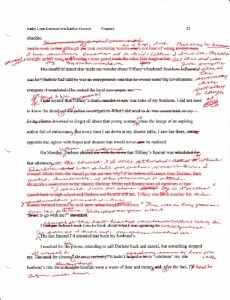
typical page during revision process
But here’s what I didn’t anticipate: everything closer than two feet is blurry. Until I picked up a pair of “cheaters” at Walmart (3x magnification), I couldn’t read. Even the food on my plate was out of focus. Worse, I couldn’t edit. As regular readers of this blog know, I revise by hand, often using asterisks and stars to insert new material. I couldn’t see the printout well enough to read it, let alone make changes. I have reached the point where I can see the printout when it’s next to the monitor on my PC, and therefore could type corrections into a doc file, but since I still can’t focus properly on the printout when it’s in my lap . . .
So, here I am with an enforced month and a half off from any writing projects I can’t do directly on the computer. I did not expect that!
I guess I shouldn’t complain. I can still read other people’s books on my iPad, thanks to enlarged fonts. I can even reread some of the trade paperbacks I bought, years ago, in large print format. My eyes aren’t completely working together on this yet, but they’re improving.
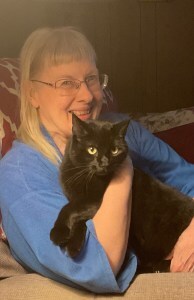
the bags are there, but they’re harder to see in this pre-surgery photo
There is, however, one other side-effect I didn’t anticipate. Now that I’ve essentially gone from being nearsighted to being farsighted, I am aware of some things that, to be truthful, I’d just as soon not be. For instance, it’s hard to pretend I’m a decent housekeeper when that I can see the dust on the baseboards. I don’t even want to talk about being able to see the walls and floor of the shower stall. I’m not likely to become any better at cleaning than I was before, but ignoring what needs doing is no longer an option.
Worse, though, is what I see every time I look in the mirror. Poor eyesight combined with glasses frames did a wonderful job of hiding the bags under my eyes. Ditto for assorted wrinkles. I don’t much care for looking ten years older than I thought I did, or for the fact that I still won’t have new glasses when the family gathers for Thanksgiving. I’d consider wearing the “cheaters” if they didn’t blur everything farther than a foot in front of me.
Oh, well. I don’t suppose there’s much point in vanity once you hit seventy-five. I can’t undo the surgeries, and honestly, I wouldn’t want to. My overall vision is much improved, even with the current drawbacks.
But I sure will be glad to get those new glasses!

BIG glasses, back in the day
Kathy Lynn Emerson/Kaitlyn Dunnett has had sixty-four books traditionally published and has self published others, including several children’s books. She won the Agatha Award and was an Anthony and Macavity finalist for best mystery nonfiction of 2008 for How to Write Killer Historical Mysteries and was an Agatha Award finalist in 2015 in the best mystery short story category. She was the Malice Domestic Guest of Honor in 2014. Her most recent publications are The Valentine Veilleux Mysteries (a collection of three short stories and a novella, written as Kaitlyn) and I Kill People for a Living: A Collection of Essays by a Writer of Cozy Mysteries (written as Kathy). She maintains websites at www.KaitlynDunnett.com and www.KathyLynnEmerson.com.
November 13, 2022
New England Crime Bake 2022 – History is Mystery
I’m just back from the New England Crime Bake, a three-day conference of crime writers from across the region, and have some highlights and photos to share.

This year’s Guest of Honor was William Martin, the master of the historical thriller. Have you read Back Bay? Cape Cod? Citizen Washington? The Lincoln Letter? If so, you know Bill has the ability to bring history alive with compelling stories of suspense. His work inspired this year’s theme of HISTORY IS MYSTERY and his current novel, December ’41 inspired many to wear WWII-era attire to the Saturday evening banquet.
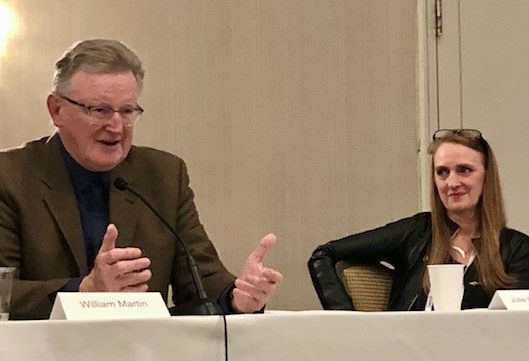
On Friday evening, Bill Martin showed off his skill as a storyteller during the TRUTH OR FICTION? panel. The audience doubted his true stories and bought his lies, the mark of an expert. At right is Julie Carrick Dalton, who told some cracking good true and untrue tales of her own.
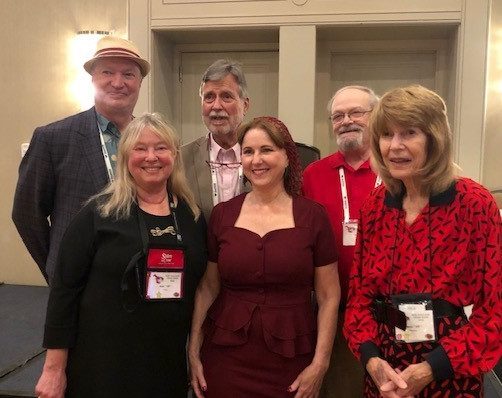
Four members of this blog pose during the 1940s-themed banquet. Back row L to R, Matt Cost, Richard Cass and Vaughn Hardacker (who always wins the prize for longest drive). Front row L to R, MCW founder Kate Flora, B.J.Magnani (former chair of the department of pathology and laboratory medicine at Tufts University and the author of three novels featuring Dr. Lily Robinson, poison expert) and Leslie Wheeler, co-winner of this year’s Lifetime Achievement Award.
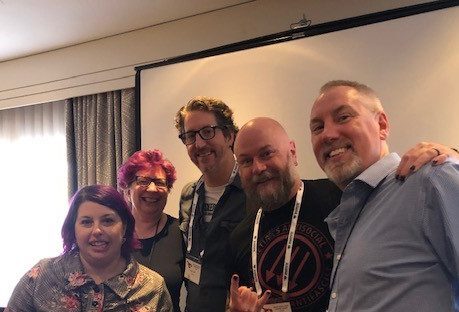
Maine thriller author and MCW alum Chris Holm, far right, was part of a panel discussion titled ANOTHER KIND OF FUTURE – VAMPIRES, ETC., which broke new ground for brilliant and hilarious panel discussions. From left, moderator Nicole Asselin poses with panelists Dana Cameron, Paul Tremblay, Bracken MacLeod and Chris.
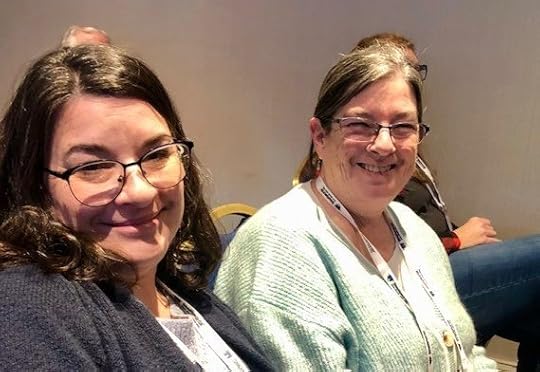
The Milliken sisters, Rebecca and the MCW blog’s own Maureen, in the audience at a panel discussion.

MCW alum Julia Spencer-Fleming, center, was a lively member of a terrific panel discussion on BUILDING THE COMPLEX PLOT. From left, moderator C. Michele Dorsey, Liv Constantine, Julia, Peter Swanson and Glede Browne Kabongo.

Me, moderating/herding the cats during the TRUTH OR FICTION?panel on Friday night.
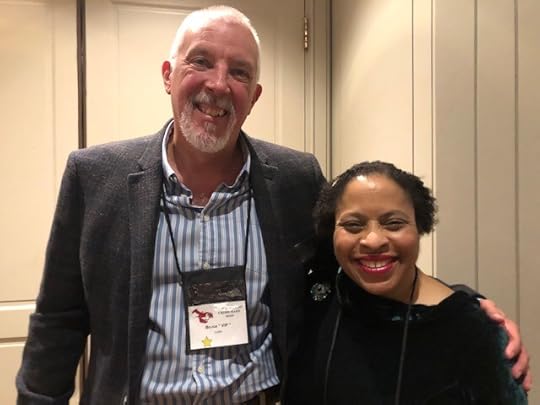
MCW alum Bruce Robert Coffin with Alexia Gordon, author of the award-winning Gethsemane Brown mystery series and a pal of many Maine Crime Writers.
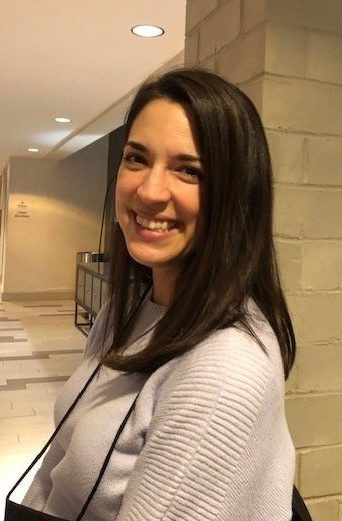
Caitlin Wahrer, whose debut novel, THE DAMAGE, won the Maine Literary Aware for Crime Fiction and was nominated for the 2022 Edgar Award for Best First Novel.
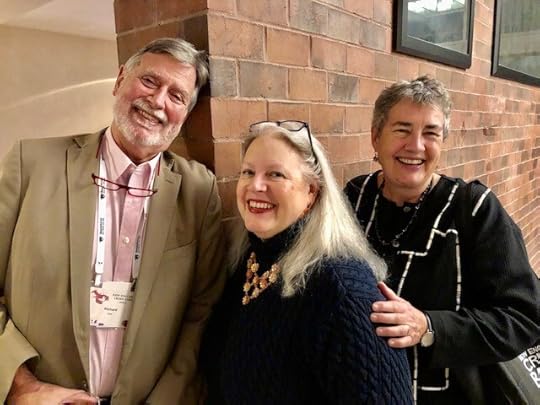
Dick Cass, Julia Spencer-Fleming and me.
As you can see from all of the smiles, it was a fun, productive and memorable weekend. For readers of this blog interested in attending Crime Bake in the future, it takes place in Massachusetts on the second weekend of each November. For more information go to https://crimebake.org
Brenda Buchanan brings years of experience as a journalist and a lawyer to her crime fiction. She has published three books featuring Joe Gale, a newspaper reporter who covers the crime and courts beat. She is now hard at work on new projects. FMI, go to http://brendabuchananwrites.com
November 11, 2022
Weekend Update: November 12-13, 2022
 Next week at Maine Crime Writers there will be posts by Brenda Buchanan (Monday), Kaitlyn Dunnett/Kathy Lynn Emerson (Tuesday), Kate Flora (Thursday), and Maureen Milliken (Friday).
In the news department, here’s what’s happening with some of us who blog regularly at Maine Crime Writers:
Matt Cost will be joining many fellow Maine Crime Writers as well as many more at Crime Bake this weekend. A great opportunity to take some great classes, listen to scintillating panel discussions, and mingle with crime writers.
An invitation to readers of this blog: Do you have news relating to Maine, Crime, or Writing? We’d love to hear from you. Just comment below to share.
And a reminder: If your library, school, or organization is looking for a speaker, we are often available to talk about the writing process, research, where we get our ideas, and other mysteries of the business, along with the very popular “Making a Mystery” with audience participation, and “Casting Call: How We Staff Our Mysteries.” We also do programs on Zoom. Contact Kate Flora
November 10, 2022
Maine Veterans’ Homes

Vaughn C. Hardacker
Today, November 11, is Veterans’ Day. It was originally Armistice Day to commemorate the veterans of WWI. The treaty ending the war (even though hostilities had stopped months before) was signed at 11 A.M. (the eleventh hour) on the 11th day of the 11th month. President Dwight D. Eisenhower signed a bill making it a day to honor all veterans who served honorably on May 26, 1954. As a veteran, it is a day I hold dear and makes me pause and reflect on “What have I done for other veterans this past year?” This year I can reflect back with pride and a sense of accomplishment.
About The Maine Veterans’ Homes. The Maine Veterans Homes’ are regulated by the Maine Department of Veterans Affairs but are not run by it. The homes are run by a non-profit corporation, The Maine Veterans Homes’ The administration of Maine Veterans’ Homes is vested in the Board of Trustees of the Maine Veterans’ Homes. The Board of Trustees is formally appointed by the Governor and is comprised of honorably discharged Veterans and non-veteran community members who broadly represent the various Veteran organizations, interests, and geographic regions of the state. The initial charter specified that locations would be in Augusta, Bangor, Caribou, Machias, Scarborough, and South Paris. The board later changed this without the approval of the legislature.
In October 2021, the Board met behind closed doors and decided to close the Caribou and Machias locations in May 2022. They also agreed to keep this confidential until February 2022 because they feared an exodus of nurses and staff. Delaying the announcement also made the window for public input would be reduced. When they made the announcement public, the Board cited the following reasons for the closures (1) difficulties in finding qualified staff and (2) a declining population of veterans. When he learned of the closures, Senator Troy Jackson took action. He wrote a bill requiring the Maine Veterans’ Homes to go before the legislature (which was not required then) and contacted several area veterans groups.
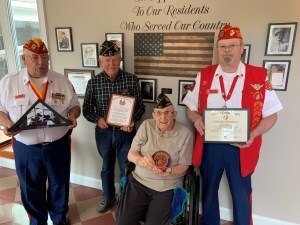
Presentation of WWII Appreciation to Robert Michaud USMC
As Commandant of Detachment 1414 of the Marine Corps League, I was notified of this decision. It spurred me into action. Several years ago, my detachment identified as many living WWII veterans as possible. We visited each one and presented them with a certificate of appreciation and an American Flag. It was possibly one of the most emotional events I’ve ever been involved in. The reaction we received from these men and women was phenomenal, everything from surprise to hugging us–we even saw a lot of tears. Never before had I experienced a ninety-something-year-old veteran struggling out of a wheelchair to stand at attention to salute me. I even met a Navy veteran who drove one of the landing craft that took U. S. Marines ashore at the battle of Iwo Jima.
At the time, five of these veterans lived in the Caribou Maine Veterans’ Home. We learned of a public hearing with the Committee On Veterans and Legal Affairs and obtained access. More than twenty local veterans attended and were each given three minutes to speak. We got our eyes open wide about the management of the Maine Veterans’ Homes. The CEO of the non-profit (who we later learned was earning $243,000.00 per year) stated his case mentioning the items listed above. The next speaker was an employee of the Caribou home. Her comments were: “Of course, they can’t find qualified staff. They’ve had a hiring freeze on since October. As for there not being a large enough population of veterans, currently, 100% of our beds are occupied, and we have a waiting list.” She closed with a warning, “We haven’t started seeing an influx of Vietnam and Gulf wars veterans The committee approved Senator Jackson’s bill and went before the entire legislature, which was unanimously approved. Governor Mills signed the bill into law, and the Maine Veterans’ Homes backed down. Another factor was the expansion of the Augusta location.
The Maine Veterans’ Homes had received approval for a $30,000,000 bond to construct a new home in Augusta. There was more surprise when we saw photos of the new location (where we were told our patients could be moved to. Why not tell our people to say a final goodbye to their loved ones because they’d never see them again?) The new home was over budget by a considerable amount, and The Maine Veterans’ Homes wanted it to be as fully occupied as possible to justify the cost overruns (this is my personal theory). The pictures showed fancy entrances to the rooms (all of which were private), coffee shops, and conference rooms that could be rented. “What do those things have to do with caring for our veterans?” was the most often asked question.
In closing, we saved the Caribou and Macias homes, and the board, which previously had no representation north of Bangor, now has an Aroostook County member. I wrote a letter to the governor recommending the expansion of the Board and the creation of an advisory committee that would meet periodically with the management of the Caribou home to discuss ways in which we, veterans’ organizations, can assist them. We also have made a commitment to ourselves that we will not be caught off guard again… we will continue to monitor the actions of The Maine Veterans’ Homes.
BTW. It has been reported to me that the CEO of the Maine Veterans’ Homes has announced his intention to retire early in 2023.
Places & Spaces
I recently had to go back in one of my novels and change the name of a popular restaurant I used. Why? Because the restaurant went out of business and I didn’t want to date my novel by having a restaurant that no longer exists. So instead I changed it to Becky’s Diner, knowing that Becky’s Diner is an institution that has been around for awhile, and should be around for the foreseeable future.
As a reader, do you enjoy reading about real places and products in a novel? I know I do. I tend to look up stuff on the internet after reading about place and see if the mentioned restaurant or coffee shop really exists. Or a particular brand of local beer. Real places in a book grounds the story for me and makes it authentic. If I’m visiting that city, its a place where I probably would like to visit, and sit in the same seat that a familiar character or villian once sat in, like Norm in Cheers. Or quaff a local brew that the characters like to drink.
But there are times when I need to use a fictional business place or restaurant in my story. For example, if one of my characters has a bad meal there. Or if something negative happens in the business that might end up with the owner of the establishment suing me for libel. Ha! I’m a working writer. Good luck getting blood from a stone.
Say I’m writing a story about an unethical doctor or shady hospital administrator. Or a sleazy college professor who seduces his students. In that scenario, there’s no way I’m using a real name. Instead of Maine Medical I’ll make up another name, like Casco Bay Hospital. Or Dirigo University. I’ll use a name that won’t get me in trouble, but somehow alludes to the locale I’m setting my story in. I’ll never write a novel about a chef who poisons his customers and have him working at a wonderful floating restaurant named Demillo’s.
In one of my earlier books, a horror novel before I transitioned to crime fiction, I set one gory scene in a well-known Boston college. This was before I really started thinking about places and spaces in my novel. Well, it could have been a disaster publicity-wise. But instead the book made 10 Best Literary References to Berklee College, alingside some big name writers. https://www.berklee.edu/news/berklee-now/10-best-literary-references-berklee
My general rule in using an establishment or product’s name in a book is to use if it’s good, and change the name if it reflects negatively on the place or product. I’ve even had instances in my book where readers were so convinced a fictional beer was real that they looked it up, only to discover it never really existed. I suppose that’s a compliment.
In any case, if you’re a writer, keep using those landmarks in your manuscript to give a sense of place and space. Mention popular local beers and coffee shops. Your readers will surely appreciate it and enjoy your novel more than if you go generic.
November 8, 2022
TAKING BREAKS AIN’T ALL BAD by Jule Selbo

I had to take a break from working on the next book in my Dee Rommel series (8 DAYS) for a good week and a half last month to write a speech for a conference. The picture above (from Madam Satan, a 1930s film) is an indication of my annoyed and frustrated self.
But it turned out to be a good break – and educational. The most important lesson was that I no longer wanted to take on other projects – that I wanted to concentrate on one creative thing – writing this mystery/crime series.
But besides that – I did find that my thinking regarding my main character, Dee Rommel, did benefit from some of the energy (positive and negative) that I garnered while doing research for my speech.
What’s the speech for?

A conference on Feminist Film. Why am I involved? Here’s the background: When I was a screenwriter in Hollywood, I was drafted by California State University, Fullerton to help set up a playwriting degree in the Theater Department. Since I had, formerly, worked happily as a playwright in NYC (and put it aside when I started writing tv and film projects), I jumped at the chance to get my small toe back into the theater. I figured out a way to arrange with the studio I was working for to have every Thursday night off (7pm to 10 pm) so I could teach at the University. (I had to promise I’d come back to the studio after 10 pm if needed – and lots of times, given tv series’ schedules, that did happen.)
The Film Department at the University started sending their students over to the playwriting class and eventually asked me to help set up an MFA program in the film department for screenwriters.
Soon I had one foot in Hollywood and one foot in academia. I liked it. The two paths complimented each other and satisfied two different parts of my brain. I ended up writing three “how-to-write” screenwriting books and also contributed other academic books and wrote journal articles on film history while writing (not so academic) projects for Disney and Aaron Spelling (who says Melrose Place was not an academic project?).
The work that takes me away from my 8 DAYS writing schedule is my final swan song to my academic life. I hang up my professor’s mortarboard and tassel May 2023. (Yeah!) But as life plays out, in these final months, I was asked to do this speech at the conference. And since the gathering is in Sweden and my plane fare and hotel would be covered, I said yes. (I’ll be giving my keynote on November 10 – that might be the day you’re reading this blog). But the bad news was (for me) I had to switch gears from crime/mystery and think about what I considered to be viable and not-so-viable feminist films in America.

One of the academic journal articles I wrote a few years back was on PRE-CODE (1929-1934) cinema in America. That’s the era from when sound in movies became the norm and before the “Code to Govern the Making of Talking, Synchronized and Silent Motion Pictures” was adopted. Film historians have noted that male-female relationships, during this period, were presented as healthy, sane and lively. Men and women were presented as equal partners in the “adventure of life”. Many of the films written in this era are feminist films – written by women and men.
When the 1934 Production Code, (sometimes referred to as the Hays Code) was adopted, many film stories/topics/subjects were no longer allowed and characters inhabiting stories were forced to change. (This censorship code has nothing to do with the Rating Systems (G, PG, R, X etc.) that was adopted in the late 1960s.) The Production Code was instigated by ultra-conservatives and religious organizations that were concerned with what they saw as Americans’ “lax morality”; they were especially concerned that women were being celebrated for being intelligent, soul-searching, clever, ambitious and desirous of equality. The head of the Production Code Administration office was Irish Catholic Joseph Breen, he became famous for saying, “I am so enthusiastic about this whole (censorship) business that I’d be tempted to bite the legs off of anybody who might dare to cross me…”

Reading about Breen and his agenda has always annoyed me – and Dee Rommel, my protagonist, is fueled, at times, by annoyance. So as I dug back into this topic, I was reminded to keep that side of Dee “alive.”
In Pre-Code cinema in America, a woman could get divorced and not be ostracized (like a man), she was in charge of decisions about her own body (like a man), she could have affairs and be understood (just like a man), she could be head of a company (like a man), she could choose not to have a family – or if she did have a family, she could make choices that did not always put family responsibilities first and be understood (like a man), she could love someone of her own sex and not be judged.
However, to be in accordance with the 1934 Code, female protagonists were expected to be virgins or safely married, they had to obey their husbands or acknowledge that men “knew best”, they had to sacrifice all for hearth and home, they could not “enjoy” liquor, they could not let a kiss linger for more than three seconds and one of their feet must always be on the floor while being kissed, and many many more restrictions. These edicts were written into a document and scripts were written (or re-written against the original author’s desire) to adhere to the rules. If a woman was the femme fatale in a noir film – she must be punished (killed, arrested or ostracized), she must be presented as absolutely soulless/despicable. (Remember Double Indemnity (1944, a Code film), Stanwyck did end up on a beach with a cocktail looking pleased, but she was ostracized and audiences were set up to hate her supreme evilness.)
I decided, for my speech, to look at American feminist films written/produced in America in the last twenty years or so and compare them with the feminist films written during the PreCode era. My research energized me in unexpected ways. Dee Rommel, my protagonist, has definite opinions on a woman’s place in America, the opportunities she should have and or demand and how she expects to be treated in professional and social situations. So, as noted earlier, when my research “upset” me, it fueled the corner of my brain where Dee Rommel was waiting.
My research also got me wondering this: If the Production Code had never been put into effect, would some of the movies being made today still need to be made? For nearly 40 years after the Code was adopted, the depiction of women was controlled by the “moral watchdogs” whose agenda was to keep a woman basically silent and “in her place”. (Dee Rommel (if she had lived in those times) would not have been a fan of these watchdogs.)
Would we, in America, still have to be making some of the movies we’re making? Did the strict Code really re-form expectations and hopes and ways women were treated? How influential were those Code films? While digging into the list of feminist films produced in the last twenty years, it struck me (duh) how similar/same these more recent film stories were to the Pre-Code era’s films.
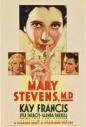
In 1934, Mary Stevens MD, was a box office hit; it dealt with a professional woman (a doctor) who has to decide whether or not to go through with a pregnancy.

Call Jane (2022) is a very similar story, as are many other recent films because this subject today, is relevant to today’s concerns.
 Divorcee was a 1930 movie where a woman left an unsatisfactory, unequal marriage and, despite threats from family and husband, was able to retain her place of respect in society and her social sphere. When the Code was enacted, it was decreed that “the sanctity of marriage was always to be upheld.” If there was trouble in a marriage, it was solved and the partners were reunited at FADE OUT.

In 42nd Street (1933), Millie (1931) and Ladies They Talk About (1933) same-sex love was included in films, and then these stories disappeared – listed an inappropriate by the Code.
It wasn’t until 1982’s Personal Best (penned by Robert Towne), that the subject of a love affair between two women was explored in a mainstream Hollywood film.
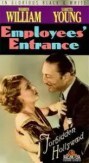
Sexual harassment in the workplace was explored in Employee’s Entrance (1933) and Female (1934; in this film it is the female boss harassing the men). Studios are now deep into telling the same stories ( think Bombshell and the many #MeToo movies on the horizon) for American movie-goers. She Said – focused on the Harvey Weinstein case, is just one of the films.
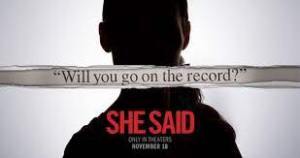
I could list the Pre-Code movies that dealt with women, in abusive relationships, who gathered the strength to take legal action against their abusers. Then these stories vanished. It was until Post-Code (mid-1960s) that movies like The Burning Bed (1984), The Accused (1988) and the more recent Pink (2020) and Women Talking (2022) could be made.
Who know where some of the issues in American society would be if those 40 years of “stories shaped by the Code” had not happened? What do you think? I think of some of the plots/problems/reasons for crime that Dee Rommel is going to find herself in – and wonder if I might be looking at different motives. Sure, murder, robbery and other biggees seem to be a perennial problem, but would character motivations in other areas be different?
I could go on, but you get the point. Reading, researching and reminding myself of film stories made before the Code went into effect, and then the time period where (most) storylines were controlled and shaped in an attempt to model human behavior and thought and didn’t deal with “real” problems/crimes/abuses – got me re-energized to keep Dee Rommel strong, opinionated and determined to follow her own path.
Lea Wait's Blog
- Lea Wait's profile
- 509 followers

