
Michael Jecks's Blog, page 36
July 11, 2012
The Most Crucial Writing Tools
I’ve already had a few enquiries about how easy it is to put new works up on the internet, so thought I’d add a few comments.
First, you obviously need a piece of software that will help you to create your work. And most authors will leap to Word immediately. Well, you can use Word. I have myself, in times gone past.
In fact I have used quite a lot in the last eighteen years as a novelist: from a copy of Wang Labs’ own wordprocessor (simple, effective, more than adequate, now sadly no longer available), Word Perfect (more comprehensive, very good, and I still miss it), to Word from Microsoft (adequate, but starts to get all emotional and tired when you reach about 100,000 words, so not good enough).
All are useful. Word is something I do use to dash off a letter. But when I turn on my computer, I don’t want a simple text editor. I need something that will help me produce effective work. That’s why I, like a lot of other professional authors, have chosen Scrivener.
Right – first statement, for those of a doubting disposition: I do not hold shares in the two software packages I am discussing here. Both have been bought at my own expense. However, when I find a good product, I believe very firmly in letting other people know about them. It doesn’t hurt me, and it may help others. So here goes.
Scrivener can be found here http://www.literatureandlatte.com/. Go to through the tabs for the best view of this superb piece of software. Why is it good?
Sigh.
Look, instead of working on one page within an entire document, all of which is a long stream of text, Scrivener allows you to work on simple documents within a project. Every document is discrete, and that’s great. It means if you decide that the flow of the book is not quite right, and it would be good to move that scene there to earlier or later, all you do is grab the document (scene) and drag and drop to the place where you want it in the “Binder”. Just think of it as a large project held in a binder. You want to move pages? You pull them out and shove them back into the binder in the right spot. It’s that easy.
But that’s only a part of the benefits. Each document has its own “inpector” window. This I find phenomenally useful. There is a space for a synopsis of the scene (which can be displayed with other scenes’ summaries on a corkboard background, as though you were looking at a novel as a group of index cards on a wall, shifting one above another, until you’re happy with the novel’s layout). Under that there are labels and a “status” title so you can highlight the scenes in any way you want. In addition there is a section for you to add keywords, so you can keyword search throughout the project for specific people, say, and make sure that they develop as characters through the novel. Another (brilliant, brilliant, brilliant) facility is for notes.

A typical Scrivener screen.
“Wow,” I hear you say? OK. Think of this. There are two sets of notes: one is scene-specific, one is project-specific. So you can add notes for the scenes or the whole novel. Great. Where it shines, is that you can have text in the notes, or photos, or html links – anything. And when you’re working, you can constantly refer back to them to refresh your memory.
I can type my works as I usually do, the flow and the story unfolding before me, referring to my notes as I go, or, I can make use of the corkboards.
These, as I mentioned above, are great little additions. You can develop a general flow (which is what I’m starting to do now) or plan and plot in great detail.
That really is the beauty of Scrivener – it is up to you. I know, for example, that friends like David Hewson use the keyword searches extensively. I confess, I do not. In my case, I find that the word-in-text search is more reliable. I don’t have to remember to put a name into the scene’s search box. Instead, whenever I need to find someone, I type his name into the search box at the top of the screen, and Scrivener helpfully presents me with all the scenes in which that word appears, while also highlighting the word in that scene.
And there is another little point. When I type, I like no distractions. With Scrivener, I don’t have them. A control- command “f” takes away and hides all the screen, and all I have is a sheet of paper on a black background, with, if I want it, a typing line. Everything I type appears on the same line, so my eyes aren’t having to flit up and down to find where I am. I always know (and it’s preset-able to your preferences, of course).

My typing line is there in pink highlight.
But while the software is superb, it does lack one little thing: a timelining facility.
When I was a dedicated crime writer, I used to have to make sure of my timelines by scribbling extensive notes all over the place. The most important scenes had to be linked to each other, with who was doing what and when, so I didn’t end up with the murder occurring three days after the body was found or something.
Scrivener’s Keith Blount wrote recently to let all users know about another wonderful package: Aeon Timescale.
I am in the middle of researching a book that will be a work largely of non-fiction. I have a bunch of papers to work from, and I have the broad sweep of history through the Second World War, as well as all the websites and books you could hope for. But to make sense of events happening across two continents, I need to have a fairly detailed timeline. I was really pulling my hair out until Keith’s email.

Aeon downloaded as a trial within a matter of moments, and in less than half an hour, I was working on it. I kept going for about three hours – and at the end, I had the complete timeline and an outline for my book.
But not only that: Aeon links seamlessly with Scrivener, so when I next opened my document in Scrivener, all the Aeon timelines were already there as chapter or scene headings.
And that is the final beauty with Scrivener. It links to Aeon, but also to a growing suite of alternative packages. When I used to use (I did love it and still miss it) my iPad, I used to use an app that brought up a series of note cards. I could outline stories briefly, store them, and next time I was home, they would load into Scrivener so I could use them as notes. I also used Simplenote, an app that allows you to take – well, simple notes, really. And that too integrated.
For my usual tablet now I use an Android. No, I disagree with David Hewson here. I am not so convinced of Android, and when I can, I’ll return to an iPad, but for now I can at least output (automatically, it just syncs) my Scrivener files to my HTC so that when I’m away from home I can still mark up alterations and corrections.
Now, of course, with something like Scrivener, you can print documents. But the manner of working is not “type, check, print” like in Word. You first compile your project, which sets up the basic formats, margins, formats etc. This can be output into almost any format. The common ones are things like Word, and you can email or print direct from there, if you want, but then there are the alternatives: epub format, or .mobi, for example.
I used these when I was working on a lengthy modern-day novel, and output the entire work into epub. I could then load that into my iPad and work on my own books on the pad. And enjoy the process much more, because the tablet was infinitely more pleasant to read and work on than roughly 500 sheets of A4.
However, there is another huge benefit.
In the last few weeks I’ve been working on my old short stories. They’re all out of print, and I owned the rights. So I thought I should make them available again. And to do that, I immediately thought about putting them on Kindle as ebooks. And now, if you want, you can read them. It took an hour.
My shorts were all in Word format on my computer. I had to figure out how to produce them as ebooks. Obviously first there was a long, long process of editing and proof-checking (because two were on ancient disks and corrupted, so there was some retyping and – well, you don’t need to know). However, once that was done, I asked Scrivener to import them. It did. Faultlessly, I’m glad to say.
The next thing to do was export them to electronic format. I told it to compile the works as a Kindle book. It did.
I went into the Kindle Direct Publishing site, loaded my book and picture, and then Kindle gave me an opportunity to preview the format. When I went in, the chapters ran straight into each other, one ending, the next beginning, on the same pages. I didn’t like that. So, back to Scrivener, I changed the tick-boxes on compile to tell it to put in a page break between chapters, compiled it again, uploaded it again, and checked the preview. It was fine.
That entire upload, think: “bugger,” go back to Scrivener, alter the output, recompile, upload again and check, took less than ten minutes. The majority of that time was waiting for Kindle to accept the book (because my line speed down here in Dartmoor is not blisteringly fast).
Within four hours I was selling copies of FOR THE LOVE OF OLD BONES and other stories.
So, for my money, Scrivener is not a desirable piece of software. It is as essential to me as a writer as is my Apple computer itself. I could not function without either of them. They are absolutely crucial to my being able to forget about the tools I am using so that I can concentrate on my stories and the best way of getting them out there, in front of people.
And after only two weeks of playing with Aeon Timeline, I have to admit, it’s already up there, almost as important as Scrivener.
For those who want to learn more about either of these, the Scrivener website is at http://www.literatureandlatte.com/. For more information about Aeon Timeline, go and check it out at http://www.scribblecode.com/.
You will see that both offer free downloads for a limited period. I tested both in some detail before investing, but I would say that Scrivener is ludicrously cheap for the job it does. It suits not only authors and novelists, but students, managers – anyone who has to write moderately long documents which require thought and good formatting. Aeon Timeline can be used by project managers, engineers, and a number of other guys because it is so flexible. And the fact that it integrates so smoothly with Scrivener makes life just so much easier.
Go and test them today, folks.
Meanwhile, I would be highly remiss not to remind you that you can buy the superb collection of short stories: FOR THE LOVE OF OLD BONES from Amazon for your Kindle or for any computer device that runs the Kindle app (computer, phone, iPad etc) for a truly ridiculously small price.
For your copy, please paste these links into your browser:
Amazon UK:
Amazon US:
Good Writing, and Happy Reading!
Tagged: Aeon Timeline, amazon, authors, books, crime writing, ebooks, novelist, projects, publishing, Scrivener, writing








July 9, 2012
First Attempt at Epublishing.
At a time when publishing is in such a state of turmoil, the last thing that an experienced author wants to do is set off in a different direction.
Which is what I am doing. Still, there are good reasons for it. I want to sell more books.

New book at the ready. It’s already on Kindle – it beat my short stories!
And what is irritating is, I have some stories that are ready and waiting to be sold.
People who have followed me on FaceBook and Twitter will already be bored stupid with my mindless witterings about my short stories. Yes, yes, I know. I first started talking about them months ago.
You see, I have, over the years, contributed to a number of short story anthologies. I had great fun writing for the second Ellis Peters memorial, a book called Past Poisons. Then there were the “Monster” books from Robinson, and two American collections called Murder Most Medieval and Murder Most Catholic. All four of these contained some really rather good Jecks work.
More recently, I’ve written some very good crime short stories – the first was a really fun story set in Roman England, then there were a couple of police procedurals, and another set in the Jacobean era. Oh, and there was a modern spy thriller, and a horror story. Yes, a horror story. Great, gruesome fun, that was.
It’s the strange thing, but while Sherlock Holmes depended upon the cheerful spine-freezer magazines of the late 1800s to pay for Sir Arthur C-D’s mortgage, it’s now that hideous nemesis of the book-market, the internet, that is likely to save short stories for posterity.

The workspace is a little cluttered just now. Only the Ridge has all the space she needs!
People can write a short in little time, but getting money for them is damn hard. Some people sell them to the BBC, if they’re lucky; others sell occasionally to the few monthly magazines that still exist. But the payment for either is not too hot. However, to try to print a book and make a few pennies you would have to pay a fortune.
And that is where the internet comes in. Suddenly authors can collect a bunch of short stories into a collection and put them out into the world with the chance of being paid a very respectable 30 cents each sale.
Put it into perspective: if I were to sell a book in America today, I would be very lucky to make twelve cents. The discounts which are demanded by importers are up to 80%. Since authors tend to be paid on net receipts, that means my income’s shot immediately. Take out the cost of an agent’s fees, let alone tax, and the actual amount my wallet receives is a pittance. I earn more from loaning a book at a library.
Well, perhaps I’ll be more keen on writing shorts in future. But I haven’t electronically published a book myself. The thought was, frankly, terrifying. I cogitated over it extensively, picking up a pencil as a new displacement activity (this one’s my Ridgie).

So terrifying I resorted to sketching dogs instead of getting on with it.
For a long time I’ve held that epublishing will suffer from the most basic, obvious problem: authors cannot edit their own work.
We are all short-sighted. We write out stories, and they read really well to us. We read them on the screen, on the page, and aloud, sometimes. And they really do seem bloody marvellous. And then we send them to an editor.
There is a reason why editors earn good money. It is that they are vital. They read a book and spot that the guy who’s talking on page 300 was the one the author killed on page twenty (Len Deighton once did that, apparently). They also spot little problems with the plot, and sometimes make insulting, silly suggestions that – oh, actually make a rather mediocre book become good.
It’s not only editors, it’s copyeditors. And proof readers. All of them are employed for the simple reason that over many years it has been shown that they are needed. This will no doubt surprise many, but publishers tend to dislike throwing money about. They don’t see it as their moral duty to keep numbers of perfectly well-behaved copy editors off the streets. If they can dispose of excess staff, they tend to do so.
Once I was told that of all books written, only 1% ever got into print. Some of the 99% are unlucky. They hit an editor’s desk on a morning that she was nursing a really bad hangover, or on the day she had to have the cat put down, or the morning she discovered her husband was shagging his secretary – so many reasons, and the worst of it is, the author never knows.
But for every book that is rejected for the reasons I’ve given, many, many more are rejected because – sorry to be blunt, but – the book is rubbish.
It’s a book that’s been written, read through once, and sent off because the author wants to be a millionaire. It’s got spelling mistakes all over it. The format is single-line spaced, printed both sides of the paper, and there is a covering letter demanding that the publisher swears on a bible in St Paul’s cathedral that he/she (delete as applicable) will not steal any part of it. Worse, it’s been lifted almost entirely from someone else’s work.
You wouldn’t believe some of the ill-considered work that people send in to editors. After all, every hopeful scribbler should realise that a sample of work is a sales tool. It is there to grab the attention of a hard-nosed editorial executive so tightly that the little darling will happily stand up in a commissioning meeting and say “We have to buy this book!”
Sadly, those moments of managerial courage are all too few and far between because 99% of the books sent in are rejected.
What the aspiring author won’t believe is that the tome they’ve worked on so hard could be rubbish. No, it was the editor; she was a fool. She had no judgement. Look at JK Rowling. She got Harry Potter refused by loads of publishers. They have no idea.
So now the ever-hopeful writer looks around for some other means of getting their efforts read by a wide public.
In the past, most would just put it in a bottom drawer and forget about it. Some, the wealthier, would go to a publisher who asked them to “share” the costs of production until the book’s merits were discovered, and then both would make a fortune. But not now. No. Now there is the internet and Kindle.
But, and it’s a bit “but” – how do you find a book to buy?
An example. The other day I had to go to London. It was to be a long train journey. So, rather than lug around a load of books, I thought I’d skim Kindle and find something good.
I spent 45 minutes searching – and gave up. I didn’t know what I wanted, so I needed some good searching facilities – but failed to locate them. Instead, I had a “Highest/Lowest” search. And would you believe how many free books there are? A lot. As a means of finding worthwhile new writing, it was a disaster.
Even when you do find what looks like a good book, you’re stuffed, because you start to hunt by cover, and only when you’ve bought one do you discover that the damn thing was written by a mentally-defective multi-millionaire who could afford to commission a top artist to design his jacket but was tested when asked even to spell his own name. Inside are hundreds of pages of turgid prose.
So when a new ebook appears on Amazon, it won’t necessarily appear on the reader’s horizon. There are just too many books.
Which is why authors still want to be associated with their publishers. Because publishers not only make sure that the books are readable, they also pay other people to go and market them. They have publicity teams and marketing staff. Most of all, though, they have a brand. If you see a book on Kindle that has been published by “De-Caffeinated Green Tea Press” you may think twice, but if it’s there with Simon & Schuster, or Orion, or Harper Collins as publisher, you have a verification of quality. Hopefully.
They also have technical know-how. For example, they know how to edit funny computer programs and things. I don’t.
So yes, I was dreading loading my shorts.
Luckily, all my short stories are pre-published, so they’ve been edited. I had to retype two of them, though (the originals are still on floppy disks – fat load of good that is. I don’t possess a floppy disk drive), but fortunately my wife is an excellent copyeditor. So, getting the books onto the computer was easy. Next, the part I dreaded, was translating them into .mobi, the language Kindles use.
A needless panic. Scrivener has a neat output option on compiling a novel. It goes straight into .mobi. In fact, I decided to write a blog about my trials and troubles of converting a book to Kindle. Scrivener meant that was pointless. A three-line blog is not very interesting.
So, having girded my bits for a while, today I logged into Amazon and nervously tried to upload my book.
It went. Took a matter of minutes to log myself into their Kindle system and then it was gone. I cannot believe how easy it was.
So, perhaps in future there will be more Jecks stories out there. Certainly today it was not the appalling, mind-killing experience I had feared. I could almost get to like it!
And for those who are interested, “For the Love of Old Bones – and other stories” is on Kindle right now – I’ve put the links at the bottom.
I’m rather excited!

And here it is. A wonderful little book that will sell in the thousands, hopefully!
Amazon US: http://www.amazon.com/For-Love-Old-Bo...
Amazon UK: http://www.amazon.co.uk/For-Love-Old-...
Tagged: authors, books, ebooks, novelist, publishing, Scrivener, Templar series, writing







July 5, 2012
Pens, Pencils, Computers – Guess My Favourites
Writing – again.
The last few weeks have been really fun. Hard, but fun.
I am in the middle of the next book for Simon & Schuster, which is to be an action story based on the Hundred Years War, with the campaign that finally led to Crécy, and I am enjoying it enormously. However, then this other project came up …
My agent (Blessings be upon him) came up with a client who has a brilliant story, but needed help to get it written. Being the master of business that he is, he got his other client and me into a room and locked the door for an hour or so.
The result is, I have a different project to work on.
So, when I say I’m writing a ghost story, I don’t mean I’m now heavily into Gothic script and tall towers with malevolent, black-cloaked figures peering over the upper walls, I mean I’m writing someone else’s story. Or the outline and a few samples, anyway, until we get the contract agreed. Main thing is, it’s a hugely harrowing tale, with two people who suffer from the worst of the Depression and Nazi persecution.
As I say, it’s harrowing, but it’s a brilliant story, and there’s a superb twist at the end, making it deeply satisfying too.
At the same time, earlier this year I was invited to work with a director on a documentary about the book industry, with specific reference to ebooks and how they’re affecting people. That was fun – and it led on to a chat about other possible projects. So now I’m doing a treatment for her, with two outlines which could well prove very interesting as well. And I’m not saying why, no. You’ll have to wait to find out – if they ever get off the ground.
But the main thing is, while researching the Hundred Years War and a ghost project is all very fine and dandy, there are things a writer needs. Clearly I need this thing (taps computer), and this (tablet), but there are other things that make writing more enjoyable.
One thing that is wonderfully delightful is a printer.
No, I’m not joking. A couple of years ago, it died, and in recent months when I’ve needed something printed I’ve had to go upstairs and ask (very politely) whether my wife could print it for me. Usually she’s OK.
Owing to the Horrible Hewson (author of THE KILLING. I’m not jealous
) I was persuaded to sell my iPad to get an HTC Flier, which has two key attributes: one, it is small and fits into my cargo pockets in my trousers; two, it has a pen. No, I mean it. I can send a book to my Flier, and there revise my work, edit, draw scribble writing all over it, add, delete lines, all in red. I haven’t had to print anything for months. That makes life a great deal easier on occasion.
Hmm. It works, but I’m still convinced that the iPad was more … don’t know, coherent somehow. It just works – in some ineffable way all of its own – rather better than Android boxes.
What the hell. The main thing is, I’ve recently been forced back to paper because of receiving reams of paper for the ghost project. And with other stuff I needed to do, I got around to working on the printer and mending it (a background flogging HP Laserjet 8s for Wordplex and Wang finally paid off).
So I began searching for a way to work with paper again.

My current editing/writing tools of choice. Yes, I still love the Conway Stewart, but I dare take these ones out with me daily!
First, I got some Faber Castell pencils. I have used highlighters for years – and I hate them. There is something about the feel of a drying highlighter that drives me potty. It irritates the hell out of me that they dry out so fast, and then it annoys me even more to think of all the landfill being stuffed full of gaudy yellow plastic. In preference I use a dry-highlighter. It’s basically a pencil with hugely bright lead. And it works superbly without drying more than it needs.
But a highlighter is only a part of my investment. I also got a brilliant pair of pencils, one with a 3mm lead, one with a 5mm. These clutch pencils are superb for marking out flow charts, for emphasising important points, and for just about anything, including sketching my old Ridgie when I’m really bored.

Yes. Her.
And last of all, but Dear Heaven, definitely not least, I finally bought another fountain pen.
I have wittered on about pens often enough in the past.
I love a good, heavy, fat pen. My Conway Stewarts are, basically, beautiful. I have a Drake in solid silver that is my real favourite to write – the balance is perfect for me, the nib a sheer delight; then there is the wonderful Michael Jecks pen, which I rarely take out purely because it is truly irreplaceable; and finally, a gorgeous black Churchill, as fat as Winston’s favourite cigar, and even more beautiful. All three write like a dream, and I adore them.
There’s only one catch.
Look them up on the internet and take a squint at their prices. Yes. Those are the prices for each one, individually. Rather a lot, isn’t it? And bearing in mind my favourite pencil, the Graf von Faber Castell Perfect Pencil got itself lost this year while I was walking the dogs, I don’t fancy taking my Conway Stewarts out of my office when I go working. I know I will lose them.
Which is why I bought a Kaweco AL Sport.
It is small, and fits into any pocket. It is – to my mind – beautiful, with a slender barrel and fine grey colour, and it writes like a pen that costs ten times as much. It has a steel nib, but the damn thing is as near perfection as I can imagine.
The only problem I have right now, is that all the work I have to do is the mass-typing stuff. What I really, really want is a few days to sit down with my pen, highlighters, pencils and a pad of really good Rhodia paper, and scribble, scrawl and sketch.
But I can’t. Blast.
Oh, and before I forget, I will shortly have to blog about another fabulous invention soon. It’s a software package that almost makes me happy not to be using a pen: Aeon Timeline. I have been using it to get the timeline straight for my WWII story, and it’s proved invaluable.
Especially since it integrates fully with Scrivener. Basically it’s saved me about a fortnight’s work in the last three days.
Watch this space.
I should just say that I bought all my pens and pencils from a rather wonderful little store call Cult Pens. I used them originally because they are based in Tiverton, the town which inspired my Templar series, and I’ve carried on using them because they’re brilliant to deal with. I have no axe to grind – I don’t earn money for endorsements, sadly – although I live in hope of Simon the MD buying me a beer sometime – but every order I’ve put in with them has been despatched the same day and invariably arrives the day after. Their staff are helpful and knowledgeable and actually seem to like pens.
Which I like.
If you’re interested, look them up at www.cultpens.com. Personally I’m thinking I may need another Kaweco AL Sport in black plastic before too long. I’ll be sure to have a need if I can just sit down and think it through …

I love the Bernese too, yes. But you try to subtly shade a dog that’s basically mostly black.
Tagged: blogs, books, Cult Pens, ebooks, novelist, pencils, pens, writer, writing







June 18, 2012
Book Sales
Books, books and more books!
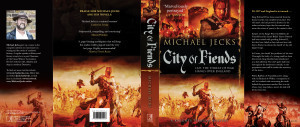
Yes, it’s that time of year. A new Jecks book, CITY OF FIENDS, which means that there are one or two lucky folks who can buy copies for family or friends.
This one is a return to my roots, so to speak. The action begins with the sudden death of poor Bishop James of Exeter, when he and his entourage were murdered at one of his ecclesiastical manors. At the same time, a poor young servant was found murdered. It’s just a sign of the terrible period, that these two killings should take place – or is there more to them both?
CITY OF FIENDS is a great read, and the last of a sequence. The next story will be a prequel, returning to Baldwin’s youth during the terrible siege of Acre.
Many thanks to all those who have already asked for copies of the latest book, or for past stories. I have to apologise to those who enquired before the weekend. Unfortunately, the unexpected and untimely arrival of a nephew threw all my plans out by a day! Still, I’ve checked all the prices, and they appear to be as I’ve set out below.
UK – City of Fiends hardback £24.50
Trade paperback £17.00
Europe – Hardback £26.00
USA – Hardback £30.00
Australia – Hardback £31.00
These prices will include all postage, packing, a signed postcard from a previous book, and a selection of bookmarks. All books will be signed by the author, and if a special comment is required, let me know and I’ll add it for you.
I also have one copy each of Bishop Must Die and King’s Gold in hardback for the same prices.
There are also trade paperback copies of King of Thieves for £15, or Bishop Must Die, The Oath, orKing’s Gold, all at £17, and again, all include the same selection of postcard, bookmarks, and signature.
If you are interested in other titles, do please let me know. I have some stocks of paperbacks as well, and the postage for them will be significantly less, hopefully.
Tagged: books, crime writing, Exeter, medieval, Templar series







May 22, 2012
Orange Prize
Today I heard that the Orange Prize – well, it’s not. Not any more.
A pleading, sad-sounding Kate Mosse was on the Today Programme making a case for how good a bargain the prize was, and any sponsor would make a fortune.
She has my sympathy. When I was Chairman of the Crime Writers’ Association back in 2004, and for the years before that and my advisory year afterwards, the main topic at every single ruddy meeting was sponsorship.

A Gold Dagger for the best crime book of the year.
Sponsorship coloured our views of everything. The CWA has the oldest set of awards in the business, and we always thought that they should get a lot more recognition. But they didn’t.
I and my predecessor spent ages negotiating and managed to win two years of sponsorship from Book Club Associates. That wasn’t a huge success, sadly, and it collapsed.
After my time, a great deal was set up with a private bank. That was wonderful because for a few short years the CWA had the largest prize. Wish to God I’d won that one while the bankers were paying.
But many members hated that. They didn’t want successful parasites like bankers paying fortunes.
When that sponsorship ended, there was a new arrangement – and this one has been very hard to swallow. It led to many authors feeling disgruntled, because all of a sudden the cosy club that was the CWA was being dictated to. In exchange for the money, the CWA Daggers became the Specsavers. Instead of continuing the tradition of rewarding writers for the best in international crime writing, with many daggers, the awards were moved slightly. Most became rewards for actors, not writers. Even the prize in the name of the founder of the CWA, the John Creasey, had to have its name changed to suit the TV suits. They felt the public wouldn’t know who he was. Clearly educating the public has fallen off the remit of broadcasters.
What then, was there for the CWA membership – a group of writers only? In short: nothing.
Which is why, very regretfully, I resigned from the CWA.

Yes, even this twit has had to stand on his hind legs and present the odd prize!
So yes. I can fully appreciate the difficulties of Orange organisers who are trying to find a new sponsor. In these trying times, attempting to winkle a few hundred thousands from a sponsor is like trying to persuade the German public that they should happily spend a few more billions to keep Greece in the Euro zone.
Yes. Not easy.
But do I have any sympathy for the Orange? No.
I dislike intensely any divisive prizes. And the Orange is exclusively for women writers. No men may apply.
If there was a prize for males only, there would be a screaming uproar.
The basic premise was, that women had a raw deal. They weren’t judged in the same way as men. They didn’t get the same rewards.
I don’t know if that was true then – but it isn’t now. If you look at the top selling UK writers, they are JK Rowling, PD James, EL James, the author of the Twilight series, the author of … Ye Gods, when it comes to making money or writing great literary fiction, the women are at the top of the pile already.
Of course, the complaint is always there that the publishing market is driven by men.
It isn’t. I’ve had eight editors in almost twenty years. One was male. The publishing market is run by women to a much greater extent than any other market.
Perhaps it’s the readers, then.
No. We’re always told that the majority of readers are women. Men just don’t get books. Their attention spans are too … Oh, whatever.
So, what is the point of the Orange prize? It serves no useful purpose whatsoever. It doesn’t promote equality because by its very existence it is divisive.
Which is why, while I feel great sympathy for Kate Mosse’s attempts to reinvigorate the Orange, I’m afraid I rather hope she fails.
Better by far to create a prize that is inclusive to replace the Orange. A prize that recognises the best in writing – only that. Male or female should be irrelevant because the author’s sex is irrelevant when it comes to good writing.
Tagged: authors, books, crime writing, CWA, Orange Prize, prizes, writing







May 21, 2012
Olympics
No, I don’t like the Olympics.
Today, the ‘torch’ is near to home, in Okehampton. Because of that, large numbers of people are thronging the streets (I imagine – obviously I’m here at my desk). It’s a ‘once in a lifetime’ experience, I am told. It’ll never happen again, I am told.
Good. The Black Death was a once in the lifetime event for a lot of people. Doesn’t mean everyone wanted the experience.
So no, I am not persuaded.

And to celebrate English culture – oh, there’s not going to be any of that. No Morris.
Let’s be realistic. I dislike watching gymnastics generally. It does nothing for me to see other people participating in sports. In the same way, I don’t watch cricket, or football (I detest football).
The only sports I have been interested in are those in which I could participate. I enjoyed Karate for a long time. I am a keen pistol shooter and toxiphilite. I really like cycling.
But there is a clear theme running through this. I don’t like going to watch: I like taking part. And while I am competitive, it’s not competition against others. I don’t need to see someone else collapsing in tears of frustration to feel good. My interest has always been in improving my own abilities without reference to anyone else’s.
However, while I dislike gymnastics, while I find the thought of watching syncronized swimming less appealing than taking a dip in a fish tank full of piranha fish, and watching a bunch of runners dashing over a short distance (I cannot be bothered to do some research to find out what the actual lengths are) fills me with utter horror, I do not claim the right to stop other people watching. I don’t see why any group should have the right to stop another pursuing their pleasures.
However, if I could, I would stop the Olympics rolling round the world every four ruddy years. Few more pointless, foolish, extravagant means of wasting money and resources have ever been conceived, short of all-out war.
The whole system is set up to make money for large corporations and a few individuals. Large amounts of money.
Look at the set up.
The Olympic committee has massive power. They can persuade a winning nation to build a small city. Access to that city, for the weeks of the Olympics, can be provided on a preferential basis to the top brass of that organisation, so roads will be closed off and their use given solely to them. Increasing, by the way, the gridlock for everyone else. Specific rights are sold off to a small number of sponsors. And let’s not forget that in this good-health-fest the food suppliers will be McDonald’s, the drink suppliers will be Coca Cola.
McDonald’s and Coca Cola. Two companies which are hardly synonymous with good health or corporate best practise.
They, and their corporate companions, will be sponsoring the London Olympics to the tune of £1 billion. That is a lot.
Of course the after-effect of all this is an increase in sports across the UK. That is the stated aim, anyway.
What a farce.
The after-effects of the Olympics will be a mountain of trash with the badges of Coke and McDonalds. It will be a huge increase in global warming, with jets bringing thousands of people to London, it will be a debt bill that will take ages to pay off. And in terms of actual sports for the people of Britain – it’ll have a negligible effect for a short while.
It will not persuade old farts like me to take up running or swimming. It won’t persuade school children to do so. Those who want to and enjoy sports will seek them out and participate already.
However, the Olympics will cost the country billions of pounds. Some of that money could have gone into building or maintaining swimming pools, cycle paths, sports stadia and in training sports coaches.
Throughout the country, local authorities are closing sports fields and swimming pools. The great institutions created for us by our Victorian forebears are being shut and demolished for lack of funds. But in London nine billion pounds is going on the Olympics. Building the athletes’ village, which will become extortinately expensive housing; building the main stadium – who will run that afterwards? There are plenty of optimistic noises coming from people like Sebastian Coe, who runs a company called Complete Leisure Group. He has no ulterior motive, of course http://www.guardian.co.uk/sport/2007/...
The whole sorry bandwagon is rolling on. Last time China; this year London – next time, where? I don’t know, and I really, really don’t care.
It is wasteful in the extreme. And, to be honest, plain daft. If we want to celebrate the Olympics, a better system would be to accept sponsorship from a nation, let that nation have the torch procession (an innovation, I am told, of Hitler, who knew a thing or two about controlling the media and public). But leave the Olympics where they belong. In Greece.
Yes. Why not stop the corporate sponsorship. In England it is next to impossible to use any of the Olympic logos without paying for the rights. You are not allowed in the stadium with a drinks brand other than Coke. Those seen with a Pepsi will be restrained and have their drinks removed. A can of Irn Bru could see you tasered, while if you munch on a Subway, God forbid, you will be terminated with extreme force.
I think I got that right.
In London a small kebab shop run by a Greek gentleman for fifteen years has been told to remove his legitimate business name because it’s called the ‘Olympic Kebab’. Can’t have people making money from things like that. The punters could get confused, and think his little taverna was a corporate sponsor!
Apart from anything else, the Greeks could do with a little good news. Having their Olympics return permanently to the place where they were invented would not be a bad way to celebrate them.
And for the rest of the world, it would mean stopping this four yearly nonsense of building entire towns to satisfy the whims of the Olympic Committee.
Postscript – Today Georgina Geikie (http://www.gseagency.com/portfolio/ge...), I am told, carried the Olympic torch through Okehampton. I know Georgina because I used to shoot at the same pistol club as her.
Back in the 1990s, the pistol shooting sports in the UK were growing, and until Dunblane there was never any question about the UK’s pre-eminence in the shooting world. We always won a disproportionate number of Olympic medals.
However, after Dunblane pistol shooting was banned in the UK.

Friends practising their shooting in Kent. We used to be able to do this. Now Olympic, Commonwealth and other shooters have to travel abroad.
Now Olympic shooters are to come to Britain with their pistols and they will be allowed to compete in Britain. Does this mean an extraordinary risk to the British? No, because obviously Olympians are safe with guns. It’s only the British public who cannot be trusted.
That is why Georgina must travel to Switzerland to practise with her guns. She isn’t allowed to do so in England any more. So her success is disproportionate compared with those who are allowed to handle their guns daily, and go shooting regularly. She has been handicapped, like her peers, because of ill-thought-out gun control laws.
Seb Coe was a keen supporter of shooting. He was the chairman of the shooting fraternity in the west country until Dunblane. Of course after that day, he became a single-minded politician again, and refused to answer any calls from shooters.
Post-Postscript – And now I learn that the torch went out in Torrington. The brilliant design of this ludicrous cheese-grater means any gust of wind can blow it out. Ingenious or what!
Tagged: guns, olympic torch, olympics, sports, torch







May 15, 2012
Writing Tips: In Praise of Editors – or – Where to Research?
OK. This is a subject I’ve moaned about before, but still, here goes. It’s more interesting in so many ways than the latest grief to hit the Eurozone.
Research is always a hot button. ‘Can you help me? I’m looking for …’ is one of the most common questions I get – at least once a week.
So let me tell the following little story.
Last week, while going to be interviewed for a documentary, I was interested to see that a fellow twit on twitter had my name. Out of pure interest, I had to ‘friend’ him and now, no doubt, Mike Jecks up north is following my tweets, as I follow his.
And then I was interested to find that, according to that arbiter of all that is accurate, Wikipedia, apparently I have a distant relation up in the north called ‘Alan’, who also has a son called ‘Michael’.
I guess there is a relationship between these two stories. But, and it’s a biggie for me, it just highlights how dangerous a tool (or weapon) Wikipedia is for a researcher.
You see, I have a brother – which since I’m a pedant, I will call a ‘close’ relative – called Alan. He is a very pleasant guy, who does not, quite categorically, live in the north of England. I know this pretty much for certain, because phone calls to him used to cost a lot, since they all needed the prefix 64 – for New Zealand.
Now, he could have fibbed to me, and been living high on the hog in Manchester, but I doubt it. His business (Alan Jecks Insurance Brokers, or AJIB) is pretty well established in NZ, and I cannot see any reason why he’d make that up. So, someone who went to Wikipedia to learn all they wanted about my family would have been sadly misinformed, first as to our relationship, and second in terms of his location.
I know. It’s a daft example. But there is a serious point behind it.
You see all the time I get emails and facebook requests for information about things and people. Folks write to me for recipes for medieval food, for dates of battles (or to try to correct me on dates for battles, how far a horse could travel, what sort of money was available etc).
Many of those who complain about my facts do so from that unenviable position of greater knowledge, mostly gleaned from the internet.
And much of it is, to be polite, ballocks.

Occasionally you see a setting like this that will kick off research into the setting or the building.
Today I had a chat with my editor. A rare, but really pleasant thing, to talk to my editor. She is knowledgeable, she likes my period, and especially my writing (you’d be surprised how often editors don’t much like the books they’re working on). My copyeditor was discussed. And I like discussing Joan, for the simple reason that she is a real professional. She first looked over my work with book 3 in the Templar series, and continued all the way through to book 28 with one gap. Since moving to Simon & Schuster, she’s also copyedited books 30 and 31, and now she’s going to get book 32, whether she likes it or not.
I like her hugely – and the big reason why is, she is my first line of defence. When I write my books, I check every detail as far as I can. I read voraciously: books on history, on biography, on the morals of the period, the Church, politics, horses, armour, geography, the law, wills, divorce, mercantile ventures, shipping, money, religious Orders … bloody everything.
Yes, sometimes I get something wrong, and when I do it tends to be my fault. It is vanishingly rare that books misdirect me (a well-known historian got the date of the French King’s wedding wrong by two years, which mucked up my work for a while). But the copyeditor, if she knows her period, will save a lot of trouble. She is the failsafe who makes sure of details.
And that, after my long digression, is why the internet is a massively dangerous tool. Still. Books are checked, read and rechecked, while information on the web can be cobbled together haphazardly and dumped on the net.
I think the two books of mine that have resulted in the highest number of complaints are still The Last Templar and Belladonna at Belstone.

Sometimes there’s no alternative than to get out and look at places, see how they are in their landscape. That is good research – better than reading a Wiki about them.
The Last Templar received twenty one complaints from the very first fan letter. It was enough to make my editor enormously anxious. That letter, had I not disproved each of those nasty little niggling details, could have spelled the end of my career as an author, because the writer took a dislike to my writing for some reason. Editors who have taken a punt on a new author do not like to have people declare that ‘He even got the date of the siege of Acre wrong’. Fortunately I was able to reassure her. The complainer had not researched his material well.
The second, Belladonna, received quite a lot of complaints from religious readers. There are still three complaining reviews on Amazon about my writing, my characterisation, my research – basically declaring my effort to be below any sort of par. Which is nice, because all the cases they complained about, and which I mentioned, were culled from the visitations of Bishops Grandisson and Stapeldon. It is pretty obvious to me that the reviewers concerned would have disliked any book that insulted the Catholic Church.
Sadly, many now think that a page on Wikipedia is as safe as a comment in the Oxford Dictionary of National Biography.
It isn’t. It never can be.
The DNB is compiled by the world’s experts in specific people. They edit their works and condense their own lifetimes of research so that the DNB can be trusted. Not only that, editors and copyeditors go through their work and double and triple check. And if there’s anything contentious, a range of other folk get involved. Which is why printed books tend to be reliable.
This, in large part, was what I was explaining on camera last week. It is why I seriously like editors and copyeditors.
Publishers have rigorous procedures to go through before a book appears on the shelves. Ebooks are easier, faster, and democratic. Which means they run the risk of being dross.
Take the example of the old days. A writer who started a book, it was reckoned, had a one percent likelihood of finishing it. One in a hundred. Because writing, actually, isn’t all that easy.
Then, having completed his version of War and Peace, he posted it to a nice lady editor in a publishing house. There would be a less than one percent change that it would get into print.
That is: a one in ten thousand chance that having started to write a book, it will ever end up in print.
It’s better than the Lottery, but not exactly hot odds on making yourself rich, let alone a millionaire.
In the sad old days of yore, the writer would sigh as the rejection letters materialised, and then get on with book two, grimly setting his jaw in determination to get something else published. He was, after all, only one of the nine thousand nine hundred and ninety nine in ten thousand to have received the rejection.
However, now, with the modern, glorious internet, we have this new opportunity.
Now, when the rejection letter appears, the writer shrugs, gives a sneering two finger salute to the foolish publisher, and throws the manuscript down the line at the internet. There he will see his glorious prose receive the reward it deserved.
So it may, so it may. But the reward may be exactly that which the publisher expected.
Sadly, many of these struggling authors will discover that their efforts with one novel will not succeed. Yes, some (50 Shades of Grey etc) will become wealthy. Most will remain desperately writing in the hope that their style will one day appeal to someone other than their mother.
And readers will keep on searching for the next good book. Searching ruddy hard amongst the towering lists of books that now infect hard drives all over the world!
Don’t get me wrong. I’m about to become an epublished author. Already my first six books are out there through HarperCollins’ imprint, Avon, and all the recent titles are available from Simon & Schuster, but I’m going to publish a superb thriller too fairly soon. I’m joining the ranks of electronic authors.
But I still have a suspicion that until there is a rigorous organisation that can read manuscripts, check them, give them a stamp of approval, and then put them up on the internet with a recognisable mark, like, say, a brand, to prove that they have been through a serious process, it will remain damn hard to find the good books.
Oh – I know, let’s call these places ‘Publishers’.
Because, as an author, if I’d been on the web, and I saw my books being torn apart, like Belladonna and Last Templar have been on Amazon, by people who enjoy the vicarious thrill of ripping into a published author, I would have had my career and means of earning an income destroyed.
So, you see, I like publishers. I really, really like editors like my own, and copyeditors, and proofers. They all help make my books work.

And hopefully after months of work, you will receive a pile like this.
And I look forward to a day when the web is rather better organised, and I can go onto it and find some on-line publishers with books I can buy safe in the knowledge that they’ll be readable and will have their basic facts checked.
So, when you want to write and research a decent book, do as I do.
Turn off the wifi. For facts about history and people, go to a library and see which books have the best indexes, which have the best sets of notes, and then use those books for reference.
Because you can trust books.
Tagged: authors, books, ebooks, Libraries, medieval, novelist, publishing, research, writing







May 8, 2012
Testing Times – Writing for the Web
It was a while ago I decided that I’d have to test the digital waters.
At present a few of my books are up there on the web. I’ve the first six or so titles available through the HarperCollins imprint Avon Books in the US, and the more recent books are all on the internet as well. However, the bulk of my series isn’t up there yet, and there are good financial reasons for that.
I’m a firm believer in the “No one but a blockhead ever wrote, except for money” class of authors. If I’m going to think up a good plot, spend days or months writing it down, and miss out on little pleasures like holidays and a life generally, I want to be paid something for my effort.
A few years ago my last publisher demanded all digital rights for free. I wasn’t keen, oddly enough.
For me, the best guarantee that I’ll earn something at some future date is the fact that a publisher is prepared to defray some of my up-front costs – ie, pay me.
Publishers do perform a useful purpose.
They have the ability to see a possible bestseller. The mere fact that a publisher has taken on a book is an indication that the book is of a reasonable quality. Then, publishers edit, copyedit, re-edit and proof read every book that they publish. You may still find the odd typo, but generally they do a good job. A publisher’s label on a jacket is a sign of quality, no matter what indie and self-published authors assert. A book that is edited and copyedited and then published will not have had the critical eye of an industry professional tearing it apart, and thus may (it’s not definite, but it’s pretty much certain) be far poorer than a published book.

City of Fiends – time you pre-ordered your copy now. Available in less than a month now!
But even if the author gets a publishing contract, he or she still gets a pretty bad deal. My last publishers agreed a punitive rate of discount which hurt me badly (and is the reason why I was forced to leave their stable). After all, when a publisher pays an advance, it is only an interest-free loan which has to be paid back (so many people don’t get that: advances are not a gift or salary, they must be repaid out of royalties).
But now we don’t need publishers. We have Kindle. The internet is invigorating. It’s open, freeing, liberating, exciting. That’s what I see all about me. Excitement. Liberation. Freedom.
Excuse me.
You look at those words again, and apply them to your income. “Exciting” and “liberating” tend to have unpleasant connotations when they refer to your own money. It begins to sound like that appalling cliché about every horrible event in your life being an “opportunity”. No. Horrible things happen. They are not opportunities, they are often bloody disasters. I know this. I’ve lived through two recessions that have destroyed my livelihood. They weren’t soul-inspiring events.
The fact is, whether you are employed or self-employed, you crave a little stability. A minimum income level, perhaps.
For writers, there has never been any security. We write and hope that a fickle audience will be teased into buying. Most writers have suffered from appalling incomes for many years. Over three quarters earned less than the national average wage when the Society of Authors last checked. That was before the advent of Kindle, Googlebooks etc.
But the internet is here to stay. There is no getting away from that.
And so, I have decided to bite the bullet and see how my own works will fare. It necessarily means a change in the way that I work, because I must learn how to market and irritate the hell out of people with my scribblings about my books. Well, ideally not irritate them, but you know what I mean – there is a fine balance between determinedly flogging your wares and putting off any readers who might otherwise have been excitedly running to the computer to order the latest.
Whereas in the past I spent all the year planning, thinking and plotting about new stories, now I have to spend much more time in marketing and selling them. It’ll reduce the number of stories I can write. It’s a shame, but it is inevitable. I have to sell them to survive.
What is the best way of selling books? Well, I’ve decided that I’ll start with short stories. Heck, they’re easy. A short read, and I think that a single short of 7-8,000 words should be worth a pound. It’s a diversion for an hour or two, and I guess 50 pennies per hour should be fair payment.
Then, I’ve a collection of four stories that are all Baldwin/Puttock tales and which have been published over some years. They all seem to be begging to be lumped together, so I thought that all together I could sell them for £2.99, which again is pretty cheap for about eight hours of entertainment.

The cover for my new collection of short stories – to be released shortly (as soon as I figure out how to get it up on Kindle!)
Of course, if these go well, I will be looking at my modern thriller. That, and an associated short story, could be sold on the internet too. I guess the thriller would be a good buy at £4.99, the short for another 99 pennies.
It’s not a precise science, of course. Many people will think that I’m charging far too much. I recently had an enthusiastic fool try to recommend that I put all my books on the web for free, and hope that readers will read my work and then come back and pay me something for it. Somehow I don’t think he’d like his own income to depend upon others coming back to pay him from goodwill.
I am not that kind of blockhead.
However, while some folks think I’m overpricing, I have to consider several factors. One, that I am looking at about a year of solid work for all the above stories. I don’t see why I should give away my time and labour for free. Second, other people have designed covers etc. I’ve already had to pay them for their work – and it’s good work, too, as you can see from the short story cover. They are worth their pay, just as I am.
So, is 99 pennies too much for a short story? Is £4.99 too much for a novel? Or are they too little?
I don’t know, in short. But it’s going to be interesting to find out!
Tagged: authors, blogosphere, books, crime writing, Michael Jecks, novelist, publishing, writing





April 26, 2012
Scams and Thieves
It’s always good to hear from people. A phone call is a wonderful thing.
Yesterday, while aimlessly reading about some aspects of history (I won’t bore you) my phone rang, and I picked it up.
There was a silence.
Now, OK, the silence lasted perhaps five or six seconds, but when you’re thinking of detailed characters and in-depth work on a plot, those seconds seem like a bloody long time.
Still, after the pause there was a burst of music of some sort, and then a happy, cheerful voice.
I am used to the fact that many telephone services have been exported to the Indian subcontinent. I am used to the fact that almost any type of computer support means a call to Delhi or Mumbay. I don’t have a problem with that.
In fact, I have had a kind of love for India since first reading “Flashman” many years ago. George MacDonald Fraser was so brilliant at evoking a period and brought the smells and heat to life. I like India. One day I will go there.
I have nothing against India or Indians.
However, I do have a lot against people calling me when I’m working. Especially if they’re intending to rob me.
‘Michael Jecks,’ I said. OK, I may have been a little curt. I was busy.
‘Sir, how are you today?’
‘What are you selling?’
One benefit of having been a salesman is the right to be rude to other salespeople.
‘Sir, we are …’
‘I said, what are you selling?’
‘Sir, your computer is running slowly because we have seen a …’
‘Don’t give me that ballocks!’ I said and hung up.
To be honest, I may have said a little more, but I don’t think so. And it was a pity.
You see, if I’d had my brain in gear, I may have been able to keep him on the phone for a while. I may have learned more about his spiel, perhaps got more from him about his company and so on. At the least I would have stopped him calling someone else for a bit.
But probably not. What he was trying to get was my credit card details so he could rob me. Yes, call me a cynic, but he was lying. My computer was on, in front of me as I spoke, and working fine. And with the firewalls I’ve got, it would take a guy quite a while to get through to it. A phone centre making, clearly, many calls on an autodialling telecomms system ain’t going to have the time.
Why am I bothering to justify this? The guy was clearly working in a boiler room for crooks. And crooks being crooks, he may actually have been calling from Azherbajan – or London, for all I know.
In any case, I’ve given no one permission to link to my computer. He was admitting to fraud by telling me the computer was slow.
Arse.
But if you get a call like that, do bear in mind that the best approach is mine. Just hang up on the thieving scrotes.
And never, never, give them your credit card details.
Tagged: computers, crooks, India, thieves, thinking, writing







April 13, 2012
Cartels – what next for publishing?
The whole idea of preventing cartels is to permit the public to get the cheapest price, always. And it’s a good idea, clearly.
Except …
Sometimes a cartel may not be a cartel.
How about this? Forty years ago, say, a massive international conglomerate decides to increase its profits. It sees a few small companies making a fair living in Portugal. This international company’s profits are worth more than Portugal’s GDP, but it has investors to please. So it goes in. By slashing its prices, it puts the indigenous firms out of business. Oh, and meantime, the profits of all its suppliers are cut dramatically, too. But the conglomerate is safe and happy.
IBM was capable of doing just that, but it was shy of closing the competition and being accused of being a monopoly. However, if the firms tried to protect themselves against a corporate pirate, would they have been guilty of a crime? After all, their actions as a cartel may have protected the market from a monopoly.

This is the sort of cover I like. Excitement, murky plots hinted at, and plenty of blood. But without a publisher designing and paying for the cover, covers like this will become much more rare.
However, shift forward to the present. Consider a company that has already forced thousands of competing companies out of business. It has done so well, now it’s moving into the base for its own suppliers, and supplying itself with basic products so that it can not only screw its suppliers into the ground, but take over their businesses entirely. Its suppliers depend upon a core of creative people – well, they’ll be out of work soon, their livings destroyed.
They can, of course, join in the new model. And since that is a monopolistic model, they will have to accept whatever the monopoly offers. If there is a terrible, tightly-drawn contract that screws them to the wall, so be it.
And the public, of course, will get what they wanted. Vast quantities of cheap, easily accessible product – for now.
For the future, however, when the one company controls all product, the public will find that pricing can become an issue again. Those supplying direct will lose their incomes, just as farmers lose in negotiations to supermarkets now. Lots of small suppliers will always be screwed by one large retailer.
A cartel is a bad thing – usually.

How much longer before all publishers disappear?
But in publishing today there is a clear example of a situation where a cartel may not be a bad thing.
When a series of businesses feel a basic need to protect themselves from one of the most predatory firms, which is determined to maintain a monopolistic stranglehold on its market, it seems natural for businesses to be permitted to at least discuss strategies to protect themselves.
After all, by preventing a monopoly, they are protecting the market. And if by keeping some prices higher they allow more people to work in the market itself and make a living, that is itself a good thing.

Without publishers there won't be signing tours, chances to meet your favourite authors - only masses of titles on a website, with no indication of writing skill or ability.
For a lot more (and more rationally coinsidered) discussion on this, please look at http://www.nytimes.com/2012/04/12/bus...
Tagged: amazon, authors, cartels, monopoly, publishing, writing








