
Michael Jecks's Blog, page 34
May 10, 2013
A new pen!
I first heard of the Visconti pen some months ago when I was working hard on my last book.
It is the normal way of things for a writer. You would not believe the inventive ways by which an author can avoid writing. There is research, there is reading other people’s books to get a flavour for what is being read by other people, there is fetching a coffee, chatting to the postman, calling parents, friends, brothers, and irritating them with the fact that you’re desperately seeking any displacement activity that will save you from writing the next book.
This day, I was looking at Cult Pens’ website, and found the Visconti.
Now, I am an author. I have little in the way of decent expenses and equipment, but one thing I can claim for is things to be used for writing. And I like that.
There is nothing, nothing whatsoever, as appealing to me as sitting with a blank sheet of paper and writing. With a few outline sketches and scrawls, I can plan out a book, and it’s much more enjoyable than bashing keys on a keyboard.
Some years ago I went to Conway Stewart and proposed to them that they should design a new collection, perhaps to call it the Detection Collection, and work in collaboration with crime writers to create new pens. It was a success, and the Michael Jecks Pen was the result. Soon there will be more.

The Michael Jecks Pen.
I love the Michael Jecks pen, but I dare not take it out with me too often. It could be damaged, it could get lost, and that would mortify me because my Author’s Prototype is literally irreplaceable, so generally I always used my first Conway Stewart pen, a Churchill.

Black resin Churchill, and my lovely Drake in silver.
It’s a great pen. It writes well, and I like the size and weight, but there are some problems with it.
The first issue for me is, after using it a lot in recent years, it has grown a little scratched. Nothing massive, but where I have carried it in my pocket, the edges have been rubbed and marked. I work two days each week at Exeter University for the Royal Literary Fund, helping students to write more effectively, and I do need to carry a pen with me all the time (I hate biros and won’t use them). I have to travel to give talks and sign books, and doing this scratches my poor old pen. I can, I know, get it repolished, but then it would only get scratched again. Why bother?
There is, however, another, more serious problem. Over the years I have used my Churchill a lot. Recently, I was researching a new character in the Devon and Exeter Institution, and had to write ten pages of A4. To do that, I had to refill the pen twice. Fortunately I had my travelling inkwell from Visconti with me, and that was enough to keep me going, but it caused a certain amount of frustration. There should, I felt, be a better way of working. I ought to be able to find a pen with a larger capacity. Not an eyedropper, because that is a surefire way to acquire smudges and stained fingers, but a pen with significantly more capacity than a standard piston or converter pen.
For me, as a serious writer, such a pen was essential. That was why I began to look for a pen that would fulfil my requirements, and because I was looking at Cult Pen’s site, idly looking at the newer versions of my Visconti Travelling Inkwell, I found myself staring at their Homo Sapiens.

The latest three manuscripts for proofreading with my Visconti on top.
I should state here that my version is the Bronze model. This is different to the Steel model, which has a different filling mechanism (please see the Note at the bottom of this review).
The Homo Sapiens is a good size. For me, it fits the hand perfectly. I don’t like to cap my pens – mainly because I always worry that capping will scratch the barrel – and without the cap, the Homo Sapiens sits comfortably on the web between thumb and forefinger.
Its weight is well balanced. It is nothing like as heavy as, say, my Michael Jecks Conway Stewart, but it’s a little more than my old Churchill, which is a little over light for my taste. And here I should mention the material it is made of.
The adverts make a lot of this. It’s composed of a mixture of lava and, I have read, some form of resin or rubber. Some say it is basaltic lave from Etna, some say it is 50% lava. I don’t know and I care even less. I would imagine that lava alone would make for a cold and highly brittle material. This isn’t. Whatever it is that bonds the lava in this pen, it is lovely. It is instantly warm to the touch, and has a rock-hard feel. However, after carrying it in my shirt pocket, I was appalled to see scratches all over the cap. And not small ones, either, but large, silvery blotches smeared all over it. Mortified to have damaged my beautiful new pen, I rubbed the marks and was delighted to see them disappear. Later I realised that the shirt I’d been wearing had a hidden zip-pocket inside the main pocket, and it was the metal zip that had made those marks – not because the metal had marked the pen, but because the pen had rubbed and eroded the metal zip!
The feel is good, the robustness is a delight. The adverts say that it won’t be affected by heat up to too hot to touch, and it is certainly rock-hard. This pen will not be damaged in normal use. I will never have to worry about scratches. However, some people may not like the matte effect. I do. There is one other aspect which I adore. Under very bright lamps or in sunlight, the pen glitters. There are tiny flecks of mica, so it seems, within it.

Not very clear in this light, but you can just see the little flecks of mica in the barrel.
When you first look at the pen, the material appears bland. It is not black, but more a kind of very deep grey. Depending upon the light, it can appear to be a tinted with blue or brown – it reminds me a little of the deep black of my old Bernese Mountain Dog, an almost black, but with hints of brown. Either way, it most certainly is not pure black.
Even with the matte appearance of the lava mix, the pen itself is not a dull-looker. With two bands of bronze on the cap, a third, larger band on the barrel, which holds the words “Homo Sapiens”, and a spacer at the end, this pen looks glorious. The clip too is made of bronze, and has the distinctive Visconti curve. Apparently this is made to emulate the Ponte Vecchio in Florence, where Visconti is based. I’ve never been there (sadly), so I can’t vouch for that. It does look, I think, elegant – but that’s not the point. My only concern with a clip is, that it’s strongly sprung to guarantee that I won’t lose the pen (as I did with a Graf von Faber Castell Perfect Pencil some months ago, which slipped from my pocket). I was pleased to find that the spring behind the clip is certainly strong enough to hold this pen in the pocket. I have worn it in my pocket every day for about the last six weeks and have never had a concern about it falling out, even with thin shirt pocket material.

The clip, showing the beginning of the patina forming.
I should just note here that the bronze is not lacquered or treated in any way. The bronze discolours or, as the salesmen like to say, “develops a patina over time”. In the past, I understand Visconti did provide a cleaning cloth with the early pens, but they don’t any more. However, I confess I rather like the discolouration. It makes the clip look distinctive, and I think makes the pen look more like the working tool it is. It isn’t a pretty Mont Blanc or Yard-o-Led: this is a functional writer’s workhorse. There is one thing that intrigues me, however, and that is that the clip and bands are supposed to be all bronze. Yet it is only the main pocket clip that tarnishes. All the bands on the cap and barrel seem to be unaffected. This could be because they are all handled more regularly, I suppose, but I’d have thought that the flat top surface of the clip would also be rubbed regularly and wear away the patina. I have no axe to grind here, but I thought it was interesting.
Another thing I really, really like about the Homo Sapiens is the opening mechanism.
Yes, most people will look at me like a twit for saying that, but this is just a delight to use. Most pens, obviously, use a simple screw thread or a push-fit. My Cross pens are all push-fit now. In the past, they used a strong spring to clip the cap to the body, but in recent years they have moved to a simple inner sheath of plastic that grabs the section. This seems fine, until you go to a black tie dinner and the pen falls out of its cap in your jacket, as I learned to my embarrassment. I don’t trust plastic inner sleeves any more.
A screw is safer, but it has the disadvantage of taking time to open. I know this is a small matter, but there are times when it’s an irritant to have to turn the barrel one and a half or two times just to remove the cap.
The Visconti’s system is a kind of cross between a bayonet and an interrupted screw. In the cap is a spring-loaded cylinder. As you push the section of the pen inside, this cylinder pushes against the section. On the outside of the section you can see geometric slots cut at an angle. In the cap itself there are lugs that match them. Thus to close the pen, you push in the section, and twist 1/5th of a turn clockwise. To remove the cap, you push in and rotate it 1/5th of a turn anticlockwise. It’s quick, convenient, and a delight to use. I have seen one review that claimed this was a failing in the pen, because he found the pen kept uncapping itself in his pocket. I can only say this is not a problem I’ve experienced.
So, getting down to the nitty gritty, how does it write? It is deliciously smooth and silky. I love my Conway Stewarts, and I would not say this is dramatically better, but the nib (a medium) is very soft to use, and lays down a reliable, clear line without ever skipping. It starts as soon as it is laid to the paper, and so far hasn’t failed once. Even when writing for extended periods, it just keeps on going.
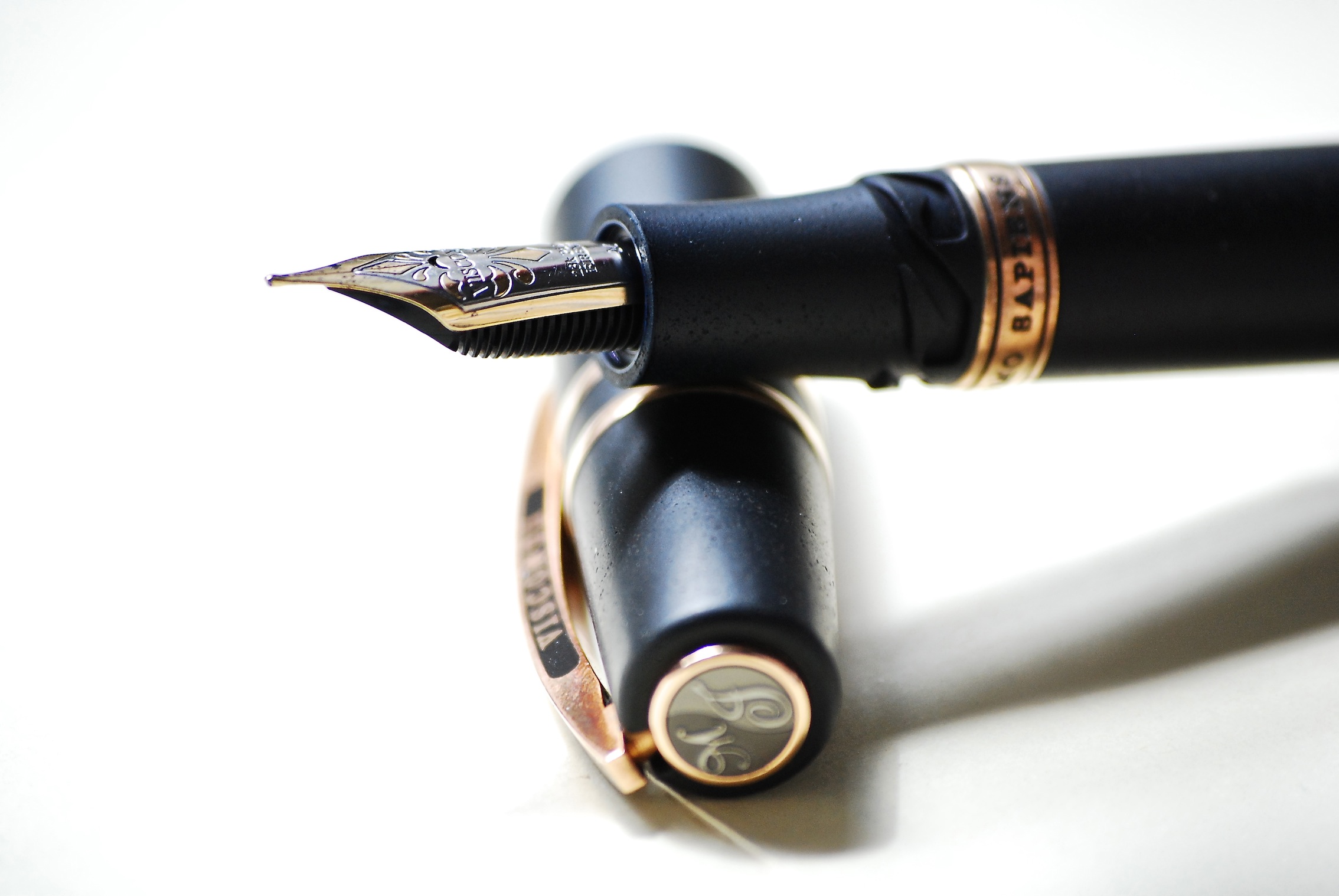
Just a beautiful nib.
The nib is a curious one: it’s made of palladium, which is one of the few metals, like gold, which is valued in carats. Unlike gold, it is a slightly firmer metal, and for that reason the nibs are made of 23 carat palladium. That should mean that the nib will be even more resistant to corrosion than many gold nibs, apparently. Since I regularly clean my pens it won’t be a problem. The thing I really like most about the pen is that there is a great amount of variability in the thickness of the line. It’s not a flex pen, but I do like to use inks that give shading, and I write (I guess) a little harder on the downstroke than sideways. This nib, without effort, gives me an almost stub-effect on my writing. It is purely because of this that I am writing a little more slowly than before. It is just a delight to use. The Conway Stewarts are good pens, with gorgeous nibs, but I do prefer this.
However, as well as writing smoothly and beautifully, the best thing for me is, it keeps on writing. The bronze version has a wonderful “powerfiller” mechanism inside. This is an odd system to me. If I get the details wrong here, I apologise, but it’s worth trying to explain. So, as far as I can make out from my researches: the barrel contains a cylinder with parallel sides. At the bottom, near the nib, these sides flare. Inside the cylinder is a piston, fully sealed, which slides up and down the cylinder. To fill it, you hold the nib in ink, and pull up on the end cap. It pulls on a titanium rod that draws the piston up. That does nothing to draw up ink, though. The ink is pulled in when you push the piston down. I know it’s counter-intuitive, but as you press the rod back into the pen’s barrel, the pistol is creating a vacuum behind it. As it reaches the flare in the cylinder, the vacuum is released, and sucks ink up into the void.
Some people have got very confused with this. Personally, I love it. I will have to measure the precise quantity of ink that it draws, but it is a lot more than my old cartridge-converter pens – probably about double their capacity. Certainly I haven’t been able to run it dry yet while writing, and fortunately it works superbly well with my Visconti Travelling Inkwell.

The clever magnetic top that allows initials, precious stones or anything to personalise the pen.
There is one last thing I must mention. When I received my pen, I was delighted to see that instead of the Visconti logo in the top of the cap, Cult Pens had taken the time to replace it with my initials. Visconti has a wonderful system called the “my pen” system, whereby the cap can be personalised to every owner in this way. You can have either initials, a semi-precious stone, or signs of the zodiac. It’s entirely up to you. That little touch for me, added to the appeal enormously.
So, in short, it is a highly robust pen, constructed from material that is thoroughly scratch and heat resistant, strong and robust. The nib works beautifully – it is as near perfection as I have yet found. I find the appearance very attractive and interesting – there really is nothing quite like it. The ink reservoir is much larger capacity than others I have tried. I really like the system for removing the cap, the strength of the cap’s clip, and the overall weight and balance.
For anyone who writes a lot and who is looking for a solid, reliable pen for everyday use, I would happily recommend the Homo Sapiens. You can find more details on it here: http://www.cultpens.com/acatalog/Visconti-Homo-Sapiens.html
I should add here that I am writing a weekly diary piece for Cult Pens over on their website at http://www.cultpens.com/blog and that they are sponsoring my writing. However, this review is based on my own use over six weeks and my own opinions. I hope the review is some help to others considering new pens.
NOTE: All the comments above are specifically related to the Homo Sapiens oversized pen in bronze. The models in steel and the shorter pens do not use the wonderful powerfiller system, but instead use a simple piston filler. This will, I am sure, be plenty adequate for people who only want a pen for occasional note-taking or shorter writing, but for people like me who need more capacity, I’d recommend the bronze oversize every time.
Tagged: author, books, Cult Pens, pens, writing



May 2, 2013
Random Thoughts
It was a while ago that I first spoke with the folks at Cult Pens. At the time I was desperate for some special ink colours, and I was delighted to learn that I could buy them from a company based not far from my house. Tiverton has always had a special importance for me, because my wife and I were married there rather more years ago than I care to remember now.
Later, I had the great good fortune to discover the Perfect Pencil from Faber Castell, and again, I was able to turn to Cult Pens to buy it. Since then I have purchased fibre-tipped pens, inks, paper, pencils, highlighters, and everything else in terms of stationery.

A few of my notepads. I think I need to rationalise!
But a while ago it occurred to me that it would be interesting to write blogs with a company like Cult. I thought that explaining how writers work could be useful and interesting. After all, most people know what authors are like, don’t they?
An author is a bone-idle character who finds it impossible to hold down a real job. Instead, the novelist scratches himself awake at some unGodly hour of the day, probably about ten o’clock, and performs the necessary calisthenics of his exercise regime by reaching for the packet of cigarettes and bump-starting his lungs. Then he performs the obvious necessary routines in the toilet, peering blearily at the reddened eyes that tell of an exciting evening during which certain activities may, thankfully, remain exceedingly hazy. Having gargled and splashed a little water about the place, he wanders downstairs, and for two hours, on a strict diet of cigarettes and coffee, he writes. Two hours of intense concentration and effort, you understand. He may cover almost two pages before being forced to answer the phone. Naturally it will be his agent or his editor, asking him to attend a thrilling lunch party for a new author. Or something. And so off he goes. It’s essential networking, after all.
And of course this fictional author is a multi-millionaire.
You will, I hope, note that word “fictional”.
There are authors who have large fortunes. Some best-sellers will earn a half a million a year without breaking a sweat. But the vast majority of all authors are lucky to hit the national average wage. They struggle to juggle basic essential bills against an income that remains a mystery until that wonderful day when royalty advices come through the post.
But royalties are odd. They are paid regularly – every six months. For the rest of the year the author has to carefully hoard and scrimp and save wherever he can. He may see books appear in the shops, but it will be up to nine months before he will see any money. The publishing industry is set up to pay their main creative talents every six months, but only after a further three months have passed. So authors will earn their money for all the sales from January to June in March or April the following year. July to December sales are paid to the author in September or October the following year.
That may not sound too bad – but of course it’s all rather late for the work put in.
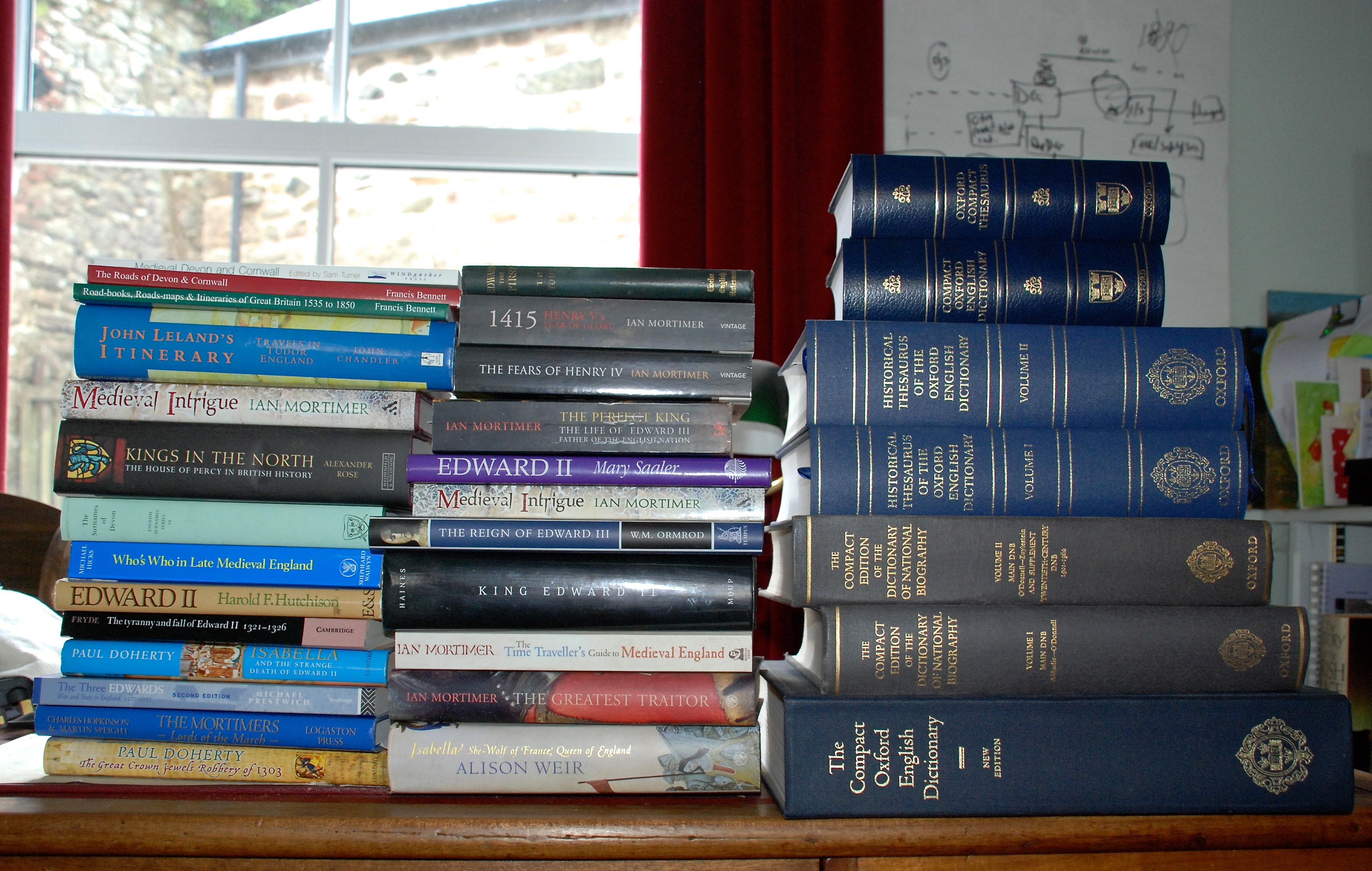
A little holiday reading. My basic research.
For example, take my first book. I wrote that in early 1984, and it was published in 1985. I was paid an advance (which wasn’t bad for a new author at the time) of £3,000 in the middle of the year. Not all that money came through, though. An author is paid rather like a builder, with stage-payments. So I was paid one third for signing the contract, and I was to receive a second third on hardback publication, and the final sum when the paperback was on sale.
Let’s look at that. It means I earned £1,000 in 1984. In 1985 I earned £1,000 in March when my book came out in hardback, and another £1,000 in November. But this wasn’t real money. It was “advances”, which are an interest free loan against expected royalties. That means that when the books start to sell, the income from them has to first pay back the advances loaned by the publisher. So although I earned the advances, I knew I wouldn’t earn more from that book until there had been enough sales to pay off the £3,000. And when I had, say six months after the publication of the paperback, it would be a while before I would receive my money. Six months after launch would mean May in 1986, so I would receive my first money in November of that year. Except I knew full well that it would be more likely to be the following six months before I started earning money, so it would be March 1987. And so it came to pass.
Life then was tough. It’s a great deal harder today for authors trying to set out on a career writing. The money is much worse, for a start. In the 1980s and 90s, authors were paid based on the cover price of the book (which meant about 47 pence per paperback). Now, with discounting rampant, authors are allowed a percentage of receipts to the publisher, which means income can be as low as 6 pence – or even 7.
Authors tend to work long hours. They work from home, and drive partners and families potty by remaining in a bemused state for weeks at a time, living other lives and imagining experiences that would usually lead to demands for the men in white coats to come and measure them up for coats that button at the back but, in truth, while it’s a ridiculous way to try to earn a living, and it certainly is not profitable except for a tiny minority of writers, it’s still a marvellous existence for a group of people who are irrepressible, enthusiastic, keen, and pathologically incapable of being employed.
People like me, really.
And so I write. However, because I write a lot of fiction all the time, I do find it hard to keep up with blogs like this. I’m trying, ye Gods, am I ever, to keep up to date with this, but it’s not easy. And so, with the sponsorship of Cult Pens (You see? I did mention them for a reason), I am writing a diary blog over at http://www.cultpens.com/blog/ – look up on the bar and you’ll see my blog piece.
The idea is, that I’ll be explaining what I’ve been getting up to. After all, I’m now the author of the longest running series by a living author (so I’m told), and the 32nd title, TEMPLAR’S ACRE, will be a massive event, winning prizes and praise all over the place from 6th June. Seriously, it’s been wonderfully reviewed by my peers, and I have very high hopes for it. Simon and Schuster are sending me on signing tours all over the place, and to celebrate the new book, they will be relaunching the first three Templar books on the same day as ACRE, and the next three in the series in July, and a further three in August – and so on. You get the drift.
So, with major launches, signing tours, talks, literary festivals and the rest of it, there will be lots to write about.
And those very nice folks at Cult Pens have given me a pen, ink and paper in order to get it all down.

Here are The Leper’s Return, Squire Throwleigh’s Heir and The Abbot’s Gibbet. All proofed and ready to republish.
Meanwhile, I have to get cracking with my social media campaign. By which I mean, try to figure out what the hell I am doing!
Tagged: author, blogs, books, crime writing, marketing, novelist, publishing, Templar series, writing


April 26, 2013
Displacement Activities
This has been one of those weeks of urgent work with very little to show. A few days ago Simon and Schuster let me know that there were another three books needing to be proofed, and suddenly there were three more titles to look at.
And they were good books, too. The Abbot’s Gibbet, The Leper’s Return, and Squire Throwleigh’s Heir. All hold a special significance for me.

Three more titles to check as proofs.
The Abbot’s Gibbet was originally going to be called Widecombe Fair. I was convinced of this title – a rare event – because I thought that the name would resonate with people. So I persuaded editors and agents alike that this was to be my blockbuster novel.
Then I went to research the book. Nothing. I found nothing anywhere about Widecombe Fair in the 1320s.
Well, such things happen. Hitler bombed the British Library a few times. It was flooded more than once, and over the centuries unscrupulous types have used books and records for firelighters, so I wasn’t unduly concerned to learn that there was nothing for me to get my mitts on. I gave up with the British Library and came to Devon, where I searched diligently through the Devon and Cornwall Record Society, the Archives, the Devon and Exeter Institution, the University … everywhere I could think of.
Eventually, desperate, I sought the advice of the Cathedral Librarian.
“I’m looking for anything about Widecombe Fair in the 1300s.”
“You’ll find that hard.”
“Why?”
“Widecombe Fair started in the 1800s.”
I still like the story.
The other two are special, too. They bracketed my move to Devon. The Leper’s Return was the last book I wrote in Surrey before our move, while Squire Throwleigh’s Heir was my first book written in Devon after the move.
Leper was a great book to write. I had to research this fascinating disease, repellent in so many ways, but also humbling. When you see the photos from the Scandinavian colony islands in the late nineteenth century, it is hard not to be affected. And then, when you read how lepers were treated in the fourteenth century, often for people who had nothing more than a form of psoriasis – well, whenever I went to give a talk on the subject, I used to get quite choked up.

Thanks to Chris Chapman for this picture.
But Squire Throwleigh was the one that really grabbed me as I was writing it. The whole book was based on some recent history that shocked and stunned the whole country, and I wanted to write it for a long time, but it was a matter of finding the right way into the story. And then, while walking my lovely, sorely missed old girl Hattie, after moving to our new home, I discovered Shilstone Rocks, and the location, the wild, barren, desperate scenery gave me that immediate connection. I knew I had a place that would drive my story, and with that came all the characters and themes. And rereading it today, the book still works very well on many levels.
But rereading your own work is tedious. It’s not something you want to do. So as my displacement activity of the week, I began to test and document all my collection of sixteen inks in a Conway Stewart Churchill pen with a medium nib.
I know. I’m a sad character!

Diamine’s Oxblood, Deep Dark Blue, Prussian Blue and Blue Black

Diamine’s China Blue, Saphire Blue, Teal and Conway Stewart Green

Diamine Kelly Green, Emerald, Saddle Brown, and Waterman’s Havana

Diamine Sunshine Yellow, Passion Red, Grey, Deep Dark Blue and Mont Blanc Black. I’ll stick with Deep Dark Blue
Tagged: author, books, crime writing, Dartmoor, Ink, novel, writing


April 16, 2013
Slip Ups and Errors
I rarely like to think back to errors made in previous books. Well, not with my own books, anyway.
This last weekend, I was very glad to be asked to Scarborough for their annual Literary Festival, and while up there, I was made to reflect upon books past. A lady from the audience wanted to know how authors felt about writing books that were clearly anachronistic, because they didn’t represent the way people spoke accurately.
It’s hard. I clearly recall Ian Morson saying, when he and I shared a stage once, that he worked very hard to avoid modern language seeping into his work. He would happily use words that were modern and colloquial, but one one book, while trying to think of a suitable term for a man being sent into a trance-like state, he tied himself into knots. He couldn’t use “hypnosis” because that was a very modern term; Mesmerism was worse, since it was based on Mr Mesmer, who wouldn’t be born for centuries.
All historical authors have to struggle and work their way around this one. It’s damn hard to figure out the best way to get round it. Personally, I think the only thing a writer can do is give a good “feel” for the way people spoke. It would be impossible, for example, to accurately reflect the way that people really spoke in the 1320s. They spoke Anglo-Saxon, Celtic, Norman French, and Latin, with a smattering of other languages depending upon their travels and their experiences. To render their tongue into modern English would be a major task. And it would be irrelevant to the reader.
Just as a reader of Juvenal or Tolstoy would expect to find it translated into modern, comprehensible English by a translator, so I think readers expect me to similarly translate for my characters.
And even then, when I do use medieval terms, I can be told off. one reader was unhappy to read of “posses” in my books, saying they brought her up sharp to read a clearly modern word in a story purporting to be about medieval England. I had to point out that “Posse Commitatus” was a legal term from the Statutes of Winchester, 1285.
But there are some slip-ups that cause more problems.
I was recently going through a book (a published novel) which had some technical errors that were, to me at least, glaring.
For example, it used phrases such as “cocked crossbows”. Well, crossbows were “spanned”, but never “cocked”. Originally called a “dog”, in later days the little lever holding the flint in the flintlock was termed the “cock”. So I was a little irritable. But then matters deteriorated. Weapons were apportioned to groups of warriors who would not have used them. While writing about the 1290s, he mentioned a force of English longbowmen, which was well ahead of their time. Long bows weren’t going to be routinely used in the English arsenals until Haldon Hill, against the Scots. And when the writer started talking about gunpowder and “grenades”, I really did lose much of my patience. Yes, I can suspend disbelief for a while, but there are limits to my abilities.
One inaccuracy that always annoys me is people talking about “quarterstaffs”, as though they were a specific weapon. They were not. A staff was a standard tool for much of our history, and some people learned specific defensive arts with them. It was a good idea: a man would always carry his staff with him. It wasn’t a mere prop for walking. It would hold outlaws at bay, which is why beadles, watchmen and sheriff’s men would routinely be armed with iron-shod staffs.
A staff could be used “half-staff” or “quarter-staff”. Each referred to the amount of the staff that was gripped between the hands. Thus half-staff meant a half of the staff was gripped, usually the middle section, with two quarter-lengths protruding beyond the grip. A man could jab with each end, block overhead blows, and generally cause mayhem. By shifting his grip to hold only one quarter of the staff between his hands, he could become a still more dangerous opponent. He would now have a long weapon with which to strike, like a man with a lance. Stabbing and swinging this, he could hold a swordsman out of reach or threaten a man on horseback. A staff was a useful weapon. A quarter-staff was a means of fighting with one, not a different or specific weapon in its own right!
For more on staffs, the history of English fighting, and weapons generally, I can recommend Terry Brown’s excellent English Martial Arts, published by Anglo-Saxon Books.
Which doesn’t mean I don’t get things wrong. I am prone to silly errors in my books, and I am inordinately glad for professional editors and copyeds to correct my more ridiculous slips. But that’s because every author has a responsibility to make sure that his or her writing is accurate.
Happy reading!
Tagged: authors, books, ebooks, Libraries, medieval, novel, publishing, writing


April 11, 2013
Back to Work!
This has been, without a doubt, the busiest Easter I’ve had since about 1976.
When I was a kid, Easter was a big deal. We would all pile into the old man’s car, mother in front, the four brothers behind, and drive off to Devon (we lived in Surrey back then). At Northay Farm, near Crewkerne, we would decamp, and take over the large farm cottages owned by the farmer. It was a bit of a squeeze when the Morton family joined us.
Don Morton had been a friend of my father’s for many years, since they were at primary school together. He was a tall, bluff, genial, cheerful character, who I remember was always laughing. During the war, he had been a secure, safe Ack Ack gunner in an anti-aircraft emplacement on the Kent coast – a Bofors gun or something similar. But although he was safe and protected by several miles of sea from German attack, he had a senior officer who was a pain in his backside. So Don did the daft thing: he volunteered to go to war in earnest.
He was over the channel with the later waves of soldiers, arriving two days after D-Day, and promptly caught a dose of food-poisoning that laid him out. But from then on, as soon as he was healed, he was off to the front.
The memories of those months stayed with him forever. He would never speak of his experiences to his son and daughters, but the horrors stayed with him, concealed behind his affable manner. Only many years later, in about 1999, when he realised that none of his grandchildren actually knew what the war was about, nor how it had affected him and his friends, did he begin to plan to write a memoir, and I was proud to have him dictate his story to me so I could type it all up for him.
Easters with the Mortons were loud, happy, grand times in the 1960s and 70s. Since then, sadly, I suppose I’ve allowed my work to overshadow all festivals other than Christmas. However, this year we made a bit of an effort, and with a turkey and some guests, it was much more of a special occasion.
Not that I was allowed to take too much time off.
It was two weeks before that I was told that I would have a little work. Three book manuscripts were to be sent to me for proof-checking. These, LAST TEMPLAR, MERCHANT’S PARTNER and MOORLAND HANGING, are all to be republished in June. On the 6th, the same day as TEMPLAR’S ACRE finally hits the bookshelves, these three will all be relaunched, and I have to admit, they stand the test of time. For me, it was a real test to pick up those three and begin to read. After all, they were first novels. My first ones. And that is enough to fill any author (who is either honest or sensible) with dread. But they read really well. I actually enjoyed them – which is fortunate, because I actually had four clear days in which to work on all three. That was a process of what I would call “power reading”!

The three manuscripts, completed, with post-it notes to show the corrections. A lot of work!
But after that, there were meetings. Meetings with my agent (a superstar), my last agent (without whom I wouldn’t today be in print), my editor (the most near-to-perfect editor who lives today) and my new manager of publicity. All superb, enjoyable meetings which achieved a lot … unlike the infinitely enjoyable meeting in the Garrick Club later on Tuesday. That achieved precisely nothing, apart from a significantly less efficient head on Wednesday morning.
However, it was the other meeting I need to mention here.
Last week, I had a good meeting with a delightful company, Cult Pens (Cultpens.com). I have been a customer of theirs for some years. Cult are superbly efficient, and carry a wide variety of stock. I use them for paper and pens, inks and pencils, and their speed of delivery and general helpfulness has impressed me.
However, they were surprised when I suggested to them that I might write a blog for them every week.
My idea was, that I should write a short blog post about the next few months – or longer if it seems to interest their readers. I’ll write about what authors do: writing, planning, plotting, inventing characters, going to literary festivals, book signings, meeting with publicity and sales staff – everything. I’ll explain how I perform my researches, how I get ideas for murders, how I sketch out motivations for the different suspects – basically, everything about what I do.
This year I have two short stories to write, one novella for the 10th anniversary Medieval Murderers and a second for The Floating Admiral with my friends in the Detection Club, and at least one full-length novel with the potential for a second if I can manage it. At the same time I’m helping plan a new literary festival, sorting out marketing for the existing books, and doing all those things that the self-employed are supposed to get involved with. And working with the Royal Literary Fund two days each week to help students at Exeter University.
It may seem that taking on a new blog will be a bit too much. However, there is a rationale behind it. I’m hoping that if I’m forced to sit down and write up a diary-piece each week, it’ll help me make sense of what I’m actually (hopefully) achieving!
All of which means, keep your eyes open on the Cult Pens website for more about me. I’ll still be writing here on my old blog, but my thoughts here will necessarily become more about my general life and thoughts, rather than purely about my activities that week.
I hope it’ll prove to be at least a little bit diverting for you!
Unlike the hound, who seems to be sleeping rather too well today …

This is where the hound rests when it’s wet outside.
Tagged: author, books, novel, projects, publishing, writing


March 28, 2013
What a week!
I have never tried to keep a diary before. It’s one of those tasks that has passed me by. Generally, I’ve always thought that they are journals for people with too much time on their hands.
Time … How to organise it, how to make best use of it. These are questions which are always tormenting my poor brain. I’ve never had time to sit down and record the events of my days. The better days it would be impossible (because they invariably involve largish quantities of alcohol, rendering their accurate recording more than a little problematic on the night, and downright impossible – or hellishly embarrassing – to recall the following morning).

My current editing/writing tools of choice. Yes, I still love the Conway Stewart, but I dare take these ones out with me daily!
But there is a lot that is worth recording.
Last week, I was so knocked sideways by a cold that I lost two days.
Usually that would be irrelevant and unimportant. However, it happened to affect me enormously because I was preparing for a talk this week to a lecture hall full of medical students. I was very keen to do a good job.
However, the preparation was badly affected by that blasted cold. It meant I didn’t have enough time to research and plan as well as I should have.
On Monday this week I had a meeting with the Historical Writers’ Association, involving four hours on trains up to Reading and back, and all the way I was working on the lecture, which I gave on Tuesday morning.
After the lecture there was the usual round of appointments with students, helping them with their essays – and thanks to the one who told me her essays and marks had improved massively since she started coming to me. It was good to hear that my work is helping.
Tuesday evening, and Wednesday too, I was basically wiped out. The after-effects of the cold hit me hard. Luckily I only dozed on the bus on the way home and didn’t sleep past my own stop. It was a close thing, though!
And then we reach today: Thursday. This morning I prepared for work with pens and paper, but as soon as I sat down, I realised my hearing aid was dead – and I’d run out of batteries. So off to Okehampton medical centre, and now it’s working again. Luckily I was able to walk the dog at the same time.
But then it was time to sit down and plan the next few weeks. I have three books to proofread in a hurry, a short story or two to write, a novella to write, a novel to write before the end of September, and another novel to edit extensively. Meanwhile I’ve also three ideas to expand upon which could one day end up as novels. And I’ve several events to attend. There are blog posts to write daily, I’ve taken up the concept of this diary, and in the meantime I also have to plan and prepare a marketing campaign for the next books to be launched.
Being an author does not mean sitting down and writing for three hours a day. It’s a full time job, with all the ancilliary work essential for any small business.
Which does leave me rather confused as well as very tired at the end of a week.
Still, tomorrow is a day off. Thank goodness for Easter! For tomorrow I will not worry about writing. All I intend doing is some painting and having fun!
I hope all those who celebrate the feast day have a great weekend, and I wish the same for those who don’t!
Tagged: author, blogs, books, Diary, novel, writing


March 22, 2013
A Weekly Update
This year has been a bit of a whirlwind (as usual), but I’m gradually getting things together.
So, what’s happening?
First, I am working on a new literary festival. No, I don’t mean I’m just attending – I’m working on the idea of a festival to help writers and readers. We had a meeting about the feasibility with friends yesterday, and I have to admit, the concepts are working very well. With luck there will be a new festival opening its doors next year in the summer. Watch this space!
Before that, I have to embark on the new story for next year’s Medieval Murderers collection. For this book, the tenth anniversary story, I’m going to be going into a favourite subject of mine – Lust! What will it entail? Well, to be honest, I haven’t a clue yet, but with luck it’ll read well when it’s on paper. The characters will please all those who like Baldwin, yes, but there’ll also be some new characters from my 2014 book, FIELDS OF BLOOD. So hopefully a fair bit for all readers to chew on.
However, I cannot start that quite yet. First, I will have to proofcheck these three manuscripts which are currently lying on my desk. One is THE LAST TEMPLAR, the second THE MERCHANT’S PARTNER, the third – you guessed it – A MOORLAND HANGING.

Proof manuscripts and assorted notepads. The lifeblood of the author!

Exeter University. This isn’t where I’ll be speaking to students!
These three are now being prepared to be reprinted in their new format. When TEMPLAR’S ACRE comes out on June 6th, these new editions will all be available at the same time. And then, every month, there will be more of the original books hitting the shelves. So get your purses ready. This could be interesting.
Except I can’t get down to that straight away.
Oh no. No, because first I have the duties of a member of the Royal Literary Fund to perform. That means that I have a number of students to talk to about their essays, but next week, for one week only, I’m going to be giving a lecture (cue scary music) on writing. It’s not going to be hard work for the audience, although it may be for me. With luck it will be a fairly light-hearted look at the sort of basic mistakes students can make. And with luck it will focus them on the areas they need to look at. It’s been great fun getting ideas down on paper and planning, and I hope it’ll be well-received.
And that all kind of leads on to my next little bit of news – of a sort. I’ve decided that with all the things going on, I need to rationalise how I plan, and one really good way to do that might be to start a diary.
So, very soon, I’ll be making a set of diary notes about what I’m doing, what is coming up, what plans I’ve got (which is going to be difficult to prevent giving away any plots!), and probably pictures of my notes and works in progress. It’ll include a lot of my handwritten jumbled notes as well as screen shots from my computer, and with luck it will build into a kind of working scheme for aspiring authors to see what writers have to get up to.
Or should avoid!
More on that next week, though. First, I have to write this lecture …
Tagged: author, blogs, books, crime writing, Templar series, writing


March 15, 2013
Writing – and Speaking
This week I went to Stockton on Tees and had a wonderful evening with the always-wonderful Karen Maitland in front of a select audience in the local library – thanks to Claire Pratt and her team for making us so welcome!
The hard thing is, such events are slowing. In the past, there were plenty of libraries queuing up to offer authors the chance to get out and meet the public, but with the latest spending cuts, their budgets are growing very restricted. And at the same time, authors are seeing their own incomes collapse. We tend to be paid on net receipts to the publisher, so if the publisher has to discount by 60, 70 or 80 percent, the author’s income correspondingly dives.
So what is the way out for authors trying to pay a mortgage?
There are many different approaches.
Of course, an idea that always appeals to me is looking to the past and seeing what can be gleaned from authors in earlier days. The clear message there is, that authors didn’t tend to stay at home and write. They went out into the cold, cruel world, and read their work to people.
Why is it, I wonder, that poets have retained this as one of their more important skills? Poets are routinely described as “performance poets”, but authors are, well, just authors.
Perhaps it’s the way that novelists started earning more money. Back in the 60s and 70s, there was a cultural shift. Those who wanted to earn a living by prose were considered to deserve to be able to have a home, a room to write in, a pension even. Poets, on the other hand, were frivolous scribblers. Their works couldn’t justify a decent living wage because, well, they didn’t sell enough to live on their writings generally. A few made it to the really big time, but not that many.
Perhaps this is the time to start thinking about returning to the old methods. Book up village halls, give readings and talks, sell books afterwards. It’s certainly one line I intend to follow.
And if possible, I will be trying to do it with the support of the local libraries. They are suffering badly now, and I want to help them if at all possible. It will mean getting more professional in the way that the evenings are run, it will mean more effort being put in, but hopefully it’ll result in profits and libraries being protected a little.
So again, thanks to Claire and the librarians of Stockton on Tees. Karen and I had a great evening with you on Wednesday, and you have given us a lot to think over in the coming months.


February 4, 2013
Templar’s Acre
Just a short taster, folks. The next book in the Templar series is the prequel, Templar’s Acre, a story all about the early years of Baldwin de Furnshill and his time as a pilgrim in the Holy Land. It’s not a crime story, but an adventure story of his time out in the wildest, most dangerous toehold remaining to the Christians, and I personally love it. It’s grim in parts, full of excitement, and includes several characters I really enjoyed. Hopefully all those who enjoyed the series so far will like this too, and with luck even more people will be brought into the fold by the story.

I really like this new cover – bold and strong!
Templar’s Acre will be published on 6th June, both in the UK and USA. Book it now!


January 31, 2013
Modern Books, ebooks and Writing
Writing books is a funny way to try to earn a crust. Authors are expected to be slightly odd characters (and most of us can live up – or down – to that), with peculiar insights which can be gained only by using illegal drugs or by excessive quantities of legal ones. I tend to the second.
But being a writer, for me, was a way not so much of earning a living, but of continuing my delight in and with books.
I have always loved books. I find it deeply, humiliatingly, hypocritical still, to be telling off my son for reading under his bedclothes, when I can still remember doing the same thing myself at his age. And, oddly enough, reading the same William books as he is now. Exactly the same in most cases, since the thieving little brute has filched my ancient hardbacks.
Books have accompanied me through my life. As I sit here, irritably wondering when I’ll ever be able to get the paintings down from the roof to decorate a wall, all I can see is the thick, insulating layer of hardback and paperback titles on the walls all around. There is no space whatever for paintings.
Some of these books I recall from early childhood.

No space for paintings on my walls!
The William Brown books I started reading when I was only about eight years old. And at the same time, every year when a new Paddington Bear story came out, I went straight to the bookshop in Purley to buy it. I can still remember the delight of finding a new title that appealed to me. The day I found The Hobbit and felt that slightly thicker paper, I knew I had to buy it, and read it voraciously that weekend. Oddly, I was keen at that time on Neil Young, and After the Goldrush and Harvest still evoke The Hobbit better than any film score for me.
Almost immediately afterwards, I had to read The Lord of the Rings. Not the three volume version – that wasn’t on sale, I think – but the original, ruddy great tome that pulled at my satchel’s straps as I walked to the train. There has never been a book that grabbed my attention in the same way, I think. I adored that. I’m delighted that my son has already nearly finished it (two or three years ahead of me, then).
At the same time I discovered Elliott O’Donnell’s Casebook of Ghosts, a series of tales of his investigations into various apparitions in the late 1800s and early 1900s. Obviously most of these are invented twaddle, but the impact of such ghoulish, gothic stories on an imaginative child’s brain can be guessed by the books underneath that on the shelves: The Vampire, a collection presented by Roger Vadim that I remember reading with thrills of horror during English at school (and for those of a mind to see such things, the story of The Cloak by Robert Bloch, and Carmilla by Sheridan Le Fanu, are still among the best vampire stories ever written – infinitely better than the present crop, to my mind); the Dennis Wheatley books; collections of mild to horrible penny dreadfuls with skulls and ghosts on the covers, too. I will return to The Vampire and read it again soon.

Research: mediaeval only. The things I have to read …
However, while I have always read fiction for pure pleasure, my whole life has been influenced most strongly by non-fiction, and in the main, history and warfare. I was nine when I picked up Lyn MacDonald’s book on Paschendaele, and only a little older when I read Walter Kerr’s The Somme. In short order I read Mannstein’s Lost Victories, Bidwell’s The Chindit War, and the superb, much-thumbed, History of the First World War and History of the Second World War, both by the brilliant strategist and tank exponent, Basil Liddell Hart. I read Popsky’s Private Army, Rome ’44, The Battle for Stalingrad, Das Reich and hundreds more in my very early teens. Warfare has guided my reading, my holidays, my thoughts, for all my life.
I still read many books for pure pleasure. I cannot help but acquire all the books Terry Pratchett writes. When I need relief from writing, it is him and PG Wodehouse to whom I turn. But I have to admit that for me reading is less of a pleasure than it used to be.
I tend not to read crime books any more. It’s a shameful admission, for I was once the chairman of the Crime Writers’ Association, and have performed on many crime panels and stages over the years – but I find now that so many crime books are so graphic in their portrayal of extreme violence towards usually defenceless victims, that I cannot extract any pleasure from them. The intellectual striving for the truth that I always (and still do) enjoy in Sherlock Holmes tales doesn’t really occur in so many modern books. To a large extent, I think that the crime genre has expanded to encompass the horror genre that I used to read as a teenager. Also, while I love reading books like those written by Manda Scott, Tony Riches, Ben Kane and Robert Low, I daren’t read too many of them in case my own writing is too heavily influenced by theirs. It is a difficult thing to read other people’s books.
Which is why I tend to read books written by long-dead authors. Somerset Maugham, Conan Doyle, Alistair MacLean or Graham Greene all work very well. And I am still happy to pick up even older works – especially since they can be acquired free, or at least very cheaply, as ebooks.
Because the most important thing about books is not, really, whether they are on paper, an electronic screen, or carved with care into blocks of granite. The important thing is, that they are read.

ebooks can be fun – and useful for edits.
My books, the ones all around me here in my huddled, messy, dusty, scruffy office, are old friends. I could no more sell my red-covered copies of The Great War in four volumes by Winston Churchill, or my Hobson Jobson or my Mr Punch’s History of the Great War, or my Big Fat Book of the .45 ACP than I could commit suicide. And I couldn’t, no. I have about 6,000 books in my house. I ain’t reducing that willingly.
In years to come, my lad will probably sit in a room and look at his ancient Nintendo, his Kindle and his – whatever the next thing will be – with as much fondness as I look at the coloured spines running around my walls. I can’t help thinking that his minimalist shelves will be sad and empty, though.
It’s a father’s prerogative to prefer his own belongings. I’m allowed to. But I appreciate that many people really, really like the thought of getting their hands on fifteen hundred books simultaneously on one pocket-sized device. For you, at the end of this post there is a list of all the books you can now buy on ebook. All my first thirteen and the last three Templar series titles are available to you now, as well as two collections of short stories and my hugely acclaimed modern spy novel, Act of Vengeance. The later titles in the Templar series will soon, with luck, be available too.
And for the old fogies like me, who really do prefer paper – the first thirteen books will all be republished this year.
Happy reading!
Act of Vengeance - a modern spy novel. Lee Child: “An instant classic British spy novel. Mature, thoughtful, and intelligent. Highly recommended.” http://tinyurl.com/b748l8g for US & http://tinyurl.com/a5b4pvl for UK
No One Can Hear You Scream collection of Michael Jecks Short Stories: New collection of short stories ranging from Roman Britain to present day, a mix of tales: http://tinyurl.com/8rrdmdn & http://tinyurl.com/8cc7sr7
Anyone who likes Baldwin de Furnshill Templar stories should read the Templar short story collection: For the Love of Old Bones. http://tinyurl.com/ara6zt7 or http://tinyurl.com/ara6zt7
Templar Series:
#1 The Last Templar on ebook from Simon and Schuster: http://tinyurl.com/bgydkpl
#2 The Merchant’s Partner is still one of my personal favourite stories: http://tinyurl.com/bcnrbsr
#3 A Moorland Hanging is selling well as an ebook - http://tinyurl.com/apnm6qr
#4 The Crediton Killings – lovely new cover for the ebook looks lovely! - http://tinyurl.com/a532a58
#5 The Abbot’s Gibbet is going very well as an ebook: http://tinyurl.com/agmh7pa
#6 My first love story, as the agent said: The Leper’s Return in ebook: http://tinyurl.com/bh5w83v
#7 Squire Throwleigh’s Heir – said to be my most shocking story: US: http://tinyurl.com/a3t7xbf UK: http://tinyurl.com/bjbgyxh
#8 Belladonna at Belstone caused more complaints than any other story! Naughty nuns as they were reported in two Devon Bishop’s visitation records
US: http://tinyurl.com/avrjadt UK: http://tinyurl.com/bgudj7b
#9 The Traitor of St Giles – The Three Ravens story retold: US: http://tinyurl.com/amkw8js UK: http://tinyurl.com/amkw8js
#10 The Boy-Bishop’s Glovemaker for my first Christmas tale: US: http://tinyurl.com/au6wcrm UK: http://tinyurl.com/acj8t8l
#11 The Tournament of Blood is now an ebook: US: http://tinyurl.com/az8uvfr UK: http://tinyurl.com/a9z4f4f
#12 The Sticklepath Strangler, a name discovered in a pub! Ebooks at US: http://tinyurl.com/akok9g8 UK: http://tinyurl.com/aloatyc
#13 My first Dartmoor legend story, The Devil’s Acolyte ebook at US: http://tinyurl.com/a8pjuwf UK: http://tinyurl.com/b8gbvl9
#29 The Oath, a storming story of honour in battle: US: http://tinyurl.com/avvc7oo UK: http://tinyurl.com/bfw5aek
#30 King’s Gold – the story of King Edward II’s escapes from prison: US: http://tinyurl.com/ara2z9v UK: http://tinyurl.com/a57vasg
#31 City of Fiends, getting rave reviews. Thanks to all who’ve written fantastic reviews! http://tinyurl.com/ak7e7b6 & UK http://tinyurl.com/atvf32h

My books. I do have a lot now …
Tagged: author, books, crime writing, librarians, Libraries, novelist, publishing, writing


