
Michael Jecks's Blog, page 35
January 15, 2013
Review: The Church of Fear

The volcano in which the bodies of aliens were blown up by the evil space alien Xenu. Or something. Really dreadful concept for religion, but no one said L Ron was a good sic-fi author!
The Church of Fear – Inside the Weird World of Scientology, by John Sweeney (@johnsweeneyroar) – is a stunning read.
This book is an in-depth analysis of an investigation into the Scientologists (I cannot give them the title of “Church” because I do not believe an organisation so focussed on money should be given that honour) by John Sweeney and the Panorama team from the BBC. Sweeney conducted his researches originally in 2007 for a programme.
Scientology describes Sweeney as “a bigot and a liar … psychotic” which, I would reckon, coming from the cult would rank as a pretty good reference for anyone. However, Sweeney has been a reporter for many years, working with the UK’s better newspapers and latterly as a reporter for the TV. He has worked in war zones from A to Z: Algeria, Bosnia and Chechnya to Zimbabwe. His writing is sympathetic and even-handed. And yet he touched some very hot buttons with his subjects here.
The Scientologists have been attempting to win “church” or religious status in the UK because that would give them many financial (and legal) benefits. However, British High Court Judge Mr Justice Latey said in 1984: “Scientology is both immoral and socially obnoxious … It is corrupt, sinister and dangerous. It is corrupt because it is based on lies and deceit and has its real objective money and power for Mr Hubbard … It is sinister because it indulges in infamous practices both to its adherents who do not toe the line unquestionably and to those who criticise it or oppose it. It is dangerous because it is out to capture people and to indoctrinate and brainwash them so they become the unquestioning captives and tools of the cult, withdrawn from ordinary thought, living, and relationships with others.” I think that the quotation is worth repeating in full, because it does give a strong flavour of the judge’s view. He did not consider that they deserved religious or charitable status.
The BBC has a long record with the Scientologists. In the 1980s they investigated and produced a Panorama programme that was scathing in its conclusions. The Sweeney programme was to be a follow-up, largely as a result of many interviews with ex-Scientologists, and with the parents and families of those who had joined the cult and cut themselves off from their relations.
Sweeney sets out how the programme came to life, how he went about his researches, and then the seven day ordeal in America, when he found himself being followed by Scientologists, brow-beaten, insulted, slandered, and brain-washed highly effectively by a team of Scientologists at several meetings. It led, eventually, to his explosion after a great deal of intimidation ( a rather amusing scene that can be seen on youtube – look for “exploding tomato”!). However, as he details the events that led to his outburst, it is perfectly obvious how the tactics of the Scientologists were specifically designed to create just such an outcome so that they could use it to denigrate Sweeney and the BBC.
I saw the original Panorama, but also the follow-up. And in that, Sweeney tracked down two of the most abusive and, I would say, terrifying of the Scientologist agents. Both had since left the organisation, and as a result Sweeney was able to gain more background to the incidents in that first programme.
In this book the reader learns how a cult operates. A leader who can, apparently, do no wrong and who demands unquestioning obedience, while remaining answerable to no authority whatever, nor control; beneath him, a dedicated body of men and women who are enslaved to his will. Rational or independent thought is impossible in such an environment, especially when access to books, media and the internet are reason for punishment.
But the clearest proof to me that this is a cult is the fact that, in order to learn anything about the “truth”, one must pay. And keep on paying. No matter what the religion, the facts and truths of it are freely available to believers and non-believers alike. Religions want to persuade people to join them. Not so with the Scientologists: they want people to pay to learn more. There are levels of “Operating Thetan”, and the secrets of each level must be purchased.
But I can let you into a little secret. Apparently the Scientologists believe in Xenu. Look him up on the web (they can’t of course, sadly) and you may find the truth according to L Ron Hubbard. If it weren’t so sad what happens to Scientologists, it would be pitiful.
This book, by describing the research and setting Sweeney’s efforts and discoveries in context, gives a wonderful history of L Ron Hubbard and Scientology. I cannot recommend it highly enough to anyone who is interested in cults, who has lost a friend of family member to a cult, or who fears losing them. Please buy it, read it, and recommend it to your own friends.
Tagged: John Sweeney, Scientology, writing


January 14, 2013
Review: The Queen’s Vow – C.W.Gortner
One of the odd things through the year for me is receiving books, unannounced, from publishers who hope for kind words about a book. They’ll often be from a publisher I don’t have any involvement with (like this: Hodder), from people I’ve never met, and with books from people I don’t know, haven’t met, and probably never will. Log-rolling a friend this ain’t!
CW Gortner is one such. He is, apparently, half-Spanish and spent his childhood in Spain, although he now lives in the US. He has published some books which have received great acclaim, and they are published in 14 languages ( I picked all that up from the PR material). However, his book – a weighty tome, as these all appear to be nowadays – is being heavily promoted. Once assumes Hodder spent a lot buying in the book!
I picked it up with trepidation, wondering whether it was worth the investment of time – and I’m glad I did.
First, the period: it is set in the 1400s, in a time of great unrest. Spain doesn’t exist: Aragon, Castile and other kingdoms and principalities are independent, and they are all prey to stronger neighbours (including France). When King Juan II of Castile dies, his young daughter, Isabella, finds that her life immediately changes. Her half-brother, Enrique IV, son to Juan by his first marriage, inherits the throne, but politics are confused. He has no child, so Isabella’s young brother Alfonso becomes the first in line to the throne in the event of Enrique’s death. And this would be well, were his wife, Juana of Portugal, not quite so determined and ambitious. She wants to ensure her own line is secured. Which would be fine, were it not for the fact that Enrique was gay and unwilling, or unable, to give her a son.
At first all seems well, until the day that Juana brings a child into the world. Then the politics become very confused.
The period detail is all very convincing; the setting, which could (should) be thoroughly head-spinning, is depicted simply and effectively; the characterisation is, to be frank, superb. The different people are superbly well-described, and although some feel two-dimensional, the main characters are all wonderfully rounded, from the gay Enrique, the main character Isabella and the marvellous Archbishop Carrillo. However, all are put into the background by the horrible, repellent character of Torquemada, who is made as repulsive as the chief instigator of the Inquisition should be.
These were days of civil war, of famine, of deceit, of terror and torture. There were appalling horrors with the beginning of the Inquisition, famines, the plague, and war. And yet they were days of hope and foresight. Under the enlightened rule of Isabella of Castile and Ferdinand of Aragon, this period saw a radical lurch towards modernity. There was culture, art, and a boom in wealth as the sponsorship of Columbus leads to the discovery of the new world.
It’s a marvellous story, and one that is superbly told. If I have a criticism, it is that (with a young daughter) the depiction of the infanta Isabella as an early teenager is not entirely believable, and there is a little too much romance in the middle of the story as Isabella discovers the pleasures of marriage with her husband Ferdinand, but these are niggles and minor compared with the sweep of a story that covers so much ground in 360 odd pages. A more serious complaint is, that the cover makes this look like a romance-only. Yes, there is some romance in it, and if I was looking for a book on the shelves, I’d probably avoid this cover. Which is a shame. I’d be missing a brilliant read. The cover should have a woman Joan of Arc-like, clad in steel, with a scene of ships on a storm-tossed sea behind, perhaps images of tortured victims of the autos de fe. There was so much that could have been made of this cover – but instead a simple, attractive shot of a blonde woman in a crown was chosen. It was a cheap option and not a good one. It reminds me of my own personal most-loathed cover, the poor-quality picture of a crossbow that adorned The King of Thieves in hardback. Truly dreadful – but I’ll kick that soap-box aside.
I’d recommend this book to anyone who enjoys history novels with the smell of the period rising from every page. It’s gritty, often violent, but most of all, it’s a fascinating, gripping read.
And so to the final point: I have been allowed two copies of the paperback version of this book to go to the first two people who can get to me with the answer to a simple question: what was the name of Isabella’s father. Yeah, not the most difficult question in the world! Sadly, because of the costs of postage, this is an offer to UK readers only. Apologies to all those in the US who read this blog.
Write with your answers to Michael.Jecks@gmail.com, giving your answer to the question and I’ll write to the two who have won to get their addresses. The names (not addresses) of the winners will be put in the comments section of this post.
Happy reading!
Tagged: authors, CW Gortner, Historical Novel, writing


January 11, 2013
Glocks, Brownings and Delays
I was listening to the radio this morning and thinking what a joy it was to hear something sensible on guns. For a bit. Well, it made a change.
The trouble is, journalists really do have absolutely no idea what they are talking about. The piece began by saying that the British Army has at last realised that the Browning Hi-Power was a little bit long in the tooth.
Actually, that doesn’t matter a damn. The age of a gun is no issue. As the reporter did finally say, the thing was that the gun was costing a bit to maintain now. Well, that’s no news. Hi-Powers were the invention of the brilliant John Moses Browning, who gave us so many iconic guns, from Winchester repeating rifles, to the Colt Automatic, the Browning Automatic Rifle, shotguns and many types of pistol. But they were first produced back in about 1935 (from memory) and used by the Wehrmacht in WWII. However, their age in design terms means nothing. They were reliable 9mm sidearms.
The maintenance is a problem, though. I used to have a Colt .45 Auto which I shot competitively, and went from that to a Para-Ordnance .45 because of the greater magazine capacity, but it was in effect the same gun. Reliable, strong and accurate, both were a pleasure to shoot. But although they were mass-produced, anyone who has worked on a Colt or Browning knows the little quibbles with sears and triggers. The problem being, you replace a worn piece, and suddenly you could have a machine gun on your hands. If the sear is ground a little too much, the gun would go full auto and spray bullets down the line with gay abandon. A slight shock to any shooter! Give a gun like that to a squaddie, and you’re asking for some trouble.
Browning was an inventive genius, but Glock was a mechanical and plastics genius. He took Browning’s basic concept of a locking barrel in a gun and refined and refined and refined. When his first pistols appeared in about 1982, he had taken the idea of the self-loading pistol and cut it back to the absolute bare essentials. In so doing, he created a gun that was a dream to shoot: easy, accurate and very fast. It also just happened to be reliable and safe compared with older guns.
Just to take one example: the American Army chose in the 80s to modernise their handguns and discarded their old warhorse the Colt 1911A1 in .45

My old Colt Series 80 – lovely old beast!
ACP, a lovely gun, but one showing its age. They moved to the more modern Beretta 92, a gun made famous in films such as Lethal Weapon. This gun is pretty much an evolution of older Beretta types, and the family history is recognisable. It has 70 components. Which is very good. From memory, their old Colts had 67. However, for reliability you want fewer parts. The fewer the better, and this is where Gaston Glock was so bright. By redesigning aspects like the trigger mechanism, he brought the Glock’s parts down to 34. And all are precisely manufactured, so you can remove the trigger mechanism from one and place it in another, and the gun will fire immediately, safely, without going full auto. All parts are interchangeable. It is a squaddie’s dream.
But the report in today’s BBC prpogramme went on to talk about safety. They said that a Browning could take up to four seconds to fire, because (horror of horrors) the shooter may find it hard to turn off the safety. What complete journalistic balls!
I will admit to some bias here. I have shot several Brownings. They were, to me as a shooter, one of the iconic weapons of the 20th Century: beautifully designed, attractive, light. I was delighted to shoot one, just as I was the first time I handled a Webley Fosberry, or the Mauser Broomhandle, or the Luger. And God, what a disappointment!
The thing was clunky. The balance was awful, and the grip felt somehow plain wrong in my hand. It was lovely to look at, but I found it hard to hit a target under competitive conditions. It was such a sad surprise for me – but for a soldier who has to depend upon it, it could mean the difference between life and death.
However, replacing it with even the near-perfect Glock isn’t enough.

Me, when considerably younger, heavier, and happier, drawing from speed-holster. What larks!
When I did my first pistol training on the Colt (which was the precursor to the Browning Hi-Power, with the same safety systems etc) I learned in one day how to draw and fire two shots accurately in less than one second. The failing here is not one of the guns’ ability, but the lack of training and support in the Army. If our soldiers were given more time with their firearms, were given more ammunition to practise with, they would soon be able to fire confidently and accurately. In the good old days when there were gun laws that allowed safe target shooting in the UK, I regularly shot with Army and Police shooters. They were able to improve their safety and accuracy by shooting with competitive shooters. Now, sadly, they are dependent upon a niggardly government. Soldiers are allowed a few rounds in practice before going to Afghanistan, police get (usually, depending on the force) 25 about rounds every two weeks.
Before, to maintain their skills these same officers would routinely shoot 4-600 rounds every weekend. They were safer and so were we the public. But now, when out of uniform, they are not allowed to shoot. They are not allowed to buy their own ammo, and we are all less safe because of it.
But at least, at last, our soldiers will have a sidearm which they can use to protect themselves.
Tagged: Army, Browning, Browning Hi-Power, Colt, guns, Pistols, police


The Next Big Thing …
And now: the Next Big Thing – ten questions in ten minutes. Not such an easy concept for an author who spends his time thinking carefully about what he should be writing, revising, editing, and then throwing it away and starting again. Which is actually what happened here, because I carefully wrote what I thought were responses of the best form for the questions – and then realised I had written about the book I’m currently writing, not the book that’s out next, which is rather more relevant. Sigh.
The Next Big Thing is a lovely concept: authors write about their next project, and respond to a few questions quickly to
give a feel for what it’s about. I’ve been a good boy and only gave ten minutes to it, so it may feel rushed, but that is the nature of the beast! At the end, you’ll find that there are some other authors whom I’ve invited to put down their own responses. Give them a day or so, and you’ll be able to see what they think too. Also, please go and look at http://russelljamesbooks.wordpress.com for my friend Russell James’ own take on the project.
Happy reading!
• What is the working title of your next book?
Templar’s Acre, which will be published in May this year.
• Where did the idea come from for the book?
I’ve spent the last few years working on my Templar series, with (so far) 31 titles published. However, I always wanted to go back to the beginning and explain where my main characters came from – this, a prequel to the series, goes into that, with Sir Baldwin de Furnshill’s youth seared by the end of the Crusader states and the fall of Acre.
• What genre does your book fall under?
For the purpose of this book it’s historical adventure, I suppose. I tend not to think about genres, only whether the story’s good or not. Most of my books have been considered crime novels, but this is a definite departure.
• What actors would you choose to play the part of your characters in
a movie rendition?
I’d have to have Alan Rickman – but then also Brian Blessed, Colin Firth, James MacAvoy and Michael Fassbender. Then I’d HAVE to have the brilliant Gary Oldman, and maybe Joseph Fiennes … Enough to be going on with! Since it’s a story about a ferocious time, with several tumultuous fights and a major siege, I’d need a few more too! And for the young Baldwin … well, I’m still wondering. Someone like a young Alan Rickman who could act convincingly as a seventeen-year-old. A hard position to fill.
• What is the one sentence synopsis of your book?
The story of a young, dedicated Christian who goes to the East to find a new life while defending the Christian states against the Mameluk hordes.
• Will your book be self-published or represented by an agency?
Agency – it was commissioned by Simon & Schuster.
• How long did it take you to write the first draft of the manuscript?
I believe it took about four months for the main draft. It’s hard to tell: the gestation of a story can be years, but putting the basics on paper may take weeks.
• What other books would you compare this story to within your genre?
I suppose I’d have to think of authors like Bernard Cornwell and Antony Riches. It’s a bit like a James Clavell or Wilbur Smith, I guess, with action set over a long period, explaining the motivations of the men and women in that troubled time during the violent battles that led to the eviction of the Christians.
• Who or what inspired you to write this book?
That period has always influenced me. From a very early age I was convinced that only by understanding our ancestors could we hope to avoid some of their more dramatic mistakes, and that started me off researching history. As soon as I first read about the Knights Templar, back in the early 1990s, I was convinced that the trials against them were a sham, and that they were victims of an appalling injustice. Because of that, I’ve always wanted to go back to their last years. This is really their story, the tale of men who were trusting and honourable, and who were destroyed for their qualities of honesty and integrity.
• What else about your book might pique the reader’s interest?
What more can I say? It’s a novel set in a period of turmoil, with devastation and destruction on all hands, with a small community standing against an overwhelming invader, much like Britain in 1939. It is uplifting, but terrifying, and the outcome shocking; but there is kindness, loyalty and love. It is a novel about people in adversity, and how they cope. Personally, I am immensely proud of it. I hope it is the sort of book that will linger in the minds of readers for a long time.
And now, if you’ve liked this, why not look at the websites of Quintin Jardine, Manda Scott, Danuta Reah and Anthony Riches?
http://quintinjardine.me

A selection of titles from some of my favourite authors.
http://wordpress.mcscott.co.uk
http://www.danutareah.co.uk/wordpress/?cat=1
http://www.anthonyriches.com
Tagged: Anthony Riches, authors, blogs, Danuta Reah, Historical Writers, Manda Scott, Quintin Jardine, writing


December 11, 2012
Slowness and Ebooks
All right, I know, I’ve been slow to get back to the blog. What with the time spent writing, there’s just not been enough time to write regularly. I’m hoping that will change a little soon, but there are still too many distractions, culminating last month in the death of my lovely old Bernese. The house is a much quieter place without her.
So, what’s been happening?

My Lovely Old Berner, Dori.
A couple of years ago I wrote a modern spy story. It was, according to the folks I sent it to, really pretty good, although there were the odd typo and so on. Nothing major. My agent was very impressed with it, and saw a means of making some cash, so he sent it off to publishers he knew, full of the optimistic belief that he (and I) would soon get a deal. Sadly, he was mistaken.
The book, Act of Vengeance, was good, according to all the comments on the rejection slips, but in the present market – well, I wasn’t known for modern spy thrillers, and setting me up as a spy author rather than a medievalist was just too hard. Especially in the current climate. So, thanks, but no.
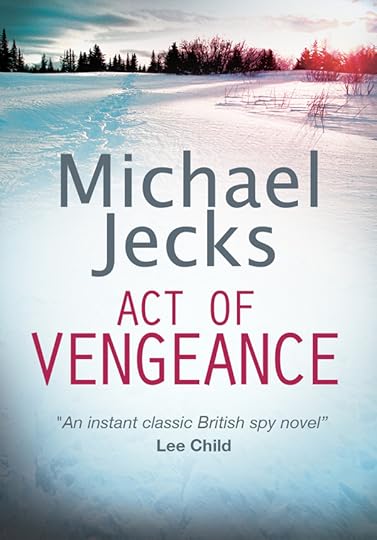
The new cover
It’s not something for which I can blame them. Those editors have to take a book and then sell the idea of the book to their colleagues. That isn’t easy in any market. To take a book from a man known for a very different genre, no matter how good, is far more work than taking a book from an unknown and selling that. The unknown is a guy who can be moulded to suit the marketing campaigns, whose name carries no additional junk with it. It’s plain easier to sell.
And the editor would have to be very convinced about the book in that market. And let’s face it, the market’s pretty full of good thriller writers. Grisham, Child, Deaver, all are known for their taut writing styles and page-turning abilities.
There is another aspect to it, as well. When you look at modern thrillers, sales are tough. When I began looking into it, I was appalled to see an article that said the sales of many conspiracy, Dan Brown style books have collapsed by 80 percent or so. An ever smaller number of writers are making money at that game.
It’s a phenomenon that has hurt all authors, not only thriller writers. Authors of all types (including those whom I most admire) are seeing their sales drying up, their profit per book shrivelling and their incomes dwindling to a fraction of what they used to enjoy. Even authors who have kept up their sales have seen the amount they’re paid per book reduce to a pathetic number of coins. It’s not now strange to be offered a pittance – six pennies – for a book sold on a major internet site. At the same time, the market for second hand books has blossomed, meaning that many sales an author could once have expected are now lost. Ebooks are coming across strongly – but they have their own risks. The value which people place on books is reducing. People who see an ever-increasing number of titles for free now baulk at the thought of paying eight pounds or nine pounds for a new novel. I’ve even had a complaint from one man because my collection of four short stories was too expensive, in his view, at under a dollar per story. How cheap did he expect his entertainment to be, I wondered?
After all, when I received another complaint today, saying that £5.99 was too much for a novel, I started thinking. People will pay more than that to go to a cinema or buy a DVD. Yet a film will last a mere two hours or so. A book for that money will entertain the reader for at least two or three days. For value, a book is far better. And if the price is cut, that means work must also be cut. You don’t get the same work if you pay less, because writers won’t be able to sit and write. They’ll need to work more in other fields to maintain any kind of living standard.
Publishers are finding the new world difficult to navigate. How do you sell books in a market in which the majority of buyers think that books should all be priced at under a dollar? There is no money there for the publisher to make a profit. Certainly not for an author, who sees the royalties reducing to an infinitesimal level. So many authors will give up. They will have to take on full-time work, and stop writing in the hope that they will be able to make a living from their writing, because there will not be one. The only possible way to make money will be from writing directly to internet, and hoping that the sales there will add up, in time, to enough to keep the authors ticking over.
Modern Short Stories
I don’t like that thought. Publishers are too valuable. It is publishers who take a poorly written but imaginative book and turn it into something wonderful. It’s the teams of editors who make this transformation, the copy editors, the proof readers, who convert dull prose into grammatical, correctly spelled works of brilliance. Authors have the initial ideas, but without the folks in the offices who create gorgeous covers and the sales teams who go out and tell the world about the stories, most authors would never break out.
The next few years will be tough. There are glimmers of hope in the way the market is going, but all too few.
So, I thought I may as well try the market myself. Act of Vengeance is now out on Kindle. And I’ve my collections of short stories, No One Can Hear You Scream and For the Love of Old Bones, both of which you can buy today for your Kindle. All are winning great reviews, thank goodness. Go and look. Act of Vengeance has the brilliant “An instant classic British spy novel … mature, thoughtful, and intelligent … but also raw enough for our modern times. Highly recommended.” from Lee Child (I owe him a scotch for that)!
But the good thing is, my main books are going from strength to strength.
The first thirteen have now been snapped up by Simon and Schuster as well, and they are already uploaded as ebooks. With luck the rest of the series will soon join them. And then there is the latest book: Templar’s Acre, which will be out next summer.
It’s a new diversion for me: a prequel that tells the story of Baldwin’s early years, and how he came to join the Templars. It was enormously good fun to write, and I’m hoping it will explain a lot about him to folks who’ve enjoyed his stories so far!
So, in the run up to Christmas, I am hoping that my latest ebooks will attract some interest. If you have missed any of them, take a look when you get a chance and see how you feel.
And now, I’m going. I have more work to do tonight … well, I’m off Morris dancing, to be honest. I look forward to a few too many beers to keep me warm!
Tagged: ebooks, literature, publishing, Templar series, writing


Review of WOLF’s GOLD by Anthony Riches, published by Hodder & Stoughton
ISBN 978 1 444 71186 8
For the last few weeks I’ve not had a chance to read anything that wasn’t non-fiction, nor to write anything other than the final version of the first draft of my next book, which is the reason for the lateness of this review.
This is the first book of Anthony’s I’ve read. He is one of those fortunate types who writes for his own pleasure, because he has a real day job, and the enjoyment of writing comes out in his books, as does his delight in history, military especially. He has a knack of bringing soldiers to life, with all their coarseness and brutality, loyalty and affection.
His series is a brilliant concept: it follows the life of one guy who’s lost his inheritance, relations, everything, because of betrayal back in Rome. His dreams are haunted by his father demanding revenge, or his younger brother staring at him. An awful survival guilt drives the main character through the books, initially because he has no idea who or what led to his fall from grace, and latterly (in this book) because he finds out and starts to seek vengeance. The next book, I think, will take readers back to Rome. That’s a book I’m looking forward to!
Anyway, Wolf’s Gold, the fifth in the Empire series, begins with the Tungrian auxiliary cohorts arriving in Dacia, far beyond the Danube, to guard a complex of gold mines. The Sarmatians are keen to take the gold, and have little fear of the Romans. They know that Rome prefers to pay protection-money than get involved in unnecessary campaigns, but in this area there are some complicating factors: devious Sarmatians who want power over their own people, more Sarmatians who detest Rome and all she stands for, and will fight to the last to destroy any Roman soldiers they find, and when Roman politics are also thrown into the mix, the result is a complicated but immensely satisfying plot to torture the mind!
This is a book which really grabs you. It’s the story of one little campaign, in effect, but that is like saying Rorke’s Drift was an insignificant sideshow in the Zulu War. Wolf’s Gold has stayed with me (with jealousy while I was finishing my own next title) and it’s one that I will go back and read again for pleasure. It’s a story full of treachery, deceit, honesty, integrity and very well-written battle scenes that will have readers on the edge of their seats!
Read it. You won’t be disappointed!


November 26, 2012
Betrayal, by Julian Stockwin

Ignore the photo of the rifles, folks. No, they didn’t have the Brown Bess in left and right hand models, but you tell the cover designers that and they’ll turn nasty …
There are books I try to avoid, and books I have to buy. To my great shame, there are also books which I haven’t read – mainly, in my defence, because I don’t have that much time to read. I have a lot of books to read before I can write my own ones, and for that reason, even though I have a growing pile of books to read when I get time (time? Ye Gods, that is one commodity missing from my life), they’ll all have to wait until I’ve finished my own book. I’m late on my latest deadline.
Yes. I tend to have to pick up books about warfare, about armour, about the history of mental illness and treatment in the fourteenth century, or how dogs were trained to hunt. Exciting books: no time for fiction.
Years ago I used to have more time. In those days there was little more enjoyable, I found, than a chance to sit down with a bottle of deeply naughty whisky (cask strength), light a fire and read the latest Patrick O’Brian. In fact, I would think that he absorbed as many Christmas breaks as MR James and Elliot O’Donnell. I used to love ghost stories, you see.
But all of that lengthy preamble is only to say what a delight it has been to read Julian Stockwin’s latest.
I’ve known Julian from the writing circuit for at least ten years now, I’d guess. I first met him at an author’s day in Tavistock Library, I think, or it could have been a festival in Cornwall – I’m not sure. But I do know that I have been aware of his work for a long time, and it is a matter of huge regret that I have never found the time to immerse myself in his titles.
I will rectify that.
Julian was himself a sailor. He joined the British navy (when we still had one) at the age of fifteen, before going out to join the Royal Australian Navy. He has had experience of the various seas he describes in his books, and that deep knowledge and understanding shows in his writing.
This book is one of a series set in the very early 1800s. After the successful attack on Cape Town, HMS L’Aurore was not enjoying the tiresome duty of sailing up and down the African coast. Her commander, Kydd, and his confidential secretary Renzi are bored.
So when they hear from their commander, Commodore Popham, of unrest in the Spanish colonies, it seems a fair idea to race across the ocean with a small force of ships and soldiers, to make a swift assault on the small city of Buenos Aires. The tales of silver was one incentive, but for British naval officers, the potential for glory while simultaneously hurting the Spanish is just too tempting to resist.
But when they manage to reach the city, and learn that the promised uprising fails to materialise, they realise that they are too small a force, and that the population is growing more and more hostile to the British forces.
This is a brilliant read. From the first page I was hooked and (apologies to my own editor) I was forced to set aside my own work. It’s firmly grounded on the characters and the locations depicted, but also in the actual history of the time.
A superb, rip-roaring read in the best traditions of Hornblower and Aubrey and Maturin.
Betrayal is published by Hodder and Stoughton, with the ISBN : 978 1 444 71200 1
With thanks to Hodder and Stoughton for the review copy.
Tagged: author, books, Michael Jecks, novel, writing


August 20, 2012
Lovely New Operating System. Shame about the software …
There are times when you just want to despair.
Take a for instance. Last week, hit with a slight glitch on my iMac, I had a brilliant thought. Rather than messing about with a slow system, surely it was time for me to update the operating system.
Now, I used to work in computing. I’m not a fool, oh no. Not me. The first thing that any sensible person will do, when offered an upgrade to the OS of his computer, is pick up the machine, detach it from any network, and run for the hills. Because we all know what a new upgrade is. It’s a small bomb that will go off almost immediately without warning.

The look that says, ‘You mug. I woudn’t have done that.’
It’s not surprising. It’s the same with cars. The best time to buy a car? When that model is just about to be (or already has been) superseded by the successor. It will have had all the glitches and technical faults ironed out. All those irritating little quirks that made the ride a little unpleasant, the minor annoyances like the computer that failed (as mine did on a saloon – the irritating little fault there was the one that cut out the engine, brakes, and everything else useful when accelerating. It did it once while overtaking an articulated lorry, while another was heading straight at me from the opposite direction. Oddly enough I have never forgotten that experience).
The equivalent on a computer is … well, read on, dear reader, read on.
I started to upload the new OS on Wednesday last week. I had a week to do a lot of work. My family went away to leave me in peace just for that reason. So, half-way through my allocated time, I sat down to load this software.
It didn’t. I tried four times to load the ruddy software, and each time it failed. Twice it went through the process of loading all the way to telling me it was about to restart the computer to bring Mountain Lion to me. The Lion was, apparently, asleep. It never materialised.
However, this could well have been due to the miserable speed of broadband in my village, so I decided to set it to run again, but this time to leave it to load overnight. I patted the iMac on the head and wandered off.
And next morning, O, frabjous day! Callooh! Callay! et cetera, and I had a wonderful new computer. Well, it felt like it.
First of all, none of my old operations worked. Now, I’m not stupid, and I knew that things were a little different. After all, I was jumping two OSs to get to Mountain Lion – for the techies, leaping from 10.6 to 10.8 – and there were tweaks.
Such as, instead of two fingers swiping to go backwards in Safari, now it’s one finger. Not a big deal, but confusing as hell when you don’t realise. Why isn’t there a little “Read this first!” Document? It would make it easier for old farts like me.
Or the other one, whereby now I have lots of “desktops”? Why? Actually, I rather like them already, but it would be nice to know what they were, why they had been designed, and how I should navigate between them. I now learn it’s by swiping two fingers over the keyboard – but it would have saved quite a lot of panic if someone had told me that. For one thing, when I thought I was swiping between two pages on Safari, and suddenly found I was in a new desktop with everything disappeared on me, I almost had a heart attack.
Still, all is well. I have the superb new OS, and I am delighted with it.
The only problem is, that they also forgot to mention that the old “PowerPC” was gone.
Now, I do not have the faintest idea what the hell this was. But I do know it’s not there now. Why? Because some redundant old rubbish software now comes up with a delightful apology, telling me that “PowerPC” isn’t there anymore so this software won’t work. And it doesn’t. Boy, doesn’t it fail beautifully.
Nothing major, of course. But for me, as a writer, there is a bit of a thing with little packages. Like, for example, Word. It is, believe it or not, rather BLOODY irritating when the software I’ve used for the last eleven years disappears.
Which is why this little piece is being typed up on Nisus Pro. It’s so far rather nice, with some pleasant tweaks, but the main thing I really like is the fact that it’s full page and working brilliantly on my screen so I can type from a good distance away, and the fact that it’s compatible with Word. And Scrivener.

The new Wordprocessor. Nisus Pro. Ideal for authors, I think!
So the iMac is functioning perfectly. Sadly, of course, things don’t go wrong one at a time. So my little G4 Powerbook now won’t work with wifi, won’t link to the web, won’t work with Word (because I reset the thing and now the original disks won’t let me open Word – I don’t have the original codes to fire them up).
It will, fortunately, work as a glorified typewriter for simple text entry. I can take it to work when I start helping students at the end of next month, and type up books in my spare time, which is a relief.
My wife is back home now. She had a lovely time away.
The first morning back, she tried to turn on her PC.
It wouldn’t work.
Tagged: author, books, computers, writing


August 2, 2012
Review of RENEGADE by Robyn Young
I am not having a good time just now. I have a huge amount of work to get through, and at every turn something goes wrong. That’s why it was such a relief to find a new writer.
We all know that feeling of finding a new author – one whose writing style just feels right, one who has the skill to bring to life a whole new world, and one who almost seems to be in the room, telling you the story as it unfolds.
I’ve got that now.
It’s a matter of embarrassment that I haven’t read any of Robyn Young’s books before. It’s not easy, though. When you’re like me, and you have a lot of friends, there are two problems. First, will parts of that story stick in your mind and lead to accusations of plagiarism; and second, what do you do if you seriously don’t like one of your best friends’ pieces of work? The short answer is, don’t accept books from friends.
However, many writers like me came to writing mainly because they – we – really do like reading. And it would be pretty difficult to ignore some of the best writers in the market, wouldn’t it?
So when I was offered a review copy of Renegade, I took it up with some trepidation.
I was right to be nervous.
It’s one of those books that you pick up in a moment of distraction because, say, the ruddy Olympics are (still) on, and rather than sit with baying mobs (wife and children) it’s better to walk from the room and read a book.
Of course, what would have been better would have been to pick up another book. One to help research the book I’m supposed to be writing, say, or the next one I’m thinking about already. But sadly, I didn’t. I picked up this one, and it was a problem immediately. What was going to be a short read was a major diversion for the next three days. I even took it walking with me – and the four miles never disappeared so easily.
Renegade is the second in the series of stories based on Robert the Bruce and his rebellion against the English, in the guise of Edward I. It’s my period, the one in which I’ve been immersed for the last seventeen or eighteen years with my own Baldwin de Furnshill/Puttock series.
Robyn has a wonderful skill. She goes behind the history to the roots of legends and stories to pull up ever more convincing detail. In this book she goes to the beginning of the myths of the four nations that make up Britain. There is the Scottish Stone of Scone, the English Sword Curtana, the Crown of Arthur from Wales, and from Ireland, the Staff of Malachy. According to prophecy, when these are all gathered together, the Kingdom of Britain shall be once more at peace.
So the story begins with the Staff of Malachy, with the first discovery, and moves quickly on to the time of the Bruce, and his early days after inciting rebellion in the first book.
Bruce has escaped the English and is in Ireland again. But his peace is shattered when he has acquired the Staff. To escape and preserve it, he gives it to a kinsman, but then he’s captured. He escapes from gaol and makes his way to the English, where he inveigles his way into the court with promises of loyalty from now on, but in a warlord’s court like that of King Edward, no one is entirely trusted, least of all a man who was a rebel. Bruce has to prove himself by fighting and killing his countrymen so that he might preserve his nation and hope to take the Scottish crown for himself.
This book deals with his earlier part of his life. There is a lot more to his story, from his sending his brother to Ireland to take the Irish crown, to the battles where he broke the English armies at Bannockburn and the raids that wrought such disaster on the Northern Marches all the way to York. These will no doubt appear in a third book. But for now, this book is gripping, exciting, and written with a swift, tense pace that grabs the reader and doesn’t let go.
It’s the very best in modern historical writing, and Robyn is here at the peak of her abilities. My only problem is that I have to go and find her past books – and wait a year for her next one.


July 20, 2012
Review of ROME: THE EAGLE OF THE TWELFTH by Manda Scott
This is the first of a series of reviews I’ll be putting up here. They will tend to be books by friends, and an exercise in log-rolling. They are the books I want to read, rather than those which I am given to review.
I hope you enjoy them!
Anyway, there are times when you pick up a book with extreme reluctance when you are an author. Because you already know and admire the writer.
My friend Ruth Dudley Edwards has an easy answer to the dilemma of a friend giving her a book. With gentle politeness she will refuse, because she wouldn’t want to mislead her readers with a review that is not genuinely her opinion, and likewise wouldn’t want to offend a friend by giving an honestly sharp critique. It is a good principle to stick to. However, I want to help friends whose work I admire.
And anyway, with Manda Scott’s books, I never have to worry.
This, the latest in her ROME series, is, basically, about as good as it can get. If you like historical adventure, and you’re interested in the Roman period, you have to get into her series.

Apologies for the dirty keyboard. You try taking a photo in a hurry when the dog nudges you!
So far her leading character Pantera has spied for Rome all over the known world, from Britain to Jerusalem. In this book, he is less of a key character, because the main portion of the book is devoted to the story of Demalion, son of a horse trader, who joins the Twelfth Legion as a young, unproven trooper. It is not a unit to inspire. Dogged by bad luck and poor leadership, the men have much to prove. But here they prove their value to each other and to their commanders.
But a campaign in Judea shatters the Legion. Not only are almost all their men killed in a short but ferocious series of battles, the ultimate humiliation is inflicted: they lose their eagle.
I believe that there is a genuine story about the loss of the 12th’s eagle – because I overheard Ben Kane talking to Manda. Personally, I don’t care. This story grips like superglue. I couldn’t put it down.
In fact it held me spellbound even though I should have been working on my own next book – which is always a proof of good quality writing and storytelling.
Manda has produced a superb story that really deserves its place on the bestseller lists.
Beats the hell out of 50 Shades of whatever, for my money!
Tagged: authors, Historical Novel, review, Rome, writing


