
Kathy McCoy's Blog, page 12
July 10, 2014
Retirement's Moments of Quiet Desperation
There was a time when the dream of retirement fired imaginations: with visions of a better life, a happier life, in a resort setting or simply relaxing in a long-time home, lingering over coffee, no alarm clocks, no demanding bosses, no office politics -- just a sort of endless, delicious summer where one's life would be one's own.
For some, retirement is this dream fulfilled.
For others, there are moments of quiet desperation, despite lovely settings and abundant leisure time.
There are those who find that their money is disappearing much faster than they ever imagined and that they may need to go back to work at an age when employers are less welcoming and physical limitations may preclude most work possibilities.
There are those who are increasingly distressed by diminished physical capabilities, by the aches and pains and limitations of age.
There are those who find time hanging heavy. They don't know what to do with themselves -- and may regret leaving the work force.
There are those who feel trapped in a marriage that worked, somehow, before retirement because the couple didn't spend much time together. I've seen such desperation in the couple who hunker down at the local McDonald's or Starbucks: he on his cellphone, she clipping coupons for hours on end without any interaction with each other. There was a couple in a doctor's waiting room, she on oxygen, he looking distant and grim and they were sniping at each other. There are couples, too, who readily admit that they are sick of each other but can't afford to divorce, unable to live on divided assets.
All of these issues take on more urgency because of the serial losses of aging and letting go and, at the same time, because of a sense of limited time and resources. The window of opportunity for new beginnings is closing and the choice, for many, seems to be between striking out in a late-life change or accepting what is, however unsatisfactory that may feel.
Some of these moments of quiet desperation are, at least in part, the result of planning based on fantasy: that there would be enough money somehow, that happiness would come with freedom, that less than perfect relationships would transform in a new setting or lifestyle.
And these moments of desperation come when the fantasies fail to blossom into reality -- and when reality shows some harsh truths: that one's body isn't what it used to be and one is unlikely to morph from coach potato to super-athlete with a little more gym time; that the money required to maintain your working lifestyle is not enough and you're faced with a choice of changing your expectations or going back to work; that negative relationships and relationship patterns are unlikely to change without hard work from both of you -- or some hard choices; that focusing solely on self and pleasure isn't the key to nirvana.
Adjusting to the gap between expectations and reality, making your life in retirement work for you may take some major changes on your part. Even changes that feel small can make a big difference.
Some steps that could make a positive difference:
Want what you have. Instead of dreaming of the unattainable or looking back with longing on a former lifestyle fueled by two good incomes, take a look with gratitude at what you have now: a roof over your head, healthy food, the freedom to create life anew, the love of friends and family and treasured pets. Life can feel wonderful when you live with gratitude for what you have.
Find beauty where you are. Maybe you dreamed of retiring to a seaside cottage or a cool urban condo and found both out of your reach. So you're living in the same old house in the same old suburb or in a modest condo, apartment or mobile home. Or perhaps you're living in a nice new retirement home in a strange new place -- maybe simply a new town in a different state or maybe in a manufactured oasis in the middle of a desert. Adjusting to what is and looking around with new eyes, you can begin to appreciate the comfort of your long-time home and familiar surroundings. You can take a deep breath and vow to discover all the positives in your new home town -- even if you've relocated to a place that suddenly feels desolate. If you let yourself, you can find beauty in the uniqueness of a desert environment or a busy urban area or the singular charm of a smaller town. When you open your heart to what is, disappointments can turn to joy.
To improve your relationship, try acting and reacting in different ways. You don't get positive change by repeating those same old behaviors over and over. So try something new.
Do thoughtful things for each other instead of staying locked into gender roles. A friend of mine told me recently that her across the street neighbor, who has severely arthritic hands, had called her during the dinner hour and asked her come lift a cooking pot filled with water and pasta to the sink for draining and rinsing. The woman's husband was sitting in a lounger not 10 feet from the stove. But he felt that anything to do with cooking and kitchen duty was women's work.
Look at nagging in a new way. If the nagging is about your health and less than ideal lifestyle habits, instead of bristling, try seeing the love and caring behind the grousing.
Have a serious, loving talk and enlist each other's help in overcoming bad habits -- like snapping at each other or tuning each other out or cutting each other off conversationally during social events. Agree on a subtle signal that says "Please stop!" at the first sign of irritation triggers or excessive and pointless criticism. This isn't a matter of convincing your spouse to act in a more civil manner. Monitor your own behavior, note what needs to change and see if your relationship doesn't improve.
Change your focus to making life better for others. We all have aches, pains, limitations and disappointments as we enter the later decades of life. But these seem less onerous if we shift our focus to others: perhaps peers less fortunate than we are, perhaps to younger family members who could use a helping hand, loving guidance and affirmation, perhaps to strangers in need -- people who are homeless, those in hospitals, children needing extra help in the classroom, animals in need of rescuing or fostering. There is so much that needs to be done to make life easier for those around us. We're limited only by our willingness to get involved. With volunteer work, a small business or an expanded hobby, with a desire to help others, we can help ourselves as well.
There are, of course, some moments of quiet desperation that are triggered by tragic turns in our lives and aren't so easily solved simply with attitude adjustments or small changes. But for many of the disappointments and moments of disillusionment that come as we settle into retirement, it's important to remember that happiness in retirement isn't automatic because wherever you go, there you are. Your emotional baggage and habits and behavior patterns follow you wherever you go. So take a look around ....and open your eyes, your heart and your mind... and see what a difference you can make in your own life and the lives of those around you.

For some, retirement is this dream fulfilled.
For others, there are moments of quiet desperation, despite lovely settings and abundant leisure time.
There are those who find that their money is disappearing much faster than they ever imagined and that they may need to go back to work at an age when employers are less welcoming and physical limitations may preclude most work possibilities.
There are those who are increasingly distressed by diminished physical capabilities, by the aches and pains and limitations of age.
There are those who find time hanging heavy. They don't know what to do with themselves -- and may regret leaving the work force.
There are those who feel trapped in a marriage that worked, somehow, before retirement because the couple didn't spend much time together. I've seen such desperation in the couple who hunker down at the local McDonald's or Starbucks: he on his cellphone, she clipping coupons for hours on end without any interaction with each other. There was a couple in a doctor's waiting room, she on oxygen, he looking distant and grim and they were sniping at each other. There are couples, too, who readily admit that they are sick of each other but can't afford to divorce, unable to live on divided assets.
All of these issues take on more urgency because of the serial losses of aging and letting go and, at the same time, because of a sense of limited time and resources. The window of opportunity for new beginnings is closing and the choice, for many, seems to be between striking out in a late-life change or accepting what is, however unsatisfactory that may feel.
Some of these moments of quiet desperation are, at least in part, the result of planning based on fantasy: that there would be enough money somehow, that happiness would come with freedom, that less than perfect relationships would transform in a new setting or lifestyle.
And these moments of desperation come when the fantasies fail to blossom into reality -- and when reality shows some harsh truths: that one's body isn't what it used to be and one is unlikely to morph from coach potato to super-athlete with a little more gym time; that the money required to maintain your working lifestyle is not enough and you're faced with a choice of changing your expectations or going back to work; that negative relationships and relationship patterns are unlikely to change without hard work from both of you -- or some hard choices; that focusing solely on self and pleasure isn't the key to nirvana.
Adjusting to the gap between expectations and reality, making your life in retirement work for you may take some major changes on your part. Even changes that feel small can make a big difference.
Some steps that could make a positive difference:
Want what you have. Instead of dreaming of the unattainable or looking back with longing on a former lifestyle fueled by two good incomes, take a look with gratitude at what you have now: a roof over your head, healthy food, the freedom to create life anew, the love of friends and family and treasured pets. Life can feel wonderful when you live with gratitude for what you have.
Find beauty where you are. Maybe you dreamed of retiring to a seaside cottage or a cool urban condo and found both out of your reach. So you're living in the same old house in the same old suburb or in a modest condo, apartment or mobile home. Or perhaps you're living in a nice new retirement home in a strange new place -- maybe simply a new town in a different state or maybe in a manufactured oasis in the middle of a desert. Adjusting to what is and looking around with new eyes, you can begin to appreciate the comfort of your long-time home and familiar surroundings. You can take a deep breath and vow to discover all the positives in your new home town -- even if you've relocated to a place that suddenly feels desolate. If you let yourself, you can find beauty in the uniqueness of a desert environment or a busy urban area or the singular charm of a smaller town. When you open your heart to what is, disappointments can turn to joy.
To improve your relationship, try acting and reacting in different ways. You don't get positive change by repeating those same old behaviors over and over. So try something new.
Do thoughtful things for each other instead of staying locked into gender roles. A friend of mine told me recently that her across the street neighbor, who has severely arthritic hands, had called her during the dinner hour and asked her come lift a cooking pot filled with water and pasta to the sink for draining and rinsing. The woman's husband was sitting in a lounger not 10 feet from the stove. But he felt that anything to do with cooking and kitchen duty was women's work.
Look at nagging in a new way. If the nagging is about your health and less than ideal lifestyle habits, instead of bristling, try seeing the love and caring behind the grousing.
Have a serious, loving talk and enlist each other's help in overcoming bad habits -- like snapping at each other or tuning each other out or cutting each other off conversationally during social events. Agree on a subtle signal that says "Please stop!" at the first sign of irritation triggers or excessive and pointless criticism. This isn't a matter of convincing your spouse to act in a more civil manner. Monitor your own behavior, note what needs to change and see if your relationship doesn't improve.
Change your focus to making life better for others. We all have aches, pains, limitations and disappointments as we enter the later decades of life. But these seem less onerous if we shift our focus to others: perhaps peers less fortunate than we are, perhaps to younger family members who could use a helping hand, loving guidance and affirmation, perhaps to strangers in need -- people who are homeless, those in hospitals, children needing extra help in the classroom, animals in need of rescuing or fostering. There is so much that needs to be done to make life easier for those around us. We're limited only by our willingness to get involved. With volunteer work, a small business or an expanded hobby, with a desire to help others, we can help ourselves as well.
There are, of course, some moments of quiet desperation that are triggered by tragic turns in our lives and aren't so easily solved simply with attitude adjustments or small changes. But for many of the disappointments and moments of disillusionment that come as we settle into retirement, it's important to remember that happiness in retirement isn't automatic because wherever you go, there you are. Your emotional baggage and habits and behavior patterns follow you wherever you go. So take a look around ....and open your eyes, your heart and your mind... and see what a difference you can make in your own life and the lives of those around you.


June 26, 2014
Hindsight Advice to the Next Generation
"I don't want my kids to follow in my footsteps, to do what I did!"
His vehemence came as a surprise when I opened the email from a dear, long-time friend with two college-age daughters.
My first thought was that his daughters would do well to emulate their Dad.
I've known him since he was a twentysomething just starting out in New York publishing and quickly making a name for himself with his combination of insight, kindness, brilliance, hard work and decency.
But he is adamantly warning his daughters away from the same path -- encouraging them to take summer jobs in financial services, corporate public relations -- anything but journalism, book publishing and other print media. "I tell them that they have a choice: to work hard and make good money in business or to work just as hard and make practically nothing in publishing. I don't want them to have the hardships and the uncertainty, especially with the changing nature of the publishing business these days," he wrote. "I want them to have good lives with financial stability and the freedom to pursue all their creative interests on the side."
I could see his point. If I had children, I might be inclined to urge them to explore careers that they could enjoy and, at the same time, have bright employment and financial prospects. Would I have listened if my parents had urged me in a similar direction? Probably not.
I'm the aging poster child for doing what you love in work where money is unpredictable. I have been an actress, a writer and a psychotherapist. All hold the potential for good earnings, with hard work and a large -- very large -- portion of luck. Acting, in particular, is an iffy bet in terms of financial security with so much more than talent involved in getting a coveted big break. And even though writing and psychotherapy are more accessible and less arbitrary than show business, financial bonanzas can be elusive. I have written 15 books for major New York publishers. Only one so far has earned decent money -- and that has been over a period spanning more than 30 years. I optimistically started a psychotherapy private practice -- after the investment of tens of thousands of dollars in advanced degrees in midlife -- and found, with the dominance of managed care, my earnings to be steady but modest.
A college friend Kandace, now deceased, also had a journalism degree followed by a midlife switch to psychotherapy. "What is it about us?" she asked over lunch one day. "Why do we gravitate to these various careers where it's so hard to make a living? Do we have a hidden poverty wish?"
One wonders. Perhaps it's a matter of some people putting more value on financial security while others value the experience of following a dream. And one wonders how young people hear these cautionary tales and fervent advice. Do they hear them with the puzzlement evident on Benjamin's face in "The Graduate" when a family friend urged him to consider a career in "Plastics." Or do they take this advice more to heart than previous generations at a time when student loans are so overwhelming and full-time jobs with good salaries and benefits are so hard to come by?
And, for a young person with creative passions, is it possible to have a happy, satisfying life with these pursuits relegated to the sidelines? Or, in the long run, is the pleasure of following one's dreams worth the financial risks? Does it make sense to pursue high-paying jobs, even if the passion is not there? Is following one's low-paying passions always a mistake?
How have you advised your growing or grown children? How have they found a satisfying balance in their lives? More to the point: what choices have you made in life that you hope your children don't make ?
Parental advice can make more of an impression on a young person than many of us imagined -- either as put-upon youth or as concerned parents.
I remember my own parents having their own urgent career advice for us -- advice we heard with half-closed eyes and long suffering attitudes.
Father urged my brother Michael to become a medical doctor, both to avoid being drafted for Vietnam service and to have lifelong security. He himself had aspired to a medical career after experiencing the disappointments of engineering work in a corporate setting but didn't feel he could start over. He wanted Michael to get his career off to a great start. Mike shrugged off the advice, setting his sights on becoming a college math professor and arguing that draft avoidance was an insufficient reason to choose a career in medicine.
Mother advised my sister Tai, who showed great skill and compassion when family members were ill, to become a nurse. Tai rolled her eyes and insisted that her passion was dance.
Both of my parents rushed to implore me to become a writer which, only in comparison with my other passion, acting, seemed like a more reasonable bet.
It took combat in Vietnam and the passage of time to move Michael in the direction of medicine, in his own time and for his own reasons. It took even more time for Tai to see the wisdom of a career in nursing -- a goal she began to pursue in earnest after life-saving brain surgery, a marriage on the rocks and a toddler daughter to support. I enjoyed five years of doing both writing and acting in my twenties until I became increasingly aware of too many fifty-something actors and actresses who were so talented, so deserving of fame and fortune, who lacked only luck. They were still waiting on tables or driving cabs while hoping against hope for a big break. Writing, while competitive, didn't seem as
arbitrary. If you had talent and a good work ethic, you had a chance. Success didn't hinge on your looks -- at least then. In time, we all became converts to our parents' point of view -- even if our parents didn't live to see Tai's epiphany.
And yet there are young people who follow their dreams and make them happen. My friend Tim has four children -- three of them in the entertainment field. Laura is an award-winning playwright and college professor; Mary Kate is a film and t.v. actress; Stephen is a musical theatre actor/singer who works non-stop. His fourth child, Eliza, is an elementary school teacher. All work steadily and love what they do. None are likely to experience financial windfalls. But they're content.
These are strange times for those of us in midlife and beyond -- a time in life when we look back with longing or amusement or regret at roads taken or not taken. And we want to spare those we love who come after us from some of the rough patches along the way. And so we warn them away from certain career fields or behaviors or relationships without being sure that they've heard us. Then we cross our fingers and hope for the best.
But we know, as our parents did before us, that young people make their own lives, their own success and failure, their own happiness and regrets -- and we can only watch and cheer them on and comfort them along the way.

His vehemence came as a surprise when I opened the email from a dear, long-time friend with two college-age daughters.
My first thought was that his daughters would do well to emulate their Dad.
I've known him since he was a twentysomething just starting out in New York publishing and quickly making a name for himself with his combination of insight, kindness, brilliance, hard work and decency.
But he is adamantly warning his daughters away from the same path -- encouraging them to take summer jobs in financial services, corporate public relations -- anything but journalism, book publishing and other print media. "I tell them that they have a choice: to work hard and make good money in business or to work just as hard and make practically nothing in publishing. I don't want them to have the hardships and the uncertainty, especially with the changing nature of the publishing business these days," he wrote. "I want them to have good lives with financial stability and the freedom to pursue all their creative interests on the side."
I could see his point. If I had children, I might be inclined to urge them to explore careers that they could enjoy and, at the same time, have bright employment and financial prospects. Would I have listened if my parents had urged me in a similar direction? Probably not.
I'm the aging poster child for doing what you love in work where money is unpredictable. I have been an actress, a writer and a psychotherapist. All hold the potential for good earnings, with hard work and a large -- very large -- portion of luck. Acting, in particular, is an iffy bet in terms of financial security with so much more than talent involved in getting a coveted big break. And even though writing and psychotherapy are more accessible and less arbitrary than show business, financial bonanzas can be elusive. I have written 15 books for major New York publishers. Only one so far has earned decent money -- and that has been over a period spanning more than 30 years. I optimistically started a psychotherapy private practice -- after the investment of tens of thousands of dollars in advanced degrees in midlife -- and found, with the dominance of managed care, my earnings to be steady but modest.
A college friend Kandace, now deceased, also had a journalism degree followed by a midlife switch to psychotherapy. "What is it about us?" she asked over lunch one day. "Why do we gravitate to these various careers where it's so hard to make a living? Do we have a hidden poverty wish?"
One wonders. Perhaps it's a matter of some people putting more value on financial security while others value the experience of following a dream. And one wonders how young people hear these cautionary tales and fervent advice. Do they hear them with the puzzlement evident on Benjamin's face in "The Graduate" when a family friend urged him to consider a career in "Plastics." Or do they take this advice more to heart than previous generations at a time when student loans are so overwhelming and full-time jobs with good salaries and benefits are so hard to come by?
And, for a young person with creative passions, is it possible to have a happy, satisfying life with these pursuits relegated to the sidelines? Or, in the long run, is the pleasure of following one's dreams worth the financial risks? Does it make sense to pursue high-paying jobs, even if the passion is not there? Is following one's low-paying passions always a mistake?
How have you advised your growing or grown children? How have they found a satisfying balance in their lives? More to the point: what choices have you made in life that you hope your children don't make ?
Parental advice can make more of an impression on a young person than many of us imagined -- either as put-upon youth or as concerned parents.
I remember my own parents having their own urgent career advice for us -- advice we heard with half-closed eyes and long suffering attitudes.
Father urged my brother Michael to become a medical doctor, both to avoid being drafted for Vietnam service and to have lifelong security. He himself had aspired to a medical career after experiencing the disappointments of engineering work in a corporate setting but didn't feel he could start over. He wanted Michael to get his career off to a great start. Mike shrugged off the advice, setting his sights on becoming a college math professor and arguing that draft avoidance was an insufficient reason to choose a career in medicine.
Mother advised my sister Tai, who showed great skill and compassion when family members were ill, to become a nurse. Tai rolled her eyes and insisted that her passion was dance.
Both of my parents rushed to implore me to become a writer which, only in comparison with my other passion, acting, seemed like a more reasonable bet.
It took combat in Vietnam and the passage of time to move Michael in the direction of medicine, in his own time and for his own reasons. It took even more time for Tai to see the wisdom of a career in nursing -- a goal she began to pursue in earnest after life-saving brain surgery, a marriage on the rocks and a toddler daughter to support. I enjoyed five years of doing both writing and acting in my twenties until I became increasingly aware of too many fifty-something actors and actresses who were so talented, so deserving of fame and fortune, who lacked only luck. They were still waiting on tables or driving cabs while hoping against hope for a big break. Writing, while competitive, didn't seem as
arbitrary. If you had talent and a good work ethic, you had a chance. Success didn't hinge on your looks -- at least then. In time, we all became converts to our parents' point of view -- even if our parents didn't live to see Tai's epiphany.
And yet there are young people who follow their dreams and make them happen. My friend Tim has four children -- three of them in the entertainment field. Laura is an award-winning playwright and college professor; Mary Kate is a film and t.v. actress; Stephen is a musical theatre actor/singer who works non-stop. His fourth child, Eliza, is an elementary school teacher. All work steadily and love what they do. None are likely to experience financial windfalls. But they're content.
These are strange times for those of us in midlife and beyond -- a time in life when we look back with longing or amusement or regret at roads taken or not taken. And we want to spare those we love who come after us from some of the rough patches along the way. And so we warn them away from certain career fields or behaviors or relationships without being sure that they've heard us. Then we cross our fingers and hope for the best.
But we know, as our parents did before us, that young people make their own lives, their own success and failure, their own happiness and regrets -- and we can only watch and cheer them on and comfort them along the way.
June 18, 2014
A Gentle End for a Lovely Cat
My beloved cat Gus died today at the age of 16.
It shouldn't have been a surprise, but it seems that death so often catches us somewhat by surprise.
Gus had been frail this past year, losing weight and strength. His weight loss accelerated by April and I began to worry about leaving him for a long-planned trip to Hawaii to visit my dear friend Jeanne who has been ill. A vet at a nearby clinic was reassuring. "His lab work is fine," she said. "His kidneys are in great shape. He doesn't have diabetes. He's just old. Oh, it's possible that he could have intestinal cancer, but it's very costly to diagnose and would be hard to treat successfully at his age. Try some of this special food and see how he does. I'm sure it will be fine to leave him."
So we left, with our neighbor Kelly, who has a small pet-sitting business, minding our cats. Her emails were upbeat, but concerned: Gus was eating enthusiastically, but was still losing weight. I asked her about gastrointestinal problems. Yes. But manageable. She fought hard to keep him healthy, to keep him alive, while we were gone -- with massages and hand feeding and cuddling and daily encouragement. And we were thrilled when he met us at the door when we returned late last Wednesday.
But his appearance was a shock: his weight loss had gone into overdrive and his fur hung like an oversized coat on a body defined by prominent bones. He was ravenously hungry but his system could no longer process food. He had projectile diarrhea. As the week went on, he stopped grooming himself and, quite uncharacteristically, was smelly and unkempt. A lifelong model of calm with an even temper and loving nature, he was suddenly cranky and whined constantly. His weight had plummeted from 18 pounds last year to a fraction over five pounds.
But he still purred whenever I touched him, still melted into my arms when I picked him up, still took my hand in his paws and rubbed it all over his face -- things he has done since we adopted him and his brother Timmy as seven week old kittens back in 1998.
He was still in so many ways himself. When would we know to let go?
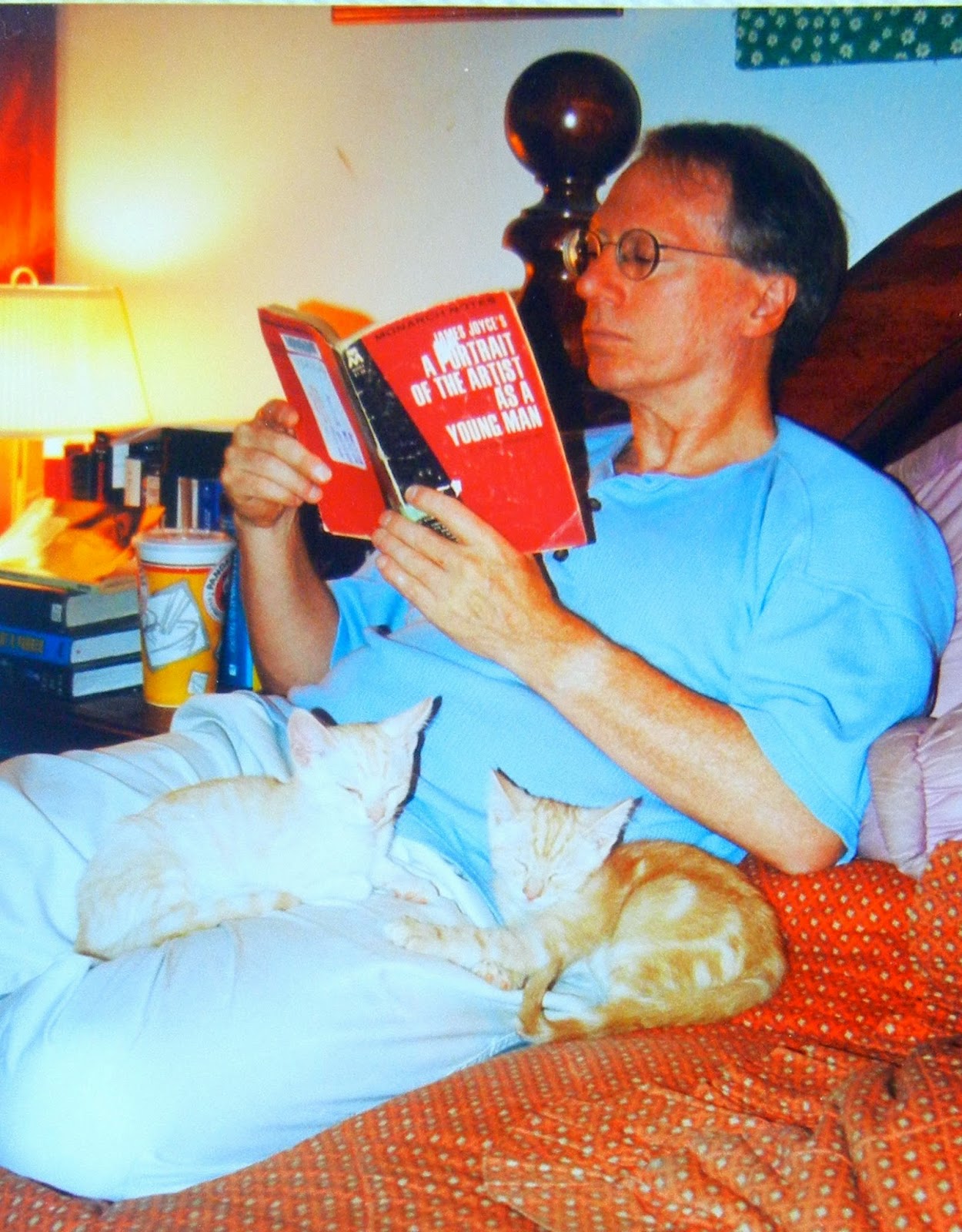
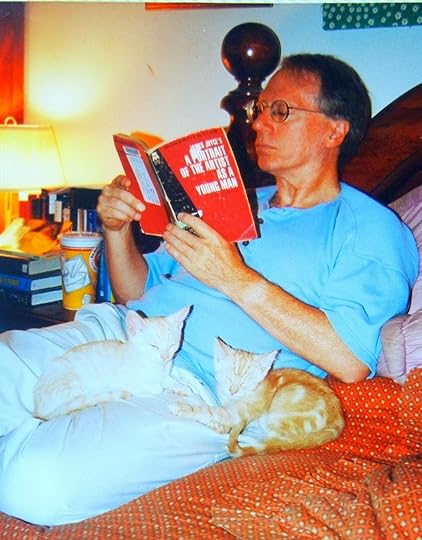 Gus (r) and Timmy cuddle up to Bob in 1998
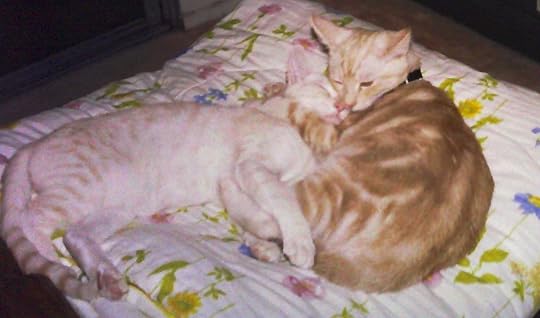 Loving brothers Timmy and Gus in 1998
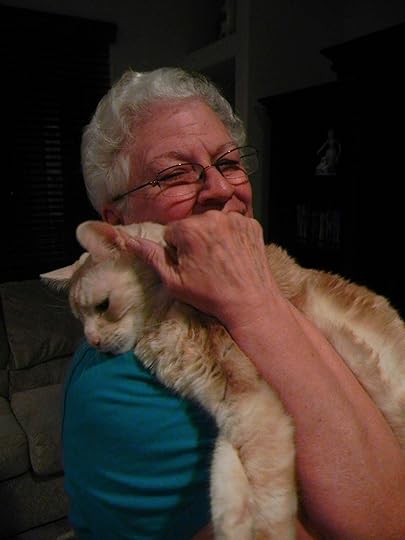
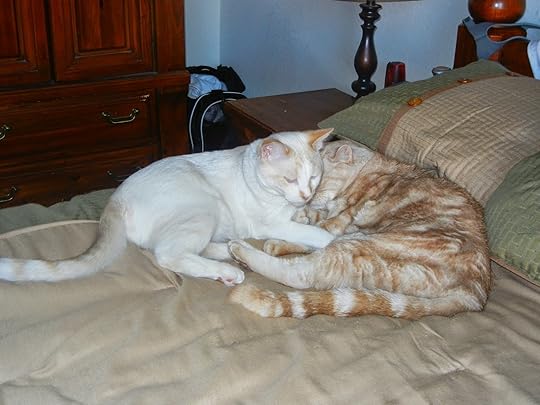 Loving companions Hammie and Gus 2014
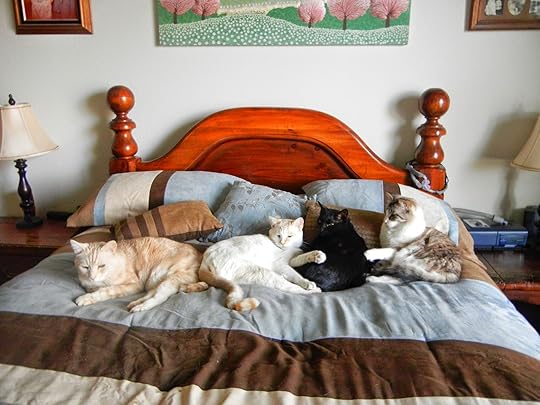 Gus, Hammie, Maggie and Sweet Pea 2014
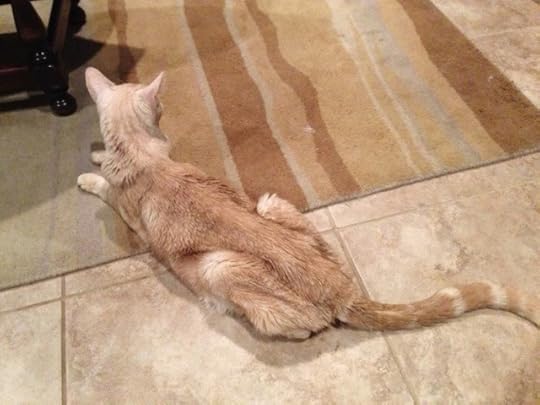 Shockingly thin: Gus in June 2014
He would brighten, then decline in an endless loop over the next few days. But I could see a steadier decline yesterday, watching him struggle to walk and to sit and to lie down, tottering on uncertain limbs. And then there was last night: while Gus usually preferred to start his nights on the living room couch, I looked over to the corner of the bedroom last night as I was turning in and saw him curled up in the little bed he had had since kittenhood. And I said a quiet prayer that he would pass away quietly and peacefully in that little bed.
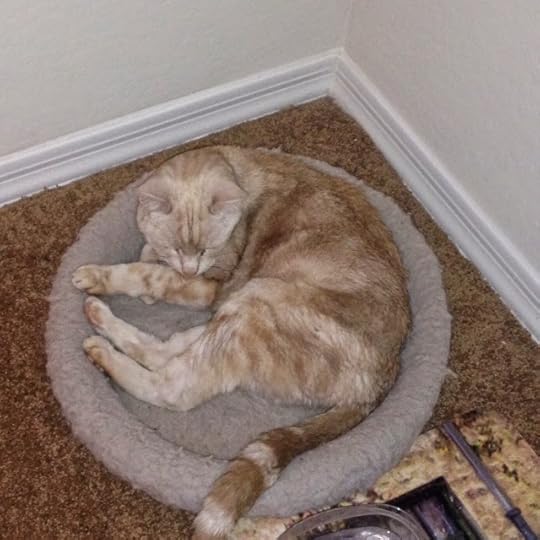 Gus settling in for his last night - June 17, 2014
But at 2 a.m., I was suddenly awakened by the sound of very loud purring beside me. I could hear it through sleep and the ear plugs I often wear if Bob is snoring. I was astonished to see Gus standing beside me, purring and rubbing his face against mine. Then he settled on my chest, still purring, his paws embracing me. Every time I would drift off to sleep, he would rub or touch my face, seeming to beg "Stay with me." I had a sense that he was saying a very personal, very loving "Goodbye" with the last of his strength. As the night went on, there was another round of dashes to the cat box with explosive diarrhea, crying, wincing with pain when I touched his stomach. Whimpering, he cuddled close and I knew it was time.
Bob called the veterinary clinic before dawn and we set off with Gus several hours later, choking back the pain behind our ordinary conversation, reassuring Gus who lay moaning in his carrier. I longed for our former vet in California from whom we had adopted Gus and Timmy, someone who knew him and would understand the magnitude of this loss that loomed before us.
But at this seemingly impersonal clinic, they did understand, creating a peaceful, supportive, caring environment, letting us have time to express our love to Gus before and after his sedation and the ultimate heart-stopping injection and to linger afterwards to caress him and to cry over this wonderful animal companion who had meant so much to us over the years. He was the only cat we had who had known every one of our other cats in our 32 year adventure in sharing our lives with a series of unique and loving cats. Gus also truly raised our current generation -- Maggie, 7, Sweet Pea,4, and Hammie, 2 -- from kittenhood. He was the cat who always purred, loved to be held and was invariably sweet and caring in the worst of times.
As we stood there today, stroking and holding Gus as his life ebbed away, we talked wistfully of the possibility of an afterlife, of a rainbow bridge where we might -- despite all of our religious doubts -- meet again with our beloved Gus, with Timmy and Freddie and Marina. We imagined how happy he would be to see his littermate Timmy, dead seven years and one month to the day. We hoped. We dreamed. And we said "Goodbye": Godspeed, sweet Gus. May you discard your elderly, ill body like an old coat and soar into a new life of unending love and adventure.
"I hope," Bob said, stoking his still warm body. "I hope if there is such a thing as reincarnation, that Gus will have another life as the highest order being possible."
He paused and thought about it.
"Maybe this was the highest order," he said. "Maybe cats and dogs are closer to perfection than we are."
I can't help but think that may be so -- at least in Gus' case. He was perfect: perfectly loving, perfectly wonderful, perfectly Gus. We'll love and miss him forever.

It shouldn't have been a surprise, but it seems that death so often catches us somewhat by surprise.
Gus had been frail this past year, losing weight and strength. His weight loss accelerated by April and I began to worry about leaving him for a long-planned trip to Hawaii to visit my dear friend Jeanne who has been ill. A vet at a nearby clinic was reassuring. "His lab work is fine," she said. "His kidneys are in great shape. He doesn't have diabetes. He's just old. Oh, it's possible that he could have intestinal cancer, but it's very costly to diagnose and would be hard to treat successfully at his age. Try some of this special food and see how he does. I'm sure it will be fine to leave him."
So we left, with our neighbor Kelly, who has a small pet-sitting business, minding our cats. Her emails were upbeat, but concerned: Gus was eating enthusiastically, but was still losing weight. I asked her about gastrointestinal problems. Yes. But manageable. She fought hard to keep him healthy, to keep him alive, while we were gone -- with massages and hand feeding and cuddling and daily encouragement. And we were thrilled when he met us at the door when we returned late last Wednesday.
But his appearance was a shock: his weight loss had gone into overdrive and his fur hung like an oversized coat on a body defined by prominent bones. He was ravenously hungry but his system could no longer process food. He had projectile diarrhea. As the week went on, he stopped grooming himself and, quite uncharacteristically, was smelly and unkempt. A lifelong model of calm with an even temper and loving nature, he was suddenly cranky and whined constantly. His weight had plummeted from 18 pounds last year to a fraction over five pounds.
But he still purred whenever I touched him, still melted into my arms when I picked him up, still took my hand in his paws and rubbed it all over his face -- things he has done since we adopted him and his brother Timmy as seven week old kittens back in 1998.
He was still in so many ways himself. When would we know to let go?
 Gus (r) and Timmy cuddle up to Bob in 1998
 Loving brothers Timmy and Gus in 1998
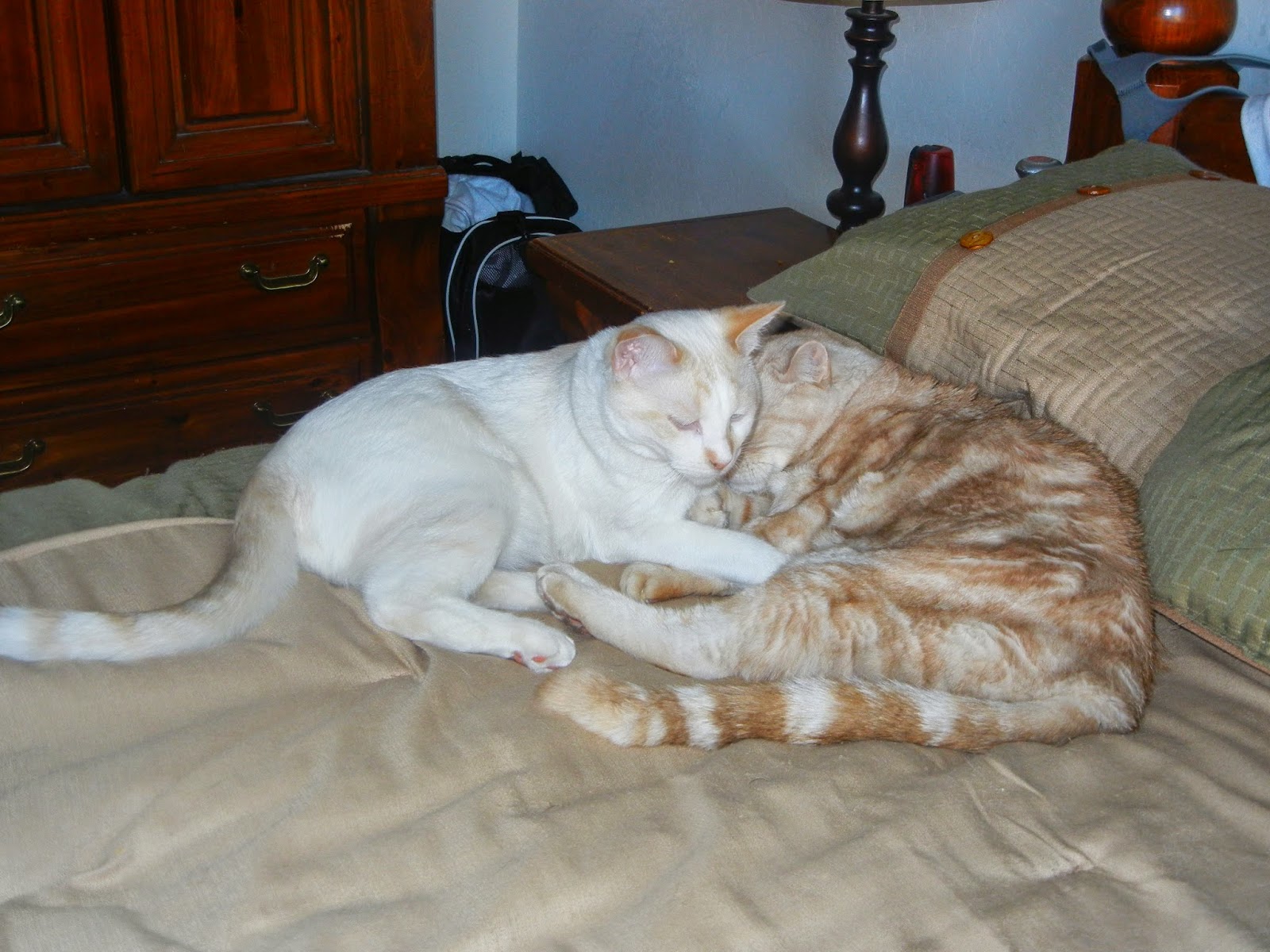 Loving companions Hammie and Gus 2014
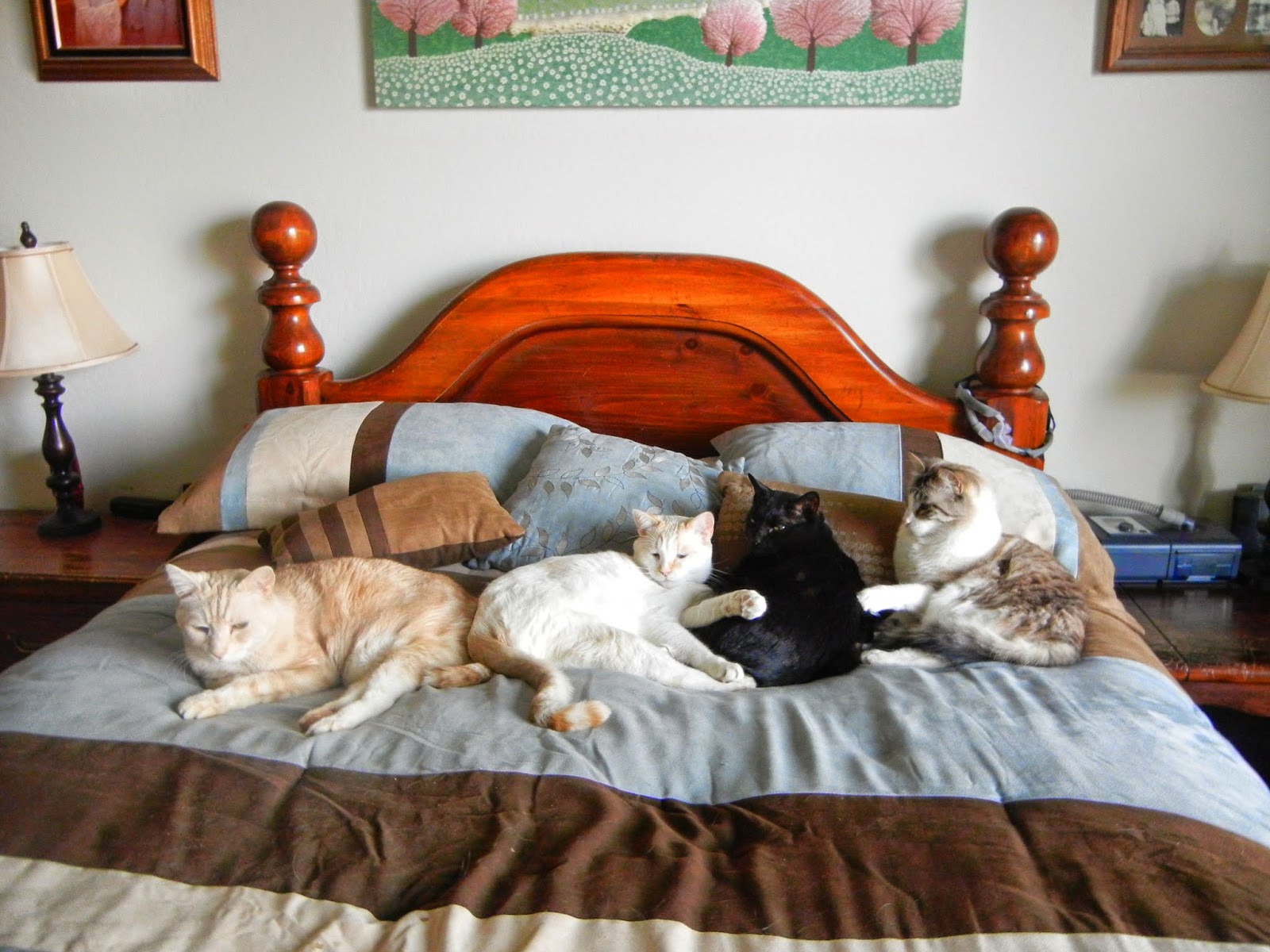 Gus, Hammie, Maggie and Sweet Pea 2014
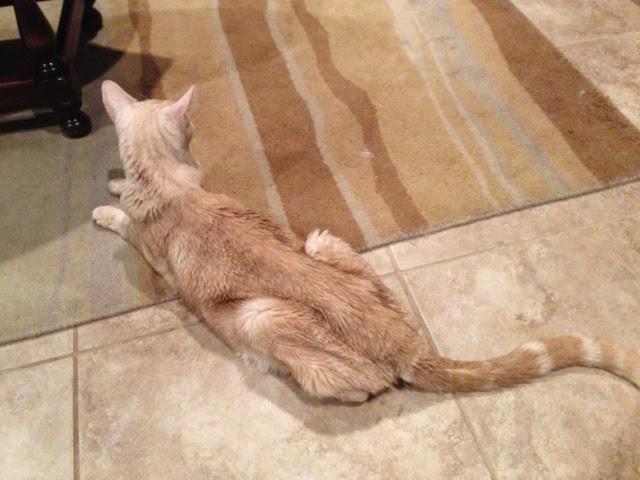 Shockingly thin: Gus in June 2014
He would brighten, then decline in an endless loop over the next few days. But I could see a steadier decline yesterday, watching him struggle to walk and to sit and to lie down, tottering on uncertain limbs. And then there was last night: while Gus usually preferred to start his nights on the living room couch, I looked over to the corner of the bedroom last night as I was turning in and saw him curled up in the little bed he had had since kittenhood. And I said a quiet prayer that he would pass away quietly and peacefully in that little bed.
 Gus settling in for his last night - June 17, 2014
But at 2 a.m., I was suddenly awakened by the sound of very loud purring beside me. I could hear it through sleep and the ear plugs I often wear if Bob is snoring. I was astonished to see Gus standing beside me, purring and rubbing his face against mine. Then he settled on my chest, still purring, his paws embracing me. Every time I would drift off to sleep, he would rub or touch my face, seeming to beg "Stay with me." I had a sense that he was saying a very personal, very loving "Goodbye" with the last of his strength. As the night went on, there was another round of dashes to the cat box with explosive diarrhea, crying, wincing with pain when I touched his stomach. Whimpering, he cuddled close and I knew it was time.
Bob called the veterinary clinic before dawn and we set off with Gus several hours later, choking back the pain behind our ordinary conversation, reassuring Gus who lay moaning in his carrier. I longed for our former vet in California from whom we had adopted Gus and Timmy, someone who knew him and would understand the magnitude of this loss that loomed before us.
But at this seemingly impersonal clinic, they did understand, creating a peaceful, supportive, caring environment, letting us have time to express our love to Gus before and after his sedation and the ultimate heart-stopping injection and to linger afterwards to caress him and to cry over this wonderful animal companion who had meant so much to us over the years. He was the only cat we had who had known every one of our other cats in our 32 year adventure in sharing our lives with a series of unique and loving cats. Gus also truly raised our current generation -- Maggie, 7, Sweet Pea,4, and Hammie, 2 -- from kittenhood. He was the cat who always purred, loved to be held and was invariably sweet and caring in the worst of times.
As we stood there today, stroking and holding Gus as his life ebbed away, we talked wistfully of the possibility of an afterlife, of a rainbow bridge where we might -- despite all of our religious doubts -- meet again with our beloved Gus, with Timmy and Freddie and Marina. We imagined how happy he would be to see his littermate Timmy, dead seven years and one month to the day. We hoped. We dreamed. And we said "Goodbye": Godspeed, sweet Gus. May you discard your elderly, ill body like an old coat and soar into a new life of unending love and adventure.
"I hope," Bob said, stoking his still warm body. "I hope if there is such a thing as reincarnation, that Gus will have another life as the highest order being possible."
He paused and thought about it.
"Maybe this was the highest order," he said. "Maybe cats and dogs are closer to perfection than we are."
I can't help but think that may be so -- at least in Gus' case. He was perfect: perfectly loving, perfectly wonderful, perfectly Gus. We'll love and miss him forever.
May 15, 2014
Rita's Lessons in Aging with Grace
 Rita Stack
1920-2014
Rita Stack was one of a kind.
She was a unique presence at our community center with her luminous smile and friendly greetings. There were no strangers in Rita's life -- only friends and soon-to-be friends. She was incredibly active, a fixture at the water aerobics class, at mental health trivia games, bingo, Mexican Train -- and she always stole the show at the annual Follies variety show where she portrayed, variously, the world's oldest living Mouseketeer, a honeymooner, and the reigning Miss Sun City Anthem. Her sense of humor was legendary, her generosity of spirit an inspiration.
Rita Stack, 93, who died quickly, quietly and unceremoniously on May 3, was perhaps the most beloved member of our community, moving here in 2008 when her widowed daughter Yvette bought a home and invited her mother to leave her apartment in San Francisco to join her here.
"It's odd how things turn out," Rita told me several years ago as we rested briefly during a vigorous protest and picketing of a copper mine proposed near our homes. "Yvette thought she would be taking care of me. But here I am taking care of her. I feel so blessed that I could be here to help her. It was simply meant to be -- and I'm so grateful that I can be here for her."
Rita, indeed, seemed the stronger of the two as her daughter has struggled with a serious respiratory ailment the past few years. But despite the health challenges Yvette faced, this dynamic duo was at the center of so many celebrations -- dressed in red, white and blue and throwing candy to the crowds as they drove their golf cart in the Fourth of July parade, dressing up for Halloween, celebrating Christmas with both a joyous spirit and deep faith.
Many of us have considered Rita the ultimate role model for aging gracefully. She lived to love and to give. It was always about others. And in her giving, she made an indelible impression on others.
"I didn't know her well, but I liked her so much," my neighbor Phyllis said today. "The first time I met her out at the pool four years ago, she smiled at me and said 'Oh, my! You are so pretty!' And I told her she had a friend forever."
We were all talking about Rita during her Celebration of Life today -- and how she lived fully and joyfully until her last day on this earth.
The large ballroom was filled to standing room only as people spoke of how they had loved Rita and how she had been a role model and substitute mother for so many of us.
Diane, her water aerobics instructor, told a story about Rita calming her as she fretted about low attendance at the class one day. "She told me 'Don't worry about the people who aren't here. Concentrate on the people who are here!' And later, as she caught me frowning over the attendance sheet, Rita leaned over to me and whispered 'Stop worrying!'"
Paul, a member of the theatrical society, talked about encountering Rita in the semi-darkness of backstage during a dress rehearsal for the Follies show. He greeted her enthusiastically and she replied with equal joy: "Hello, Betty! It's so good to see you!"
The crowd erupted with laughter at this point, Betty and her partner Kathleen laughing most heartily of all. Betty is about the same height as Paul with close-cropped hair. Paul continued with his story: "So I bent down to kiss her and she stroked my cheek, discovering my two days growth of stubble. She stopped short. 'You're not Betty!" she said. And I said 'No, I'm Paul.' Her face brightened. 'Oh, Paul!' she said, laughing. "Well, I'm truly glad to see you, too!"
A woman told of the time she encountered Rita at a New Year's Eve party in this same ballroom a few years ago. She looked more joyous than usual and the woman asked her what was so delighting her.
"My daughter," Rita said, beaming, pointing to Yvette on the dance floor. "My daughter is feeling better tonight, well enough to dance. She's still my baby, you know. And it brings such joy to my heart to see my little girl dancing..."
Another man in the crowded ballroom talked quietly about his grief over losing his mother in 2005 and "I thought I had lost everything, but in 2008, I met Rita and she was like a second mother to me. She cared so much about what I thought and how I was feeling. She was -- and is -- an angel."
And so many spoke of Rita as a role model for the rest of us. We explored the lessons Rita taught us about living a graceful and meaningful older age.
Rita's lessons in graceful aging include:
1. Emotional generosity builds bridges. Rita had a smile and a friendly greeting for everyone. She genuinely cared how people were feeling. She listened well (even if she was in the pool minus her hearing aids) and was more interested in learning about others' life stories than having the spotlight on herself, though her own story was a compelling one of enduring early hardships with energy and imagination. She knew that the secret to winning friends was not by overwhelming others with her own life achievements, but by helping others to feel loved, admired and important and, most of all, by being a wonderful friend to others.
2. Good health isn't just luck or good genes but can also be a choice. Rita looked younger and more vigorous than her age due, at least in part, to a lifelong pattern of healthy eating and exercise. She was lean and fit all her life and, even after she needed a walker as her balance became a little more uncertain, she took a daily stroll around the neighborhood and was a frequent presence at the fitness center, never missing her water aerobics class. She never gave up her lifetime habit of being active and engaged with others and with life.
3. Define your life with positives rather than negatives. Although Rita, a child of the Depression, a young wife who didn't see her husband for nearly four years during World War II, a mother of six children, a woman who faced a painful life transition in middle of her years, certainly had her challenges in life, what she emphasized was the positive: how cute her husband was as a youth, how proud she was of having five children in five years, how special each of her six children, twelve grandchildren and 21 great-grandchildren were to her, how she had loved every place she had lived or visited, how blessed she felt that none of her children had ever gone to bed hungry, as she had so many times during her own Depression-era childhood. Even as some limitations of age appeared, she continued with aplomb. She moved with enthusiasm and vigor on her walker, never pitying herself, but talking about how fortunate she was to still be mobile and active.
4. It's never too late to try something new. Rita was up for learning and trying anything. She didn't worry about looking foolish. She thoroughly enjoyed herself -- and spread that joy around. She was a genuine star of the theatrical society because of her sheer joy in being there, in that moment, in the company of dear friends. She was funny and game and invariably delightful in her various star turns.
5. Kindness is a key to living fully. At a time of life when many are set in their ways and soured on life, Rita always had something good to say to or about everyone. She always had time to stop and listen, to ask questions, to remember the challenges of another. People mattered to her -- both close friends and acquaintances. She was a perfect antidote to the chronic complainers, mean girls (and guys), to the perpetual critics and cranks one too often finds in a retirement community. Through her shining example, we learned that a life lived with kindness and consideration for others is a rich and fulfilling one. And it is a life treasured and celebrated by more people than she ever could have imagined.
As the celebration of Rita's life continued, Yvette and her brother Leo spoke of their joy in having had Rita as a mother -- of her infectious zest for life and her quiet courage when life was painful and, in the privacy of her home and with her family, she faced her own tribulations.
Her friend Betty read passages from Rita's journal that revealed both the hardships of her childhood and lifelong feelings of good fortune. There was a video of her life in pictures along with filmed scenes of Rita's "Follies" highlights. Throughout the film, the song "Aquarius" played. And we learned that whenever Rita was alone in the house she and Yvette shared, she would put on her favorite album, the original cast recording of "Hair" and play her all-time favorite song "Aquarius" over and over.
When the moon is in the seventh house
And Jupiter aligns with Mars
Then peace will guide the planets
And love will steer the stars...
With the song still ringing in our ears, we all went out to the lawn behind the community center and stood in a very large circle. In the center of the circle, Yvette and Leo released yellow balloons, embracing each other and calling out to the heavens their love for their mother. The rest of us released white balloons with blessings and resolutions to emulate Rita by living each day with more love and kindness and joy.
The white balloons clustered around the two yellow balloons, soaring high into the bright blue Arizona sky.

May 6, 2014
Crossroads and Conscience
In my nearly eternal search for dietary health and sanity, I've been trying a non-diet of clean foods with an emphasis on fruit and vegetables while slashing my intake of processed foods and limiting carbohydrates like bread and pasta. Rather than focusing on deprivation, I'm striving for balance and for learning to savor foods that are both healthy and delicious.
This afternoon, I headed to the supermarket for more raw vegetables for a salad and a few packets of frozen vegetables. But coming out of the frozen food section, I found myself staring at the bakery area. I felt the near-magnetic pull of bagels.
As I stood wrestling with my conscience, two different neighbors wandered by. The first smiled and admitted to a special trip to the market to satisfy her yearnings for a fistful of Hershey bars. Chocolate! I stared at her. She has kidney disease. Chocolate is high up on her list of forbidden foods. I wanted to say "But you know better...."
But there I was, checking out the bagels.
Another neighbor cruised by, not noticing our friendly greetings. He looked past us, muttering -- was it to himself or to us? -- "I came to get some cookies for a pig-out!" A pig-out??? He has diabetes with eye complications and cardiac problems.
What was this: death wish central?
And it made me think how often we sabotage our best efforts at healthy choices -- for the momentary pleasure instead of long-term benefits or to calm the anger or anxiety or a myriad of other troubling feelings that are, nonetheless, never quite stilled by guilty treats. Or maybe some simply are tired of trying so hard to avoid health disasters when these are looming so insistently. Sometimes we just give up trying so hard or trying at all.
So the diabetic man got his stash of cookies. I saw him later sitting in his car, about a block from his home, hunched over his loot and eating cookies quickly, furtively, in a binge that may or may not escape his wife's attention.
But blood sugar and potassium levels and weight are figures that don't lie. And those toxic lies we tell ourselves:
"Just this once..."
"A little won't hurt..."
"It doesn't really make that much difference..."
But it does make a difference.
A little can lead to a lot.
And this once can go on and on.
Our time, our window of opportunity to turn things around isn't infinite. Our chances to improve our health and prospects for a more mobile and vigorous old age are dwindling with every cheat and treat and positive change deferred.
I looked at my neighbors. They're in their seventies and are starting to have severe health problems as a result of their chronic conditions. I'm only a year away from that perilous decade with some health challenges of my own -- high blood pressure and pre-diabetes -- that could grow into major life-limiting/life-threatening health problems unless I commit to a new way of eating and living.
And I wondered: what were we doing to ourselves -- seeking out great quantities of cookies and chocolate and bagels?
A little step toward health today might help to prevent a devastating choice tomorrow.
A painful flashback hit me: just this morning, when I accompanied another neighbor Phyllis (whose kidney disease is an inherited malady) to her kidney dialysis session -- a painful ordeal she undergoes three times a week -- we saw a familiar figure emerging from the treatment area to the waiting room. The woman, in a wheelchair, looked considerably younger than either of us but has already lost a leg to diabetes and had been getting kidney dialysis for some time. Phyllis looked puzzled. It was only 6:15 and people were getting hooked up to the machines now. No one would be finished for some hours. We looked at the woman and her husband who was pushing the wheelchair. Their faces spoke of quiet grief and resignation as they left the building. Phyllis exhaled slowly. "She is quitting dialysis," she said quietly. "She hasn't been wanting to continue for a while..." She bit her lip. We both knew that the last person who made the choice to quit dialysis was dead a week later.
Sometimes, of course, health catastrophes are totally out of our control. Illness can strike regardless of the choices we make.
But at some junctures, we can choose to fight for health with wise, life-affirming choices. There are small crossroads in our lives, moments when one healthy choice can lead to another or one poor choice can also lead to another. There are times when we can step back, let our yearnings for health and vitality prevail over the toxic quick-fix. There are opportunities we have to do something different and better for ourselves.
There are times...
I put the bag of mini-bagels back on the shelf and walked quickly away.
.
This afternoon, I headed to the supermarket for more raw vegetables for a salad and a few packets of frozen vegetables. But coming out of the frozen food section, I found myself staring at the bakery area. I felt the near-magnetic pull of bagels.
As I stood wrestling with my conscience, two different neighbors wandered by. The first smiled and admitted to a special trip to the market to satisfy her yearnings for a fistful of Hershey bars. Chocolate! I stared at her. She has kidney disease. Chocolate is high up on her list of forbidden foods. I wanted to say "But you know better...."
But there I was, checking out the bagels.
Another neighbor cruised by, not noticing our friendly greetings. He looked past us, muttering -- was it to himself or to us? -- "I came to get some cookies for a pig-out!" A pig-out??? He has diabetes with eye complications and cardiac problems.
What was this: death wish central?
And it made me think how often we sabotage our best efforts at healthy choices -- for the momentary pleasure instead of long-term benefits or to calm the anger or anxiety or a myriad of other troubling feelings that are, nonetheless, never quite stilled by guilty treats. Or maybe some simply are tired of trying so hard to avoid health disasters when these are looming so insistently. Sometimes we just give up trying so hard or trying at all.
So the diabetic man got his stash of cookies. I saw him later sitting in his car, about a block from his home, hunched over his loot and eating cookies quickly, furtively, in a binge that may or may not escape his wife's attention.
But blood sugar and potassium levels and weight are figures that don't lie. And those toxic lies we tell ourselves:
"Just this once..."
"A little won't hurt..."
"It doesn't really make that much difference..."
But it does make a difference.
A little can lead to a lot.
And this once can go on and on.
Our time, our window of opportunity to turn things around isn't infinite. Our chances to improve our health and prospects for a more mobile and vigorous old age are dwindling with every cheat and treat and positive change deferred.
I looked at my neighbors. They're in their seventies and are starting to have severe health problems as a result of their chronic conditions. I'm only a year away from that perilous decade with some health challenges of my own -- high blood pressure and pre-diabetes -- that could grow into major life-limiting/life-threatening health problems unless I commit to a new way of eating and living.
And I wondered: what were we doing to ourselves -- seeking out great quantities of cookies and chocolate and bagels?
A little step toward health today might help to prevent a devastating choice tomorrow.
A painful flashback hit me: just this morning, when I accompanied another neighbor Phyllis (whose kidney disease is an inherited malady) to her kidney dialysis session -- a painful ordeal she undergoes three times a week -- we saw a familiar figure emerging from the treatment area to the waiting room. The woman, in a wheelchair, looked considerably younger than either of us but has already lost a leg to diabetes and had been getting kidney dialysis for some time. Phyllis looked puzzled. It was only 6:15 and people were getting hooked up to the machines now. No one would be finished for some hours. We looked at the woman and her husband who was pushing the wheelchair. Their faces spoke of quiet grief and resignation as they left the building. Phyllis exhaled slowly. "She is quitting dialysis," she said quietly. "She hasn't been wanting to continue for a while..." She bit her lip. We both knew that the last person who made the choice to quit dialysis was dead a week later.
Sometimes, of course, health catastrophes are totally out of our control. Illness can strike regardless of the choices we make.
But at some junctures, we can choose to fight for health with wise, life-affirming choices. There are small crossroads in our lives, moments when one healthy choice can lead to another or one poor choice can also lead to another. There are times when we can step back, let our yearnings for health and vitality prevail over the toxic quick-fix. There are opportunities we have to do something different and better for ourselves.
There are times...
I put the bag of mini-bagels back on the shelf and walked quickly away.
.
April 30, 2014
Living Lightly
Some memories are painfully vivid years later -- among them the task of cleaning out the homes of my parents and Aunt Molly after their deaths.
My parents were hoarders, especially in their later years. There were rooms in their 1,000 square foot home that were filled with junk: old newspapers and magazines, clothing, inexplicable collections of old wax honey containers and mismatched shoes, wadded up towels, scattered tools -- all of it chewed by the rats that scampered relentlessly underfoot and overhead. I had often offered to help my mother clean many times over the years and she always shook her head with a combination of fear and shame. Their lives and their home were chaotic. After they died, our cleanup took more than a year and was, in a word, horrifying.
In contrast, Aunt Molly's house -- about the same size -- always looked immaculate and inviting. But after she died, we found that her closets, garage and attic were bursting with treasures, trivia and collections of a life fully lived. There were wonderful discoveries -- like the trunk with the first pictures we had ever seen of her long-dead parents, the grandparents we never knew, and a collection of love letters that reassured us that she had known love and passion in her life. But there were also challenges -- like roll after roll of fabric for all the drapes and clothes she never made. We donated it all to a young costume designer. But there were things that were impossible to donate and that brought us to a screaming point.
Once, when the realtor selling her house asked Bob and me to remove all the furniture from the house on a few hours notice, pull up the carpet and swab the foundation with bleach to remove all traces of her surly and incontinent nightmare of a cat named Sugar, Bob and I had a mutual meltdown trying to navigate a cat-pee soaked sleep sofa out of her den. At one point, the couch became wedged in the narrow hallway. We dropped it and burst into tears, sobbing and screaming and embracing each other before we took a deep breath and carried on.
When we look back, we can't help but think ahead to our own demises and what will be left behind for family to sort through. And we've decided to try to give them a break by lightening our lives right now.
So:
We've designated Saturdays for going through the house, one room at a time, to throw away or donate what no longer seems necessary. It's amazing, when we think about what we chose to move with us from Los Angeles four years ago, and how little we needed some of it. It feels good to begin to let go.
For the things with meaning, artifacts of our lives and of previous generations, we've already made plans to pass the relics on. My brother Mike brought the subject up during a visit last month when he and his family were briefly back in Los Angeles from their main home in Bangkok. He asked me if I would consider parting with family pictures, Aunt Molly's television scripts and other mementos that mean a lot to all of us. And we made plans to transfer these treasures sometime in the next year or so when he would fly in to Phoenix and drive back to L.A. with me in a car filled with boxes of memories. It makes sense: both Mike and my sister Tai are younger and have children who may someday treasure these items -- or not. But photos can be scanned and shared and become a part of the larger family story.
We've lined up charities that will take clothing and furniture that we may part with now or leave behind in years to come.
We've decided that our feline family will decrease, over time, by attrition, that there will be no more kittens in our future. We may, at some point, volunteer to foster kittens and cats for a rescue organization. But adoptions? I don't think so. We hope -- in a way -- that we will outlive our beloved pets. But just in case we don't, we've discussed plans for their continued care by family or by a major pet rescue organization, realizing that this will be made easier if we do not add to our pet population in the meantime.We're proceeding slowly with some things -- the handwritten books I wrote when I was six, letters from my mother and Aunt Molly when I was in college, my first Valentine. It is all being scanned and photographed for future reference and there will come a day when I no longer feel the need to run my fingers over these actual treasured objects and will let them go, too.
It's interesting, this letting go. It seems to be a trend of sorts, with several neighbors also talking of selling artifacts or giving these away to family sooner rather than later so it all falls into the right hands.
Life feels lighter with cleaner closets, less cluttered shelves and family relics headed elsewhere. There is a momentum that feels life-affirming and immensely freeing.
We feel better with less. And our loved ones are thanking us already.

My parents were hoarders, especially in their later years. There were rooms in their 1,000 square foot home that were filled with junk: old newspapers and magazines, clothing, inexplicable collections of old wax honey containers and mismatched shoes, wadded up towels, scattered tools -- all of it chewed by the rats that scampered relentlessly underfoot and overhead. I had often offered to help my mother clean many times over the years and she always shook her head with a combination of fear and shame. Their lives and their home were chaotic. After they died, our cleanup took more than a year and was, in a word, horrifying.
In contrast, Aunt Molly's house -- about the same size -- always looked immaculate and inviting. But after she died, we found that her closets, garage and attic were bursting with treasures, trivia and collections of a life fully lived. There were wonderful discoveries -- like the trunk with the first pictures we had ever seen of her long-dead parents, the grandparents we never knew, and a collection of love letters that reassured us that she had known love and passion in her life. But there were also challenges -- like roll after roll of fabric for all the drapes and clothes she never made. We donated it all to a young costume designer. But there were things that were impossible to donate and that brought us to a screaming point.
Once, when the realtor selling her house asked Bob and me to remove all the furniture from the house on a few hours notice, pull up the carpet and swab the foundation with bleach to remove all traces of her surly and incontinent nightmare of a cat named Sugar, Bob and I had a mutual meltdown trying to navigate a cat-pee soaked sleep sofa out of her den. At one point, the couch became wedged in the narrow hallway. We dropped it and burst into tears, sobbing and screaming and embracing each other before we took a deep breath and carried on.
When we look back, we can't help but think ahead to our own demises and what will be left behind for family to sort through. And we've decided to try to give them a break by lightening our lives right now.
So:
We've designated Saturdays for going through the house, one room at a time, to throw away or donate what no longer seems necessary. It's amazing, when we think about what we chose to move with us from Los Angeles four years ago, and how little we needed some of it. It feels good to begin to let go.
For the things with meaning, artifacts of our lives and of previous generations, we've already made plans to pass the relics on. My brother Mike brought the subject up during a visit last month when he and his family were briefly back in Los Angeles from their main home in Bangkok. He asked me if I would consider parting with family pictures, Aunt Molly's television scripts and other mementos that mean a lot to all of us. And we made plans to transfer these treasures sometime in the next year or so when he would fly in to Phoenix and drive back to L.A. with me in a car filled with boxes of memories. It makes sense: both Mike and my sister Tai are younger and have children who may someday treasure these items -- or not. But photos can be scanned and shared and become a part of the larger family story.
We've lined up charities that will take clothing and furniture that we may part with now or leave behind in years to come.
We've decided that our feline family will decrease, over time, by attrition, that there will be no more kittens in our future. We may, at some point, volunteer to foster kittens and cats for a rescue organization. But adoptions? I don't think so. We hope -- in a way -- that we will outlive our beloved pets. But just in case we don't, we've discussed plans for their continued care by family or by a major pet rescue organization, realizing that this will be made easier if we do not add to our pet population in the meantime.We're proceeding slowly with some things -- the handwritten books I wrote when I was six, letters from my mother and Aunt Molly when I was in college, my first Valentine. It is all being scanned and photographed for future reference and there will come a day when I no longer feel the need to run my fingers over these actual treasured objects and will let them go, too.
It's interesting, this letting go. It seems to be a trend of sorts, with several neighbors also talking of selling artifacts or giving these away to family sooner rather than later so it all falls into the right hands.
Life feels lighter with cleaner closets, less cluttered shelves and family relics headed elsewhere. There is a momentum that feels life-affirming and immensely freeing.
We feel better with less. And our loved ones are thanking us already.
April 9, 2014
Retirement in Perspective: The Fourth Anniversary
How could it be?
It's the fourth anniversary of my retirement. How could it be so long since I walked away from my desk at UCLA -- when the memories are still so vivid?
How could we be looking at our fifth blazing summer here in rural Arizona?
How could time be flying by so fast?
And yet....the time has brought a changing perspective of life in retirement.
It no longer feels like an open-ended vacation, but regular life.
Arizona no longer feels like an exotic vacation destination, but home.
I have fewer illusions, whether they be of recapturing lost youth or creating a circle of close friends here.
My weight is not going to melt off without more effort, more vegetables, more exercise, less wishing.
And knowing your neighbors -- as I longed to do in the anonymity of our former suburban Los Angeles neighborhood -- does not always make them friends.
And one can be as happy or as unhappy in a lovely new home as it was in the old one.
Life, with all its ups and downs, discoveries, disappointments, joys and sorrows, goes on at an alarmingly rapid pace.
And yet, my prevailing sentiment on this fourth anniversary is gratitude.
I'm grateful that, despite the impact of the financial crash on our savings and those of so many others, we had the resources to retire anyway.
I'm grateful that, four years after retiring, both Bob and I are still healthy and active, still intellectually curious, still delighting in the time to pursue our passions for learning, for his music, for my writing.
I'm grateful for the good friends I have made here and, especially, for the old friends whose love has endured through the physical distance between us.
I'm grateful to be doing work that I love, to have another book coming out from a major publisher next fall, to have another chance to pursue a career that has meant so much to me for five decades.
We have no guarantees. I have friends who have not yet been able to retire or whose health has failed just as they were poised to pursue long-deferred dreams of travel and volunteering. Sometimes life changed in a minute. And in a day or a minute, life could change irrevocably for any of us.
But today life is grand. And I'm so grateful for every minute!

It's the fourth anniversary of my retirement. How could it be so long since I walked away from my desk at UCLA -- when the memories are still so vivid?
How could we be looking at our fifth blazing summer here in rural Arizona?
How could time be flying by so fast?
And yet....the time has brought a changing perspective of life in retirement.
It no longer feels like an open-ended vacation, but regular life.
Arizona no longer feels like an exotic vacation destination, but home.
I have fewer illusions, whether they be of recapturing lost youth or creating a circle of close friends here.
My weight is not going to melt off without more effort, more vegetables, more exercise, less wishing.
And knowing your neighbors -- as I longed to do in the anonymity of our former suburban Los Angeles neighborhood -- does not always make them friends.
And one can be as happy or as unhappy in a lovely new home as it was in the old one.
Life, with all its ups and downs, discoveries, disappointments, joys and sorrows, goes on at an alarmingly rapid pace.
And yet, my prevailing sentiment on this fourth anniversary is gratitude.
I'm grateful that, despite the impact of the financial crash on our savings and those of so many others, we had the resources to retire anyway.
I'm grateful that, four years after retiring, both Bob and I are still healthy and active, still intellectually curious, still delighting in the time to pursue our passions for learning, for his music, for my writing.
I'm grateful for the good friends I have made here and, especially, for the old friends whose love has endured through the physical distance between us.
I'm grateful to be doing work that I love, to have another book coming out from a major publisher next fall, to have another chance to pursue a career that has meant so much to me for five decades.
We have no guarantees. I have friends who have not yet been able to retire or whose health has failed just as they were poised to pursue long-deferred dreams of travel and volunteering. Sometimes life changed in a minute. And in a day or a minute, life could change irrevocably for any of us.
But today life is grand. And I'm so grateful for every minute!
March 19, 2014
A Saying...
The voice on the other end of the phone was familiar and cheerful.
It was Stan, my husband's best friend from high school. Although we have never met in person, I had heard about Stan for years: how Stan, a star athlete and leading member of the school's popular crowd, befriended Bob when he came to the school as a shy and uncertain new junior; how Stan helped him to get a memorable summer job at a camp for blind children where they both worked during college; how Stan offered him shelter and support when Bob's father threw him out of the house because he was working at the camp instead of at a higher paying summer job.
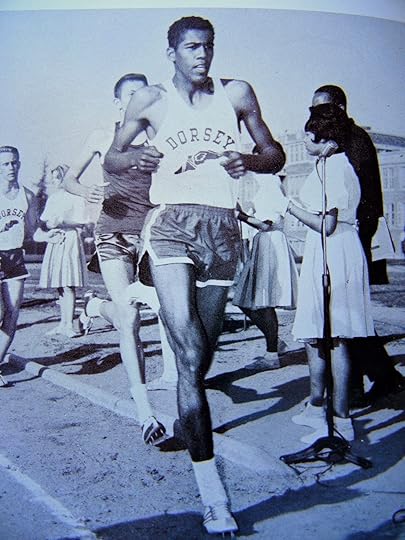 Wellington Stanislaus (Stan), star athlete
In the busy times of young adulthood after college, they lost touch with each other for many years, happily reuniting via Facebook when both were over 65. Now they call each other several times a week -- Stan from his home in Central California or Bob from our home in Arizona.
Bob has offered support during Stan's recent orthopedic surgeries and Stan has offered his unfailing optimism to Bob who battles cyclical depressions.
"Just a minute!" I told Stan. "Bob is right here."
"Wait!" Stan cried. "I was calling you. I heard a saying the other day that really meant a lot to me and I think you'd like it, too."
"Oh," I said, a little surprised. "What is it?"
"Those who expect happiness only from sunshine have never danced in the rain."
I smiled at the saying. Stan was right. I was intrigued.
It seemed to me to be about the possibility of finding joy in all seasons -- all seasons of the year, all the seasons of one's life.
It seemed to be about the joy and the pain that are part of all our lives and how our bittersweet experiences give us greater hope in the dark times and greater appreciation for the sunshine in our lives.
It seemed to be about finding joy amidst sorrow, those moments of levity that make us stronger for the next wave of pain.
It seemed to be about re-discovering hope and happiness after a painful life transition.
It seemed to be about experiencing life fully and joyfully every day of our lives.
I thought about the ebb and flow of happiness in my own life -- of times when happiness was an elusive major expectation and of times when it caught me by surprise.
I thought about what I knew of Stan's life experiences -- the career challenges, the devastating losses, the disappointments, the dreams that didn't come true -- and I suddenly understood much better this spirit suffused with joy, even when days are dark and the forecast is unrelentingly stormy.
This is a man who knows all about dancing in the rain.
It was Stan, my husband's best friend from high school. Although we have never met in person, I had heard about Stan for years: how Stan, a star athlete and leading member of the school's popular crowd, befriended Bob when he came to the school as a shy and uncertain new junior; how Stan helped him to get a memorable summer job at a camp for blind children where they both worked during college; how Stan offered him shelter and support when Bob's father threw him out of the house because he was working at the camp instead of at a higher paying summer job.
 Wellington Stanislaus (Stan), star athlete
In the busy times of young adulthood after college, they lost touch with each other for many years, happily reuniting via Facebook when both were over 65. Now they call each other several times a week -- Stan from his home in Central California or Bob from our home in Arizona.
Bob has offered support during Stan's recent orthopedic surgeries and Stan has offered his unfailing optimism to Bob who battles cyclical depressions.
"Just a minute!" I told Stan. "Bob is right here."
"Wait!" Stan cried. "I was calling you. I heard a saying the other day that really meant a lot to me and I think you'd like it, too."
"Oh," I said, a little surprised. "What is it?"
"Those who expect happiness only from sunshine have never danced in the rain."
I smiled at the saying. Stan was right. I was intrigued.
It seemed to me to be about the possibility of finding joy in all seasons -- all seasons of the year, all the seasons of one's life.
It seemed to be about the joy and the pain that are part of all our lives and how our bittersweet experiences give us greater hope in the dark times and greater appreciation for the sunshine in our lives.
It seemed to be about finding joy amidst sorrow, those moments of levity that make us stronger for the next wave of pain.
It seemed to be about re-discovering hope and happiness after a painful life transition.
It seemed to be about experiencing life fully and joyfully every day of our lives.
I thought about the ebb and flow of happiness in my own life -- of times when happiness was an elusive major expectation and of times when it caught me by surprise.
I thought about what I knew of Stan's life experiences -- the career challenges, the devastating losses, the disappointments, the dreams that didn't come true -- and I suddenly understood much better this spirit suffused with joy, even when days are dark and the forecast is unrelentingly stormy.
This is a man who knows all about dancing in the rain.
March 5, 2014
The Many Shades of Beautiful
It's a memory that has stayed with me: my Hawaiian friend Jeanne Nishida, whose parents' ancestries were Chinese and Japanese, was sitting up late with me in our college dorm talking about her self-image growing up. One of a small minority of Asian students at Northwestern at that time, Jeanne was used to feeling different, even when growing up in Hilo, Hawaii. There were no beauty role models who looked like her in mainstream American culture. As a child, she used to amuse both family and tourists by saying that she wanted to be Betty Grable when she grew up.
We laughed when she told the story, but inside I felt a twinge of sadness that my dear friend had grown up wishing to be fair and blonde. "Either that or that I would wake up and be a lovely Chinese Hawaiian," she said recently. "But by the time I was eight, I realized that wasn't going to happen."
In college, where I met her, life wasn't always easy for Jeanne because she didn't fit the old stereotype that many had at that time of a tiny, sweet, shy, submissive Asian woman. She was -- and is -- smart and strong and not afraid to voice her opinions. She loves sports -- and ended up with a marriage made in heaven, to Jimmy Yagi, the (now retired) basketball coach of the University of Hawaii, Hilo Vulcans. She is a "what you see is what you get" sort of person, without pretense. She is loyal and funny and loving, the very best kind of friend to have.
I always thought she was beautiful, both inside and out. It took some time for Jeanne to realize her very special beauty.
I saw this scenario often when I was a psychotherapist for several psychiatric clinics dedicated to those with life-changing or life-threatening illnesses or injuries. I had patients of all colors and ethnicities and was often surprised and saddened by the stories of discrimination, even within families, against those who were more dark-skinned than others. One client, Diana, was from Guyana and her lighter-skinned family was ashamed of her darker skin and hadn't included her in many family activities when she was growing up. The pain lingered in her heart, even as she won college scholarships, work accolades and traveled the world. She was one of the most fascinating, warm and beautiful women I have ever met, but what she wanted most in life was to be embraced and accepted and loved and to have a sense of fitting in. She longed to belong and struggled to see the beauty -- both inside and out -- that was so evident to those who knew and loved her.
And I've seen this in my own family when my sister-in-law Jinjuta remembers the pain of growing up feeling distinctly unbeautiful because of her darker skin, typical of her Northern Thailand origins. It's painful to think of this lovely, smart, and wonderfully kind woman having a moment's doubt about her singular beauty and intrinsic worth.
Jeanne sent me a video the other day of the lovely and talented Lupita Nyong'o, giving a speech several days before her Academy Award triumph, and talking about growing up in Kenya as a dark-skinned woman. It took her some years to realize what real beauty is and to feel this within.
What an amazing story to hear from a young woman who has become not only a celebrated actress but also a beauty icon in the past few months. And how her message that real beauty is goodness and compassion and love resonates.
It's a message that so many young girls need to hear -- both girls of color and girls who are simply plagued by adolescent self-criticism or by the pain of not fitting neatly into society's standards of beautiful.
It's a message that we also need to hear and remember as we age and as traditional, youthful beauty fades into memory. We need to remember that there are many shades and many seasons of beauty and that the greatest measure of beauty is not light skin or youth or a lithe, slim body, but a loving heart and generous, compassionate spirit.

February 26, 2014
Rethinking Retirement
When I called my friend Chuck, a busy and successful physician, to wish him a happy 69th birthday earlier this month, his voice was filled with stress and exhaustion.
"I'm so glad that this will be my last working birthday," he said. "I'm getting too old for this -- seeing a patient every 15 minutes and working every other weekend. I just don't have the energy anymore."
He told me that while he might hang onto his medical license, he had no intention of doing any work -- ever -- after his retirement this coming July.
I recognized the exhaustion, the longing for leisure. But, from the vantage point of four years into retirement, living the total immersion experience in an active adult -- mostly retired -- community, I choked back a cautionary response.
Retirement may be a shock for this hard-working -- and much feted -- professional.
He may struggle with identity once the accolades cease and the role he has played for more than 40 years is in the past.
Or maybe not.
Maybe his love of travel -- and his means to do all the traveling he could imagine -- will be sustaining. Maybe the luxury of just being, just living quietly, in his lovely home with his partner of 35 years will be a dream come true.
It's so hard to predict how retirement will play out for an individual once the initial euphoria over not having to get up at a certain hour, not having to commute or to deal with office politics or overwhelming work loads has passed.
We each build our own retirement lifestyle. For some it is, indeed a dream come true. For others, it is a miasma of boredom, conflict and loss.
What can make the difference?
A realistic pre-retirement wish list. Take a close and hard look at your financial situation and what is possible before you retire. If extensive travel is beyond your means, can you be happy with day trips closer to home? Or relocating to a spot that feels like you're on vacation? If you want to maintain a lifestyle that may be difficult with retirement income, would it be worth it to you to work some years longer to build your retirement savings?
In addition to dollars and cents, consider genetics, your health and the march of time in this mix. How is your health now? How have your family elders fared in their later years? Will postponing your retirement and travels preclude certain adventures that time and aging may make impossible? Some travels may need to be vacations now, not later. Weigh the possibilities. What can you live without -- and what is critical to your retirement happiness?
And what interests and hobbies are on your list to pursue once retired? If that list is non-existent or very short, think again. In my own observations of many retired people here, the ones who tend to struggle the most post-retirement are those who did not have a plan once work stopped. Far too many spend endless hours staring at a television screen and wondering what to do with themselves.
Another consideration for retirement choices: the growing and changing of your family. I've seen so many people choose to age in place to be near grandchildren or to move to be close to family -- only to find that grandchildren with busy schedules don't have as much time as the grandparents had hoped to hang out with them. Or kids get job transfers that take them away. Or they want to spend more time with their kids without extended kin -- which means you -- and you may see much less of all of them than you had hoped. Certainly, family and dear friends are a consideration in your decision to move or stay, but they can't be the major reason for a decision one way or another -- because so much can change.
A compromise in lifestyle choices. It's certainly not uncommon for a lot of post-retirement restlessness and disappointment to come as a result of spouses disagreeing on lifestyle.
One partner may want to move to a warmer location while the other prefers to stay put near family and friends. Looking at your own situation, what might work for both of you? Perhaps you'll choose to stay put for now with regular vacations to the sunbelt. Or move to the sunbelt with regular trips back to see friends and relatives. About half of our community here in Arizona are "snowbirds" who have primary homes elsewhere but who spend winters here in the sun. That's a great compromise for those who can afford to buy a second home -- or to rent for the winter months.
For those who have to make a hard choice about the location of their one home, it's important for partners to listen and to try to understand each other's reasons behind preferences for home location and lifestyle.
One neighbor couple made the decision to relocate here after a serious discussion of priorities. They had been married for more than forty years and he had married her when she was a young, divorced single mother with a toddler son. After they added another son to the mix, their life was devoted to raising the kids and, with time, with helping to raise the grandkids. The man not only longed for life in a sunnier climate, but also wanted -- at long last -- more quality time with his wife without extended family around on a daily basis. She had vigorously opposed a move away from kin, but as they talked about why he wanted to move, she began to see his point of view. They made an agreement: they would move. But they would also return to visit family for the holidays each year and every summer, they would take a vacation with the whole family. So far, nearly five years into this arrangement, all is well.
Another frequent area of conflict is in daily tasks: one partner, citing retirement, sits and simply watches or, worse, directs the action -- as the other spouse tackles all the household tasks. You may find peace in compromising on housework so that both partners can have more leisure. For some couples, this means sharing tasks more equally -- recognizing that homemakers deserve some respite as well in retirement. For others, it can mean paying for professional yard services or house cleaning. For still others, it has meant taking a chore and turning it into a hobby: a number of couples here are enthusiastic members of the community cooking club -- trying and testing new recipes as the couples cook together, progressing way beyond the mindset of "Hey, honey! What's for dinner?"
Giving yourself permission to change your mind. Your choice of a retirement lifestyle doesn't have to be set in stone. One couple I know imagined spending their retirement on the road as carefree RVers, but found that they missed a sense of community. So they amended their retirement plans a bit: now they spend half the year on the road in their RV and the other six months as active members of this community.
But it's important to realize that some decisions are harder than others to undo -- e.g. giving up a career and letting time pass and then trying to get back into the job market. It can make sense to hang onto a professional license or to keep your hand in your work part-time if cold turkey full-time retirement feels too intimidating and final. While a number of aging Boomers plan to work part-time during at least the early years of retirement, it's often easiest to realize that dream of working part-time by continuing to work fewer hours for the same employer or in the same profession, perhaps on a consulting basis, or by reinventing yourself in your own business. Getting a new job in your sixties and beyond isn't impossible, but it can be a challenge.
Sometimes -- overwhelmed with exhaustion, burnout or aggravation -- we idealize the freedom of retirement and minimize how much work means to us.
Make no mistake: I still have moments of euphoria on a weekday when I can sleep until 8 a.m. if I choose instead of getting up at 4:30 a.m. and sprinting for the commuter bus. I still feel delight on a Sunday when I can linger over coffee and newspapers instead of working a stressful 9 hour shift seeing mostly court-ordered patients -- as I did during a two-year clinical internship 20 years ago -- which I loathed so much (mostly due to the management's mistreatment of interns) that I still marvel to find my Sundays free.
That said, I didn't realize how much I had missed certain aspects of my previous work life until I sold a book -- my first in six years -- to a major publisher recently and found myself working feverishly with a tight deadline.
Of course, I moaned and complained as I always have about deadlines. But I also felt energized and joyous most days as I worked on the book. It had been far too long since I had found myself totally immersed in a writing project. And this book was a departure from my usual themes: "Purr Therapy" is a memoir about two cats who worked with me periodically in my private psychotherapy practice to help soothe and calm anxious patients. So, in part, the book is also a memoir about my career as a psychotherapist, a career I chose to give up when I retired (though I've retained my professional license in California).
Writing the book reminded me how much I had loved my career as a therapist and what joy writing brought to my life. I always imagined my work as a writer figuring prominently into my retirement years. But I didn't realize how important writing was to my sense of well-being until I was hard at work again. I now envision a bit more work and a little less leisure in my future.
Making the decision to retire in stages. An increasing number of our generation are choosing to retire in stages instead of stopping all work suddenly. A number of people I know are still working part-time or are active volunteers. Letting go of work in stages can be an ideal solution if your work means a great deal to you or if financial considerations preclude retirement as early as you would like.
Bob's most fervent desire was to retire at 62. But we ran the numbers and found that, with my work situation, with some years to go before I could qualify for a pension from my workplace, and with realities like a mortgage, full retirement at that early age for him just wasn't a reasonable choice, long-term, for us. However, Bob found a good compromise: he opted for a new, reduced work schedule -- taking a cut in pay for a four day work week. Fridays became precious to him, a preview of freedom to come, over the four years he waited for full retirement.
Keeping your mind open to new possibilities. Times and feelings and people change. When endless days of golf began to get boring, some neighbors got into volunteer work at the local elementary school or the Food Bank or the county animal shelter. Some found themselves pursuing political or social activism. "I couldn't have imagined that I'd be doing this!" one friend said, smiling in sudden amazement, as we stood on a picket line protesting a proposed copper mine near our community.
As we were ending our birthday phone conversation, Chuck sighed as his nurse reminded him that yet another patient was waiting. "Well, who knows?" he said. "I think I will keep my license just in case. I don't want to work for money ever again, but, now that I think of it, it might be good to use my medical skills to volunteer. I think I might really enjoy volunteer work...."
I smiled and we agreed -- retirement brings so many possibilities for contentment, for fun and growth and for joy in doing work we love and giving to others.
"I'm so glad that this will be my last working birthday," he said. "I'm getting too old for this -- seeing a patient every 15 minutes and working every other weekend. I just don't have the energy anymore."
He told me that while he might hang onto his medical license, he had no intention of doing any work -- ever -- after his retirement this coming July.
I recognized the exhaustion, the longing for leisure. But, from the vantage point of four years into retirement, living the total immersion experience in an active adult -- mostly retired -- community, I choked back a cautionary response.
Retirement may be a shock for this hard-working -- and much feted -- professional.
He may struggle with identity once the accolades cease and the role he has played for more than 40 years is in the past.
Or maybe not.
Maybe his love of travel -- and his means to do all the traveling he could imagine -- will be sustaining. Maybe the luxury of just being, just living quietly, in his lovely home with his partner of 35 years will be a dream come true.
It's so hard to predict how retirement will play out for an individual once the initial euphoria over not having to get up at a certain hour, not having to commute or to deal with office politics or overwhelming work loads has passed.
We each build our own retirement lifestyle. For some it is, indeed a dream come true. For others, it is a miasma of boredom, conflict and loss.
What can make the difference?
A realistic pre-retirement wish list. Take a close and hard look at your financial situation and what is possible before you retire. If extensive travel is beyond your means, can you be happy with day trips closer to home? Or relocating to a spot that feels like you're on vacation? If you want to maintain a lifestyle that may be difficult with retirement income, would it be worth it to you to work some years longer to build your retirement savings?
In addition to dollars and cents, consider genetics, your health and the march of time in this mix. How is your health now? How have your family elders fared in their later years? Will postponing your retirement and travels preclude certain adventures that time and aging may make impossible? Some travels may need to be vacations now, not later. Weigh the possibilities. What can you live without -- and what is critical to your retirement happiness?
And what interests and hobbies are on your list to pursue once retired? If that list is non-existent or very short, think again. In my own observations of many retired people here, the ones who tend to struggle the most post-retirement are those who did not have a plan once work stopped. Far too many spend endless hours staring at a television screen and wondering what to do with themselves.
Another consideration for retirement choices: the growing and changing of your family. I've seen so many people choose to age in place to be near grandchildren or to move to be close to family -- only to find that grandchildren with busy schedules don't have as much time as the grandparents had hoped to hang out with them. Or kids get job transfers that take them away. Or they want to spend more time with their kids without extended kin -- which means you -- and you may see much less of all of them than you had hoped. Certainly, family and dear friends are a consideration in your decision to move or stay, but they can't be the major reason for a decision one way or another -- because so much can change.
A compromise in lifestyle choices. It's certainly not uncommon for a lot of post-retirement restlessness and disappointment to come as a result of spouses disagreeing on lifestyle.
One partner may want to move to a warmer location while the other prefers to stay put near family and friends. Looking at your own situation, what might work for both of you? Perhaps you'll choose to stay put for now with regular vacations to the sunbelt. Or move to the sunbelt with regular trips back to see friends and relatives. About half of our community here in Arizona are "snowbirds" who have primary homes elsewhere but who spend winters here in the sun. That's a great compromise for those who can afford to buy a second home -- or to rent for the winter months.
For those who have to make a hard choice about the location of their one home, it's important for partners to listen and to try to understand each other's reasons behind preferences for home location and lifestyle.
One neighbor couple made the decision to relocate here after a serious discussion of priorities. They had been married for more than forty years and he had married her when she was a young, divorced single mother with a toddler son. After they added another son to the mix, their life was devoted to raising the kids and, with time, with helping to raise the grandkids. The man not only longed for life in a sunnier climate, but also wanted -- at long last -- more quality time with his wife without extended family around on a daily basis. She had vigorously opposed a move away from kin, but as they talked about why he wanted to move, she began to see his point of view. They made an agreement: they would move. But they would also return to visit family for the holidays each year and every summer, they would take a vacation with the whole family. So far, nearly five years into this arrangement, all is well.
Another frequent area of conflict is in daily tasks: one partner, citing retirement, sits and simply watches or, worse, directs the action -- as the other spouse tackles all the household tasks. You may find peace in compromising on housework so that both partners can have more leisure. For some couples, this means sharing tasks more equally -- recognizing that homemakers deserve some respite as well in retirement. For others, it can mean paying for professional yard services or house cleaning. For still others, it has meant taking a chore and turning it into a hobby: a number of couples here are enthusiastic members of the community cooking club -- trying and testing new recipes as the couples cook together, progressing way beyond the mindset of "Hey, honey! What's for dinner?"
Giving yourself permission to change your mind. Your choice of a retirement lifestyle doesn't have to be set in stone. One couple I know imagined spending their retirement on the road as carefree RVers, but found that they missed a sense of community. So they amended their retirement plans a bit: now they spend half the year on the road in their RV and the other six months as active members of this community.
But it's important to realize that some decisions are harder than others to undo -- e.g. giving up a career and letting time pass and then trying to get back into the job market. It can make sense to hang onto a professional license or to keep your hand in your work part-time if cold turkey full-time retirement feels too intimidating and final. While a number of aging Boomers plan to work part-time during at least the early years of retirement, it's often easiest to realize that dream of working part-time by continuing to work fewer hours for the same employer or in the same profession, perhaps on a consulting basis, or by reinventing yourself in your own business. Getting a new job in your sixties and beyond isn't impossible, but it can be a challenge.
Sometimes -- overwhelmed with exhaustion, burnout or aggravation -- we idealize the freedom of retirement and minimize how much work means to us.
Make no mistake: I still have moments of euphoria on a weekday when I can sleep until 8 a.m. if I choose instead of getting up at 4:30 a.m. and sprinting for the commuter bus. I still feel delight on a Sunday when I can linger over coffee and newspapers instead of working a stressful 9 hour shift seeing mostly court-ordered patients -- as I did during a two-year clinical internship 20 years ago -- which I loathed so much (mostly due to the management's mistreatment of interns) that I still marvel to find my Sundays free.
That said, I didn't realize how much I had missed certain aspects of my previous work life until I sold a book -- my first in six years -- to a major publisher recently and found myself working feverishly with a tight deadline.
Of course, I moaned and complained as I always have about deadlines. But I also felt energized and joyous most days as I worked on the book. It had been far too long since I had found myself totally immersed in a writing project. And this book was a departure from my usual themes: "Purr Therapy" is a memoir about two cats who worked with me periodically in my private psychotherapy practice to help soothe and calm anxious patients. So, in part, the book is also a memoir about my career as a psychotherapist, a career I chose to give up when I retired (though I've retained my professional license in California).
Writing the book reminded me how much I had loved my career as a therapist and what joy writing brought to my life. I always imagined my work as a writer figuring prominently into my retirement years. But I didn't realize how important writing was to my sense of well-being until I was hard at work again. I now envision a bit more work and a little less leisure in my future.
Making the decision to retire in stages. An increasing number of our generation are choosing to retire in stages instead of stopping all work suddenly. A number of people I know are still working part-time or are active volunteers. Letting go of work in stages can be an ideal solution if your work means a great deal to you or if financial considerations preclude retirement as early as you would like.
Bob's most fervent desire was to retire at 62. But we ran the numbers and found that, with my work situation, with some years to go before I could qualify for a pension from my workplace, and with realities like a mortgage, full retirement at that early age for him just wasn't a reasonable choice, long-term, for us. However, Bob found a good compromise: he opted for a new, reduced work schedule -- taking a cut in pay for a four day work week. Fridays became precious to him, a preview of freedom to come, over the four years he waited for full retirement.
Keeping your mind open to new possibilities. Times and feelings and people change. When endless days of golf began to get boring, some neighbors got into volunteer work at the local elementary school or the Food Bank or the county animal shelter. Some found themselves pursuing political or social activism. "I couldn't have imagined that I'd be doing this!" one friend said, smiling in sudden amazement, as we stood on a picket line protesting a proposed copper mine near our community.
As we were ending our birthday phone conversation, Chuck sighed as his nurse reminded him that yet another patient was waiting. "Well, who knows?" he said. "I think I will keep my license just in case. I don't want to work for money ever again, but, now that I think of it, it might be good to use my medical skills to volunteer. I think I might really enjoy volunteer work...."
I smiled and we agreed -- retirement brings so many possibilities for contentment, for fun and growth and for joy in doing work we love and giving to others.
Kathy McCoy's Blog

- Kathy McCoy's profile
- 5 followers
Kathy McCoy isn't a Goodreads Author
(yet),
but they
do have a blog,
so here are some recent posts imported from
their feed.

