
Kathy McCoy's Blog, page 11
October 31, 2014
The Land of Smiles -- and Many Holidays!
If you want to find a spirit of celebration all around you, Thailand is the place to be.
The Land of Smiles -- despite recent political unrest -- happily celebrates all holidays -- their own and those belonging to different cultures.
When Bob and I visited my brother Mike and his wife Jinjunta in Bangkok for Christmas and New Year's - 2006-2007 - we were amazed at the Christmas decorations and music all around us, some of the songs translated to Thai, some of the music played on Asian instruments giving the familiar tunes a whole different lilt. Although Thailand is largely Buddhist with a Muslim minority in the southern part of the country, Christmas spirit abounds there during our holiday season, even as they celebrate a cherished holiday of their own: their beloved King's birthday.
Another major holiday is the April Water Festival, as the always warm weather gets even hotter, where people happily throw water on each other as they celebrate the season -- right along with the Christian Easter.
Now pictures from Mike and Jinjunta, joined by their children Maggie, 5, and Henry, 2, show that Halloween is also observed in Thailand. But it is Halloween with a Thai twist: instead of begging for candy from neighbors, kids fill a candy bag at home and take it to school, exchanging candy with their classmates, getting the experience of giving as well as taking.
 Maggie's kindergarten class all ready for Halloween Thai-style
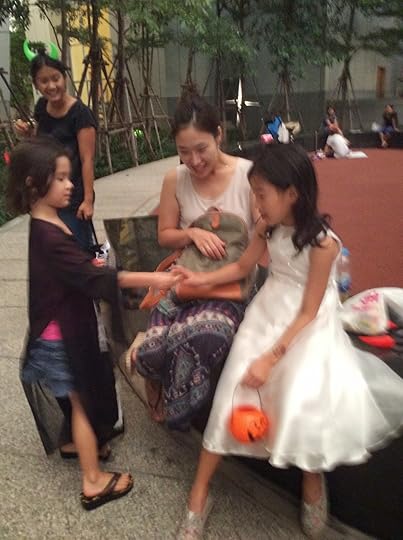 Maggie, left, exchanges candy with a classmate
This is a land that cherishes its own traditions and takes pride in the fact that it was never a Western colony. Nevertheless, Thailand embraces other cultures' causes for celebration with such endearing enthusiasm, one can't help but smile!
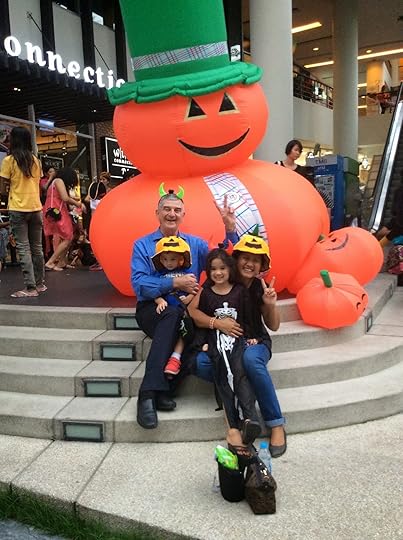 Mike, Henry, Maggie, Jinjuta: Happy Halloween!
[image error]
The Land of Smiles -- despite recent political unrest -- happily celebrates all holidays -- their own and those belonging to different cultures.
When Bob and I visited my brother Mike and his wife Jinjunta in Bangkok for Christmas and New Year's - 2006-2007 - we were amazed at the Christmas decorations and music all around us, some of the songs translated to Thai, some of the music played on Asian instruments giving the familiar tunes a whole different lilt. Although Thailand is largely Buddhist with a Muslim minority in the southern part of the country, Christmas spirit abounds there during our holiday season, even as they celebrate a cherished holiday of their own: their beloved King's birthday.
Another major holiday is the April Water Festival, as the always warm weather gets even hotter, where people happily throw water on each other as they celebrate the season -- right along with the Christian Easter.
Now pictures from Mike and Jinjunta, joined by their children Maggie, 5, and Henry, 2, show that Halloween is also observed in Thailand. But it is Halloween with a Thai twist: instead of begging for candy from neighbors, kids fill a candy bag at home and take it to school, exchanging candy with their classmates, getting the experience of giving as well as taking.
 Maggie's kindergarten class all ready for Halloween Thai-style
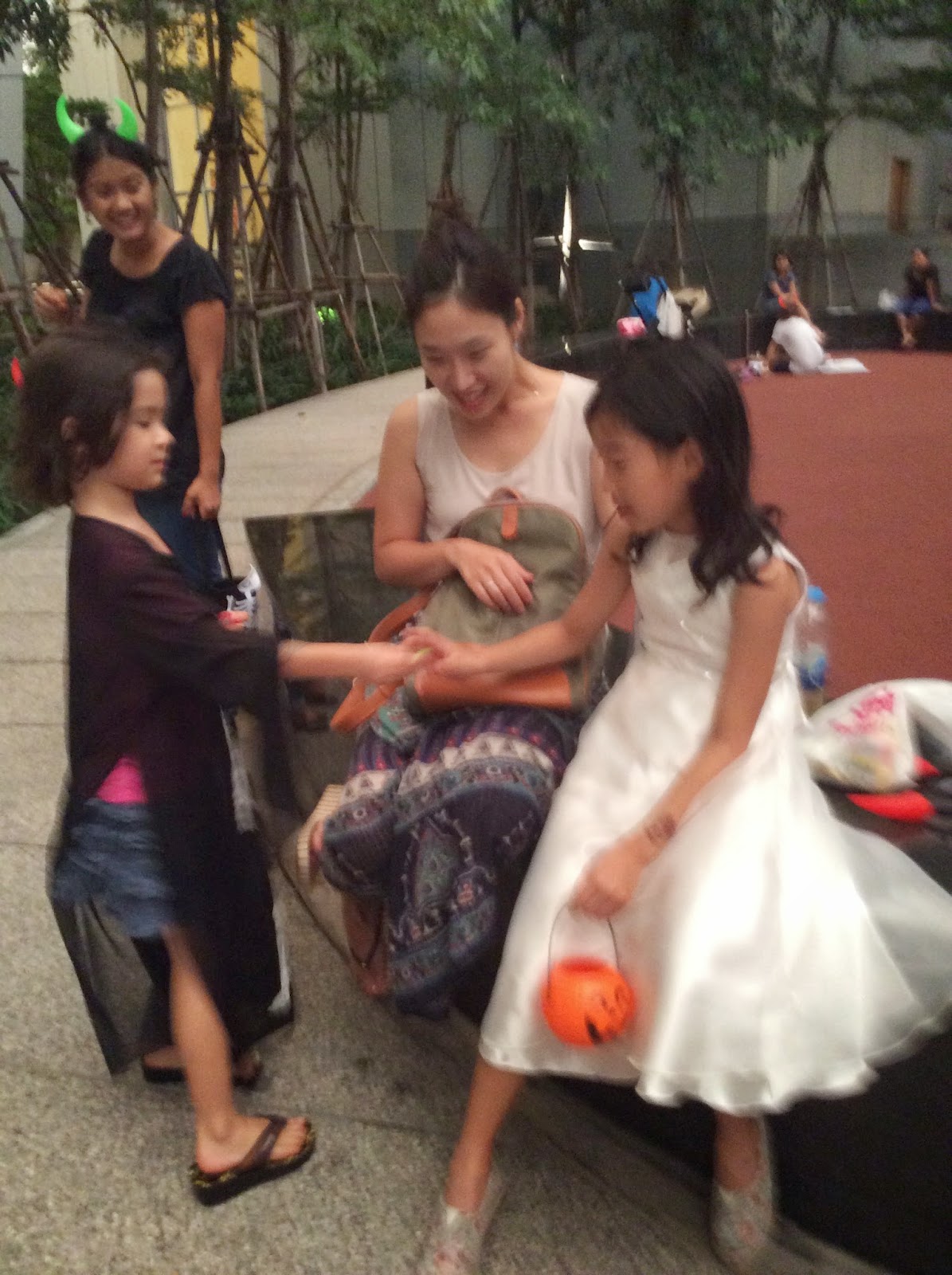 Maggie, left, exchanges candy with a classmate
This is a land that cherishes its own traditions and takes pride in the fact that it was never a Western colony. Nevertheless, Thailand embraces other cultures' causes for celebration with such endearing enthusiasm, one can't help but smile!
 Mike, Henry, Maggie, Jinjuta: Happy Halloween!
[image error]


The Land of Smiles -- and Many Holidays!
If you want to find a spirit of celebration all around you, Thailand is the place to be.
The Land of Smiles -- despite recent political unrest -- happily celebrates all holidays -- their own and those belonging to different cultures.
When Bob and I visited my brother Mike and his wife Jinjunta in Bangkok for Christmas and New Year's - 2006-2007 - we were amazed at the Christmas decorations and music all around us, some of the songs translated to Thai, some of the music played on Asian instruments giving the familiar tunes a whole different lilt. Although Thailand is largely Buddhist with a Muslim minority in the southern part of the country, Christmas spirit abounds there during our holiday season, even as they celebrate a cherished holiday of their own: their beloved King's birthday.
Another major holiday is the April Water Festival, as the always warm weather gets even hotter, where people happily throw water on each other as they celebrate the season -- right along with the Christian Easter.
Now pictures from Mike and Jinjunta, joined by their children Maggie, 5, and Henry, 2, show that Halloween is also observed in Thailand. But it is Halloween with a Thai twist: instead of begging for candy from neighbors, kids fill a candy bag at home and take it to school, exchanging candy with their classmates, getting the experience of giving as well as taking.
Maggie's kindergarten class all ready for Halloween Thai-style
Maggie, left, exchanges candy with a classmate
This is a land that cherishes its own traditions and takes pride in the fact that it was never a Western colony. Nevertheless, Thailand embraces other cultures' causes for celebration with such endearing enthusiasm, one can't help but smile!
Mike, Henry, Maggie, Jinjuta: Happy Halloween!

The Land of Smiles -- despite recent political unrest -- happily celebrates all holidays -- their own and those belonging to different cultures.
When Bob and I visited my brother Mike and his wife Jinjunta in Bangkok for Christmas and New Year's - 2006-2007 - we were amazed at the Christmas decorations and music all around us, some of the songs translated to Thai, some of the music played on Asian instruments giving the familiar tunes a whole different lilt. Although Thailand is largely Buddhist with a Muslim minority in the southern part of the country, Christmas spirit abounds there during our holiday season, even as they celebrate a cherished holiday of their own: their beloved King's birthday.
Another major holiday is the April Water Festival, as the always warm weather gets even hotter, where people happily throw water on each other as they celebrate the season -- right along with the Christian Easter.
Now pictures from Mike and Jinjunta, joined by their children Maggie, 5, and Henry, 2, show that Halloween is also observed in Thailand. But it is Halloween with a Thai twist: instead of begging for candy from neighbors, kids fill a candy bag at home and take it to school, exchanging candy with their classmates, getting the experience of giving as well as taking.
Maggie's kindergarten class all ready for Halloween Thai-style
Maggie, left, exchanges candy with a classmateThis is a land that cherishes its own traditions and takes pride in the fact that it was never a Western colony. Nevertheless, Thailand embraces other cultures' causes for celebration with such endearing enthusiasm, one can't help but smile!
Mike, Henry, Maggie, Jinjuta: Happy Halloween!
September 29, 2014
A Message From The Heart
While reading the Sunday New York Times yesterday, I came upon an article that make me sit up, take notice....and remember.
It was an opinion piece by Martha Weinman Lear, author of the books "Heartsounds" and "Echoes of Heartsounds". Her books had been about her late husband's series of heart attacks before the final one that took his life. This article was about her own heart attack.
Like many women, she did not have the classic chest-clutching pain. Instead, she felt suddenly ill with a fluttering in the chest, chills, vomiting and diarrhea. She called her doctor immediately.
It was the diarrhea that threw him off and made him decide that she had "a stomach bug."
But still he scheduled her for an EKG the next morning. What that test revealed was that she had had a heart attack. Not a mild one nor a massive one. But a substantial one. She was admitted to the hospital immediately.
Lear was lucky -- lucky that the heart attack was not massive, lucky that she had a physician willing to run a cardiac test. In the not so distant past, research on women's cardiac problems was scant and the fact that women often exhibit quite different symptoms was not recognized until quite recently. Traditionally, men showing symptoms of a heart attack have been treated appropriately and aggressively while women reporting the same symptoms have often received a psychiatric diagnosis.
Lear reported that this gender bias in diagnosis only began to change in 2001 after a study from the U.S. Institute of Medicine confirmed significant gender bias in all areas of medical research. Still, she says, women make up only 24 percent of participants in heart-related studies. But there is hope. She reported that only a few days ago, the National Institutes of Health announced that it will give grants totaling $10.1 million for scientists to include more women in clinical trials.
So there is progress. Now we need to get past lack of information and outright denial on a personal level.
And I know a lot about that, reliving my own as the memories came back.
It was a bright late August Saturday in 2003. I woke up feeling good and ready for a busy day. I had cancelled my Saturday patients at my private psychotherapy practice that day because of a schedule conflict with one of my other two jobs -- this one the admissions representative job for Northwestern University. I was due at a picnic at a lovely park in Santa Monica -- about 40 miles from my home -- honoring the entering freshman from the Southern California area. Several alums would also be attending to give information and encouragement to the enrolling students and their parents. And I was to host the event and furnish the food -- heaping platters of deli sandwiches I would pick up locally and transport to the park.
But before hitting the deli, I decided to go to my private practice office to finish up some paperwork. There was plenty of time. I sat down at my desk, pulled out an insurance company file and started writing. Suddenly, I went from feeling fine to feeling terrible.
It happened in an instant. I felt dizzy, a fluttering in my chest and broke out in a cold sweat. I fell to the floor and passed out. When I came to, I felt extreme nausea and overwhelming fatigue. I crawled on my hands and knees to the adjacent private bathroom in my office and, for the next half hour, alternated between bouts of vomiting and diarrhea.
Then most of the symptoms passed except the weakness and fatigue. I crawled from the bathroom to the couch and lay there considering my options. Going to the emergency room was not among them. In my tunnel vision, all I could think about was the picnic. I had to go. I had to get the food there. It was my job. People were depending on me. It never occurred to me to call one of the alums and ask him to come up to Santa Clarita and pick up the pre-paid for food at the deli and to send my regrets. My only options, as I lay there considering them, were to do it all myself or ask my husband Bob for help. I realized, at last, that I couldn't, shouldn't, drive. I picked up the phone and called Bob.
When he arrived, looking concerned, I minimized my symptoms. "It was probably a touch of food poisoning or something," I said, ignoring the fact that he and I had eaten the same dinner the night before and the same breakfast that morning and he had no symptoms whatsoever. "I'll be fine. I just need you to do the driving this morning."
So we picked up the sandwiches and transported them to the park. Steve, then head of the alum volunteer group, looked at me closely as he took the sandwich platters from Bob. "Are you okay?" he asked, putting a hand on my arm. I was still feeling so weak and fatigued, I could barely stand.
"I'm a little under the weather today," I said, averting my face lest he see the extent of my distress. "Could you please host this event today? Do you mind? I think I need to go home."
"Of course," Steve said, putting an arm around me. "I wish you had called me before. I would have taken a swing up your way to pick up the food so you wouldn't have to come all this way. I'll handle this. You take care of yourself."
But I didn't. Slumped in the front seat on our drive back home, I got a call on my cell phone from a friend who happened to be a doctor. I told him about my symptoms and he started yelling "Why aren't you in the emergency room??? Go to the emergency room NOW!!!" I nodded and hug up. Bob looked at me curiously.
"What was that all about?"
I sighed. "Oh, Larry...you know, he's so excitable. He thinks I should go to the emergency room."
"If he thinks so, you should. The Kaiser hospital is two off-ramps away. Let's stop by there and just be sure this isn't anything serious."
I shrugged. "They'll just tell me I have the flu or food poisoning and I'd feel silly. Let's just go home. I want to sleep this off."
So I did. And I was lucky: I woke up. Feeling better.
But Larry had called every emergency room in the area to see if I was there. He was frantic over my lack of interest in getting tested and treated. He fumed at me for a long time. But it took me three years to go for a cardiac exam because, well, I was so busy. I didn't get those cardiac tests until 2006 when I was entering a medically supervised weight loss program at UCLA Medical Center. It was then that my cardiac problems became real to me and that I knew the terrible risk I had taken three years before when my fatigue and denial had kept me from seeking immediate help.
My subsequent reading about the differing symptoms for women's heart attacks, most recently Martha Weinman Lear's New York Times article, has been instructive and alarming and has made me want to spread the word.
If you have any of the following symptoms, particularly in combination, seek medical help immediately : sudden neck, shoulder or back pain, chills, cold sweat, nausea, vomiting, diarrhea, pressure in the chest area.
Please don't do what I did.
My tunnel vision about work obligations, my habitual busyness, my skewed priorities and my denial that anything serious was wrong could have killed me on that sunny Saturday eleven years ago.
I'm profoundly grateful to have lived to tell this cautionary tale.[image error]
It was an opinion piece by Martha Weinman Lear, author of the books "Heartsounds" and "Echoes of Heartsounds". Her books had been about her late husband's series of heart attacks before the final one that took his life. This article was about her own heart attack.
Like many women, she did not have the classic chest-clutching pain. Instead, she felt suddenly ill with a fluttering in the chest, chills, vomiting and diarrhea. She called her doctor immediately.
It was the diarrhea that threw him off and made him decide that she had "a stomach bug."
But still he scheduled her for an EKG the next morning. What that test revealed was that she had had a heart attack. Not a mild one nor a massive one. But a substantial one. She was admitted to the hospital immediately.
Lear was lucky -- lucky that the heart attack was not massive, lucky that she had a physician willing to run a cardiac test. In the not so distant past, research on women's cardiac problems was scant and the fact that women often exhibit quite different symptoms was not recognized until quite recently. Traditionally, men showing symptoms of a heart attack have been treated appropriately and aggressively while women reporting the same symptoms have often received a psychiatric diagnosis.
Lear reported that this gender bias in diagnosis only began to change in 2001 after a study from the U.S. Institute of Medicine confirmed significant gender bias in all areas of medical research. Still, she says, women make up only 24 percent of participants in heart-related studies. But there is hope. She reported that only a few days ago, the National Institutes of Health announced that it will give grants totaling $10.1 million for scientists to include more women in clinical trials.
So there is progress. Now we need to get past lack of information and outright denial on a personal level.
And I know a lot about that, reliving my own as the memories came back.
It was a bright late August Saturday in 2003. I woke up feeling good and ready for a busy day. I had cancelled my Saturday patients at my private psychotherapy practice that day because of a schedule conflict with one of my other two jobs -- this one the admissions representative job for Northwestern University. I was due at a picnic at a lovely park in Santa Monica -- about 40 miles from my home -- honoring the entering freshman from the Southern California area. Several alums would also be attending to give information and encouragement to the enrolling students and their parents. And I was to host the event and furnish the food -- heaping platters of deli sandwiches I would pick up locally and transport to the park.
But before hitting the deli, I decided to go to my private practice office to finish up some paperwork. There was plenty of time. I sat down at my desk, pulled out an insurance company file and started writing. Suddenly, I went from feeling fine to feeling terrible.
It happened in an instant. I felt dizzy, a fluttering in my chest and broke out in a cold sweat. I fell to the floor and passed out. When I came to, I felt extreme nausea and overwhelming fatigue. I crawled on my hands and knees to the adjacent private bathroom in my office and, for the next half hour, alternated between bouts of vomiting and diarrhea.
Then most of the symptoms passed except the weakness and fatigue. I crawled from the bathroom to the couch and lay there considering my options. Going to the emergency room was not among them. In my tunnel vision, all I could think about was the picnic. I had to go. I had to get the food there. It was my job. People were depending on me. It never occurred to me to call one of the alums and ask him to come up to Santa Clarita and pick up the pre-paid for food at the deli and to send my regrets. My only options, as I lay there considering them, were to do it all myself or ask my husband Bob for help. I realized, at last, that I couldn't, shouldn't, drive. I picked up the phone and called Bob.
When he arrived, looking concerned, I minimized my symptoms. "It was probably a touch of food poisoning or something," I said, ignoring the fact that he and I had eaten the same dinner the night before and the same breakfast that morning and he had no symptoms whatsoever. "I'll be fine. I just need you to do the driving this morning."
So we picked up the sandwiches and transported them to the park. Steve, then head of the alum volunteer group, looked at me closely as he took the sandwich platters from Bob. "Are you okay?" he asked, putting a hand on my arm. I was still feeling so weak and fatigued, I could barely stand.
"I'm a little under the weather today," I said, averting my face lest he see the extent of my distress. "Could you please host this event today? Do you mind? I think I need to go home."
"Of course," Steve said, putting an arm around me. "I wish you had called me before. I would have taken a swing up your way to pick up the food so you wouldn't have to come all this way. I'll handle this. You take care of yourself."
But I didn't. Slumped in the front seat on our drive back home, I got a call on my cell phone from a friend who happened to be a doctor. I told him about my symptoms and he started yelling "Why aren't you in the emergency room??? Go to the emergency room NOW!!!" I nodded and hug up. Bob looked at me curiously.
"What was that all about?"
I sighed. "Oh, Larry...you know, he's so excitable. He thinks I should go to the emergency room."
"If he thinks so, you should. The Kaiser hospital is two off-ramps away. Let's stop by there and just be sure this isn't anything serious."
I shrugged. "They'll just tell me I have the flu or food poisoning and I'd feel silly. Let's just go home. I want to sleep this off."
So I did. And I was lucky: I woke up. Feeling better.
But Larry had called every emergency room in the area to see if I was there. He was frantic over my lack of interest in getting tested and treated. He fumed at me for a long time. But it took me three years to go for a cardiac exam because, well, I was so busy. I didn't get those cardiac tests until 2006 when I was entering a medically supervised weight loss program at UCLA Medical Center. It was then that my cardiac problems became real to me and that I knew the terrible risk I had taken three years before when my fatigue and denial had kept me from seeking immediate help.
My subsequent reading about the differing symptoms for women's heart attacks, most recently Martha Weinman Lear's New York Times article, has been instructive and alarming and has made me want to spread the word.
If you have any of the following symptoms, particularly in combination, seek medical help immediately : sudden neck, shoulder or back pain, chills, cold sweat, nausea, vomiting, diarrhea, pressure in the chest area.
Please don't do what I did.
My tunnel vision about work obligations, my habitual busyness, my skewed priorities and my denial that anything serious was wrong could have killed me on that sunny Saturday eleven years ago.
I'm profoundly grateful to have lived to tell this cautionary tale.[image error]
A Message From The Heart
While reading the Sunday New York Times yesterday, I came upon an article that make me sit up, take notice....and remember.
It was an opinion piece by Martha Weinman Lear, author of the books "Heartsounds" and "Echoes of Heartsounds". Her books had been about her late husband's series of heart attacks before the final one that took his life. This article was about her own heart attack.
Like many women, she did not have the classic chest-clutching pain. Instead, she felt suddenly ill with a fluttering in the chest, chills, vomiting and diarrhea. She called her doctor immediately.
It was the diarrhea that threw him off and made him decide that she had "a stomach bug."
But still he scheduled her for an EKG the next morning. What that test revealed was that she had had a heart attack. Not a mild one nor a massive one. But a substantial one. She was admitted to the hospital immediately.
Lear was lucky -- lucky that the heart attack was not massive, lucky that she had a physician willing to run a cardiac test. In the not so distant past, research on women's cardiac problems was scant and the fact that women often exhibit quite different symptoms was not recognized until quite recently. Traditionally, men showing symptoms of a heart attack have been treated appropriately and aggressively while women reporting the same symptoms have often received a psychiatric diagnosis.
Lear reported that this gender bias in diagnosis only began to change in 2001 after a study from the U.S. Institute of Medicine confirmed significant gender bias in all areas of medical research. Still, she says, women make up only 24 percent of participants in heart-related studies. But there is hope. She reported that only a few days ago, the National Institutes of Health announced that it will give grants totaling $10.1 million for scientists to include more women in clinical trials.
So there is progress. Now we need to get past lack of information and outright denial on a personal level.
And I know a lot about that, reliving my own as the memories came back.
It was a bright late August Saturday in 2003. I woke up feeling good and ready for a busy day. I had cancelled my Saturday patients at my private psychotherapy practice that day because of a schedule conflict with one of my other two jobs -- this one the admissions representative job for Northwestern University. I was due at a picnic at a lovely park in Santa Monica -- about 40 miles from my home -- honoring the entering freshman from the Southern California area. Several alums would also be attending to give information and encouragement to the enrolling students and their parents. And I was to host the event and furnish the food -- heaping platters of deli sandwiches I would pick up locally and transport to the park.
But before hitting the deli, I decided to go to my private practice office to finish up some paperwork. There was plenty of time. I sat down at my desk, pulled out an insurance company file and started writing. Suddenly, I went from feeling fine to feeling terrible.
It happened in an instant. I felt dizzy, a fluttering in my chest and broke out in a cold sweat. I fell to the floor and passed out. When I came to, I felt extreme nausea and overwhelming fatigue. I crawled on my hands and knees to the adjacent private bathroom in my office and, for the next half hour, alternated between bouts of vomiting and diarrhea.
Then most of the symptoms passed except the weakness and fatigue. I crawled from the bathroom to the couch and lay there considering my options. Going to the emergency room was not among them. In my tunnel vision, all I could think about was the picnic. I had to go. I had to get the food there. It was my job. People were depending on me. It never occurred to me to call one of the alums and ask him to come up to Santa Clarita and pick up the pre-paid for food at the deli and to send my regrets. My only options, as I lay there considering them, were to do it all myself or ask my husband Bob for help. I realized, at last, that I couldn't, shouldn't, drive. I picked up the phone and called Bob.
When he arrived, looking concerned, I minimized my symptoms. "It was probably a touch of food poisoning or something," I said, ignoring the fact that he and I had eaten the same dinner the night before and the same breakfast that morning and he had no symptoms whatsoever. "I'll be fine. I just need you to do the driving this morning."
So we picked up the sandwiches and transported them to the park. Steve, then head of the alum volunteer group, looked at me closely as he took the sandwich platters from Bob. "Are you okay?" he asked, putting a hand on my arm. I was still feeling so weak and fatigued, I could barely stand.
"I'm a little under the weather today," I said, averting my face lest he see the extent of my distress. "Could you please host this event today? Do you mind? I think I need to go home."
"Of course," Steve said, putting an arm around me. "I wish you had called me before. I would have taken a swing up your way to pick up the food so you wouldn't have to come all this way. I'll handle this. You take care of yourself."
But I didn't. Slumped in the front seat on our drive back home, I got a call on my cell phone from a friend who happened to be a doctor. I told him about my symptoms and he started yelling "Why aren't you in the emergency room??? Go to the emergency room NOW!!!" I nodded and hug up. Bob looked at me curiously.
"What was that all about?"
I sighed. "Oh, Larry...you know, he's so excitable. He thinks I should go to the emergency room."
"If he thinks so, you should. The Kaiser hospital is two off-ramps away. Let's stop by there and just be sure this isn't anything serious."
I shrugged. "They'll just tell me I have the flu or food poisoning and I'd feel silly. Let's just go home. I want to sleep this off."
So I did. And I was lucky: I woke up. Feeling better.
But Larry had called every emergency room in the area to see if I was there. He was frantic over my lack of interest in getting tested and treated. He fumed at me for a long time. But it took me three years to go for a cardiac exam because, well, I was so busy. I didn't get those cardiac tests until 2006 when I was entering a medically supervised weight loss program at UCLA Medical Center. It was then that my cardiac problems became real to me and that I knew the terrible risk I had taken three years before when my fatigue and denial had kept me from seeking immediate help.
My subsequent reading about the differing symptoms for women's heart attacks, most recently Martha Weinman Lear's New York Times article, has been instructive and alarming and has made me want to spread the word.
If you have any of the following symptoms, particularly in combination, seek medical help immediately : sudden neck, shoulder or back pain, chills, cold sweat, nausea, vomiting, diarrhea, pressure in the chest area.
Please don't do what I did.
My tunnel vision about work obligations, my habitual busyness, my skewed priorities and my denial that anything serious was wrong could have killed me on that sunny Saturday eleven years ago.
I'm profoundly grateful to have lived to tell this cautionary tale.
It was an opinion piece by Martha Weinman Lear, author of the books "Heartsounds" and "Echoes of Heartsounds". Her books had been about her late husband's series of heart attacks before the final one that took his life. This article was about her own heart attack.
Like many women, she did not have the classic chest-clutching pain. Instead, she felt suddenly ill with a fluttering in the chest, chills, vomiting and diarrhea. She called her doctor immediately.
It was the diarrhea that threw him off and made him decide that she had "a stomach bug."
But still he scheduled her for an EKG the next morning. What that test revealed was that she had had a heart attack. Not a mild one nor a massive one. But a substantial one. She was admitted to the hospital immediately.
Lear was lucky -- lucky that the heart attack was not massive, lucky that she had a physician willing to run a cardiac test. In the not so distant past, research on women's cardiac problems was scant and the fact that women often exhibit quite different symptoms was not recognized until quite recently. Traditionally, men showing symptoms of a heart attack have been treated appropriately and aggressively while women reporting the same symptoms have often received a psychiatric diagnosis.
Lear reported that this gender bias in diagnosis only began to change in 2001 after a study from the U.S. Institute of Medicine confirmed significant gender bias in all areas of medical research. Still, she says, women make up only 24 percent of participants in heart-related studies. But there is hope. She reported that only a few days ago, the National Institutes of Health announced that it will give grants totaling $10.1 million for scientists to include more women in clinical trials.
So there is progress. Now we need to get past lack of information and outright denial on a personal level.
And I know a lot about that, reliving my own as the memories came back.
It was a bright late August Saturday in 2003. I woke up feeling good and ready for a busy day. I had cancelled my Saturday patients at my private psychotherapy practice that day because of a schedule conflict with one of my other two jobs -- this one the admissions representative job for Northwestern University. I was due at a picnic at a lovely park in Santa Monica -- about 40 miles from my home -- honoring the entering freshman from the Southern California area. Several alums would also be attending to give information and encouragement to the enrolling students and their parents. And I was to host the event and furnish the food -- heaping platters of deli sandwiches I would pick up locally and transport to the park.
But before hitting the deli, I decided to go to my private practice office to finish up some paperwork. There was plenty of time. I sat down at my desk, pulled out an insurance company file and started writing. Suddenly, I went from feeling fine to feeling terrible.
It happened in an instant. I felt dizzy, a fluttering in my chest and broke out in a cold sweat. I fell to the floor and passed out. When I came to, I felt extreme nausea and overwhelming fatigue. I crawled on my hands and knees to the adjacent private bathroom in my office and, for the next half hour, alternated between bouts of vomiting and diarrhea.
Then most of the symptoms passed except the weakness and fatigue. I crawled from the bathroom to the couch and lay there considering my options. Going to the emergency room was not among them. In my tunnel vision, all I could think about was the picnic. I had to go. I had to get the food there. It was my job. People were depending on me. It never occurred to me to call one of the alums and ask him to come up to Santa Clarita and pick up the pre-paid for food at the deli and to send my regrets. My only options, as I lay there considering them, were to do it all myself or ask my husband Bob for help. I realized, at last, that I couldn't, shouldn't, drive. I picked up the phone and called Bob.
When he arrived, looking concerned, I minimized my symptoms. "It was probably a touch of food poisoning or something," I said, ignoring the fact that he and I had eaten the same dinner the night before and the same breakfast that morning and he had no symptoms whatsoever. "I'll be fine. I just need you to do the driving this morning."
So we picked up the sandwiches and transported them to the park. Steve, then head of the alum volunteer group, looked at me closely as he took the sandwich platters from Bob. "Are you okay?" he asked, putting a hand on my arm. I was still feeling so weak and fatigued, I could barely stand.
"I'm a little under the weather today," I said, averting my face lest he see the extent of my distress. "Could you please host this event today? Do you mind? I think I need to go home."
"Of course," Steve said, putting an arm around me. "I wish you had called me before. I would have taken a swing up your way to pick up the food so you wouldn't have to come all this way. I'll handle this. You take care of yourself."
But I didn't. Slumped in the front seat on our drive back home, I got a call on my cell phone from a friend who happened to be a doctor. I told him about my symptoms and he started yelling "Why aren't you in the emergency room??? Go to the emergency room NOW!!!" I nodded and hug up. Bob looked at me curiously.
"What was that all about?"
I sighed. "Oh, Larry...you know, he's so excitable. He thinks I should go to the emergency room."
"If he thinks so, you should. The Kaiser hospital is two off-ramps away. Let's stop by there and just be sure this isn't anything serious."
I shrugged. "They'll just tell me I have the flu or food poisoning and I'd feel silly. Let's just go home. I want to sleep this off."
So I did. And I was lucky: I woke up. Feeling better.
But Larry had called every emergency room in the area to see if I was there. He was frantic over my lack of interest in getting tested and treated. He fumed at me for a long time. But it took me three years to go for a cardiac exam because, well, I was so busy. I didn't get those cardiac tests until 2006 when I was entering a medically supervised weight loss program at UCLA Medical Center. It was then that my cardiac problems became real to me and that I knew the terrible risk I had taken three years before when my fatigue and denial had kept me from seeking immediate help.
My subsequent reading about the differing symptoms for women's heart attacks, most recently Martha Weinman Lear's New York Times article, has been instructive and alarming and has made me want to spread the word.
If you have any of the following symptoms, particularly in combination, seek medical help immediately : sudden neck, shoulder or back pain, chills, cold sweat, nausea, vomiting, diarrhea, pressure in the chest area.
Please don't do what I did.
My tunnel vision about work obligations, my habitual busyness, my skewed priorities and my denial that anything serious was wrong could have killed me on that sunny Saturday eleven years ago.
I'm profoundly grateful to have lived to tell this cautionary tale.
September 5, 2014
Daily Gratitude
It was an ordinary day, a quick phone call to my cousin Caron recently to wish her a happy birthday, I asked her how she was planning to celebrate turning 74.
I hesitated slightly as I asked the question. Caron has grown frail the past few years, suffering from COPD and tethered to oxygen 24 hours a day. Her loving husband Bud has taken over all the household tasks and cares for her full-time.
Caron laughed quietly. "You know, the best celebration I can imagine is just having one more ordinary day," she replied. "I'm grateful for every day of my life. Every day is a celebration!"
Her words made me think of a conversation I had with Aunt Molly a little over a decade ago. It was near the end of her life. And she was telling me about a recent visit to her doctor when he had expressed concern about her heart. He had handed her his stethoscope, asking her to listen to the off-rhythm heartbeats. Instead of alarm, what she felt was wonder.
"It seemed miraculous to me, as imperfect as the rhythm might have been," she said. "I thought that my heart has been beating for 87 years -- since I was in my mother's womb -- and it has never stopped, never been a problem up to now. I said a quiet thanks to my heart for carrying on so well for so long. And if it's getting tired, if it needs to stop sooner rather than later, so be it. I'm grateful for every heartbeat, for every moment of every day that may be left."
The memory of Aunt Molly and the experience of talking with Caron recently make me stop and think about how casually we accept the days given to us.
So many spend days complaining that life isn't as perfect as they had hoped it would be. Whether it's complaining about the weather, about the food at the local diner, about neighbors they have come to know and not like, about the vicissitudes of daily life, so many of us get caught up in the small stuff and lose sight of the big picture -- that we're alive, in reasonable health, living comfortably in a world filled with wonders.
Some spend days watching t.v. or playing cards "to kill the time", to fill the empty hours of each day, letting opportunities to help others, to express love, to explore their own unique creative gifts slip away.
Some of us count the days until a vacation, a special event, or some other happy occasion, mentally skipping over the time in between -- time that may end up being as eventful or meaningful as the long-anticipated occasion.
And some of us put off positive changes until tomorrow, always assuming that tomorrow will be soon enough, that tomorrow will, in fact, come.
I've made a promise to myself not to wait until a life-threatening or life-limiting disorder strikes to begin to treasure all of my days. Each day - regular, unremarkable days as well as the days marking memorable occasions -- is a gift. It is a chance to look around and see the world in a new way. It is a chance to accept what is and embrace whatever life brings with joy -- living with gratitude instead of self-pity, wonder instead of fear.
Each day is, indeed, worth celebrating.[image error]
I hesitated slightly as I asked the question. Caron has grown frail the past few years, suffering from COPD and tethered to oxygen 24 hours a day. Her loving husband Bud has taken over all the household tasks and cares for her full-time.
Caron laughed quietly. "You know, the best celebration I can imagine is just having one more ordinary day," she replied. "I'm grateful for every day of my life. Every day is a celebration!"
Her words made me think of a conversation I had with Aunt Molly a little over a decade ago. It was near the end of her life. And she was telling me about a recent visit to her doctor when he had expressed concern about her heart. He had handed her his stethoscope, asking her to listen to the off-rhythm heartbeats. Instead of alarm, what she felt was wonder.
"It seemed miraculous to me, as imperfect as the rhythm might have been," she said. "I thought that my heart has been beating for 87 years -- since I was in my mother's womb -- and it has never stopped, never been a problem up to now. I said a quiet thanks to my heart for carrying on so well for so long. And if it's getting tired, if it needs to stop sooner rather than later, so be it. I'm grateful for every heartbeat, for every moment of every day that may be left."
The memory of Aunt Molly and the experience of talking with Caron recently make me stop and think about how casually we accept the days given to us.
So many spend days complaining that life isn't as perfect as they had hoped it would be. Whether it's complaining about the weather, about the food at the local diner, about neighbors they have come to know and not like, about the vicissitudes of daily life, so many of us get caught up in the small stuff and lose sight of the big picture -- that we're alive, in reasonable health, living comfortably in a world filled with wonders.
Some spend days watching t.v. or playing cards "to kill the time", to fill the empty hours of each day, letting opportunities to help others, to express love, to explore their own unique creative gifts slip away.
Some of us count the days until a vacation, a special event, or some other happy occasion, mentally skipping over the time in between -- time that may end up being as eventful or meaningful as the long-anticipated occasion.
And some of us put off positive changes until tomorrow, always assuming that tomorrow will be soon enough, that tomorrow will, in fact, come.
I've made a promise to myself not to wait until a life-threatening or life-limiting disorder strikes to begin to treasure all of my days. Each day - regular, unremarkable days as well as the days marking memorable occasions -- is a gift. It is a chance to look around and see the world in a new way. It is a chance to accept what is and embrace whatever life brings with joy -- living with gratitude instead of self-pity, wonder instead of fear.
Each day is, indeed, worth celebrating.[image error]
Daily Gratitude
It was an ordinary day, a quick phone call to my cousin Caron recently to wish her a happy birthday, I asked her how she was planning to celebrate turning 74.
I hesitated slightly as I asked the question. Caron has grown frail the past few years, suffering from COPD and tethered to oxygen 24 hours a day. Her loving husband Bud has taken over all the household tasks and cares for her full-time.
Caron laughed quietly. "You know, the best celebration I can imagine is just having one more ordinary day," she replied. "I'm grateful for every day of my life. Every day is a celebration!"
Her words made me think of a conversation I had with Aunt Molly a little over a decade ago. It was near the end of her life. And she was telling me about a recent visit to her doctor when he had expressed concern about her heart. He had handed her his stethoscope, asking her to listen to the off-rhythm heartbeats. Instead of alarm, what she felt was wonder.
"It seemed miraculous to me, as imperfect as the rhythm might have been," she said. "I thought that my heart has been beating for 87 years -- since I was in my mother's womb -- and it has never stopped, never been a problem up to now. I said a quiet thanks to my heart for carrying on so well for so long. And if it's getting tired, if it needs to stop sooner rather than later, so be it. I'm grateful for every heartbeat, for every moment of every day that may be left."
The memory of Aunt Molly and the experience of talking with Caron recently make me stop and think about how casually we accept the days given to us.
So many spend days complaining that life isn't as perfect as they had hoped it would be. Whether it's complaining about the weather, about the food at the local diner, about neighbors they have come to know and not like, about the vicissitudes of daily life, so many of us get caught up in the small stuff and lose sight of the big picture -- that we're alive, in reasonable health, living comfortably in a world filled with wonders.
Some spend days watching t.v. or playing cards "to kill the time", to fill the empty hours of each day, letting opportunities to help others, to express love, to explore their own unique creative gifts slip away.
Some of us count the days until a vacation, a special event, or some other happy occasion, mentally skipping over the time in between -- time that may end up being as eventful or meaningful as the long-anticipated occasion.
And some of us put off positive changes until tomorrow, always assuming that tomorrow will be soon enough, that tomorrow will, in fact, come.
I've made a promise to myself not to wait until a life-threatening or life-limiting disorder strikes to begin to treasure all of my days. Each day - regular, unremarkable days as well as the days marking memorable occasions -- is a gift. It is a chance to look around and see the world in a new way. It is a chance to accept what is and embrace whatever life brings with joy -- living with gratitude instead of self-pity, wonder instead of fear.
Each day is, indeed, worth celebrating.
I hesitated slightly as I asked the question. Caron has grown frail the past few years, suffering from COPD and tethered to oxygen 24 hours a day. Her loving husband Bud has taken over all the household tasks and cares for her full-time.
Caron laughed quietly. "You know, the best celebration I can imagine is just having one more ordinary day," she replied. "I'm grateful for every day of my life. Every day is a celebration!"
Her words made me think of a conversation I had with Aunt Molly a little over a decade ago. It was near the end of her life. And she was telling me about a recent visit to her doctor when he had expressed concern about her heart. He had handed her his stethoscope, asking her to listen to the off-rhythm heartbeats. Instead of alarm, what she felt was wonder.
"It seemed miraculous to me, as imperfect as the rhythm might have been," she said. "I thought that my heart has been beating for 87 years -- since I was in my mother's womb -- and it has never stopped, never been a problem up to now. I said a quiet thanks to my heart for carrying on so well for so long. And if it's getting tired, if it needs to stop sooner rather than later, so be it. I'm grateful for every heartbeat, for every moment of every day that may be left."
The memory of Aunt Molly and the experience of talking with Caron recently make me stop and think about how casually we accept the days given to us.
So many spend days complaining that life isn't as perfect as they had hoped it would be. Whether it's complaining about the weather, about the food at the local diner, about neighbors they have come to know and not like, about the vicissitudes of daily life, so many of us get caught up in the small stuff and lose sight of the big picture -- that we're alive, in reasonable health, living comfortably in a world filled with wonders.
Some spend days watching t.v. or playing cards "to kill the time", to fill the empty hours of each day, letting opportunities to help others, to express love, to explore their own unique creative gifts slip away.
Some of us count the days until a vacation, a special event, or some other happy occasion, mentally skipping over the time in between -- time that may end up being as eventful or meaningful as the long-anticipated occasion.
And some of us put off positive changes until tomorrow, always assuming that tomorrow will be soon enough, that tomorrow will, in fact, come.
I've made a promise to myself not to wait until a life-threatening or life-limiting disorder strikes to begin to treasure all of my days. Each day - regular, unremarkable days as well as the days marking memorable occasions -- is a gift. It is a chance to look around and see the world in a new way. It is a chance to accept what is and embrace whatever life brings with joy -- living with gratitude instead of self-pity, wonder instead of fear.
Each day is, indeed, worth celebrating.
August 27, 2014
Parents and Adult Children: Clashing Expectations
Carol smiled faintly when I encountered her at the supermarket the other day and then sighed as we sorted through the late season peaches on display.
"I hear distress," I said quietly.
She sighed again. "I just feel so disappointed about my son. We pulled up roots and moved all the way here to be close to him and we never see him and his wife. Well, maybe once a month we'll have dinner. This isn't what I envisioned. We gave up friends and familiar places to move here and...well, you'd just think..."
"Did your son ask you to move here?"
She smiled ruefully. "No," she said. "It was our decision...well, really mine. I guess I had this fantasy of being close again. But he and his wife have their own life and that doesn't include us very often. I'd like to be part of that life -- to see the grandchildren for fun, not just babysitting them while they're sleeping. I wish we were included in some of the birthday parties and celebrations. I don't want to be a pain in the neck. I just would like to see them more. Moving here, I expected that we would..."
Listening to accounts from other parents of grown children and from adult children themselves, it's evident that there are many different clashing expectations causing disappointment and disagreements between the generations.
There are many parents like Carol whose adult children are doing well in life but who are just not as engaged with their parents as the parents might like.
And there are parents who listen in dismay as adult children express disappointment in them.
There are adult children who expect to be rescued financially, over and over again. There are adult children who expect their parents to babysit on demand, putting their own preferences and plans on hold. There are some who expect that their parents will enshrine their past, staying in the family home and keeping their high school/childhood treasures -- even their childhood rooms -- safe, untouched and awaiting visits.
And there are some adult children who are disappointed that their active Baby Boomer parents are so unlike the grandparents that they themselves had when growing up.
"It's a whole different thing with these Boomer grandparents," one young mother of a a toddler told me recently. "They're so busy doing their thing that they're not your typical grandparents. My grandma and my Nana both baked cookies and read me stories and couldn't get enough time with me. I feel I have to make an appointment with my Mom for her to spend time with Emma. She just doesn't seem into being an traditional Grandma. "
The distress that both generations can feel over expectations continually unmet or experienced as unreasonable demands can put an emotional wedge between parent and adult child that can cause pain that persists long past the conflicted relationships.
My friend Susan, who recently joined a support group for cardiac surgery patients, called me the other day to tell me about a woman in the group who talked continually about how much her parents had disappointed her throughout her life. The woman, she told me, is 84 years old and her parents have been gone for many years. Only the sting of unmet expectations survives.
One elderly and ailing man contacted his lawyer recently to see about disinheriting his three children. The lawyer inquired about their transgressions. "They're all too busy living their own lives to be part of this family anymore," he said. "Yes, they call and come over once a week or so. They show up for major holidays. But they're all living away from home and getting into relationships that take up so much of their time and it's not at all what I had hoped when they were growing up..."
The lawyer looked at his distressed client and then closed the file. "I want you to think about this more," he said. "And I want you to consider that all of our children disappoint us in some ways. And we disappoint them, too. I imagine that your children might be disappointed that you aren't more supportive of them building lives of their own or getting involved in love relationships. It goes both ways."
What can you do if you find yourself disappointed in an adult child -- or your son or daughter is expressing disappointment in you?
Do a reality check. How reasonable -- or not -- are the expectations that you harbor? Or that they have of you?
"I think both sides here are being a little unreasonable," Carol told me when we sat down for coffee after grocery shopping. "My son is treating us like unpaid, on-demand babysitters and I'm expecting that we'll be part of every family celebration they have, forgetting that some things they like to keep within their immediate little nuclear family. I guess that my own expectations are the only ones I can truly change. I can choose to take a step back, even though a part of me really doesn't want to do that. I think it would help the relationship with my son and daughter-in-law."
Another close friend recently ended a long unhappy marriage, a decision that sent their 37-year-old daughter into a paroxysm of anger, grief and disappointment that "my parents didn't try harder to keep things together, especially now that I have two little ones who loved visiting their grandparents at the home where I grew up. All of that is changing now. And I think it's all just really selfish and unnecessary."
Her father disagrees. "My ex-wife and I tried very hard to be the best parents we could be," he said. "We stayed together many years after the marriage was emotionally over to see our son and daughter securely into adulthood. Now both of us are ready to have a last chance at happiness, whatever form that takes as we venture out on our own. There aren't other people involved. We still love and want to spend time with the kids and grandkids. We just don't want to live together any more. I don't think that's unreasonable. At the same time, I'm not saying this split isn't painful for us and our family. But it's pain we need to work through together."
When possible, work toward compromise. You might express your desire to see your grandchild conscious, not just when sleeping or to participate in an occasional family celebration while respecting the need of your adult child's family to have time alone together.
It doesn't have to be an emotional confrontation -- just a simple request: "I'm happy to babysit the grandkids whenever we can arrange to do that, but I'd also like to see them awake and enjoy a get-together with them on a regular basis. How can we do that without interfering with their schedule and yours?"
This shows respect for their needs while setting boundaries for you -- sending the message that you may not always be available to babysit.
And changes that have your adult children already mourning a piece of their past are often a bit less painful if the kids have some voice in the matter.
If you're looking to move on and move out of a long-time home, compromise may mean giving your adult children the option of claiming their childhood treasures before you pitch them. "My mother threw away all my yearbooks, prom pictures and other treasures of my growing up years when my parents moved to their dream home after my brother and I finished college," my friend Pat told me, without rancor, not long ago. "I'm not a collector nor am I especially sentimental about high school. Still, it would have been nice to have had the option of being asked if I would like to have them. I have to admit I was a little disappointed when Mom informed me that these all went into the trash."
With a late life divorce, while the decision to split is very much your own, working out details involving children and grandchildren together may ease tensions with adult children who feel blindsided and aghast at the demise of a long marriage. "Our grandchildren, who are too young to understand what divorce is, seem to be doing well and are having more grandparent time because my ex-wife and I often see them separately as well as together at family celebrations," my friend told me recently. "And our daughter is starting to relax and to realize that we're still her parents and still her children's grandparents. That love never changes."
Begin to let go of your guilt and your hurt. Whether you are an adult child or the parent of an adult child, moving on with your life is not a betrayal of those you love nor is your child's independence or different lifestyle or clashing concepts of what it means to be family a betrayal of you. We all do the best we can at the time, whether we're trying to balance the needs of a young, growing family with the needs of aging parents or whether we're aging parents feeling the pain of angry accusations of not doing enough or facing a sense of exclusion from a busy adult child's life.
Friends and co-workers often bend my sister Tai's ear with their complaints about parents who weren't -- or aren't -- loving enough or young adult children who are unexpectedly challenging -- knowing that Tai grew up in a family plagued with alcoholism and abuse. But she tends to have little patience with those who get mired down by family of origin pain and disappointments. "I guess I tend to be blunt," she told me recently. "I usually say something like 'Put on your big girl pants and move on down the road. Grow up. Get over it. We all did the best we could at the time. Parents usually do the best they can for their children, even if it feels woefully inadequate.'"
Coming to terms with unmet expectations is not a matter of saying that certain actions or expectations weren't hurtful.
It's a matter of learning to live with the pain that is inevitable when loving but fallible people share their lives.
It's a matter of giving yourself a chance to let go of the pain, often little by little, and get on with your life and grow in new ways, finding wisdom and insights in both painful and rewarding life experiences.
Sometimes this growth through pain means doing what you consider to be the right thing, whether or not you feel your adult children (or your parents) deserve it. This can mean keeping in touch, even from a healthy distance. It can mean expressing love, even though you might not like your parent or your child at that moment.
There is no instant cure for the pain of clashing expectations between parents and their adult children. But there is a way to start the healing process. Instead of yearning for what could be or what might have been, take those first tentative steps toward making peace with what is.
[image error]
"I hear distress," I said quietly.
She sighed again. "I just feel so disappointed about my son. We pulled up roots and moved all the way here to be close to him and we never see him and his wife. Well, maybe once a month we'll have dinner. This isn't what I envisioned. We gave up friends and familiar places to move here and...well, you'd just think..."
"Did your son ask you to move here?"
She smiled ruefully. "No," she said. "It was our decision...well, really mine. I guess I had this fantasy of being close again. But he and his wife have their own life and that doesn't include us very often. I'd like to be part of that life -- to see the grandchildren for fun, not just babysitting them while they're sleeping. I wish we were included in some of the birthday parties and celebrations. I don't want to be a pain in the neck. I just would like to see them more. Moving here, I expected that we would..."
Listening to accounts from other parents of grown children and from adult children themselves, it's evident that there are many different clashing expectations causing disappointment and disagreements between the generations.
There are many parents like Carol whose adult children are doing well in life but who are just not as engaged with their parents as the parents might like.
And there are parents who listen in dismay as adult children express disappointment in them.
There are adult children who expect to be rescued financially, over and over again. There are adult children who expect their parents to babysit on demand, putting their own preferences and plans on hold. There are some who expect that their parents will enshrine their past, staying in the family home and keeping their high school/childhood treasures -- even their childhood rooms -- safe, untouched and awaiting visits.
And there are some adult children who are disappointed that their active Baby Boomer parents are so unlike the grandparents that they themselves had when growing up.
"It's a whole different thing with these Boomer grandparents," one young mother of a a toddler told me recently. "They're so busy doing their thing that they're not your typical grandparents. My grandma and my Nana both baked cookies and read me stories and couldn't get enough time with me. I feel I have to make an appointment with my Mom for her to spend time with Emma. She just doesn't seem into being an traditional Grandma. "
The distress that both generations can feel over expectations continually unmet or experienced as unreasonable demands can put an emotional wedge between parent and adult child that can cause pain that persists long past the conflicted relationships.
My friend Susan, who recently joined a support group for cardiac surgery patients, called me the other day to tell me about a woman in the group who talked continually about how much her parents had disappointed her throughout her life. The woman, she told me, is 84 years old and her parents have been gone for many years. Only the sting of unmet expectations survives.
One elderly and ailing man contacted his lawyer recently to see about disinheriting his three children. The lawyer inquired about their transgressions. "They're all too busy living their own lives to be part of this family anymore," he said. "Yes, they call and come over once a week or so. They show up for major holidays. But they're all living away from home and getting into relationships that take up so much of their time and it's not at all what I had hoped when they were growing up..."
The lawyer looked at his distressed client and then closed the file. "I want you to think about this more," he said. "And I want you to consider that all of our children disappoint us in some ways. And we disappoint them, too. I imagine that your children might be disappointed that you aren't more supportive of them building lives of their own or getting involved in love relationships. It goes both ways."
What can you do if you find yourself disappointed in an adult child -- or your son or daughter is expressing disappointment in you?
Do a reality check. How reasonable -- or not -- are the expectations that you harbor? Or that they have of you?
"I think both sides here are being a little unreasonable," Carol told me when we sat down for coffee after grocery shopping. "My son is treating us like unpaid, on-demand babysitters and I'm expecting that we'll be part of every family celebration they have, forgetting that some things they like to keep within their immediate little nuclear family. I guess that my own expectations are the only ones I can truly change. I can choose to take a step back, even though a part of me really doesn't want to do that. I think it would help the relationship with my son and daughter-in-law."
Another close friend recently ended a long unhappy marriage, a decision that sent their 37-year-old daughter into a paroxysm of anger, grief and disappointment that "my parents didn't try harder to keep things together, especially now that I have two little ones who loved visiting their grandparents at the home where I grew up. All of that is changing now. And I think it's all just really selfish and unnecessary."
Her father disagrees. "My ex-wife and I tried very hard to be the best parents we could be," he said. "We stayed together many years after the marriage was emotionally over to see our son and daughter securely into adulthood. Now both of us are ready to have a last chance at happiness, whatever form that takes as we venture out on our own. There aren't other people involved. We still love and want to spend time with the kids and grandkids. We just don't want to live together any more. I don't think that's unreasonable. At the same time, I'm not saying this split isn't painful for us and our family. But it's pain we need to work through together."
When possible, work toward compromise. You might express your desire to see your grandchild conscious, not just when sleeping or to participate in an occasional family celebration while respecting the need of your adult child's family to have time alone together.
It doesn't have to be an emotional confrontation -- just a simple request: "I'm happy to babysit the grandkids whenever we can arrange to do that, but I'd also like to see them awake and enjoy a get-together with them on a regular basis. How can we do that without interfering with their schedule and yours?"
This shows respect for their needs while setting boundaries for you -- sending the message that you may not always be available to babysit.
And changes that have your adult children already mourning a piece of their past are often a bit less painful if the kids have some voice in the matter.
If you're looking to move on and move out of a long-time home, compromise may mean giving your adult children the option of claiming their childhood treasures before you pitch them. "My mother threw away all my yearbooks, prom pictures and other treasures of my growing up years when my parents moved to their dream home after my brother and I finished college," my friend Pat told me, without rancor, not long ago. "I'm not a collector nor am I especially sentimental about high school. Still, it would have been nice to have had the option of being asked if I would like to have them. I have to admit I was a little disappointed when Mom informed me that these all went into the trash."
With a late life divorce, while the decision to split is very much your own, working out details involving children and grandchildren together may ease tensions with adult children who feel blindsided and aghast at the demise of a long marriage. "Our grandchildren, who are too young to understand what divorce is, seem to be doing well and are having more grandparent time because my ex-wife and I often see them separately as well as together at family celebrations," my friend told me recently. "And our daughter is starting to relax and to realize that we're still her parents and still her children's grandparents. That love never changes."
Begin to let go of your guilt and your hurt. Whether you are an adult child or the parent of an adult child, moving on with your life is not a betrayal of those you love nor is your child's independence or different lifestyle or clashing concepts of what it means to be family a betrayal of you. We all do the best we can at the time, whether we're trying to balance the needs of a young, growing family with the needs of aging parents or whether we're aging parents feeling the pain of angry accusations of not doing enough or facing a sense of exclusion from a busy adult child's life.
Friends and co-workers often bend my sister Tai's ear with their complaints about parents who weren't -- or aren't -- loving enough or young adult children who are unexpectedly challenging -- knowing that Tai grew up in a family plagued with alcoholism and abuse. But she tends to have little patience with those who get mired down by family of origin pain and disappointments. "I guess I tend to be blunt," she told me recently. "I usually say something like 'Put on your big girl pants and move on down the road. Grow up. Get over it. We all did the best we could at the time. Parents usually do the best they can for their children, even if it feels woefully inadequate.'"
Coming to terms with unmet expectations is not a matter of saying that certain actions or expectations weren't hurtful.
It's a matter of learning to live with the pain that is inevitable when loving but fallible people share their lives.
It's a matter of giving yourself a chance to let go of the pain, often little by little, and get on with your life and grow in new ways, finding wisdom and insights in both painful and rewarding life experiences.
Sometimes this growth through pain means doing what you consider to be the right thing, whether or not you feel your adult children (or your parents) deserve it. This can mean keeping in touch, even from a healthy distance. It can mean expressing love, even though you might not like your parent or your child at that moment.
There is no instant cure for the pain of clashing expectations between parents and their adult children. But there is a way to start the healing process. Instead of yearning for what could be or what might have been, take those first tentative steps toward making peace with what is.
[image error]
Parents and Adult Children: Clashing Expectations
Carol smiled faintly when I encountered her at the supermarket the other day and then sighed as we sorted through the late season peaches on display.
"I hear distress," I said quietly.
She sighed again. "I just feel so disappointed about my son. We pulled up roots and moved all the way here to be close to him and we never see him and his wife. Well, maybe once a month we'll have dinner. This isn't what I envisioned. We gave up friends and familiar places to move here and...well, you'd just think..."
"Did your son ask you to move here?"
She smiled ruefully. "No," she said. "It was our decision...well, really mine. I guess I had this fantasy of being close again. But he and his wife have their own life and that doesn't include us very often. I'd like to be part of that life -- to see the grandchildren for fun, not just babysitting them while they're sleeping. I wish we were included in some of the birthday parties and celebrations. I don't want to be a pain in the neck. I just would like to see them more. Moving here, I expected that we would..."
Listening to accounts from other parents of grown children and from adult children themselves, it's evident that there are many different clashing expectations causing disappointment and disagreements between the generations.
There are many parents like Carol whose adult children are doing well in life but who are just not as engaged with their parents as the parents might like.
And there are parents who listen in dismay as adult children express disappointment in them.
There are adult children who expect to be rescued financially, over and over again. There are adult children who expect their parents to babysit on demand, putting their own preferences and plans on hold. There are some who expect that their parents will enshrine their past, staying in the family home and keeping their high school/childhood treasures -- even their childhood rooms -- safe, untouched and awaiting visits.
And there are some adult children who are disappointed that their active Baby Boomer parents are so unlike the grandparents that they themselves had when growing up.
"It's a whole different thing with these Boomer grandparents," one young mother of a a toddler told me recently. "They're so busy doing their thing that they're not your typical grandparents. My grandma and my Nana both baked cookies and read me stories and couldn't get enough time with me. I feel I have to make an appointment with my Mom for her to spend time with Emma. She just doesn't seem into being an traditional Grandma. "
The distress that both generations can feel over expectations continually unmet or experienced as unreasonable demands can put an emotional wedge between parent and adult child that can cause pain that persists long past the conflicted relationships.
My friend Susan, who recently joined a support group for cardiac surgery patients, called me the other day to tell me about a woman in the group who talked continually about how much her parents had disappointed her throughout her life. The woman, she told me, is 84 years old and her parents have been gone for many years. Only the sting of unmet expectations survives.
One elderly and ailing man contacted his lawyer recently to see about disinheriting his three children. The lawyer inquired about their transgressions. "They're all too busy living their own lives to be part of this family anymore," he said. "Yes, they call and come over once a week or so. They show up for major holidays. But they're all living away from home and getting into relationships that take up so much of their time and it's not at all what I had hoped when they were growing up..."
The lawyer looked at his distressed client and then closed the file. "I want you to think about this more," he said. "And I want you to consider that all of our children disappoint us in some ways. And we disappoint them, too. I imagine that your children might be disappointed that you aren't more supportive of them building lives of their own or getting involved in love relationships. It goes both ways."
What can you do if you find yourself disappointed in an adult child -- or your son or daughter is expressing disappointment in you?
Do a reality check. How reasonable -- or not -- are the expectations that you harbor? Or that they have of you?
"I think both sides here are being a little unreasonable," Carol told me when we sat down for coffee after grocery shopping. "My son is treating us like unpaid, on-demand babysitters and I'm expecting that we'll be part of every family celebration they have, forgetting that some things they like to keep within their immediate little nuclear family. I guess that my own expectations are the only ones I can truly change. I can choose to take a step back, even though a part of me really doesn't want to do that. I think it would help the relationship with my son and daughter-in-law."
Another close friend recently ended a long unhappy marriage, a decision that sent their 37-year-old daughter into a paroxysm of anger, grief and disappointment that "my parents didn't try harder to keep things together, especially now that I have two little ones who loved visiting their grandparents at the home where I grew up. All of that is changing now. And I think it's all just really selfish and unnecessary."
Her father disagrees. "My ex-wife and I tried very hard to be the best parents we could be," he said. "We stayed together many years after the marriage was emotionally over to see our son and daughter securely into adulthood. Now both of us are ready to have a last chance at happiness, whatever form that takes as we venture out on our own. There aren't other people involved. We still love and want to spend time with the kids and grandkids. We just don't want to live together any more. I don't think that's unreasonable. At the same time, I'm not saying this split isn't painful for us and our family. But it's pain we need to work through together."
When possible, work toward compromise. You might express your desire to see your grandchild conscious, not just when sleeping or to participate in an occasional family celebration while respecting the need of your adult child's family to have time alone together.
It doesn't have to be an emotional confrontation -- just a simple request: "I'm happy to babysit the grandkids whenever we can arrange to do that, but I'd also like to see them awake and enjoy a get-together with them on a regular basis. How can we do that without interfering with their schedule and yours?"
This shows respect for their needs while setting boundaries for you -- sending the message that you may not always be available to babysit.
And changes that have your adult children already mourning a piece of their past are often a bit less painful if the kids have some voice in the matter.
If you're looking to move on and move out of a long-time home, compromise may mean giving your adult children the option of claiming their childhood treasures before you pitch them. "My mother threw away all my yearbooks, prom pictures and other treasures of my growing up years when my parents moved to their dream home after my brother and I finished college," my friend Pat told me, without rancor, not long ago. "I'm not a collector nor am I especially sentimental about high school. Still, it would have been nice to have had the option of being asked if I would like to have them. I have to admit I was a little disappointed when Mom informed me that these all went into the trash."
With a late life divorce, while the decision to split is very much your own, working out details involving children and grandchildren together may ease tensions with adult children who feel blindsided and aghast at the demise of a long marriage. "Our grandchildren, who are too young to understand what divorce is, seem to be doing well and are having more grandparent time because my ex-wife and I often see them separately as well as together at family celebrations," my friend told me recently. "And our daughter is starting to relax and to realize that we're still her parents and still her children's grandparents. That love never changes."
Begin to let go of your guilt and your hurt. Whether you are an adult child or the parent of an adult child, moving on with your life is not a betrayal of those you love nor is your child's independence or different lifestyle or clashing concepts of what it means to be family a betrayal of you. We all do the best we can at the time, whether we're trying to balance the needs of a young, growing family with the needs of aging parents or whether we're aging parents feeling the pain of angry accusations of not doing enough or facing a sense of exclusion from a busy adult child's life.
Friends and co-workers often bend my sister Tai's ear with their complaints about parents who weren't -- or aren't -- loving enough or young adult children who are unexpectedly challenging -- knowing that Tai grew up in a family plagued with alcoholism and abuse. But she tends to have little patience with those who get mired down by family of origin pain and disappointments. "I guess I tend to be blunt," she told me recently. "I usually say something like 'Put on your big girl pants and move on down the road. Grow up. Get over it. We all did the best we could at the time. Parents usually do the best they can for their children, even if it feels woefully inadequate.'"
Coming to terms with unmet expectations is not a matter of saying that certain actions or expectations weren't hurtful.
It's a matter of learning to live with the pain that is inevitable when loving but fallible people share their lives.
It's a matter of giving yourself a chance to let go of the pain, often little by little, and get on with your life and grow in new ways, finding wisdom and insights in both painful and rewarding life experiences.
Sometimes this growth through pain means doing what you consider to be the right thing, whether or not you feel your adult children (or your parents) deserve it. This can mean keeping in touch, even from a healthy distance. It can mean expressing love, even though you might not like your parent or your child at that moment.
There is no instant cure for the pain of clashing expectations between parents and their adult children. But there is a way to start the healing process. Instead of yearning for what could be or what might have been, take those first tentative steps toward making peace with what is.

"I hear distress," I said quietly.
She sighed again. "I just feel so disappointed about my son. We pulled up roots and moved all the way here to be close to him and we never see him and his wife. Well, maybe once a month we'll have dinner. This isn't what I envisioned. We gave up friends and familiar places to move here and...well, you'd just think..."
"Did your son ask you to move here?"
She smiled ruefully. "No," she said. "It was our decision...well, really mine. I guess I had this fantasy of being close again. But he and his wife have their own life and that doesn't include us very often. I'd like to be part of that life -- to see the grandchildren for fun, not just babysitting them while they're sleeping. I wish we were included in some of the birthday parties and celebrations. I don't want to be a pain in the neck. I just would like to see them more. Moving here, I expected that we would..."
Listening to accounts from other parents of grown children and from adult children themselves, it's evident that there are many different clashing expectations causing disappointment and disagreements between the generations.
There are many parents like Carol whose adult children are doing well in life but who are just not as engaged with their parents as the parents might like.
And there are parents who listen in dismay as adult children express disappointment in them.
There are adult children who expect to be rescued financially, over and over again. There are adult children who expect their parents to babysit on demand, putting their own preferences and plans on hold. There are some who expect that their parents will enshrine their past, staying in the family home and keeping their high school/childhood treasures -- even their childhood rooms -- safe, untouched and awaiting visits.
And there are some adult children who are disappointed that their active Baby Boomer parents are so unlike the grandparents that they themselves had when growing up.
"It's a whole different thing with these Boomer grandparents," one young mother of a a toddler told me recently. "They're so busy doing their thing that they're not your typical grandparents. My grandma and my Nana both baked cookies and read me stories and couldn't get enough time with me. I feel I have to make an appointment with my Mom for her to spend time with Emma. She just doesn't seem into being an traditional Grandma. "
The distress that both generations can feel over expectations continually unmet or experienced as unreasonable demands can put an emotional wedge between parent and adult child that can cause pain that persists long past the conflicted relationships.
My friend Susan, who recently joined a support group for cardiac surgery patients, called me the other day to tell me about a woman in the group who talked continually about how much her parents had disappointed her throughout her life. The woman, she told me, is 84 years old and her parents have been gone for many years. Only the sting of unmet expectations survives.
One elderly and ailing man contacted his lawyer recently to see about disinheriting his three children. The lawyer inquired about their transgressions. "They're all too busy living their own lives to be part of this family anymore," he said. "Yes, they call and come over once a week or so. They show up for major holidays. But they're all living away from home and getting into relationships that take up so much of their time and it's not at all what I had hoped when they were growing up..."
The lawyer looked at his distressed client and then closed the file. "I want you to think about this more," he said. "And I want you to consider that all of our children disappoint us in some ways. And we disappoint them, too. I imagine that your children might be disappointed that you aren't more supportive of them building lives of their own or getting involved in love relationships. It goes both ways."
What can you do if you find yourself disappointed in an adult child -- or your son or daughter is expressing disappointment in you?
Do a reality check. How reasonable -- or not -- are the expectations that you harbor? Or that they have of you?
"I think both sides here are being a little unreasonable," Carol told me when we sat down for coffee after grocery shopping. "My son is treating us like unpaid, on-demand babysitters and I'm expecting that we'll be part of every family celebration they have, forgetting that some things they like to keep within their immediate little nuclear family. I guess that my own expectations are the only ones I can truly change. I can choose to take a step back, even though a part of me really doesn't want to do that. I think it would help the relationship with my son and daughter-in-law."
Another close friend recently ended a long unhappy marriage, a decision that sent their 37-year-old daughter into a paroxysm of anger, grief and disappointment that "my parents didn't try harder to keep things together, especially now that I have two little ones who loved visiting their grandparents at the home where I grew up. All of that is changing now. And I think it's all just really selfish and unnecessary."
Her father disagrees. "My ex-wife and I tried very hard to be the best parents we could be," he said. "We stayed together many years after the marriage was emotionally over to see our son and daughter securely into adulthood. Now both of us are ready to have a last chance at happiness, whatever form that takes as we venture out on our own. There aren't other people involved. We still love and want to spend time with the kids and grandkids. We just don't want to live together any more. I don't think that's unreasonable. At the same time, I'm not saying this split isn't painful for us and our family. But it's pain we need to work through together."
When possible, work toward compromise. You might express your desire to see your grandchild conscious, not just when sleeping or to participate in an occasional family celebration while respecting the need of your adult child's family to have time alone together.
It doesn't have to be an emotional confrontation -- just a simple request: "I'm happy to babysit the grandkids whenever we can arrange to do that, but I'd also like to see them awake and enjoy a get-together with them on a regular basis. How can we do that without interfering with their schedule and yours?"
This shows respect for their needs while setting boundaries for you -- sending the message that you may not always be available to babysit.
And changes that have your adult children already mourning a piece of their past are often a bit less painful if the kids have some voice in the matter.
If you're looking to move on and move out of a long-time home, compromise may mean giving your adult children the option of claiming their childhood treasures before you pitch them. "My mother threw away all my yearbooks, prom pictures and other treasures of my growing up years when my parents moved to their dream home after my brother and I finished college," my friend Pat told me, without rancor, not long ago. "I'm not a collector nor am I especially sentimental about high school. Still, it would have been nice to have had the option of being asked if I would like to have them. I have to admit I was a little disappointed when Mom informed me that these all went into the trash."
With a late life divorce, while the decision to split is very much your own, working out details involving children and grandchildren together may ease tensions with adult children who feel blindsided and aghast at the demise of a long marriage. "Our grandchildren, who are too young to understand what divorce is, seem to be doing well and are having more grandparent time because my ex-wife and I often see them separately as well as together at family celebrations," my friend told me recently. "And our daughter is starting to relax and to realize that we're still her parents and still her children's grandparents. That love never changes."
Begin to let go of your guilt and your hurt. Whether you are an adult child or the parent of an adult child, moving on with your life is not a betrayal of those you love nor is your child's independence or different lifestyle or clashing concepts of what it means to be family a betrayal of you. We all do the best we can at the time, whether we're trying to balance the needs of a young, growing family with the needs of aging parents or whether we're aging parents feeling the pain of angry accusations of not doing enough or facing a sense of exclusion from a busy adult child's life.
Friends and co-workers often bend my sister Tai's ear with their complaints about parents who weren't -- or aren't -- loving enough or young adult children who are unexpectedly challenging -- knowing that Tai grew up in a family plagued with alcoholism and abuse. But she tends to have little patience with those who get mired down by family of origin pain and disappointments. "I guess I tend to be blunt," she told me recently. "I usually say something like 'Put on your big girl pants and move on down the road. Grow up. Get over it. We all did the best we could at the time. Parents usually do the best they can for their children, even if it feels woefully inadequate.'"
Coming to terms with unmet expectations is not a matter of saying that certain actions or expectations weren't hurtful.
It's a matter of learning to live with the pain that is inevitable when loving but fallible people share their lives.
It's a matter of giving yourself a chance to let go of the pain, often little by little, and get on with your life and grow in new ways, finding wisdom and insights in both painful and rewarding life experiences.
Sometimes this growth through pain means doing what you consider to be the right thing, whether or not you feel your adult children (or your parents) deserve it. This can mean keeping in touch, even from a healthy distance. It can mean expressing love, even though you might not like your parent or your child at that moment.
There is no instant cure for the pain of clashing expectations between parents and their adult children. But there is a way to start the healing process. Instead of yearning for what could be or what might have been, take those first tentative steps toward making peace with what is.
August 8, 2014
In Honor of World Cat Day....
World Cat Day???
I had no idea that there was such a day until my friend Tim Schellhardt, a veteran journalist who keeps up on all the news as it is breaking, sent me a link this morning saying that newspapers around the world are featuring cats on their front pages because today is, indeed, World Cat Day.
In honor of this global celebration of everything feline, I'd like to share a short video I made recently to help promote my upcoming book PURR THERAPY:WHAT TIMMY AND MARINA TAUGHT ME ABOUT LIFE, LOVE AND LOSS, which will be published by HCI Books on October 7.
The book is a memoir about my years as a psychotherapist, about the unexpected blessings we find in life and, most of all, about the two cats -- Timmy and Marina -- who worked with me from time to time in my private psychotherapy practice to comfort and calm patients who asked for their help. These two extraordinary cats taught me important and lasting lessons along the way, leaving a legacy of love.
Both Timmy and Marina died unexpectedly and tragically young, like angels lent for just a brief time. As you will see, my three surviving cats have their moments of being wonderfully therapeutic -- or not -- at home. And Hammie may even have potential as a real therapy cat.
Here's a sneak peak at the video introducing the cats of PURR THERAPY.
Happy World Cat Day!

July 22, 2014
Rainforest Reveries
As I look back wistfully to that special week, it seems a very long time ago. But it has been only a month and a half since we were there.
It was a long-time dream, a trip two years in the planning: we would go to Hilo, Hawaii to visit my dear friend Jeanne Nishida Yagi and her husband Jimmy Yagi. And, while there, we decided, just this once, to rent a home nearby. It was a beautiful cabin on a ridge, in the middle of an island rainforest, with huge waterfalls at the back of the property.
I had seen the house years ago in Architectural Digest. It was built as a vacation retreat by a gay architect from San Francisco who died before having a chance to enjoy it. A local businessman bought it and keeps it as a vacation rental and special event venue called The Falls at Reed's Island. It is booked months, years in advance. (While we were there, the owner told us that he had just had to tell someone trying to reserve Christmas week 2015 that is was already booked.) We saved considerable money by making our reservations two years ago. And all the time since, we had been anticipating, dreaming of our stay there.
We could never have imagined, even looking at the beautiful pictures on the website, just how wonderful it would be: the steady and comforting sounds of water -- the falls, the river, the rain -- throughout the house and the living sounds of the rainforest -- birds by day, singing frogs by night. There were the mists and rainbows and lush tropical vegetation, flowers growing wild.
 Bob meditating in the back yard of The Falls
 View from the kitchen window
With the soothing sights and sounds, my thoughts settled into reverie...
I thought about the joy of new experiences -- being in a place so new, so different, so unfamiliar, yet comforting and the wonder of beauty all around us, so vivid, from every window. Every glimpse outside was a delight and a revelation.
I thought about how we so often take for granted and stop seeing the beauty most familiar to us so quickly.... and wondered what delights I might be overlooking at home. I made a vow to reconnect with the unique beauty awaiting us at home -- the startling clarity of a desert sky at night, the smell of the desert after a monsoon rain, the colors of blooming palo verde in the spring and the sweet, unexpected smell of citrus blossoms in the air.
I thought with love and a bit of worry about our ailing cat Gus -- how he would love the smells and sounds of the rainforest, how he blessed our lives every day, how I wanted to soothe and comfort him all the remaining days of his life, never realizing that we would have only a week together between our return and his death. But there in the rainforest, I felt a loving connection to Gus as I was surrounded by forces of nature and quietly accepted the fact that sooner rather than later, we would lose this beloved animal but treasure having known him forever.
I thought that, for all the beauty of this wondrous place, the greatest joy of this trip was spending time with my friend Jeanne and her family.
I thought about the meaning of long friendships in our lives. Jeanne and I have been friends since our early days of college. At that time, we were united in being geographically unusual: she, a native of Hilo, Hawaii and I hailing from Los Angeles, were among the few warm weather natives traveling to Northwestern's campus north of Chicago. A year ahead of Jeanne, I was matched with her as a Big Sister to ease her transition on campus. We clicked and have been dear friends since.
We braved the Great Storm of '67 together -- venturing out for ice cream with the conditions still near white-out, spending a Christmas together later that year in my graduate student apartment complete with Christmas tree and cookies Jeanne baked and a holiday dinner we cooked together. There were letters and phone calls and visits in our early career years, particularly after Jeanne returned to Hawaii after working for the Peace Corps in Saipan and Washington, D.C. We battled weight gains and celebrated periods of svelteness and mourned the loss of several dear friends together. She was at my side in 1977 when I married Bob and I was delighted when she married Jimmy in 1980.
It was -- and is -- a marriage made in heaven. She is an avid basketball fan, he a well-regarded basketball coach with an international reputation. His first wife Carol, a dear friend of Jeanne's, died of cancer in the late Seventies and Jeanne and Jimmy fell in love while sharing their grief and loving memories of Carol. They spent their honeymoon at a basketball camp in Colorado. This is a partnership that was meant to be. "We make a great team," Jimmy said smiling fondly at his wife during our visit.
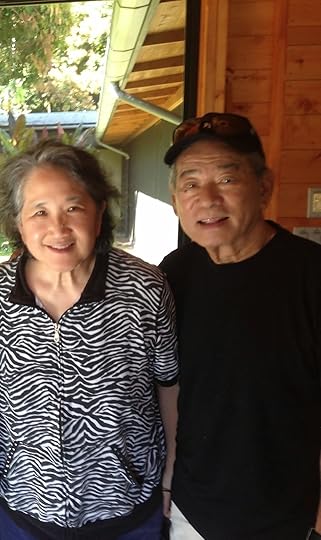 Jeanne and Jimmy Yagi
They have both had health challenges in the past year, but have come through with the support of a loving extended family and each other.
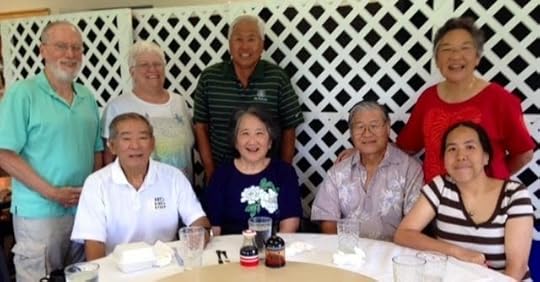 Sunday brunch with Jeanne (center) and family
It was wonderful to see the love and humor and generosity of spirit abound -- even more beautiful, more soothing, than the sights and sounds of the rainforest.
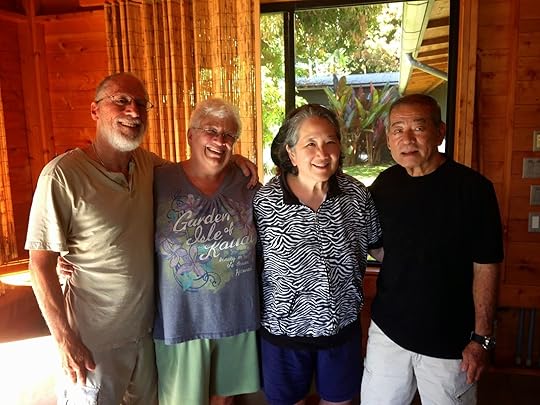 We decided to make visits a new tradition.
"Please make this a tradition at least once a year," Jeanne said quietly before we left and again in an email. "It doesn't have to cost you any more than airfare. Stay with us next time. Use our second car."
The important thing, we agreed, was having time, more time together, time to talk, time to enjoy the friendship that first blossomed in our teens and that has thrived into our golden years.
Waterfalls are gorgeous, but nothing is more glorious than joy and love in the eyes of a dear friend.

It was a long-time dream, a trip two years in the planning: we would go to Hilo, Hawaii to visit my dear friend Jeanne Nishida Yagi and her husband Jimmy Yagi. And, while there, we decided, just this once, to rent a home nearby. It was a beautiful cabin on a ridge, in the middle of an island rainforest, with huge waterfalls at the back of the property.
I had seen the house years ago in Architectural Digest. It was built as a vacation retreat by a gay architect from San Francisco who died before having a chance to enjoy it. A local businessman bought it and keeps it as a vacation rental and special event venue called The Falls at Reed's Island. It is booked months, years in advance. (While we were there, the owner told us that he had just had to tell someone trying to reserve Christmas week 2015 that is was already booked.) We saved considerable money by making our reservations two years ago. And all the time since, we had been anticipating, dreaming of our stay there.
We could never have imagined, even looking at the beautiful pictures on the website, just how wonderful it would be: the steady and comforting sounds of water -- the falls, the river, the rain -- throughout the house and the living sounds of the rainforest -- birds by day, singing frogs by night. There were the mists and rainbows and lush tropical vegetation, flowers growing wild.
 Bob meditating in the back yard of The Falls
 View from the kitchen window
With the soothing sights and sounds, my thoughts settled into reverie...
I thought about the joy of new experiences -- being in a place so new, so different, so unfamiliar, yet comforting and the wonder of beauty all around us, so vivid, from every window. Every glimpse outside was a delight and a revelation.
I thought about how we so often take for granted and stop seeing the beauty most familiar to us so quickly.... and wondered what delights I might be overlooking at home. I made a vow to reconnect with the unique beauty awaiting us at home -- the startling clarity of a desert sky at night, the smell of the desert after a monsoon rain, the colors of blooming palo verde in the spring and the sweet, unexpected smell of citrus blossoms in the air.
I thought with love and a bit of worry about our ailing cat Gus -- how he would love the smells and sounds of the rainforest, how he blessed our lives every day, how I wanted to soothe and comfort him all the remaining days of his life, never realizing that we would have only a week together between our return and his death. But there in the rainforest, I felt a loving connection to Gus as I was surrounded by forces of nature and quietly accepted the fact that sooner rather than later, we would lose this beloved animal but treasure having known him forever.
I thought that, for all the beauty of this wondrous place, the greatest joy of this trip was spending time with my friend Jeanne and her family.
I thought about the meaning of long friendships in our lives. Jeanne and I have been friends since our early days of college. At that time, we were united in being geographically unusual: she, a native of Hilo, Hawaii and I hailing from Los Angeles, were among the few warm weather natives traveling to Northwestern's campus north of Chicago. A year ahead of Jeanne, I was matched with her as a Big Sister to ease her transition on campus. We clicked and have been dear friends since.
We braved the Great Storm of '67 together -- venturing out for ice cream with the conditions still near white-out, spending a Christmas together later that year in my graduate student apartment complete with Christmas tree and cookies Jeanne baked and a holiday dinner we cooked together. There were letters and phone calls and visits in our early career years, particularly after Jeanne returned to Hawaii after working for the Peace Corps in Saipan and Washington, D.C. We battled weight gains and celebrated periods of svelteness and mourned the loss of several dear friends together. She was at my side in 1977 when I married Bob and I was delighted when she married Jimmy in 1980.
It was -- and is -- a marriage made in heaven. She is an avid basketball fan, he a well-regarded basketball coach with an international reputation. His first wife Carol, a dear friend of Jeanne's, died of cancer in the late Seventies and Jeanne and Jimmy fell in love while sharing their grief and loving memories of Carol. They spent their honeymoon at a basketball camp in Colorado. This is a partnership that was meant to be. "We make a great team," Jimmy said smiling fondly at his wife during our visit.
 Jeanne and Jimmy Yagi
They have both had health challenges in the past year, but have come through with the support of a loving extended family and each other.
 Sunday brunch with Jeanne (center) and family
It was wonderful to see the love and humor and generosity of spirit abound -- even more beautiful, more soothing, than the sights and sounds of the rainforest.
 We decided to make visits a new tradition.
"Please make this a tradition at least once a year," Jeanne said quietly before we left and again in an email. "It doesn't have to cost you any more than airfare. Stay with us next time. Use our second car."
The important thing, we agreed, was having time, more time together, time to talk, time to enjoy the friendship that first blossomed in our teens and that has thrived into our golden years.
Waterfalls are gorgeous, but nothing is more glorious than joy and love in the eyes of a dear friend.
Kathy McCoy's Blog

- Kathy McCoy's profile
- 5 followers
Kathy McCoy isn't a Goodreads Author
(yet),
but they
do have a blog,
so here are some recent posts imported from
their feed.

