Leonard D. Hilley II's Blog, page 14
December 5, 2017
Never Poke a Hornet’s Nest
Sound advice, isn’t it?
When I was eight or nine years old, two of my cousins came to visit. They were brothers and four to five years older than I. My neighbor, Mrs. Gray, owned an old gas station on a lot between our house and hers. She used the building for storage. On the back wall of this building was a medium-sized hornet’s nest.
My cousins were tough and always into mischief. They dared me that I wouldn’t take a stick to the nest and strike it. I suppose I wanted to impress them, and I didn’t realize exactly how a hornet’s nest was designed or how many hornets were hidden inside. Acting brave, I took the stick and walked to the nest.
I had seen numerous paper wasp nests around the house and shed. I had even helped my grandfather knock them off the edge of roofs, but the hornet’s nest didn’t seem as bad at first glance. Until this day, though, I had never seen one.
The hole near the bottom of the nest had a couple of hornets setting right inside it. There weren’t any on the outside. The stick I had was a walking stick my grandfather had made from a sapling and shaped like an L. Not seeing many hornets, I took the crooked end of the stick and swung. The stick bounced off the nest and did no damage, but the second I struck, I had already turned to run.
“Run!” Michael said.
I did. I tore up the ground to get to the edge of the woods where they stood. But nothing happened. No hornets chased me, so I returned and tapped it again. Immediately, I spun on my heels and ran to them again while glancing over my shoulder. This time about a half dozen hornets had pursued, but then midway across the field, they turned and flew back to the nest. Still, the nest showed no damage.
The third time I went to the nest, I was nervous. A few hornets were flying around and several more waited at the entrance. I thought I’d hit the nest one last time and if I didn’t damage the nest, I was done.
However, something occurred that I had not anticipated. This time, the L end of the walking stick lodged into the side of the nest and split the bottom half from the top half. The bottom dropped with a ball of hornets. A LOT of hornets. Angry ones. Before I could even turn to run, a swarm of hornets covered my left arm. In panic, I yelled and my feet were moving without my knowledge. I swatted them off my arm as I ran.
I read the panic in my cousins’ eyes as I sprinted right at them. I imagine their fear came from seeing the terror in my eyes. Once I reached the woods, the hornets dissipated and headed to defend their nest. Dozens of them swarmed the air above the broken nest on the ground. I was shaken.
Michael checked my arm. Seven stings. I was lucky. Although I felt no pain (perhaps due to shock), I viewed hornets in a whole new light. I held a great deal of respect for them. I learned how foolish it is to poke at a hornet’s nest. Regardless of how peaceful it looks on the outside, once someone provokes what’s inside, repercussions ensue.
The same can be said for those who, for whatever foolish reason, decide that it’s a good idea to attack someone’s reputation even when that person knows nothing about the individual he has sought to attack. If all someone has is hearsay, and no presentable facts, generally it’s a good thing to not poke a hornet’s nest. Or as my father always said, “Let sleeping dogs lie.”
Some lessons are learned the hard way, like mine with the hornets. You only poke so many times before the wrath gets released.


Paperbacks for Dee’s Mystery Solvers: Witch Cat, Now Available!
 Yesterday, my paperback copies of Dee’s Mystery Solvers: Witch Cat arrived. Currently available via all bookstores and Amazon.
Back Book Jacket:
“Marty Sullivan’s black cat, Edgar, mysteriously appears at the most unusual times and in the least expected places. For the others in Dee’s Mystery Solvers Club, they suspect the cat is somehow magical. What they don’t know is Marty’s secret about Edgar and where he found the cat. Marty wants to tell them his secret. But in doing so, he knows his suspicious sister, Dee, won’t rest until they solve the complete mystery. Her unyielding stubbornness might place their lives into danger, especially after he tells her that Edgar was found in the haunted Tangled Forest. Marty’s second greatest fear is that returning to the forest might cause him to lose Edgar forever, as the cat’s true owner is a ghost … The ghost of a witch.”
Also available on #Kindle and #KindleUnlimited.
December 3, 2017
My Interview With Urban Fantasy Author, C.L. Schneider
Hi C.L. Schneider,
Thank you for taking the time for an interview, and welcome to my blog.
Regardless of how folks say, “You can’t judge a book by its cover,” great book covers are the first impressions for readers looking to discover new authors, and in a way, the initial handshake before gaining more insight about what’s on the inside of the book. Your incredible covers definitely snap the attention for fantasy/sci-fi readers and demand a closer look to your worlds and adventures inside. Who does your cover art?
My cover artist is Alan Dingman. Alan is a portrait artist and illustrator whose work history includes St. Martin’s Press, The NY Times, Rolling Stones, and Simon & Schuster (where he currently works) as well as privately commissioned portraits and murals. Alan illustrated Stephen King’s 3D pop-up book, The Girl Who Loved Tom Gordon. Multiple books of his design have hit the New York Times Bestseller List.
I’m lucky enough to know Alan and his family personally. We met over ten years ago when our oldest children became friends at a park. Aside from being a talented artist I admire, I consider Alan a close friend.
Covers have always been extremely important to me as a reader. When I decided to self-publish, I refused to skimp on the cover. I knew Alan had the talent I was looking for, so I approached him with my ideas for Magic-Price. I extended an offer to hire him on the side, and was thrilled when he accepted. Alan’s covers continue to be beyond my expectations.
I often tell my college English students that anyone can choose to be a writer, but usually it’s the other way around. Writing, as a profession, chooses us to become authors because we have no choice but to get the stories onto the page. Did you know at an early age that you wanted to be an author?
I’ve been writing for as long as I can remember. As a young girl, I wrote poetry and short stories (mostly murder mysteries). When my favorite characters in TV shows or movies were heading a direction I didn’t like, or didn’t dive deep enough into an area I wanted them to explore, I’d write my own script. Fan fiction wasn’t a thing at the time, but that’s basically what I was doing. I put together commercials and news reports and made my poor family sit down and listen as I sat behind a cardboard desk and ‘reported’ the news.
By the time I was sixteen, I’d abandoned my dreams of growing up to be a spy or a famous actress, and was dead-set on becoming a published author. I grew up in a family of readers, and my dad was more than happy to buy me a typewriter to pursue my dream. I sat up a card table in the living room and went to work on my first novel. I wrote in a notebook in school, when I was supposed to be paying attention, and then came home and typed at night. The result: a 600-page post-apocalyptic behemoth entitled, A Twist of Fate.
The itch to make my dream a reality was hard to ignore at that point. More than anything, I wanted to see my book on a shelf. Unfortunately, life got in the way. It wasn’t until many years later when my children were old enough to be in school full time, that I was truly able to devote myself to a writing career.
What authors influenced you the most early in life?
Some of my early literary influences were: Margaret Mitchell, C.J. Cherryh, Jennifer Roberson, Marion Zimmer Bradley, the Bronte sisters. The later influences of Jim Butcher and Simon Green, were instrumental in teaching me how to write first person.
What book are you currently reading?
I usually have several going at one time. Right now, I’m currently reading: Recreance, an epic fantasy by H.G. Chambers, A Work in Progress, a thriller by Rocky Rochford, and the 1st book in a paranormal series, The 11th Percent by T.H. Morris.
Since publishing my own book, I have read indie authors almost exclusively. It wasn’t a conscious decision really, I just discovered this whole other world of books and authors, and have had no reason to look elsewhere.
What inspired The Crown of Stones trilogy?
 Illustrator: Alan Dingman
The Crown of Stones Trilogy was inspired almost entirely by the creation of my protagonist, Ian Troy. I was a huge reader as a child. I was lucky enough to have access to a wide variety of genres and spent many hours losing myself in story after story. In creating Ian, I set out to pay homage to some of the characters I fell in love with growing up. I wanted Ian to walk in two worlds, to be both good and bad, a cowboy and an outlaw, a hero and a monster; valiant yet broken; vulnerable enough to suffer, yet resilient and courageous enough to fight the odds. I wanted a tortured soul, a true anti-hero whose greatest strength—magic—was also his greatest weakness. As Ian’s character become more complex, the story developed around him.
 Illustrator: Alan Dingman
My other inspiration was a chunk of amethyst that had been sitting on my bookshelf for years. I’d always wanted to write a story about a deadly magic hidden inside the stone. I knew a little about new age magic and crystal healing, and liked the idea of Ian being able to tap into and manipulate the energy inside a stone. I had a working title then: The Amethyst Crown. Once I started my research and learned more about the variety of stones and their uses, I saw a gold mine of ideas. I realized I didn’t want to limit Ian to one stone and one kind of magic. I developed an entire magic system with nine different type of magic-users and using a large variety of stones. As my magic system developed, the storyline evolved. Suddenly Ian’s entire magic-addicted race (the Shinree) were born. The crown itself grew from one stone to nine, and the title changed to The Crown of Stones.
Your descriptions for the scenes in your books are effectively visual. Please tell us about how you create such vividness?
 Illustrator: Alan Dingman
Thank you! Writing in first person takes me deep into the minds of my characters. It allows me to step into the scene with them, to feel like I’m experiencing it as them.
I strive to wholly visualize what my characters are seeing, hearing, tasting, and smelling. By weaving those elements into the narrative and dialogue, I do my best to bring the readers into the scene with me.
You indicate that as a mother, you’re a referee to two sons. Finding time to write as a parent is often difficult. Describe your typical writing day and how much time you get to write each day.
I’m very fortunate to be able to write full-time. But, being home all day doesn’t mean I spend all that time writing. The usual housework, shopping, errands, school activities, and the like., all need to get done. If none of that is pressing, I sit down at my desk as soon as the kids leave for school. How much time I spend writing each day, versus email, promoting, working on blurbs, covers, etc., depends on what else is on my to-do list. Self-published authors wear a lot of hats. Distraction and interruption are the norm. With that in mind, on a typical day, I spend a minimum of three to four hours on my current work in progress, whether it’s writing, rewriting, or editing. Some days I sit down at 7:30 and don’t stop until it’s 2 in the afternoon and I’m starving! Other days, I’m lucky to squeeze in an hour.
When my kids were little, I learned how to write in small bursts. I couldn’t not write, so I squeezed it in; five minutes here, ten minutes there. It was incredibly frustrating at the time not to have large blocks. But it taught me how to fall in and out of a scene or a character’s head quickly. So, on the days when I do have a long list of errands or the kids are home sick, I can still squeeze something in. Even if it’s only revising a single paragraph. I’m a firm believer in writing something every day. If that something is only a sentence, it’s one more sentence than I had yesterday.
How long does it typically take for you to write the first rough draft?
Longer than it should! It varies. Summer is harder with the kids home from school. But, I admit, I’m not a fast writer. I find it incredibly tempting to go back and fix a scene in the draft that I know isn’t flowing right. I try to resist, but it’s a sickness 
November 27, 2017
Fishing: The One in a Million Cast
When I was a child, I often wanted to go fishing. Although I had begged my father numerous times to take me fishing, I can remember only two times that he did.
Once, he took my older brother, Chris, and I to Town Creek near Fyffe, Alabama. We had parked on the side of the road and walked through the trees to the creek bank beneath the bridge. The only fish we caught looked like a large goldfish, so looking back, it must have been a carp. I remember my brother reeling it to the bank and the fish flopping on the bank. Our father unhooked it and released it. The fish was bleeding as he put it back in the water, and shortly thereafter, we left.
The other time he took me fishing was with his friends, Johnny and Annette, to Will’s Creek in Will’s Valley near Collinsville. Whether I was fishing or not, I loved going to this creek. An old dam with what was left of a gristmill was a fun place to explore. But since we didn’t have fishing poles, Johnny allowed me to use one of his.
I wasn’t too good at casting, and I didn’t catch a fish that day. It was also the first time that I had seen someone use sweet corn as bait. After we had fished for less than a half hour, the fishing line in the reel I was using knotted up and wouldn’t cast. I took the pole to my father, but since he never fished, he had no idea how to fix it. Embarrassed, he told me that I had torn up the rod and reel, but Johnny came over and grinned.
He said, “Don’t worry about it. I can fix it when I get home.”
A few years later, after my parents divorced, I still had the urge to fish and wanted to learn as much about it as possible. I mowed lawns during the spring and summer months to earn money. I picked up aluminum cans as another means to get money. After I earned enough, I decided to buy my first rod and reel.
My mother took me to Kmart, and I bought a Zebco 404. I bought some bobbers and didn’t know much about the type of hooks I needed, so I bought a Lakewood lure. This lure had a treble hook covered with feathers and a spinning blade near the top, which is called a ‘rooster tail’ by fishermen. Not knowing the purpose for the hook or how to use it properly, I attached a bobber and placed grasshoppers on the three hooks. I caught panfish like crazy.
Boykin Farms had a good sized pond in the pasture behind our house. I fished there, and the great thing during the summer was not having to worry about bait. Grasshoppers and crickets were everywhere.
One day, my friend, Jerry, came to the pond with me to fish. He brought his fishing pole, and when he saw my lure, he said, “You don’t need a bobber for that. Just cast it out and reel it in.”
My first thought was ‘that will never work.’ So, I continued placing grasshoppers on it and used the bobber.
Before he left to go home, he reeled in a largemouth bass. Up until this point, I had only caught bream. This was the first bass I had ever seen, and he told me that if I quit using the bobber with my lure, I should catch a lot of bass, as the lure was made specifically for that purpose. Since he needed to get home, we took our stringer of fish back to the house.
The next day I returned to the pond and caught several bream, still using my poor technique. The sky darkened and storm clouds formed. Thunder rumbled. I didn’t have long to fish and needed to get away from the pond before the lightning was closer. Before leaving, I decided to follow Jerry’s advice. I took the bobber off the line and cast the lure out. Almost immediately, a fish yanked the lure and pulled away.
I cannot explain the excitement of the strike and the struggle to reel in this fish. It zigzagged back and forth, pulling away as hard as possible. I somehow managed to reel the fish onto the edge of the bank. It was a two pound bass. I was hooked (pardon the pun) from using the lure in the way it was meant to be used.
I reached down to unhook my first bass and discovered a problem. The fish, although small, had put up a greater fight than I had imagined. Two of the three hooks had been snapped off, and the remaining hook was barely attached to the inside of its mouth. The body of the lure was bent and destroyed. How I got the fish to the bank remains a mystery, but I placed it on the stringer and hurried home before the storm got worse.
My mother took me to Kmart so I could buy another lure, but for some reason, Kmart no longer carried the Lakewood lures. I found others that were considered the ‘true’ Rooster Tail lures, so I bought a couple of those.
Catching bass was becoming easier, and an old man (Denson) who worked on cars and lawnmowers about a quarter of a mile from the house gave me several old Field & Stream magazines. My knowledge for catching bass and other fish was increasing.
Some months later, I told one of my friends, Tony, on the school bus that I was going to the pond to fish after I got home. He told me that he’d get his pole and meet me at the pond, but he lived about two miles away.
I got to the pond and was trying to catch a few fish before he arrived. The best place I had found to fish was near the drainage pipe on the deep end of the pond. I made several casts and one unfortunate cast. My lure snagged the rusted pipe. I attempted to pull the lure free but instead, the knot on the eye of the lure unraveled. I replaced the lure with another rooster tail and kept casting.
Again, I cast too close to the pipe and snagged. This was my last lure, and I didn’t want to lose it, too. So I tried something that had worked for me before, and that was releasing the line and backing up as far as possible and pulling at the hook from a different angle. Sometimes, this freed the hook.
I had unraveled a lot of the fishing line and was pulling the line over the top of the cattails when something totally unexpected happened. The end of the fishing line in the reel had never been tied at the factory and the line slipped off my fishing pole and fell atop the water. Within seconds the line sank, along with my heart.
About this time, Tony climbed over the pasture fence and waved. A few minutes later he met me on the dam of the pond. I told him how I had lost my line in the water, so he cast his line across where mine should have sank. After several casts, his hook caught my line and he reeled it in. He handed me the fishing line. I took a small piece of driftwood, wrapped the line around it, and slowly began backing up until the line tightened. I pulled slowly but not hard as I feared the line might break like it had the first time. The tension on the line slacked, and I figured that I had lost the second lure.
I kept wrapping the line around the piece of wood until the end of the line revealed that I had not lost my lure, but instead, I had caught the other lure I had lost on the rusted pipe. One of the treble hooks had went perfectly through the eye hole of the other lure! Instead of losing both, I had retrieved the first one with what has to be ‘A Cast in a Million.’ Perhaps a Trillion? Who knows? But I could never repeat the feat in a dozen lifetimes.
November 23, 2017
Happy Thanksgiving!
When I was a kid, my mother always placed the turkey in the oven before going to bed. The next morning when we awakened, the smell of turkey filled the house. I sat up on the side of my bed and placed my feet upon the cold hardwood floor. We only had space heaters back then.
My mother was an excellent cook when we were kids, and the turkey aroma made those early morning hours seem like an eternity before we finally got to eat. A bowl of cereal didn’t suffice when in my mind, I pictured all the trimmings that encircled the golden bird: mashed potatoes, early peas, green beans, homemade rolls and gravy, stuffing, corn, and more. Then the deserts: apple pie, pecan pie, cookies.
During those early years of my life, these memories still come each year. Despite the animosity between my parents, differences were put aside on this day, at least until I was twelve years old. But we ate until we could eat no more, watched football, and sometimes cartoon specials later in the evening. Out came the Polaroid and our father making us stand or sit while he took pictures. And if it wasn’t too cold, we went outside in the yard to take more photos.
I don’t know what it was about the old Polaroids, but when those flashbulbs went off and then bounced across the floor, my sister and I scrambled to get them. That’s a good time to learn what ‘hot’ means, I suppose.
Thanksgiving is a time to spend with those you love, in the here and now, and for those who have passed on. It’s a time to recall the things we’re most thankful for. We are blessed to have family. Treasure them while you can. Life is like a blink in time. While we’re young, we take life for granted. But as we get older, we look to the past for the memories. Tell those who are still with us how much you love them, and how important they are.
Happy Thanksgiving!
November 22, 2017
What Time Is It?
It’s the time of year where each day almost has equal daylight hours as with night. When the time change occurs, mistakes can easily occur.
Some years ago, in 1990, I went to visit my mother on a Sunday evening around 5 p.m. As I got closer to the house, I saw my twin sisters and little brother standing at the edge of the driveway. They had their school backpacks over their shoulders. They waved with excitement when they saw me. After I got out of the car, they came running.
“What are you doing?” I asked.
“We’re waiting for the bus,” they replied.
“It’s Sunday,” I said.
“No, it’s not!” one of the twins said.
My first wife laughed at them. “Yes, it is.”
“No, it’s Monday. Why are you here so early?” my sister asked.
“It’s Sunday,” I repeated.
This circular argument continued for several minutes until our mother came outside. She smiled and asked, “What are you doing here so early?”
Again, I tried to explain that it was Sunday and not Monday. She looked confused for a moment and then she adamantly insisted that it was Monday. By now, I was wondering if I were wrong.
Finally, I suggested that someone go in the house and turn on the television to see what television shows were on. “60 Minutes should be on,” I said.
They went inside and turned on the television. The Sunday evening shows were on.
My mother shook her head. “We were exhausted when we got home this afternoon, so we all took naps. When I awoke and looked at the clock, I thought we had slept through the night.”
I was relieved that it was Sunday, but for about ten minutes or so, I thought maybe I had been wrong. It was the strangest episode of cognitive dissonance I had ever experienced.
Have any of you ever gotten so confused about the time or what day it was? Did you ever forget to set your clocks back or forward? At least computers today and the Internet have ways to remind us. Back in 1990, that luxury didn’t exist.
November 18, 2017
Paperback for Dee’s Mystery Solvers: Witch Cat Scheduled Next Week
 The paperback for ‘Witch Cat,’ the newest edition of Dee’s Mystery Solvers is scheduled for release next week.
Book jacket blurb:
“Marty Sullivan’s black cat, Edgar, mysteriously appears at the most unusual times and in the least expected places.
For the others in Dee’s Mystery Solvers Club, they suspect the cat is somehow magical. What they don’t know is Marty’s secret about Edgar and where he found the cat.
Marty wants to tell them his secret. But in doing so, he knows his suspicious sister, Dee, won’t rest until they solve the complete mystery. Her unyielding stubbornness might place their lives into danger, especially after he tells her that Edgar was found in the haunted Tangled Forest.
Marty’s second greatest fear is that returning to the forest might cause him to lose Edgar forever, as the cat’s true owner is a ghost … The ghost of a witch.”
November 16, 2017
Throwback Thursday: How Time Flies
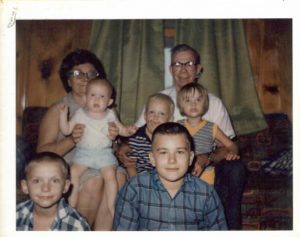 1970s: Grandpa & Grandma & the Hilley children
The older I get, the more I find myself looking back at the pictures when we were children. It is strange how sometimes our minds stay younger while our bodies age. In the 70s, we were kids and worries weren’t ours to bear. Time and distance separates us now.
We had adventures back in those days, using our imaginations because technology didn’t occupy our attention. I doubt I’d be the writer I am, if such electronics had been available then.
When this Polaroid photo was taken, we had one of those thirty-to-forty foot antenna poles fastened to the back of the house. If the wind blew the right direction, we might get three stations. So comic books, drawing & coloring, and exploring the woods were things we did most often. Some nights we went to the drive-in to watch a movie, but other than that, we let our imaginations entertain us.
Years have passed.
 2007: At my mother’s funeral.
In the top picture, our grandparents were with us. Now, I have two children and a grandson. In retrospect, this seems to have happened so quickly. Our grandparents are gone, and I hold memories of them like great treasures. Those early years shaped me in some ways. My two brothers often told stories that prompted my imagination to flourish. Our grandfather had volumes of stories that I wish I could have heard before he passed in 1984. My older sister was the one who prompted my interest in ‘The Witching Hour’ comics, as those were her favorites. My younger sister and I spent countless hours creating our own worlds with the Fisher Price Little People. All these events shaped me. I knew early on that I’d become an author. In my character I played with the Little People, I pretended I was a bestselling author, even though I was about nine years old. And two years after that, I wrote my first novel.
I have no doubt that my siblings helped spark my imagination at such an early age. I am so thankful for them.
November 15, 2017
Self-esteem and Building a Better Me
After a bad relationship fails, often we’re left wondering what we did wrong. At least that was how I felt after my horrible first marriage ended.
During a marriage that had lasted less than three years, she had left me three times. She was seven years older than I, but acted like a spoiled child, getting her parents to pack up her stuff and bring her home to them.
Logic should have told me that the issues weren’t me, but having low self-esteem when I entered that relationship was something she had capitalized upon. It took years for me to look at the real issues. I had tried everything I could to make the marriage work. Nothing was ever good enough.
She had convinced her friends how horrible a person I was, and she had even tried to convince the people I had gone to church with for years (before I had met her) the same thing. She painted such a vivid picture that she had almost convinced me. Almost. The good folks I went to church with didn’t buy her lies, and some even spoke with me in private, telling me they had known her reputation before I had met her. A little late for that news, but okay.
She had been married twice before me and had gone through dozens of ‘bad’ relationships, according to how she detailed the stories. A used car salesperson couldn’t have told more convincing lies than she could. She was better at telling lies than ever telling the truth or admitting fault. She was always the victim, and this was how she had wanted to portray me, but the truth emerges … eventually.
One day I had pulled up to a red light in Rainsville, Alabama. I glanced over to the car in the lane beside me. In the backseat was my ex-wife. She was pointing at me and cackling madly. Her three friends in the car held looks of bewilderment as they glanced at her uneasily. It apparently dawned upon them at that moment that the problem wasn’t me, but her. The epiphany was seeing her crazy behavior, and when they looked at me, a bit of fear was in their eyes for having her in the car with them. I simply shook my head and drove on after the light turned green. However, the other three women in that car no longer had anything to do with her. They no longer invited her on their outings. They ceased all contact with her. In fact, one of the three kept in contact with me, trying to help me get custody of my daughter, because she was greatly concerned about my daughter’s safety.
Because my marriage had failed, I felt like a failure. My mental wounds were fresh. The tears in my heart bled. Devastation overshadowed me. I needed to rebuild myself. I needed to become stronger. Looking back, I cannot say why I decided to sign a contract at Brian’s Gym, but I did. Unknowingly, this was a first step in building my self-esteem.
Brian Hudson owned the gym, and I had gone to Plainview High School with him. I had graduated two years earlier than he. Brian was easy-going and we talked a lot. After a few weeks, I began working out with him. He competed in bodybuilding and was much stronger than I. But, he pushed me to do more reps even though I was exhausted. I learned so much from him.
In a couple of months, I noticed big changes in my physique. At the same time, I was making new friends. The gym was a different atmosphere. A lot of people talk about the massive egos bodybuilders have in these gyms, but I never met one person that acted that way. In fact, it was quite the opposite. Most were helpful to explain the proper way to do exercises if you asked. It didn’t matter if they were 250 lbs or a beginner like myself.
I worked at Sunrise Hosiery, and even before my shift ended, I couldn’t wait to get to the gym to work out. My drive was never to become a competitor. I simply wanted to be stronger and healthier. Lifting weights was also an outlet to burn off the mental frustration I suffered. After a few months, people noticed my arms and chest were getting bigger. Some made comments. Others commented with their eyes without saying a word, which was a bigger compliment sometimes. This prompted me to keep going to the gym.
The more I worked out, the better I felt.
However, my biggest obstacle, strangely enough, was my mother. Since my divorce, I had to move in with her. I was trying to maintain a healthy diet to gain lean muscle, and she knew my weakness: sweets.
I have always had a sweet-tooth and each evening before I came home from the gym, she made cookies or brownies or cake. While some might suggest her actions weren’t deliberately aimed at making me fail, you didn’t know my mother. She was a cynical person and did things on a calculated basis to ensure others didn’t succeed at their goals or dreams since she had given up on her own.
In the mid-70s, I watched The Incredible Hulk week after week, idolizing Lou Ferrigno and aspiring one day to be like him. Before my mother and father separated, my father brought home some bodybuilding program books a friend had given him. He gave these to me and then he bought me one of those cheap barbells with the concrete plates covered in plastic, so I could do some exercises at home. I did on a daily basis, but mainly my arms, as I didn’t have a weight bench.
After their separation, my father came to visit on a Saturday. My mother sat at the breakfast table in her housecoat with coffee. She was trying to overcome her hangover from drinking the night before.
My father looked at me. “Looks like you’re still working out.”
I nodded.
My mother said, “Yeah, he’s trying to get bigger so he can beat me up.”
Why she even said such a thing remains a mystery. My father glared at her for the comment, even scolded her, and I didn’t know how to react. I did lessen the amount I was working out, but I don’t even know why I did. I guess the comment hurt because my goals had nothing to do with such a repulsive action. My goals had nothing to do with her at all.
And years later, in the early 90s, she was still trying to keep me from succeeding at my goals. Resisting sweets was difficult, but I managed. I kept working out. I kept growing, both physically and mentally.
I had always been a shy person. Talking to strangers, especially women, had been difficult for me. But the more I worked out, the more confident I became. I’m not entirely sure why that correlation occurred for me, but I became uninhibited at approaching people and talking to them. I asked out attractive women, when I wouldn’t have done so in the past due to my low self-esteem. I had been afraid of rejection. But that was no longer a fear for me. My confidence allowed me to face rejection and know the world didn’t end if she declined.
Even with my upswing in confidence, things at home still hung over me like a black cloud. With my mother trying to tempt me from my healthier lifestyle, the memories of my little brother’s death, and an ex-wife who continued to stalk me, I realized I had no choice but to move away.
I decided to reapply for admission to Berea College for several reasons. One, it was two states away, which made it impossible for my ex-wife to stalk me. Two, since I was back in college, I could live on campus instead of commuting, which saved a lot of time. Three, I had more freedom to be myself or perhaps to discover myself in a new environment. And lastly, it was due to a promise God had said to me seven years earlier. Without going back to Berea, I’d never know if I had heard Him or not. I needed to know.
[Due to circumstances based upon more personal issues, some things I cannot post publicly. The continuation for this blog post is “God’s Time Zone (Part One) & (Part Two)” at my Patreon page. Become a Patreon supporter ($2 per month), to unlock this part of my memoirs and for other writing tips. Cheaper than a lunch combo at any restaurant.]
November 11, 2017
Falsely Accused
Since my parents were pathological liars, I have always attempted to tell the truth because I hate to be lied to. Now, everyone tells the little “white lies,” as people call them, but this isn’t what I’m referring to. When someone asks a direct question about a relevant situation, I’ve been honest with them, unless the situation is something private and painful for me, and then, I simply don’t give an answer.
When I was sixteen years old, my stepfather asked if I wanted to help him and some friends move an old man’s belongings from one house to the other. Since it was Saturday, and I didn’t have anything else to do, I tagged along.
The old man, Mr. Griffith, lived in a suburb of Rainsville, Alabama. I didn’t have much information about him before we reached his house, but when we arrived, I vaguely recognized the house. I had come to this house with my friend, Ed. Ed’s father had bought some chickens from the man, and we came at night to catch them from their roosts in the trees. Of course, the place looked a lot different in the daylight. The house had a homey atmosphere.
My stepfather parked his truck in the driveway between a nice small home and a large building. The other four trucks parked behind us, almost like a police swarm arriving at a house. When we stepped out of the vehicle, Mr. Griffith got out of his yellow International pickup truck. My guess was that he was in his late sixties, at least, and he walked toward us. The other volunteers got out of their trucks and gathered around him.
Upon first impressions, he was a kind, gentle man, and I liked him. In some ways, he reminded me of my grandfather. He instructed us that we needed to load all the materials from inside the shed, which turned out to be his leatherworking workshop. He made belts, pouches, packs, dog collars, and saddle tack. A craft he had worked at for over forty years.
When he opened the door to the shop, I stood amazed at the numerous styles of belts, dog collars, and other items he had setting atop tables and benches. From the outside, I’d have never guessed such a business existed on the inside.
His hands shook slightly as he told us about how he was being forced to move. His wife of thirty + years had demanded a divorce, and she wanted him gone. His expressions revealed so many emotions: anger, sadness, grief, and confusion. While he spoke, one of his sons had come out of the house and talked to some of the help that had come to the house with us. Basically, he informed us that all of Mr. Griffith’s belongings were outside of the house, and he had nothing left on the inside. His wife refused to come out, and for whatever reasons, she did not want to see him at all.
Mr. Griffith looked at his son for a moment, still fighting through his emotions, but he didn’t address his son. After his son went back into the house, Mr. Griffith fought tears and cleared his throat, informing us he had a deadline to be off the property by noon. A detail we had not been given beforehand. So, we got to work.
My stepfather showed me all the machinery Mr. Griffith used to fashion belts and dog collars. Mr. Griffith talked with pride of how long he had worked crafting leather, and still he seemed like such a great guy, full of stories. But, he also played the victim quite well.
After we loaded up all his tack, gear, and machines into the pickup trucks, my stepfather got into the truck with a broad smile. He showed me an old handgun in its holster and slid it under his seat. He mentioned that he wanted to trade or buy it from Mr. Griffith.
Moments later, Mr. Griffith took a long 2 X 4 and walked to the side of his workshop and started ramming the board against the electrical line that ran from the house to the shop. He said, “I was the one that placed that line up there, and by God, if they want it there, they can put it back up!”
We got out of the pickup truck. Mr. Griffith’s son came outside the house and told my stepfather, “Make him stop or the law will be here to arrest him.”
My stepfather placed a hand on the old man’s shoulder and gently persuaded him to stop. With mention of being arrested, Mr. Griffith set the board against the side of the workshop and glared at his son with total disdain. The tension was heated.
Here stood a man who was being forced to leave a lifetime of memories, a home and business, where he and his wife had probably raised their children. His hurt was evident and his anger was a normal reaction. A long stream of whispering curses came from his mouth.
“Come on, now,” my stepfather told him. “We’ve got your stuff, which is what we came for. Now, you’ll have to show us where to deliver it.”
Mr. Griffith took a handkerchief and wiped his wrinkled brow. After a few moments, he surrendered a few nods and then shook his head. His brief fit of anger conceded to despair. He turned away and walked toward his International pickup. “Follow me.”
Our small convoy drove about fifteen minutes across the county, and finally he parked alongside a small house on a corner lot. We parked alongside the edge of the road.
Mr. Griffith came to the driver side of my stepfather’s truck. He said, “They’ve agreed to let me move my stuff in here.”
Sadly, the house was smaller than his former home. He seldom spoke once we started unloading the trucks, and forty-five minutes later, the trucks were empty and we headed home.
Some hours later, I was at my stepfather’s parents’ house. His nephew, Chris, and I were out on the long dirt driveway throwing a football. We stopped for a moment when Mr. Griffith’s yellow International truck crept down the driveway. As he drove closer, I smiled and waved. He didn’t wave back. He pulled up beside me and said, “Where’s my gun?”
I frowned. With all the commotion immediately after my stepfather placed the gun under his truck seat, I had completely forgotten about the gun. It had been a quick fleeting moment, and I simply had forgotten. “I don’t know.”
He turned off the truck engine and glared at me. “What did you do with my gun?”
“I don’t have it,” I replied.
“I’ll give you fifty dollars if you just give me my gun back.”
The statement pissed me off. “I don’t have your gun.”
He took a deep breath and sighed. He pulled out his wallet. “I’ll give you one hundred dollars if you’ll give me my gun back.”
“I don’t have your gun,” I replied. By now, his accusations had stirred my anger and instantly changed my opinion about the man.
“I gave the gun to your stepfather,” he said. It clicked then for me. “So what did you do with it?”
Not: “Where did he put it?” He was still accusing me of theft. But, I did suddenly remember my stepfather placing it under his seat.
“He put it under his truck seat,” I said. “That’s where he placed it. We can go look.”
“Hop in,” he said, still bitterly hateful.
We lived less than a mile away, so in a few minutes we were at my house. I got out of his truck and walked to the driver’s side of my stepdad’s pickup, opened the door, and patted under the seat until I found the gun. I retrieved it and carried it to Mr. Griffith. He was standing outside his truck at this point. When I handed it to him, he slid it partway out of its holster and inspected it. He told me how long he had owned it, and I asked if I could look at it. He obliged.
“Is it loaded?” I asked.
He nodded.
After looking at it, I handed the gun back to him.
“Come on,” he said, “I’ll drive you back.”
“No, that’s okay. I’d rather walk,” I replied.
“No, get in, and I’ll take you back.”
No apologies for accusing me of something I had not done. No one hundred dollars, either, not that I would have taken it.
As he drove back, he said, “I don’t care if you were a preacher, it wouldn’t have changed the situation.”
I was fuming mad then because his accusation still hung in the air. Apparently, he had too much pride to admit when he was wrong.
“I happen to be one,” I replied.
He jerked and straightened in his seat but didn’t make eye contact with me.
At the time, what I had said was true. I taught Sunday School, youth Bible classes on Wednesdays, and had spoken before several church congregations after turning fourteen.
His voice broke somewhat. “That’s a good thing.”
Still no apology when I got out of his truck. He drove off.
Chris looked at me and noticed the anger on my face. “What was that all about?”
I told him and my stepfather’s mother what had happened.
Having been honest with people, even during that time, his accusations of stealing his gun angered me. The situation still does when I think back to it. And then, for the man not to apologize? Strange. Sadly, this changed my feelings about him because he had shown his true self. There are much better ways to handle asking for an item, rather than immediately accuse someone of stealing. I held no interest in his gun, regardless of its worth.
About six months later, my stepfather asked if I wanted to ride with him to the next county. I agreed, but he hadn’t told me where we were going. Thirty minutes later, he turned onto a narrow backroad and then into a small drive where a silver motor home, pull-behind trailer set beside a large leafless tree. There set the yellow International pickup. The kind folks, who had taken Mr. Griffith in, apparently had their fill of him, and promptly kicked him out. He had to sell his leatherworking supplies and was reduced to this tiny trailer with winter settling upon us.
Perhaps this was why after over thirty years of marriage, his wife had finally managed to get out of their marriage. I cannot imagine what she must have endured since I had only captured a glimpse of his true personality.
The last I had heard of Mr. Griffith was his small trailer had caught fire from a kerosene heater while he was gone. The burned out shell was all that remained. Where he ended up? I don’t know. But, it makes me think of how Karma plays out. People do reap what they sow. What is on the inside eventually makes its way to the surface for all to see. You cannot hide the monster forever.