Leonard D. Hilley II's Blog, page 12
June 7, 2018
Turtle Rescue
This past week while mowing the backyard I found two Eastern Box Turtles hiding in the waist-high grass. Because the grass in this part of our yard was so sparse during the winter, I had allowed it to grow and seed before mowing, hoping that by doing so it would become thicker. Apparently the turtles liked that idea.
One of the turtles I’m pretty certain I had moved a couple of weeks earlier when mowing the side yard. I caught both turtles and brought them inside for my grandson to watch while I finished mowing. Turtles actually move a lot faster than people believe, and I didn’t want to risk one hiding in the grass I had yet to mow.
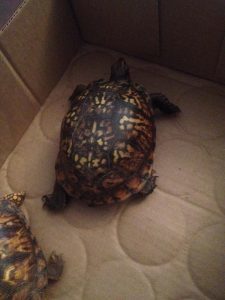 Terrapene carolina carolina Photo by Kristen King
Seeing the excitement and curiosity my grandson had for this turtles made me remember the first turtle I had found when I was about his age. I had found my first turtle in Alabama crawling across the yard and brought it to my mother. Like any boy and a lot of girls, I wanted to keep the turtle, but she didn’t want me to. So she got some fingernail polish and told me that she’d let anyone else who found it know that the turtle was mine. She wrote my name and birth date on the top of its shell, and later that evening, we turned the turtle loose near the edge of the woods.
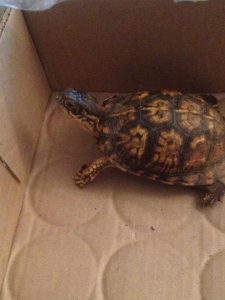 Terrapene carolina carolina Photo by Kristen King
I never expected to see that turtle again, but a couple of summers later I found it in a ditch in the pasture behind our house. The fingernail polish information was still there. I had wanted to take it home, but my mother said that it looked happy there, so she convinced me to leave it.
Over the years, I’ve found turtles on the road and rescued them. In 1998 I worked for the USDA in Kentucky setting up Gypsy Moth traps in five counties. My son was only five years old and my daughter was three. Some days they rode in the car with me. Each county had been divided up into quadrants and I had to find a place to set a trap in each quadrant. Most of these roads were in rural Kentucky where you might not see another car approach for miles. Also, it was the time of year when the turtles were on the move and often this required them to cross the road.
I don’t know how many dead turtles I had seen on the road before I decided to lessen the loss. But on the back roads, if no traffic was coming, I stopped and picked up the turtles trying to cross the road and put them in a box in the backseat. My kids loved this and wanted them ALL as pets. After rescuing nearly twenty turtles, even they realized we couldn’t possibly keep them.
We kept them for about a week before we finally had to find a safe place to release them. I didn’t want them to venture back out into the highway and find unfortunate fate as I had actually watched senseless drivers go out of their way to intentionally hit them.
My wife and I were students at Morehead State University then. The safest place we could think of to take these turtles was on a hiking trail near the woods beside the lake. We loaded up the turtles in boxes and some in buckets and our kids had fun releasing them into the wild. The next year we hiked the path and looked to see how many we might find. We hadn’t marked them in any way, and so the few turtles we did see, we weren’t sure if they had been those rescued or not. However, we were content knowing they weren’t going to be killed on the road.


May 8, 2018
Hide and Seek (Sometimes Invisible)
Growing up in Pleasant Hill, Alabama, had some unique pleasures.
One of my favorite games when we were children was hide-and-seek. My favorite place to hide was near the top of a tall yellow pine at the edge of the yard. I wore dark clothes and if I positioned myself correctly, no one could see me thirty feet above them. Of course, no one ever expected me to be that high off the ground. With a nice warm breeze, there were times when I simply didn’t want to be found and waited an hour after they had given up to eventually come down. It was a peaceful place to hide, and I could see most of the fields and houses across the road from this vantage point.
When my brother and sister came to visit during the summers, we usually paired off and played games. My brother, David, and I would explore the woods sometimes or read comics while my sisters, Gina and Tina, did similar activities.
On this occasion, I suppose I should add that this wasn’t an active game of hide-and-seek, as my brother and I were hiding from our sisters without their knowledge, so they weren’t actually looking for us. At that age, boys tend to hide from their sisters anyway and vice versa.
My mother had an old 3-speed bike that she never rode. I didn’t know how to ride a bike then, so my brother pedaled the bike standing while I tried to sit on the seat. However, for me, that never worked too well, and I ended up walking along beside him.
The old dirt road behind our house separated a pasture from the woods. It had a moderately sloped hill right before we lost sight of the house. My brother and I decided to go down the road. We usually stopped at an area in the road where a horrible mud puddle of slick red clay pooled. With thick honeysuckle and blackberries on both sides of the spot, we couldn’t get around the mud hole too easily. And if we ever returned home with red mud on our shoes or clothes, we got into trouble.
So, after reaching this spot, we decided to head back to the house. When we were near the top of the hill, the echo of our sisters talking clued us of where they were, and that they were walking directly toward us.
My brother motioned toward a path to the side of the road that was sparse with trees. We hurried to the hillside, which was only about twenty feet away from the road. A pine branch hung down in front of where we stood, but it was not wide enough and didn’t have enough needles to prevent them from seeing us. For cover, it was no different than standing behind a narrow clothesline pole. We were exposed, but David told me that if we went any farther into the woods, our feet would crunch the leaves and give away our position. So, we crouched behind the branch and the bicycle.
Our sisters continued talking as they walked up the road. Oddly, right as they walked past where we stood, they both looked directly at us. I was certain they’d seen us, but no recognition registered in their glances. They kept talking and walking. We waited until they were out of sight before we rose.
I said, “How did they not see us or the bicycle?”
He shook his head.
He told me that he wanted to get back to the house before they did, but to do so, we’d have to cut through the woods with the bike. He was older and stronger, so he carried the bike. We followed our dogs’ trail through the trees. The dogs had paths they used a lot when they wandered off in the mornings and at night. Those paths we also used, since they were worn down.
However, the path we were on took a different direction than we had hoped and if we chose to follow it, we’d go deeper into the woods and not toward the house. Leaving the path, though, was not easy. Thick rows of green briars stood like hedges. We used the bike to push our way through. But the sharp briars were unavoidable and cut through our jeans into our legs. I was no longer in a hurry to get to the house before our sisters.
We continued for a few more yards and after we passed through, we had a clearer path. However, by this time, our sisters were also heading back toward the house on the dirt road. Any movements across the dead leaves was certain to alert them, but what could we do?
I followed as my brother ran three or four steps carrying the bike, and then he’d stop. He figured if we took quick, choppy steps we’d sound more like an animal and draw less suspicion. The summer canopy kept us covered in shadow, and when our sisters heard our stomping through the leaves, their interest turned toward us.
“What’s that in the woods?” Gina said.
“I don’t know.”
They mentioned several things. One was “it might be the dogs.”
“No, the dogs are with us,” the other said.
David took several more steps, and I followed. Then we crouched low and waited.
“Whatever it was,” one of them said, “it has yellow legs.”
“A wildcat?”
They ran toward the house. Eventually, we got home and acted none the wiser when they told us about the ‘wild animal’ running in the woods.
Even to this day, I find it unusual that they had both looked right at us while we stood right in the open, and they simply didn’t see us. And that’s not the only time such a thing has occurred when I played hide-and-seek. I once hid on my hands and knees behind an upright paper bag in plain sight and the person looking for me had walked right past me.
Who knows? Maybe I can really wish myself invisible, eh?
May 4, 2018
School’s Out for Summer!
Earlier this week, my College Writing II students had their finals. This semester I had a lot of students with great writing abilities, and some of these I expect to see published in the years to come. They’re quite creative.
About a third of the students I had taught in College Writing I, and after a second semester with them, it’s difficult to see them go. I will miss reading their essays and other writing assignments. They brought their very best with unique insights at times. Overall, Spring ’18 has been a great semester.
Hats off to you! Thanks for making this semester a fantastic experience!
May 3, 2018
#Throwback Thursday
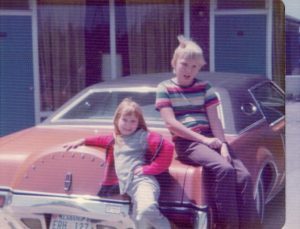 I was eleven or twelve years old (1977 or 78) when this photo with my sister was taken. My father worked for Northeast Alabama Junior College (as it was named then) as a media technician and decided to take my sister, mother, and I with him on his business trip in Nashville.
The Lincoln Continental that we’re posing with was my mother’s favorite car. While our father was at his meeting, we stayed at the hotel with our mother. We walked to local souvenir shops and other than that, we did little else.
As you can see, clothing has somewhat upgraded itself since then. A good thing, actually. But we had fun.
One thing about taking a road trip with our father was that you stopped ONLY to get gas and at an occasional restaurant. I remember many trips from Fort Payne, AL, to Middletown, OH, when we were younger. Most of the time, our father took the back roads rather than I-75, which took much longer to drive, but the scenic view was worth passing the time. Watching the landscape pass by fed my imagination, and I often had books or comics to read, too. But we never stopped at any of the interesting places. We observed from afar.
My mother told me years ago that when I was three or four years old, she and he had driven all the way to Washington state and back to Alabama, but he only wanted to drive. Never stop. She said that they passed a road sign, “The Grand Canyon Scenic Overlook, 1 Mile” but he didn’t stop. He kept driving.
Some years back, I loved driving, but I also loved stopping to see places I’d never visited before. My wife and I have stopped in some states simply to hike and enjoy nature in state parks because we most likely would never travel along those roads again. Seeing is one thing, but experiencing the place is far greater, and I think that’s something our father never really took into consideration. Meeting new people and learning the history of these small towns are what excites me about traveling. Without stopping, you cannot discover the underlying beauty, and that’s where the greatest treasures are found.
Cruelty in Nature
Not only are humans often cruel to one another, but even in the animal kingdom, there’s evidence of cruelty between species as well.
This morning while I was driving along the main street of Williamstown, WV, I watched a squirrel taking his safety route across the street via the power line. Midway across, two birds swooped and pecked the little critter, trying their best to knock the squirrel off the line into the traffic. His determination paid off, and he made it safely, if not frazzled, to the other side.
If I have my guess, another bird was probably nearby filming this incident so they could post it on Facebook or Youtube later. Even animals are getting anti-social. Maybe we’re rubbing off on them?
April 7, 2018
FREE Kindle Book This Weekend: Forrest Wollinsky Vampire Hunter

March 28, 2018
Love Audio Books? Here Are Mine:
If you enjoy listening to novels while you’re traveling, currently I have four novels in Audio format:
Shawndirea:
Lady Squire: Dawn’s Ascension
Forrest Wollinsky: Vampire Hunter
March 25, 2018
Cocoons
When I was a teenager, I loved to hunt for moth cocoons. Although the cocoons were brown and drab, most of them, they were like a treasure for me. An Easter egg found in nature.
Usually, during the dead of winter, with little I could do outdoors, I always sat by the window on the school bus, simply watching the world pass by. My mind drifted sometimes, wondering what my father was doing and why we hadn’t heard from him, or I thought about writing stories, homework, and so forth. But one day, when the sky was heavily overcast, I watched the saplings along the roadside ditches. With no leaves on the trees, it was easy to see the hanging cocoons on the sassafras trees.
For some reason, at least back in the eighties, the road department never cut down these little patches of sassafras, and since this is what Prometheus moth caterpillars feed upon, I could usually find a half dozen or so at each of these places. The problem was that I usually spotted them several miles from the house, which meant a decent hike on a Saturday to get them.
Sometimes when I got to the trees to retrieve the cocoons, I’d discover that several had already hatched from the year before. A few might have been parasitized and dead. But a few held healthy pupae and would hatch once spring came.
The Prometheus moth is neat as adults because the males are a different color than the females. The males are black, and the females are a chestnut brown with interesting designs upon them, so they’re a species worth rearing. Another odd occurrence is the males generally hunt for the females around 4 o’clock in the afternoon to mate. The caterpillars are unique as well.
The pheromones the females release to attract a mate are quite strong and attract males for quite a distance. While I was a student at Berea College in 1993, a friend of mine went hiking with me, and I found a huge Prometheus cocoon in this marsh-like area in a small forest of Virginia pines. The cocoon was much larger than any Prometheus cocoon I’d seen, so I thought perhaps this was a different species altogether. But when it hatched in late April in my dorm room, it proved to be a Prometheus female, almost the size of a small Polyphemus moth.
The moth hatched from her cocoon, which I had pinned the silken handle to my bookshelf above my desk. She clung to the bottom of the cocoon to allow her wings to unfold, and while she did so, she was already trying to attract a mate by the afternoon. A soft bumping noise tapped my dorm window. I looked through the blinds and two males were fighting at the glass, trying to get inside. I was amazed that they could even detect her scent because the window was heavy glass about 2-3 inches thick. A few minutes later, four mesmerized male moths were trying to get inside my dorm room. And from out of nowhere a bluejay snapped one of the males into its beak and flew off.
I opened the window and let two of the males inside, before they became another bird’s supper. They flew frantically in circles for a moment and then they found her. It’s amazing how nature works to ensure the survival of species, and the power of pheromones is a mystery in some ways. As thick as the glass window was, and that my room was in town, I was astounded to see so many males fighting to get inside the dorm. I will probably never witness such a feat again, as I don’t collect any longer.
This weekend while driving through Ohio on some back roads, I noticed a patch of the sassafras trees and a few little cocoons hanging, which brought back memories. The last time I was in Alabama, driving around my old stomping grounds, I noticed no small patches of sassafras along the roadsides anymore. The saddening thing is how those little patches were where the most cocoons could be found. While in Berea in 1992-93, I had found places with thousands of sassafras trees growing in a mile-wide grove and expected to find lots of cocoons. I found none, which I thought odd. Why do they prefer smaller groves at the edge of the road?
While I miss those days of collecting cocoons, I no longer have the time to rear moths like I did many years ago. I have tried to find cocoons to take photos, but other than those I saw yesterday (without a camera on hand), I’ve not found any. It worries me how the environment keeps changing, and while sassafras growing on the edges of banks are nothing more than weed trees to the highway departments and land owners, they are food and shelter for an intriguing moth species, if one takes the time to notice.
Until next time ….
March 19, 2018
Aetheaon Chronicles: Book Three
The rough draft for Aetheaon Chronicles: Book Three has been completed, and the revision process is underway. A cover unveiling will be announced in the near future.
The interesting thing about the third book is that this novel isn’t what I had thought the third book to be. Let me explain.
As with the first two epic novels in the series, the prose gets into the minds of various characters throughout the novels. The scenes shift from one character to another in different chapters. Originally, this is how I expected the third book to be carved up. I had already written the first three chapters, which followed various characters, delving into each main character’s POV. At the end of the third chapter, I discovered a major problem. Had I followed the previous patterns, the volume would easily expand over 2,000 pages. That’s far too vast for a single novel.
The projected third book was “The Elves of Woodnog: The Plague-bringer,” but that title is actually being pushed further down the line to perhaps Book 6 or Book 7. The third book now focuses upon the three main Dwarves: Boldair (newly appointed King by King Staggnuns and King Thorgum of the Dwarven Alliance), Drucis, and Dwiskter. Viorka, the fynx, travels with them as they journey to Nagdor for Boldair’s coronation. But the journey suffers several detours that reveal areas of Aetheaon’s map I didn’t know existed. New cities and new races.
After making the decision to give each major character his/her own novel, I expected the novel to be roughly 75,000 to 80,000 words. But the rough draft tallied 99,500 words. After revisions, where I tend to add more description and necessary dialogue, the novel should teeter over 100,000 words.
More than that I cannot share until after the revisions are done. Believe me, it’s a struggle for me to keep further details to myself. I promise, though, it will be worth the wait.
Until next time ….
March 18, 2018
Distractions, Delays, and Postponements in Writing
Regardless of how badly authors want to write, sometimes we are unable to escape life’s distractions that inevitably invade and diminish our writing time.
Unexpected company, sickness, business meetings, or necessary errands can cut into our scheduled writing time, causing a postponement or delay. For some authors who also work full-time, the window of time is often small.
For a long time, these abrupt interruptions triggered a sense of wasted time or missed opportunities to get more words on the page. I fretted, wanting to return to writing the next scenes or episodes of dialogue in my WIP. Sometimes I berated myself, even though the circumstances preventing me from writing were necessary or due to issues beyond my control. As I’ve matured as a writer over the years, an epiphany eventually emerged.
After a major distraction had kept away from the keyboard for several days, I finally returned to pick up where I had left off in my WIP. When I had left the project, my mind held the suspicion of where the story was heading but something odd occurred.
My normal, daily, process of writing is to back up 3-6 pages of what I had written the day before. Generally, by doing so, I catch obvious errors I had overlooked while under the trance of visualizing the story while writing. For some reason, when I’m in a writing sprint, my fingers don’t always write the words my mind signals my fingers to write. Often, I find these errors, correct them, and add more layers of description or dialogue, which strengthens those scenes. By the time I’ve reached the last words written from the day before, the amount of pages have doubled, and I’m ready to move forward. Then, it happens.
Suddenly a character says something unexpected, giving new information that pivots the story off track and in a different, better direction, which enhances the story. After this occurred on various occasions, in different novels, it dawned on me that had the interrupted flow of writing not been derailed by distractions, the character probably wouldn’t have said the words.
As a proponent of Bradbury’s “Follow the characters,” I’ve found his timeless advice to be solid. Perhaps I missed the volume of quantity during the time I was unable to write, but I gained better quality with new insight I might never have had.
So I’ve learned that unexpected breaks or delays aren’t necessarily a bad thing. Short breaks help. And on those anguishing days when life gets in the way and unavoidable delays prevent me from writing, I no longer get anxious. In the depths of my mind, these characters are still working through the problems where I had left them on the page. Who knows what route they’ll choose when I sit to write again?
For the next three days, Devils Den is FREE at Amazon! –>> Devils Den (Justin McKnight Adventures)
Until next time …