Theodora Goss's Blog, page 66
March 7, 2011
Writers and Readers
I've had a feeling today that I sometimes get when I'm tired, as though part of me were missing. It's a Herbert the Alligator feeling, I suppose. As though I were incomplete.
What it makes me think of, since my mind tends in this direction, is the relationship between writers and readers. Writers sometimes think that the story is what they write, what's on the page. But of course it's not. The story is a collaboration between the writer and reader. It exists in the reader's head, but is created by both: the words of the writer and the imagination of the reader.
Good writers realize that they're collaborators, and they write out of that knowledge. Beginning writers will often describe everything. But that leaves nothing for the imagination of the reader to do. Good writers are aware of the reader. They know the reader is there to complete the story, will imagine the characters from pieces of information. So they work on providing the right pieces.
Here I was, trying to provide the right pieces yesterday, writing:

And writing:

And writing:

I think writing is partly a way to deal with that feeling of being incomplete. At least it is for me, right now. When I feel that way, I write. But honestly, I don't think I can write today. I don't know what it is. Nothing is coming out right. I can't seem to make the connection.
Maybe it's just tiredness, I don't know. Maybe it's working on a writing project that's taking up a great deal of my time. Maybe it's that tonight, I feel as though a part of me were missing, and I don't have whatever it takes to write through that, despite that.
This is a short blog post, isn't it? Well, so be it.





March 6, 2011
A Thousand Words
I've written before about writing a thousand words a day, every day. (Yes, any sort of writing will do. A thousand words of anything, as long as it really is writing. Do tweets count? I'm not sure tweets count.)
Someone, I'm not sure whom, commented that if I wrote every day, and writing was a pleasure, then I was doing something that gave me pleasure every day, and I thought – more than that. And my thoughts went back to some passages in Victor Frankl's Man's Search for Meaning.
I've had an interesting and difficult relationship with that book. I love what Frankl has to say about life in general, about how our central driving force is the search for meaning. The difficulty is that I can't seem to get through the first part of the book, where he describes being in a concentration camp. It's not that the section is horrific – quite the opposite. It's so ordinary, and I have a difficult time with the idea that one person can treat another person that way, or one group of people can treat another group of people that way, and it can become ordinary. I find that a profoundly painful, although very important, realization.
The second part of the book, which is theoretical, is much easier to read, and I think that's a sort of failure on my part, that I can take the theory but not the practical experience on which it was founded.
But there are parts of the theory that are important to me. Frankl essentially states that the search for meaning is our most important drive, and that we can endure almost anything if we can find a meaning in it. But also that meaning, searching for it and finding it, is what leads to fulfillment, to joy.
More specifically, he writes,
"For the meaning of life differs from man to man, from day to day and from hour to hour. What matters, therefore, is not the meaning of life in general but rather the specific meaning of a person's life at a given moment."
And,
"One should not search for an abstract meaning of life. Everyone has his own specific vocation or mission in life to carry out a concrete assignment which demands fulfillment. Therein he cannot be replaced, nor can his life be repeated. Thus, everyone's task is as unique as his specific opportunity to implement it."
And,
"Ultimately, man should not ask what the meaning of his life is, but rather he must recognize that it is he who is asked. In other words, each man is questioned by life; and he can only answer to life by answering for his own life; to life he can only respond by being responsible."
What I get from this is that I have to find the meaning of my life, and that the process of finding it will be something I continue to do (there is no endpoint), and that the meaning will alter depending on where I am in my life and my circumstances. And I am the one who is asked to find that particular meaning. It is my meaning, not necessarily anyone else's.
And this comes from elsewhere in Frankl, I think, but it's important for me to realize that I am called to find that meaning, whether that call emanates from within me or comes from outside. Either way, it's a call and I need to answer it, to respond. To be responsible is to be the one who responds – not by fulfilling anyone else's meaning, not by doing what anyone else tells me to do, but by doing what I am called to do.
Frankl also writes, and this I find to be very important,
"We can discover this meaning in life three different ways: (1) by creating a work or doing a deed; (2) by experiencing something or encountering someone; (3) by the attitude we take toward unavoidable suffering."
I'm not going to talk about (3) because that's the territory of concentration camps and chronic diseases, and I have no right to talk about that. I have never experienced unavoidable suffering. Frankl does say, and this is important to me, that suffering is not itself ennobling, and should be avoided whenever possible. There is no point to seeking out suffering. But if it truly is unavoidable, one can experience it in such a way that one retains meaning, and therefore a reason to continue on, to live. And one can even die with meaning.
Writing falls, fairly obviously I think, under (1), which Frankl calls "the way of achievement or accomplishment." I think I would rather call it the way of work. Because for me, the meaning of writing is not in achieving or accomplishing something, which implies that meaning arises when the work is done, but in the activity itself. I find meaning in the act of writing, in the creation.
So, by writing a thousand words a day, I'm not just giving myself pleasure. I'm also creating meaning in my life. And that's even more important, I think. If meaning is the aim of life, our fundamental drive, then every day I'm working toward that aim. I'm responding to that call.
Frankl says, "The second way of finding a meaning in life," meaning (2) above, "is by experiencing something – such as goodness, truth and beauty – by experiencing nature and culture or, last but not least, by experiencing another human being in his very uniqueness – by loving him."
I know I'm not doing the experiencing enough. I'm not getting out into the natural world enough (well, it's winter, and I hate the cold), or the museum enough, which would give me my dose of beauty. And that last bit, I wrote about in my blog post "Thoughts on Love," which was about experiencing another human being in his or her uniqueness. I'm not sure you can experience another human being in any other way. If you want to change another human being, to make him or her into something different, you lose the uniqueness, you lose the human being. I suppose what Frankl means, in a sense, is that the other human being will have his or her own meaning, his or her own response. And you have to respect that.
But what I wanted to do, here, was talk about writing a thousand words a day. If I do that, I give myself pleasure, but more than that, I provide myself with a way to both generate and discover the meaning of my life, at this particular moment. One blog post at a time.





March 5, 2011
A Writerly Day
Today, I had a particularly writerly day.
As you probably remember, I had turned in my Folkroots column earlier in the week. It's a column called "Fairies and Fairylands," and it should appear in the June issue of Realms of Fantasy. Yesterday, Doug had emailed me about the column, asking whether it was accurate to identify J.M. Barrie's Peter Pan stories as Victorian, since they had been published in the early twentieth century. He was right, of course. I should have identified them as Edwardian, or perhaps early Modern. That's what a great editor does: alert you to your mistakes, so you can make your column as accurate and informative as it can possibly be. I'm always grateful for good editing. As I was reading through the manuscript, I found some other changes I wanted to make. One paragraph was too long, so I deleted a description of Lord Dunsany's "Kith of the Elf-Folk." It hadn't really fit into the paragraph. And I was missing a general paragraph on what to do when you encounter fairies, how to behave. I thought that was necessary. Because what do you do? It's important to know, isn't it? So I spent the morning revising.
Before I could send off the revised manuscript, I had to rush to Harvard Square to have lunch with Niall Harrison, the Editor-in-Chief of Strange Horizons, and Matt Denault, who is one of the Strange Horizons reviewers. Niall lives in Oxford, and was in Boston for a week. Today was his last day here, so I'm glad I was able to meet him. We went to a Thai restaurant, where I had shumai and tom yum, and then to Bob Slate's. I'm so sad that Bob Slate's is closing. It's been in Harvard Square for so long, and as far as I'm concerned, it's the best stationary store in the world. I write in notebooks from Bob Slate's. I bought seven of them, narrow ruled, with heavy paper. I hope they last me several years. Here are Niall and Matt in front of Bob Slate's:

Then we went to Burdick's, the chocolate shop. We had their hot chocolate, and although I only had a small cup, I have to admit that I'm still feeling its effects. I'm not sure how well I'll sleep tonight. (I know, it's silly, but I respond to both coffee and chocolate that way. They keep me up.) Here is the chocolate shop:

Niall and Matt went off to Pandemonium. I needed to return home, because I still had a column to send out. But I had half an hour before I needed to get on the T to meet my ride home, so I went to some of the old places I remember from when I was a law student at Harvard. The first was the Brattle Square Florist, where I used to buy myself flowers:

The second was Colonial Drug, where I used to buy my favorite perfume, Balenciaga's Prelude. It's such an unprepossessing entrance, but it carries all the great perfumes, from the couture houses. That perfume was discontinued years go, but as I looked at the perfumes in the glass case, I saw a bottle! I asked the price. Of course, it was incredibly expensive: $130. Prelude is now a cult classic, a collector's item. I'm so sad it was discontinued. And to think I used to scent letters with it! Here is Colonial Drug:

I returned home, finished my column, and sent it to Doug. It was late, I was tired, so I looked at some friends' blogs, and on one of them I found this:
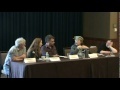
Can you see what this is? It's a video of the Mythpunk panel from Boskone! I'm on YouTube! Of course I had to watch the whole thing, the whole hour. And you know what? It was fun to watch! I thought I did pretty well, considering that I was on a panel with brilliant writers and speakers. I noticed that I use my hands a lot when I talk, and you know, I rather like that. It's me, what I do.
If you've never seen me on a panel, this is a good example of what I do, how I speak.
I'm rather proud of being on YouTube.
And I thought, if this is what a writerly day looks like, I'm in. The writing, the revising, the meeting and interacting with editors and reviewers. The watching and evaluating your own performance on a panel. There's a whole lot more that goes into being a writer, of course. A whole lot more writing than I did today, in particular. But that's also a pleasure.
So it's been a good day, and I'm feeling all writerly myself. Which feels good.





March 4, 2011
Herbert's Story
I've been worried about Herbert.
You see, I left him hanging from the ceiling in Professor Mandragora's laboratory, looking sad. Herbert was originally not going to be a character at all. He was just a literary reference. But as soon as he reacted to something, as soon as he showed that he was responding to the world around him, I had to go back and write his story.
I can make characters wicked, or selfish, all sorts of awful things. And that's all right, as long as they still have agency. But I can't trap a character.
So I decided that Herbert had to have a story of his own.
First, I had to look up where alligators come from, because I'd forgotten. The answer is Florida. (Obvious, I know, but I always mix them up with crocodiles. I should remember: crocodile, Nile.)
Herbert originally came from Florida. But by the time Professor Mandragora bought him, from her usual taxidermy shop, he had been taxidermed for more than fifty years. He was an old specimen that the taxidermist had bought on sale, somewhat the worse for wear. Professor Mandragora bought him for only twenty-five dollars.
She always went to the taxidermy shop on Thursdays, to see what the taxidermist had in stock. She brought birds and squirrels and foxes back to her laboratory. There, she took the bodies apart, added mechanical elements, and created something that was part animal, part machine. Then she added magic, to make them go. They were toys, really. Mechanical toys that allowed her to experiment, to practice her skills.
That's what she did to Herbert. But with Herbert, something happened.
What is a soul? You probably haven't thought about that question lately. And I can't give you a firm, solid answer. (Any more than the soul is something firm and solid.) The soul is the self. Everything living has one, and when it dies, that soul goes back where it came from, to become part of the soul of creation itself. The soul is part of that great soul, but also separate from it. That is a paradox, but the soul is also a paradox, infinitely small but larger than a universe. And not even witches understand it fully.
What happened was this. When Herbert had died, his soul had merged back into the soul of creation. Professor Mandragora's mechanical creations were not alive, and had no souls. But when she reanimated Herbert, a part of his soul must somehow have sensed that his old body was available again, was animate, not alive but capable of motion. And it came back.
She had given him a clockwork heart, and eyes that moved mechanically. She had inserted an entire mechanical apparatus, a metal spine that allowed him to move. She had patched parts of him with thin copper plates. And then, since she did not actually have room for an alligator in her laboratory, she had hung him from the ceiling, where he occasionally swung his head or swished his tail.
The expression of sadness on his alligator face, on the day Thea, Matilda, Emma, and Mouse visited, was the first sign that a part of his soul had returned. That afternoon, when Professor Mandragora returned to the laboratory, she immediately knew that something had happened. She took Herbert down, inserted a box made of metal plates and thin metal wires into his throat, and said, "All right, Herbert. What's wrong?"
It took him a moment. Remember, he had never spoken before. But he had always been a particularly bright alligator.
"I – don't know," he said. He swished his tail, startled by the sound of his own voice, and almost brought down a large stack of books.
"I diagnose an existential crisis," said Professor Mandragora. "It will pass, you know. As soon as you find the rest of your soul. It's probably still in Florida, in the swamp where you were shot."
"Florida?" said Herbert. His voice had an odd, but not unpleasant, whirring sound.
"How are we going to get you to Florida?" asked Professor Mandragora. "It's the middle of the semester, and I can't leave my students or my research. You'll need to get yourself down there. But how?"
For Professor Mandragora, this was a rhetorical question, a way of focusing her energy rather than actually asking. She knew how.
She gave him wings. They were made of copper, and would weather but not rust. They were large but light, and she hammered the magic right into them. (She had majored in Magical Physics at MIT.)
On a cold but sunny day (all days in Boston are cold, but not all days are sunny), she said goodbye to Herbert, and told him to take good care of himself. Then he rose into the air with more grace than you might expect from a taxidermed alligator (he had been practicing for several weeks). And he flew south. She saw him silhouetted against the sky, looking like an awkward dragon, and very much hoped that she had done the right thing. But even a taxidermed alligator deserves to find his soul, she thought. And I agree.
What happened to Herbert? There were storms, and high winds, and once he was almost lost at sea. But at last he came to the Everglades, and there he found his soul, among the roots of a cypress. It was pleased to have a body again, and for the first time in his brief afterlife, Herbert felt a sense of peace, a sense as though he was no longer missing a part of himself.
Soon after, he met a girl named Alice. She was sixteen, and she had never owned a pair of shoes. Despite what seemed like unprepossessing circumstances, Alice wanted to go to college and study ecology. But she had no money, had never had any money, and they don't let you into college for a faded dress and an old baseball cap.
I think it was Alice's idea. At least, she wrote the sign: See the Flying Alligator! Only $5!
And you know, if you put up a sign that like, people will actually want to see the flying alligator, sometimes twice in a row. Especially after a feature on the local PBS station, which was broadcast to other PBS stations so that all the way up in Boston, Professor Mandragora saw it and said, "Good work, Herbert!"
It was the Herbert stuffed alligators that allowed Alice to go to college, and then to graduate school. Herbert went with her, and eventually her roommates got used to him. Today, Alice is an ecologist (Dr. Alice, the locals call her), and Herbert lives with her in a house at the edge of the Everglades. The house is filled with plants, tanks of fish, birds undergoing rehabilitation.
And the last time I visited, they were very happy.
I've decided that every Friday, I'm going to write part of the Shadowlands serial. If you want to read parts that I've already written, go to Serial. There, you can read all about Thea Graves, Matilda Tillinghast, Emma Gaunt, and Mouse, from the beginning.





March 3, 2011
Revising Fairies
I'm not sure I've looked out of the window today.
Although I'm pretty sure it looks the same as it did yesterday, out there. Snow on the ground, melting too slowly.
But all day, I've been staring at the computer screen, revising my Folkroots column. (I mentioned that it was due on the 1st, right? And today is the 3rd. How I hate having to ask for extra time! Because I know it's important to get things in by the deadline, in publishing. Especially magazine publishing. I'm revealing my lateness to you only because, you know, you and I can talk about these things. Because we're writers, or whatever it is we are. But if I'm going to be honest about my process here, I have to tell you about when I'm not doing as well as I would like, don't I?)
I did the research a long time ago, and I meant to finish the column a long time ago as well. But I had something come up, an academic deadline I had to meet. It took all my time to meet it, and so the column was put aside for a couple of weeks, and then there was the end of the month, and I only had a few days to complete it. No matter how much you already have, producing a final manuscript always takes time and effort. Especially when it involves research, as the Folkroots columns do.
(But I learned so much! I had no idea that fairies were so complicated. There's quite a lot I haven't been able to get into the column because I simply don't have the space. For example, did you know that during the witch trials, in the 16th and17th centuries, witches were often associated with fairies? Consorting with the Queen of Fairies was a common confession at the witch trials. Fairies were essentially seen as demons, and agents of the Devil.)
I suppose this is a blog post about being the kind of writer I am, which is the kind that writes a regular column, and is regularly asked to submit stories for anthologies, and so has to meet deadlines. Once I send this column in later tonight, I will have one more deadline this month, for a project that I can't talk about yet but am incredibly excited about. It was another assignment I started some time ago that was interrupted by that academic deadline, and I'm so looking forward to getting back to it. What does it take to be that kind of writer? Well, organization for one. The ability to look at a deadline and determine how many words I need to write by when. And second, the ability to sit down and write and not get up again until the assignment is done. You know, the "butt in chair" principle. I think I learned that as a lawyer.
But this is so much more fun than being a lawyer. All the writing I do, all the creative writing (the column, the stories, eventually the novels) give me such joy. Perhaps the real benefit to having been a corporate lawyer is that in comparison, everything else is wonderful. And I don't have to do it in high heels! If you could see me now: black t-shirt, black yoga pants, black socks. Sitting in my chair in a sort of half lotus position, because I'm not flexible enough to do a full lotus. Listening to Seanan McGuire singing "Cartography":
"I know you; I met you
A long, long time ago.
But you're still a stranger,
There's so much I don't know.
"Can I walk across your borders?
Will your guardsmen let me through?
I have empty hands and pockets.
I intend no harm to you.
"So tell me your stories
And I might tell you mine;
We're both getting closer
To once upon a time."
I think it's my third favorite song on Wicked Girls, after "The Snow Queen Dreams" and "Wicked Girls":
"So trust me; believe me
When I say I'll take care.
I can't come the whole way;
I'll meet you halfway there.
"Come and wander through my cities,
Meet the people I have been.
I have left my gates unguarded.
You are welcome, please, come in."
It's a love song, of course. Sort of a love song with cartography. And this is my favorite stanza:
"We are each of us an island,
With our separate rocky shores,
But an island's not a prison –
That's what men make bridges for."
We are not each solipsistically imprisoned in the self, are we? We are capable of reaching out, of building bridges. Of understanding one another . . . (We are none of us meant to be, or feel, alone.)
And I have glasses on, and my hair is a complete mess. And I'm eating a formerly-frozen organic vegetable tamale with black beans. And later I will be eating cherry amaretto coconut milk ice cream.
It's as though I've created a cocoon around myself, made up of all sorts of things I love, and I'm doing the work I love, and that's wonderful and gives me a sense of joy, even though at the moment I'm completely exhausted and really should be doing yoga for my back rather than typing this.
But I think this is the writing life, isn't it? It's spending a lot of time in front of a computer and writing. And you know, I love it. So, so much.





March 2, 2011
The Next Year
I am tired and sad, and so I think I'll write about what I want to happen in the next year.
First, I want to finish the academic work I'm doing.
Second, I want to create a life for myself in which I can do the things I love, spend time with the people I love. I have this image in my mind of going down to North Carolina, renting a house on the beach, asking my best writer friend to come stay with me so we can both write there. It's always nicer to share something with someone, whether ice cream or an experience. And I specify my best writer friend because I can't imagine anything better than sharing both the ocean and writing.
Imagine waking up, taking a long walk on the beach, collecting shells. I haven't been to the ocean in a long time, but I still remember how the sand feels beneath my feet, how the water curls around my ankles. In North Carolina, the beaches are lined with old houses, faded from sun and salt, sitting behind the dunes. And there are pelicans drifting overhead. And the wind in the sea oats makes a particular sort of sound, a shushing that you can hear all night, together with the shush of the waves.
Imagine having breakfast and then getting to work, spending the morning writing. Lunch, and then talking about what was accomplished that morning, about how the novels are going. (These are to be novels, of course. My first novel, my friend's third or fourth.) Reading sections aloud. Troubleshooting.
A nap in the afternoon, curled up in that warm air.
Dinner would be seafood of some sort, fish or crab. I still remember the crabs we ate when we went to the ocean, when I was a child. Directly off the brown paper spread on the table, using a mallet to break the shells. The simplest foods are always the best.
And then perhaps sitting on the beach, talking in the darkness. About all sorts of things, talk as rambling as one of the beach roads, as comfortable as an old quilt. I still remember how moonlight looked on the waves, and the stars overhead. So many stars!
And finally, sleeping. There is nothing like sleeping near the ocean, listening to the waves all night long. It's like being rocked by the earth itself. I have always slept well, by the beach.
I have thought, from time to time, of doing something like this with a group of friends, of inviting a group of writer friends to come to the ocean with me and just write. But first perhaps with one person, whom I know and whose writing I know well. (And yes I'm thinking of someone specific, and yes you know who you are, and yes this is code for get working on that novel, because I want to read it! And critique it. By the ocean.)
Tonight I am tired and sad, and I want to rent a house on the beach in North Carolina, and I want to start working on a novel. For now, the fantasy of it will have to do, because there's work to be done. But eventually, after my academic work is finished – then, it will be time for the real thing. (And I'll probably get a sunburn on my nose. But that's all right.)





March 1, 2011
The Snow Queen Dreams
When I bought Seanan McGuire's CD Wicked Girls, I thought my favorite song on it would of course be "Wicked Girls." But it's not. It's a song called "The Snow Queen Dreams."
There isn't a version of the song online, but Seanan has posted the lyrics. I want to write about the song, so I'm going to write about it as though it were a poem.
This is how it starts:
"The Snow Queen dreams of glittering ice and honey,
While the King of the Summer dreams of the Snow Queen's eyes."
It's about two characters, the Snow Queen and the King of the Summer. They are in love with each other, but they each rule different parts of the year, and they can only meet on the days when those parts of the year meet. During the days when one of them is inevitably dying.
"The Snow Queen sleeps in bowers of snow and ivory,
While the King of the Summer sleeps in the forest's arms.
They're both trying to do what's right
Lost in the fading limnal light,
And they've never had any defense from the other's charms.
And a season has little regret for the ones that it harms."
They're both circling with the year, necessary parts of the seasons and so keeping to their own places in that circle. They're both trying to fulfill their respective obligations, as summer and winter. But "they've never had any defense from the other's charms," and so they dream of each other. This is the refrain:
"And she dreams of winter roses, fields of more than frozen snow,
And he dreams of summer blizzards, trees where arctic apples grow.
And they each dream of the other, and they each dream on their own,
And the days wear down the seasons as the sea wears down the stone."
She dreams of roses, but in the only way she can: I imagine roses made of ice. He dreams of blizzards, but the only way he can: and here I imagine a blizzard of apple petals, falling. And the days wear down the seasons, and they wait for those liminal days between the seasons when they can meet again.
I think these are some of the most beautiful lines in the song:
"They're both captives of what they are,
In a prison with days for bars,
And the years fade to ash before anyone knows that they're gone.
And the hands reaching out through the dark always wind up withdrawn."
These are images of time passing, of loneliness, of darkness. But still they dream of each other as the year goes round and round. And when they do meet, because they are opposites, they destroy each other:
"And the King of the Summer knows that her kisses burn.
And no matter how often they meet, they can never quite learn."
They meet when the summer dies, when the winter dies. In autumn, in spring, in the liminal seasons. That is what they dream of during summer and winter, those days of meeting:
"And they dream forever autumn, when the frost first comes to call,
And the jack-o-lanterns flicker through the candied light of fall.
And the summer and the winter can go walking hand in hand,
And a queen can be a woman, and a king is just a man."
Those are the days when they can exist not as mythological creatures, not as their respective mythic identities, but simply as themselves. I think that spring and autumn are my favorite seasons, the seasons of change and possibility. Summer and winter seems such stasis by contrast, although of course the circle of the year is always turning.
"The Snow Queen dreams of kisses as sweet as honey,
While the King of the Summer dreams of the Snow Queen's hands.
They're both circling round and round
On familiar holy ground,
And the King of the Summer knows that she understands.
And they'll dance to turn the year, and they'll dance for their lands."
They both understand the conditions under which they're living, they both know that the year needs them to turn the wheel. They both understand their places in the natural order. And so they stay in those places, even as they dream. This is how the song ends:
"They're both circling round and round
On familiar holy ground,
And the King of the Summer's hands cup the Snow Queen's heart.
And they're both of them dancing alone . . . and they're never apart."
They're never apart because they dream of each other, but also because they're both part of a natural cycle, two halves of one whole that would not exist without them. So they fulfill their duties. But when spring comes, and when autumn comes, they walk hand in hand, and the Snow Queen is a woman, and the King of the Summer is a man, no longer representatives of the seasons. For a while, at least.
The song is a love story that is both sad and beautiful, and I wish I could link to the version I have, but if you want to listen to it, you'll need to buy the CD.
I love it when a song tells a story like that. And I love stories with mythological themes. But I will say, thank goodness our lives are not like that, that we have choice and agency. It's common, in mythology, for the gods to envy us exactly that: our ability to choose our destinies. That's both the gift and the burden we have as human beings. And I wouldn't trade that for all the bowers of snow and ivory in the Snow Queen's realm.


On Faith
Sometimes it's 5 a.m., and all you have is faith.
Did you guess that it's 5 a.m.? Yes, it's 5 a.m.
Things I do not have at 5 a.m.: The ability to think clearly. Appetite (feeling sick, actually). The ability to concentrate on any task. I have spent the last seven hours going over a manuscript that I somehow, over the last month, got down to 120 pages. Of academic prose. (Including endnotes.)
In academic prose, you are not allowed to use figurative or poetic language. You have to make sure that anything you say can be supported. You cannot make claims that are too large, but if you make claims that are too small, you don't have an argument. You can't say different than: it's different from. There are all sorts of other rules, but at the moment I've forgotten them. That's what happens at 5 a.m.
At that time, when it's still dark and you're sitting there in the darkness, with only a desk lamp on, typing on your computer (as I am now), all you have is faith that what you're doing is worthwhile, that what you have written is worth something even if, looking at it again for the hundredth time, you think that it may have been written in a foreign language. Because you no longer understand it.
We tend not to talk about faith too much. It's not very popular nowadays. We would rather have ambition, intellect, drive, whatever it is that allows us to get ahead by our own efforts. Faith is for the times that you're so tired you can barely keep typing. When all those other things seem to have gone away, and your mind feels completely empty. When you can't even remember the definition of figurative language. (I had to look it up.)
You can have faith in the internal – in your own abilities. Or, and again this is not very popular – you can have faith in the external, in whatever it is that the universe intends for you. (Mother Night, the tapestry woven by spiders, the pattern we don't see: there you go, symbolism. Figurative language.) And I do believe that we shape our destinies, really I do. But I also believe in a pattern, and that I am a part of it, and that it will come out right in the end. Despite all the places where it doesn't look like it's coming out right, because I'm only seeing the part of the pattern I'm in at the moment, not the whole. And anyway, I'm only seeing it from the back.
I do wish the universe would let me get more sleep?
Although here I am writing, because I had these thoughts on faith and the necessity for it. And in particular because a friend I was talking to earlier today mentioned the subject, and I wanted to say: have faith. That's always a difficult thing to say to another person, because it seems presumptuous, doesn't it?
But even though it's dark now, at 5 a.m., it will soon be light, and even though I can see banks of snow from my window, they will soon melt, and Spring will come, and time will pass, and things will change. That's not even something we need to have faith in: we know it will happen. What we have faith in is that the change will be meaningful, will bring what we want or need into our lives.
I have faith in that too, that things are changing for some purpose. Probably a purpose I won't understand until whatever it is has happened, and the manuscript I finished tonight is part of that change. Everything I do now, every story I write, is part of it.
The prospect of change always fills me with optimism. Even at 5 a.m., when I'm so tired that my hands are heavy on the keyboard.
Good night, good morning. It's time to get some sleep . . .


February 27, 2011
Missolonghi 1824
Today, I looked like this:

Except when I looked like this:

I spend the entire day revising a hundred and twenty pages of academic prose (including endnotes). Which is probably why my brain no longer seems to be working. I thought about what to write tonight, and could not come up with anything at all.
And then I thought, why not write about one of my favorite stories of all time? It's John Crowley's "Missolonghi 1824," which I have in a collection called Novelties and Souvenirs. It's a story in which the main character is Lord Byron. I read the story many years ago and then somehow lost track of it. The problem was, for some reason I thought it was by Isak Dinesen, which to my mind is actually a compliment. I would love someone to mistake one of my stories for one of Dinesen's. She also wrote a story about Byron. I don't remember the name of her story – I would have to look it up, and honestly I don't have the energy. It's actually not as good as Crowley's, although I think Dinesen is one of the best storytellers ever. In Dinesen's story, someone tells Byron, close to his death, that he has created one of the best stories ever told. Byron asks what it is, naming various possibilities, and is told that no, it's not a story he has actually written, but the life of Lord Byron. Or am I making this up? I haven't read that story for years, so perhaps I'm getting it wrong.
But I finally found "Missolonghi 1824″ again, and was very glad to have done so. Now I give it to friends who I think will appreciate it – they have to be the sort of people to whom I would give very fine things, the finest things, and trust them with it. Whom I would trust with a glass vase once owned by the Medicis, or my personal airplane, or a heart. If they understand and appreciate it, I know they're the right sort.
I'm going to tell you about the story, so if you haven't read it, go and read it now. I don't want to spoil it for you.
It starts by introducing us to an English nobleman who is dying. (At Missolonghi in 1824, of course. That's how we know it's Byron, who is never named in the story.) He has a companion, a young Greek boy. And he tells that boy a story of how, years ago, he came to Greece for the first time and felt at home there. He says,
"As soon as I set my foot on these shores, I knew I had come home. I was no citizen of England gone abroad. No: this was my land, my clime, my air. I went upon Hymettus and heard the bees. I climbed up to the Acropolis (which Lord Elgin was just conspiring to despoil; he wanted to bring the statues to England, to teach the English sculpture – the English being as capable of sculpture as you, my dear, are of skating). I stood within the grove sacred to Apollo at Claros: except there is no grove there now, it is nothing but dust. You, Loukas, and your fathers have cut down all the trees, and burned them, out of spite or for firewood I know not. I stood in the blowing dust and sun, and I thought: I am come two thousand years too late."
He was haunted by this sense of belatedness, of having missed things: Homer and Pindar and Sappho.
He went at last into Arcadia. There, at evening, he came to a village. The villagers had captured something that day. Byron asked to see what it was, wanted to intervene, perhaps save it. The village priest tried to dissuade him, talked about a wild man who spoke but was not understood. At night, after having bought many rounds of drinks for the village men, Byron was able to go see for himself. And he saw.
"You know the eyes of your ancestors, Loukas, the eyes pictured on vases and on the ancientest of statues: those enormous almond-shaped eyes, outlined in black, black-pupiled too, and staring, overflowing with some life other than this world's. Those were his eyes, Greek eyes that no Greek ever had; white at the long corners, with great onyx centers.
"He blinked again, and moved within his cage – his captors had made it too small to stand in, and he must have suffered dreadfully in it – and drew up his legs. He struggled to get some ease, and one foot slid between the bars below, and nearly touched my knee where I knelt in the dust. And then I knew why it was that he spoke but was not understood."
He put his face to the bars of the cage, and started to say the only lines he remembered in the language this creature must have known: "Sing, Muse, that man of many resources, who traveled far and wide," the first lines of the Odyssey. And the creature, hairy, with cloven hooves and horns on its head, understood.
Byron thought, "I have not missed it after all: it awaited me here to find."
And then he cut the ropes that held the door of the cage closed, and Crowley gives us some of the most beautiful lines in the story: "The moon had risen, and he came forth into its light. He was no taller than a boy of eight, and yet how he drew the night to him, as though it were a thing with a piece missing until he stepped out into it, and now was whole."
I am telling you pieces of the story, but there is so much more. For instance, there are these lines, so beautiful: "No gift was given me, no promise made me. It was like freeing an otter from a fish trap. And that, most strangely, was what gave me joy in it. The difference, child, between the true gods and the imaginary ones is this: that the true gods are not less real than yourself."
Years ago, inspired by this story, I wrote one myself called "Catherine and the Satyr." It's not one of my best stories, and in comparison with Crowley's, to which I would give five stars, I would probably give it one. (Talk about the anxiety of influence!) The problem with my story is that, while Crowley's is about the characters, mine is about ideas – about the end of the Enlightenment and the beginning of Romanticism. It's probably not a good idea to write a story that is about ideas rather than characters. But I won't make excuses for myself. Sometimes stories work well, and sometimes they work less well.
But what I wanted to end with, really, were three things.
First, my favorite line in the entire story, and one of my favorite lines in literature ever: "But without love, without its wild possibility, he could no longer defend himself against the void: against his black certainty that life mattered not a whit, was a brief compendium of folly and suffering, not worth the stakes." I think love does that, saves you from the void. Even the knowledge of it, knowing that it is there, saves you.
Second, an idea about fantasy: I never believed the notion that science fiction was about a "sense of wonder." But I do think that fantasy is about a "sense of longing." People accuse fantasy of being nostalgic, and sometimes it is, but what we see in this story is a sense of longing for something more than our modern age can provide, for a magic that no longer exists in the world. The story tells us that it still may, in remote corners of it. Fantasy is about that – our sense of longing for more than we have, for a magic that we seem to have lost or never had. At least it is for me.
And third: I really, really want to go to Greece.



February 26, 2011
The Second Key
"Hey, girl."
She rolled over and opened her eyes. "You're already dressed."
"Got a phone call early this morning. I need to go."
The room was filled with light, filtered through white gauze curtains. What time was it? "Where are you going, this time?"
"Long, long ago, when Rome was only a wolf pup."
"What if you don't come back?"
"I always come back, don't I?"
That was fair, he did always come back. Even after dying.
"When will I hear from you?"
"That, I can't tell you. But I'm taking my magical cell phone with me." It was, indeed, a magical cell phone. Once, he had called her from the Pleistocene. He reached down, brushed her hair back from her face. It was spread across the pillow. He felt a pain in his chest – a feeling he was still getting used to. Sometimes he wished it would go away, but it was a necessary price for this – the light, coming through the curtains and falling on the old oak of the bed, polished by many hands, the rows of books in glass-fronted shelves, the woman on the bed, curled into the coverlet.
"Listen," he said, sitting beside her, then leaning on his elbow and tracing his finger over her cheek. "Can you do me a favor? Try not to make me such a jerk."
"It makes for a better story." She smiled up at him, and he could not help leaning down to kiss her.
"All right, then. Make me as much of a jerk as you want. If it's for the story's sake."
"I'll try to improve your character, by and by."
"Many thanks."
He never said goodbye, he just left. It was one of their rituals. He would walk through a door, any door, and then he was gone.
After he was gone, she got up, walked into the next room, and sat down at her desk. She looked out the window for a moment. It was spring, and across the lawn the crocuses were in bloom. The forsythia would be blooming soon. There was Cordelia, watching something. Yesterday, the cat had left a baby mouse on the doorstep. She picked up her pen, looked down at her notebook, wrote something. Crossed it out, wrote something else: The Second Key.
"There were two keys," said Professor Mandragora. "Mrs. Moth took one of them, but we never told her about the other. That's what Leonora wants to find."
"Where did you put it?" asked Matilda.
"Your aunt took it home with her over the holidays. She told us that she hid it somewhere in Tillinghast House. The safest place she could find."
"And you never asked her where, or used it again?" I asked, incredulous.
"Well," said Professor Mandragora, "for the rest of that semester, we were all forbidden from seeing each other. And the next semester we learned how to travel to the Other Country ourselves. We didn't need it anymore. We didn't exactly forget about it, but we went on to other things. Like the dragon we put on the roof of the school, junior year. We would have been suspended for that too, if we'd been caught. And Tillinghast House seemed as safe a place to leave it as anywhere else. But now you're going to have to find the key. It's too dangerous to leave in Tillinghast House with Sitgreaves there."
"Why do we have to find it?" asked Emma.
"Because Matilda is the only one who can get into that house without arousing Leonora's suspicions. I can't go, she'd remember me right away. But Matilda is supposed to visit her aunt, right? Darnation, look at that!" She was pointing to a large clock on the laboratory wall. It had thirteen hands, telling the time in thirteen different time zones, and it indicated the phases of the moon. "It's almost three o'clock. I'm supposed to be teaching a class in a few minutes! Tell me when you find the key, girls. Just look where Matilda would have considered safest."
She rushed out of the laboratory, still in her white coat and with her goggles on her head. From the hallway, we heard, "It's the other way, Professor!"
"Well," I said. "I guess it's up to us, hunh?"
"We need a plan," said Mouse.
"What we need is ice cream," said Matilda. "Ice cream first, then we plan. And I know the perfect place."
As we left, we waved goodbye to Herbert the reanimated alligator. He looked sad, as though he wanted ice cream too.
While talking toward the ice cream shop, we passed a group of students sitting on the library steps. It was only later, as I was enthusiastically finishing a scoop of pomegranate chip on top of a scoop of chocolate (my favorite combination, and perfect when they start to melt and you can mix them together), that I realized the student in the hooded sweatshirt who had stared at us so intently had looked awfully familiar.
Author's comment: So what happened was that Tollie, Matilda, Emmaline, and Leonora were using the first key to get into the pantry at night, for some cake that was being kept there until the next day. That's how they got caught. They never told about the second key because they thought it would get them into even more trouble, although to be honest I think Mrs. Moth had her suspicions. After I wrote the last section, I found that I needed a second key, because the first key had to get them into trouble, and there had to be a second key still out there for Sitgreaves and Leonora to look for. Why do I write such complicated plots, which always make me have to go back and rewrite earlier sections? I don't know, but I do. And by the way, in case you were wondering, Anatolia Mandragora teaches at MIT.