Andy Beal's Blog, page 6
June 27, 2019
BuzzFeed ask for my help understanding why blackhat reputation management is bad for your reputation
BuzzFeed News did a deep dive into how some bad people use bad online reputation management tactics to try to cover up their evil doings. BuzzFeed reached out to me–not the first time–as the ethical reputation expert they know will help them uncover the blackhat tactics and explain why they are wrong for individuals, companies, and the online reputation management industry itself.
Here’s an extract of what I told them…
Andy Beal, a consultant and author of books about SEO and online reputation management, told BuzzFeed News that most reputation projects involve “using search engine optimization to try and push negative pages further down Google [results].”
“If you’re trying to get positive things to show up in Google, those positive things need to be legitimate, be real.”
To make that happen, Beal says he works to create high-quality, positive content about a client that reflects who they are. The goal is to give a client the reputation they’ve rightfully earned, he says.
“Your reputation is a reflection of your character. So if you’re trying to get positive things to show up in Google, those positive things need to be legitimate, be real — they need to be an extension of the great things that you’re doing,” he said.
“In a legitimate reputation clean-up campaign, you focus on rehabilitating a reputation, not just whitewashing the internet with fake, positive content,” Beal previously said of that campaign.
It’s an interesting, albeit, alarming read about how the online reputation industry faces the same blackhat abuses as the traditional search engine optimization industry.
The post BuzzFeed ask for my help understanding why blackhat reputation management is bad for your reputation appeared first on Andy Beal .


May 20, 2019
The best way to respond to negative reviews in less than 30 minutes
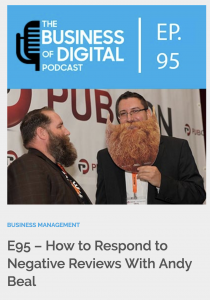 If you’re not tuning in to the Business of Digital podcast, you’re missing out on some amazing advice.
Including some from yours truly, Andy Beal. 
March 27, 2019
The TL;DR Beginners Guide to Online Reputation Management
Thanks to SEMrush, I took part in a Twitter chat to discuss some key online reputation management strategies and tactics. An hour of following a hashtag in real-time can get your pulse racing and is often difficult to follow along.
Fortunately, they did a great job of summarizing my answers to each question asked, so here you go, your TL;DR primer on the fundamentals of ORM.
Q1 Recap: @AndyBeal says ORM includes monitoring, building, improving, defending, and repairing your brand on the internet. Online reputation monitoring is an important part of ORM because monitoring alerts you to issues before Google SERPs tell you! #semrushchat pic.twitter.com/4o0n20njSE
— SEMrush (@semrush) March 27, 2019
Q2 Recap: @andybeal says it helps you to understand your target audiences by monitoring them, improve your search rankings by building a solid Google foundation, increase social media referrals & attract influencers because of a solid reputation, not dollars! #semrushchat pic.twitter.com/Vw1FvaXILD
— SEMrush (@semrush) March 27, 2019
Q3 Recap: @andybeal says scour the Googleverse for strong allies that you can help rank better while also lending respect & credibility to your reputation. Your Facebook Page? A Bloomberg profile page? A strong review profile on Trustpilot? #semrushchat pic.twitter.com/LQ3vlYxYme
— SEMrush (@semrush) March 27, 2019
Q4 Recap: @andybeal says you have to actually build something of value. It doesn’t need a ton of backlinks, just a strong, solid reason for existence. The key is to be able to justify the need for such a site, should you face a manual review. #semrushchat pic.twitter.com/JKiw3FdJLc
— SEMrush (@semrush) March 27, 2019
Q5 Recap: @andybeal says

March 14, 2019
If you’re not following the 80/20 rule, you’re missing out on massive social media growth
I work with many clients that need help growing their social media follower counts. Most of the time I see them failing to follow one simple principle: the 80/20 rule.
What is the 80/20 rule?
Simple, 80% of the content you share on your social media channels should be focused on helping your audience. What do I mean by that? Share content that is not all about you. Share content that helps followers to dress better, cook tastier recipes, understand their finances, etc, etc. The key is to share posts, pics, and videos so valuable, so helpful, that they will a) trust you, b) want to subscribe or follow you to get even more, and c) share them with others so that they too demonstrate that they’re valuable enough to follow.
This then helps you to build a larger social network in which to then, 20% of the time, share and post content that helps you to grow your actual business. Just 20% of the content you share online should be that sales pitch, your latest press release, paid endorsement, or valuable coupon.
Too many brands have the 80/20 rule flipped. They spend so much time hawking what they offer that they just can’t grow their audience. After all, who wants to follow a social media profile that is constantly trying to get you to buy their products or services? We see enough sponsored posts in our feeds already!
The more helpful posts, images, and videos you share, the larger you will grow your audience. The larger your audience, the more business you’ll see from the 1 in 5 posts that are self-promotional.
The post If you’re not following the 80/20 rule, you’re missing out on massive social media growth appeared first on Andy Beal .
January 30, 2019
When facing a reputation crisis, don’t just apologize continually, instead demonstrate a continual change
Kevin Hart recently did an interview where he was once again asked about his previous actions. Here’s a good summary of his reply:
“I’m done with it,” Hart told host Michael Strahan. “It gets no more energy from me. … There’s no more conversation about it. I’m literally over that. I’m over the moment. And I’m about today.”
He continued: “I have explained how I’ve evolved, which makes me say, ‘I’m over it.’ I’m not saying how I’ve changed any more. … I’m not giving no more explanation of who I am. I’ve done it. … You will not hear me saying anything else about it.”
That raises an important reputation strategy: when you face a reputation crisis, apologize sincerely but then turn your efforts to demonstrate that you have changed.
It can be easy to get caught in an “apology-loop” where you are profusely apologizing over and over again. Now, there are certainly some situations where that is needed, but for most reputation roadkill incidents, you should find a platform and audience that will best receive and amplify your apology.
After that, you should spend your time learning from what went wrong. You should spend your resources to re-build your services, products, or character so that it will affirm that you did not merely pay lip-service.
Then?
Then you should continue to demonstrate why your stakeholders (customers, media, investors, etc) should once again place their faith and trust in whatever it is you are selling–products, services, or simply “who you are.”
For Kevin Hart, we now wait and watch to see if he’s merely “over it” or has truly “evolved.”
The post When facing a reputation crisis, don’t just apologize continually, instead demonstrate a continual change appeared first on Andy Beal .
January 22, 2019
Avoid relying on sponsorships for your influencer marketing, instead follow these two important strategies
2019 continues to see the growth of the “influencer marketing” trend, but there’s one important caveat:
Don’t just sponsor an influencer, first build a great company, then build a great relationship
Too many brands put together a plan to sponsor influencers (pay them cash or give them freebies) with large followings on Twitter, Instagram, or YouTube. They want them to use their products, review their services, or even just throw out a few tweets about their latest app.
There are a few reputation risks with this approach.
You could pay money to someone with an artificial follower count, you may pick an influencer who has a reputation that doesn’t align with yours, or you could even just be called out by others.
Instead, spend your time and money on a different influencer marketing approach:
Build a product or service that is so amazing, key influencers will want to share and recommend it.Cultivate a natural connection with influencers. Follow them, share them, praise them, and thank them any time they say something great about you.Setting aside a budget that only sponsors influencers is akin to only relying on paid search ads or boosted social posts. You get a quick hit, but you’ll have to keep spending. Instead, follow a similar path to organic search or social follower growth–build it slowly, invest in something of quality, and then wait for the long-term influencer praise.
The post Avoid relying on sponsorships for your influencer marketing, instead follow these two important strategies appeared first on Andy Beal .
January 15, 2019
Always listen to customer complaints directly, before you hear about them remotely
Perhaps the biggest reason why many reputations come under fire from negative reviews is because the author felt they had no other way to be heard. Perhaps the manager was not available. Maybe the customer service rep didn’t respond to their email. Or, the social media help team simply couldn’t, well, help.
When unhappy customers feel they have not received attention or achieved a satisfactory resolution, they head to their favorite online destination to vent and warn others. They want your attention, but they also want restitution.
Instead of waiting for a tweet, comment, review, or blog post, make sure you have your own, direct channel for customers to voice their concerns. If you run a hair salon, place a sign on the counter with the owner’s cell phone for any issues. If you lead a software company, send an email asking a customer to reach out should they ever have a concern. And, if you have a social media help or support account, then for the love of pete, empower your employees to actually help and resolve any issues!
Just like a funny looking mole on our skin which we just ignore and hope it doesn’t amount to anything, you should not stick your head in the sand and ignore unhappy customers. Instead, take the lead. Take the initiative. Provide your customers a means to share their complaints directly with you.
Their complaints may not tickle your ears, but they will sound a lot louder if amplified by social media, Google, and word of mouth!
The post Always listen to customer complaints directly, before you hear about them remotely appeared first on Andy Beal .
January 9, 2019
Even a global brand, has a local reputation
I often hear talk from those that focus on global branding while others keep their efforts fixed on local marketing. The thing is, everyone has both.
While a Fortune 500 company may indeed have a brand that blankets the entire country, and even other countries, it should not take its attention away from its local reputation. Further, it should not assume that its local reputation is the same as the one it manages around the world.
Your local reputation can be determined by the employees that work at a specific local office or store. And, it can help and hurt. In Repped, I talk about how The Mattress Firm was my last choice for mattress shopping due to what I had read about the national brand. However, when I finally shopped there, the location nearest to me was outstanding in their assistance and treatment of me as a customer.
That’s just one example of how a national or global brand can have a different local reputation. Location, pricing, cultural nuances, neighborly recommendations, even how cutthroat your competition, can all affect how you are perceived, and reviewed, locally.
And, if you’re a local, small business, the opposite is also true of you. I’ve lost track of the number of small businesses that I have seen receive national news coverage–good and bad–because of something they did at a small bricks-and-mortar store, located at a town with just one stoplight!
Do not dare confine your reputation management to just one view: global, national, or local. Instead, monitor all of them. Learn where you earn praise. Understand what leads to criticism. Embrace each, learn from each, and your reputation will benefit immensely!
The post Even a global brand, has a local reputation appeared first on Andy Beal .
January 2, 2019
Make a New Year’s resolution to build an AUTHENTIC reputation
It’s that time of year when we all look ahead to the changes we want to make in our lives and in our business. While I wish you all the best for any plans to change your health, finances, or business goals, don’t overlook your reputation.
It would be easy for me to suggest some cliche resolution to improve your online reputation, but if you wanted just one tip from me, it would be this: build an authentic reputation.
What do I mean by “authentic?”
Don’t just try and build a reputation that gets you more likes or puts you at the top of Google. That is just a short-term resolution. You may achieve it, but if it’s just a whitewashing job, then it won’t help you in the long-term.
Instead, work on letting your true, authentic character shine through to your reputation. Whether personally, professionally, or corporately. What do you stand for? What do you abhor? How do you conduct yourself when not on Twitter or LinkedIn? In other words, don’t focus on building a reputation that you think your target audience would most appreciate. Instead, build a reputation that most reflects on who you are.
By doing so, you will have fewer customer complaints, fewer employee arguments, and fewer reputation issues. Why? Because your reputation will not be built on what you hope your audience wants to see but built on a foundation of who you truly are!
If you want to be a Reputation Rainmaker in 2019, be authentic!
The post Make a New Year’s resolution to build an AUTHENTIC reputation appeared first on Andy Beal .
August 8, 2018
Quoted in Business Insider: Some obscure bloggers really want you to know the CEO of MoviePass’ parent company is not a ‘scam artist’
Business Insider uncovered some shady looking online reputation efforts for MoviePass CEO. They asked me to weigh in with my thoughts:
“There are many ‘black hat’ reputation firms that use a smorgasbord of spammy tactics to try and cover up a bad reputation,” Andy Beal, CEO of Reputation Refinery and author of “Repped: 30 Days to a Better Online Reputation,” told Business Insider. “Instead of helping to genuinely rebuild a tarnished reputation and work on campaigns that highlight a person’s honest effort to rebuild their character, they instead rely on efforts to game the search engines.”
“Shady tactics include paying bloggers to publish ghost-written posts, asking friends and employees to write positive blog posts, or even creating new company or personal websites and linking them together to manufacture some Google juice,” Beal continued. “Fortunately, Google looks for both relevance and authority. Most high profile individuals will find their negative news appears on high profile, high authority websites. These will always outrank spammy, artificially created web content on Google. If Ted Farnsworth is behind any spammy reputation clean-up efforts, it will do more harm to his overall reputation than good.”
You can read the full story here.
The post Quoted in Business Insider: Some obscure bloggers really want you to know the CEO of MoviePass’ parent company is not a ‘scam artist’ appeared first on Andy Beal .