Moira Reid's Blog, page 3
March 31, 2022
Homosexuality in the Literary Canon
Eve Kosofsky Sedgwick wrote extensively on the place of homosexuality in the literary canon, especially in the authors thereof. The evidence of this lifestyle is apparent in some cases quite clearly, in others more obscured, but in most cases, hidden from the public view due to prevailing sentiment that homosexual lifestyles were wrong by the majority rule of white, cis male, heterosexual literary elites.
Two novels referred to by Sedgwick, Dorian Gray and Billy Budd, provide “a durable and potent centerpiece of gay male intersexuality and indeed [have] provided a durable and potent physical icon for gay male desire,” (Sedgwick, Eve, pp 183). The stories follow people living in lifestyles of homosexual desire, and the struggles which erupted from the societies around them as a result. Recognizing the value of these literary works “must cease to be taken for granted and must instead become newly salient in the context of their startling erotic congruence,” (pp 184).
In the past, and even still today, the literary canon was not allowed to show homosexuality present in many of the writers. Socrates, along with many of his contemporaries, practiced homosexual relationships; this was considered normal for Greece at the time, but many arguments will claim that this normality nullifies its value in understanding it. “Passionate language of same sex attraction was extremely common during whatever period is under discussion—and therefore must have been completely meaningless,” (pp 186). This argument, however, is not extraordinarily strong. There are many things which are commonplace to the era which espouses them yet are not given any special recognition in the languages of those people.
For instance, Roman concrete was lost to modern science for centuries, because the recipe called for “water” to be used in mixing it. However, the water they were referring to was salt water (Irving, Michael, 2017). There was not the need to specify the difference, because why would someone use water that was not salt water? This does not trivialize the necessity of using salt water in the mixing process for Roman concrete. Yet because the distinction was not made, future people could not determine how to replicate it for centuries because they missed the hidden cue. This is like the cues of homosexuality in the literary canon, as Sedgwick points out.
The questions of “Has there ever been a gay Shakespeare… Proust?” (pp 186) could have clear answers when the canon is reviewed. That answer could very well be, “Not only have there been a gay… Shakespeare, and Proust but that their names were… Shakespeare, Proust.” Whether or not these individuals held relationships with members of the opposite sex does not remove the existence of homo erotic themes in their work, which provide if not a basis for their own homosexuality, one for an acceptance of the lifestyle and understanding that it had value even in their own time. The pressure to view all literature as that of the homophobic canon denies the humanity of those with same sex attraction and limits our own access to the robust and colorful culture around us. Denying these roots becomes a form of censorship.
“The most openly repressive projects of censorship, such as William Bennett’s literally murderous opposition to serious AIDS education in schools on the grounds that it would communicate a tolerance for the lives of homosexuals, are, through this mobilization of the powerful mechanism of the open secret, made perfectly congruent with the sooth, dismissive knowingness of the urbane and the pseudo-urbane,” (pp 187).
The current cultural norms are shifting. However, not even long-ago heterosexuality was doggedly supported as the only mode of normal human sexuality, with all other forms being viewed as toxic, deviant, even dangerous. The shifting mindset toward understanding brings greater enlightenment to everyone and shows that the canon as it is recognized can be more diverse than cis elitism in academia tends to allow. Homosexuality in literature is not only normal but has been for centuries; we’ve only forgotten in the face of cis dominance in existing media.
Works Cited
Irving, Michael. “Just add seawater: Ancient Roman concrete gets stronger over time.” Newsatlas.com. 2017. https://newatlas.com/roman-concrete-stronger-seawater/50343/
Sedgwick, Eve. “Epistemology of the Closet.” Taken from a Falling in Theory. 1996. Pp 186-189. Bedford/St. Martin’s Publishing.


March 20, 2022
Hymn of the Human Form
The Human form is Nature.
As Natural as a bird builds a nest
As a fox digs a den
As a mother knits a blanket
As a father builds a skyrise
Beside fellow men, for human forms
Who weave their Natural lives
March 19, 2022
Waking to the Pastoral Dream
I have lived on a farm, not just visited.
I have trudged through great mountains of pig shit, pled
With a damn milk cow as she stood on my foot
For four gallons of sweet cream, as white as sand
On Ozarks levee.
I have made salt butter and cream cheese, pressed
the cloths of thin whey, and drank the honeyed
Cider from the apples of Autumn’s dry boot.
And heard the music of a festival band,
N’saw, you’re same as me.
Issues with Barthes & Deconstructionism
In The Death of the Author, Barthes describes that, “writing is the destruction of every voice, of every point of origin.” This puzzled me. How is it that one could view writing in such a way? In poetic forms, voice holds different meanings than it may for Barthes, yet his statement is made in such a way as to pertain to all writing, in any form, throughout all literary formats. That includes poetry, yet there, voice is not only essential, but paramount to the function of the writing. How the, can voice exist in and be destroyed by the writing of something such as a sonnet by Shakespeare, for instance? This comes into focus as Barthes further explains, “As soon as a fact is narrated no longer with a view to acting directly on reality but intransitively, that is to say, finally outside of any function other than that of the very practice of the symbol itself, this disconnection occurs, the voice loses its origin, the author enters into his own death, writing begins.”
Writing therefore becomes an act of destruction not in that it destroys what is said, but in how it disconnects itself from the writer of it once it has left them. The focal point of understanding and interacting with a written work is in the reader, not the author. It is in this way that Barthes considers that the removal of the author makes deciphering their intention with the text unnecessary, futile, an act in foolishness even.
This relates to the views of other structuralists, in that the important thing for understanding the relationship of a written work to the society that produced it is not the event of writing, but the system itself. Understanding the rules of linguistics in a structure matter more than the application of those rules in the function of creating a written work. It removes the need to know why a person did what they did in their writings. It is irrelevant in most respects to the structuralist point of view.
Instead, with the focus being on what is written on the page, as Barthes writes, “the removal of the author… is not merely an historical fact or an act of writing, it utterly transforms the modern text (or—which is the same thing—the text is henceforth made and read in such a way that at all its levels the author is absent).” Barthes describes it as pathetic that others in the past would view the author as important to the written work. Barthes explains:
Having buried the author, the modern scriptor can no longer believe, as according to the pathetic view of his predecessors, that this hand is too slow for his thought or passion and that consequently, making a law of necessity, he must emphasize this delay and indefinitely ‘polish’ his form. For him, on the contrary, the hand, cut off from any voice, borne by pure gesture of inscription (and not of expression) traces a field without origin—or which at least, has no other origin than language itself, language which ceaselessly calls into question all origins.
Barthes, R. 1977.
While these points are written in what could be called an eloquent tone of voice, ultimately the ideas behind them feel hollow for me. A nihilistic approach to living, where the individual is of little to no worth because they are no more than cogs in the mechanism (Mambrol, N. 2016). The structure created them, and therefore gets credit and value for what they produce. This system of thinking could be easily screwed, and allow for all forms of rhetoric to influence the societies which employ them. The writings of marginalized citizens are not their own anymore, they belong to society, and as such, they are not proffered the value of their work. It could be used to erase the struggles of the less fortunate, to steal the value which would otherwise belong to the creators of content in the name of viewing the structure as greater than its parts.
This slippery slope is one that could easily be coopted by groups who would prefer not to see the harm being inflicted on the outgroups. White, cis male authorities can use this to continue the status quo, keeping women, BIPOC, and LGBTQ+ communities from having their works recognized as part of their experiences; they simply exist as part of the language, something that anyone could have produced. There is also another way to interpret this, by dividing social structures among those distinct groups. This, however, also acts as a division. Those who produce are still otherized by this act, leaving me feeling less than hopeful in the structuralist ideals and their applications. Our societies deserve better.
Works CitedBarthes, Roland. The Death of the Author. 1977. Taken from Falling into Theory. 2000. Bedford/St. Martins Publishing.
Mambrol, Nasrullah. 2016. Structuralism—Literary Theory and Criticism. https://literariness.org/2016/03/20/structuralism/
March 18, 2022
The Left Hand of Darkness: A Story of Gender Identity
Since its publication in 1969, The Left Hand of Darkness has received both acclaim and criticism. This makes sense, considering that the controversies in the book center around the nature of gender and sex, told from an ardent male viewpoint, hanging heavy with use of masculine pronouns. Despite any monumental achievement in The Left Hand of Darkness, these perceived shortcomings could easily add sour taste in the mouth of any who seek greater female representation, or a viewpoint which eschews gender and sexuality as a means of othering members of a society. No matter how close to the heart of The Left Hand of Darkness these issues may appear, this does not change the incredible impact the story has had on the literary community, readers of SF, and society at large.
To boil down The Left Hand of Darkness into only the issues around the use of pronouns and perceptions of masculinity misses the point of the tale; the book is not meant to critique masculinity or femininity. Le Guin shows the difficult bridge between understanding gender as a member of a gendered species and culture, revealing the human conditions faced within social classes and constructs both in her time and today.
Le Guin also drew great inspiration from one text which explored the transition between male and female, pulling in those elements to her creation of The Left Hand of Darkness. At one point in her life, Le Guin, along with a number of other authors, were asked which novels were of greatest inspiration to their work as SF authors. While many of the authors answers fell into what I expected to see of such a question, Le Guin took a different approach:
[She], however, interpreted the question rather broadly and selected twentieth-century modernist Virginia Woolf and her novel, Orlando, a satirical history of English literature which traces the life and loves of an Elizabethan poet who lives for centuries and changes sex. Le Guin wrote- ‘I learned a lot from reading the ever-subversive Virginia Woolf. I was seventeen when I read Orlando. It was half revelation, half confusion to me at that age, but one thing was clear: that she imagined a society vastly different from our own, an exotic world, and brought it dramatically alive. I’m thinking of the Elizabethan scenes, the winter when the Thames froze over. Reading, I was there, saw the bonfires blazing in the ice, felt the marvelous strangeness of that moment five hundred years ago -the authentic thrill of being taken absolutely elsewhere.’
(Swank K. 2021, pp. 139)
Another clear sign of Le Guin’s feminism in The Left Hand of Darkness comes in the keeping of lineage by the citizens of Gethen. It is as we would describe ‘matriarchal,’ although such a term would have no meaning on Gethen. “Descent of course is reckoned, all over Gethen, from the mother, the ‘parent of the flesh,’” (Le Guin U. 98). This pattern of putting greater value on the bearer of children appears as a trope in other SF novels where topics of gender and sexuality are points of interest much as they are in The Left Hand of Darkness. This trope is used to show the disparity apparent in our own world:
Far from providing greater claims to the resultant offspring, in other words, the additional risks and burdens of gestation and childbirth are often considered legally and socially inferior to the male’s genetic contribution. Furthermore, the unequal division of reproductive labor across the sexes often extends beyond the physiological requirements of gestation and lactation, leading to unfair distribution of the burdens of childrearing and restricting women’s full participation in public life. As such, I argue that pregnancy and childbirth may be seen as a potential threat to gender equality, one that is both socially constructed and entrenched in Nature.
(Kendal E. 2018, pp. 67)
Le Guin uses these focal points in The Left Hand of Darkness to imagine a world where the burden of childbearing is shared by all members of society equally. While such lines as “The King was pregnant,” may garner a laugh from readers, the deeper message is that the weight of childbearing and rearing is not placed solely on the shoulders of one social group or another. For real world societies, “Pregnancy is a condition that causes pain and suffering, and that only affects women. The fact that men do not have to go through pregnancy to have a genetically related child, whereas women do, is a natural inequality,” (Smajdor, A 2012, pp 90). For the people in The Left Hand of Darkness, it is a shared responsibility, with the humans of Gethen being as likely to be a mother as a father when kemmering. In Utopian Literature and Bioethics: Exploring Reproductive Difference and Gender Equality, author E. Kendal also said of The Left Hand of Darkness:
In ethical terms, this novel essentially employs a Rawlsian “veil of ignorance” method toward the burdens of pregnancy. According to John Rawls, when people are required to choose a social model dictating the distribution of resources, rights, and positions in a society, but they do not know which position they will personally occupy in the resultant society, they will tend toward a model that promotes equality and guarantees protection for the least advantaged members. Since citizens of Winter cannot know in advance whether they will be personally affected by the conditions created for physical gestation, they are thus motivated to promote the social model most favorable to the disadvantaged.
(Kendal E. 2018, pp. 71)
The effects of this on the lifestyles of the people of Gethen are clear in many places within The Left Hand of Darkness. The people of Gethen do not have the same views as people of Earth regarding paternity and maternity, with “the distinction between a maternal and a paternal instinct… scarcely worth making; the parental instinct, the wish to protect, to further… not [being] a sex-linked characteristic,” (Le Guin K. pp. 106). They have never known life within the confines of split genders. The presence of the word, “he,” within the novel is not the result of Gethenians preferring male pronouns. Indeed, Gethenians, when not in kemmer, do not have male or female pronouns. The format of the novel is indicative of the narrator, Genly Ai, translating the texts of Estraven and Gethenian lore into English, his own native tongue, and his struggles with identifying those he interacts with without a gendered pronoun.
It is this struggle, this intentional struggle, that I believe drove Le Guin’s intentions behind not creating new language to define the genderless humans of Gethen. The purpose is not to fill in that gap, but to call attention to the unease created by its existence. “In other words, the novel forces readers to become androgynous readers: readers are asked to resist reading from any gendered perspective. The result of such a request is to keep the reader continuously off guard and unsettled, mirroring Genly Ai’s predicament in the novel.”
(Pennington J. 2000, pp. 99)
Le Guin has long incorporated a variety of themes into her work regarding social gender stereotypes, crossing cultural boundaries of the western world. In A Wizard of Earthsea, she depicts male characters as deeply emotional, experiencing sadness and loss with a free expression of tears, and relationships with other men that, while platonic, show deep connection and love. The machismo present in the works of other SF authors of her time may be present in some forms, such as Genly Ai’s views on women, yet they are not depicted in such a way as to label them as objective truth. Where Phillip K Dick’s depictions of women in The Man in the High Castle and The Three Stigmata of Palmer Eldritch focus mostly on their physical appearance, and how they can be used as sexual set pieces for his male characters, Le Guin creates characters that are fully human, thought out beyond their sexuality, or gender.
The Left Hand of Darkness has almost no female characters in it, instead having the bulk of the cast of “Karhiders [the reader is] with as not a man, but a manwoman,” (Le Guin, U. 1969, pp. 101). Genly is the only being through most of the book who reflects the familiar of Earth, a being who does not enter the kemmer state of sexuality and gendering. This move by Le Guin is intentional, to show the issues in our own society in recognizing and understanding a system without constant gender. “Male and female readers cannot escape their own gendered perspectives conditioned by society,” (Pennington J. 2000, pp 98) making it hard for readers to identify with the text without bringing their own gendering terms with them to Gethen.
It is important to note, though, that when Genly calls down his ship near the end of the novel, “the first off was Lang Heo Hew, unchanged, of course, precisely as I [Genly] had last seen her,” (pp. 318). The presence of Lang Heo Hew shows that in the Ekumen, men and women can and do occupy the same fields of study and employment. Women in The Left Hand of Darkness, and the Hainish novels and the Ekumen in general, are not depicted as less than men. This information reveals that the issues in the text with how women are described by Genly, and the prevalent use of male pronouns, are issues with Genly himself, and not Le Guin, in his record keeping. Indeed, the readers are caught in much the same web as Genly, because they, too, must attempt to separate themselves from the foundations of identity instilled from their earliest infancy:
The Left Hand of Darkness evokes a powerful individual reader response because each reader must define his or her inner space where gender finds its own ideological space; the novel requires readers to resist a gendered reading of the narrative. A productive approach to embrace when analyzing The Left Hand of Darkness is to examine how Le Guin defines that inner space between male and female textually in her outer space novel, and to examine how the text “activates” readers to enter those alien gender spaces.
(Pennington, J. 2000, pp. 99)
The readers position of viewing all they know about Gethen from the perspective of Genly Ai is central to the message of The Left Hand of Darkness. This confusion, of knowing how to gender humans, but not Gethen humans, is best shown in “The Question of Sex,” where Ong Tot Oppong writes:
The following must go into my finished Directives: when you meet a Gethenian you cannot and must not do what a bisexual naturally does, which is to cast him in the role of Man or Woman, while adopting towards him a corresponding role dependent on your expectations of the patterned or possible interactions between persons of the same or opposite sex. Our entire pattern of socio-sexual interactions is nonexistent [on Gethen]. They cannot play the game. They do not see one another as men or women. This is almost impossible for our imagination to accept. What is the first question we ask about a newborn baby?
(Le Guin, U. pp. 101)
For readers today, this concept may not be as hard to imagine. Transgender rights are growing around the globe, and along with it a greater understanding of what it means to be a person irrespective of the sex one is assigned at birth. There are still confusions in this regard, however, especially for the English language, which remains without a singular, non-gendered pronoun. The word ‘they’ is being used more often in the singular, but as yet official keepers of the English language such as Oxford Dictionary have not added the changing colloquial usage to the overall lexicon. For the English language, and many others, the concept of identity is indelibly connected to gender, with many children being engendered to their social standing as soon as they leave the womb, with pink and blue smocks assigned upon the clipping of the umbilical.
This issue of gendering perhaps does not exist in Gethenian language, however. It is made clear in “The Domestication of Hunch,” where Genly speaks with Goss, a member of the Handdarata religion about a person who was always “in kemmer.” These individuals in The Left Hand of Darkness are referred to as Perverts, a possible sign that assigning gender for Gethenians is the greater offense, in stark contrast to our own perceptions. At one point while talking about the Pervert, “Goss used the pronoun that designates a male animal, not the pronoun for a human being in the masculine role of kemmer. He looked at little embarrassed,” (Le Guin U. pp. 67). This shows the existence of multiple pronouns in Gethenian language; those for animals, which on Gethen are sexed male, female always (separating them biologically from Gethenian humans), those for individuals in kemmer as male or female, and then by implication, a pronoun for Gethenians during their androgynous phase between kemmering.
This shows that there are pronouns in Gethenian languages which the narrator Genly Ai could have used in place of the English pronoun, “he.” Yet the use of an alien word was not the desire of Le Guin in this manuscript. As shown earlier, she sought to sow the seeds of confusion and unease in readers as they came upon the pronoun usage of Genly. This confusion is experienced by Genly also, as he navigates the world of Gethen, and the alien culture where he is immersed. The reader travels the world with him, and learns, just as Genly does, to see things outside of their world view, growing and gaining a newfound appreciation for people, very real people, who fall outside the gender duality our societies have for so long required of our species.
As Genly and Estraven travel along the Gobrin Ice, their bond is forged in love. Genly’s love for Estraven acts as a symbol for his understanding of the humans of Gethen; it acts as a symbol for the readers emergence upon this understanding also, the understanding of loving those who are different, who society tells us to view as an other. Just as Genly and Estraven know that only through joining through the Ekumen can a society finally become one with itself, the reader can find a path to oneness with the human race, even those who differ from themselves. These differences are not limited to male female, either. The symbolism of The Left Hand of Darkness incorporates religious difference, socio-economic, and racial differences. Truly, it is as Genly said:
For it seemed to me, and I think to him, that it was from that sexual tension between us, admitted now and understood, but not assuaged, that the great and sudden assurance of friendship between us rose: a friendship so much needed by us both in our exile, and already so well proved in the days and nights of our bitter journey, that it might as well be called, now as later, love. But it was from the differences between us, not from the affinities and likenesses, but from the differences, that that love came: and it was itself the bridge, the only bridge, across what divided us.
(Le Guin, K. pp. 267)
Le Guin set out to create a thought experiment. One looking at a world where gender was not the norm. She created a story of betrayal and trust, of traveling across the cold, unrelenting fields of what is considered immutable in our world—the constructs of gender and the ways it defines our identity. The Left Hand of Darkness brings the reader through the other side of that frightening chasm of facing our gender identity and grants us a serenity only possible through the journey. While critics of her work lose sight of these victories, choosing to focus on the problematic gender pronouns employed by Genly, the truth inherent in her work still shines through, a light in the darkness, there on its left hand.
Works CitedLe Guin, Ursula K. The Left Hand of Darkness. Pinguin Random House LLC. 1969
Kendal E. Utopian Literature and Bioethics: Exploring Reproductive Difference and Gender Equality. Lit Med. 2018;36(1):56-84. doi: 10.1353/lm.2018.0002.
Pennington J. Exorcising Gender: Resisting Readers in Ursula K. Le Guin’s Left Hand of Darkness. Extrapolation. 2000;41(4):351-358. doi: 10.3828/extr.2000.41.4.351.
Smajdor, Anna. In Defense of Ectogenesis. Cambridge Quarterly of Healthcare Ethics 21, no. 1 (2012): 90–103.
Swank K. Ursula’s Bookshelf. Mythlore. 2021;39(138):137-155.
Gender Identity in Le Guin’s Gethen
Since its publication in 1969, The Left Hand of Darkness has received both acclaim and criticism. This makes sense, considering that the controversies in the book center around the nature of gender and sex, told from an ardent male viewpoint, hanging heavy with use of masculine pronouns. Despite any monumental achievement in The Left Hand of Darkness, these perceived shortcomings could easily add sour taste in the mouth of any who seek greater female representation, or a viewpoint which eschews gender and sexuality as a means of othering members of a society. No matter how close to the heart of The Left Hand of Darkness these issues may appear, this does not change the incredible impact the story has had on the literary community, readers of SF, and society at large.
To boil down The Left Hand of Darkness into only the issues around the use of pronouns and perceptions of masculinity misses the point of the tale; the book is not meant to critique masculinity or femininity. Le Guin shows the difficult bridge between understanding gender as a member of a gendered species and culture, revealing the human conditions faced within social classes and constructs both in her time and today.
Le Guin also drew great inspiration from one text which explored the transition between male and female, pulling in those elements to her creation of The Left Hand of Darkness. At one point in her life, Le Guin, along with a number of other authors, were asked which novels were of greatest inspiration to their work as SF authors. While many of the authors answers fell into what I expected to see of such a question, Le Guin took a different approach:
[She], however, interpreted the question rather broadly and selected twentieth-century modernist Virginia Woolf and her novel, Orlando, a satirical history of English literature which traces the life and loves of an Elizabethan poet who lives for centuries and changes sex. Le Guin wrote- ‘I learned a lot from reading the ever-subversive Virginia Woolf. I was seventeen when I read Orlando. It was half revelation, half confusion to me at that age, but one thing was clear: that she imagined a society vastly different from our own, an exotic world, and brought it dramatically alive. I’m thinking of the Elizabethan scenes, the winter when the Thames froze over. Reading, I was there, saw the bonfires blazing in the ice, felt the marvelous strangeness of that moment five hundred years ago -the authentic thrill of being taken absolutely elsewhere.’
(Swank K. 2021, pp. 139)
Another clear sign of Le Guin’s feminism in The Left Hand of Darkness comes in the keeping of lineage by the citizens of Gethen. It is as we would describe ‘matriarchal,’ although such a term would have no meaning on Gethen. “Descent of course is reckoned, all over Gethen, from the mother, the ‘parent of the flesh,’” (Le Guin U. 98). This pattern of putting greater value on the bearer of children appears as a trope in other SF novels where topics of gender and sexuality are points of interest much as they are in The Left Hand of Darkness. This trope is used to show the disparity apparent in our own world:
Far from providing greater claims to the resultant offspring, in other words, the additional risks and burdens of gestation and childbirth are often considered legally and socially inferior to the male’s genetic contribution. Furthermore, the unequal division of reproductive labor across the sexes often extends beyond the physiological requirements of gestation and lactation, leading to unfair distribution of the burdens of childrearing and restricting women’s full participation in public life. As such, I argue that pregnancy and childbirth may be seen as a potential threat to gender equality, one that is both socially constructed and entrenched in Nature.
(Kendal E. 2018, pp. 67)
Le Guin uses these focal points in The Left Hand of Darkness to imagine a world where the burden of childbearing is shared by all members of society equally. While such lines as “The King was pregnant,” may garner a laugh from readers, the deeper message is that the weight of childbearing and rearing is not placed solely on the shoulders of one social group or another. For real world societies, “Pregnancy is a condition that causes pain and suffering, and that only affects women. The fact that men do not have to go through pregnancy to have a genetically related child, whereas women do, is a natural inequality,” (Smajdor, A 2012, pp 90). For the people in The Left Hand of Darkness, it is a shared responsibility, with the humans of Gethen being as likely to be a mother as a father when kemmering. In Utopian Literature and Bioethics: Exploring Reproductive Difference and Gender Equality, author E. Kendal also said of The Left Hand of Darkness:
In ethical terms, this novel essentially employs a Rawlsian “veil of ignorance” method toward the burdens of pregnancy. According to John Rawls, when people are required to choose a social model dictating the distribution of resources, rights, and positions in a society, but they do not know which position they will personally occupy in the resultant society, they will tend toward a model that promotes equality and guarantees protection for the least advantaged members. Since citizens of Winter cannot know in advance whether they will be personally affected by the conditions created for physical gestation, they are thus motivated to promote the social model most favorable to the disadvantaged.
(Kendal E. 2018, pp. 71)
The effects of this on the lifestyles of the people of Gethen are clear in many places within The Left Hand of Darkness. The people of Gethen do not have the same views as people of Earth regarding paternity and maternity, with “the distinction between a maternal and a paternal instinct… scarcely worth making; the parental instinct, the wish to protect, to further… not [being] a sex-linked characteristic,” (Le Guin K. pp. 106). They have never known life within the confines of split genders. The presence of the word, “he,” within the novel is not the result of Gethenians preferring male pronouns. Indeed, Gethenians, when not in kemmer, do not have male or female pronouns. The format of the novel is indicative of the narrator, Genly Ai, translating the texts of Estraven and Gethenian lore into English, his own native tongue, and his struggles with identifying those he interacts with without a gendered pronoun.
It is this struggle, this intentional struggle, that I believe drove Le Guin’s intentions behind not creating new language to define the genderless humans of Gethen. The purpose is not to fill in that gap, but to call attention to the unease created by its existence. “In other words, the novel forces readers to become androgynous readers: readers are asked to resist reading from any gendered perspective. The result of such a request is to keep the reader continuously off guard and unsettled, mirroring Genly Ai’s predicament in the novel.”
(Pennington J. 2000, pp. 99)
Le Guin has long incorporated a variety of themes into her work regarding social gender stereotypes, crossing cultural boundaries of the western world. In A Wizard of Earthsea, she depicts male characters as deeply emotional, experiencing sadness and loss with a free expression of tears, and relationships with other men that, while platonic, show deep connection and love. The machismo present in the works of other SF authors of her time may be present in some forms, such as Genly Ai’s views on women, yet they are not depicted in such a way as to label them as objective truth. Where Phillip K Dick’s depictions of women in The Man in the High Castle and The Three Stigmata of Palmer Eldritch focus mostly on their physical appearance, and how they can be used as sexual set pieces for his male characters, Le Guin creates characters that are fully human, thought out beyond their sexuality, or gender.
The Left Hand of Darkness has almost no female characters in it, instead having the bulk of the cast of “Karhiders [the reader is] with as not a man, but a manwoman,” (Le Guin, U. 1969, pp. 101). Genly is the only being through most of the book who reflects the familiar of Earth, a being who does not enter the kemmer state of sexuality and gendering. This move by Le Guin is intentional, to show the issues in our own society in recognizing and understanding a system without constant gender. “Male and female readers cannot escape their own gendered perspectives conditioned by society,” (Pennington J. 2000, pp 98) making it hard for readers to identify with the text without bringing their own gendering terms with them to Gethen.
It is important to note, though, that when Genly calls down his ship near the end of the novel, “the first off was Lang Heo Hew, unchanged, of course, precisely as I [Genly] had last seen her,” (pp. 318). The presence of Lang Heo Hew shows that in the Ekumen, men and women can and do occupy the same fields of study and employment. Women in The Left Hand of Darkness, and the Hainish novels and the Ekumen in general, are not depicted as less than men. This information reveals that the issues in the text with how women are described by Genly, and the prevalent use of male pronouns, are issues with Genly himself, and not Le Guin, in his record keeping. Indeed, the readers are caught in much the same web as Genly, because they, too, must attempt to separate themselves from the foundations of identity instilled from their earliest infancy:
The Left Hand of Darkness evokes a powerful individual reader response because each reader must define his or her inner space where gender finds its own ideological space; the novel requires readers to resist a gendered reading of the narrative. A productive approach to embrace when analyzing The Left Hand of Darkness is to examine how Le Guin defines that inner space between male and female textually in her outer space novel, and to examine how the text “activates” readers to enter those alien gender spaces.
(Pennington, J. 2000, pp. 99)
The readers position of viewing all they know about Gethen from the perspective of Genly Ai is central to the message of The Left Hand of Darkness. This confusion, of knowing how to gender humans, but not Gethen humans, is best shown in “The Question of Sex,” where Ong Tot Oppong writes:
The following must go into my finished Directives: when you meet a Gethenian you cannot and must not do what a bisexual naturally does, which is to cast him in the role of Man or Woman, while adopting towards him a corresponding role dependent on your expectations of the patterned or possible interactions between persons of the same or opposite sex. Our entire pattern of socio-sexual interactions is nonexistent [on Gethen]. They cannot play the game. They do not see one another as men or women. This is almost impossible for our imagination to accept. What is the first question we ask about a newborn baby?
(Le Guin, U. pp. 101)
For readers today, this concept may not be as hard to imagine. Transgender rights are growing around the globe, and along with it a greater understanding of what it means to be a person irrespective of the sex one is assigned at birth. There are still confusions in this regard, however, especially for the English language, which remains without a singular, non-gendered pronoun. The word ‘they’ is being used more often in the singular, but as yet official keepers of the English language such as Oxford Dictionary have not added the changing colloquial usage to the overall lexicon. For the English language, and many others, the concept of identity is indelibly connected to gender, with many children being engendered to their social standing as soon as they leave the womb, with pink and blue smocks assigned upon the clipping of the umbilical.
This issue of gendering perhaps does not exist in Gethenian language, however. It is made clear in “The Domestication of Hunch,” where Genly speaks with Goss, a member of the Handdarata religion about a person who was always “in kemmer.” These individuals in The Left Hand of Darkness are referred to as Perverts, a possible sign that assigning gender for Gethenians is the greater offense, in stark contrast to our own perceptions. At one point while talking about the Pervert, “Goss used the pronoun that designates a male animal, not the pronoun for a human being in the masculine role of kemmer. He looked at little embarrassed,” (Le Guin U. pp. 67). This shows the existence of multiple pronouns in Gethenian language; those for animals, which on Gethen are sexed male, female always (separating them biologically from Gethenian humans), those for individuals in kemmer as male or female, and then by implication, a pronoun for Gethenians during their androgynous phase between kemmering.
This shows that there are pronouns in Gethenian languages which the narrator Genly Ai could have used in place of the English pronoun, “he.” Yet the use of an alien word was not the desire of Le Guin in this manuscript. As shown earlier, she sought to sow the seeds of confusion and unease in readers as they came upon the pronoun usage of Genly. This confusion is experienced by Genly also, as he navigates the world of Gethen, and the alien culture where he is immersed. The reader travels the world with him, and learns, just as Genly does, to see things outside of their world view, growing and gaining a newfound appreciation for people, very real people, who fall outside the gender duality our societies have for so long required of our species.
As Genly and Estraven travel along the Gobrin Ice, their bond is forged in love. Genly’s love for Estraven acts as a symbol for his understanding of the humans of Gethen; it acts as a symbol for the readers emergence upon this understanding also, the understanding of loving those who are different, who society tells us to view as an other. Just as Genly and Estraven know that only through joining through the Ekumen can a society finally become one with itself, the reader can find a path to oneness with the human race, even those who differ from themselves. These differences are not limited to male female, either. The symbolism of The Left Hand of Darkness incorporates religious difference, socio-economic, and racial differences. Truly, it is as Genly said:
For it seemed to me, and I think to him, that it was from that sexual tension between us, admitted now and understood, but not assuaged, that the great and sudden assurance of friendship between us rose: a friendship so much needed by us both in our exile, and already so well proved in the days and nights of our bitter journey, that it might as well be called, now as later, love. But it was from the differences between us, not from the affinities and likenesses, but from the differences, that that love came: and it was itself the bridge, the only bridge, across what divided us.
(Le Guin, K. pp. 267)
Le Guin set out to create a thought experiment. One looking at a world where gender was not the norm. She created a story of betrayal and trust, of traveling across the cold, unrelenting fields of what is considered immutable in our world—the constructs of gender and the ways it defines our identity. The Left Hand of Darkness brings the reader through the other side of that frightening chasm of facing our gender identity and grants us a serenity only possible through the journey. While critics of her work lose sight of these victories, choosing to focus on the problematic gender pronouns employed by Genly, the truth inherent in her work still shines through, a light in the darkness, there on its left hand.
Works CitedLe Guin, Ursula K. The Left Hand of Darkness. Pinguin Random House LLC. 1969
Kendal E. Utopian Literature and Bioethics: Exploring Reproductive Difference and Gender Equality. Lit Med. 2018;36(1):56-84. doi: 10.1353/lm.2018.0002.
Pennington J. Exorcising Gender: Resisting Readers in Ursula K. Le Guin’s Left Hand of Darkness. Extrapolation. 2000;41(4):351-358. doi: 10.3828/extr.2000.41.4.351.
Smajdor, Anna. In Defense of Ectogenesis. Cambridge Quarterly of Healthcare Ethics 21, no. 1 (2012): 90–103.
Swank K. Ursula’s Bookshelf. Mythlore. 2021;39(138):137-155.
“A Social Kind of Privacy”
Office work weren’t always in cubes.
Got Rob Propst to thank for that.
1968, and he built walls for workers,
Walls for focus, walls for barriers.
No Friends beyond a wall. Walls make
Enemies of outsiders. The 60’s was filled with walls,
An Iron Curtain, still not enough to keep the fallout,
‘Cause Vlad Putin thinks we need another war.
People started taken down walls, but desk walls,
Cube walls are still there. The world burns,
And I can’t see my fellow man past the spreadsheets,
The boss on bedsheets with someone not their spouse.
Propst thought walls would help. Now we’re blinded
By corkboard, waiting for wars behind walls to fill our
Lungs with people ash, like it’s the 60’s, Duck & Cover
Playing on PBS as my nephew asks when the wars end.
March 17, 2022
Le Guin, Dear Mother
It was Spring, 2001, when I first truly met you.
Your maps, rich with names I couldn’t read,
A magic that spoke to me, your words so true
That I could not help but know the power of a name.
When I was gifted the magic of words, they were yours.
I saw your wizard, his journey and tears, and they were mine,
Became even more dear to me than family, who never did
Show the love even Ged knew from his first teacher.
You were my true mother, and all I learned of life is you.
When Winter’s chill reached me, I walked with Genly
Through endless sorrow, and came through, stronger,
Because you wrote him into being, and me with him.
It was Spring, 2018, when the world lost you.
I never beheld your face. Never showed you
The tear-stained manuscripts I wrote for you.
But I love you, even now, and wish you knew
Dear Mother,
That one boy, so small and broken, was made your son by your words.
Photo credit Copyright © by Marian Wood Kolisch
Elegy of the Midwest
He who do, does.
He who don’t, don’t.
Really, simple as that.
He who is, was,
he who ain’t, ain’t.
Why argue ’bout it?
Take time with it,
the meaning a does.
When the doing ain’t
done, it becomes don’t.
No matter what it was
whatcha meant by that.
Y’all walk along that
divide, of what it
meant, or why it was
meant for them who does.
Life grows old with taint
on the vine. Don’t
Regret it. Life that’s
Lived gotta end, ain’t
no man go forever, it
grows and wanes, does
the doing, then buzz
goes the fly. Was
goes to is; don’t
say y’ain’t seen compost. Does
grass grow on that?
Like John in 1637, it
ends on water, faint
against the mornin’, paint
on a cross, saying who was.
Me and you, ends it
the same. Hearts don’t
pump forever. Simple as that:
He who do, does.
Don’t that matter? Was it
a forever “does,” then forever’d be
was. And that ain’t right.
March 8, 2022
The Phantom of the Opera: A Story of Surviving Abuse
Coming originally from author Gaston Leroux, The Phantom of the Opera is a staple story that many could discuss without having ever read the book or seen the films. It pervades our time with its narrative of love, loss, and suffering. Many may simply view The Phantom of the Opera as a simple love story. Three hopeless lovers caught in the classic triangle. But this story is so much more than that. It is a story of not only surviving abuse, but overcoming it.
One may assume that the abuse survivor here is Christine Daae, the young woman who is caught in the wiles of the Phantom. Yet, while she does survive a terrible ordeal that is abusive, she is not the person of interest in this observation of the story as one of overcoming abuse. The Phantom himself is the abuse survivor. Let me explain.
The Phantom was born with a facial anomaly, and it started his life immediately on a path of rejection and abuse. He described himself in one scene as having his mother’s fear and loathing. We also see that early on in his life, around the age of twelve, he is an unwilling sideshow in a circus, where is facial difference is the subject of ridicule and and torment. He is beaten by his captors, and treated with below human dignity. The severity of his situation is not unique to this story alone. Thousands of children suffer in like manner, to varying degrees, all over the world. The study of the effects of this on the minds and well being of children has lead to recent revelations on what is called Complex Post Traumatic Stress Disorder, or CPTSD. Even long after the abuse is over, the survivors of this abuse continue to register in their brains that the danger is around them. Triggers of all kinds can lead to dysregulation, violent outbursts, and more. Seeing the life given to the Phantom in his early youth shows he was afflicted terribly, and made to feel he was unlovable, a monster, even evil.
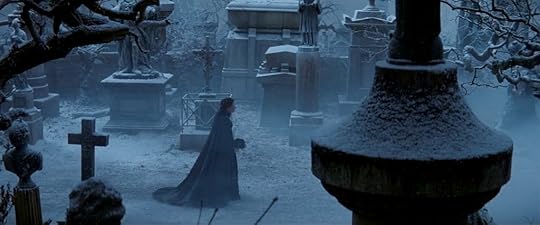 The Phantom meets Christine in a Graveyard
As the Phantom matured, he remained isolated. And it is this isolation that continued the abuse long after his former abusers were dead or gone. The greatest abuse, however, isn’t physical. Many studies have shown that emotional, psychological abuse does greater damage and is harder to heal from than any other abuse. The Phantom lead his whole life believing he was unlovable. Even when he was protected by a young Madame Giry, who gave him asylum in the opera house, he was not shown affection. Given that he continued to wear a mask throughout his life, it is even possible that Madame Giry reviled his appearance, perhaps even encouraged his wearing of the mask.
The mask is a symbol of hiding. It is to cloak your true self, either to hide wrong doing, or to blend in, or become something you are not. Over time, the Phantom, believing the lie that he was a monster, became one. He acted in violence to get what he wanted. He claimed Christine was his. This narcissistic behavior is a reflection of who he believed he had to be to be accepted. It was a plea, a call to be heard, to be human, if even only as a villain in another person’s story.
The turning point for the Phantom, where he learns the truth, is when Christine is his captive, and he threatens to kill Raoul unless she stays with him. It is the Phantom at his most monstrous. Yet even with all that hate, Christine still shows him genuine compassion. Compassion is something he has never yet known. But it is what he has been missing. The Phantom, a survivor of decades of abuse, isolation, and loathing, had never known that even with all that was wrong in his life, he was still worthy of human kindness and decency.
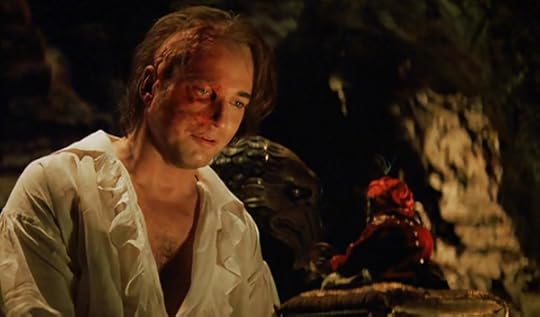
It isn’t Christine that frees the Phantom from his cycle of abuse. She only opens the door by showing him compassion. In the end, it is the Phantom who saves himself. After years of abuse, he is finally met with the one message his mind had never been given: that he was loveable, as he was. That he was enough. Overcome by this emotional release, he lets both Christine and Raoul go. He is seen next, singing a somber rendition of “Masquerade,” as he regards a toy which recalls his lost childhood. He is sad not because of what he lost with Christine, but because of what he never had as a child. This moment is a reflection of his true self. He is unmasked, both physically and emotionally, and finally free. In this scene, he is crying at the release of those years of pain. He is himself for the first time. He lets go of who he became to survive, and is once again the twelve year old boy who longed to belong in the world. He is free.
As the film closes, we see that many years later, the Phantom is still alive, and likely living a normal life. This is shown by there being a ring and a rose left at the grave of the now late Christine; these were items he had held on to as reminders of his love for her. She showed him his first experience with true compassion. And from that, he was freed to lead a life not as a monster, but as a man.
Abuse manifests in many ways. But escaping the pains of it requires personal growth and serious effort. The process is painful, but the freedom is worth it.