
Tarek Fatah's Blog, page 20
June 8, 2015


June 7, 2015
“Muslims have not just put a Burka on their wives and daughters, but also on their Wisdom and Intellect”
India’s leading Gujarati language talk show host Devangh Bhatt chats with Tarek Fatah on his show ‘Adithya’ or ‘Our Guest’ during my visit to the beautiful capital of Gujarat State, Ahmedabad. The interview is motsly Urdu and Hindi with Bhatt’s comments in Gujarati. Apologies to non Indo-Pakistanis.
http://tarekfatah.com/wp-content/uploads/2015/06/India-is-safe-place-for-Muslims-Tarek-Fatahs-exclusive-Interview-by-Devang-Bhatt.mp4
June 6, 2015
All Islamic extremism is unacceptable – Be it Iranian or Saudi inspired

 June 2, 2015
Tarek Fatah
The Toronto Sun
On Sunday, over 700 Canadians braved unseasonal cold and non-stop rain for four hours outside an Islamic centre north of Toronto.
They came to protest a bizarre celebration honouring the life and deeds of the late Iranian theocratic dictator, Ayatollah Khomeini.
There were politicians from the left to the right, writers, poets, artists, former prisoners and exiles, grandmothers, refugees, victims of torture.
They were mostly Iranian Canadians, but also Pakistanis, Jews, Kurds, orthodox Muslims, Marxists and Monarchists.
Inside the sprawling mosque other Canadians were bused in to participate in the macabre display of contempt for life and liberty.
It was encouraging to hear Liberal MPP Reza Moridi praise Prime Minister Harper for his stand against Iran. Such bipartisanship is rare.
Denunciation of the Khomeini celebrations came from across the political spectrum, including Defence Minister Jason Kenney.
He tweeted: “Disturbing to see anyone in Canada celebrating the murderous depravity of Ayatollah Khomeini’s brutal dictatorship.”
But there is another reality that does not bode well for our country.
After all, there are other Islamist centres across Canada where misogyny, homophobia, anti-Semitism and cursing of non-Muslims and secular Muslims are routine.
Yet politicians of all stripes shrug in the face of these facts, embracing those who would want to see a caliphate in Canada, with sharia law as this country’s constitution.
The difference being, these mosques are pro-Saudi Arabia and the Muslim Brotherhood, rather than pro-Iran and the ayatollahs.
Apparently politicians have determined embracing pro-Saudi Islamists can generate votes while rejecting pro-Iran Islamists will cost almost none.
Why else would NDP leader Thomas Mulcair in March visit the Islamic Society of North America (ISNA) mosque in Mississauga and declare: “For years, this mosque has played a vital role in Mississauga — promoting education and charity for all. And it’s been a leader in promoting unity—a lesson so important to the Prophet Mohammed, peace be upon him”?
Perhaps Mulcair isn’t aware of a 2005 story in the Globe and Mail identifying millions of dollars worth of Saudi funding to the ISNA mosque where he spoke.
(The Globe reported the funding was touted on the ISNA’s website although a spokesman officially denied it.)
Or a 2013 Toronto Star story on the Canada Revenue Agency revoking the charitable status of the ISNA Development Foundation after concluding it “facilitated the transfer of (charitable) resources that may have been used to support the efforts of a political organization . . . and its armed wing,” in Pakistan.
(The charity denied the allegation.)
Or that the parent organization of ISNA in the U.S. has been listed by the U.S. Justice Department as an “Unindicted Co-Conspirator” in a terror funding trial.
ISNA was never charged with any crime, but prosecutors listed it as one of the “entities who are and/or were members of the U.S. Muslim Brotherhood.”
(A federal judge later ruled the document should not have been released and ISNA said its inclusion was guilt by association.)
In 2013, Liberal leader Justin Trudeau spent an evening at ISNA’s Islamic Centre with the congregation during the Muslim holy month of Ramadan.
This same organization Mulcair and Trudeau embraced recently refused to allow its boys’ school soccer team to play against a Catholic school team with two girls on it.
Does this mean Islamism Saudi-style is fine, while Islamism, Khomeini-style is not?
Canadians need to put this question to all three political party leaders before this fall’s election.
June 5, 2015
May 23, 2015
May 20, 2015
Exiled Bangladesh writer Taslima Nasreen – The bravest woman I know

“It’s the pen and the sword; the sword always wins.”
 May 20, 2015
Tarek Fatah
The Toronto Sun
On my way to Delhi’s Indira Gandhi airport Sunday night for a flight back to Canada, I made a detour to pay my respects to someone I consider the bravest woman alive today — exiled Bangladeshi author, Taslima Nasreen.
She and her cat “Minu” live alone on the top floor of a four-storey apartment complex in the suburbs of India’s sprawling capital.
Millions of Indians live in such complexes. Except in this building, she is the only resident.
For security reasons, the elevator is disabled. The lights in the stairway leading up to her spartan flat are as dim as those in a coal mine. Armed Indian security officers guard the complex around the clock.
Outside her apartment door stands a towering soldier, bearing an automatic rifle.
Despite the security, this woman of steel, who has braved both physical and verbal assaults over her last 20 years in exile, sounds despondent.
She tells me, “The jihadi death squads of Bangladesh, who have killed three secular writers in three months, have now added my name to their list.”
Swiping her iPad, Nasreen shows me the threat made on Twitter by someone using the now-deleted handle @JihadForKhilafa, a call to jihad to establish an Islamic Caliphate.
“@TaslimaNasreen u r also among the 84 who r on the hitlist. Count ur days -;” the message reads.
Nasreen repeats a line from the award-winning Bangla film Nirbashito about freedom of speech, based on her life.
“It’s the pen and the sword; the sword always wins.”
Nasreen smiles, as she often does, with a wicked twinkle in her eyes, but I sense an air of despondency in her.
“We will win,” I tell her, trying to infuse her with some optimism.
“Kaisa jeeta ga, tumm bhi tho bhag gaya?” she asks me in jest.
(“How can we win, when you, too, are running away?”)
She speaks in a lilting, Urdu accent, reminding me of the 1970s, when both of us were citizens of Pakistan.
“No, I am not running away,” I protest. “I will fight the cancer of Islamofascism until it’s defeated.”
But she isn’t convinced.
“That’s your problem, Tarek,” she tells me, “stop fooling yourself, (the problem is) Islam, not Islamofascism.”
“I, too, am a European citizen”, she lectures me. “I too, can live in Europe, but I choose to fight the extremists here in India. This is where the epic ‘Ghazwa-e-Hind’ (will occur).”
This refers to the end-of-time battle Prophet Mohammed is said to have predicted, where non-Muslims will come under Islamic control, triggering the long-awaited Islamic Armageddon.
Nasreen taunts me, arguing this war will not be waged by jihadis in air-conditioned Canada.
“Come to Canada,” I suggest.
“Really?” she responds sarcastically. “I can never forget the mob of Muslim students in Montreal’s Concordia University, who successfully disrupted my speech, and I had to be taken away by police.
“Even if I go to safety in the West, who will take care of my cat?” she adds.
As she speaks, Minu purrs and scratches Nasreen’s sari.
We part, knowing we may never meet again.
The woman I consider the world’s bravest feminist, who has no family, siblings, parents or children, just her conviction and integrity, beams me a smile.
I am teary-eyed as I say “Khuda Hafiz”, (“May God be your Protector”), a parting wish banned by Islamists in Bangladesh and Pakistan, but not yet in India.
May 8, 2015
“Pakistan ITSELF is a दौउद इब्राहीम Dawood Ibrahim” – A discussion on India’s Door Darshan State Network
“Pakistan ITSELF is a दौउद इब्राहीम Dawood Ibrahim”. Discussing Dawood Ibrahim दौउद इब्राहीम on India’s Door Darshan TV with BJP and Congress MPs and a former Indian Consul General in Karachi. Senior Indian journalist Sudharshan Rajan is the host.”Pakistan ITSELF is a दौउद इब्राहीम Dawood Ibrahim”
Posted by Tarek Fatah on Thursday, 7 May 2015
 Who is Dawood Ibrahim? Here is Wikipedia on the Indian gangster turned terrorist who then turned jihadi.
Dawood Ibrahim (born Dawood Ibrahim Kaskar) is the leader call “Bhai” of Indian organised crime syndicate D-Companyfounded in Mumbai.
He is currently on the wanted list of Interpol for Cheating, Criminal Conspiracy and Organised Crime Syndicate. He was No. 3 on the Forbes’ World’s Top 10 most dreaded criminals list of 2011, rising from the 4th position in 2008.
Indian court has recently issued a warrant on Dawood Ibrahim for sport fixing crime in the Indian Premier League.[6]Dawood Ibrahim is accused of heading a vast and sprawling illegal empire in and against India and Indians. After the 1993 Mumbai bombings, which Ibrahim allegedly organised and financed, he became India’s most wanted man.
May 5, 2015
May 3, 2015
Images of Prophet Muhammad from Islamic Art and History before the clan of Ibn Saud took Muslims hostage

Isaiah’s vision of Jesus riding a donkey and Muhammad riding a camel, al-Biruni, al-Athar al-Baqiyya ‘an al-Qurun al-Khaliyya (Chronology of Ancient Nations), Tabriz, Iran, 1307-8. Edinburgh University Library. EDINBURGH UNIVERSITY LIBRARY
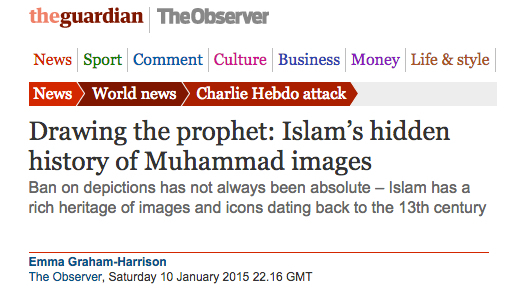
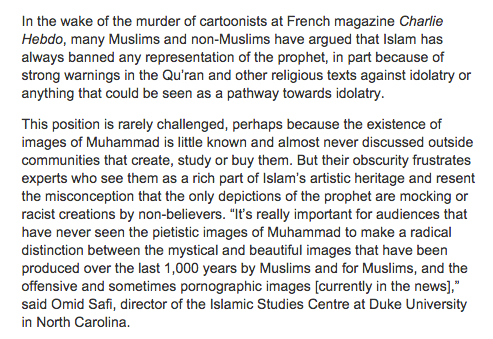
To many Muslims, any image of the prophet Muhammad is sacrilegious, but the ban has not always been absolute and there is a small but rich tradition of devotional Islamic art going back more than seven centuries that does depict God’s messenger. It began with exquisite miniatures from the 13th century, scholars say. Commissioned from Muslim artists by the rich and powerful of their day, they show almost every episode of Muhammad’s life as recounted in the Qur’an and other texts, from birth to death and ascension into heaven.
Intended as private aids to devotion and prayer, these detailed scenes were made for both Sunni and Shia worshippers, and surviving examples can be found in dozens of major museum and library collections.
They also laid the foundations for a popular, if minority, tradition of devotional and inspirational images that still exists today, from icons cherished in homes to a five-storey government-commissioned mural in the heart of Tehran and even to revolutionary street art in Cairo – although the prophet’s face is obscured in both those public drawings.

Ka‘ba, al-Darir, Siyer-i Nebi (The Biography of the Prophet), Istanbul, Ottoman lands, 1595-96. TOPKAPI PALACE LIBRARY

The Prophet Muhammad receives revelations at Mount Hira, al-Darir, Siyer-i Nebi (The Biography of the Prophet), Istanbul, Ottoman lands, 1595-1596. TOPKAPI PALACE LIBRARY

The Prophet Muhammad sits with the Abrahamic prophets in Jerusalem, anonymous, Mi‘rajnama (Book of Ascension), Tabriz, ca. 1317-1330. TOPKAPI PALACE LIBRARY

The Prophet Muhammad enthroned, surmounted by angels, and surrounded by his companions, Firdawsi, Shahnama (Book of Kings), probably Shiraz, Iran, early 14th century. FREER/SACKLER MUSEUM OF ASIAN ART/SMITHSONIAN INSTITUTION
![Illustration showing Mohammed (on the right) preaching his final sermon to his earliest converts, on Mount Ararat near Mecca; taken from a medieval-era manuscript of the astronomical treatise The Remaining Signs of Past Centuries by the Persian scholar al-Biruni; currently housed in the collection of the Bibliotheque Nationale, Paris (Manuscrits Arabe 1489 fol. 5v). This scene was popular among medieval Islamic artists, and several nearly identical versions of this drawing (such as this one [shown in detail below] and this one) were made in the Middle Ages.](http://tarekfatah.com/wp-content/uploads/2015/01/0_01.jpg)
Illustration showing Mohammed (on the right) preaching his final sermon to his earliest converts, on Mount Ararat near Mecca; taken from a medieval-era manuscript of the astronomical treatise The Remaining Signs of Past Centuries by the Persian scholar al-Biruni; currently housed in the collection of the Bibliotheque Nationale, Paris (Manuscrits Arabe 1489 fol. 5v). This scene was popular among medieval Islamic artists, and several nearly identical versions of this drawing (such as this one [shown in detail below] and this one) were made in the Middle Ages.

Mohammed (on the right, astride Buraq) and the Angel Gabriel (center) talk with Abraham (left) in Paradise. Persian, 15th century.

Mohammed arrives on the shores of the White Sea. Also from the Apocalypse of Muhammad, written in 1436 in Herat, Afghanistan (now in the Bibliotheque Nationale, Paris).

Mohammed greeting ambassadors from Medina. Likely of central Asian origin, though the site on which the image was found does not give an exact date or location.

Mohammed (far right) and the Archangel Gabriel standing in front of a giant angel. From the Miraj-name, Tabriz (c. 1360-70). In the Topkapi Palace Library, Istanbul.

Mohammed borne on Gabriel’s shoulders, arriving at the gate of paradise guarded by the angel Ridwan. From the Miraj-name, Tabriz (c. 1360-70). In the Topkapi Palace Library, Istanbul.

An angel presenting Mohammed (upper left) and his companions with a miniature city. In the Topkapi Palace Library, Istanbul.

The Archangel Gabriel carries Mohammed on his shoulders over mountains where angels are shown among golden flames. In the Topkapi Palace Library, Istanbul.

Mohammed flying over Mecca, at the beginning of his “Night Journey.” The square building in the center is the Ka’aba. From the manuscript entitled Khamseh, by Nezami, 1494-5. Currently in the British Museum.

Mohammed (riding the horse) receiving the submission of the Banu Nadir, a Jewish tribe he defeated at Medina. From the Jami’al-Tawarikh, dated 1314-5. In the Nour Foundation’s Nasser D. Khalili Collection of Islamic Art, London.

Another version of the same image as above, also likely from Rashid al-Din’s Jami’al-Tawarikh. This image is likely a redrawn lithograph of the original, and was printed in the book History of Egypt, by S. Rappoport, which contains the caption, “The original of the illustration is to be seen in a finely illuminated MS. of the ninth century, A. D., preserved in the India Office, London. The picture is of peculiar interest, being the only known portrait of Muhammed, who is evidently represented as receiving the divine command to propagate Muhammedanism.” Obviously, the caption is in error; the style of drawing appears to come from later than the ninth century, and needless to say this is not “the only known portrait of Muhammed.”

Mohammed exhorting his family before the battle of Badr. It is not immediately apparent which figure in this drawing is Mohammed. From the Jami’al-Tawarikh, dated 1314-5. In the Nour Foundation’s Nasser D. Khalili Collection of Islamic Art, London.

Mohammed (on the left) leading Hamza and the Muslims against Banu Qaynuqa’. From the Jami’al-Tawarikh, dated 1314-5. In the Nour Foundation’s Nasser D. Khalili Collection of Islamic Art, London.

Mohammed’s Flight from Mecca in 622 AD; Algerian color postcard from the 1920s or ’30s. Mohammed is the figure entering the cave. The original postcard is in a private collection.
(Hat tip: Martin H.)

Mohammed receiving his first revelation from the angel Gabriel. Miniature illustration on vellum from the book Jami’ al-Tawarikh (literally “Compendium of Chronicles” but often referred to as The Universal History or History of the World), by Rashid al-Din, published in Tabriz, Persia, 1307 A.D. Now in the collection of the Edinburgh University Library, Scotland.

A young Mohammed being recognized by the monk Bahira. Miniature illustration on vellum from the book Jami’ al-Tawarikh (literally “Compendium of Chronicles” but often referred to as The Universal History or History of the World), by Rashid al-Din, published in Tabriz, Persia, 1307 A.D. Now in the collection of the Edinburgh University Library, Scotland.

Mohammed solves a dispute over lifting the black stone into position at the Kaaba. The legends tell how, when Mohammed was still a young man, the Kaaba was being rebuilt and a dispute arose between the various clans in Mecca over who had the right rededicate the black stone. (The Kaaba was at that time still a polytheistic shrine, this being many years before Islam was founded.) Mohammed resolved the argument by placing the stone on a cloth and having members of each clan lift the cloth together, raising the black stone into place cooperatively. Miniature illustration on vellum from the book Jami’ al-Tawarikh (literally “Compendium of Chronicles” but often referred to as The Universal History or History of the World), by Rashid al-Din, published in Tabriz, Persia, 1307 A.D. Now in the collection of the Edinburgh University Library, Scotland.
(Hat tip: Brett K. and Martin H.)

Mohammed’s birth. Miniature illustration on vellum from the book Jami’ al-Tawarikh (literally “Compendium of Chronicles” but often referred to as The Universal History or History of the World), by Rashid al-Din, published in Tabriz, Persia, 1307 A.D. Now in the collection of the Edinburgh University Library, Scotland.

The Mi’raj (also called the “Night Ride”) of Mohammed on Buraq. Miniature illustration on vellum from the book Jami’ al-Tawarikh (literally “Compendium of Chronicles” but often referred to as The Universal History or History of the World), by Rashid al-Din, published in Tabriz, Persia, 1307 A.D. Now in the collection of the Edinburgh University Library, Scotland.

Mohammed (on the far right) and Abu Bakr on their way to Medina while a woman milks a herd of goats. Miniature illustration on vellum from the book Jami’ al-Tawarikh (literally “Compendium of Chronicles” but often referred to as The Universal History or History of the World), by Rashid al-Din, published in Tabriz, Persia, 1307 A.D. Now in the collection of the Edinburgh University Library, Scotland.

Mohammed (upper right) visiting Paradise while riding Buraq, accompanied by the Angel Gabriel (upper left). Below them, riding camels, are some of the fabled houris of Paradise — the “virgins” promised to heroes and martyrs. This image and the following five images are Persian, 15th century, from a manuscipt entitled Miraj Nama, which is in the Bibliotheque Nationale, Paris. Taken from The Miraculous Journey of Mahomet, by Marie-Rose Seguy.

Mohammed, flying over Paradise, looks at the houris harvesting flowers and enjoying themselves. Persian, 15th century.

Mohammed, along with Buraq and Gabriel, visit Hell, and see a demon punishing “shameless women” who had exposed their hair to strangers. For this crime of inciting lust in men, the women are strung up by their hair and burned for eternity. Persian, 15th century.

Next, Mohammed sees women strung up by hooks thrust through their tongues by a green demon. Their crimes were to “mock” their husbands and to leave their homes without permission. Persian, 15th century.

Further on, Mohammed sees a red demon that is torturing women by hanging them up by hooks through their breasts, as they are engulfed in flames. The women are being punished for giving birth to illegitimate children whom they falsely claimed were fathered by their husbands. Persian, 15th century.

Mohammed (on the right, astride Buraq) and the Angel Gabriel (center) talk with Abraham (left) in Paradise. Persian, 15th century.

The Night Journey of Muhammad on His Steed, Buraq; leaf from a copy of the Bustan of Sacdi, dated 1514. From Bukhara, Uzbekistan. In The Metropolitan Museum of Art.

Muhammad’s Call to Prophecy and the First Revelation; leaf from a copy of the Majmac al-tawarikh (“Compendium of Histories”), ca. 1425; Timurid. From Herat, Afghanistan. In The Metropolitan Museum of Art.

Another miniature showing Mohammed astride Buraq. Provenance unknown.

Mohammed in a cavern, in a painting entitled “The Charge of the Lion.” The painting possibly depicts Mohammed (along with Abu Bakr, not depicted) hiding from pursuers in the Cave of the Bull during the Hijra in 622. Unknown provenance, now in the Bibliotheque Nationale, Paris.

Mohammed presented to the monk Abd al Muttalib and the inhabitants of Mecca. 18th century Ottoman copy of a supposedly 8th century original. Now located in the Topkapi Palace Museum, Istanbul.

Detail of Mohammed from the picture above, in Paradise with beautiful females.

Journey of the Prophet Muhammad; leaf from a copy of the Majmac al-tawarikh (“Compendium of Histories”), ca. 1425; Timurid. Herat, Afghanistan. In The Metropolitan Museum of Art.
Images of the Prophet Muhammad from non-Muslim sources:

This Russian painting from 1840-1850 shows prophet Muhammad preaching. The artist is Grigory Gagarin.

Portrait of Mohammed from Michel Baudier’s book Histoire générale de la religion des turcs (Paris, 1625). It was sold at auction by Sotheby’s in 2002. The same image was used on the cover of issue #2195 of the French magazine Le Nouvel Observateur.

This gravure of Mohammed can be found in Alexander Ross’s Pahsebeia, or A View of all Religions in the World, a book from 1683. It should be noted that these clothes were not known in the Arabic peninsula during that period and thus the image is not correct.

This beautiful lithograph of Mohammed belongs to a Spanish edition of the Koran from 1932.

This depiction of Muhammad appears on the frontispiece for the 1900 reprint of the book The Life of Mohammed, by an author coincidentally named George Bush.

The cover of the 1911 Danish biography called Profeten Muhammed written by Johannes Østrup shows this beautiful image of Mohammed riding on a stylized flying horse.

This 1928 German advertisement for meat extract shows Gabriel guiding Mohammed on a flying horse up to Allah.
Tarek Fatah's Blog

- Tarek Fatah's profile
- 79 followers

