Rob Kitchin's Blog, page 167
October 18, 2013
Review of The Hour of the Cat by Peter Quinn (Duckworth Overlook, 2006)
 June 1938 and Germany seems poised to invade Czechoslovakia, the French and British trying to find a path of appeasement. In Berlin, Colonel Oster tries to persuade his boss, Admiral Canaris, that a military coup is the only way to deal with Hitler and the Nazis, but the head of Military Intelligence prevaricates, despite the rumour circulating about war and eugenics programmes. In New York, veteran of the trenches, Fintan Dunne, has left the police to ply his trade as a gumshoe. He accepts a job to investigate the supposed framing of a Cuban refugee for murder; a case that nobody seems happy he’s pursuing. The case proves more complex and dangerous than he anticipates, tainted by police corruption, politics, and the long shadow of events in Germany. But Dunne isn’t a quitter, despite the risks and consequences.
 The strength of The Hour of the Cat is its plot, characters, and historical contextualisation and detail. The story is an expansive, complex but intricately plotted tale that blends a traditional style private investigator tale with national and international politics. There are numerous interlinked subplots that mix fictional and real-life characters and are contextualised within the historical record of the time, such as the eugenics movement on both sides of the Atlantic, the expressions of Nazism in the US, the neutrality position of many in the US, developments within Germany and plots inside its military, and even weather events. Along with its elaborate plot are a large cast of characters, each of which is well drawn and accompanied by a back story. The result is a compelling and fascinating tale. Where the story is let down a little is in the telling. The slow pacing, detailed contextualisation, and understated prose produces a rather flat narrative, with a little too much of the telling not moving the story forward, and the complexity of the story might have benefitted from losing one or two subplots. Nevertheless, The Hour of the Cat is a clever tale that provides an interesting insight into the US life and politics just prior to the Second World War.


October 17, 2013
Totally captivating ...
 I love that feeling when you're reading a novel and rolling around at the back of your mind is, 'this is brilliant.' I'm about 150 pages into John Lawton's Then We Take Berlin and this thought has been there for quite a time now. Totally captivating. Hopefully a feeling that lasts until the final page. A feeling worth sharing, I think.
October 16, 2013
Review of The Gods of Gotham by Lyndsay Faye (Headline, 2012)
 August 1845, Timothy Wilde’s career as a barman in lower Manhattan is ended by a fire that decimates a district. A couple of days later his politically connected brother, Valentine, secures him a post in the newly formed city police department. Wilde is a reluctant police officer in a town that is teeming with crime and poverty, made worse by thousands of penniless Irish arriving to escape the great potato famine. But he’s also a very good detective and when a young girl who is covered in blood crashes into his legs he sets about investigating her story. What he discovers threatens the future of the force and to bring tensions in the city to boiling point.
 The Gods of Gotham hits all the buttons for a successful debut novel -- colourful characters, engaging prose, a strong sense of place and time, historical interest and detail, authentic dialogue, and a page turning plot. Faye drops the reader into mid-nineteenth century New York and its urban fabric, social life and tensions, squalor, and political shenanigans, building the story around real events that took place in the city at the time. This world she populates with a range of well-penned characters, who speak using slang used at the time and published in George Matsell’s (the first chief of police of New York) The Secret Language of Crime published in 1859. The tale is well plotted with plenty of intrigue, feints, and twists and turns. The prose is lively and expressive and evocative. Despite all the positives there are couple of detractions: at times scenes are over written, with the prose style and twists becoming a little overbearing and wearing as the story unfolded; and occassionally the details and research are writ large, when they either weren't needed or should have been more contextual than front and centre. Nonetheless, The Gods of Gotham is an interesting, entertaining and engaging read.

October 13, 2013
Lazy Sunday Service
 Back in Ireland after a hectic week in New York and Boston. Normally I find more time for reading when travelling, but not on this trip. I read just two books, both historical novels set in New York, which were very different in style but each very good. Expect reviews of Lyndsay Faye's The Gods of Gotham (set in 1845) and Peter Quinn's The Hour of the Cat (set in 1938) in the coming week.
 My posts this week:
Review of A Private Business by Barbara Nadel
Review of Black Wattle Creek by Geoffrey McGeachin
Compromises
October 12, 2013
Compromises
Dexter eased open the front door and stepped quietly into the darkened hall.
His mother appeared in the kitchen doorway, her face tired, hair tangled.
‘Where have you been?’
‘Out.’ He brushed past her and opened the fridge.
‘I’ve been worried sick. It’s two fifteen in the morning.’
‘Is he still here?’
‘He’s in bed.’
‘Why?’
‘Why what?’
‘Why’s he still here? He’s a monster.’
‘He’s ... It’s ... Maybe when you’re my age you’ll understand. Life’s all about compromises.’
‘Is that what I am? A compromise?’ He headed empty handed to the stairs. ‘Is that what your bruises are?’
A drabble is a story of exactly 100 words
His mother appeared in the kitchen doorway, her face tired, hair tangled.
‘Where have you been?’
‘Out.’ He brushed past her and opened the fridge.
‘I’ve been worried sick. It’s two fifteen in the morning.’
‘Is he still here?’
‘He’s in bed.’
‘Why?’
‘Why what?’
‘Why’s he still here? He’s a monster.’
‘He’s ... It’s ... Maybe when you’re my age you’ll understand. Life’s all about compromises.’
‘Is that what I am? A compromise?’ He headed empty handed to the stairs. ‘Is that what your bruises are?’
A drabble is a story of exactly 100 words
October 9, 2013
Review of Black Wattle Creek by Geoffrey McGeachin (Penguin, 2012)

Ten years after starting a relationship with Rebecca in the Diggers Rest Hotel, Charlie Berlin is living in suburban Melbourne with his wife and two children, Peter and Sarah. He’s still working as a cop, but his career is in a dead-end, he’s struggling to make ends meet, and he is still living with the demons of his time as bomber pilot and POW in a Polish camp. When a recently bereaved widow becomes suspicious about the activities of a funeral home, Berlin agrees to investigate. It’s immediately obvious that the director of the company has something to hide and his interest piqued, Charlie starts to poke around. It soon becomes clear though that he’s stumbled onto something much bigger than he anticipated and he’s inadvertently put himself and his family at risk. Rather than turning a blind eye, however, he stubbornly continues to investigate the strange goings-on at Black Wattle Creek.
Black Wattle Creek has two strong elements: the character of Charlie Berlin and his family, and the reason behind his investigation. Berlin is interesting company, a caring family man who’s haunted by his past, and is tenacious in his pursuit of a solving a case. When he looks into the suspicions of one of his wife’s friends about a local funeral home he has no idea what he getting himself into. It soon becomes obvious that maybe he’d be better off keeping his nose out of other peoples’ business. Where the story seems to become a little unstuck, however, is in its unfolding. There were two aspects that I had a hard time buying which worked to undermine the fidelity of the tale somewhat. The first was the strategy of those he’s investigating, who inflict savage violence on those Berlin consults rather than the man himself. The second was Berlin being enlightened by the same people when there was really no need and then let wander free. Nevertheless, the tale is enjoyable, mainly because Berlin is a compelling, wounded character and the pacing and prose are nicely done. The third book in the series is due out next year and I’m looking forward to reading it in due course.
Many thanks to Geoffrey McGeachin for sending me a copy of the book, which has recently won the 2013 Ned Kelly Award for best crime novel in Australia.

October 7, 2013
Review of A Private Business by Barbara Nadel (Quercus, 2012)
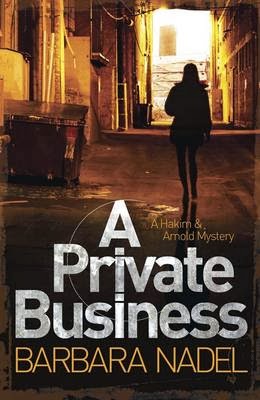 Recently bereaved, former foul-mouthed comedienne Maria Peters has found God, is trying to make a comeback, and is convinced that someone is stalking her. She turns to a former cop turned private investigator, Lee Arnold, who has just hired Mumtaz Hakim as his assistant. Lee and Mumtaz have problems of their own. Lee’s business is struggling and his brother is an alcoholic who’s making his mother’s life difficult. Mumtaz’s husband was recently murdered and she’s been left with a sixteen year old step-daughter and enormous debts that threaten their home. Lee and Mumtaz take on the case, but despite close surveillance can spot no interference in Maria’s life except her own paranoia. As that grows she is drawn closer to a born again church and becomes ever more withdrawn and skittish. The question is whether her concerns are real or delusions?
 The real strengths of A Private Business is the characterisation, contextualisation and social interplay between characters. Nadel has created four strong lead characters in former cop, Lee, Muslim widow, Mumtaz, divorced and world weary cop, Vi, and former alternative comedienne, Maria Peters. The plot focuses as much on their own lives and troubles, and the various forces shaping them, as it does the investigation, and this is a definite plus rather than a distraction. They are genuinely interesting characters with fleshed out back stories and social networks. The story itself is relatively straightforward and its clear from very early on what is happening; it’s more a case of how it unfolds and resolves than a puzzle. My impression on finishing the story was that it would be perfect for a television adaptation. I’m looking forward to reading the second book in the series.

October 6, 2013
Lazy Sunday Service
 I arrived in New York on Friday morning. My luggage seemed to get lost in the airport and popped out on the baggage carousel 20 minutes after all the others, just as I was finishing off the forms and heading into the city to buy some clothes. Other than that, it's going well. I managed to get to The Mysterious Bookshop on Friday afternoon. I set a purchase limit of five books. In the end I succumbed to seven:
The Thicket by Joe Lansdale
The Visitation by Ivy Pochoda
Rough Riders by Charlie Stella
Then We Take Berlin by John Lawton
Tapestry by J. Robert Janes
Jade Lady Burning by Martin Limon
Severance Package by Duane Swiercznski
I'm happy with this haul, though its added a couple of kilo to my suitcase. It's a wonder I only managed to stick to seven. It would have been a lot more if I'd browsed in earnest - these were all within a few feet of the front entrance! I'm looking forward to reading them sometime between now and Christmas.
My posts this week:
Pushing one's luck
Review of Pale Horses by Nate Southard
September reviews
Review of The Riot by Laura Wilson
October 5, 2013
Pushing one’s luck
‘You really are a sour fecker, Charlie. You take pleasure when some poor bugger fails and you begrudge anyone who has even the slightest bit of success.’
‘At least I don’t discriminate in my sourness.’
‘No, you stick the knife in and jiggle it about with equal relish, no matter who or what the circumstances.’
‘Maybe you’ve had enough to drink, Joe.’
‘Don’t try and tell me when I’ve had too much to drink, you sanctimonious bastard!’
‘Then stop spitting out insults.’
‘You deserve them, you cold hearted fecker.’
‘Careful now, Joe, don’t forget I’m vindictive and violent as well.’
A drabble is a story of exactly 100 words.
‘At least I don’t discriminate in my sourness.’
‘No, you stick the knife in and jiggle it about with equal relish, no matter who or what the circumstances.’
‘Maybe you’ve had enough to drink, Joe.’
‘Don’t try and tell me when I’ve had too much to drink, you sanctimonious bastard!’
‘Then stop spitting out insults.’
‘You deserve them, you cold hearted fecker.’
‘Careful now, Joe, don’t forget I’m vindictive and violent as well.’
A drabble is a story of exactly 100 words.
October 3, 2013
Review of Pale Horses by Nate Southard (Snubnose Press, 2013)
 Sheriff Hal Kendrick has a secret he’s hiding from his work colleagues – he’s been diagnosed with the early stages of Alzheimer’s. Increasingly forgetful, everyday he struggles to get by, relying on bluff and prompts to perform his duties and a GPS to travel around. Worse still, he can barely remember the name of his wife or his life history. His wife wants him to retire before his illness is discovered. Hal, however, is determined to try and leave the county in a better state than when he became sheriff, or at the least solve the murder of a young woman found in a field. Colleen Lothridge has been beaten to death with a hammer. Part-time deputy Danny Cole went to school with Colleen and is friends with her husband, Bobby. He’s convinced he knows the identity of the killer, a former marine suffering from post-traumatic stress disorder. Since returning to Indiana, Korey Hunt has been drinking, blacking out, fighting his demons and anybody who rubs him up the wrong way, and attending therapy. All he wants is to return to a normal life, not face a life in prison for a murder he says he didn’t commit. Hal might be able to finish his career with a conviction, but it could be at the expense of rough justice.
Pale Horses is a country noir of the blackest kind, offset with strong bittersweet undertones. The story charts the intersections of three principal characters over the course of a murder investigation: an aging sheriff with Alzheimer’s, an unbalanced deputy with a drug habit and a Christina Ricci obsession, and a former marine haunted by his time in Iraq and Afghanistan. All three characters are very well drawn and developed as the story progresses. In particular, Hal Kendrick is a wonderfully observed character, with Southard sympathetically charting his slow decline and increasing confusion. There is a good sense of place and contextualisation concerning small town, rural America, and the plot is compelling, building to a violent but nicely done denouement. In my view, it is ready made for a movie adaptation in the vein of Daniel Woodrell’s Winter’s Bone (it needs an indie treatment, not a Hollywood one). Unsettling, uncompromising, dark and bittersweet, Pale Horses is a gripping read.
I've been lucky enough to read an ARC of Pale Horses and it should be published shortly.