Robin Chambers's Blog
September 14, 2019
“Loneliness and loss and the reparative powers of love”
 Better Strangers by Lesley Hayes
My rating: 5 of 5 stars
This trilogy is clearly a labour of love. It's also about forgiveness, of course, though getting there almost certainly involves "the nameless feeling that [is] something like thirst and something like pain, and most of all like a darkness." I gave volume 1 in this series five stars, and have no hesitation in granting volume two the same supreme accolade. Reading Lesley Hayes always helps one come to terms with one’s own demons. It’s a considerable comfort to be reminded that we are all on more or less the same journey, and whatever our circumstances, we are levelled by having to make the best of it in equal measure.
Have there been “times in your life when it felt as though the brick wall was coming to meet you, whether you drove into it or not”? Maybe during those times your “sense of humiliation was not something to be shared.” Perhaps there have been occasions when you “loathed this feeble, needy infant inside [you], and would not listen to its sad little voice, its plangent longing to be held in [someone’s] arms again.” The author’s training as a psychotherapist serves her and her readers well in this immensely readable account of the lives of three women who vowed in adolescence always to be best friends and who now make their way through fifteen more years of their adult lives, bearing to the best of their ability their individual encounters with some of “the thousand natural shocks that flesh is heir to.”
I look forward to reading the final volume of the trilogy, with some trepidation; but I’m fairly sure that - like Beatrice at the end of Chapter 8 (which in particular spoke to me) - I will have “stared down [my] own bleak expectations and allowed love to overrule them.”
View all my reviews


August 13, 2019
Capital punishment for being Ireland
 Anna by Colm Herron
My rating: 5 of 5 stars
Colm Herron is an exceptional writer who deserves more widespread recognition, and ‘Anna’ is his finest work to date. It deals (as do his other books) with the special relationship Northern Ireland has with bigotry, and Herron has a rare ability to get right to the heart of the matter. I found myself thinking throughout: “What a piece of work is a man” – immensely talented and yet deeply flawed; funny, sad, noble and pathetic, all at the same time.
This is a story about abuse. It’s told by Robert, “twenty-eight, respectable teacher, virgin till two weeks ago”, whose mind from early childhood was undermined by Roman Catholic dogma and myth and whose heart was led down the garden path with fables and warnings from God knows when. “You have to remember that in our hierarchy of evil the sin of fornication ranks more seriously than any other up to and sometimes including homicide …” He strikes up a relationship with Anna, an angry, bisexual, radical socialist who throughout her childhood was sexually abused by her father, and who – predictably - has no regard for Catholic principles. Featuring in this hilariously entertaining tapestry of a tale are a host of local characters, each of whom adds to the richness and profundity of the narrative.
Herron has a wicked sense of humour, a sharp eye for detail, and a command of language and literature that makes his work a deep and lasting pleasure to read. I am resisting the temptation to offer you a hundred examples of his biting wit, spot-on similes and touchingly lyrical language. Instead, I will simply recommend “Anna” without reservation. Do read this book. I think that, like me, you will laugh and cry in equal measure.
View all my reviews
December 4, 2018
You’ll learn more about philosophy and psychology than housewifery
 The Other Woman by Lesley Hayes
My rating: 5 of 5 stars
Here are “twelve stories to make you smile, make you sad, and maybe make you ponder on the absurdities and tragedies in our quest for love.” Those are the author’s words, and as with all her words, they ring true; though I find, now one year into my fourth quarter-century, that the emotions they rouse are recollected in the comparative tranquility and comfortable sanctuary of encroaching old age. We have, however, all been there. “Oh pretty, pretty noose, Kate. Let me place you tenderly around my neck …”
The stories are compulsive reading, though I found I needed time between each to think through the layers of what I had learned. For example, is it an “unrealised search for perfection that gives love its elusive, painful sense of urgency?” The questions raised and observations made in each story may at certain times have crossed your mind, but never, perhaps, in words so well expressed.
“This was a very specific kind of happiness. A rather dangerous kind. It belonged entirely to Joe.” “Once you’ve got out of the habit of crying, it’s a dangerous one to get back into.” “How do people get to be such clichés and not realise?” “I’m numb in the place where pain used to be, where perhaps it ought to be.” “I don’t go out of my way to hurt anyone. It’s something that just happens.” When reading Lesley Hayes, you will glean a good deal about philosophy and psychology and almost nothing about housewifery. Mothers, incidentally, almost never get a good press.
I enjoy her dry wit, her sense of irony, her telling turn of phrase. I could quote a hundred examples, but let me tempt you further with a few. “I wonder who this ‘mum’ person is. Does he mean the washed-out hag who has turned man-hatred into an art form?” “She and I have a pact not to understand one another.” “It seemed to me that she was losing out on the depths of human emotion in which I painfully wallowed.” “I forgot not to be clever. Habit dies hard.” “Mostly, though, people didn’t close their eyes when they saw her, and so they missed a lot.” “… one of those rare flashes that fate playfully shafts you with.” “He was a complex character - a detail she hadn’t realised when she fell in love with him.” “Knowing Rachel of old, she waited to catch her as she toppled, exhausted, from her high horse.” “She grew ancient and fatigued with wisdom.”
Her stories draw you in, make you laugh and cry, and above all make you think deeply about the human condition and the minefield of relationships we all stumble through with varying degrees of damage. They are both entertaining and valuable, and I recommend them without reservation.
View all my reviews
November 17, 2018
There is no telling what the final destination might be
 Exits and Entrances by Lesley Hayes
My rating: 5 of 5 stars
This is the seventh novel by Lesley Hayes that I have read and reviewed. I enjoyed (and learned a lot from) the other six, and was very confident the seventh would not disappoint. It didn’t.
We first meet her three protagonists in their relatively early teens, when they vow with “all the unspoilt certainty of youth” to be friends forever. Inevitably, their paths diverge when they launch themselves into the world and face significantly different challenges; but they remain as true as they find they can be to their early vow, at least during the years this volume covers. This first volume of an intended trilogy entitled "Written in Water" follows three young women – Cordelia, Rosalind and Beatrice – through the years 1962–1972.
It is meticulously researched, referencing many of the significant social and political events of these years, and is sure to bring back sharp memories for anyone who, like me, lived through those years as a socially conscious young adult. Lesley Hayes is shrewd, kind and perceptive in the portrayal of her characters and I found myself regularly relishing her pithy and often amusing depictions of them. “Rosalind had not so much lost her virginity as hurled it at the first reasonably attractive man who had looked as though he were up to the job.” She had been on “a number of dates where sex had proceeded more from fulfilling her side of an anticipated bargain rather than ignited passion.” For Beatrice, “it was preferable to keep the love she longed for alive in the realm of possibility rather than dead on the scorched earth of denial.” “Katya shrugged. ‘Is determined to stay put,’ she said. ‘Baby is bloody stubborn. Must be a girl.’”
The author’s observations on life in general are always thought-provoking. Beatrice “had already discovered an important lesson, one which would prove useful throughout her life, that lowering one’s expectations eliminated a large proportion of emotional suffering.” “Once a journey of any kind was begun there was no telling what the final destination might be.” “We’re all hiding in case the truth of who we are condemns us to ridicule.” “External beauty fades in time, but with enough attention, inner beauty grows.” “Fascism in one form or another still thrives – even among schoolboys.”
The author’s obvious empathy with her characters makes it easy for her readers to like and to sympathise with them, recognising in their different struggles to find happiness so much with which they can personally identify. How many of us, for example, are like Paddy and dress up our despair as political world-weariness, which isn’t the same thing at all?
“She had the look of someone who knew where she was going even though as yet she had nowhere to go.” This trilogy clearly has worthwhile places to go, and I am looking forward to accompanying it on that journey.
View all my reviews
June 6, 2018
Powerful and profound
 Proof Positive by Lucy V. Hay
My rating: 5 of 5 stars
An essential criterion for any good book – as it is for any good poem – is that it should say something important about the human condition in a powerful way. 'Proof Positive' does that from the beginning. I have rarely read an opening chapter so powerful and profound.
Lucy Hay has a sharp eye for telling detail and an almost pathological awareness of the discrepancy between human potential and actual achievement within the constricting contexts of family and social class. It hurts like ‘Hamlet’, and Alan Bennett’s ‘Talking Heads’.
The action is intimately observed, each character scrupulously and minutely drawn. Lizzie tells this story in all its manifestations, and each time you are convinced it must be largely autobiographical with the kind of descriptive detail one associates with someone’s personal reality – e.g. “I could see all five of my sisters, their eyes wide, at least one of them delighted I had fallen from grace with such a bump.” I could quote a hundred more examples.
For all those reasons I was SO not ready for what happened 22% into the story. I won’t give it away, but it is extraordinarily effective. I saw that technique employed in a film once, but I don’t recall having come across it in a book. I think it works spectacularly well.
This is an important book about the human condition. It doesn’t run along the tramlines of a predictable genre, preferring instead to follow the urgings of Lucy Hay’s heart, her scrupulous and endearing honesty, her superb eye and very sharp ear. How many Lizzie’s can there be? Well one, of course, but layered, deep, analytical and sensitive to the nth degree.
'Proof Positive' should be required reading for all teens (Education Secretaries take note!). It’s a very thought-provoking and deeply enjoyable read.
View all my reviews
April 9, 2018
Life relentlessly returns us to the truths we need to learn
 The Girl He Left Behind by Lesley Hayes
My rating: 5 of 5 stars
“I’m hopeful.” The last two words of this book reflect what I have come to expect from Lesley Hayes’ novels. She always takes us on a fascinating journey through the trials and tribulations of her characters, enabling us almost constantly to identify with them and to relate their experiences to our own in a way that helps us understand ourselves; but just as reliably, she leaves us with hope that despite “the thousand natural shocks that flesh is heir to”, all may yet be well.
So many of her observations resonate with me. “It’s interesting how the way you see someone initially sets the template for who you believe them to be – at least until you’ve amassed enough contradictory data to see them otherwise. Sometimes, even then, however compelling the reasons to revise your view of them, you cling to that first vision as if it is the truth.” “I made that mistake human beings are so prone to, believing that I could heal her and make her whole again. It’s such an arrogant delusion.” Ouch.
“Can any of us say with certainty that we understand the person we love, or ourselves?” The author exemplifies the importance of that question in this beautifully written first-person narrative. Kat takes us through a painful journey towards her eventual, key realisation that “Alex filled me up with Alex. Annie has always filled me with love.”
“Who can adequately interpret the mystery of love?” How is it that you can go on loving someone long after you stopped liking them? The author gets close to answering that question when she has Alex tell Kat: “She’s really just an illusion you’ve kept alive inside you – and that’s the only place you’ll find her.”
“What was the glitch in the human condition that made alternative seem wrong rather than simply other?” That’s another vitally important question. So many of Lesley Hayes’ insights will resonate with her readers: “I suspect that ‘closure’ is one of those myths we hold on to, regardless of all the evidence that the best we can aim for is to offload our baggage of grief in increasing increments.”
There are some lovely images. “There was a solidity to her that didn’t match her delicate outward appearance. I had almost broken a tooth on a chocolate like that once.” She is always analytical, and painfully honest about feelings: “If my childhood had taught me anything it was how to survive without love.” “The fact was I couldn’t really bear it not to be true that I understood Alex better than anyone.” “Sometimes crying can be a welcome release, at other times it’s simply a painful reminder of desolation.” How often have we been “torn between anger at [a person’s] selfishness and compassion for [their] suffering?”
After reading one of Lesley Hayes’ books, you are almost certainly bound to agree with her that “Life trumps fiction every time.” This story is a brilliant depiction of life, though how much of it is ‘fiction’ in any sense is something only the author knows. I imagine it was difficult to write. It would have been impossible for me.
Kat asked Alex once “whether therapy was supposed to make people happy.” “That isn’t the point of it, Kat,” she explained. “Its purpose is really to help people transform neurotic misery into common unhappiness.”
I have said it before and I say it again: Lesley Hayes deserves to be regarded as a major figure in English Literature. I have now read and reviewed six of her books, the same number as were written by Jane Austen. Is her work “caviar to the general”? I sincerely hope not. Are there literary agents and major publishers out there with the wit to recognise quality writing more than capable of generating profitable sales with the right marketing? I seriously doubt it; but I have recommended her previous five books without reservation and have no hesitation in adding this sixth one to her pantheon of excellence.
View all my reviews
March 22, 2018
Each molecule is a little angel’s harp
 Angel's Harp by Philip Newey
My rating: 5 of 5 stars
This is a brilliant book: gentle, profound, understated and beautifully written. It portrays its protagonist’s attempt to understand what it is that makes the core of his being occasionally vibrate with wonder. I think Keats was grasping at the same thing in his Ode on a Grecian Urn when he concluded: “Beauty is truth, truth beauty. That is all ye know on earth, and all ye need to know.”
Alan’s quest leads him to train as an Anglican priest, where he learns that the human response to those moments when the molecules reverberate inside you with a mystical sense of the music of the spheres doesn’t have anything to do with the ‘spirituality’ appropriated by organised religion. This is the story of his search for what makes an “angel’s harp” sound suddenly in the ‘soul’. His high expectations date from early childhood. He planted seeds and “eagerly awaited the emergence of beanstalks, but none so far had lived up to my expectations.” When, one day, Melanie (the girl next door) “brought him something which, in her opinion, was probably the skeleton of a Martian,” he wasn’t so sure, “being an expert in such matters.”
There is so much in this story with which I identify. It delves deeply into the human psyche and asks a number of interesting questions. Here are some important ones: “But what if, just what if, the thing that makes people believe in God is this very thing, the music, the beauty? That doesn’t mean that all the other stuff about God is true. But what if, somewhere there at the bottom of it all, is music? But why? Does it mean anything? Does it serve any purpose? Is it all just some accidental by-product of chemicals, just an unintended side-effect of evolution?”
How many of us have ever tried to pin down ‘joy’? For Alan, it had nothing to do with ‘God’. Alan has an acute awareness of the discrepancy between the potential and the actual when it comes to the Anglican take on Christianity: “Alan’s years at theological college, and his subsequent experience with the Church, had done more than any exposure to religious delusions could to disabuse him of any spiritual tendencies.” However, he finds evidence in books that others have felt this ‘wonder’ too and gone in search of its source. There is something ‘mystical’ in the uncanny synchronicities that sometimes almost impossibly reverberate in life; and then we glimpse, as Wordsworth did in his Lines written a few miles above Tintern Abbey: “sensations sweet, felt in the blood and felt along the heart, and passing even into my purer mind with tranquil restoration.”
Alan makes real progress in his quest. It’s a fascinating journey, and any reader could be forgiven for thinking that happiness would eventually be his just reward for an exceptionally virtuous and altruistic life. The ending, however, is a stark reminder that no matter how sensitive and intelligent and good and kind and caring and thoughtful you are, you are still striving to make order out of a chaos that can, and often will, kick you in the teeth. Hamlet was on the same wavelength. “What a piece of work is a man, how noble in reason, how infinite in faculty, … in action how like an angel, in apprehension how like a god! … And yet, to me, what is this quintessence of dust?”
You will come across a book of this quality only rarely. I recommend it to you without reservation.
View all my reviews
February 14, 2018
Inspector Sheehan takes on The Devil, and needs all the help he can get
 The Coven Murders by Brian O'Hare
My rating: 5 of 5 stars
What gives Brian O’Hare’s Inspector Sheehan mysteries their added frisson for me is the pervasive influence of a rigorously traditional, fundamentalist Roman Catholic viewpoint dominating the thoughts and actions of one or more of the main characters in the context of a rigorously tradition-bound, fundamentally troubled ‘Norn Iron’ (Northern Ireland). I imagine that in such a place, it is as easy to believe in the Devil as it is to believe in God.
In this story, the devils and their minions are very real. It opens with a prologue containing a vivid description of the depraved actions of a Satanic cult, leaving the reader in no doubt what the current case will focus on. We see a human sacrifice committed, twenty-one years before a couple of hikers find skeletal remains in a dingly dell and Inspector Sheehan embarks on the unravelling of the case. What is far less clear, however, is who is committing a whole string of murders with an apparently identical MO, twenty-one years later. As each of the murders is committed, it seems increasingly likely that someone is targeting the cult ...
Professor O’Hare is nothing if not thorough. He has done his research, and there is plenty of convincing detail to lend credence to the tale. The clues are there, there are no red herrings, and the perpetrator/s can eventually be identified by the reader, provided s/he is paying close attention to everything the characters do and say throughout.
It is on record that Martin Luther once threw his inkhorn at the devil. When I was growing up, the spilling of salt always occasioned the throwing of some of it over your left shoulder. I learned later that this practice was based on the belief that the devil stands behind your left shoulder and the salt is intended for his eyes. Inspector Sheehan and his team need more than inkhorns and an occasional pinch of salt to deal with the demons in this particular case.
Another one for connoisseurs of the genre, especially those willing at least for a while to see the world and our existence in it through the eyes of those who believe that the devil is an ever-present, supernatural force of evil only kept at bay through the power of Christ. A thoroughly enjoyable read.
View all my reviews
February 3, 2018
His life was full of self and lust and lies
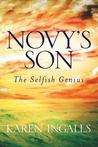 Novy's Son: The Selfish Genius by Karen Ingalls
My rating: 4 of 5 stars
This is a long and painfully revealing story about the author’s father. He saw himself as “someone who was betrayed, who was never understood nor appreciated, but who is a genius of aristocratic blood”. His behaviour throughout his ninety-five years, however, deservedly earned him his reputation as “a ladies’ man, a curmudgeon, a son of a bitch, and an elitist.” It is a tough read.
Murray Clark, or as he later re-named himself to escape his debtors, Michael St Germain, was a selfish, self-centred, egotistical, alcoholic, sex-addicted sociopath. He continually trashed the opportunities presented to him while exploiting the generosity and patience of his parents and of the many women who gave him chance after chance. He let his two daughters down unforgivably, and barely appreciated their later kindness and forgiveness (particularly the efforts of his younger daughter, Karen), and always blamed others for his screw-ups.
Having lived through it, and perhaps in an attempt to say “Goodbye To All That” the author tells her father’s story in the first person from his point of view. It therefore unfolds as autobiography. Some moments must have been particularly painful to write about. “I was now seeing changes in Joan, who was more withdrawn, which caused me concern. Yet my time with Grace was more important. I simply no longer asked the girls any questions, as I did not want my fears confirmed that they were being mistreated … Part of me did not want to know what happened in Helen’s house to cause Karen so much distress. It might mean I would have to deal with it.”
The style is homespun, lifted and contrasted at the end of each chapter by the literary prose of Herman Melville. I couldn’t in every case determine the relevance of the end paragraphs to the events of the chapter, though I enjoyed each extract. In my e-version, the Melville paragraphs weren’t highlighted by quotation marks (though the author was always acknowledged). I think a paperback version of the book (with drop caps, the author’s name at the bottom of each page, words split by hyphens and so on) had been uploaded into the Kindle Store, resulting in a messy e-version, though it was always possible for a diligent reader infused with goodwill to navigate the text. My version needed a good, professional edit.
Murray does provide the reader with some valuable insights: his challenging of theology for example, and of social attitudes regarding sexual urges in adolescence. He asks some important questions. “With so many events and players in the course of history, is only one group of people the enslaved, the abused, the innocent ones? Is history not full of unfairness and cruelty?” There are also moments of refreshing honesty when he acknowledges his shortcomings. “I was too small for football, not fast enough for track, and couldn’t throw or hit well enough for baseball.” “It was not until years later I realized Richard just wanted to be with me and be like me. Actually, he turned out to be a better man than me.”
Did the author put those words into his mouth because he said them or because they were true? I asked myself that question many times. I thought this was a very brave book, and I do hope writing it brought the author some closure.
View all my reviews
January 29, 2018
As entertaining and revealing as Books 1-3
 Three-Ways: A Detectives Seagate and Miner Mystery by Mike Markel
My rating: 5 of 5 stars
Karen Seagate doesn’t cut herself much slack: “I should start to feel a little better about myself. Once each blue moon, I get something right.” She says of her partner, Ryan Miner: “He sets the bar so high I just walk under it. Don’t even have to bend.”
The crime is committed in the Prologue, described in enough detail to put the reader several steps ahead of the police by narrowing the number of suspects to the number of women who had had sex with the victim that evening. That throws into relief the number of possible permutations the police have to consider when starting from scratch in a murder investigation. We know many of those permutations are wide of the mark, but they don’t, not having read the prologue. Karen makes an observation near the end of the book: “If you’ve never been a cop, you’d be surprised how often you sit at your desk, knowing you don’t understand something but not knowing exactly where you went off track or how to get back on it.” That’s a key sentence.
I really enjoy the author’s dry humour. Introducing Robin, the Evidence Technician, Karen tells us: “She frequently changes the color of the streaks in her hair, the only rule being that the color must not appear in nature.” Describing a booth near the back of a Coffee Hut, Karen says it looked “like it was decorated by a couple of eighth-graders with a half hour and a budget of twenty bucks.” Concerning relationships, Karen comments: “It’s not that I think it’s important to be honest in a relationship or anything sensible like that.” Of the murdered victim she says: “I have no idea what – if anything – Austin was in love with, except maybe his own reflection in a pool.” Or how about: “Ryan is quite a bit smarter than me in almost every measurable way, but when it comes to infantile behaviour, he’s not in my league.”
Mike Markel is brutally frank about human weakness. “She was way past shallow, vain, thoughtless, and the rest of those other bad things we’d all admit to if we were being honest.” Referring to domestic violence cases, Karen says: “If she’s conscious, she’ll tell me what she did wrong. She bought the wrong kind of ketchup, or she was talking too loud on the phone when he was trying to watch football, or he saw her smile when she ran into the guy from down the street, or some other deadly sin.”
He provides readers with plenty of convincing detail to bring his characters and venues to life. He knows a good deal about police procedure and is interestingly familiar with the intricacies of University life. Above all, he writes very well, and I am looking forward to reading the next book in his series.
View all my reviews