Sandra Beasley's Blog, page 13
January 28, 2013
O Kalamazoo
I just woke up from two hours of deep sleep, which took place while curled up in a chair in the middle of Western Michigan University's library. Luckily no one stole my laptop or wrote on my face while I was out. I've hit the travel wall--every Kleenex used in my purse, lymph nodes swollen, craving peanut butter for the sheer energy--and soon, after a visit to a WMU class on "food and culture" that has read Don't Kill the Birthday Girl, I'll be on my way back to North Carolina. But what a wonderful time I have had while here. So I give you: three days in photographs.
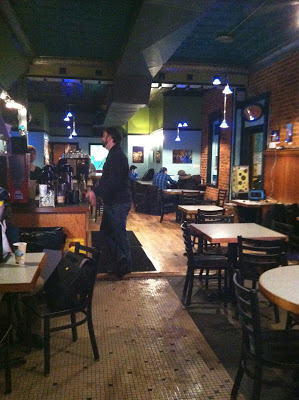
Kalamazoo is an ace town for coffeeshops. Here is a glimpse of the 24-hour-open Fourth Coast (which refers to the coast of Lake Michigan, in case you're wondering). After a welcome-to-town lunch with my host, the poet Traci Brimhall, I spent my Friday afternoon here--and got 1,000 words written of an essay I've been mulling over for months. Creativity upon arrival is always a good omen.
Afterwards my other host, Jon, picked me up for dinner and a trek to Louie's Trophy Grill, which features very large game animals on the walls. We saw three guys and their bartender do a shotski--four shot glasses mounted in a ski for simultaneous drinking. I could have gotten in on the action had there not been sour mix in the shots. Foiled! Afterward a slight mis-Google-directioning landed us in, um, Galesburg. I got back to Traci's at 1 AM; the poor, brave poet had to stand outside in her socks so I could find their apartment amidst the identical rows of snow-covered buildings.
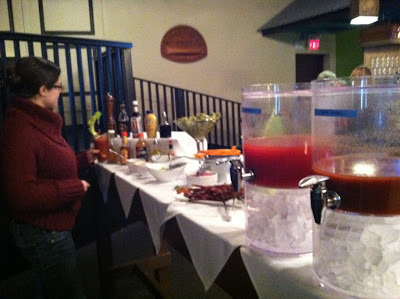
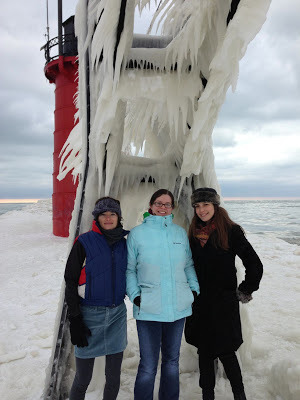
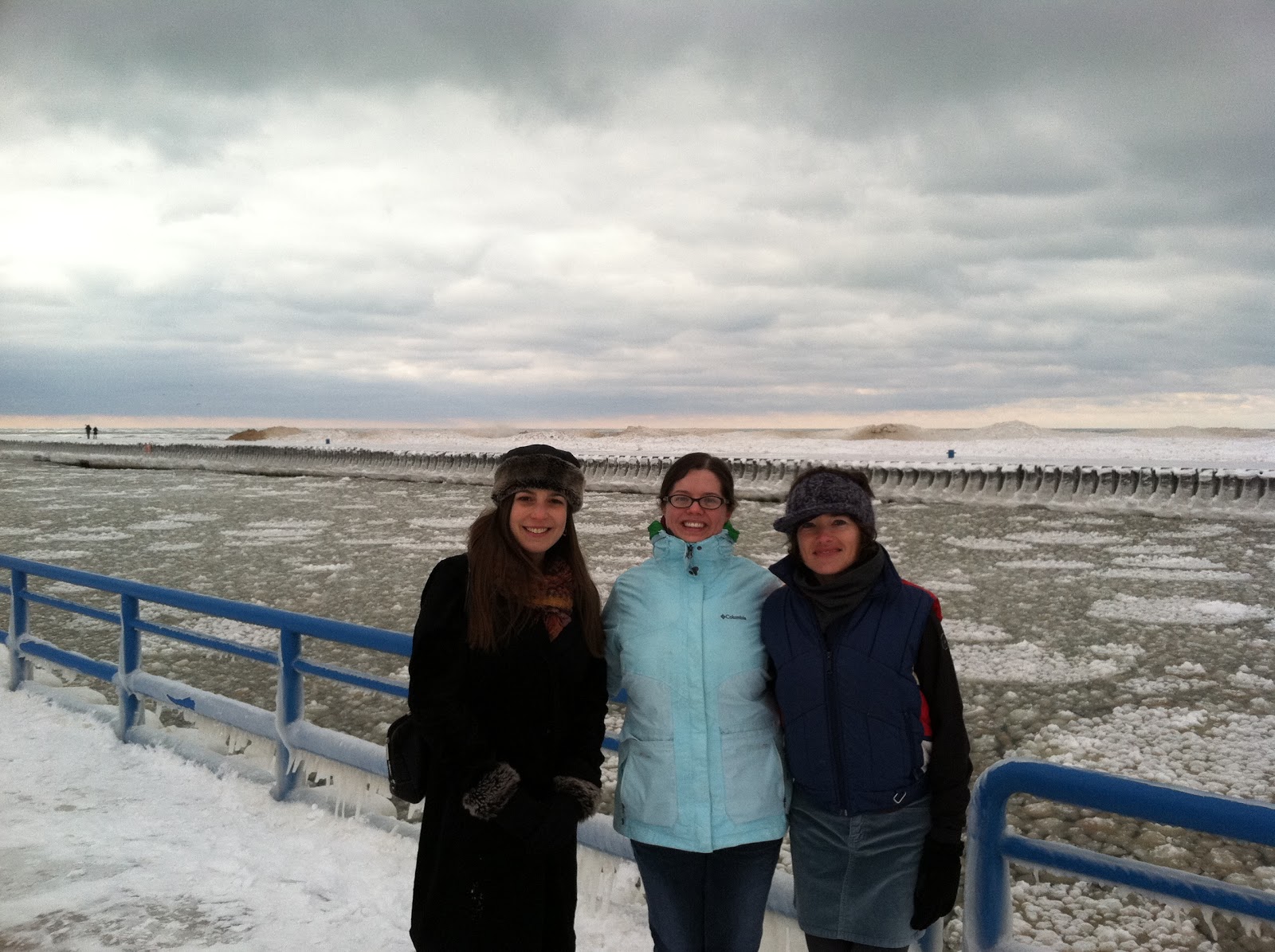
The next morning Traci, her husband Robert, Jill Osier (the other KBAC reader), and I headed out to South Haven, a beach town about an hour away. On the drive out we saw Christmas tree farms, fields of bare blueberry bushes with bright red branches against the snow, a 20-foot-tall compound bow advertising an archery shop, and the place that sells "The World's Greatest Hamburger," which as you can imagine was quite the temptation. But we pushed on to the Thirsty Perch, which had good hot french fries and this Make-Your-Own Bloody Mary bar. Celery salt, two different varieties of hot sauce, horseradish, thick crisp bacon: we were in heaven. But what followed was even better.
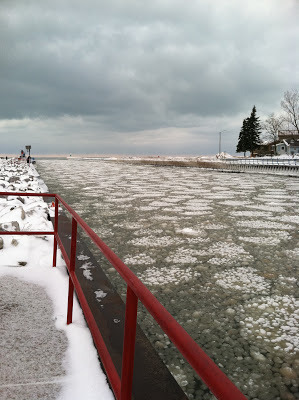
This is what happens at the icy edge of a Great Lake...

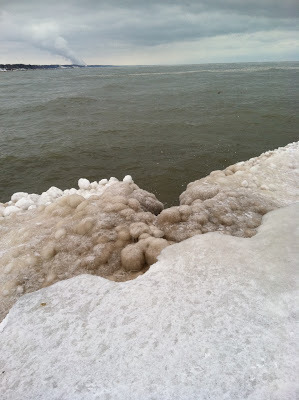
...where one watches each splash of a wave freeze as it meets the shore.
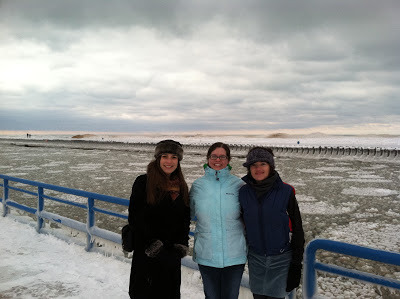
I asked Jill, who lives in Alaska, if this made her feel at home. But she lives in an area that is fairly dry, without a lot of snow fall. Traci and Robert had never been to South Haven in winter before. In other words, we were all agog at the beauty of it.
By the time we got back to Kalamazoo, we had only an hour to warm up and change for our reading at the Kalamazoo Center for Book Arts. Great crowd--almost 40 people--including some folks I had written to over the years, or known as fellow New Issues poets, or published in Folio, but had never met in person.
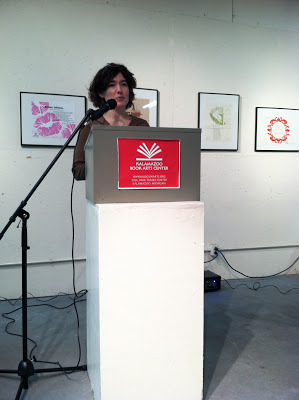
Jill read first. Her work is quiet and stunning, offering double-takes of language as a signifier of emotional indeterminacy. This is the lead-off poem to her chapbook Bedful of Nebraskas from sunnyoutside press; it first appeared in a 2005 issue of Poetry:
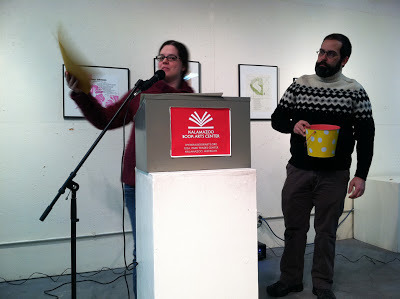
During an intermission, copies of our books and broadsides were raffled off to the crowd. I was anxious to see which poem of mine they had chosen for a broadside. Turned out they had picked "Mercy," the poem that currently closes my third collection.
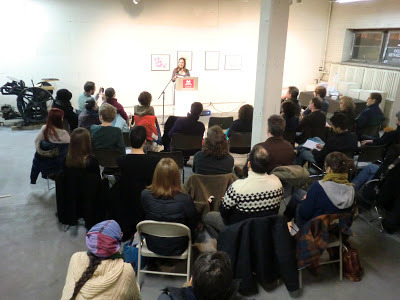
I talked about my gratitude to have had New Issues Poetry & Prose take a chance on my first collection--it was great to have both Marianne Swierenga, who was my editor, and current managing editor Kimberly Kolbe in the house. I shared a mix of poems from Theories of Falling, I Was the Jukebox, and new work. I read "The Hotel Devotion" because Kim, the lovely intern who introduced me, said it was her favorite.
Afterwards we went to Food Dance, where I ate an amazing Moroccan dish: roasted butternut squash piled high withIsraeli couscous, olives, chickpeas, and almonds. Conversations ran late and included this guess at someone's age: "I figure, between 25 and 65." We marveled at the music mix, which somehow covered the guilty-pleasure spectrum from Verve Pipe to Guns 'N Roses to Tom Petty to Jay-Z.
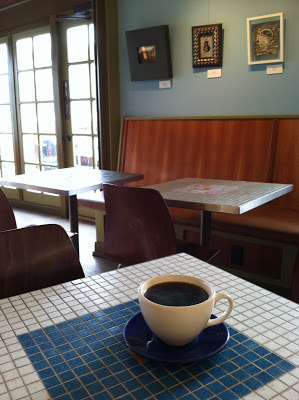
The next morning we went by the downtown Water Street Coffee en route to dropping Jill off at the train station. I stayed to get work done, enjoying one of the most delicate cups of coffee I have ever savored--a gently ground pour-over whose surface swirled--while reading through a batch of submissions for a sestina contest. Then I couldn't resist the allure of returning to Food Dance, across the street.
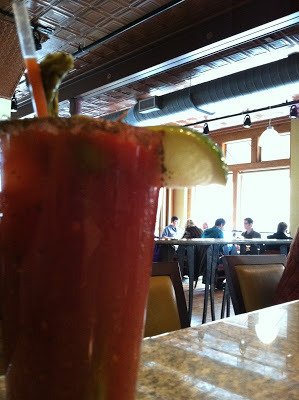
The music was still addictive; this time, an even peppier mix that included Stevie Wonder and Culture Club. I sat at the bar, ordered a Bloody Mary with Absolut Peppar, house-made vegetable juice and a pickled asparagus garnish, and settled in to read. Not that a searing account of contemporary war isn't a good way to spend a Sunday morning, but after the first 100 pages I decided to change it up.
I convinced the waitress to let me try all three of the Sandra-friendly housemade breads--sourdough, multigrain, and a stellar hot-from-oven rosemary and potato bread, all of which I slathered with thick blueberry-blackberry jam. My neighbors at the bar, overhearing me introduce myself as an out-of-towner, struck up conversation. The guy to my right was on his way out of town, moving to Cincinatti to serve a one-year fellowship as a team doctor to the Reds. He said of the guy to my left, "You've come to the right place; he's the mayor of Kalamazoo." It took several jokes and 20 minutes of conversation later to figure out he was, in fact, the actual mayor.
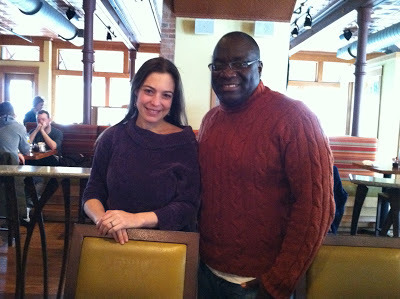
Me and Mayor Bobby Hopewell. An incredibly nice guy who, in addition to his civic service, works in hospital administration. On his way out, he told the Food Dance folks he wanted to pick up my check. Kalamazoo, you rock.
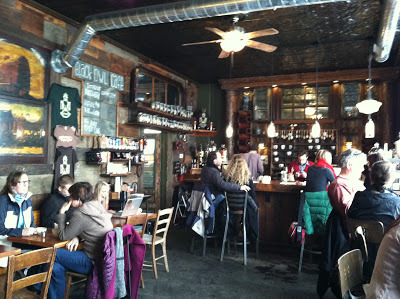
Bobby said my mission of coffeeshop surveyance would not be complete without a visit to the Black Owl, so that is where I went to finish Kevin Powers' The Yellow Birds. This is a small but very cool new venue, with a steampunk aesthetic and six different methods of making their coffee. There are plans to add a bar angle; I bet it flourishes.
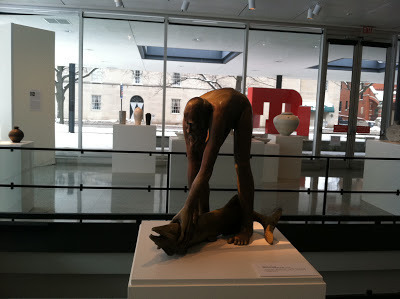
To walk off all the calories from my morning's indulgences I headed down to the Kalamazoo Institute of Arts, which offers quite a bargain of entertainment for $5 admission. An exhibit of Ansel Adams photography had just opened over the weekend. An unexpected highlight was "Stoked: Five Artists of Fire and Clay," which focuses on the legacy of the Saint John's University Pottery studio, now in its thirtieth year, anchored by the influence of artist in residence Richard Bresnahan. My favorite work was by his youngest apprentice (and the only woman) Anne Meyer.
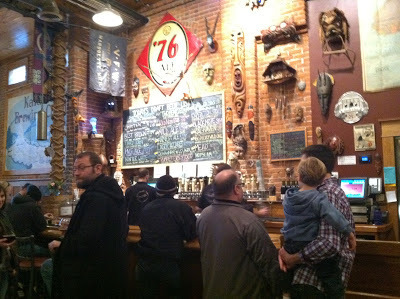
No Kalamazoo experience is complete without a round at the Eccentric Cafe of Bell's Brewery, for which Jon met up with me. Bell's has quite a friendly, boisterous scene; I bet it's a great place for live music. I ordered a flight of six samplers and decided my favorite was Harvest Ale, a pale ale brewed with Michigan-sourced barley and hops. My dinner was the veritable bucket o'peanuts they scooped me for $1.60.
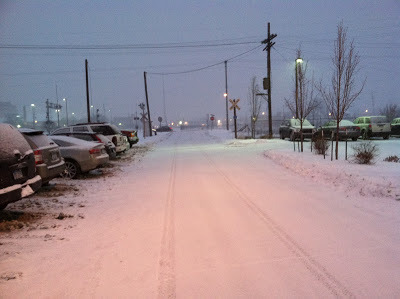
By the time we left Bell's the snow was coming down. We made a quick pit stop at the aptly named Beer and Skittles; I picked up one last Michigan beer, New Holland's "The Poet" Oatmeal Stout. Jon dropped me off at Water Street's Oakland location--where chairs are luxurious and KBAC broadsides are on display--to head home with Marianne, where we spent a few hours talking before deep sleep (part one; "deep sleep, part two" took place at the aforementioned library, where Marianne now works).
I met Marianne on my first night of my first visit to Virginia Center for Creative Arts, way back in 2005. We had no way of knowing that she'd be my editor at New Issues, much less that eight years later we'd be in her living room. One thing I've learned about traveling is that everyone has their favorite cities and towns; places where you'll take any excuse to go back for a visit. Kalamazoo, welcome to my list. I'll see you again.

Kalamazoo is an ace town for coffeeshops. Here is a glimpse of the 24-hour-open Fourth Coast (which refers to the coast of Lake Michigan, in case you're wondering). After a welcome-to-town lunch with my host, the poet Traci Brimhall, I spent my Friday afternoon here--and got 1,000 words written of an essay I've been mulling over for months. Creativity upon arrival is always a good omen.
Afterwards my other host, Jon, picked me up for dinner and a trek to Louie's Trophy Grill, which features very large game animals on the walls. We saw three guys and their bartender do a shotski--four shot glasses mounted in a ski for simultaneous drinking. I could have gotten in on the action had there not been sour mix in the shots. Foiled! Afterward a slight mis-Google-directioning landed us in, um, Galesburg. I got back to Traci's at 1 AM; the poor, brave poet had to stand outside in her socks so I could find their apartment amidst the identical rows of snow-covered buildings.

The next morning Traci, her husband Robert, Jill Osier (the other KBAC reader), and I headed out to South Haven, a beach town about an hour away. On the drive out we saw Christmas tree farms, fields of bare blueberry bushes with bright red branches against the snow, a 20-foot-tall compound bow advertising an archery shop, and the place that sells "The World's Greatest Hamburger," which as you can imagine was quite the temptation. But we pushed on to the Thirsty Perch, which had good hot french fries and this Make-Your-Own Bloody Mary bar. Celery salt, two different varieties of hot sauce, horseradish, thick crisp bacon: we were in heaven. But what followed was even better.

This is what happens at the icy edge of a Great Lake...

...where one watches each splash of a wave freeze as it meets the shore.
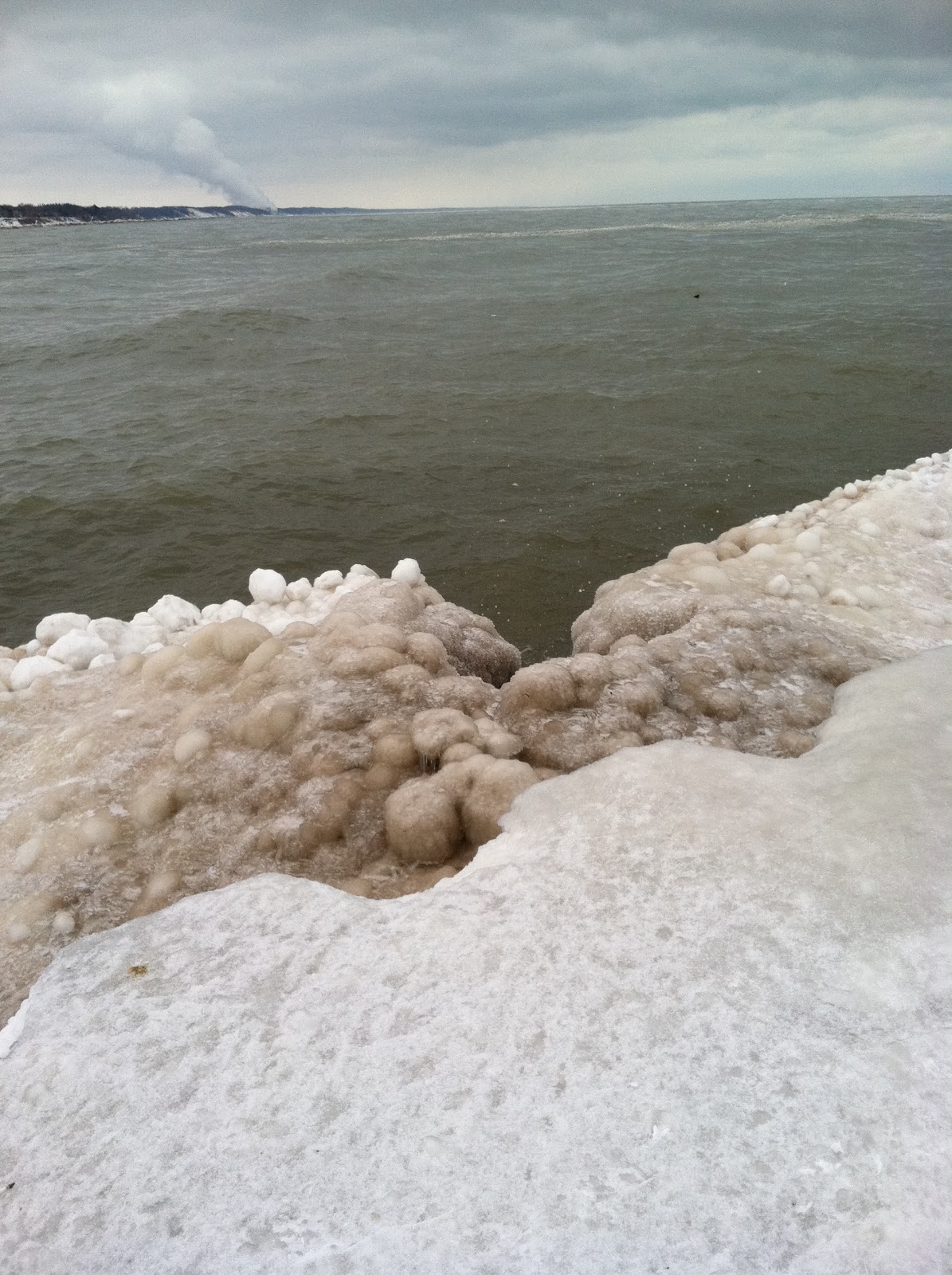
I asked Jill, who lives in Alaska, if this made her feel at home. But she lives in an area that is fairly dry, without a lot of snow fall. Traci and Robert had never been to South Haven in winter before. In other words, we were all agog at the beauty of it.

By the time we got back to Kalamazoo, we had only an hour to warm up and change for our reading at the Kalamazoo Center for Book Arts. Great crowd--almost 40 people--including some folks I had written to over the years, or known as fellow New Issues poets, or published in Folio, but had never met in person.

Jill read first. Her work is quiet and stunning, offering double-takes of language as a signifier of emotional indeterminacy. This is the lead-off poem to her chapbook Bedful of Nebraskas from sunnyoutside press; it first appeared in a 2005 issue of Poetry:
DEAR
I did not walk down to the lake today.
Maybe I should have, though if you leave
a pail of rainwater sitting in the yard,
it gives an answer to most things. Emptied,
it's metal asking questions. Your face appears
undisturbed if you approach it carefully.
No one at the lake would have known me.
I don't think you can approach a lake carefully,
or I don't think we ever approach what we mean
to a lake.

During an intermission, copies of our books and broadsides were raffled off to the crowd. I was anxious to see which poem of mine they had chosen for a broadside. Turned out they had picked "Mercy," the poem that currently closes my third collection.

I talked about my gratitude to have had New Issues Poetry & Prose take a chance on my first collection--it was great to have both Marianne Swierenga, who was my editor, and current managing editor Kimberly Kolbe in the house. I shared a mix of poems from Theories of Falling, I Was the Jukebox, and new work. I read "The Hotel Devotion" because Kim, the lovely intern who introduced me, said it was her favorite.
Afterwards we went to Food Dance, where I ate an amazing Moroccan dish: roasted butternut squash piled high withIsraeli couscous, olives, chickpeas, and almonds. Conversations ran late and included this guess at someone's age: "I figure, between 25 and 65." We marveled at the music mix, which somehow covered the guilty-pleasure spectrum from Verve Pipe to Guns 'N Roses to Tom Petty to Jay-Z.

The next morning we went by the downtown Water Street Coffee en route to dropping Jill off at the train station. I stayed to get work done, enjoying one of the most delicate cups of coffee I have ever savored--a gently ground pour-over whose surface swirled--while reading through a batch of submissions for a sestina contest. Then I couldn't resist the allure of returning to Food Dance, across the street.

The music was still addictive; this time, an even peppier mix that included Stevie Wonder and Culture Club. I sat at the bar, ordered a Bloody Mary with Absolut Peppar, house-made vegetable juice and a pickled asparagus garnish, and settled in to read. Not that a searing account of contemporary war isn't a good way to spend a Sunday morning, but after the first 100 pages I decided to change it up.
I convinced the waitress to let me try all three of the Sandra-friendly housemade breads--sourdough, multigrain, and a stellar hot-from-oven rosemary and potato bread, all of which I slathered with thick blueberry-blackberry jam. My neighbors at the bar, overhearing me introduce myself as an out-of-towner, struck up conversation. The guy to my right was on his way out of town, moving to Cincinatti to serve a one-year fellowship as a team doctor to the Reds. He said of the guy to my left, "You've come to the right place; he's the mayor of Kalamazoo." It took several jokes and 20 minutes of conversation later to figure out he was, in fact, the actual mayor.

Me and Mayor Bobby Hopewell. An incredibly nice guy who, in addition to his civic service, works in hospital administration. On his way out, he told the Food Dance folks he wanted to pick up my check. Kalamazoo, you rock.

Bobby said my mission of coffeeshop surveyance would not be complete without a visit to the Black Owl, so that is where I went to finish Kevin Powers' The Yellow Birds. This is a small but very cool new venue, with a steampunk aesthetic and six different methods of making their coffee. There are plans to add a bar angle; I bet it flourishes.
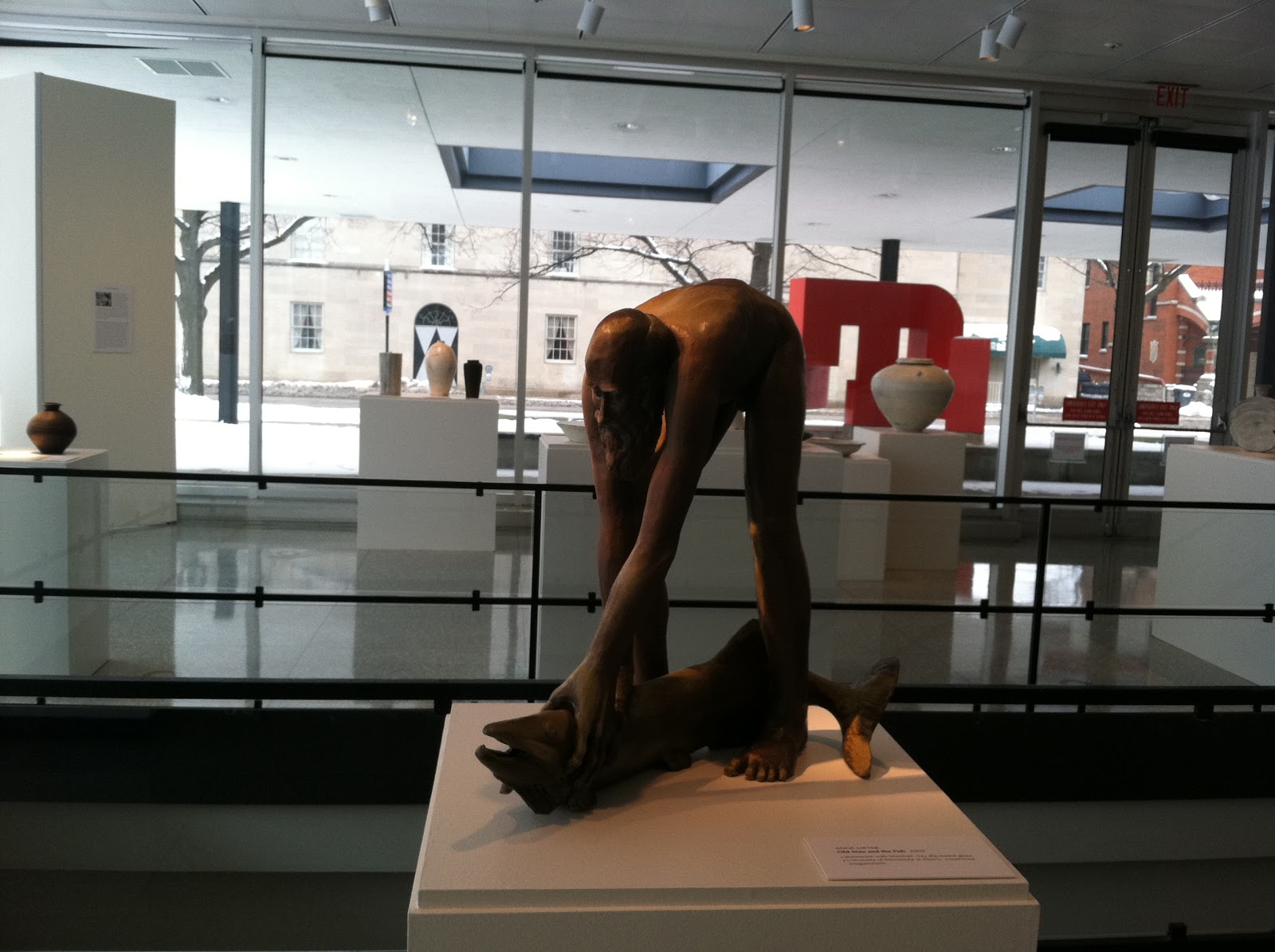
To walk off all the calories from my morning's indulgences I headed down to the Kalamazoo Institute of Arts, which offers quite a bargain of entertainment for $5 admission. An exhibit of Ansel Adams photography had just opened over the weekend. An unexpected highlight was "Stoked: Five Artists of Fire and Clay," which focuses on the legacy of the Saint John's University Pottery studio, now in its thirtieth year, anchored by the influence of artist in residence Richard Bresnahan. My favorite work was by his youngest apprentice (and the only woman) Anne Meyer.

No Kalamazoo experience is complete without a round at the Eccentric Cafe of Bell's Brewery, for which Jon met up with me. Bell's has quite a friendly, boisterous scene; I bet it's a great place for live music. I ordered a flight of six samplers and decided my favorite was Harvest Ale, a pale ale brewed with Michigan-sourced barley and hops. My dinner was the veritable bucket o'peanuts they scooped me for $1.60.
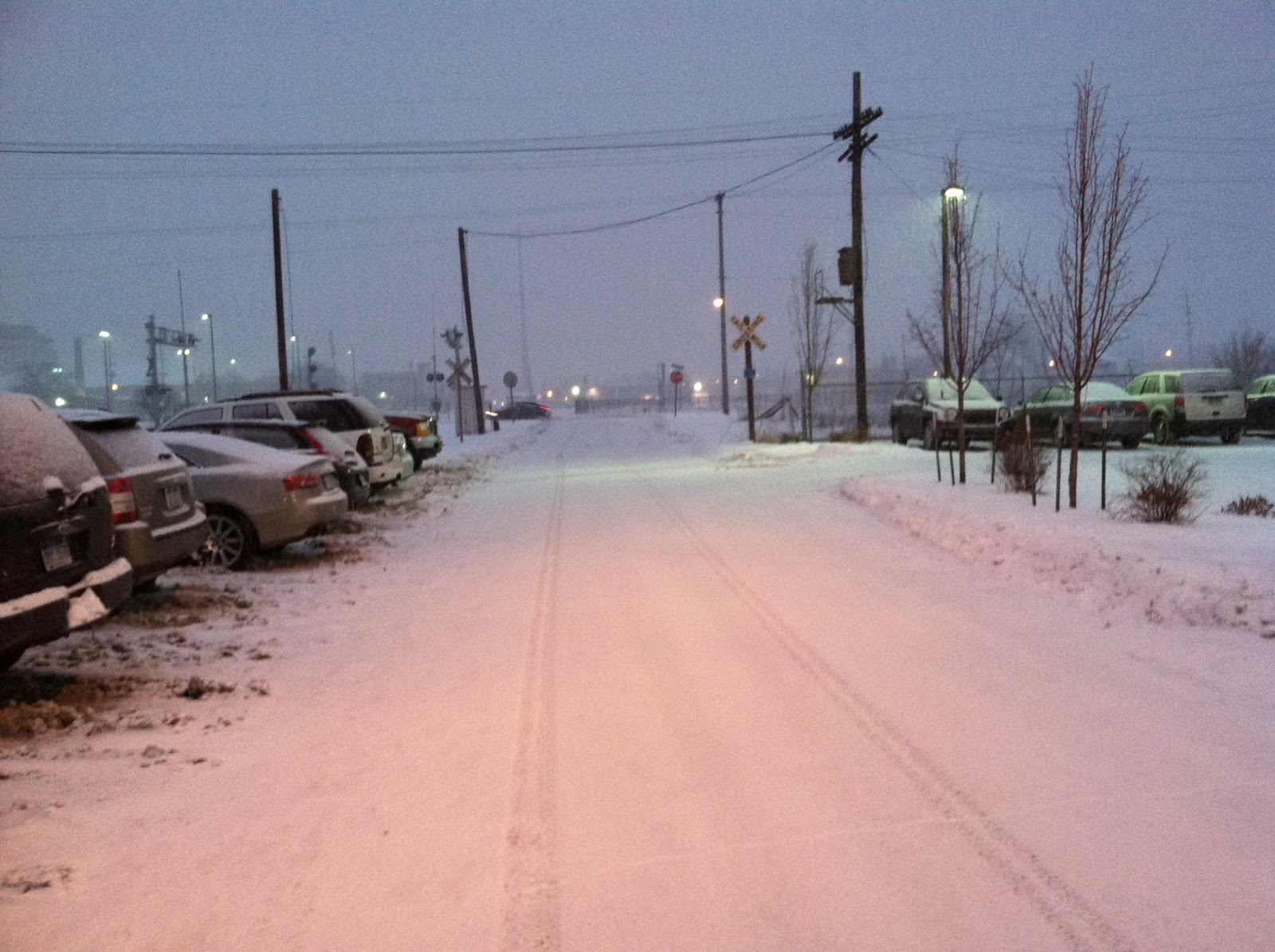
By the time we left Bell's the snow was coming down. We made a quick pit stop at the aptly named Beer and Skittles; I picked up one last Michigan beer, New Holland's "The Poet" Oatmeal Stout. Jon dropped me off at Water Street's Oakland location--where chairs are luxurious and KBAC broadsides are on display--to head home with Marianne, where we spent a few hours talking before deep sleep (part one; "deep sleep, part two" took place at the aforementioned library, where Marianne now works).
I met Marianne on my first night of my first visit to Virginia Center for Creative Arts, way back in 2005. We had no way of knowing that she'd be my editor at New Issues, much less that eight years later we'd be in her living room. One thing I've learned about traveling is that everyone has their favorite cities and towns; places where you'll take any excuse to go back for a visit. Kalamazoo, welcome to my list. I'll see you again.


January 23, 2013
Rabbit Holes
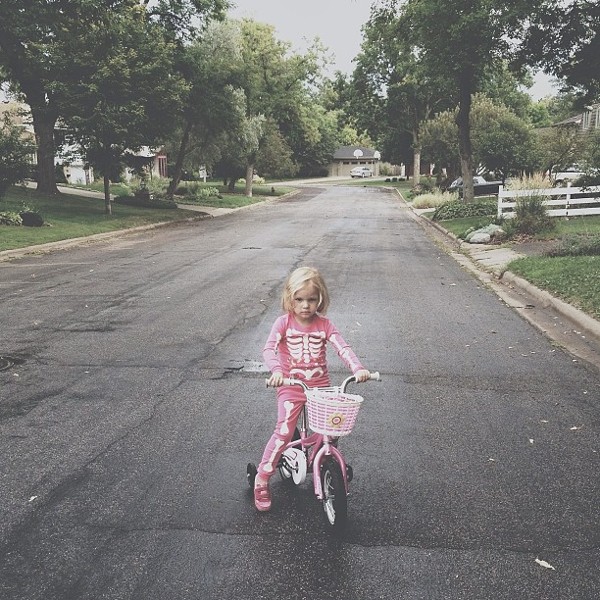
"tuff turf" is from Minneapolis artist Brock Davis's collection "2012 iPhone photos," favorites taken over the past year. Lots of wonderful images to be found.
Amidst teaching classes and finalizing my poetry manuscript (!), on Friday I'll fly to Michigan for a Saturday night reading at the Kalamazoo Book Arts Center with Jill Osier. They have designed a broadside of one of my poems--but I don't know which poem. Since it'll be on the snowy side, my sightseeing plans are modest: a series of coffeeshops, the local art museum, and Bell's brewery. Then on Wednesday, February 6, I will trek up to Charlottesville for a reading with the VQR folks. It will take place at OpenGrounds, an interdisciplinary space that didn't even exist when I was at UVA.
There's been a lot of "po-world" conversations buzzing around the internets in the past month, from Robert Pinsky's announcement that Slate will no longer publish poems; to Richard Blanco's inauguration day poem (and, dare I say, his Huffington Post essay that probably won even more hearts in the writing community); to the laughable inauguration poem authored by James Franco, which becomes less funny when you realize he has a contract for a collection with Graywolf, an opportunity so many poets work their whole lives toward; to the headlines determined to frame Sharon Olds' T.S. Eliot prize in the context of her divorce; to this ridiculous blogpost by Washington Post staffer Alexandra Petri, which was immediately smacked down by Coldfront's John Deming and others.
I never know how far to go with these discussions, especially in the strange space of social media. The problem with Facebook is that people (myself included) go on too long; the problem with Twitter is that we have to keep comments so short. What I do know is that if I get physical flashbacks to the days of my college debating society--sweating, nausea, loss of circulation in a foot too long folded under me--that's a bad sign. Besides, so much of it is momentary, passing. This is not the month that poetry will live or die in contemporary culture. Poetry is a coelacanth, lurking and ancient. Yet it's also the sparrow; everywhere, accessible. Poetry can take care of itself.
That said, the moments that have interested me have not been Poets vs. The Philistine World, but Writers Disagreeing With Writers. The latter is getting lost amidst the bluster of the former. I was surprised to see a respected editor say on Facebook that Sharon Olds is a particular case who has earned having a heavy biographical reading applied to her work because she lacks attention to craft. I disagree. And I would love to have a deeper discussion of that, looking at exemplar poems from the perspective of line break and figurative language.
I was surprised when poets said that the "fiscal pressures" that led to Slate's editorial decision (though I doubt that is the real, sole reason) should be allayed by having poetry editors volunteer their time, and poets forgo contributor fees. That is categorically bad precedent to set. No magazine that pays should be encouraged to think of poetry as a mode that isn't "real work" and needn't be compensated in a manner comparable to other genres. Even if that means venues wither along the way because their ROI isn't judged sufficient. But there are poets I respect who would disagree with me. And that's the conversation I'd like to have, in real time and space. Not on Twitter.
AWP in Boston is coming up in March. Most attendees joke about the fact that the hotel bar and the offsites are as much the destination of the in-conference events. It's because the discussions we are craving most can't be pitched months in advance. They lace together news and gossip, personal experience and bias. I'm game to go down the rabbit hole with y'all in discussing these issues, and others. But only if we can hold hands along the way, and drink from the same bottle of potion. You can't hold hands online. As for the potion--well, that's why I carry a flask to AWP.
January 16, 2013
Life Among the Bears

I am halfway through my second week at Lenoir-Rhyne University, whose mascot is the Bears. Our poetry workshop kicked off with looking at some of my favorite contemporary poems, such as Meg Kearney's "Creed" (anaphora and other rhetorical ordering principles) and Natasha Trethewey's "Mississippi" (explaining the ghazal form). We looked at Henry Taylor's "Artichoke":
ARTICHOKE
"If poetry did not exist, would you
have had the wit to invent it?"
-Howard Nemerov
He had studied in private years ago
the way to eat these things, and was prepared
when she set the clipped green globe before him.
He only wondered (as he always did
when he plucked from the base the first thick leaf,
dipped it into the sauce and caught her eye
as he deftly set the velvet curve against
the inside edges of his lower teeth
and drew the tender pulp towards his tongue
while she made some predictable remark
about the sensuality of this act
then sheared away the spines and ate the heart)
what mind, what hunger, first saw this as food.
-H.T. (from The Flying Change)
...They immediately fixated on that parenthetical phrase, of course, and the way it changes the tone of the scene. I asked if they'd ever seen a similar move in a poem. Then I showed them how it echoes something John Keats did two hundred years earlier:
This living hand, now warm and capable
Of earnest grasping, would, if it were cold
And in the icy silence of the tomb,
So haunt thy days and chill thy dreaming nights
That thou would wish thine own heart dry of blood
So in my veins red life might stream again,
And thou be conscience-calm’d–see here it is–
I hold it towards you.
-J.K. (1795-1821)
That's what I love about teaching, those little a-ha moments.
This week I came on strong with the craft vocabulary. I admit, John Hollander isn't the friendliest voice for beginning students. (He's like Waldorf and Statler combined, if Waldorf and Statler insisted on bickering in iambic pentameter.) But I'm a big believer that workshoppers are always talking about things in loosey-goosey terms when there are wonderful words--caesura, assonance, spondee, stichic, chiasmus--designed to articulate our aesthetic impressions. If I can inspire even one student out of fourteen to adopt the vocabulary of form in talking about free verse, to understand that the two modes exist on a continuum, I'll be thrilled.
I was met with glassy stares by the time we got to ottava rima. They're antsy to turn to their own poems. "I gotta give you vegetables first," I said, "before the cotton candy and funnel cake." At one point, I chanted the "Pat-a-cake" nursery rhyme (to demonstrate accentual meter), and I seriously considered tap-dancing in anapestic tetrameter. In for a penny, in for a pound.
Hickory has its charms. My welcoming party included some fun, quirky conversations; never again, when buying chairs, will I settle for less eight-way hand-tied upholstery. (The things you learn in a furniture town.) I am exploring a spectrum of North Carolina beers. UMI, the Japanese restaurant, continues to amaze me--my new favorite dish is the vegetable nimono, which includes thick slices of gobo (mountain carrot) and lotus root simmered in a dashi broth.
The roads are bizarrely tricky. In addition to quadrants (NE, NW, etc) there are numbered streets, numbered avenues, and numbered "Avenue Place"-s, often all three intersecting within feet of each other. There is Lenoir-Rhyne Boulevard, which seems like a convenient main road--up until the intersection where Lenoir-Rhyne's campus is within sight-line, at which point it refuses to let you enter and veers off to the right instead. Bears must have excellent senses of direction but I, mere poet, get lost and turn around and get lost again. Luckily I'm used to it. I am, after all, also a DC girl.
January 3, 2013
My Heart is Full
My heart is full.
I don't mean my heart is a playpen of puppies. My heart is full like a saturated cloud chamber in which the slightest particle shift causes precipitation. So much good and bad has been happening that I don't know how to hold it all. If you've noticed my online quiet--and it extends another week or so--you know the cause.
I was in Mississippi when I learned about the passing of Jake Adam York. 36 hours earlier I had been having a spirited conversation about local real estate in the Faulkner/Falkner House kitchen with Jake's brother Joe, and Joe's beautiful & pregnant wife Kathryn (now a proud mama of a gorgeous little girl). I spent the night in between sleeping on the floor of a borrowed living room in Water Valley, rain falling in torrential sheets over the tin roof. The man I love had put a ring on my finger and I said Yes, all over again. Then I said This house is not our house, is it?
It wasn't, much as we'd wanted it to be. So we went out and found the finest crab legs and corn you can get cooked in a gas station. We hunkered down and made best of it. The diamonds got juicy with king crab juice and spice boil. A storm came and went. And the next night, when we went out for the fancy dinner befitting an engagement, I was selfish enough to check Facebook on my phone, and there was news of Jake.
A moment of grace for a barbecue poet.
A proper obituary.
A couple of joyous fools in earnest conversation for Southern Spaces.
His amazing poems.
We'd traded emails not that long ago, on the occasion of his reading in Jackson one night, mine the next--two ships, passing. We promised a drink for next time. There was always such a promise. That man was determined to teach even a diehard scotch lover like myself to enjoy bourbon. We split the difference with rye.
First time we traded missives was spring of 2010, after I'd been asked to follow in his footsteps as Ole Miss Summer Poet in Residence in Oxford, a town and summer than changed my life. Jake warned of bees living in the Grisham House mailbox. He praised Jack Pendarvis. His solemn advice was, "And since I did it last year you have to roast a hog or some other large animal at the conclusion of your residency."
He was writing some of the bravest poems of any of us, poems than confronted and embraced American history in equal measure. If the world were a James Bond villain, its gift would be the cruelty of juxtaposition. There's a newborn who doesn't even know the uncle she's missing.
I woke from a nap on January 1 and thought, 8:09 PM? Too late to call. But I called anyway--to wish the woman who has mentored me, who has done so much to shape the author I am today, a Happy New Year. Only to find out she'd fallen down a flight of concrete stairs the day before. Her husband answered her cell phone. Somehow she was awake, voice odd from the hospital's oxygen, and we spoke. She was determined to offer her house as our wedding palace. She spent all today in surgery.
I am praying. I never pray. I listen over and over to the interview that Maurice Sendak did with NPR shortly before his death. Don't even get me started on "The Lives They Loved," which pulls me down the slope of tears every time I even try to read it. My heart is full. I go over Jason Crane's 2012 round-up (of which I was honored to play a small part) and I love the honesty there. It is the eve of my move down to Hickory, and I am as tense as a bird that hasn't yet figured out it has wings. For all the celebrations going on in my life--and they are many--there is also the the knowledge of loss and change.
So much happens in a year, to break our hearts and mend them, to break them again and make them ever stronger.
I don't mean my heart is a playpen of puppies. My heart is full like a saturated cloud chamber in which the slightest particle shift causes precipitation. So much good and bad has been happening that I don't know how to hold it all. If you've noticed my online quiet--and it extends another week or so--you know the cause.
I was in Mississippi when I learned about the passing of Jake Adam York. 36 hours earlier I had been having a spirited conversation about local real estate in the Faulkner/Falkner House kitchen with Jake's brother Joe, and Joe's beautiful & pregnant wife Kathryn (now a proud mama of a gorgeous little girl). I spent the night in between sleeping on the floor of a borrowed living room in Water Valley, rain falling in torrential sheets over the tin roof. The man I love had put a ring on my finger and I said Yes, all over again. Then I said This house is not our house, is it?
It wasn't, much as we'd wanted it to be. So we went out and found the finest crab legs and corn you can get cooked in a gas station. We hunkered down and made best of it. The diamonds got juicy with king crab juice and spice boil. A storm came and went. And the next night, when we went out for the fancy dinner befitting an engagement, I was selfish enough to check Facebook on my phone, and there was news of Jake.
A moment of grace for a barbecue poet.
A proper obituary.
A couple of joyous fools in earnest conversation for Southern Spaces.
His amazing poems.
We'd traded emails not that long ago, on the occasion of his reading in Jackson one night, mine the next--two ships, passing. We promised a drink for next time. There was always such a promise. That man was determined to teach even a diehard scotch lover like myself to enjoy bourbon. We split the difference with rye.
First time we traded missives was spring of 2010, after I'd been asked to follow in his footsteps as Ole Miss Summer Poet in Residence in Oxford, a town and summer than changed my life. Jake warned of bees living in the Grisham House mailbox. He praised Jack Pendarvis. His solemn advice was, "And since I did it last year you have to roast a hog or some other large animal at the conclusion of your residency."
He was writing some of the bravest poems of any of us, poems than confronted and embraced American history in equal measure. If the world were a James Bond villain, its gift would be the cruelty of juxtaposition. There's a newborn who doesn't even know the uncle she's missing.
I woke from a nap on January 1 and thought, 8:09 PM? Too late to call. But I called anyway--to wish the woman who has mentored me, who has done so much to shape the author I am today, a Happy New Year. Only to find out she'd fallen down a flight of concrete stairs the day before. Her husband answered her cell phone. Somehow she was awake, voice odd from the hospital's oxygen, and we spoke. She was determined to offer her house as our wedding palace. She spent all today in surgery.
I am praying. I never pray. I listen over and over to the interview that Maurice Sendak did with NPR shortly before his death. Don't even get me started on "The Lives They Loved," which pulls me down the slope of tears every time I even try to read it. My heart is full. I go over Jason Crane's 2012 round-up (of which I was honored to play a small part) and I love the honesty there. It is the eve of my move down to Hickory, and I am as tense as a bird that hasn't yet figured out it has wings. For all the celebrations going on in my life--and they are many--there is also the the knowledge of loss and change.
So much happens in a year, to break our hearts and mend them, to break them again and make them ever stronger.
December 7, 2012
Risk & Point of View

In the last couple of weeks, I've been asked to talk a lot about point of view in poems. In workshops I often question whether the poem has enough risk or urgency. There are many ways to heighten tension in a poem. Some are thematic, e.g. alluding to backstory. Some are syntactical, e.g. phrasing a sentence as a question. Some are formal, e.g. breaking lines at a critical junction, or enjambment between stanzas.
But I think point of view is undervalued as a determinant of tension. The POV you choose helps shape the risks your poem can take.
First Person: Here, the central risk is one of discovery. The speaker's understanding of something, or the reader's understanding of the speaker, should change across the course of the poem. That doesn't mean the subject might not also do something. But keep in mind that you've chosen a POV that privileges his or her perception of that act/experience, a version that may or may not be reliable, versus focusing on the act/experience itself.
Second Person: Here, the central risk in one of disclosure between parties. A secret is being revealed or created by those present in the world of the poem. If the "you" is being addressed through a series of imperative commands, then he or she should be asked to do something counterintuitive to what we know of that identity.
There are a ton of Second Person poems being written right now, in part because it is a shortcut to intimacy with the reader. But it's frustratingly static when "I" tells "you" a story, across the course of the poem, that in reality would already be known and complete between the two parties. It's a gimmick, much like when the character in a short story pauses on a doorstep and flashes back to an entire romance right while her finger is pressing the theoretical buzzer.
Third Person: Here, the central risk is dramatic. These are characters, and you control their stage, even if your writing is inspired by contemporary or historic events. A compelling Third Person poem, whether bird's-eye (in which you're battling the drag of expository language) or omniscient (in which you're tackling the beast of authenticity), is an awe-inspiring thing; I wish more people would try their hand at them.
Ask yourself why your draft uses its particular point of view. Try envisioning the same poem in First Person, Second, Third. What does an outside view reveal or emphasize about your "characters" and their dynamics? What secrets would one tell the other? How do you newly sympathize (or not) when an antagonist becomes the speaker?
When the poem finds its destined POV, it will cling to it. Your favorite moments won't work in the other modes. You can try the same thing with verb tense: rotate the poem through past, present, and future. And I always create an intermediate draft in which all line and stanza breaks are erased. I massage the syntax as a prose-paragraph, then I break again. Sometimes this results in the same visual format. Sometimes not.
When the poem starts to fight back, to commit over and over to certain aesthetics, that's when I know I'm on my way. And I'm wrestling with one right now, so wish me luck.

November 28, 2012
Permissions

Last night, my wonderful and very cold-ridden boyfriend came over after getting off his late work shift. We talked over tea, he dosed himself with Nyquil, and we curled up in bed. After a couple of hours I woke up, restless in the too-hot apartment, the bright blue-fairy light of my computer speakers blazing from the distant wall. I tried to find a good arm position. That failed. I tried to balance my desire to snuggle with my desire to avoid his fevered, germ-laden breath. That failed too.
When I'm trying to fall asleep, my mind wanders toward projects in progress; in this case, a book proposal I've been been considering since my January VCCA stint. Last night, I realized an idea for a narrative arc--one that resonated with life decisions I'm in the thick of right now. For the next 40 minutes, my mind poked and prodded. This could work. Episodes that had previously felt like nothing more than dissonant essays began to cohere in my mind as sequences, chapters, a braiding of memories with experiences that could be researched and reported.
Well into my second hour of wakefulness, I jumped out of bed. It was 5 AM. I grabbed my notebook and used the last match in the box to light a votive, wary of the kitchen's fluorescent glow. I poured a small glass of carrot juice, and tipped into it a swallow of vodka leftover from earlier. I scribbled until the clouds began to lighten outside.
The spell was broken, energy vented. I crawled back into bed. He wrapped his arms around me and rested his lips on the nape of my neck. That's when it hit me: this man, who also came into my life during that January VCCA stint, is in the story going forward. He is both high spire and brick foundation. He is part of the adventure.
An adventure that I will, one way or another, commit to the page. The Author rejoices in having a witness, a trusted and funny voice in dialogue for the ride. The Girlfriend wonders: Is this something we talk about? Do I ask permission?
This is a memoirist's problem. I don't face this with poems. Though we sense the texture of inspiring truth, it's understood we talk about the poem as invention. In readings, even those most revealing poem is one among many. There are other things to talk about afterwards.
I once had a man forbid me from writing about him in any form. It was stifling. It spooked me out of drafting for months. Another, an artist himself, would say "It's all material." I wonder if that maxim has ever been tested with him on the other end of the art. The first question I got after reading a personal essay at Frostburg State University this past summer was, "So, how much of that is true?" My flustered response--"um, all of it"--flip-flopped in my stomach as I considered the shady activities committed by a central (albeit unnamed) character. Right now, that essay is a finalist for a contest that offers a reading in the town where said "character" lives. It's one thing to write honestly about our weaker moments. It's another thing to deliver them to his doorstep.
Sometimes students and aspiring memoirists ask me about the risk of writing about real people. I have no problem defending the ethics. There are very few cases where someone is at legitimate risk of lawsuit for libel or slander. What you are really worried about is making your dear ones mad at you. And I can't assure you that won't happen.
"Isn't everyone flattered to see themselves in print, deep down?" No. Writers say things like that to each other, forgetting that we're writers. Our worldview is warped. My principle is that nothing is off limits, as long as 1) I've made my best effort at being truthful, and 2) I'm as hard on myself as anyone else in the scene. I stand by that. I remind myself of the revelatory nonfiction that I've read over the years, which meant so much to me, that may have been hard for that author's dear ones to see themselves in at the time. But principle is cold comfort when you lose someone over creative work.
If I could go back in time, are there pieces I'd spike, paragraphs I'd strike? No. That makes me feel selfish, but no. Second-guessing yourself as a memoirist is the worst pesticide. You don't just kill a weed; you contaminate the soil.
All of this is to say that when we woke up, puttering around the apartment and drinking orange juice, I did not ask.
Writers don't get a pass from the social pact. We have to give as good as we get--which might mean suspending judgment, cheering on a friend's decision that you'd never make for yourself, letting your own less-than-flattering moment go up on someone else's canvas. But when you surround yourself with the right people, those who go the distance of a lifetime, they recognize the capacities that you have to exercise to thrive. It is inseparable from their love of you. No permissions necessary.

November 20, 2012
Rhythm
 Spotted on one of my favorite blogs for visual innovation, Colossal: Arizona artist Ernie Button, is creating a series of photographs that show the bottom of tumblers after that last drop of single-malt scotch is drained. "It’s a little like snowflakes in that every time the Scotch dries, the glass yields different patterns and results," he says. "I have used different color lights to add ‘life’ to the bottom of the glass, creating the illusion of landscape, terrestrial or extraterrestrial."
 There is an ew factor--these are close-ups of dirty glassware--but I find the visual rhythms here beautiful, more so knowing how they're made. Above is "Macallan."
I've been thinking a lot about rhythm this week. It's only a month (!) until I take up residency at Lenoir-Rhyne University, and so I'm saying Yes to every RSVP. Most days include multiple destinations; in particular I've been on the circuit of the Writer's Center, the Folger Shakespeare Library (for both the Hardison Poetry Series and PEN/Faulkner), and the Arts Club of Washington. I see someone at a dinner party one night, and the two days later they grab a chair in front of me for a reading at Politics & Prose. The cumulative effect of these repetitions is that makes DC feel like a neighborhood instead of a city. It's ironic that the anticipation of leaving has reminded me what it's like to really live here.
The poetry manuscript is still getting turned inside out, as every new draft seems to displace as many pages as it adds. A trusted reader pointed out, "You've got a series of series." Do you present those series in discrete sections, or braided together? Unity is appealing; monotony is not. Can there be an emotional arc if the narrative is always changing hands? These are good questions, hard work worth doing, but good lordy. If I Was the Jukebox was composed in one-month sprints, this book is the marathon.
Poetry made an unexpected cameo in the food coverage of the Washington Post today, when Jim Shahin posted Jake Adam York's wonderful BBQ poem "Grace" on the All-We-Can-Eat blog. Last fall, Jake and I talked poetry, food, and the rituals of the holidays in a four-part interview for Southern Spaces. It's worth a listen (I hope); the site is carefully edited, very search-friendly, and an invaluable resource for students.
I'll leave you with Ernie Button's "Dalwhinnie"...a bottle of which waits on my shelf, ready to be poured when I get home from tonight's Story League show.


November 14, 2012
On Narwhals
 Lookee here!
I was delighted to spot a narwhal tusk on the wall of the Folger Shakespeare Library's Great Hall--part of their "Very Like a Whale" exhibit, on display through January 6. I am quite fond of narwhals; not on the scale of capybaras, maybe, but close. Like capybaras, they make a cameo in a poem of mine, "The Editor of the Encyclopedia Britannica Regrets Everything," which was nominated for a Pushcart Prize by Black Warrior Review way back when, as part of the chapbook "Bitch and Brew: Sestinas."
In case you know little about this creature, let me introduce you...
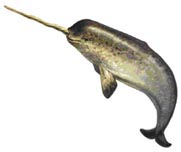
NARWHAL
Monodon monoceros
NARWHALS AHOY
In recent years, narwhals have achieved the cultural ubiquity shared by penguins, pandas, and small vanity dogs. Key indicators include the founding of “Narwhal Vs. Narwhal,” a powerpop ensemble based in Portland, Oregon; foodie-blog buzz over the “bacon chicken narwhal," two chicken breasts wrapped in bacon, fried, and detailed with pepperoni fins and a tusk carved from pepper jack cheese (recipe here); and the “Avenging Narwhal Play Set,” complete with baby seal and Koala bear figurines readied for impalement.
WHAT IS CASUALLY KNOWN
“It’s weird they have that one tooth,” he says. “Gross.”
“What’s wrong with a tooth?” I ask. “We’ve got even more teeth. Are we ‘gross’?”
“No, but theirs is freaky long—and always on the same side, left incisor. Isn’t it just the males? I only remember because it’s freaky.”

A MYTH, A SCAM, A GUESS, AND AN UNKNOWN
Nar is old Norse for corpse; Scandinavians named this arctic whale the “narwhal” because its gray, mottled body resembled that of a drowned sailor. Inuit myth claims the creature originated when a wicked woman, tricked into anchoring her son’s hunting line, was dragged into sea by a harpooned beluga. In her dying struggle, the harpoon’s shaft tangled in her hair and fused to her spirit-self, forming the narwhal.
By Medieval times the narwhal tusk was thought magical, synonymous with the unicorn horn. The Vikings delightedly jacked up their export prices. Neighboring royalty took to drinking from cups made of hollowed-out tusk, believing the cups neutralized poisons. In 1638, the Danish scholar Ole Worm (a.k.a. “Olaus Wormius”) exposed unicorns as a scam. It took another century before British physicians stopped prescribing powdered tusk for everything from erectile dysfunction to the plague.
Seafarers have long wondered why narwhals surface, rear up, and rub horns in a display known as “tusking.” Are they friendly? Conspiratorial? Jousting? Naturalist Charles Darwin decided their tusks were a secondary sex characteristic, akin to antlers—handy for showing off, not good for much else. His educated guess was soon accepted as fact.
Narwhals are exceptionally elusive to field study; none have survived in captivity. And so, there is no known record of narwhals feeding. Scientists theorize their diet from posthumous stomach dissections that yield halibut, cod, shrimp, squid, and rocks. The rocks are probably accidental.
WHAT IS ACTUALLY KNOWN
Narwhals frequent the waters of Greenland, Canada, and Russia. Each weighs between one and two tons, averaging 12 to 15 feet in body length. They dive deep and fast. Really deep: 2,400-4,500 feet. Really fast: they make the round trip in 25 minutes.
Around 75,000 narwhals live in the wild. Their predators are orcas, polar bears, and humans. The latter is under increasing regulation. In 2004 Greenland banned tusk exportation, setting hunting quotas to subsistence levels. Inuits prize raw narwhal flesh, mattak, sliced and dipped in soy sauce. The taste is termed “hazelnutty.”
THAT FREAKY LONG TOOTH
The Narwhal tusk may spiral up to 10 feet and is usually found in the upper left jaw of the male narwhal. One in 500 males sport a second tusk. Only three percent of females ever grow a tusk.
It was a 2005 study that revealed the tusk is really a pulped tooth, containing an astonishing 10 million nerve endings. Narwhals use their tooth to detect subtle shifts in salinity, temperature, and other environmental factors. This casts new light on the purpose of tusking. Perhaps it is collaborative form of tooth-brushing, scraping away algae and barnacles that block nerve tubules.
In all likelihood, tusking also generates pleasure. In contrast, the human penis contains only 4,000 nerve endings—less than half as many as the narwhal tooth. If only humans could multitask in such spectacular fashion, gingivitis would soon be a thing of the past.
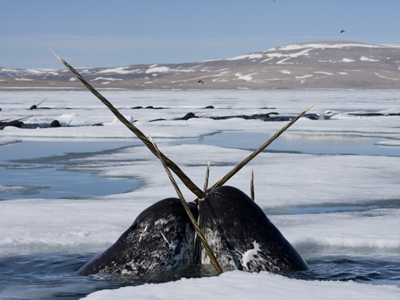
Narwhals! And that is our Wednesday serving of awesome.
These are busy days--I hope to see some folks at the VQR event tonight, and also at the Story League showcase next Tuesday, both at the Arts Club--not to mention that I'm fighting off a cold. But how could I not emerge from my hibernation to talk narwhals?

October 25, 2012
November 14! VQR Shindig & Issue Review

I have four poems from my current manuscript in the Fall 2012 Virginia Quarterly Review, themed "The Female Conscience." It took a minute, amidst all the travels, for me to get to sit down and read this gorgeous issue. But now I have, and I'm so impressed (honored) to be included. Highlights, a.k.a. an annotated TOC:
-"Is There Such a Thing as the Female Conscience?" an essay by Jean Bethke Elshtain...At the magazine where I worked for several years, Elshtain was my first "get," a prestigious scholar I convinced to contribute a small item and later, a significant book review. I am so glad the issue leads by taking on the substantial question of the theme's title and, ultimately, questioning its validity for beyond academic (if useful) provocation.
-"Dreaming of El Dorado," an essay by Marie Arana...Arana is both a confident editor and a superb reporter. This piece pulls me into the world of gold mining in La Rinconada, Peru, with ferocious energy. I care. I wish I didn't, because the options facing these people are bleak. Incredible and merciless and necessary photoessay, too.
-"The Sweet Spot in Time," an essay by Sylvia A. Earle..."I took pleasure in turning questions such as 'Did you wear lipstick? Did you use a hairdryer?' into a discourse on the importance of the ocean as our primary source of oxygen, the value of coral reefs, mangroves, and marshes as vital buffers against storms, and the delightful nature of fish, shrimp, lobsters, and crabs alive, swimming in the ocean—not just on plates swimming with lemon slices and butter." I want to be this woman when I grow up.
-"Of Flight and Life," an essay by Reeve Lindbergh...A priceless glimpse into the life of Anne Morrow Lindbergh, who served as spouse to one of Americas greatest adventurers while creating a formidable identity as an author and correspondent. Particularly poignant is the daughter's recognition of her mother's change over the years; too often we try and fail to understand our parents as homogenous, ageless archetypes.
-"Bad Feminist," by Roxane Gay...I have read most of Gay's essays and articles published in the last two years, yet this was unique access into the quirks and vulnerabilities of her mindset. So much resonates. Is it the fate of our generation of 30-somethings to feel like Bad Feminists, rather than be No Feminists at all?
-Page 93...when I came up for air and realized, hell, I'm reading this cover to cover.
-"Labor," a short story by Maggie Shipstead...It says something that while my sympathy, based on real-life experience, should have been with the three friends--the fierce, fun, independent ones, stubbornly child-free--I found myself feeling for the protagonist. The gift that is both we-love-you and now-go-away: I've been there.
-Three poems by Victoria Chang...If this is what she is up to, I want to read the book. Smart, funny poems that rely on repetition & linked phrasing (mimicking transitive properties of logic) and are set firmly, refreshingly in the non-academic workplace.
-"One to Watch, And One to Pray," a poem by Camille Dungy....No words. This poem just touched me--deeply entrenched in the moment of a family's deathbed vigil, and also irritated and enervated by the presence of a needy newborn.
-"My Fight," an excerpt from the memoir by Deirdre Gogarty...the book is called My Call to the Ring (Glasnevin, 2012), and tells the story of how Gogarty got on the path to becoming a world champion in boxing, a field owned by men. There is probably some tough, headstrong, unholy little girl in your life who needs to read it.
-"My Life as a Girl," a memoir by Stephen Burt...This dovetails beautifully with the recent profile of Burt published in The New York Times Magazine. I love Burt's refusal to defuse the ambiguities, e.g. the opening line, "Maybe I just want to be pretty."
It is interesting that the back page is a facsimile includes a note from the agent of the (then young, pre-Nobel-Prize-winning) author Nadine Gordimer, offering these markedly modest snippets for potential inclusion in an author bio:
"Publishers in both South Africa and in America want to see a novel from me, but I don't know if I can write the novel I want to write....
Except for a very short spell when I worked for the local newspaper in the small town in which I lived (how I wish I could use all the wonderful material I picked up from knowing everybody's business for that five months--but South Africa has a small white population and a long memory), and another short spell when I went to University in Johannesburg, I have always written for myself.
I now live in Johannesburg, am married, and have a baby daughter."I am not sure it was an intentional commentary by the VQR editors, but I am intrigued by the notion of what Gordimer could have written, versus what she has written. What does this tell us not just about the female consciousness, but the female conscience?
Those in the DC area have an opportunity to join us in a celebration of this issue on Wednesday, November 14, at the Arts Club of Washington (2017 I Street NW).
Beginning at 5:30 PM we will have a reception, leading into a 6 PM reading by guest editor Marie Arana (Writer at Large for the Washington Post and author of several books including the forthcoming Bolivar: American Liberator); Judith Warner (writer for the New York Times Magazine and Senior Fellow at the Center for American Progress); Mary Emma Koles (winner of the 2009 Gerald Stern Poetry Prize and the 2012 Mississippi Review Poetry Prize); and....me.
Copies of the magazine will be available for purchase, and the festivities will continue with post-reading refreshments. This event is free and open to the public.
Seriously, now. I'd venture to say that it you make it to one reading in November (as a friend of mine), make it to this one. It's an awesome glance to be part of the new forward momentum of VQR, which is of late making a lot of great hires. Onwards~

October 22, 2012
October Yes
This is the third October that I have traveled to Mississippi, and (for better and for worse) the occasion of least internet access. A few glimpses of what I saw:
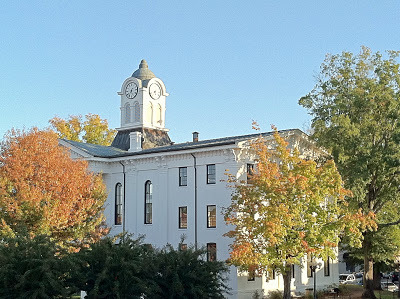 Oxford is as it always is...wonderful, and welcoming. Within the first few moments of being in town I bumped into Charlie walking outside Proud Larry's (where he was playing that night), Ron hollered down a hello from Square Books' balcony, and Chico drove by--with his dog Ringo hanging out the passenger side window--and said "Welcome home!" We ate smoked catfish salad at Ajax, caught Thacker Mountain, had a second dinner of oysters at Snackbar, and had one helluva time.
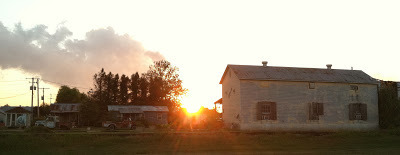
 Because it was the weekend of the big game versus Auburn ( = drunk Ole Miss craziness = no hotel rooms) we trekked out to Memphis and, ultimately, the Shack-Up Inn for the weekend. The inn is outside Clarksdale, cotton country, and consists of an aggregation of buildings that includes refurbished sharecropper shacks, a cotton gin, seed houses, and other outbuildings. Lots of corrugated tin and cypress wood. We were just a few miles down the road from the Crossroads of Highway 49 and Highway 61, where Robert Johnson supposedly sold his soul to the devil in return for his guitar skills. I don't know about that, but the BBQ ribs and beans cooked by Abe's, at the base of the crossroads, were definitely soul-worthy.
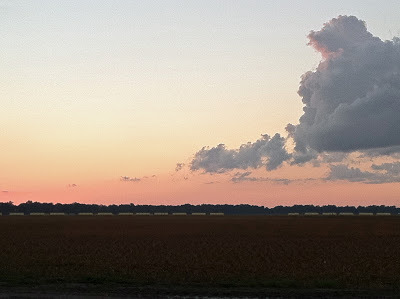
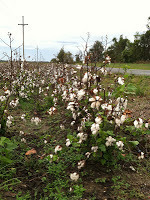
Cotton truly is the name of the game here. Those are great rolls of it, off in the distance, wrapped tight in chartreuse shrinkwrap. Fluffs of it tumble down the road as you drive.
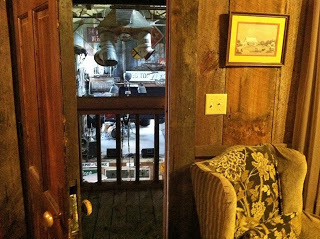 We ate those ribs while lazing our way through a Sunday on the balcony of our Sky Shack, a room that overlooks the inn's central Juke Joint Chapel.
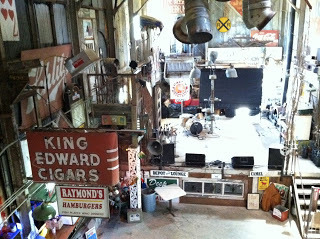 Office, pantry, sometimes music venue--but we had it to ourselves after dark.
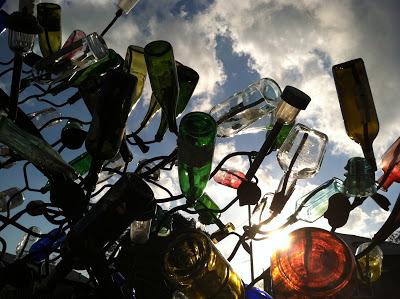 One of many bottle trees dotting the grounds, as ubiquitous as kudzu in Mississippi. From Hill Country to Jackson, Starkville, Atlanta...as we made our way east, we watched the landscape shift in tone. By the time we got to the Virginia Museum of Fine Arts in Richmond, we were talking a very different type of glass: Dale Chihuly.
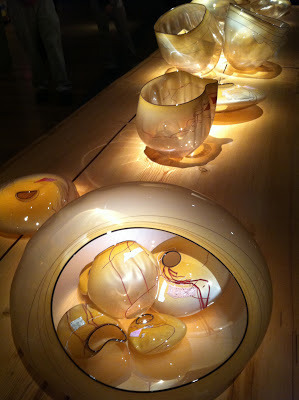 My absolute favorites were these basket-forms, which were displayed alongside the artist's collection of rugs and other woven textiles. But I could also appreciate the epic quality of the site-specific "Mille Fiori," an installation that echoed an underwater sea garden and included a wicked ghost stingray:
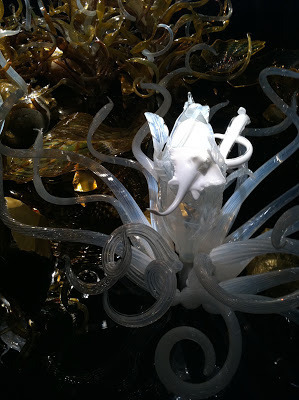
Really, you can't go wrong with a good stingray.
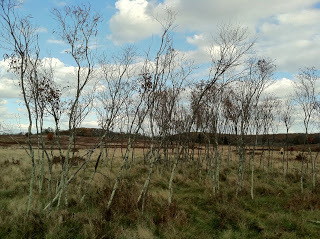
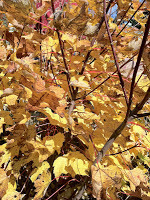 We made our way home via Skyline Drive, staying at the Skyland Resort before wandering all the way up to Front Royal. The temperature was a good 30 degrees lower than down south. On went the socks, on went the coats. We listened to bluegrass instead of blues (with a little Django Reinhardt that I'd picked up in Atlanta mixed in for good measure). Instead of BBQ-dusted potato chips, we snacked on honey-roasted peanuts. We chose darker beers instead of Red Stripe, the red wine over the white. Instead of cotton, my eye was drawn to the orange leaves like handfuls of flame.
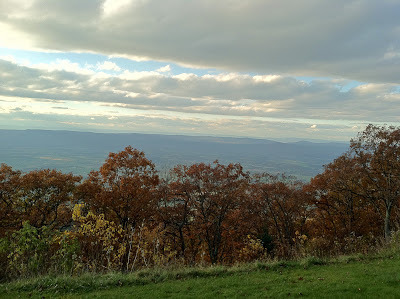
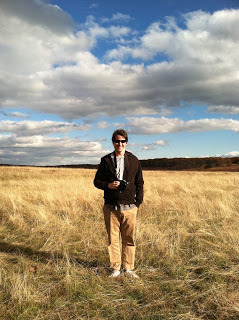 We visited 10 towns in 12 days. We went to a party at Rowan Oak, lawn strung with lights and oysters shucked on the spot. We toured Sun Studio. We watched a possum romp through Red's juke joint. We talked with writers, artists, musicians, teachers, awesome new-business owners, and a guy who lives half his year in a kayak on the river. I saw beloved friends & people I will surely never see again. The crazy thing about traveling in October is that you feel as if you come home to a different season. But after a summer of going to ground, regrouping, I'm ready for it. I'm ready for change. That so much of this narrative uses a "we" instead of the usual "I"? Part of the change.
PS ~ The really good photos are on this boy's fancy camera.
 Oxford is as it always is...wonderful, and welcoming. Within the first few moments of being in town I bumped into Charlie walking outside Proud Larry's (where he was playing that night), Ron hollered down a hello from Square Books' balcony, and Chico drove by--with his dog Ringo hanging out the passenger side window--and said "Welcome home!" We ate smoked catfish salad at Ajax, caught Thacker Mountain, had a second dinner of oysters at Snackbar, and had one helluva time.
 Because it was the weekend of the big game versus Auburn ( = drunk Ole Miss craziness = no hotel rooms) we trekked out to Memphis and, ultimately, the Shack-Up Inn for the weekend. The inn is outside Clarksdale, cotton country, and consists of an aggregation of buildings that includes refurbished sharecropper shacks, a cotton gin, seed houses, and other outbuildings. Lots of corrugated tin and cypress wood. We were just a few miles down the road from the Crossroads of Highway 49 and Highway 61, where Robert Johnson supposedly sold his soul to the devil in return for his guitar skills. I don't know about that, but the BBQ ribs and beans cooked by Abe's, at the base of the crossroads, were definitely soul-worthy.
Cotton truly is the name of the game here. Those are great rolls of it, off in the distance, wrapped tight in chartreuse shrinkwrap. Fluffs of it tumble down the road as you drive.
 We ate those ribs while lazing our way through a Sunday on the balcony of our Sky Shack, a room that overlooks the inn's central Juke Joint Chapel.
 Office, pantry, sometimes music venue--but we had it to ourselves after dark.
 One of many bottle trees dotting the grounds, as ubiquitous as kudzu in Mississippi. From Hill Country to Jackson, Starkville, Atlanta...as we made our way east, we watched the landscape shift in tone. By the time we got to the Virginia Museum of Fine Arts in Richmond, we were talking a very different type of glass: Dale Chihuly.
 My absolute favorites were these basket-forms, which were displayed alongside the artist's collection of rugs and other woven textiles. But I could also appreciate the epic quality of the site-specific "Mille Fiori," an installation that echoed an underwater sea garden and included a wicked ghost stingray:
Really, you can't go wrong with a good stingray.

 We made our way home via Skyline Drive, staying at the Skyland Resort before wandering all the way up to Front Royal. The temperature was a good 30 degrees lower than down south. On went the socks, on went the coats. We listened to bluegrass instead of blues (with a little Django Reinhardt that I'd picked up in Atlanta mixed in for good measure). Instead of BBQ-dusted potato chips, we snacked on honey-roasted peanuts. We chose darker beers instead of Red Stripe, the red wine over the white. Instead of cotton, my eye was drawn to the orange leaves like handfuls of flame.

 We visited 10 towns in 12 days. We went to a party at Rowan Oak, lawn strung with lights and oysters shucked on the spot. We toured Sun Studio. We watched a possum romp through Red's juke joint. We talked with writers, artists, musicians, teachers, awesome new-business owners, and a guy who lives half his year in a kayak on the river. I saw beloved friends & people I will surely never see again. The crazy thing about traveling in October is that you feel as if you come home to a different season. But after a summer of going to ground, regrouping, I'm ready for it. I'm ready for change. That so much of this narrative uses a "we" instead of the usual "I"? Part of the change.
 PS ~ The really good photos are on this boy's fancy camera.