Michelle L. Levigne's Blog, page 164
May 22, 2014
Letters to Kel: DO YOU HOP?
 I'm in the process of major writing surgery -- turning a fan novel I wrote decades ago into the pilot/launch novel for a new SF series. I haven't read this story in years, and had to go through it just to reacquaint myself with what I wrote. Besides changing all the character names (this was a Star Trek fan novel, by the way -- Paramount, which holds the copyright, doesn't take too kindly to people writing books with characters they own, putting their own names on them and making money. Another blog will discuss respecting other people's copyrights.), the first go-through was just to make note in my mind of all the story holes, and the major changes in the society I would have to make (as in no alien races, everybody is Human, so some major plot points and "revelations" had to be dropped and/or changed).
I was in pain before I was halfway through the revision. Not because of typos and small holes in stories and forgetting to tell readers who was talking and other stupid glitches.
No, I was in agony because I caught MYSELF head-hopping.
I started a scene in one person's POV (that's point of view, for those who don't know writer lingo) and then included a paragraph or two in someone else's POV, and then shifted to someone else's. For instance, a Klingon came into his commander's office with some news. I took a sentence to tell readers how much he despised his superior and couldn't wait to trick him into a major mistake so he would be demoted.
THEN in the next paragraph, I told you that the commander knew what his underling thought of him and he wasn't worried because he had a lot of powerful people on his side.
*sigh*
In my defense, I wrote this Trek fan novel 30-some years ago, when I had very little training and very few books on writing, no teachers up to that point other than "Writer's Digest." And just because I did it, and got caught, does not make it all right for everybody else to head-hop.
Like I ask people I edit, HOW does your POV character know what someone else is thinking or feeling? Is your POV character telepathic? Unless this is a science fiction or fantasy novel and invading other people's thoughts is a major plot element ... DON'T head-hop. STAY in the POV of the person who starts the scene. That means you cannot ever tell us what another character is thinking or feeling or planning to do, because the POV character doesn't have any way of knowing ... UNLESS you head-hop. And unless you're a big-time, bestselling author who can handle head-hopping without confusing readers, DON'T do it. All my publishers insist on staying to one POV per scene. If you absolutely must shift POV because it is essential to tell readers what another character is thinking, then either break the scene (starting a new chapter is a great way/place to do it) or make it very, very, very clear you're shifting to a new person's POV and then you STAY in that POV until the end of the scene.
No hopping.
Period.
Unless you have long ears and a puffy tail, NO hopping!


May 19, 2014
Off the Bookshelf: ABIGAIL ABERNATHY by TR Goodman
 Another Steampunk short read, this one has got me hooked on the clever, never-say-die heroine ... in only 19 pages!
The full title is ABIGAIL ABERNATHY: All-Night Analytical Engine Analyst, Volume I.
Analytical engine? Think steam-driven prototype computer, with punch cards and such. I've seen this in several other steampunk stories I've read, so I must assume this is a standard steampunk device.
In essence Abigail is defying convention by working for a living -- she's technically a member of the Geek Squad -- and the story chronicles her first day on the job, taking on a mismanaged analytical engine at a very messy, disorganized company. On top of everything else, she's contending with the attitude of the analytical engine analyst who just lost his job ...
Clever. Great character. Definitely going to look for more adventures of Abigail Abernathy ... as soon as I get this to-be-read pile down a few more inches ....
May 18, 2014
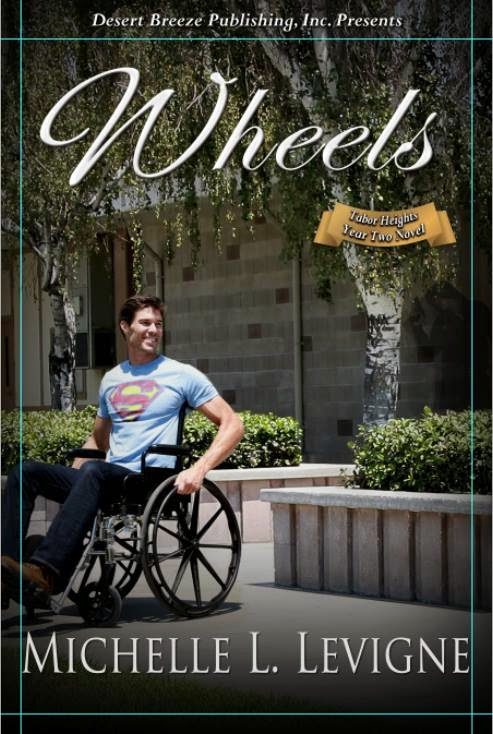
Cyber Launch Party TODAY for the Tabor Heights novel, WHEELS
ALERT!!Today is the Cyber Launch Party for WHEELS.

Wanna win a PDF copy of the original script for "MacGyver" that eventually turned into this book?
Hop on over to the Cyber Launch Party blog (www.CyberLaunchParty.blogspot.com), or the Cyber Launch Party Facebook page, and find out how!
Wanna win a PDF copy of the original script for "MacGyver" that eventually turned into this book?
Hop on over to the Cyber Launch Party blog (www.CyberLaunchParty.blogspot.com), or the Cyber Launch Party Facebook page, and find out how!
May 17, 2014
SPOTLIGHT SATURDAY: Ticket to Faerie, by F.I. Goldhaber
 Today's Spotlight is on a fantasy novel by a fellow Uncial Press author, F.I. Goldhaber.
TICKET TO FAERIE
For ten years, Alyssa's grandmother sent her magical gifts that didn't work. But, when Alyssa correctly, for once, follows the instructions that came with her 16th birthday present, she finds herself in Faerie, desperately trying to bring home a way to save her grandmother's life.
Poet, story teller, and book designer, F.I. Goldhaber continues writing
 professionally after more than a quarter century, including six years as a reporter and editor at newspapers in three states and more than a decade as business writer, editor, and marketing communications consultant for corporate, government, and not-for-profit entities.
 She wins awards for her fiction and poetry. Preditors & Editors readers poll ranked her second poetry collection, Pairs of Poems number three in poetry and various organizations honor her erotica works. Her short stories, novelettes, poems, news stories, feature articles, essays, editorial columns, and reviews appear in magazines, e-zines, newspapers, calendars, and anthologies and she published five erotica novels under another name.
In addition to paper, electronic, and audio publications, F.I. shares her words at events in Salem, Keizer, Portland, Seattle and on the radio. She appeared at venues such as Wordstock, Oregon Literary Review, bookstores, libraries, and Chemeketa Community College; gives presentations on subjects as diverse as marketing, writing erotica, and building volunteer organizations; and taught Introduction to Indie Publishing at Portland Community College and as a weekend intensive.
Find her online at: http://goldhaber.net
May 15, 2014
Letters to Kel: WHEN DO YOU BECOME "REAL"?
 I'm told that the war against e-books and e-book authors is calming down. If that's true, I have no evidence. Not because I'm not getting the response I used to get at writing conferences years ago (Who's your publisher? I've never heard of them. Oh, they publish e-books? *raised eyebrow/sneer* When are you going to write a REAL book?).
I don't know how much the attitude against/for e-books and e-publishers has changed, because I don't subject myself to the prejudiced fools (and I honestly think they're afraid -- why else would they accuse e-book authors and publishers of plotting to destroy traditional publishing? WE didn't declare the war.) who seem to think that what makes a book "real" is that it is printed by traditional publishers (based in New York, most often) on paper. I don't go to their conferences, and I've learned to ignore their devotees when they stand up to pontificate on the supposed low quality of all e-books. Yeah, the ones who insist that e-publishing is equivalent to self-publishing.
Excuse me -- if a New York Times bestseller is released in e-format, does that mean it is no longer a "real" book?
Maybe 5 years ago, at a writing conference, one speaker quoted the president of one writers organization saying, "If you're e-published, you're worse than self-published, and I despise you." The president of another writers organization wrote in her monthly column that anyone who "lowers" themselves to be e-published is irreparably damaging their writing career. And yet only a few years later, the word at their national conference was, "Hurrah for e-books!"
As a wise person in EPIC once said, " A book is a book is a book." The form it is presented in doesn't matter -- only that the writer focuses on quality and mechanics and presents a story worth the time and effort of reading it. Period.
So, when do you become a "real" writer? When are your books considered "real" books?
When people read what you write. When people come back for more. When you can open up a book or short story you published two years ago and you don't wince over stupid grammar/spelling/punctuation/plot mistakes that you made (and readers don't write to you to point out those glitches) ... because you have a solid grasp of the mechanics so you can spend your time telling the STORIES that have been burning inside your heart, begging to be released into the world.
That's when you're a real writer and your books are real books.
Period.
May 12, 2014
Off the Bookshelf: CLOCKWORK FAGIN
 "Clockwork Fagin," by Cory Doctorow, is the first story in a collection appropriately titled, "Steampunk! An Anthology of Fantastically Rich and Strange Stories" edited by Kelly Link and Gavin J. Grant. Only the first story in the anthology was available in the free preview I downloaded on my Nook.
I'm gonna go back and get the whole anthology when I finish all the freebies and samples I downloaded.
What's it about? Well ... think Oliver Twist, but the orphans not only take over the orphanage, they manage to change their horrible servitude and abusive living conditions into a life that children should live. How? Well ... it's kind of gruesome, when you think about it. It starts with a murder -- justified, believe me -- and turns into a puppet show. It gives a fascinating look at what the Industrial Revolution would have looked like if computers and lots of techno-wizardry-gadgetry had been part of it, and all the children who wound up in the poorhouse/workhouse were the castoffs, injured on the job. But their brains remain, even more clever in the quest for survival.
That's all I'm going to tell you. Get the freebie, and then read the rest of the anthology when you get the chance.
May 10, 2014
SPOTLIGHT SATURDAY: The Boy-Wolf, by Mary Patterson Thornburg
 Today's SPOTLIGHT is on another book by Mary Patterson Thornburg, and is a YA fantasy prequel to another book featured here earlier, A Glimmer of Guile.
THE BOY-WOLF
 Lashti is definitely no ordinary young man. He has a terrible secret: when the full moon rises, he becomes a wolf. Only Vivia’s love can cure him. Vivia, nearly fifteen, has never felt the way Lashti makes her feel, and the stories and ballads call this feeling "love." But to let the feeling come to its fruition would deprive Vivia of her gift of guile, the psychic powers of insight, influence, and illusion that will someday make her a great healer. So she has a choice to make. Will it be the right one? There’s no way of knowing until after it’s made.And maybe not even then.“The Boy-Wolf” is a story of young love, of superstition and illusion, of growing up. And of choosing…
Mary has self-published this prequel with Amazon Direct Publishing: http://www.amazon.com/Boy-Wolf-Mary-Patterson-Thornburg-ebook/dp/B00I2EMJ0U/ref=sr_1_1?s=books&ie=UTF8&qid=1392482017&sr=1-1&keywords=thornburg+the+boy-wolf
May 8, 2014
Letters to Kel: EVERYBODY NEEDS FRIENDS
 Like I said in the previous blog, writing is a solitary occupation. We need lots of time, hiding away with our computers, preferably in some place where people can't walk in or plop down in a nearby chair and start talking, and even though they can see we are hard at work, typing away at our computers ... *sigh* ... they expect us to carry on conversations with them or abandon what we're doing to socialize with them.
It's especially irritating when certain people in our lives have this incredible talent -- maybe even an instinct -- for knowing when we are most "in the flow" or struggling the hardest for the right word. That's when they choose to ask questions or start talking about inane things like what they're going to do when they go shopping tomorrow. And they get upset with us when we show any anger whatsoever at their interruption. Like we don't have the right to be angry when they destroy the flow, when the images we're in the process of putting into words just evaporate, and we have no real hope of recreating it. Gone. Shattered. Shredded.
grrrrrrrrrrrr.......
So, we NEED to find some writing friends. People who understand the trials and tribulations. People who want to strangle their loved ones for interrupting, expecting them to drop whatever they're writing, despite the fact they have a deadline (and then respond, "Well, if you had a deadline, why didn't you get started on it sooner?" And when responded to with, "You keep interrupting me and stealing my time!" they get huffy again. Like it's the writer's fault that no one respects their time and the things they value.)
Yes, young writer, find a writing group, or at least find a few friends who are also writers. Critique groups are fine, although I've never managed to fit into one. Some people love them. Some people click immediately. Some people profit from critique groups. I don't. Every critique group I joined wanted to put a limit on how many words I could turn in each week. Excuse me? I'm constantly under deadlines -- I write that many words in a day, forget about a week!
Find people who like and write the same genres that you do -- because they speak the same language. I had a friend who wrote YA historicals. Her critique partners wrote category romances. They kept applying romance rules to her words -- how can the heroine show up in the first five pages when there is NO heroine? -- and then getting angry when she refused to change her story to fit their mold. They kept telling her she was writing her book the wrong way, because she didn't do it their way.
Find people who will be honest with you. While it's nice to have a group of friends who pat you on the back and give hugs after every page you turn in, how much good will it do you in the long run if they love everything you write and never point out what you're NOT doing right? And at the opposite extreme, avoid the people who are only going to focus on what you're doing wrong. Find a happy medium -- people who see what's good in the story and tell you, and then point out what needs fixing. Preferably, they have enough experience to know how to fix it.
If it's an organized group belonging to a professional writing organization, that's fine. Such groups offer connections and advice and input from the "gatekeepers" -- editors and agents. At the same time, be careful of these groups. Their leadership often insist on forcing you into their specific mold -- if you don't do it their way, whether it be topics, themes, or the kinds of publishers you submit to, they will insist your book isn't a "real" book. Avoid groups that try to make everyone cookies from the same cutter.
Find the group that feeds you, supports you, kisses your boo-boos, and then shoves you out of the nest to try again, and demands your best from you. Friends who love you, friends who understand your stories and your way of looking at the world, but who don't let you get away with anything. Friends who, while they might get jealous sometimes, still help you to grow as a writer.
You can't do it alone, especially if you spend ninety percent of your time as a writer in solitary confinement.
May 7, 2014
Check out BTS Magazine -- Book reviews galore!
Interested in more than just the pitiful few books I manage to read and review on this blog?
I'm running ads in BTS Magazine, which has reviews of books in all sorts of genres, so I'd be grateful if you'd check out the ads -- and the whole magazine, of course!

Please click on the link and pop over and visit.
And save yourself some time -- bookmark it so you can visit regularly!!
You'll be glad you did.
I'm running ads in BTS Magazine, which has reviews of books in all sorts of genres, so I'd be grateful if you'd check out the ads -- and the whole magazine, of course!
Please click on the link and pop over and visit.
And save yourself some time -- bookmark it so you can visit regularly!!
You'll be glad you did.
May 5, 2014
Off the Bookshelf: CRIMSON OVERCOAT VERSUS CHRISTMAS
 The next book in my quest to soak up steampunk is actually a short story by Luke Monroe.
Crimson Overcoat is the former nom de guerre of the hero, Alexander, in this tale that mixes magic and revised history and unusual tech with a drastic revision of the Kris Kringle/Father Christmas mythos.
Alexander is enjoying the lull during the Christmas season, taking advantage of his boss being out of the office so he can indulge in some techno-wizardry work. Of course, that is interrupted when an elf named Holly comes knocking on the office door, looking for a champion. It turns out Kris Kringle isn't the jolly, lovable, benevolent old guy in red that we're used to. At least, not in this alternate history world. Alexander brings the Crimson Overcoat out of retirement and sets off for the North Pole to do battle and save an entire elf family from slavery.
Does he succeed? Does he survive? Read this novella -- free, when I downloaded it from B&N on Nook -- and find out for yourself.
I'm quite enjoying my education in all the many varieties and flavors of steampunk...