
Riku Sayuj > Status Update
22 likes · Like flag
Comments Showing 1-7 of 7 (7 new)
date newest »
newest »
message 1:
by
Gregsamsa
(new)
Mar 11, 2014 07:32AM
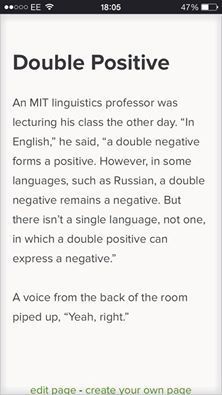
 Someone told me this a million years ago and I found it irritating because the "yeah" isn't necessary if the tone of voice is right, and if only "right" can be a negative then all it is is sarcasm.
reply
|
flag
 Gregsamsa wrote: "Someone told me this a million years ago and I found it irritating because the "yeah" isn't necessary if the tone of voice is right, and if only "right" can be a negative then all it is is sarcasm."
I would have told the same to the student.
 Actually "yeah, right" can be either a positive or a negative, depending on how it's said. Seems to me when it's a negative, it does indeed disprove the professor's assertion. Universals are seldom fool-proof. I suppose "death" is (at least for humans), certainly not "taxes".
Ted wrote: "Actually "yeah, right" can be either a positive or a negative, depending on how it's said. Seems to me when it's a negative, it does indeed disprove the professor's assertion. Universals are seldom..."
Actually "yeah, right" can be either a positive or a negative, depending on how it's said. Seems to me when it's a negative, it does indeed disprove the professor's assertion. Universals are seldom fool-proof. I suppose "death" is (at least for humans), certainly not "taxes".
Ted wrote: "Actually "yeah, right" can be either a positive or a negative, depending on how it's said. Seems to me when it's a negative, it does indeed disprove the professor's assertion. Universals are seldom..."I am finding it hard to 'hear' a "yeah, right" without sarcasm...
One person says, "Am I doing this okay do you think?", the other says "yeah ... right". Not sarcastic at all. Maybe it's the question preceding it that makes the sarcastic reply seem unlikely. But if the "yeah, right" is said sarcastically, then it would be a negative of course.That's my take anyway.
Ted wrote: "One person says, "Am I doing this okay do you think?", the other says "yeah ... right". Not sarcastic at all. Maybe it's the question preceding it that makes the sarcastic reply seem unlikely. But ..."My take is that it might be safest to avoid it unless sarcasm is exactly what you mean!
I don't think it would be misunderstood here in the states. Maybe in India. Although maybe it's an age thing also.But going back to the original story you quoted: Is the professor's universal claim that no language can express a negative using two positives falsified by (two positives + sarcastic inflection)? If not, then the "inflection" component is not accepted as part of language's meaning? And if so, then what is left of the "meaning" component of the two positives? Seems they have been completely wiped out by the inflection component.
So is "how" we say something at a higher level of meaning than the words themselves that we say? It would seem so.
And if that is so, and since we can never be sure of the inflected meaning of what another says, it seems to put up a rather large barrier to communication. Maybe this is what everyone but me has always known; or at least I haven't thought about it for a long while.
Maybe it's trivial.
