
Discover new books on Goodreads
Meet your next favorite book




The focus in all these cases is upon Jesus’s death on the cross, not the resurrection. These must remain central in any authentic description of what the first Christians believed had happened when Jesus died. But by themselves, without
...more

“The more we rely on search engines and social networks to find what we want and need, the more influence they wield. The power to include, exclude, and rank is the power to ensure that certain public impressions become permanent, while others remain fleeting.”
― The Black Box Society: The Secret Algorithms That Control Money and Information
― The Black Box Society: The Secret Algorithms That Control Money and Information

“Next to the Blessed Sacrament itself, your neighbor is the holiest object presented to your senses.”
― The Weight of Glory
― The Weight of Glory

“Another way of posing the problem is to ask oneself: what is the “present”? We say that only the things of the present exist: the past no longer exists and the future doesn’t exist yet. But in physics there is nothing that corresponds to the notion of the “now.” Compare “now” with “here.” “Here” designates the place where a speaker is: for two different people “here” points to two different places. Consequently “here” is a word the meaning of which depends on where it is spoken. The technical term for this kind of utterance is “indexical.” “Now” also points to the instant in which the word is uttered and is also classed as “indexical.” But no one would dream of saying that things “here” exist, whereas things that are not “here” do not exist. So then why do we say that things that are “now” exist and that everything else doesn’t? Is the present something that is objective in the world, that “flows,” and that makes things “exist” one after the other, or is it only subjective, like “here”? This may seem like an abstruse mental problem. But modern physics has made it into a burning issue, since special relativity has shown that the notion of the “present” is also subjective. Physicists and philosophers have come to the conclusion that the idea of a present that is common to the whole universe is an illusion and that the universal “flow” of time is a generalization that doesn’t work. When his great Italian friend Michele Besso died, Einstein wrote a moving letter to Michele’s sister: “Michele has left this strange world a little before me. This means nothing. People like us, who believe in physics, know that the distinction made between past, present and future is nothing more than a persistent, stubborn illusion.” Illusion or not, what explains the fact that for us time “runs,” “flows,” “passes”? The passage of time is obvious to us all: our thoughts and our speech exist in time; the very structure of our language requires time—a thing “is” or “was” or “will be.” It is possible to imagine a world without colors, without matter, even without space, but it’s difficult to imagine one without time. The German philosopher Martin Heidegger emphasized our “dwelling in time.” Is it possible that the flow of time that Heidegger treats as primal is absent from descriptions of the world? Some”
― Seven Brief Lessons on Physics
― Seven Brief Lessons on Physics
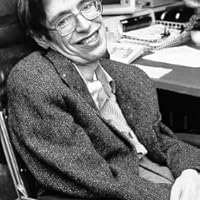
“Quantum physics tells us that no matter how thorough our observation of the present, the (unobserved) past, like the future, is indefinite and exists only as a spectrum of possibilities. The universe, according to quantum physics, has no single past, or history. The fact that the past takes no definite form means that observations you make on a system in the present affect its past. That is underlined rather dramatically by a type of experiment thought up by physicist John Wheeler, called a delayed-choice experiment. Schematically, a delayed-choice experiment is like the double-slit experiment we just described, in which you have the option of observing the path that the particle takes, except in the delayed-choice experiment you postpone your decision about whether or not to observe the path until just before the particle hits the detection screen. Delayed-choice experiments result in data identical to those we get when we choose to observe (or not observe) the which-path information by watching the slits themselves. But in this case the path each particle takes—that is, its past—is determined long after it passed through the slits and presumably had to “decide” whether to travel through just one slit, which does not produce interference, or both slits, which does. Wheeler even considered a cosmic version of the experiment, in which the particles involved are photons emitted by powerful quasars billions of light-years away. Such light could be split into two paths and refocused toward earth by the gravitational lensing of an intervening galaxy. Though the experiment is beyond the reach of current technology, if we could collect enough photons from this light, they ought to form an interference pattern. Yet if we place a device to measure which-path information shortly before detection, that pattern should disappear. The choice whether to take one or both paths in this case would have been made billions of years ago, before the earth or perhaps even our sun was formed, and yet with our observation in the laboratory we will be affecting that choice. In”
― The Grand Design
― The Grand Design

Tom’s 2025 Year in Books
Take a look at Tom’s Year in Books, including some fun facts about their reading.

2,367 books
|
119 friends

411 books
|
32 friends

100 books
|
28 friends

666 books
|
103 friends

516 books
|
84 friends

482 books
|
605 friends

90 books
|
7 friends

67 books
|
392 friends
More friends…


Polls voted on by Tom
Lists liked by Tom