
The Mookse and the Gripes discussion
Booker Prize for Fiction
>
2019 Booker Shortlist Discussion

 I agree with Hugh, this is a cop out. First choosing the best among equals is an impossible task, which is what literary awards are, then the acknowledged politics of placating certain writers or publishers, so really why do we get caught up in this? I think Atwood’s is the weakest, Sam loved it; I loved Ducks, Paul hated it, in the end some of us are unhappy about the joint award, some think it was a nice thing to do.
 Well, I’m mad and I am not playing anymore.
 If the Nobel judges had done the decent thing last week and given the prize to Atwood not Handke, then I genuinely think tonight would have gone differently.
 C I N D L E wrote: "the preemptive "winner" sticker"
I hadn't picked up on this - can you elaborate?
 If we, a bunch of amateurs, can manage to pick *one* book every year for our Shadow Booker Int. Prize, these *paid* "experts" should be able to do the same. A farce, and (I suspect) a fix from start to finish - Atwood was always going to win because they clearly wanted her to.
 There is a perspective that we aren't discussing, and that is what is good for the future of the Booker Prize. Having lost their Man sponsorship, I do not know how stable present sponsorship is, but having the award go to someone with the stature of Atwood, must bring more confidence than a lesser name. So in the long run this may help the Booker. I came to that conclusion when I was grumbling about Atwood being shortlisted at all while embargoed.
MisterHobgoblin wrote: "C I N D L E wrote: "the preemptive "winner" sticker"
There is a perspective that we aren't discussing, and that is what is good for the future of the Booker Prize. Having lost their Man sponsorship, I do not know how stable present sponsorship is, but having the award go to someone with the stature of Atwood, must bring more confidence than a lesser name. So in the long run this may help the Booker. I came to that conclusion when I was grumbling about Atwood being shortlisted at all while embargoed.
MisterHobgoblin wrote: "C I N D L E wrote: "the preemptive "winner" sticker"I hadn't picked up on this - can you elaborate?"
It turned out to only be one bookshop and their mistake but someone spotted this in a bookshop several weeks ago:
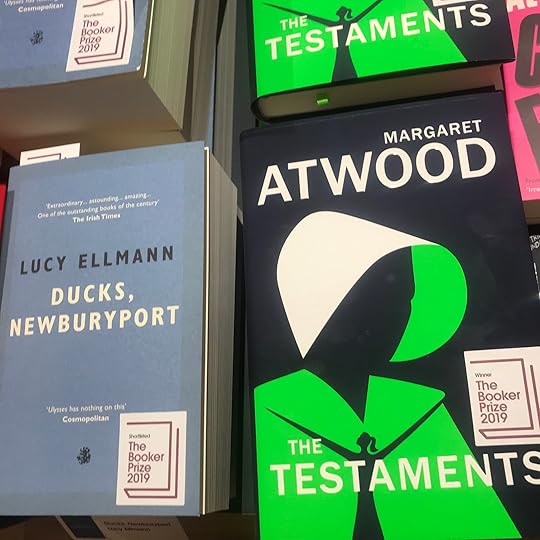
You may need to look closely but the Testament is labelled as 'winner' and Ducks 'shortlist'. The Man Booker Prize itself got involved - see The Testaments thread
Sam wrote: "There is a perspective that we aren't discussing, and that is what is good for the future of the Booker Prize. Having lost their Man sponsorship, I do not know how stable present sponsorship is, bu..."Actually rather stable and if anything with a sponsor who is a philanthropist rather than commercial company, they ought to be more immune to commercial pressure (whereas under Man, see the 'The Stolen Bicycle' incident om MBI where a Taiwanese author found himself labelled as from Taiwan, China).
 If only a small fraction of the people who have bought the Testaments pick up GWO then maybe the book may do better than had it have been (as it should have been) sole winner.
 So far it’s had very little attention on Goodreads for example, so it could benefit from reflected glory and will I think appeal to many Atwood fans.
The odd part to me is why the Booker organisers did not overrule the judges a third time after sending them back twice. I suspect time was a big issue. I wonder if next year they might move away from having the judge meeting in the day of the announcement. Or maybe they can award it to Mantel alongside the long list and then let the judges choose a second winner.
To me this is the fun type of controversy that we all enjoy getting ourselves worked up about and precisely why I follow book prizes.
The Nobel Prize controversy by contrast was I thought an unpleasant decision and genuinely unworthy of a book prize.
 Tony wrote: "If we, a bunch of amateurs, can manage to pick *one* book every year for our Shadow Booker Int. Prize, these *paid* "experts" should be able to do the same. A farce, and (I suspect) a fix from star..."
It does seem like a fix. Perhaps the coffers were too big.
My wife read 'The Testaments' (after reading 'The Handmaid's Tale' last year), and she said it was good, but also that the ending was a bit rushed and disappointing in the same way that the TV version of 'Games of Thrones' was (i.e. she felt that Atwood had lost interest with fifty pages to go and wanted to get it over and done with as soon as possible...)
One thing. People are saying that Bernardine Evaristo is the first black woman to win the Booker. Do Indian women no longer count as black?
 Yet The Testaments didn't even make it to the Scotiabank Giller shortlist (from the longlist).
While I would have preferred the judges to choose a single winner, I'm not entirely upset by a joint win.
Yet The Testaments didn't even make it to the Scotiabank Giller shortlist (from the longlist).
While I would have preferred the judges to choose a single winner, I'm not entirely upset by a joint win.I'm quite pleased that Girl, Woman, Other is the winner (as I had hoped and predicted).
On the other hand, I am equally upset that The Testaments is its co-winner - not because I dislike Atwood but rather because it was clearly the weakest of the shortlist (barring Ducks, Newburyport since I can't comment as I haven't finished it). It was, in my opinion, the least interesting and the most predictable - very clearly the "safe" choice with the widest appeal.
My discontent stems from the fact that (not an intentional Ducks reference) I feel that any of the other shortlisted books would have been better deserving of the co-win.
 MisterHobgoblin wrote: "I hadn't picked up on this - can you elaborate?"
Since Paul has shown the sticker evidence, I'll explain a bit further why I think it was rigged in Atwood's favor from the beginning.
If each of these events (embargo, sticker, Amazon, pre-publication eligibility) had occurred over a 6-12 months period, one each for different books on the longlist, I'd say coincidence. But all four plus the heavy-handed marketing happening for 'The Testaments' within a three months period within one awards window was highly suspect.
I also strongly feel that had 'Ducks, Newburyport' won, which many of us thought would be a shoe-in, had it won, I believe it would have been the same result with two winners: Atwood and Ellmann. Why? Because I think a long ago decision was made that Atwood would be a co-winner, one way or the other in order to drum up press.
Reasons why I think the Booker organization did it?
Publicity, chasing of clout of Atwood's veteran writer status, desire to gain new (younger) readers who are fans of 'The Handmaid's Tale' TV show, hoping that that will translate to press for the Booker organization. As someone else pointed out, the Booker has a new sponsor and likely needed to prove to the sponsor they are viable in the long run.
What I think though will be the fallout from this, which The Booker may not have thought through, is that the readers and long time fans of the award who do look up to The Booker for it's prestige and respectability, are now or will be turned off by such theatrics. Awards like these mean nothing if they have no credibility.
If I'm right, they did this to survive, to be competitive. Yet, it may be that they have just swiped the ladder from under their own feet. This is all just speculation of course, but if anything fishy and untoward has occurred behind the scenes to lead to today's results, I'm sure it will eventually come to light. It always does.
 Mod
Trevor wrote: "I’m trying hard to imagine the judges’ meeting."
Mod
Trevor wrote: "I’m trying hard to imagine the judges’ meeting."Yes. Or perhaps they had all been told that Attwood had to win and some of the judges (one of the judges?) wouldn't go along with it so they hastily agreed a co-winner.
 Gumble's Yard wrote: "...So far it’s had very little attention on Goodreads for example, so it could benefit from reflected glory and will I think appeal to many Atwood fans."
Keep in mind that Girl Woman Other doesn't even hit shelves in the US for another couple months. It's the only title from this year's long list to have not seen a full release, so I'm sure that plays some into its lack of attention on Goodreads.
Chris wrote: "Keep in mind that Girl Woman Other doesn't even hit shelves in the US for another couple months."I assumed that e-readers and international on-line bookshops made that a very surmountable problem these days.
 the FT has some judges information - and info on the new sponsor (which rejected the dual prize) Here's the link, but since I guess it's behind a paywall, I'll quote the judge/info things here:
 https://www.ft.com/content/780083d2-e...
Everything below is quoted bits from the FT by Maria Crawford (and the comments are scathing and trollish - I recommend skipping those.):
The jury’s decision was initially rejected by both the Booker Prize foundation’s literary director and chair of trustees because it violated a rule prohibiting joint winners.
After further, last-minute deliberations on Monday, the jury reached the same unanimous verdict. “It was the collective will of the jury to say, ‘we cannot abide by these rules’,” [said Peter Florence.]
Gaby Wood, literary director of the Booker Prize foundation, had to call Helena Kennedy, chair of the trustees, a second time with the same news.
When asked if she supported the jury’s decision, Ms Wood said only, “I support the means by which they arrived at the decision” — though she also joked that the judges would not get paid. She confirmed that the prize money of £50,000 would be split evenly between the two winning authors.
It is also the first time the award has been split between two works since a rule against dividing the prize was introduced in 1993, after the 1992 jury awarded the Booker jointly to Michael Ondaatje and Barry Unsworth.
Mr Florence said of both books: “They’re linguistically inventive, adventurous in all kinds of ways, they address the world today and they create characters that resonate with us and will resonate for a long time”. He denied that one winner would be likely to overshadow the other.
Trevor wrote: "I’m trying hard to imagine the judges’ meeting. They honestly, each of the five of them, thought both books deserved to win? None could choose between the two? And when they got pushback multiple t..."That's what they get paid for. Next time I'm asked to pass or fail my students, I'll just say I can't decide and do both ;)
 C I N D L E wrote: "MisterHobgoblin wrote: "I hadn't picked up on this - can you elaborate?"
Since Paul has shown the sticker evidence, I'll explain a bit further why I think it was rigged in Atwood's favor from the ..."
I also said several times in the run up that I thought it was fixed in Atwood's favour. However, the pre-publication eligibility is just the rules of the prize, the sticker was a mistake by a single bookshop, the embargo was in place for a long time due to the planned global launch event and Amazon just made a mistake. At least, that's one way to read the four events you refer to. The other way, of course, is that we were right.
I understand GY's comment about this kind of thing being a large part of the fun of book prizes, but I do feel very disappointed by this outcome. I am seriously thinking I won't bother reading the books next year: this no longer feels like a literary prize.
 I'm so happy my favourite - Bernadine Evaristo won. And I'm equally happy that the prize has been awarded to Margaret Attwood - I don't think The Testaments specifically deserved the prize but I think Attwood's life-time contribution to literature more than justifies her honorary win.
 I don't actually know if Attwood has won before, I just know she has been shortlisted X2 or more.
Congratulations to both!!
Atwood won for The Blind Assassin in 2000.
As opposed to which literary prize NeilThe Goldsmith with its habit of shortlisting past judges at a rate of around 1 per year in its very short history (I guess it cuts costs!)
The Nobel which likes to focus on pop stars and genocide deniers
The Women’s Prize which picked The Power (sorry Naomi) and can hardly be said to be apolitical in its choices
On a smaller scale ...
The RoC - which has joint winners this year and says it might even let all shortlisted books win in future because competition is bad.
Or the year before when a judge caught an early train and their favourite book didn’t make the list and the prize organiser almost overrode the judges shortlist when their favourite book did not make it.
Not The Booker with the big row this weekend over Ezra Mass (try searching for danjameswriter on Twitter)
Or the fuss last year at the foolhardy (!!!) judge who actually did decide to make a choice by giving a casting vote when the other votes were deadlocked
Or closer to home ...
Mookse Madness which has (I pick my words carefully) over time been influenced by people trying to win the prediction competition and others encouraging votes from third parties who may not have read the books. All of which by the way seems actively encouraged under the rules as being part of the spirit.
Or past year’s of the Booker
https://www.thedailybeast.com/the-12-...
Seems to be this mess makes it more of a literary prize than ever.
It’s a fair point. I am going off literary prizes in general. I am thinking it is better to read the books I want to read. It’s not like there aren’t very many of them. That said, I usually enjoy the MBI, the Goldsmiths and the RoC so I can take pleasure in the books themselves even if there are other shenanigans going on around them. With the Booker it always feels like I have to push through several books that I would prefer not to read and now I am wondering why I do that.What I was thinking in bed this morning before I got up was that I read for pleasure. I don’t want to be reading to try to second guess judges’ decisions or find a way through a maze of politics.
Maybe this was simply the straw that broke the donkey’s back.
Oh, and it wasn’t an early train, it was the last train which is why the judge in question had to leave.
 Mod
Erica Wagner who has judged the Man Booker twice (as well as the Goldsmiths, the Women's Prize and the Costa/Whitbread) saying on Twitter:
Mod
Erica Wagner who has judged the Man Booker twice (as well as the Goldsmiths, the Women's Prize and the Costa/Whitbread) saying on Twitter:wonderful as both these books are. If the chair has one job, it's this, surely. Been a judge twice. That's how it goes. Or should.
Problem though is that I suspect had the Chair had the casting vote, Atwood would have won.
Neil wrote: "It’s a fair point. I am going off literary prizes in general. I am thinking it is better to read the books I want to read. It’s not like there aren’t very many of them. That said, I usually enjoy t..."I understand that thought and hope you were not offended by my earlier jest. It was meant in encouragement. I am already practicing that of which you write. I haven't given up my interest or discarded the prizes completely, but I have taken the "chore" out of the process by reading what I want at my leisure. I think that one reason I am less displeased with situation is that I feel less vested in the result. I do feel it important to read some of the books I dislike though. It makes the good books seem so much better! My apologies again if my remark offended you.
From the link Gumble's Yard posted:(6) ‘A Pile of Crooked Nonsense’
In 2001 Scottish writer A.L. Kennedy had some harsh words about the prize, calling it “a pile of crooked nonsense.” Kennedy, who had been on the jury for the 1996 award, dismissed the selection process as corrupt, saying the winner was determined by “who knows who, who’s sleeping with who, who’s selling drugs to who, who’s married to who, whose turn it is.” Of her fellow judges on the committee, who awarded the prize to Graham Swift for his novel Last Orders, she said, “I read the 300 novels, and no other bastard did.”
That's devastating.
Atwood's book was positioned to win right from the start.
MisterHobgoblin wrote: "One thing. People are saying that Bernardine Evaristo is the first black woman to win the Booker. Do Indian women no longer count as black?"Indians are not considered black in racial terms. So that makes Evaristo the first black woman.
Indians and other Indic people would be called "brown," (a silly informal tag not a racial indicator) even if they are darker than Evaristo, as many are in south of the country.
 Is anyone familiar with the voting rules on the Booker? Why did voting "not work" according to Florence? Do all five judges get a vote? Or do 4 judges get a vote and the chair gets none?
 I have a hard time understanding why 5 judges were supposedly "split in the middle".
 I don't think there are rules for voting. It could be done differently every year depending on how easy or difficult they are finding it.
 Mod
Just a note on your Mookse Madness reference, GY - all was not as it seemed but since the final scores of the prediction competition were never posted, the full extent of the fun and games was never revealed.
Sam wrote: "Neil wrote: "It’s a fair point. I am going off literary prizes in general. I am thinking it is better to read the books I want to read. It’s not like there aren’t very many of them. That said, I us..."
Mod
Just a note on your Mookse Madness reference, GY - all was not as it seemed but since the final scores of the prediction competition were never posted, the full extent of the fun and games was never revealed.
Sam wrote: "Neil wrote: "It’s a fair point. I am going off literary prizes in general. I am thinking it is better to read the books I want to read. It’s not like there aren’t very many of them. That said, I us..."Sam - no I was not offended at all. I was replying to Gumble's Yard's comment about how all prizes have their defects. I know it is churlish of me to react this way, especially after last year restored some hope for me (I was losing the will to read Booker books for a couple of years before that but never said anything).
I imagine I will get over it in a few weeks (probably hours, actually). There are more important things in life than books, after all.
Any one with a copy to hand - what are the last words in Girl, Woman Other.
Gumble's Yard wrote: "Any one with a copy to hand - what are the last words in Girl, Woman Other."The last words are:
this is not about feeling something or about speaking words
this is about being
together.
These words refer to Penelope's reunion with her mother.
On the contrary they referred to the prize announcement. Antonomasia wrote: "It was up to the 80s or so in Britain that 'black' was often used by activists to encompass Indian and other visible BAME groups cf the title of Paul Gilroy's Ain't No Black in the Union Jack. BAME..."
I guess in the past everyone who wasn't white was called black, a simple division that didn't go into details of ethnicity and race.
But skin shade is not an accurate indicator of race. Many dark people are not racially black and so on..
I have extreme dislike for the term POC. I have no idea why this term has caught on because it's anything but a neutral descriptor. It excludes the white from the range of skin colours people are born with and thus makes 'white' - race and skin shade - a standard or reference point from which other colours deviate. Everyone is POC if you treat white just another skin colour.
I don't know if there are enough non-white people who would object to this label and make it known, but I know many who do. I find BAME comparatively better.
In countries where they are a minority, it's better to just call them non-white when the purpose is to compare with the majority community. Or by their countries of origin or ethnicity if you want to be specific.
 Really disappointed to be sent this by a friend who walked past foyles today: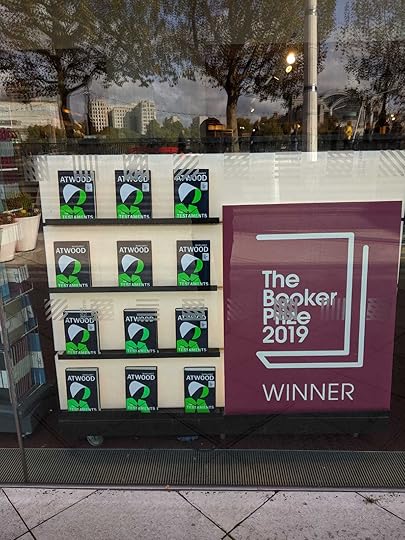
This is exactly why I was worried about the double win
That seems odd given Evaristo is speaking there on Thursday at the winner interview (without Atwood)
I think this might be southbank as opposed to Charing X rd
Makes sense but still very poor. Will be interesting to see how other bookshops deal. Your friend should tweet the picture and embarrass them if they are only showing one book in their window display.
On the BAME label:The concept of BAME has a lot to answer for, creating as it has the impression that as long as the minority box can be ticked, the job of improving diversity is done. But BAME encompasses people of Chinese or black African heritage, who are outperforming others in school exam results for example, as well as those of black Caribbean backgrounds, who – for a complex assortment of race- and class-based reasons – are more likely to be significantly behind. It includes Indian doctors, considerably over-represented at consultant level in the NHS, as well as Africans and Eastern Europeans, who make up a disproportionate number of hospital cleaners, in some cases paid below the living wage.
That's from one of the judges.
 *be aware of conspiracy theory*
What if the judges had to find a second winner, as the Atwood win was leaked few weeks ago?
It makes me sad thinking that the Booker could be crooked by capitalistic games (just like the Oscars are).
Leaked when and where?
 Jibran wrote: "Antonomasia wrote: "It was up to the 80s or so in Britain that 'black' was often used by activists to encompass Indian and other visible BAME groups cf the title of Paul Gilroy's Ain't No Black in ..."
I agree with you, Jibran. I absolutely hate the term POC and for want of a better choice, prefer to refer to myself as either Arab or non-White depending on context (or maybe an off colour person if you want to be cheeky). I feel that the term non-White somehow puts the attention back on whiteness and how it is a social construction. I can understand though why others feels it's not the perfect choice either. In the end, I guess the most positive thing is to be keep this debate open.
Gumble's Yard wrote: "Leaked when and where?"It is a bit silly, but weeks ago there was this book shop picture circulating online where we could see both the Testaments and Ducks and the Testaments had a winner sticker on it. That's the leak.

The Mookse and the Gripes
Books mentioned in this topic
New Daughters of Africa (other topics)The Prince of Homburg (other topics)
What's Bred in the Bone (other topics)
The Road (other topics)
The Far Field (other topics)
More...

I had called it from the jump that it was rigged in Atwood's favor. Every stunt pulled with 'The Testaments' being eligible before publication, the review embargo, the preemptive "winner" sticker, the Amazon shipping fiasco, etc., all pointed to publicity stunt and heavy-handed orchestration to give the win to Atwood - which in essence gives attention to the Booker Organization.
What a shame though that the more deserving author and book, Evaristo, 'Girl, Woman, Other', has to share an award that should have been hers all alone. I now see the Booker Organization in a different light, filled with skepticism and lack of veracity.