
The Filipino Group discussion

This topic is about
The Great Ideas of Philosophy
note: This topic has been closed to new comments.
Buddy Reads
>
The Great Ideas of Philosophy by Daniel Robinson | Chapter 11: Hippocrates and the Science of Life

 Ycel wrote: "As human history marched on, we did not necessarily get philosophical ideas that are more truthful and correct (view spoiler). But I shall stop here before I spoil it any further."
(view spoiler)
Sarah wrote: " bago natin masabi na tubig eto h2o eto hindi sya kuha ka ng hydrogen atom tapos oxygen then boom tubig"
(view spoiler)
Ycel wrote: "DC:
I think I just got bit by the existential nihilist bug again, what with the whole journey/destination thing.
Por que? Hmmm…you have to elaborate on this when we meet."
(view spoiler)
JL wrote: "Haha, I'll stop drinking na! Bakit nga pala KoolAid? :)"
(view spoiler)
JL: (view spoiler)
JL wrote: "And being wide awake does have its positive qualities and advantages diba, so it wasn't meant to be discriminatory."
(view spoiler)
JL wrote: "" For the ancients, the 'soulful' experience was natural and as easy as cupcake, but for us, now, I think we really need the cultivation and exercise of all our cognitive capacities (imaginative, aesthetic, moral, intellect) to once again percieve this ensouled world."
(view spoiler)
JL wrote: "http://www.thenewatlantis.com/publica..."
(view spoiler)
Talasalitaan:
(view spoiler)
Oh my goodness, we're on the second page already... Things can only get more intense :O
(Quick go-over on Chapter 2)I really feel Robinson's humor shine through here :D (view spoiler) Humor is always a great thing to have as you go through the most toxic of topics, after all xD
Something bugged me about the lecture though. How exactly would you delineate FOLK WISDOM vs PHILOSOPHY?
-> (view spoiler)
As far as I can understand, philosophy has been defined as:
-> (view spoiler)
So, do I need everything stated above to be considered "philosophical"?
Olympianism
-> (view spoiler)
The language
-> (view spoiler)
I have a few more points, but I'll add them on later. I'll also check out Angus' and Ycel's notes later :D
 Troll comment, only because I saw my name in DC's comment :D (view spoiler)
DC wrote: "[>>> You think cupcakes are easy?!?! Sumbong kita kay Tina! HAHAHA!"
I think maybe he meant it's easy to eat. Or something. JL, (view spoiler)
--
Okay carry on guys. :) *teleports away*
 Having zero background on philosophy, I thought that this book will teach me tons of ideas. But I'm having a hard time coping with the topics. :(
 I'll just catch with you guys later on when I'm able. But I'm checking this thread every now and then to see your discussions. :)
 Okay, I haven't answered Assignment 2 because 1.) I am too lazy, and 2.) I am still trying to think of answers.
Quick reaction regarding philosophy vs folk wisdom: categorizing Confucianism under folk wisdom is like calling a negro 'nigger.' You know what I'm saying?
*Back to work
 KAMILLE:
 No worries, dear. It is quite understandable if you don’t have any philosophy background. As the subject matter traces the history of ideas, one will have to expect that the topics will be a synthesis of not just philosophy but also religion, psychology, history, political science, literature, drama, the natural sciences, even mathematics. But don’t get disheartened if you are hearing about these things for the first time. You will learn a lot even by just listening, so yes, do check on this thread regularly, and check out the works mentioned in the course outline (The Iliad, The Odyssey, The Upanishads, the Greek drama/tragedies, etc.). That is how philosophy is meant to be tackled. It entails a lot of work, but the intellectual reward is enriching. :)
DC: I'm rather hoping I misunderstood this, because it made my heart jump a little. My profs were passionate about the MLM (Marx-Lenin-Mao) philosophy, and I still have vestiges of their discussion points when I was in class, half-listening.
My Dear Camille (DC) :p I fear we have come to a point of disagreement at last. I have to declare now that I am not a fan of Marxism because it did not work (the so-called people’s republics became authoritarian and wrecked their economies). On a personal level, I thoroughly dislike Marxism because it does not allow private ownership. What I own is the fruit of my labor, my thinking. To allow the state to decide how to distribute the fruits of my labor is to allow it to control my brain, myself, my whole being. Although I do not completely agree with Ayn Rand’s Objectivist philosophy, she beautifully illustrated the flaws of socialism in her influential work Atlas Shrugged . “The only proper, moral purpose of a government is to protect man’s rights, which means: to protect him from physical violence—to protect his right to his own life, to his own liberty, to his own property and to the pursuit of his own happiness. Without property rights, no other rights are possible.” (Ayn Rand, The Virtue of Selfishness )
Additional responses to follow :)1. Explain how the conception of the Olympian gods liberates Greek thought.
(view spoiler)
2. Describe factors usually offered to account for the Greek philosophical achievement that were not present in earlier and highly developed civilizations.
(view spoiler)
3. How does Isocrates intend Hellene to be understood, and does this sense of the term retain its meaning today?
(view spoiler)
Random reactions:Sarah: This is off topic but... (view spoiler)
Tina: Haha, welcome to the thread! :P (view spoiler)
Kamille: It's all right. It really takes some time to get used to the discussion, especially if you're new to the thoughts noted here. Just check in with us from time to time, because we might just be discussing a topic you're familiar and interested in :) and don't hesitate to ask questions if necessary! See you around :D
Ycel: (view spoiler)
Ontopic comments later! Haha!
 Chapter 2: just some quick observations that's hopefully Kool-Aid free :)
1) I find it interesting that some of the pre-socratic philosophers foreshadowed contemporary scientific attitudes. Deomocritus in his atomist philosophy felt that to analyze and break things down their constituent components until you reach the ultimate bottom would explain everything else (sounds eerily like Physics). Democritus represented the extreme of the early Greek's affinity with the natural earth and materiality (w/c together with the popular religion of Olympianism of Homer w/c radically divides man and gods will be, I think, corrected by Plato by seeking beyond the material towards a transcendent reality). The Sophists, I dont know, sound like precursors to radical relativists, and Anaximander's search for first principle sounds like the modern search for the grand theory of everything.
2) I find Robinson's definition of Philosophy quite interesting. Thanks DC for giving a wonderful outline: a systematic and critical perspective on all claims of other genres, something that tests the most fundamental beliefs, convictions, and values we have, something wherein criticism is central to the process, the love for wisdom, something that arises out of the need for an intelligible world in the face of danger and uncertainty. Criticality, that inner attitude to hold everything at a distance and question it, especially tradition and what has gone before, speaks of a sharp divide between the self and whatever is in question. I don't know, but it looks like the gradual emergence of this inner space allowed the Greeks to accomplish some things unheard of before: like giving the first systematic account of history (Herodotus), or like being able to study nature, including man, as an object (Democritus).
I think it is this attitude, including the other things outlined by DC, that Robinson meant as Philosophy, the Greek way. Confucianism is still called the Philosophy of Confucius, but maybe not with this attitude and spirit in mind. But I'm unfamiliar with Confucianism so I'm probably wrong. Folk Wisdom or lore, on the other hand, I think means customs that are the traditions of a culture. It is Wisdom that was given, and not earned via the thinking activity of man. A lot of the older myths hold that Wisdom or truth or even technology came from revelation from the gods or other supernatural beings. Fire came from Prometheus, for ancient Egyptians writing was taught by a god (Thoth?). Philosophy, the Greek way, sounds like a sign of man's coming of age.
In connection with Confucianism, has anyone heard of the Axial Age? Wikipedia states: "Axial Age or Axial Period is a term coined by German philosopher Karl Jaspers to describe the period from 800 to 200 BC, during which, according to Jaspers, similar revolutionary thinking appeared in Persia, India, China and the Occident...during the Axial Age "the spiritual foundations of humanity were laid simultaneously and independently in China, India, Persia, Judea, and Greece. And these are the foundations upon which humanity still subsists today"...developments in religion and philosophy [that offers a] striking parallel without any obvious direct transmission of ideas from one region to the other." A very interesting field of study.
Before this post becomes Kool-Aidy again, just want to say na natawa dn ako sa humor ni Robinson, lalo na nung ginaya nya yung boses ni Aphrodite nung knkwento nya yung part sa Iliad na nsugatan yung dyosa at ngrereklamo kay Zeus haha
Quickie comment lang. Mommy duties beckon.How exactly would you delineate FOLK WISDOM vs PHILOSOPHY?
I think philosophy is more rigorous because of the criticality component, while folk wisdom = folklore which is just a collection of a people’s legends, music, oral history, proverbs, jokes, popular beliefs, fairy tales, stories, tall tales, and customs. Consider for example the huge difference between the Homeric epics and Plato’s Republic (West) or the Five Classics vs. The Art of War (East).
Will be back later…
 though hindi ko pa natatapos ung Chapter 2. Naeexcite nanaman ako magcomment. Sorry. :) hehehe
Ycel DC JL
I totally disagree that Folk Wisdom and Philosophy are two different things. They are just the same thing with different approach.
Sabi nga nung professor kong isa yung western philo daw is more of a left brain philosophy while ung eastern eh right brain mostly.
The thing is Religion, culture and philosophy in the eastern setting is deemed as one. For example Buddhism it is a philosophy it itself pero religion din eto for some at the same time.
DC
Yes it is. Alam mo bakit ko yan natandaan nung nadaanan namin? Dahil ung genius niya nakakatuwa. I once shared yang thought na yan sa isang kaklase ko na atheist. Agnostic na sya ngayon. hahahaha. masaya yan pag usapan. :)
eto ung kinakatakot ko sa mga comments. kasi iba iba ung tono ng pagbabasa natin. pero i don't mean to be rude sa disagreement ko na un. just a friendly challenge sa thread natin. kaya guys PEACE tayo. :))) weee! :)
Angus, on your notes: (view spoiler)Ycel, on your notes: (view spoiler)
JL, on your notes: (view spoiler)
I decided to get all your arguments on religion / philosophy / folk wisdom, para isang tinginan lang :D (view spoiler)First off: Thanks all for considering my question :)
Angus, (view spoiler)
I think we've established earlier that, back in the day, people inevitably believed in a sort of divinity. (See Ycel's comment on Homo religiosus: http://www.goodreads.com/topic/show/1... ) So, whether Chinese, Greek, Filipino, etc. it was inevitable that you believed in a higher form of being. A sort of mystical element that, for them (or for you) rules the universe... Probably because they (you) don't.
JL mentions how customs and traditions are very important in the aspect of civilizations, and this probably gave rise to certain ways of thinking - inevitably putting a sort of philosophy (love of wisdom, certain ways of thinking about things) in place.
Now, as for the arguments on religion / philosophy, I think Sarah put it simply when it's a matter of cultural differences, wherein the "philosophy" of the Eastern thought has already considered all aspects of human behavior, conduct, governance (as those mentioned by Ycel), whereas the "philosophy" of the Western thought dealt mostly with questioning the systems for each of the three already in place. (I like Sarah's note on the "left brain / right brain" thought.)
Angus also provides a good point- on the excommunication/heretic part. As noted above, the system or, for the sake of brevity, the eastern philosophy already has been passed down for people not to think about. The Greeks had more freedom to criticize, and thus just did that (as Ycel notes, too). I guess that's how Greek philosophy differs from those present in the time (see, however, JL's notes in his Axial Age comment).
Yeah, so I guess it's good to think that Folk Wisdom could mean traditions and customs that have been passed on through generations (parang ang cultural logic natin ng pag-gisa ng bawang-sibuyas-kamatis, and IN THAT ORDER), while Philosophy could mean the entire system of thought.
UNLESS you guys have other thoughts pa? :D
Sarah wrote: "eto ung kinakatakot ko sa mga comments. kasi iba iba ung tono ng pagbabasa natin. pero i don't mean to be rude sa disagreement ko na un. just a friendly challenge sa thread natin. kaya guys PEACE tayo. :))) "(view spoiler)
By the way, let's have one last round of reactions, guys, and move on to Chapter 3 either today or tomorrow :D
Dears, I have been down with gastroenteritis since last night so I’ve been radio silent for a while. My legs are like jelly and my brain is woozy. Ugh. There goes Mother’s Day for me.Sarah has a point on the left brain/right brain angle. I forgot to mention that western philosophy is theory driven. Somebody summarized the salient differences here.
Let’s not be worried about being suspected of rudeness when we disagree. I think we have pretty much covered this when we spelled out the rules of engagement at the start of the thread. I am always operating on the assumption that each of us here can hold his own. Ergo, no harm done.
Darn tummy hurting again.
 I highly recommend this book for those who are interested in reading about Western philosophy, or those who are just beginning to read about Western philosophy. The Greek Philosophers from Thales to Aristotle.
 You will be surprised about what the Greeks really thought about being, causality, change, and of course what they really thought about the divine.
Hi, Mark! Thanks for the book shove :) You're welcome to join in the discussion anytime.
Ycel wrote: "Dears, I have been down with gastroenteritis since last night so I’ve been radio silent for a while. My legs are like jelly and my brain is woozy. Ugh. There goes Mother’s Day for me."
You will be surprised about what the Greeks really thought about being, causality, change, and of course what they really thought about the divine.
Hi, Mark! Thanks for the book shove :) You're welcome to join in the discussion anytime.
Ycel wrote: "Dears, I have been down with gastroenteritis since last night so I’ve been radio silent for a while. My legs are like jelly and my brain is woozy. Ugh. There goes Mother’s Day for me."(view spoiler)
Thanks for the recommend, Mark :D
Thanks, DC. Better now but not well enough to drive and cast my vote :(I am posting my thoughts now on the next lecture. I will go slightly off-topic here because I want to tackle a more contemporary (sort of) numbers issue to drive home the main point of lecture 3.
03 – Pythagoras and the Divinity of Number
(view spoiler)
Aww, Ycel, hope you fully recover soon! :/Here are the guide questions for Chapter 3.
Questions to Consider:
1. Summarize in what ways Pythagorean “numerology” is like and unlike modern mathematical models of reality.
2. Explain the striking agreement found between abstract mathematics and actually occurring natural items.
Hello guys! Haha, where are y'all? Still resting from the blood transfusions? ;)Anyway, here's my quick go-over for Chap 3.
(view spoiler)
Other comments to follow :)
Dear classmates, we can move on to chapter 4 if you like :)
Hi classmates, sorry I've been (and I'm still) busy. Work is a _____. I'll catch up. May special exams ba? :D
Ycel wrote: "Dear classmates, we can move on to chapter 4 if you like :)">>> Nuuu, wait! I want to dissect it a bit more! I did enjoy the chapter very much, even though I have a dislike towards geometry. (view spoiler) (I wanna discuss the (view spoiler))
Angus wrote: "Hi classmates, sorry I've been (and I'm still) busy. Work is a _____. I'll catch up. May special exams ba? :D"
>>> Right minus wrong. Must be strapped to tickle chair. On a cliff. LOLjk. Habol lang, Angus! :D
DC wrote: "I wanna discuss the [world-came-from-numbers angle even just a bit! And the 1-2-3-4! Darn that was awesome."OK lah *Singaporean accent*. We'll talk some more, tetraktys and all :)
Other comments on Chap 3:- The middle-ground note (view spoiler) (view spoiler)
- Jainism (view spoiler)
- I think that the look on numerology (view spoiler)
- I never thought about music and its significance (view spoiler)
- (view spoiler)
- Conch shells and snowflakes <3
- He made me think of how to compute (view spoiler)
- "Late hours and strong coffee" :D
- Quarks + gluons = cosmos?!?! But (view spoiler)
The guide questions are too tough for me. The abstractions hurt my head ^^;
Ycel wrote: "Leonardo Fibonacci (view spoiler)>>> Oh. My. G. Wow. I find this thought to be too scary. A series of numbers dictate the universe? It's too perfect. Too aligned. Too seemingly predictable - when we know that life is full of surprises, right?
So are you meaning to imply that anything - anything at all - can be so stripped to the rudiments, and that you can't exactly leave almost anything to chance? Or is it just creation that is "perfect", but what we do with creation is not?
(Wow, now that I think about it, doesn't that just ring of The Matrix tones?!)
But the note on "creation is itself harmonic, expressive of a divinely rational plan” is actually reminiscent of what Sarah and I have been talking about in spoiler tags: the Intelligent Design Theory :D
(Speaking of which, on a probably unrelated note- (view spoiler))
Sorry! This is late. And it was quite tough to munch. It's like biting an apple with new braces on (debilitating pain for the masochists).03. Pythagoras and the Divinity of Number
(view spoiler)
DC wrote: “I find this thought to be too scary. A series of numbers dictate the universe? It's too perfect. Too aligned. Too seemingly predictable - when we know that life is full of surprises, right?So are you meaning to imply that anything - anything at all - can be so stripped to the rudiments, and that you can't exactly leave almost anything to chance? Or is it just creation that is "perfect", but what we do with creation is not?”
While the different laws (expressed as, surprise (view spoiler)) regulating the universe imply an orderly plan, it does not diminish its wonders (at least for me). When I discovered Fibonacci, the awe that I have always felt for the beauty of creation was heightened and my respect for life deepened.
On the topic being too abstract…
You’ll be surprised to find out that babies understand that numbers are abstract. Babies now do you see? (Dr. Robinson’s voice, heee…)
So if you want to teach a baby the number 12 for example, you don’t show him this:
(view spoiler)
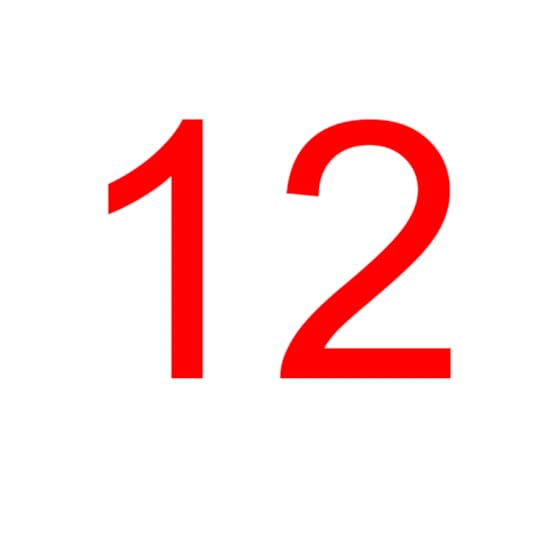
Instead you show him this:
(view spoiler)
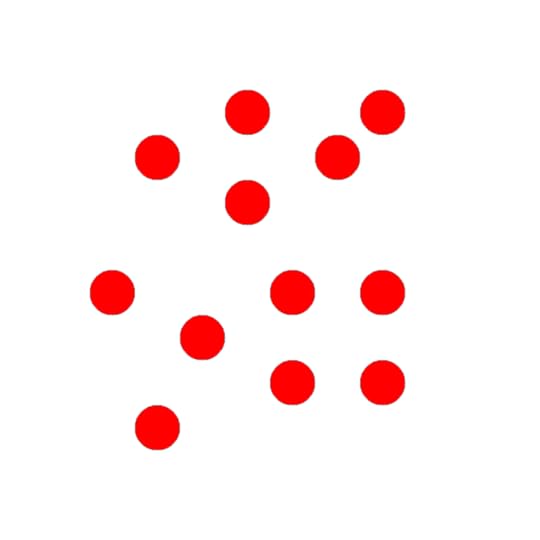
Not convinced? Glenn Domann ‘s How to Teach Your Baby Math is a great resource.
Angus wrote: (view spoiler)That's EXACTLY why I don't trust the numerology bit. I like being the center of my universe. I like believing that if I so will it, the universe will conspire to give it to me. (view spoiler)
I like being the cosmic soul, though I don't exactly want to think of myself as a simple binary code. (If that's the case, someone must be coding me? (view spoiler))
But, you know, I just realized something: what if the exceptions to the rule - the ones that break the patterns - are actually part of the patterns themselves? That every, say, child born by the 100 x 4^24-th second is MEANT to be an exception? Like planned imperfections? The Fibonacci sequence occurs every so often; its predictability means that after counting from 89 to 144, the 144th is ACTUALLY meant to be something special? That's the point of the sequence, right?
Hotdiggity dog, I think I just made my own brain explode.
Ycel wrote: (view spoiler)
I respect that, Ycel. I personally don't like thinking that everything is so planned, so orderly, but I have to admit that whatever it is that causes the sun to shine everyday and whatever it is that makes the world, there's beauty in this universe for us to behold. If only we'd all stop to smell the flowers :)
(I am tingling with happy feels over this little note. Thanks for bringing it up, Ycel. Philosophy isn't *always* as cold or as difficult as people believe it to be. It can also, after all, remind you of the simple joys and everyday wonders that life has to offer. *FEELS*)
... Darn, I think the divinity of numbers just made me realize my own humanity, and the divinity of, well, something divine. Woo. :D
DC: You will hear Dr. Robinson quoting Aristotle a lot later on: (view spoiler)*Taking a break! Game of Thrones S03E08 :)*
Just a note: The Aristotelian notion of purpose and design in nature (telos) is different from what (modern day) Intelligent Design advocates think about when they think of purpose and design in nature. here's a good short introduction from philosopher Edward Feser in his article, "Four approaches to teleology" http://edwardfeser.blogspot.com/2009/...
... and also in this well-written article, "Nature versus art" also by Edward Feser. http://edwardfeser.blogspot.com/2011/...
Welcome, Mark! :DHmm, interesting. Will look forward to when we get to Aristotle then :D
But hey, Mark, any thoughts about the Pythagorean thought about the divinity of number and all that? :)
Mark wrote: (view spoiler)
Thanks for the articles! :) I went over both... (view spoiler)
Hello guys!If you're all good with Chapter 3, let's have a last round of reactions, and move on to Chapter 4 by tomorrow (May 22), if that's good :)
Hey guys!If you're ready, let's proceed to Chapter 4: What Is There? (The Pre-Socratics and the Ultimate Stuff of the Universe)
Here are the guide questions:
1. Conclude whether there are similarities between the effects of skeptical philosophy on attitudes in ancient Greece and the effects of modern science on contemporary attitudes.
2. Given that nearly universal human customs (nomoi) are taken, therefore, to be “natural,” explain how exceptions can be dealt with.
3. Give examples of nearly universal customs that are brought about by essentially local conditions.
As usual, don't hesitate to give your viewpoints of previous chapters; we'll probably be bringing them up in future discussions anyway :D
Oh, and since Sophocles is soon coming up on stage (Chapter 5), Ycel & I have been thinking about a little... (view spoiler)
I'm really glad that you guys are reading up on the history of philosophy. The Pre-Socratics are of great interest to me, too! Their ideas helped lay the groundwork for the philosophical approach to monotheism (and shows man can know through the use of natural reason that there is a God and why there can be only one God). The work of the Pre-Socratics and the other pagan philosophers after them may be seen as preparation for the coming Good News. :-)
Classmates, so sorry. Work got crazy this week. Will post my thoughts soon.
Talasalitaan: Metaphysics is a traditional branch of philosophy concerned with explaining the fundamental nature of being and the world, although the term is not easily defined. Traditionally, metaphysics attempts to answer two basic questions in the broadest possible terms:
1. What is there?
2. What is it like?
A person who studies metaphysics is called a metaphysicist or a metaphysician. The metaphysician attempts to clarify the fundamental notions by which people understand the world, e.g., existence, objects and their properties, space and time, cause and effect, and possibility.
Ontology is the philosophical study of the nature of being, becoming, existence, or reality, as well as the basic categories of being and their relations. Traditionally listed as a part of the major branch of philosophy known as metaphysics, ontology deals with questions concerning what entities exist or can be said to exist, and how such entities can be grouped, related within a hierarchy, and subdivided according to similarities and differences.
Epistemology is the branch of philosophy concerned with the nature and scope of knowledge and is also referred to as "theory of knowledge". It questions what knowledge is and how it can be acquired, and the extent to which any given subject or entity can be known. Much of the debate in this field has focused on analyzing the nature of knowledge and how it relates to connected notions such as truth, belief, and justification.
Chapter 4, therefore, seeks to address the problem of knowledge.
Hi people :) pasensya na medyo hindi nakakaparticipate. After ng defense namin, hopefully makapagcomment ulit dito :) Chapter 4 na ba ung readings?
Chapter 4Answers to guide questions:
(view spoiler)
Random thoughts:
On metaphysics, ontology and epistemology--> when I was younger I thought philosophy was all about syllogisms so I got thoroughly turned off and chose an easier path. Looking back, I’ve known 3 persons who took philosophy as their major (2 of them armed with a master’s) and all 3 are quite incisive when they analyze issues (whether political, business, contemporary) so I guess it’s true that philosophy allows one to take a skeptical approach and provide a method that removes skepticism. Sigh. I’m making up for it now.
“And philosophy now, as utterly humanizing and humanistic enterprise, is very much on the map of thought and there will be no retreating.”
You just got to love how Dr. Robinson wraps up the topic.
Here is the complete poem by Henry Wadsworth Longfellow quoted in the lecture:
(view spoiler)
SARAH: It's OK. Good luck on your defense. Habol na lang :)
I won't be reading the previous comments first; I'll get back to them later :D Here's my quick go-over of
Chapter 4
:- LOL on (view spoiler)
- The senses deceive me? (view spoiler)
- I think it's funny that "metaphysical" (view spoiler)
- I am enamored by the question of thoughts (view spoiler)
- I like this "is what you sense (view spoiler)
- Realizing what epistemology entails (view spoiler)
- Okay, while I thought that (view spoiler)
- Democritus and his atomic relationships. (PFFFT.) (view spoiler)
- STUFF.
- Moral reality & objectivity (view spoiler)
- "Man is the measure of all things." <3
- The unclarity of the subject, shortness of human life, ridiculousness of human imagination...
- I like the thought about how Pre-Socratic (view spoiler)
- Anthropocentric VS cosmological.
- “And philosophy now, as utterly humanizing and humanistic enterprise, is very much on the map of thought and there will be no retreating.” (view spoiler)
Phew! I think I can manage the questions this time around. I'll go over them another day :)
My answers to the guide questions for
Chapter 4
.1. Conclude whether there are similarities between the effects of skeptical philosophy on attitudes in ancient Greece and the effects of modern science on contemporary attitudes.
(view spoiler)
2. Given that nearly universal human customs (nomoi) are taken, therefore, to be “natural,” explain how exceptions can be dealt with.
(view spoiler)
3. Give examples of nearly universal customs that are brought about by essentially local conditions.
(view spoiler)
Additional comments later!
Mark wrote: (view spoiler)>>> Hmm, a religious angle. I haven’t actually considered this before :) But yes, it’s all very interesting. I do hope to see the historical line of thought regarding this, as we move along :D
Sarah wrote: (view spoiler)
>>> Hey Sarah! Good luck on the defense :) And yup, Chapter 4!
Ycel
Thanks for your talasalitaan post, by the way :D Though I don’t know, being a “metaphysicist” seems more scientific-sounding than “metaphysician”, which has a doctoral air. We are technically metaphysicists, right? :)
On the post of your answers to the guide Qs: (view spoiler)
On commenting about my post: (view spoiler)
Topic: ANTIGONE FILM VIEWING ON JUNE 1
Hello everyone!
We'll be discussing Chapter 5: The Greek Tragedians on Man’s Fate soon. With this in mind, we would like to invite everyone to watch a film of Sophocles' play: Antigone. The 1961 black-and-white film, yes. It's on Youtube, by the way: www.youtube.com/watch?v=7yPFbccjKjY
Think of it as additional reference and resource. Think of it as something that could help give us an idea of Greek life and Greek tragedy. Think of it as a welcome break from all the too-deep-Philo-ARGH on the thread. Think of it as a chance to troll people who are too busy watching. (Wait, no, don't think about that.)
If you're available on June 1, Saturday, in the evening (maybe around 9pm? For confirmation!), we plan to watch the movie at the same time. No livestream, but there will probably be a chatroom. We'll just give the signal to press play at the same time, then off we go :) (view spoiler) I'd suggest you get a personal copy of the film, though, so you needn't rely on download speed when we watch it together :)
If you can't join us on the date, you can still check the movie out on your own. We could discuss it on this thread too :D
I'll be posting additional information about this later on. If you're ready to confirm your participation, do respond on this thread, or send me a personal message about it :)
Hope to see you on Saturday!
Cheers,
DC
PS: I was thinking whether we should also ready a copy of 300 too... You know, to watch after Antigone. It's Greek too, right? :D
04. The Pre-Socratics and the Ultimate Stuff of the UniverseBecause there is no retreating, here I go!
(view spoiler)
Regarding the simultaneous screening, I'm up for this. I am usually too lazy to get out of the house, so this works just fine. :)
This topic has been frozen by the moderator. No new comments can be posted.

The Filipino Group
Books mentioned in this topic
The Book of Virtues (other topics)The Great Ideas of Philosophy (other topics)
The Fifth Discipline: The Art & Practice of The Learning Organization (other topics)
Simulacra and Simulation (other topics)
Being and Time (other topics)
More...

Hindi ako si Shiela.. :l :))))"
Eeeeeeeeek! So sorry, edited.