
Classics and the Western Canon discussion
Divine Comedy, Dante
>
Inferno 30: Falsifiers, Part 2
date newest »
newest »
 "Dante here encounters more of the falsifiers, including Potiphar's wife. Two of them begin to quarrel, and Dante lingers, enjoying the repartee. Virgil, however, rebukes him for taking pleasure in such vulgar behavior, and the poets move on."
From "Dante", www.rcwalton.com/Inferno.pdf
Link for Potiphar: http://en.wikipedia.org/wiki/Potiphar. (Note the various artists' renditions of the story.)
Genesis 39:1-20 -- http://www.mechon-mamre.org/p/pt/pt01...
"142-148 Virgil's acceptance of Dante's blush ..."Stream of consciousness reaction, an article I saw yesterday on ten characteristics that supposedly particularly distinguish man from other creatures. See Number 8:
http://www.livescience.com/15689-evol...
 Lily wrote: "Virgil, however, rebukes him for taking pleasure in such vulgar behavior, and the poets move on."."
This bolgia seems to be framed by Virgil's rebukes. At the beginning of Canto 29, Virgil asks the pilgrim,
"What are you still gazing at? why does your sight still rest down there among the dismal mutilated shades?" ...
And after the pilgrim explains himself,
Then said the master, "Do not let your thought distract itself on him henceforth; attend to somewhat else, and let him stay there..."
And then at the end of Canto 30, after Master Adam accuses Sinon of Narcissism, the pilgrim "stands intent to listen" to the argument and Virgil speaks to him in anger:
Now just you keep on looking a little more and I will quarrel with you!
What's this all about? What is wrong with the pilgrim looking at the sinners? Isn't that what he is here for, to see and experience the spectacles of Hell?
Perhaps it isn't the looking per se, but the desire to look. Virgil forgives him, but warns, "the wish to hear that is a base wish." Could the same be said of those who linger too much over Inferno?
 Thomas wrote: "Lily wrote: "Virgil, however, rebukes him for taking pleasure in such vulgar behavior, and the poets move on."."
This bolgia seems to be framed by Virgil's rebukes. At the beginning of Canto 29, V..."
Hollander's gloss tickled me:
131–135. "Virgil’s harsh rebuke here seems on the mark, certainly to Dante himself. Dante’s emphatic acceptance of it stands in clear contrast to his rejection of the similar rebuke in the last canto (Inf. XXIX.4–12), where Virgil had not understood the cause of his staring into the ninth bolgia. Here Dante has become an interested bystander (rather than a man with a mission), enjoying the back-and-forth argument between the two sinners (just as do we) because it is both violent and amusing." [my bold]
You're just not reading the right kind of book, Mr. Pilgrim!
Thomas wrote: "Could the same be said of those who linger too much over Inferno? ..."Probably. But we are almost at the skating rink. And it sure would be fun to hear from some other malingers who aren't totally caught up in the rush of Advent (i.e., the season of waiting).
http://hoocher.com/Gustave_Dore/Infer...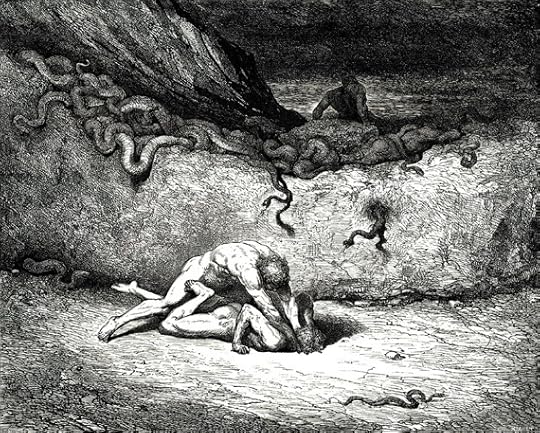
Gustave Doré: Inferno - Canto 30, lines 20-34
"...One reach'd Capocchio,
And in the neck-joint sticking deep his fangs,
Dragg'd him, that o'er the solid pavement rubb'd
His belly stretch'd out prone."
http://hoocher.com/Gustave_Dore/Infer...
Gustave Doré: Inferno - Canto 30, lines 35-46
"...That is the ancient soul
Of wretched Myrrha"
http://www.blakearchive.org/blake/ima...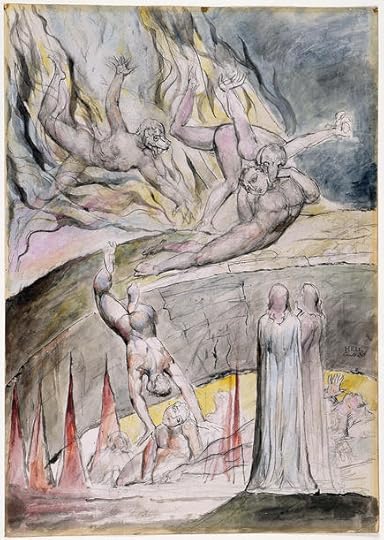
William Blake: "The Pit of Disease: Gianni Schicchi and Myrrha"
 I watched today this (~40min) video on women and violence. It reminded me of Eman's comments on our modern concern with violence (abuse) of person versus the seeming greater concerns of Dante about abuse (violence) of reason. I continue to be very uncertain how the modern world can or does or should attempt to separate them in considering law or justice or morality or punishment or ...., but I am fascinated by what he posits.
http://learningpartnership.org/vaw-film
Lily wrote: "Probably. But we are almost at the skating rink. And it sure would be fun to hear from some other malingers who aren't totally caught up in the rush of Advent (i.e., the season of waiting). "It would be great to hear from others, though I can understand how the season's good cheer may be suppressing participation. I suppose the best we can do is to follow Virgil's advice and keep moving. Better times are ahead.
Opera time! I suppose Virgil would have stern words for Puccini for turning Gianni Schicchi's deception into a comic opera. It is certainly fun, though. Here is the most well-known aria from it:http://m.youtube.com/#/watch?v=tofdd1...
And a bit about it:
http://en.wikipedia.org/wiki/Gianni_S...
 We've meet two souls in this bolgia who died by being burned at the stake, one for counterfeiting and one for failing to fly. These can serve as a reminder of the savage public punishments that were common in the Middle Ages. They put into perspective the savage eternal punishments Dante assigns to Hell.
 Laurele wrote: "Opera time! I suppose Virgil would have stern words for Puccini for turning Gianni Schicchi's deception into a comic opera. ..."
Glad to have you back, Laurele. How is your mother recovering?
Nemo wrote: "Laurele wrote: "Opera time! I suppose Virgil would have stern words for Puccini for turning Gianni Schicchi's deception into a comic opera. ..."Glad to have you back, Laurele. How is your mother ..."
Thanks, Nemo. Another crisis has passed, but not the last.
Note that Dante has no trouble understanding Sinon, though the latter is a pre-Roman Greek.
Roger wrote: "Note that Dante has no trouble understanding Sinon, though the latter is a pre-Roman Greek."Are you saying Dante's understanding of pre-Roman Greeks is uneven and/or character specific?
Lily wrote: "Roger wrote: "Note that Dante has no trouble understanding Sinon, though the latter is a pre-Roman Greek."Are you saying Dante's understanding of pre-Roman Greeks is uneven and/or character speci..."
Someone suggested that Virgil asked Dante to be silent before Ulysses because of a language problem.
 Thomas wrote: "What's this all about? What is wrong with the pilgrim looking at the sinners? Isn't that what he is here for, to see and experience the spectacles of Hell?"
I wondered about that, too. The journey seems to slow down here. Earlier we seemed to move fairly quickly through the levels, but down here we often get two cantos for a level, and things seem to be more lethargic. I wondered whether this reflects that Dante (as pilgrim) is getting more inured to the suffering, almost, I forget the exact phrase, but there is a phrase for those who get so overwhelmed with horror that they become numb to it.
(I also wonder whether Dante would today be diagnosed with PTSD.)
But also, they have a time frame, don't they, and while Dante may not be aware of it, Virgil seems to be and is trying to hurry Dante on to get through their journey before their time runs out -- is it before Easter arrives? I forget.
Roger wrote: "We've meet two souls in this bolgia who died by being burned at the stake, one for counterfeiting and one for failing to fly. These can serve as a reminder of the savage public punishments that we..."That's a good reminder. While the Inquisition is still almost two centuries away, and the Roman Circus is just a memory, it was still a fairly brutal age, and punishments would have had to be fairly severe to inspire the awe and fear that I think Dante wanted to impress on his readers.
Roger wrote: "Someone suggested that Virgil asked Dante to be silent before Ulysses because of a language problem...."Somewhere I got the impression that Dante knew the Greeks only through Latin translations. I'd have to go back and recheck to be certain that is accurate, and I'm not up to that tonight.
Lily wrote: "...It reminded me of Eman's comments on our modern concern with violence (abuse) of person versus the seeming greater concerns of Dante about abuse (violence) of reason...."Abuse of person, abuse of reason -- it all seems so obfuscated this week after Newtown. Among the things that trouble me are the irrational accusations and hateful posturing that pervade some of the commentaries on the articles associated with this tragedy. I find myself sympathizing with Dante's placement of sins involving failures of reason deep in the bowels of his Inferno.


1-12 (Juno vs. Thebes): Athamas
13-21 (Fortuna vs. Troy): Hecuba
22-27 Gianni Schicchi and Myrrha
28-33 Griffolino identifies Gianni, attacking Capocchio
34-36 Dante asks Griffolino about the second shade
37-45 Griffolino: Myrrha became another, as did Gianni
46-57 Dante observes a lute-shaped sinner
58-75 Master Adam: his dropsical thirst; his sin
76-90 Master Adam: his desires for revenge
91-93 Dante: who are those 'wet hands in winter'?
94-99 Master Adam: Potiphar's wife and Sinon
100-129 Sinon and Master Adam: battle of blows and words
130-132 Dante fixed upon their quarrel; Virgil's rebuke
133-135 Dante's shame
136-141 simile: dreamer dreaming he's not dreaming
142-148 Virgil's acceptance of Dante's blush