
Manny’s review of Starship Troopers > Likes and Comments
482 likes · Like
 D_Davis wrote: "I think the film is much better. Verhoeven is a master of bombastic satire, and this film is only bested by the over-the-top brilliance of Robocop."
How old were you when you read the book? I have a feeling that I wouldn't have appreciated it as much if I'd come across it as an adult :)
 Brilliant.
And here and there it reminds me of last night, I went to see The Event (John Clancy), the gist of which is:
It was fabulous.
At one point during the show he muffed his line....and then said he'd done that on purpose. No he hadn't. Yes he had...He said that the script was available for sale and so it was possible to check.
Later on he was speculating as to what his name was, not having introduced himself to us. He got to Ishmael and I accidentally said out loud 'Call me Ishmael'. He looked at me and said 'exactly'.
Afterwards we were wondering. Wouldn't it be brilliant if this was in the script? Well, I see the script really is for sale online, and right now I'm wondering whether to press the button.
 Manny wrote: "D_Davis wrote: "I think the film is much better. Verhoeven is a master of bombastic satire, and this film is only bested by the over-the-top brilliance of Robocop."
How old were you when you read..."
I read it as an adult its one of my fav sf books. The best Military SF i have read,strong ideas,political issues wise.
Sixth Column i just read in Expanded Universe afterword wasnt his story. JWC gave the story to him for him to write. He had to write down the racial overtones etc
 And here I thought that the suit was just a vehical to make the experience of the WWII infantry soldier believable in a high tech setting. How niave I am.
Thanks everyone!
Not, I hope you did press the button?
Mohammed, interested to hear that the plot of Sixth Column actually came from Campbell. I hadn't heard that before.
D, I'm ashamed to admit it, but I haven't seen Robocop. You're about the hundredth person who's recommended it to me. Must do something about that.
Matt, er, I suppose that your theory has something to it as well. It just seemed that there were more interesting alternatives on offer...
By the way, if anyone here has read Starship Troopers but not Bill, The Galactic Hero, you might want to check it out. One of the best SF parodies ever...
 The "deadpan satire" reviewer was me; further reflection led me to the conclusion that it was a completely untenable position and in fact Heinlein was a moral retard.
It is inaccurate to say that in the book one had to serve in the miltary to become a citizen; it was possible to become a citizen by doing any job that was regarded as life-threateningly dangerous and for the benefit of society. Heinlein manages a half-step up from the Spartans.
Robert wrote: "It is inaccurate to say that in the book one had to serve in the miltary to become a citizen; it was possible to become a citizen by doing any job that was regarded as life-threateningly dangerous and for the benefit of society."
Well... I would say that there was little difference between serving in the military against the completely non-human Bugs and doing some other life-threatening job for the good of society.
On reflection, I must say that I'm puzzled by the Bugs. How have they developed technology? How are they able to form alliances with other species, e.g. the Skinnies that we see in the opening scene? Not the most credible fictional aliens ever...
Moral retard heh i wonder if you would say that about the guy that wrote about the revolution of lunar in The Moon is a Harsh Mistress if that was your first RAH book. You cant judge the writer,the person as the same. He wrote about different ideologies.
Manny : You should read Expanded Universe if you like his stories. He has many biographic aferword how he talks about he isnt writer, he wrote stories in early 40s just to pay for mortage,house. Planning to retire. A writer group meeting a certain Anthony Bucher told him writers dont retire they just stop selling....
Fascinating stuff to read about how random he decided to stay on as a writer and become a legend,influential than most Specualitve fiction writers.
Also decent early 40s,50s stories of RAH. He is a much better writer of novels than short stories.
 The first and only time I read Starship Troopers was as a teenager and I loved every bit of it. I thought the man was saying brilliant things about an individual's relationship with society, and those suits were fucking awesome. Now, as an adult hippy progressive(with some libertarian sympathies) I'm somewhat amused by my teenage love of a book that put so much stock in the military. I've been tempted over the last few years to re-read this to see what my current thoughts about the book would be, but haven't been able to bring myself to do it as of yet.
 I haven't read it, but I will add that my brother, as an eighteen-year-old Marine, hated both the book and the movie, albeit for different reasons. The film (which he saw before reading the book) he said was demeaning to women. He thought the book was a little better but didn't like the suits because he felt the author was saying that individuals and their personal effort and commitment to training could be replaced by gadgetry. He recently had the same complaint about the recent crap film of GIJoe, which replaced the "highly trained special missions force" of the old cartoon with a bunch of egotistical jackasses in power suits.
Greg, sounds like we had pretty much the same take on the book :)
Miriam, I'm interested by your brother's comments. The book is indeed a bit undecided on people versus gadgets. The ostensible message is that it's all about the individual - there's a scene near the end of the hero's basic training where he's dropped naked in the mountains and left to fend for himself for ten days - but, as I argue, the suits are really very important. I don't think Heinlein knew himself which message he intended.
Manny, it's funny. Reading your review actually made me want to re-read the book more. Maybe if I can find it on audiobook I might be willing to invest the time. Too many books on the reading list at the moment!
"He thought the book was a little better but didn't like the suits because he felt the author was saying that individuals and their personal effort and commitment to training could be replaced by gadgetry."
I think there is alot of navel gazing going on in the interpretation of this book. I'm not sure if the fact that everyone seems to be seeing something different in the book recommends for or against the skill of the writer, or if its just more of a reflection of the self-absorbed nature of the readers.
But my own impression was exactly the opposite of your brothers. There are several extended scenes where Heinlein's protagonist is impressed upon by Heinleinian father figures that the point of the training is not to learn to use a weapon, but to turn the soldier into a weapon. Most famously, this is done when the DI throws a knife into hand of the question who asks why they need to learn to use a knife when they could just push a button.
Likewise, I had the exact opposite impression of the experience of being in the Mobile Infantry provided by the narrator than what Manny draws from it when he suggests that the point of the armor is to insulate the wearer from "needing to touch anything directly, or feel involved in the fates of the humanoid creatures he's killing by the hundred." Heinlein repeatedly constrasts the experience of being in the MI where you are emersed in personal combat (sometimes to the point of melee combat) from the experience of being in the Navy. Of the navy it would be appropriate to say that they don't need to touch anything directly or feel involved in the fates of those that they kill at some vast removed distance, but in the opening scene part of the chaotic combat montage is staring a Skinny who is training a laser weapon on him pretty much in the eye. The opening scene of combat is pretty much shaky cam in your face 'Saving Private Ryan' stuff, and the technology only serves to makes the universal infantry experience plausible to the reader (and most especially to Heinlein) in a post-nuclear age.
Indeed, as someone who initially thought conventional warfare might be obseleted by the presence of nuclear weapons, part of the book is an exploration of citizen soldiery and its moral justification in an age where by contrast someone might push a button and impersonally destroy a whole planet from a vastly removed distance. Indeed, I read the book as an appeal to the moral value of involved warfare where you were 'face to face' with 'The Other' in an age where military speaking it had become unnecessary. The suit of armor contained a moral actor at its core in a way that a bomb does not. This seemed to me to be one of the areas in the book that Heinlein spends a good deal of time considering in his dialogue to the extent that I saw it as the overarching theme of the book. The narrator certainly agonizes over it, in a way that he doesn't agonize over whether or not he actually exists. I didn't read much of anything about solipism, though of course whether you find solipism more interesting than what the book seemed to me to be about is entirely a matter of opinion.
Matt, those are interesting points, and I like the shaky-cam/Private Ryan comparison. The funny thing about Heinlein is that he pursues both threads simultaneously. You have the solipsistic philosopher and the man of action alternating with each other, and it can be hard to know which position he's backing.
I think The Moon is a Harsh Mistress, arguably his best book, is also the clearest example. Mike is the force behind the Lunar revolution, and is essentially running the show. He changes history by his courageous actions. But, at the same time, it's just a game for him, and he keeps asking the humans if they have some more time to discuss the nature of humor.
Perhaps it's this tension that makes you feel he's sometimes more than just another hack SF writer... he has moments of near-greatness.
Manny wrote: "Matt, those are interesting points, and I like the shaky-cam/Private Ryan comparison. The funny thing about Heinlein is that he pursues both threads simultaneously. You have the solipsistic philoso..."
Thats why i enjoy Heinlein stories and this book. He wrote about the philosophical ideas he is telling in the story and at the same time it was a quality military story about soldiers,their future weapons etc
Its like two books in one you can like which part of the book you want.
Storytelling,ideas wise socially,hard science wise like future weapons i havent seen better in SF. I dont enjoy hard sf almost outside RAH.
I agree about Moon, the characters like Mike made the revolution,the book. Interesting how ST doesnt need lead characters as much. They werent as important to the story.
 sooo the basis of your theory is that heinlein was detached because as a sci-fi author he wrote about space suits from time to time most notably in a book with space suit in the title?
and you believe that I as a fan didn't like the movie not because none of philosophical discussion which is the reason or the comping of age aspect of the story ever made it the screen and not because they gutted the plot but was in fact because of a lack of space suits?
Jared wrote: "sooo the basis of your theory is that heinlein was detached because as a sci-fi author he wrote about space suits from time to time most notably in a book with space suit in the title?
and you believe that I as a fan didn't like the movie not because none of philosophical discussion which is the reason or the comping of age aspect of the story ever made it the screen and not because they gutted the plot but was in fact because of a lack of space suits?"
Hey, can't a guy write a pretentious literary review once in a while without everyone jumping on him? Sheesh...
Lol my apologies. Please carry on my friend
 I definitely like your interpretation of the space suit theme. Man do I need to read more Heinlein now.
 Wow-the symbolism of your final paragraph involving the exos is pretty powerful.
I think James Cameron is the one who should really get the credit, but thank you anyway!
 Is it me or do Heinlein's characters always smile grimly, or there's lots of 'said angrily'?
Love the irony.
Listening to this story on the Ipod; maybe a mistake? Still undecided on audiobooks. Unfortunately though all the saids followed by endless adverbs - the ubiquitous 'he smiled grimly' - is interfering with what is in fact a great sci-fi military story. Perhaps I should read it instead.
When you've finished, read John Sladek's parody "Engineer to the Gods, by Hitler I.E. Bonner", in The Steam-Driven Boy. It's spot on.
Will look at the above book. Thanks.`
What's your take on audiobooks? Do you think they highlight minor stylistic faults in a way reading doesn't?
I'm afraid I just never use audiobooks... very old-fashioned about loving real paper :)
I'm a book lover like you, as well as being a pusher of wood, so I agree about the feel of a real book in one's hands. I mostly (Heinlein's adverbs having an affect) read books, and only use the Kindle at the gym to avoid the tedium of exercise, but when pottering around the house I've started listening to the Ipod. After a few audiobooks I'm convinced that interpreting the story auditorially highlights lots of style problems in the books - back to reading.
 All of the actors in the film had square shaped heads. I would fit in their society and not be gunned down.
Mariel wrote: "All of the actors in the film had square shaped heads. I would fit in their society and not be gunned down."
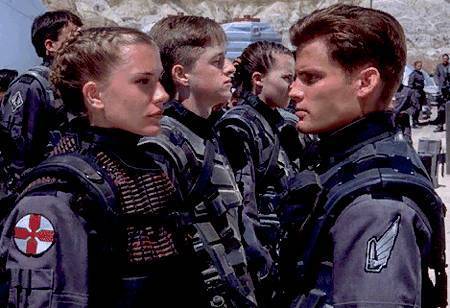
OMG Mariel, you're right! Even the hot lady soldiers!
They use different camera lens on those foreign planets. Apparently they add a few pounds to the chin...
How did the square heads fit into the cock pit?
Mariel, you have created something I would have thought impossible, a Heinlein Koan. I am pondering its significance and already feel the rest of the universe evaporating. Soon I will experience the mystic realization that no one exists but me.
This didn't happen to the actors. They waved their guns in the face.
Manny wrote: "Mariel, you have created something I would have thought impossible, a Heinlein Koan. I am pondering its significance and already feel the rest of the universe evaporating. Soon I will experience th..."
Seems unlikely, because the more you study Zen the further you get from enlightenment...oh, but you may be achieving solipsistic narcissisum instead, so perhaps what you say will happen. ;-)
 You're probably not aware that this book was made into a boardgame by Avalon Hill in the, oh I would guess early '80s. It wasn't a bad game. Good guys against the bugs, with the good guys having tactical thermo-nuclear weapons as their big equalizer. The bugs tunnels were drawn on a map by the bug player before play began. The trooper player had to find them in some manner, then typically go into the tunnels to inflict damage.
I may have some of these details wrong, it's been a long while.
 I love Verhoven as well. He is my favorite. director of all time. Basic Instinct. I prefer his work in Europe more though.
 I've never attempted to parse which books in Heinlein's bibliography were supposed to be satire or not. I've always regarded Heinlein as an author of speculative fiction, and his speculation extending beyond just hypothetical inventions (FTL travel, positron if brains, cybernetic implants) and assuming entire hypothetical worlds of hypothetical political truths. The Moon is a Harsh Mistress, for example, is absurd on its face: Nothing about the libertarian moon society could ever function. But in Heinlein's expert construction, he imagines a world where libertarian ideals are truth, and in the same voice can also imagine a separate world where fascism is the ultimate good.
I agree, he is definitely not a satirist...
In terms of the question of whether 'the libertarian moon society could ever function', it only exists for the space of little over a year and its only functional because it has high sophont class AI managing its affairs. This completely avoids any question of whether a libertarian society can govern its own affairs, and is roughly equivalent to the assertion implicit in Iain M. Banks work that communism is functional for large societies if you have effectively infinite energy resources and manufacturing capacity. For all I know, libertarian societies do work if you have a superhuman AI managing their affairs, and communist societies likewise work if you have fleets of kilometer long starships managing all human affairs. It's hard to draw conclusions in those circumstances, nor am I certain that the irony of having a libertarian society effectively ruled by a benevolent dictator was entirely lost on Heinlein. He's often quite subtle in his absurdities, and his shifting political exploration and varied social structures he postulates suggests to me he was not entirely convinced in his own mind what the 'one true answer' was.
Though I am unsure exactly what you mean by absurd on its face. Do you mean a bunch of criminals come together and form a frontier nation? That never happens.
In any event, in the novel, the libertarian aspects of moon society do not survive even a few days past the destruction of the superhuman AI or the assumption of power of the new Luna government. Whether it was destined to collapse on its own in the long term or not is not really addressed, nor is it addressed whether the freedom is generally a functional social structure rather than merely one that is desirable for certain persons. Heinlein seems to be suggesting more that libertarianism is the law of the frontier, and that a persons of a certain demeanor seek out that frontier freedom.
But if he's postulating it as a single political solution, then what are we to make of the rather different one in Starship Troopers? I think one of the reasons Heinlein 'works' for me is that for the most part with writers we can say, "He has this sort of politics.", and we can expect all their books to be cheerleading rather simplistically for that one sort and denouncing all the rest. Heinlein defies such easy categorization. He has trends, but not necessarily easy answers. The protagonist of 'Stranger in a Strange Land' sets up a communist commune, but that book also ends with a critique that perhaps the 'stranger' was somewhat in error - Mike himself confesses this realization - and better but unexplored long term solutions will need to be found.
The way I read Starship Troopers is the same. Throughout the novel the protagonist wrestles with what he believes about his own society. The book ends with the protagonists conviction and resolution as he put aside all further questions and is settled in his mind, but the way that final page is written to me looks like the author is daring the reader to do the opposite and that is exactly at this moment that Rico stops questioning that he becomes somewhat ridiculous - to simplistic, to jingoist, to chauvinist (in the old sense before it became solely associated with gender). I've always been inclined to think that effect was at least in part conscious, because that sort of ending where Heinlein invites criticism would be typical of the end of the other Heinlein's I've read. It's not satire. It's a sort of open mindedness you rarely see in anyone, much less writers. You don't necessarily need to agree with Heinlein about everything, but Heinlein doesn't seem to agree with Heinlein about everything.
And while I think Heinlein's society in the midst of a perpetual interstellar was is too militaristic, although this criticism seems weird considering the hypothetical situation, I reject the notion that it is easily described as fascist.
 Manny, great and thoughtful review. I didn't like this book as much as you did, but I do think your analysis is spot on. I agree with you about "The Moon is a Harsh Mistress". I think it's a better book than "Starship Troopers". Matt, I agree with your comments about Rico.
Thank you Mona! (I have spent too much of my life thinking about Heinlein's books :( ). I subscribe to the theory that Moon is so good at least in part because he was helped by Marvin Minsky, but I guess it will never be proved...
Manny wrote: "Thank you Mona! (I have spent too much of my life thinking about Heinlein's books :( ). I subscribe to the theory that Moon is so good at least in part because he was helped by Marvin Minsky, but I..."
Oh, I didn't know that, since I hadn't noticed that Marvin Minsky was credited in the book.. Learn something new every day :)
He is not credited, but I have heard this from ex-MIT people who were around at the time and claim to be well informed.
 Great review. When I was in the military, deployed to Iraq, several of my fellow soldiers looked to his ideas with enthusiasm, especially the citizenship tied to military service
Thank you Lyn! And nice to hear that soldiers still love Heinlein. I agree, he is very good at showing you the positive side.
When were you in Iraq?
back to top

message 1:
by
[deleted user]
(new)
Feb 21, 2010 10:35AM
I think the film is much better. Verhoeven is a master of bombastic satire, and this film is only bested by the over-the-top brilliance of Robocop.
reply
|
flag
D_Davis wrote: "I think the film is much better. Verhoeven is a master of bombastic satire, and this film is only bested by the over-the-top brilliance of Robocop."How old were you when you read the book? I have a feeling that I wouldn't have appreciated it as much if I'd come across it as an adult :)
Brilliant.And here and there it reminds me of last night, I went to see The Event (John Clancy), the gist of which is:
"The man stands in a pool of light on the stage. He is an actor. We know this because he tells us so, but also because our past experience tells us that this is what actors do. He appears to be intelligent, but that might just be clever direction. There is a huge gap between what we assume and what we actually know. The more he tells us, the less we think for ourselves. We are truly in the dark.
The first few minutes of John Clancy's intelligent and exhilarating monologue, performed with a conjurer's elan by David Calvitto, appear to be a facetious exercise in meta-theatre. Calvitto stands on stage and deconstructs everything he is doing the entire theatre-going experience. It's funny and cute, but just when you think you've got the joke, the monologue lurches into darker, more invigorating territory, and you start to realise that the show is deadly serious.
Generally speaking, we go to a play, the lights dim and the actors try very hard to make us suspend our disbelief. In the theatre, we all believe in fairies and Tinkerbell never dies. But what if we haven't realised that we are permanently sitting in a darkened theatre, and everything we believe and experience in our lives is an illusion, a cunning fantasy designed to make us forget all the important things and create a kind of collective amnesia?
The Event deliberately and cruelly destroys illusion: it makes us see how the trick is done, and challenges us to rise from our safe seats in the comforting dark and protest.” The Guardian.
It was fabulous.
At one point during the show he muffed his line....and then said he'd done that on purpose. No he hadn't. Yes he had...He said that the script was available for sale and so it was possible to check.
Later on he was speculating as to what his name was, not having introduced himself to us. He got to Ishmael and I accidentally said out loud 'Call me Ishmael'. He looked at me and said 'exactly'.
Afterwards we were wondering. Wouldn't it be brilliant if this was in the script? Well, I see the script really is for sale online, and right now I'm wondering whether to press the button.
Manny wrote: "D_Davis wrote: "I think the film is much better. Verhoeven is a master of bombastic satire, and this film is only bested by the over-the-top brilliance of Robocop."How old were you when you read..."
I read it as an adult its one of my fav sf books. The best Military SF i have read,strong ideas,political issues wise.
Sixth Column i just read in Expanded Universe afterword wasnt his story. JWC gave the story to him for him to write. He had to write down the racial overtones etc
And here I thought that the suit was just a vehical to make the experience of the WWII infantry soldier believable in a high tech setting. How niave I am.
Manny - I was about 13-14 when I first read it. My first experience with it was with a Choose Your Own Adventure-type book based on Starship Troopers. That was when I was about 10 or so.
I really like Verhoeven, and Starship Troopers is my 2nd favorite film of his.
I really like Verhoeven, and Starship Troopers is my 2nd favorite film of his.
Thanks everyone!Not, I hope you did press the button?
Mohammed, interested to hear that the plot of Sixth Column actually came from Campbell. I hadn't heard that before.
D, I'm ashamed to admit it, but I haven't seen Robocop. You're about the hundredth person who's recommended it to me. Must do something about that.
Matt, er, I suppose that your theory has something to it as well. It just seemed that there were more interesting alternatives on offer...
By the way, if anyone here has read Starship Troopers but not Bill, The Galactic Hero, you might want to check it out. One of the best SF parodies ever...
The "deadpan satire" reviewer was me; further reflection led me to the conclusion that it was a completely untenable position and in fact Heinlein was a moral retard.It is inaccurate to say that in the book one had to serve in the miltary to become a citizen; it was possible to become a citizen by doing any job that was regarded as life-threateningly dangerous and for the benefit of society. Heinlein manages a half-step up from the Spartans.
Robert wrote: "It is inaccurate to say that in the book one had to serve in the miltary to become a citizen; it was possible to become a citizen by doing any job that was regarded as life-threateningly dangerous and for the benefit of society."Well... I would say that there was little difference between serving in the military against the completely non-human Bugs and doing some other life-threatening job for the good of society.
On reflection, I must say that I'm puzzled by the Bugs. How have they developed technology? How are they able to form alliances with other species, e.g. the Skinnies that we see in the opening scene? Not the most credible fictional aliens ever...
Moral retard heh i wonder if you would say that about the guy that wrote about the revolution of lunar in The Moon is a Harsh Mistress if that was your first RAH book. You cant judge the writer,the person as the same. He wrote about different ideologies.Manny : You should read Expanded Universe if you like his stories. He has many biographic aferword how he talks about he isnt writer, he wrote stories in early 40s just to pay for mortage,house. Planning to retire. A writer group meeting a certain Anthony Bucher told him writers dont retire they just stop selling....
Fascinating stuff to read about how random he decided to stay on as a writer and become a legend,influential than most Specualitve fiction writers.
Also decent early 40s,50s stories of RAH. He is a much better writer of novels than short stories.
The first and only time I read Starship Troopers was as a teenager and I loved every bit of it. I thought the man was saying brilliant things about an individual's relationship with society, and those suits were fucking awesome. Now, as an adult hippy progressive(with some libertarian sympathies) I'm somewhat amused by my teenage love of a book that put so much stock in the military. I've been tempted over the last few years to re-read this to see what my current thoughts about the book would be, but haven't been able to bring myself to do it as of yet.
I haven't read it, but I will add that my brother, as an eighteen-year-old Marine, hated both the book and the movie, albeit for different reasons. The film (which he saw before reading the book) he said was demeaning to women. He thought the book was a little better but didn't like the suits because he felt the author was saying that individuals and their personal effort and commitment to training could be replaced by gadgetry. He recently had the same complaint about the recent crap film of GIJoe, which replaced the "highly trained special missions force" of the old cartoon with a bunch of egotistical jackasses in power suits.
Greg, sounds like we had pretty much the same take on the book :)Miriam, I'm interested by your brother's comments. The book is indeed a bit undecided on people versus gadgets. The ostensible message is that it's all about the individual - there's a scene near the end of the hero's basic training where he's dropped naked in the mountains and left to fend for himself for ten days - but, as I argue, the suits are really very important. I don't think Heinlein knew himself which message he intended.
Manny, it's funny. Reading your review actually made me want to re-read the book more. Maybe if I can find it on audiobook I might be willing to invest the time. Too many books on the reading list at the moment!
"He thought the book was a little better but didn't like the suits because he felt the author was saying that individuals and their personal effort and commitment to training could be replaced by gadgetry."I think there is alot of navel gazing going on in the interpretation of this book. I'm not sure if the fact that everyone seems to be seeing something different in the book recommends for or against the skill of the writer, or if its just more of a reflection of the self-absorbed nature of the readers.
But my own impression was exactly the opposite of your brothers. There are several extended scenes where Heinlein's protagonist is impressed upon by Heinleinian father figures that the point of the training is not to learn to use a weapon, but to turn the soldier into a weapon. Most famously, this is done when the DI throws a knife into hand of the question who asks why they need to learn to use a knife when they could just push a button.
Likewise, I had the exact opposite impression of the experience of being in the Mobile Infantry provided by the narrator than what Manny draws from it when he suggests that the point of the armor is to insulate the wearer from "needing to touch anything directly, or feel involved in the fates of the humanoid creatures he's killing by the hundred." Heinlein repeatedly constrasts the experience of being in the MI where you are emersed in personal combat (sometimes to the point of melee combat) from the experience of being in the Navy. Of the navy it would be appropriate to say that they don't need to touch anything directly or feel involved in the fates of those that they kill at some vast removed distance, but in the opening scene part of the chaotic combat montage is staring a Skinny who is training a laser weapon on him pretty much in the eye. The opening scene of combat is pretty much shaky cam in your face 'Saving Private Ryan' stuff, and the technology only serves to makes the universal infantry experience plausible to the reader (and most especially to Heinlein) in a post-nuclear age.
Indeed, as someone who initially thought conventional warfare might be obseleted by the presence of nuclear weapons, part of the book is an exploration of citizen soldiery and its moral justification in an age where by contrast someone might push a button and impersonally destroy a whole planet from a vastly removed distance. Indeed, I read the book as an appeal to the moral value of involved warfare where you were 'face to face' with 'The Other' in an age where military speaking it had become unnecessary. The suit of armor contained a moral actor at its core in a way that a bomb does not. This seemed to me to be one of the areas in the book that Heinlein spends a good deal of time considering in his dialogue to the extent that I saw it as the overarching theme of the book. The narrator certainly agonizes over it, in a way that he doesn't agonize over whether or not he actually exists. I didn't read much of anything about solipism, though of course whether you find solipism more interesting than what the book seemed to me to be about is entirely a matter of opinion.
Matt, those are interesting points, and I like the shaky-cam/Private Ryan comparison. The funny thing about Heinlein is that he pursues both threads simultaneously. You have the solipsistic philosopher and the man of action alternating with each other, and it can be hard to know which position he's backing.I think The Moon is a Harsh Mistress, arguably his best book, is also the clearest example. Mike is the force behind the Lunar revolution, and is essentially running the show. He changes history by his courageous actions. But, at the same time, it's just a game for him, and he keeps asking the humans if they have some more time to discuss the nature of humor.
Perhaps it's this tension that makes you feel he's sometimes more than just another hack SF writer... he has moments of near-greatness.
Manny wrote: "Matt, those are interesting points, and I like the shaky-cam/Private Ryan comparison. The funny thing about Heinlein is that he pursues both threads simultaneously. You have the solipsistic philoso..."Thats why i enjoy Heinlein stories and this book. He wrote about the philosophical ideas he is telling in the story and at the same time it was a quality military story about soldiers,their future weapons etc
Its like two books in one you can like which part of the book you want.
Storytelling,ideas wise socially,hard science wise like future weapons i havent seen better in SF. I dont enjoy hard sf almost outside RAH.
I agree about Moon, the characters like Mike made the revolution,the book. Interesting how ST doesnt need lead characters as much. They werent as important to the story.
sooo the basis of your theory is that heinlein was detached because as a sci-fi author he wrote about space suits from time to time most notably in a book with space suit in the title?and you believe that I as a fan didn't like the movie not because none of philosophical discussion which is the reason or the comping of age aspect of the story ever made it the screen and not because they gutted the plot but was in fact because of a lack of space suits?
Jared wrote: "sooo the basis of your theory is that heinlein was detached because as a sci-fi author he wrote about space suits from time to time most notably in a book with space suit in the title?and you believe that I as a fan didn't like the movie not because none of philosophical discussion which is the reason or the comping of age aspect of the story ever made it the screen and not because they gutted the plot but was in fact because of a lack of space suits?"
Hey, can't a guy write a pretentious literary review once in a while without everyone jumping on him? Sheesh...
Lol my apologies. Please carry on my friend
I definitely like your interpretation of the space suit theme. Man do I need to read more Heinlein now.
Wow-the symbolism of your final paragraph involving the exos is pretty powerful.
I think James Cameron is the one who should really get the credit, but thank you anyway!
Is it me or do Heinlein's characters always smile grimly, or there's lots of 'said angrily'?
Love the irony. Listening to this story on the Ipod; maybe a mistake? Still undecided on audiobooks. Unfortunately though all the saids followed by endless adverbs - the ubiquitous 'he smiled grimly' - is interfering with what is in fact a great sci-fi military story. Perhaps I should read it instead.
When you've finished, read John Sladek's parody "Engineer to the Gods, by Hitler I.E. Bonner", in The Steam-Driven Boy. It's spot on.
Will look at the above book. Thanks.`What's your take on audiobooks? Do you think they highlight minor stylistic faults in a way reading doesn't?
I'm afraid I just never use audiobooks... very old-fashioned about loving real paper :)
I'm a book lover like you, as well as being a pusher of wood, so I agree about the feel of a real book in one's hands. I mostly (Heinlein's adverbs having an affect) read books, and only use the Kindle at the gym to avoid the tedium of exercise, but when pottering around the house I've started listening to the Ipod. After a few audiobooks I'm convinced that interpreting the story auditorially highlights lots of style problems in the books - back to reading.
All of the actors in the film had square shaped heads. I would fit in their society and not be gunned down.
Mariel wrote: "All of the actors in the film had square shaped heads. I would fit in their society and not be gunned down." OMG Mariel, you're right! Even the hot lady soldiers!
They use different camera lens on those foreign planets. Apparently they add a few pounds to the chin...
How did the square heads fit into the cock pit?
Mariel, you have created something I would have thought impossible, a Heinlein Koan. I am pondering its significance and already feel the rest of the universe evaporating. Soon I will experience the mystic realization that no one exists but me.
This didn't happen to the actors. They waved their guns in the face.
Manny wrote: "Mariel, you have created something I would have thought impossible, a Heinlein Koan. I am pondering its significance and already feel the rest of the universe evaporating. Soon I will experience th..."Seems unlikely, because the more you study Zen the further you get from enlightenment...oh, but you may be achieving solipsistic narcissisum instead, so perhaps what you say will happen. ;-)
You're probably not aware that this book was made into a boardgame by Avalon Hill in the, oh I would guess early '80s. It wasn't a bad game. Good guys against the bugs, with the good guys having tactical thermo-nuclear weapons as their big equalizer. The bugs tunnels were drawn on a map by the bug player before play began. The trooper player had to find them in some manner, then typically go into the tunnels to inflict damage.I may have some of these details wrong, it's been a long while.
I love Verhoven as well. He is my favorite. director of all time. Basic Instinct. I prefer his work in Europe more though.
I've never attempted to parse which books in Heinlein's bibliography were supposed to be satire or not. I've always regarded Heinlein as an author of speculative fiction, and his speculation extending beyond just hypothetical inventions (FTL travel, positron if brains, cybernetic implants) and assuming entire hypothetical worlds of hypothetical political truths. The Moon is a Harsh Mistress, for example, is absurd on its face: Nothing about the libertarian moon society could ever function. But in Heinlein's expert construction, he imagines a world where libertarian ideals are truth, and in the same voice can also imagine a separate world where fascism is the ultimate good.
I agree, he is definitely not a satirist...
In terms of the question of whether 'the libertarian moon society could ever function', it only exists for the space of little over a year and its only functional because it has high sophont class AI managing its affairs. This completely avoids any question of whether a libertarian society can govern its own affairs, and is roughly equivalent to the assertion implicit in Iain M. Banks work that communism is functional for large societies if you have effectively infinite energy resources and manufacturing capacity. For all I know, libertarian societies do work if you have a superhuman AI managing their affairs, and communist societies likewise work if you have fleets of kilometer long starships managing all human affairs. It's hard to draw conclusions in those circumstances, nor am I certain that the irony of having a libertarian society effectively ruled by a benevolent dictator was entirely lost on Heinlein. He's often quite subtle in his absurdities, and his shifting political exploration and varied social structures he postulates suggests to me he was not entirely convinced in his own mind what the 'one true answer' was.Though I am unsure exactly what you mean by absurd on its face. Do you mean a bunch of criminals come together and form a frontier nation? That never happens.
In any event, in the novel, the libertarian aspects of moon society do not survive even a few days past the destruction of the superhuman AI or the assumption of power of the new Luna government. Whether it was destined to collapse on its own in the long term or not is not really addressed, nor is it addressed whether the freedom is generally a functional social structure rather than merely one that is desirable for certain persons. Heinlein seems to be suggesting more that libertarianism is the law of the frontier, and that a persons of a certain demeanor seek out that frontier freedom.
But if he's postulating it as a single political solution, then what are we to make of the rather different one in Starship Troopers? I think one of the reasons Heinlein 'works' for me is that for the most part with writers we can say, "He has this sort of politics.", and we can expect all their books to be cheerleading rather simplistically for that one sort and denouncing all the rest. Heinlein defies such easy categorization. He has trends, but not necessarily easy answers. The protagonist of 'Stranger in a Strange Land' sets up a communist commune, but that book also ends with a critique that perhaps the 'stranger' was somewhat in error - Mike himself confesses this realization - and better but unexplored long term solutions will need to be found.
The way I read Starship Troopers is the same. Throughout the novel the protagonist wrestles with what he believes about his own society. The book ends with the protagonists conviction and resolution as he put aside all further questions and is settled in his mind, but the way that final page is written to me looks like the author is daring the reader to do the opposite and that is exactly at this moment that Rico stops questioning that he becomes somewhat ridiculous - to simplistic, to jingoist, to chauvinist (in the old sense before it became solely associated with gender). I've always been inclined to think that effect was at least in part conscious, because that sort of ending where Heinlein invites criticism would be typical of the end of the other Heinlein's I've read. It's not satire. It's a sort of open mindedness you rarely see in anyone, much less writers. You don't necessarily need to agree with Heinlein about everything, but Heinlein doesn't seem to agree with Heinlein about everything.
And while I think Heinlein's society in the midst of a perpetual interstellar was is too militaristic, although this criticism seems weird considering the hypothetical situation, I reject the notion that it is easily described as fascist.
Manny, great and thoughtful review. I didn't like this book as much as you did, but I do think your analysis is spot on. I agree with you about "The Moon is a Harsh Mistress". I think it's a better book than "Starship Troopers". Matt, I agree with your comments about Rico.
Thank you Mona! (I have spent too much of my life thinking about Heinlein's books :( ). I subscribe to the theory that Moon is so good at least in part because he was helped by Marvin Minsky, but I guess it will never be proved...
Manny wrote: "Thank you Mona! (I have spent too much of my life thinking about Heinlein's books :( ). I subscribe to the theory that Moon is so good at least in part because he was helped by Marvin Minsky, but I..."Oh, I didn't know that, since I hadn't noticed that Marvin Minsky was credited in the book.. Learn something new every day :)
He is not credited, but I have heard this from ex-MIT people who were around at the time and claim to be well informed.
Great review. When I was in the military, deployed to Iraq, several of my fellow soldiers looked to his ideas with enthusiasm, especially the citizenship tied to military service
Thank you Lyn! And nice to hear that soldiers still love Heinlein. I agree, he is very good at showing you the positive side.When were you in Iraq?