
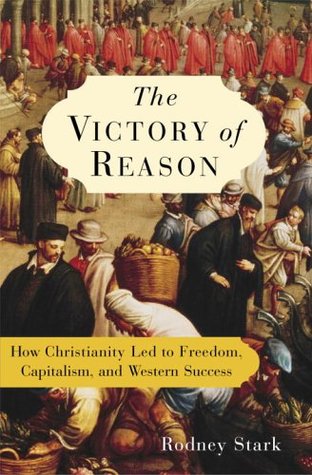
More on this book


Kindle Notes & Highlights

by
Rodney Stark
Read between
October 9 - October 28, 2025

While the other world religions emphasized mystery and intuition, Christianity alone embraced reason and logic as the primary guide to religious truth.
But from early days, the church fathers taught that reason was the supreme gift from God and the means to progressively increase their understanding of scripture and revelation. Consequently, Christianity was oriented to the future, while the other major religions asserted the superiority of the past.
The success of the West, including the rise of science, rested entirely on religious foundations, and the people who brought it about were devout Christians. Unfortunately, even many of those historians willing to grant Christianity a role in shaping Western progress have tended to limit themselves to tracing beneficial religious effects of the Protestant Reformation.
The Christian image of God is that of a rational being who believes in human progress, more fully revealing himself as humans gain the capacity to better understand. Moreover, because God is a rational being and the universe is his personal creation, it necessarily has a rational, lawful, stable structure, awaiting increased human comprehension . This was the key to many intellectual undertakings, among them the rise of science.
The rise of science was not an extension of classical learning. It was the natural outgrowth of Christian doctrine: nature exists because it was created by God. In order to love and honor God, it is necessary to fully appreciate the wonders of his handiwork. Because God is perfect, his handiwork functions in accord with immutable principles . By the full use of our God-given powers of reason and observation, it ought to be possible to discover these principles.
“Christianity did not condemn slavery; it dealt it barely a glancing blow.”81 Rather, slavery is said to have disappeared because it became an unprofitable and outdated mode of production.
At the end of the eighth century, Charlemagne opposed slavery,
The theological conclusion that slavery is sinful has been unique to Christianity
In many respects, the fall of Rome involved the collapse of a city, not of a civilization. During the second century, the population of Rome approached 1 million; by the eighth century, Romans numbered fewer than fifty thousand; and by 1377, when the pope moved his court back from its captivity in Avignon, the city contained only about fifteen thousand inhabitants.
It is, of course, true that, along with the decline of the city of Rome, the empire broke into many pieces. But that was tragic only if one admires profligate rulers, literary Latin, and the pursuits of the idle rich.
the so-called Dark Ages saw an extraordinary outburst of innovation in both technology and culture. Some of this involved original inventions, some of it came from Asia. But what was most remarkable about the Dark Ages was the way in which the full capacities of new technologies were rapidly recognized and widely adopted, as would be expected of a culture dominated by faith in progress—recall Augustine’s celebrations of “exuberant invention.” Nor was innovation limited to technology; there was remarkable progress in areas of high culture—such as literature, art, and music—as well. Moreover,
...more
The three-field system first appeared in the eighth century and was adopted so widely and rapidly that during the nineteenth century many historians erroneously assumed it dated from Roman times. But the Romans knew only a two-field system of agriculture, because they did not know that legumes helped to restore the land, and thus land needed to lie fallow less often. Thus, half of their land lay fallow each year, compared with one-third under the medieval three-field system.27 Not only did most Europeans eat far better during the Dark Ages than in Roman times but they were healthier, more
...more
Using the fallow plot for grazing also had dramatic effects on medieval and then on early capitalist economies. “Manure was highly prized, for it was a rare and precious product, none of which must be wasted. The most blessed of all the animals was the sheep.”28 Sheep provided milk, butter, cheese, and meat. Their skins provided the parchment on which scribes copied out books. But most of all, sheep provided wool. Since wool cloth was in very high demand during the Middle Ages, wool fleeces were the major industrial raw material. Woolen cloth industries dominated the early days of capitalism,
...more
Roman buildings were essentially unheated. There were no fireplaces, stoves, or furnaces because no one had figured out an efficient way to ventilate the smoke. In their shacks and hovels, Roman peasants clustered around an open fire while the smoke rose through a large hole left in the roof, which also let in rain, snow, wind, and cold.30 Urban Romans even lacked holes in their roofs; as they cooked over wood or charcoal braziers, the smoke was simply allowed to concentrate indoors. Asphyxiation was avoided because the buildings were extremely drafty, since they lacked windowpanes and were
...more
They invented the chimney and the fireplace, whereupon even roaring blazes did not smoke up the room. Nor was it any longer necessary to have drafty homes. With the smoke rising harmlessly up their chimneys, folks in the Dark Ages ate better-prepared food, breathed far better air, and were a lot warmer in winter.
The path to modern times did not suddenly open during the Renaissance any more than it sprang from the forehead of Zeus. Western civilization arose progressively over many centuries subsequent to the fall of Rome: the so-called Dark Ages were a period of profound enlightenment in both the material and the intellectual spheres, which when combined with Christian doctrines of moral equality, created
a whole new world based on political, economic, and personal freedom.
It all began with the New Testament.
Jesus asserted a revolutionary conception of moral equality, not only in words but in deeds. Over and over again he ignored major status boundaries and associated with stigmatized people, including Samaritans, publicans, immoral women, beggars, and various other outcasts, thereby giving divine sanction to spiritual inclusive-ness.
Rome was essentially a waterfront empire encircling the Mediterranean. True, Caesar did cross the channel and colonize Britain. But even there, Hadrian had to build a wall to isolate the fierce tribes of the north. Much the same happened on the Continent. Romans seldom crossed the Rhine, nor did they venture often or far across the Danube.
In 810, when the Franks replaced the Lombards as the rulers over much of Italy, they too attempted to conquer the coastal area including Venice. But the marshes and lagoons were too much for them, and in addition, the Byzantine emperor sent a fleet to the support of his province. By now, Venice had become immensely important to Byzantium as its main outlet in the West, made ever more significant as Islam developed a trading network throughout the region, including Spain, Sicily, and the toe of Italy, along with North Africa.
Since the days of Charlemagne, Venice had been recognized as a dukedom and was administered by a duke, known as the doge. But Venice was unlike most other dukedoms
Venice was not the first Italian city-state to develop a commune; that honor may belong to Pisa.46 But by the middle of the twelfth century, Venice’s commune was in full operation, with five layers of government.
Venice and the other leading medieval Italian city-states were by modern standards medium-sized towns—in the year 1000, Venice had a population of about thirty thousand, and the other three of the big four were considerably smaller.
Everyone knew everyone else, current public opinion was quite transparent, and consensus often was easily achieved. This, combined with relatively open political institutions, allowed Venice to sustain a substantial degree of freedom and responsive governance. The secret to it all was a rapidly expanding economy that not only resulted in a few great fortunes but created large numbers of families having considerable means, and brought previously
By the fifteenth century, the true rulers of Florence were members of the Medici family, although they carefully kept a very low political profile and observed all of the democratic formalities.
As rulers of Florence, they were very protective of private property and of commercial and
by the sixteenth century the Medici had become tyrants who presided over the economic decline of Florence.
Milan is situated midway in the large plain that crosses northern Italy and nestles against the mountains. Far from the sea, since Roman times Milan had been a key communication center because the primary passes through the Alps converged here. This location was the major reason that Milan became the Roman empire’s second city. But the city’s rise to medieval greatness was not a given. The Roman city of Milan was devastated in 452 by Attila the Hun and razed by the Goths nearly a century later.
In the year 1000, Amalfi may have been the largest city in Italy, with an estimated population of thirty-five thousand.68 Located on the shores of the Mediterranean, well south of Rome, it was by then a major center of overseas trade. From its founding, probably in the middle of the eighth century, the city combined seafaring and commerce in a triangular pattern involving Muslim North Africa and Byzantium.
First came the assembly of local cargoes: grain, wine, fruits, and timber.69 These were traded for various products and gold in Tunisian ports and for spices and gold in Egypt. Then on to Byzantium, where the gold was used to obtain various Eastern luxury products and especially religious goods such as vestments, altar cloths, and incense.70 Returning to Amalfi, traders sold these goods in order to buy more local products and to launch new voyages.
The medieval bank evolved from money changing—the word “bank” itself initially referred to a money changer’s table. For centuries, the great variety of coins in circulation and the variations in the extent to which any given coin had been trimmed or debased required specialized knowledge when it came to equating funds for the settlement of debts.
Money changers served as middlemen who determined the relative worth of coins: “Do these twenty shillings equal one gold florin, or does a fair exchange require twenty-three of these shillings?” Money changers charged a fee for their services, and this long caused them to be condemned as usurers, but their services could not be done away with. In time the money changers began to maintain accounts of deposit for their clients and to lend as well as change money, thereby becoming banks of deposit.
local bankers began to credit and debit from the accounts of one another’s depositors—as with modern checking accounts. In this way, even huge amounts of money could be transferred without involving coins. When such a transfer was made over a considerable distance, it involved a bill of exchange—a notarized document authorizing payment to a specific individual or firm. To settle payment for wool cloth shipped from Bruges to Genoa, for example, a bill of exchange was sent to a bank in Bruges from a bank in Genoa, whereupon the Bruges bank credited the account of the woolen firm and entered this
...more
Even the most distant branches were staffed entirely by people hired and trained in Italy, and all business was conducted in Italian. Consequently, as far as is known, until well into the fifteenth century, even all of the very small banks in western Europe were Italian banks, and certainly there were no non-Italian international banks. It is known that in this era all the banks in England and Ireland were branches of Italian banks, as were all of those in Flanders, and only Italian banks are known to have existed in medieval France and Spain.
In 1347, galleys returning from the Near East brought bubonic plague to the major Italian port cities. When Genoa was alerted to the peril, the first infected galleys to arrive “were driven from the port by burning arrows and divers engines of war.”54 But it was too late. Within a year the Black Death had spread along the trade routes all across Europe. 55 By the time it ended in 1350, a third of the population—about 30 million people—had died. This was a terrible human tragedy, but ironically, its economic and political impact was largely positive, and the survivors and their children lived
...more
the English Parliament passed a Statute of Laborers in 1349 that fixed wages at the levels of 1346.
for many centuries, capitalism remained the West’s most valuable secret.
IT WAS WOOLEN CLOTH THAT FIRST BROUGHT CAPITALISM TO NORTHERN Europe. Even in Roman times, the towns of Flanders were famous for making the finest woolens in the world, and by the tenth century their woolens probably produced more income than any other product manufactured in Europe. Cloth from Flanders was the chief item at the great trade fairs held in the Champagne region beginning in the eleventh century, where the primary buyers were Italian merchants seeking goods
to resell all around the Mediterranean.
The rapid spread of capitalism in England initiated many centuries of remarkable industrial growth that laid the economic and military basis for what became a global empire. Of course, none of this could have occurred had these areas not already enjoyed a considerable degree of freedom.
Medieval Flanders (the name means “flooded land”) was a powerful principality in the southwestern section of the Low Countries, roughly equivalent to modern Belgium and part of southern Holland
The Portuguese discovery of a sea route around Africa to the East Indies in 1493 made Antwerp even more important as a trade center because the King of Portugal shipped nearly everything (mostly spices, particularly pepper) arriving back in Lisbon from Asia on to Antwerp, in part because syndicates organized there were prepared to buy entire cargoes, often while the ships were still in transit.
Once Venice had been the chief outlet, but by the start of the sixteenth century the shipments went mainly to Antwerp, and from there to the rest of the world.19
By late in the sixteenth century Amsterdam was replacing Antwerp as Europe’s primary port and financial center. It did so largely by default, as Antwerp’s economy was wrecked by war and Spanish occupiers, who destroyed its democratic practices and ate up its financial and commercial institutions. It is remarkable that Amsterdam was able to function as a port, because entry to its shallow harbor required passage over a large mud bank. Through the fifteenth century this was accomplished by keeping the ships serving Amsterdam small and relatively flatbottomed.
It is true that when Amsterdam took Antwerp’s place as the leading port and financial center of western Europe, it was a Protestant city.
Many writers have linked Dutch Calvinism and capitalism as a leading example of the Protestant ethic.
In fact, the Calvinist preachers could not even get businesses or the pubs to shut down for the Sabbath.
Lutherans, Mennonites, and Catholics could not hold services in some parts of the Dutch Republic and Catholic priests were barred in some places.
Still, there were many Catholics in most areas of the country, and in Amsterdam, “a substantial body of prominent citizens”38 remained Catholic. To a considerable extent, “the expansion of Dutch
