
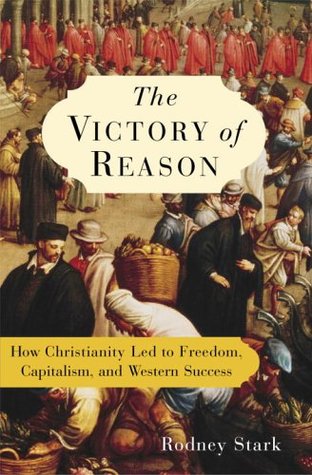
More on this book


Kindle Notes & Highlights

by
Rodney Stark
Read between
October 9 - October 28, 2025

trade and the development of the commercial spirit were carried on in spite of the Calvinist Church rather than because of it. . . . Dutch Calvinism was opposed to the working of the capitalist spirit, and . . . Calv...
This highlight has been truncated due to consecutive passage length restrictions.
From the start, Amsterdam’s commercial prominence was challenged, as was its independence. For several generations, the Dutch Republic had to fight off repeated attempts by the Spanish to make it a part of the Spanish ...
This highlight has been truncated due to consecutive passage length restrictions.
capitalism shaped Holland’s commercial landscape as completely as windmills and dikes shaped its geography.
Soon after the conversion of the Roman Emperor Constantine in 312, there came to be essentially two Catholic churches. Prior to Constantine, the church was led by a dedicated, poorly paid, and rather ascetic clergy, who sometimes knowingly risked martyrdom. This group, and its heirs, constituted the church of piety.
Between 1659 and 1661, four Quakers who had previously been whipped and driven out of Massachusetts were hanged for having returned. Other colonies were not so intolerant, but most of them also established state churches—the Church of England in New York, Virginia, Maryland, North and South Carolina, and Georgia, and the Congregationalists
A second reason for not coming was that the voyage was extremely dangerous. Not only did many die aboard ship from various diseases or from running out of water but large numbers of ships were lost. The Atlantic was wide and stormy, and the Spanish had inferior ships, poor maintenance, and relatively unskilled sailors—recall the fates of both Armadas.
in 1770 American colonies exported more flour to England than they did unmilled grain, large amounts of soap and candles, far more barrel staves, masts, and finished boards than logs, an immense amount of rum (rather than undistilled molasses), and even 3,149 pairs of shoes.42 Another source of economic stimulation to North America was that, although the British used their naval superiority to prevent ships flying other flags (especially the Dutch) from carrying cargoes to their colonies, they permitted colonial vessels to operate freely. Since ships could be built far more cheaply in New
...more
In 1772, exports from the American colonies to England were valued at 1.3 million pounds sterling, while imports from England totaled 3 million.45 However, the bill for maintaining colonies far exceeds the price the colonial power pays for its imports.
In 1620, when the Mayflower set sail, Britain was the world’s foremost economic power,
In 1776 there was very little manufacturing in North America. There were many small workshops making needed items such as shoes, harnesses, kettles, nails, pails, and simple hand tools, but their products were sold only in the local market. Larger-scale production tended to be limited to refining food and drink for export (for example, milling flower and distilling rum). A bit more sophisticated were plants making candles and soap or preparing furs and hides for export.
Consider too that in America there were no mandatory church tithes, and taxes were very low.
In addition to being highly paid and equipped with the latest technology, American workers were notable in another way. They were far better educated than workers anywhere else in the world (excluding Canada).
A major point of contention during the Reformation had to do with reading the Bible.
For centuries the church had thought the best way to avoid endless bickering and disagreement about God’s word was to encourage only well-trained theologians to actually read the Bible.
What the public knew about the Bible was only what their priests told them. Then came the printing press. The Bible was the first book Gutenberg published. It was written in Latin, but very soon Bibles were being printed in all of the major “vulgar” languages (hence “vulgate” Bibles), making the Bible the first-ever best seller.
So, when the Pilgrims arrived in 1620, one of the very first things they did was to concern themselves with educating their children. In 1647 the Massachusetts Colony enacted a law asserting that all children must attend school.58 It required that in any township having fifty households, one person must be appointed to teach the children to read and write, and the teacher’s wages were to be paid either by parents or by the inhabitants in general.
Furthermore, in any township having a hundred or more households, a school must be established,
Christianity created Western Civilization. Had the followers of Jesus remained an obscure Jewish sect, most of you would not have learned to read and the rest of you would be reading from hand-copied scrolls.
There are many reasons people embrace Christianity, including its capacity to sustain a deeply emotional and existentially satisfying faith. But another significant factor is its appeal to reason and the fact that it is so inseparably linked to the rise of Western Civilization.
