
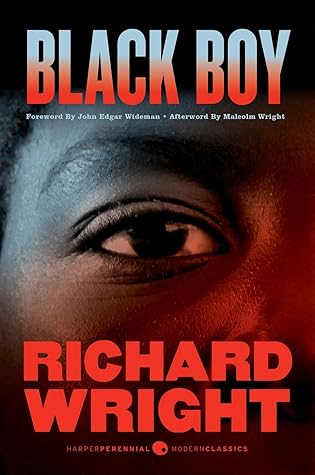
More on this book
Community


Kindle Notes & Highlights


Why could I not eat when I was hungry? Why did I always have to wait until others were through? I could not understand why some people had enough food and others did not.
A paternal right was the only right, to my understanding, that a man had to beat a child.
shaking hands I was doing something that I was to do countless times in the years to come: acting in conformity with what others expected of me even though, by the very nature and form of my life, I did not and could not share their spirit.
I used to mull over the strange absence of real kindness in Negroes, how unstable was our tenderness, how lacking in genuine passion we were, how void of great hope, how timid our joy, how bare our traditions, how hollow our memories, how lacking we were in those intangible sentiments that bind man to man, and how shallow was even our despair.
(Whenever I thought of the essential bleakness of black life in America, I knew that Negroes had never been allowed to catch the full spirit of Western civilization, that they lived somehow in it but not of it.
To hold an attitude of antagonism or distrust toward Jews was bred in us from childhood; it was not merely racial prejudice, it was a part of our cultural heritage.
I had never in my life been abused by whites, but I had already become as conditioned to their existence as though I had been the victim of a thousand lynchings.
My mother’s suffering grew into a symbol in my mind, gathering to itself all the poverty, the ignorance, the helplessness; the painful, baffling, hunger-ridden days and hours; the restless moving, the futile seeking, the uncertainty, the fear, the dread; the meaningless pain and the endless suffering.
Wherever I found religion in my life I found strife, the attempt of one individual or group to rule another in the name of God. The naked will to power seemed always to walk in the wake of a hymn.
This business of saving souls had no ethics; every human relationship was shamelessly exploited.
I was building up in me a dream which the entire educational system of the South had been rigged to stifle. I was feeling the very thing that the state of Mississippi had spent millions of dollars to make sure that I would never feel; I was becoming aware of the thing that the Jim Crow laws had been drafted and passed to keep out of my consciousness; I was acting on impulses that southern senators in the nation’s capital had striven to keep out of Negro life; I was beginning to dream the dreams that the state had said were wrong, that the schools had said were taboo.
The southern whites would rather have had Negroes who stole, work for them than Negroes who knew, however dimly, the worth of their own humanity. Hence, whites placed a premium upon black deceit; they encouraged irresponsibility; and their rewards were bestowed upon us blacks in the degree that we could make them feel safe and superior.
Each of us depended upon the whites for the bread we ate, and we actually trusted the whites more than we did each other. Yet there existed in us a longing to trust men of our own color. Again Harrison and I parted, vowing not to be influenced by what our white boss men said to us.
I had seen many Negroes solve the problem of being black by transferring their hatred of themselves to others with a black skin and fighting them.
Well-to-do Negroes lived in a world that was almost as alien to me as the world inhabited by whites.
It was in the psychological distance that separated the races that the deepest meaning of the problem of the Negro lay for me. For these poor, ignorant white girls to have understood my life would have meant nothing short of a vast revolution in theirs. And I was convinced that what they needed to make them complete and grown-up in their living was the inclusion in their personalities of a knowledge of lives such as I lived and suffered containedly.
My reading in sociology had enabled me to discern many strange types of Negro characters, to identify many modes of Negro behavior; and what moved me above all was the frequency of mental illness, that tragic toll that the urban environment exacted of the black peasant.
Had they understood what was happening, they would never have allowed millions of perplexed and defeated people to sit together for long hours and talk, for out of their talk was rising a new realization of life.
(If I were a member of the class that rules, I would post men in all the neighborhoods of the nation, not to spy upon or club rebellious workers, not to break strikes or disrupt unions; but to ferret out those who no longer respond to the system in which they live. I would make it known that the real danger does not stem from those who seek to grab their share of wealth through force, or from those who try to defend their property through violence, for both of these groups, by their affirmative acts, support the values of the system in which they live.
The millions that I would fear are those who do not dream of the prizes that the nation holds forth, for it is in them, though they may not know it, that a revolution has taken place and is biding its time to translate itself into a new and strange way of life.
who are buoyed by social aggressiveness. My knowledge of how Negroes react to their plight makes me declare that no man can possibly be individually guilty of treason, that an insurgent act is but a man’s desperate answer to those who twist his environment so that he cannot fully share the spirit of his native land. Treason is a crime of the state.)
The only people he could move to believe in him were those who shared his own world of fear, and all the world that lay beyond his terribly restricted vision was enemy ground.
What quality of will must a Negro possess to live and die with dignity in a country that denied his humanity?
“You claim to be fighting oppression, but you spend more of your time fighting each other than in fighting your avowed enemies.”
