
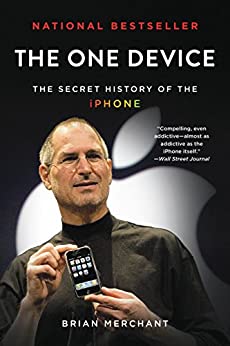
More on this book
Community


Kindle Notes & Highlights

Read between
December 28 - December 31, 2019

Radical, civilization-scale transformations aren’t usually rapid and seamless. They tend to be one or the other.
But smartphones took over the world quietly and completely in a matter of years, and we barely noticed.
the U.S. population, in which smartphone ownership rose from about 10 percent in 2007 to 80 percent in 2016.
The iPhone might actually be the pinnacle product of all of capitalism to this point.
The top car brand, the Toyota Corolla: 43 million units. The bestselling game console, the Sony PlayStation: 382 million. The number-one book series, Harry Potter: 450 million books.
The iPhone: 1 billion. That’s nine zeros.
“It is, quite simply, the bestselling product of all time.”
“It’s almost vanishingly rare that we pick a new device that we always have with us,”
“Clothes—a Paleolithic thing? Glasses?
And a phone. The list is tiny. In order to make that list, it has to be desira...
This highlight has been truncated due to consecutive passage length restrictions.
now accounts for two-thirds of the company’s revenue.
Profit margins on the iPhone have been reported to be as high as 70 percent,
The iPhone isn’t just a tool; it’s the foundational instrument of modern life.
Steve Jobs did not invent the smartphone, though his team did make it universally desirable. Yet the lone-inventor concept lives on. It’s a deeply appealing way to consider the act of innovation. It’s simple, compelling, and seems morally right—the hardworking person with brilliant ideas who refused to give up earned his fortune with toil and personal sacrifice.
It’s also a counterproductive and misleading fiction.
most technologies are invented simultaneously or nearly simultaneously by two or more teams working entirely independently.
Innumerable inventive minds are, at any given time, examining the cutting-edge technologies and seeking to advance them.
The iPhone is a deeply, almost incomprehensibly, collective achievement.
the iPhone is what’s often called a
convergence tec...
This highlight has been truncated due to consecutive passage length restrictions.
Ideas require raw materials and hard labor to become inventions.
Each of those laborers and miners are an essential part of the iPhone’s story—it wouldn’t be in anyone’s pocket today without them.
man-computer symbiosis
A coexistence with an omnipresent digital reference tool and entertainment source, an augmenter of our thoughts and enabler of our impulses.
They were, essentially, trying to invent new ways of interfacing with machines.
the kernel of this clandestine collaboration would become the iPhone.
The story of the iPhone starts, in other words, not with Steve Jobs or a grand plan to revolutionize phones, but
with a misfit crew of software designers and hardware hackers tinkering with the next evolutionary step in human-computer symbiosis.
“User-interface design is still unknown to most people, even now,”
at Apple, “people didn’t feel empowered to have ideas and to follow through.… Everything was micromanaged by Steve,”
“It really kind of started by listing things like, ‘I wish this would work better,’”
interested in directly interacting with the screen—streamlining receptive acts like closing windows.
That sort of direct manipulation could make navigating computers more efficient, expressive, more fun.
Fortunately, there was a consumer technology out there that already allowed users t...
This highlight has been truncated due to consecutive passage length restrictions.
“We kind of started playing around with multitouch and that was the thing that resonated with a lot of people,”
Resistive touch is often inexact, glitchy, and frustrating to use. Anyone who’s ever spent fifteen minutes mashing their fingers onto a flight-terminal touchscreen only to get flickering buttons or random selections is keenly aware of the pitfalls of resistive touch.
Instead of relying on force to register a touch, capacitive sensing puts the body’s electrochemistry to work.
Because we’re all electrical conductors, when we touch a capacitive surface, it creates a distortion of the screen’s electrostatic field, which can be measured as a change ...
This highlight has been truncated due to consecutive passage length restrictions.
The ENRI team’s experiment had suddenly become an exciting prospect, but if Steve Jobs found out about it too early and disagreed, the whole enterprise stood to get shut down.
They homed in on fixing the ENRI group’s shit list: Pinch to zoom replaced a magnifying glass icon, a simple flick of the screen simplified click-and-drag scrolling.
Throughout, their creative partnership made for a powerful symbiosis.
Ording and Chaudhri say it was already clear that what they were working on had the potential to be revolutionary.
“Right away, there was something cool about it,”
I feel that ideas are very fragile, so you have to be tender when they are in development.
“It’s just one of those things where instantly anyone who saw it was like, ‘This is the coolest thing I’ve ever seen,’”
The question was—would Steve Jobs think so too? After all, Jobs was the ultimate authority—he could kill the project with a word if he didn’t see the potential.
The rig worked. The demos were compelling.
“The iPhone is a confluence technology. It’s not about innovation in any field,”
Motorola wanted nothing to do with the first smartphone. Soon it became clear that IBM wasn’t so sure either.
‘You know, all this is going to be in one device. It’s not going to be all this separate stuff.’”
