
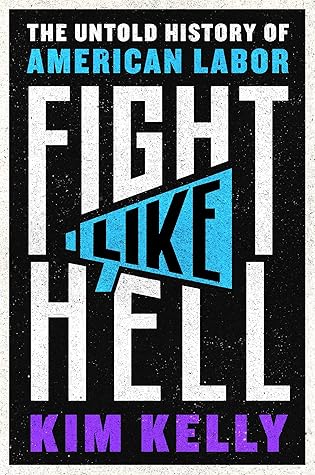
More on this book
Community


Kindle Notes & Highlights

by
Kim Kelly
Read between
December 29, 2023 - March 23, 2024

In 1869, the Colored National Labor Union was formed to represent the unique interests of Black workers who had been shut out of the larger National Labor Union. Its first president, Isaac Myers, was cofounder of the Colored Caulkers Trade Union Society, and its second leader was the indomitable Frederick Douglass, elected in 1872.
The worker must have bread, but she must have roses, too. —ROSE SCHNEIDERMAN, LABOR ACTIVIST AND AMERICAN CIVIL LIBERTIES UNION COFOUNDER
But there was also a deep political undercurrent running through the tenements, beer halls, and cafes of the Lower East Side, long known as a hotbed of radicalism. Eastern European Jewish socialists, German communists, and Italian anarchists broke bread with American trade unionists and Irish republicans, sharing ideologies and building solidarity across language and ethnic lines. Here, amid the squalor and the shared struggles, the working classes began to dream of something better than the short, cruel lives to which they’d been consigned.
I have always tears in my eyes when I think, “It should never have happened.” The executives with a couple of steps could have opened the door. But they thought they were better than the working people. It’s not fair because material, money, is more important here than everything. That’s the biggest mistake—that a person doesn’t count much when he hasn’t got money. What good is a rich man and he hasn’t got a heart? Rose died one year after the documentary aired. She was 107.
The woman behind the New Deal was a queer feminist, a self-proclaimed “revolutionist” who fought for what was right even when it was unpopular, and refused to back down even after her bitter male colleagues in Congress tried to impeach her in 1939 over her support for radical union leader Harry Bridges. “I
To borrow a phrase from Mark Twain, history does not repeat itself, but it does rhyme.
“Bread and Roses Strike.”
A group of enraged Italian women happened upon a lone police officer on an icy bridge. After stripping him of his gun, club and badge, they sliced the officer’s suspenders and took off his pants—a humiliation technique popular with the disorderly women of Lawrence—and dangled the officer over the freezing river.
Rabinowitz continued working as a union organizer and remained a proud Wobbly until her death in 1963. In 2017, she was inducted into Labor’s International Hall of Fame as a “feminist, fighter, writer, and organizer.”
Fort McPherson,
It was nothing less than extraordinary to see Lucy confidently preach fire, brimstone, and anarchy to halls full of rowdy white male factory workers.
“A very large number of the police were wounded by each other’s revolvers.”
Hubert Harrison. Harrison, a West Indian immigrant, was known for his writing on socialism and Black liberation as well as his involvement in the 1913 Paterson Silk Strike, and was dubbed “the father of Harlem radicalism” by labor and civil rights leader A. Philip Randolph.
Black Marxism: The Making of the Black Radical Tradition.
Industrial unionism] is the abolition movement of the 20th century,” he wrote in a letter to the Baltimore Afro-American in 1920. “And if sufficient number of workers rally to its standard, complete industrial emancipation will be the heritage of all us workers and we will become disenthralled from the thralldom of the rich.”
class reductionist
The nation’s entry into World War I had been accompanied by the passage of a portentous series of bills: the 1917 and 1919 Espionage Acts and the 1918 Sedition Act. Together they essentially made it illegal to publicly criticize the government, the military, the draft, or the flag itself, and law enforcement took the opportunity to ramp up its long-running war on anti-capitalist, pro-worker organizing.
A pro-war parade saw Equi join uninvited, incendiary banner in tow: “Prepare to die, workingmen, JP Morgan & Co. want preparedness for profit.”
Tennessee’s Coal Creek War catapulted the issue of convict leasing onto the national stage. In April the Tennessee Coal Mining Company had rejected a suite of demands from its employees, and instead shut down its mine outside Briceville, Tennessee, in retaliation. Later that summer the company tore down miners’ homes to build a stockade to house a new staff of involuntary, incarcerated laborers, and reopened.
The conflict came to a dreadful head on April 20, when company goons and the Colorado National Guard violently attacked a striking miners’ camp, slaughtering twenty-one in the process. Most of the victims were women and children. The Ludlow Massacre
In 1917, during another Latino-led strike in Bisbee, Arizona, the company oversaw the largest forced migration by a private corporation in American history. At the behest of Phelps Dodge company president Walter Douglas, twelve hundred union members were rounded up at gunpoint, herded into cattle cars still loaded with manure, then left stranded in the New Mexico desert 173 miles away. Few ever made it back to Bisbee. “It was like the army had prisoners,” Katie Pintek, a witness to the event, recalled later. “If they saw someone standing about to run, they were going to shoot. Two did get
...more
Bisbee Deportation,
“Keep a variety of laborers, that is different nationalities, and thus prevent any concerted action in case of strikes, for there are few, if any, cases of [Japanese], Chinese, and Portuguese entering into a strike as a unit,” George H. Fairfield of the Makee Sugar Company recommended to his fellow planters.
the AFL refused to recognize their charter unless they expelled their Japanese members, and the union, horrified, refused. The response from JMLA’s secretary, J. M. Lizarras, spoke volumes about the power of multiracial organizing, and of what true solidarity looks like: “Better to go to hell with your family than to heaven by yourself.”
In 1944 sugar’s “Big Five” companies—Alexander & Baldwin, American Factors, Castle & Cooke, C. Brewer, and Theo. Davies—embarked upon a two-year plan to cut the heart out of Hawai’i’s domestic workforce, hoping to demoralize its Japanese employees by recruiting six thousand new laborers from the Philippines. In the midst of World War II, Japan had been an occupying force in the Philippines, and planters assumed the divide would translate to their workers. Having caught wind of the plan, the sugar workers’ union, the International Longshoremen’s and Warehousemen’s Union (ILWU), infiltrated the
...more
Seventy-plus years later, Hawai’i remains heavily unionized, boasting the highest rate of union membership in the nation at nearly 24 percent.
2018 documentary Adios Amor: The Search for Maria Moreno
would strike over their bosses’ refusal to pay them the new state-mandated 31-cent-per-hour minimum wage. Once again, the WTUL arrived on the scene ready to offer support and resources, and Eleanor Roosevelt, a member of the league, offered the workers the use of her Secret Service agents to protect them from police (and had them arrest at least one laundry boss for hurling insults).
And America’s obsolete labor laws, the most impactful of which were passed back in the 1930s, remain ignorant to the diversity of people, circumstances, and industries this country has developed over the past century. Still, as of 2020, 65 percent of Americans said they approve of labor unions, and 48 percent of workers who were polled in 2017 said they would join a union if allowed; but far too many don’t even have the option. So-called right-to-work states like Georgia, Texas, and Alabama (and their Republican legislatures) hamstring organizing at every turn, and even workers in states with
...more
Sharecroppers and their families were bound to the soil. They signed agreements with landowners to rent acreage, supplies, and tools to grow crops like cotton, rice, and tobacco. In exchange, sharecroppers would theoretically receive a share of the profits. But in reality, white landowners devised means to force their sharecropping partners into vicious cycles of debt.
By 1918, Black farmers returning from military service overseas in World War I had hit upon a plan to close this terrible addendum to the era of chattel slavery. That year, Robert L. Hill founded the Progressive Farmers and Household Union of America (PFHUA) with the stated aim to “advance the interests of the Negro, morally and intellectually, and to make him be a better citizen and a better farmer.”
By 1919, the union felt strong enough to take action on behalf of a group of Black cotton farmers in Elaine who wished to sue their employers for their fair share of that year’s bumper crop. White lawyer Ulysses S. Bratton, known to be sympathetic to the Black workers’ plight and credited with years of work suing Delta landowners for violations of the Peonage Act, took the case. On September 30, 1919, Bratton sent his son, Ocier, an accountant and World War I veteran, down to the Ratio lodge to meet with union organizers and collect his lawyer’s fee. Less than an hour into the younger
...more
Officials scrambled to deflect focus away from the carnage in the Elaine streets, drawing attention to their efforts to punish those responsible for the deaths of five white people also killed in the melee. They circulated an unfounded conspiracy that the PFHUA had recruited Elaine’s Black workers into a plot to massacre Elaine’s white residents, foisting responsibility for the violence on the Black residents who’d been its primary victims.
“It was a Declaration of Economic Independence, and the first united blow for economic liberty struck by the Negroes of the South!” Wells later wrote of the landowners’ reaction to Black sharecroppers’ efforts to unionize and bargain for higher prices. “That was their crime and it had to be avenged.” Her masterful report on her findings in Elaine, The Arkansas Race Riot,
Ida B. Wells acted as a documentarian of those atrocities, risking her own life many times over to force Americans to recognize the scourge of lynching. “If the Southern people in defense of their lawlessness, would tell the truth and admit that colored men and women are lynched for almost any offense, from murder to a misdemeanor, there would not now be the necessity for this defense,” she wrote in her book The Red Record: Tabulated Statistics and Alleged Causes of Lynching in the United States. “But when they intentionally, maliciously and constantly belie the record and bolster up these
...more
By the early 1900s, the Pullman Company was the largest employer of Black workers in the United States.
The company’s hiring policy hinged on stereotypes around the supposed “docility” of Southern men when compared with their Northern and Western counterparts and, in its early days, extended this theory to include formerly enslaved workers out of the assumption that they would be instinctively more deferential and accustomed to menial labor. The company also specifically placed a premium on dark-skinned men as a means of enforcing the color line between servant and served. No porter would ever be mistaken for a passenger on Pullman’s watch or, worse, become too friendly with a passenger’s wife.
Their labor was essential to upholding Pullman’s reputation for luxury, yet they still depended on tips to pad out their meager salaries and were forbidden to eat alongside passengers or even sleep during their long overnight shifts (George Pullman is often credited with hastening the widespread adoption of tipping as a customary practice in America—thanks for that one, George).
Malcolm X spent time on the railroads as a youth selling sandwiches and washing dishes, but lasted only about a day with Pullman. He undoubtedly found Pullman’s well-padded rule book and demand for obsequious service intolerable. But while he was there, the revolutionary observed, “We were in that world of Negroes who were both servants and psychologists, aware that white people are so obsessed with their own importance that they will pay liberally, even dearly, for the impression of being catered to and entertained.”
A’lelia Walker, Harlem socialite and heir to Madam C. J. Walker’s hair salon empire;
By the time he was fourteen, Rustin knew he was gay, and when he told his grandmother about his realization, she accepted the news without judgment. As a result, he never felt shame or guilt around his sexuality, even when his identity was used against him by his detractors, or after he was arrested and imprisoned in 1953 for engaging in consensual sexual activity with other men.
“It’s anti-union to red-bait, race-bait, or queen-bait,”
Ironically, PATCO was one of the few unions that had endorsed Reagan in the lead-up to his 1980 presidential campaign, and Reagan had sent the union a letter promising to look out for their interests. Instead, with Reagan’s backing, the strike was broken in a matter of days. So was PATCO itself; the union was decertified the following October and ceased to exist.
Worse, a terrible precedent had now been set, and the aftereffects of Reagan’s war on PATCO would ripple throughout the labor movement for decades. Politically, Reagan’s hard line against labor became a plank in the Republican platform and a loyalty test for the new generation of conservatives he helped spawn. Opposing unions—public sector and otherwise—has since become utterly entrenched in the Republican Party’s policies and public image, even as it continues to attempt to paint itself as representing “hardworking blue-collar men and women,” as Texas senator Ted Cruz (himself a millionaire
...more
The number of large-scale strikes plummeted, declining by nearly 90 percent between 1977 and 2016;
PATCO Syndrome
For decades, their militant, progressive membership was predominantly made up of women and gay men, and they elected feminist activist Patt Gibbs, an out lesbian, to the presidency of the Association of Professional Flight Attendants in 1977.
After the Boeing Air Transport Office (a precursor to United Airlines) turned her down for a pilot job, Ellen Church, a trained pilot and registered nurse, became America’s first woman flight attendant in 1930.
“single, younger than 25 years old; weigh less than 115 pounds; and stand less than 5 feet, 4 inches tall,” and expected to handle luggage, take tickets, tend to sick passengers, help fuel the plane, and even tighten the bolts holding the seats to its floor.
She would go on to become one of the nation’s most respected Marxist political intellectuals and a lifelong activist for workers’ rights, feminism, Black liberation, and Asian American issues. As she told an interviewer prior to her death in 2015 at the age of one hundred, “People who recognize that the world is always being created anew, and we’re the ones that have to do it—they make revolutions.”
