
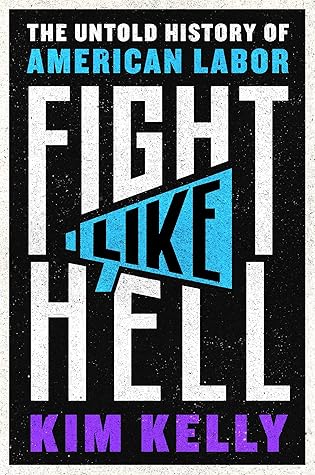
More on this book
Community


Kindle Notes & Highlights

by
Kim Kelly
Read between
December 29, 2023 - March 23, 2024

DRUM’s pressure campaigns led anxious employers to boost outreach to recent Arab immigrants, assuming that a looming fear of deportation would keep the workers “docile” and unlikely to cause trouble for the bosses. But instead of serving as a meek and obedient counter to the more militant Black workers intent on spreading their revolutionary message on the factory floor, Arab workers quickly found common ground with Black workers as exploited minorities in a majority-white setting. The Black workers, especially those who were active in revolutionary circles and Black nationalism, were familiar
...more
The image of the white, blue-collar, cisgendered male manufacturing worker may persist in some imaginations as the classic avatar of the American working class, but as these stories and the many others before and after them have shown, this country’s blackened temples of heavy industry have always been the site of multiracial, multigender, and queer labor conflicts, campaigns—and sometimes even victories.
“Though broken in body, I was fighting with those millions to stamp out those same principles that we fought against during the war,” Williams later reflected, on his time battling discrimination on multiple fronts. “I was fighting for the civil rights of every disabled citizen.”
STAR was more than a mutual aid project, as Marsha P. Johnson once said. “We believe in picking up the gun, starting a revolution if necessary. Our main goal is to see gay people liberated and free and have equal rights that other people have in America.”
In 1973, only a few years after the Stonewall uprising, Rivera was excluded from the speakers’ list at a gay pride rally organized to celebrate its anniversary because the crowd was uncomfortable with her profession. Furious, Rivera got onstage anyway and castigated the crowd for abandoning their queer sex worker brothers and sisters who had been arrested and jailed for their means of survival. “I will not put up with this shit,” she shouted. “The people are trying to do something for all of us, and not men and women that belong to a middle-class white club. And that’s what you all belong to!”
Civilian Conservation Corps (CCC) camps later used to imprison Americans of Japanese and German descent
“I don’t want sympathy or a helping hand out of this life,” one of them wrote. “All I ask is a living wage and I will get out of it myself.” Another, who signed her letter “One of Society’s Victims,” offered a solution to those intent on moralizing her out of a job. “To the good people who are really interested in us I say, you cannot save us unless you overthrow the system of society that made us what we are.”
“[Women] will always be coming into [sex work] as long as conditions, wages and education are as they are,” Madam Reggie Gamble had raged from that pulpit a hundred years before. “You don’t do any good by attacking us. Why don’t you attack those conditions?”
“I use the term ‘sex work’ to establish this work as labor,” she explains. “I wanted to use this term to supplant the reference to the individual activities, because I wanted it to stand for all those.”
Throughout the nation’s history, various forms of indentured servitude, debt bondage, and outright enslavement have powered the U.S. economy and enriched its owner class, building an empire on the backs of enslaved Black and Brown captives as well as poor and working-class immigrants from across Asia, Africa, Europe, and elsewhere. After the Civil War and Reconstruction, when slavery was de jure abolished, the forced labor system of choice shifted from chattel slavery to penal labor, and shockingly little has changed since. It may have been more visible in the early twentieth century, when
...more
The forced laborers working on these new American plantations are paid mere pennies on the hour—if at all. Meanwhile, prison labor generates an estimated $1 billion per year. Federal Prison Industries, also known as UNICOR, is a government-owned prison labor program that has begun marketing its incarcerated workers’ services to companies who want to avoid the costs associated with outsourcing their business and flaunt a “Made in America” label while paying next to nothing for slave labor right here at home.
These circumstances have also led to gruesome historical echoes like the one at the Louisiana State Penitentiary—better known as Angola, or “the Alcatraz of the South”—where incarcerated workers pick cotton in the same plantation fields once worked by Reconstruction-era convict laborers, and by enslaved Africans before them.
Wages for prison jobs have decreased since 2001, and even the highest-paid incarcerated workers, like firefighters in California, see their hourly pay top out around $2 per hour.
“We noticed that almost all [the prisoners] had some black on them,” corrections officer Sergeant Jack English told the New York Daily News. “Some had black armbands, some had black shoe laces tied around their arms, others had little pieces of black cloth or paper pinned on them…. It scared us because a thing like that takes a lot of organization, a lot of solidarity, and we had no idea they were so well organized.”
Hybachi LeMar,
“I had no idea there were forty-four camps throughout the state and that 30 percent of on-the-ground crews in California were incarcerated firefighters making a tiny fraction of what free world firefighters make,”
Breathing Fire: Female Inmate Firefighters on the Front Lines of California’s Wildfires
“So many people feared for their lives in a really immediate way over the last year,” Dubal explained. “What emerged from that is fury and outrage—and outrage and fury and love are the roots of organizing and solidarity.”
