
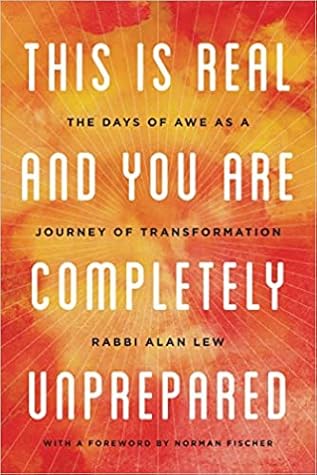
More on this book
Community


Kindle Notes & Highlights

by
Alan Lew
Read between
August 14 - November 26, 2023

The first thing we do during the High Holidays is come together; we stand together before God as a single spiritual unit.
We heal one another by being together. We give each other hope.
And then second, v’hitvadu—we make confession.
And third, we perform this service, this ancient ritual of judgment and transformation, of forgiveness, of life and death.
Rosh Hashanah is Yom Ha-Zikaron—the Day of Remembrance; the day we remember that our roots are in heaven, the day heaven remembers us. Rosh Hashanah is the day of kingship, the day we acknowledge the sovereignty of heaven over our earthly lives.
We don’t know how to do Teshuvah. We are incapable of transforming ourselves. For this, we need to enter a realm beyond the one we usually occupy, a consciousness beyond our own. For this, we need the limitless, the endless, the incomprehensible, the measureless, the mysterious. In short, we need heaven. This is where Rosh Hashanah carries us.
Every moment we are renewed by a plunge into the void. This void is called heaven. There is a void at the beginning of creation and a void afterward. Life is the narrow bridge between these two emptinesses.
Breath—ruach, nefesh—is precisely an energized nothingness, a dynamic emptiness at the center of our being that mirrors the dynamic emptiness out of which life arose.
To rest is to die, so we never permit ourselves a moment’s rest, a moment’s nefesh, a moment’s nothingness.
But if we stop resisting it for a moment, it is precisely this return that can save us. It is precisely this return that can renew us, return us to heaven. Human renewal is one of the universe’s great mysteries, one we tend to take for granted.
Nothing happens to us when we sleep, and it is precisely this nothing that restores us.
So we get back to heaven by doing nothing. We reconnect with the nothing that gives our life meaning by stopping.
In short, holiness is an all-encompassing emptiness. In short, holiness is heaven. And Rosh Hashanah is about our connection to heaven.
Without this connection to heaven, we can’t make Teshuvah. We can’t forgive others or ourselves without it. We can’t see ourselves without it. We can’t know ourselves.
On Rosh Hashanah, the gates between heaven and earth are opened, and things that were beyond us suddenly become possible. The deepest questions of our heart begin to find answers. Our deepest fear, that gaping emptiness up ahead of us and back behind us as well, suddenly becomes our ally. Heaven begins to help us.
Self-forgiveness is the essential act of the High Holiday season. That’s why we need heaven.
We need to feel judged and accepted by a Power who transcends
a sense of something or someone larger and beyond our self.
Though self-forgiveness may end with God, it begins with us.
Inner healing requires self-acceptance. Rebbe Nachman of Bratslav offered the following strategy: When all we see and feel is negativity, we must search within ourselves for an aspect of goodness, what he called a white dot within the black, and then find another and another until these dots form musical notes. Our task, he said, is to find enough white notes to form a melody—a melody that will define our core and affirm our fundamental goodness.
To forgive ourselves, we must be willing to give up our ideas about how we might be better. We need to give up one of our most cherished beliefs—that there is something wrong with us,
But do prayer, Teshuvah, and Tzedakah actually change our fate? The rabbis who came along later realized that of course they do not.
Teshuvah doesn’t change what happens, and it doesn’t change the way we are. It merely changes the way we see these things. We no longer see things as evil, we simply see them as they are, and that makes all the difference.
We are afraid of reflection because we are afraid of ourselves. We are afraid that if we ever stopped running long enough to catch a glimpse of ourselves, we would see something we didn’t like.
The real work we have to do at this time of year, I think, is to find compassion no matter what. But we have to find it for ourselves before we can be of much use to others.
Forgiveness—the desire of God to forgive us—is an irresistible force.
It is your life’s work to turn evil into good.
On Rosh Hashanah, all who have come into the world pass before God.
Rosh Hashanah was called Yom Ha-Zikaron, the Day of Remembrance, the Day of Mindfulness. If God were not aware of us, this whole pageant of Teshuvah and forgiveness wouldn’t make much sense.
Memory has a much richer palette. It is more subjective and therefore more reliable. It doesn’t pretend to be a mirror of objective truth.
Your days are like scrolls, Rabbi Bachya Ibn Pakuda wrote. Write on them only what you would like to have remembered.
We keep trying to pose for the snapshot of our life, but at Rosh Hashanah our deepest need is to see the tape.
Judaism came into a primitive world where the poor were demonized. Poverty was seen as the consequence of a moral fault. The poor didn’t deserve to be helped. But Judaism came to say that this is not how heaven sees things. Heaven thinks that the poor are to be helped, not blamed.
The truth of our lives is the closest thing to us there is, as the Torah reminds us. It is right in front of our eyes. It is embedded in our bodies.
The tape didn’t stop running in between the events we imagined were important. It caught all those small, in-between moments too, the moments when we thought no one was watching. It counts, even if we felt invisible when we were doing it.
But the annoying thing about God is that God seems to be interested in everyone. It’s on the tape. It’s written in the book of our life.
God watches the whole video with a boundless, heartbreaking compassion.
And what does God do then? God listens. God says, Moses, you are a human being, and all human beings have to die, and now is your time. But I’ll attend to you. I’ll bury you myself. I’ll give you my full attention. And then God comes down and takes Moses’ soul with a kiss, weeping, weeping, weeping as He does.
At Rosh Hashanah we begin to acknowledge the truth of our lives. This truth is written wherever we look.
What is there is already so. It’s on the tape. Owning up to it doesn’t make it worse.
For ten days, transformation is within our grasp. For ten days, we can imagine ourselves not as fixed and immutable beings, but rather as a limitless field
we have the sense that we can shape our lives by choosing where to invest our focus and intention, by choosing which forms to follow and which to let go.
Parshat Netzavim is the beginning of the grand coda of the Torah.
Parshat Netzavim addresses Teshuvah itself, the process of active transformation we experience during the ten days, more directly and to greater effect than any other portion of the Torah.
Transformation does not have a beginning, a middle, or an end. We never reach the end of Teshuvah.
Real spiritual transformation invariably takes a long time to manifest itself in our lives.
So the process of Teshuvah is neither clear nor linear.
Teshuvah—transformation—is a reciprocal process that depends on both God and us.
Teshuvah begins with a turn, a turn away from the external world and toward the inner realm of the heart.
But why does the heart require such an indirect approach? Why won’t it just open wide when we ask it to? Why does it resist us so? We are sentimental about the heart, but the truth is, most of us spend a great deal of time and energy avoiding the heart at all costs.
