
More on this book
Community


Kindle Notes & Highlights

by
Alan Lew
Read between
September 28 - October 23, 2019

the purpose of ritual is to render the invisible visible, then what is the profound, universal, unseen, and unspoken reality that all of this ritual reflects? What journey of the soul, what invisible journey of transformation, does all of this make visible?
Every soul needs to express itself. Every heart needs to crack itself open. Every one of us needs to move from anger to healing, from denial to consciousness, from boredom to renewal.
Forgiveness, it has been said, means giving up our hopes for a better past.
Something remained when the Temple was destroyed two thousand years ago. This was perhaps the most significant turning point in Jewish history. Judaism continued without the Temple, an inconceivable possibility at the time. But the truth is that if the Temple had never been destroyed, the renewal Judaism needed so badly could never have taken place. If the walls of the Temple had never fallen down, the fundamental spiritual impulse of Judaism—the powerful emptiness at its core—may very well have been smothered.
Tisha B’Av has a hot tip for us: Take the suffering. Take the loss. Turn toward it. Embrace it. Let the walls come down.
The walls of our soul begin to crumble and the first glimmerings of transformation—of Teshuvah—begin to seep in. We turn and stop looking beyond ourselves. We stop defending ourselves. We stop blaming bad luck and circumstances and other people for our difficulties. We turn in and let the walls fall. Our suffering, the unresolved element of our lives, is also from God. It is the instrument by which we are carried back to God, not something to be defended against, but rather to be embraced.
Before Israel goes off to war, the Torah tells us, the officers of the army must address the people and tell them the following: Who is the man who has built a new house but has not yet inhabited it? Let him go and return to his house, lest he die in the war and another man inhabit his house. Who is the man who has planted a vineyard and has not yet harvested it? Let him go and return to his house, lest he die in the war and another man harvest it. Who is the man who has been betrothed to a woman but has yet not taken her to wife? Let him go and return to his house, lest he die in the war and
...more
The urge to complete unfinished business, to tie up loose ends, is one of the strongest forces in nature, and God help anyone who stands in its way.
So while we are conducting spiritual inventory during Elul, we might begin by asking ourselves, What are the loose ends in my life? How is my mind torn? Where are the places my mind keeps wanting to go? What is the unfinished business in my life? What have I left undone? When we look out at the world through a torn mind, our experience of the world is torn. In some cases we might decide that it’s just time to let go—to recognize that we are distracted by something that will never be completed—and in some cases, we might decide that the only cure is in fact completion; that there’s nothing for
...more
So when we are taking inventory, one of the things we might decide is that we have to simplify our lives.
“Who is the man who is fearful and faint-hearted? Let him go and return to his house, lest his brother’s heart melt as his heart has.” The assumption beneath this admonition is staggering in both its scope and its simplicity: we all share the same heart. We penetrate each other far more than we are ordinarily aware.
What is the pain that is pressing on your heart right this moment? That’s what you need to make Teshuvah about. You need to make Teshuvah about your fractured mind and your fearful heart.
What is occluding the deep connection between you and your fellow human beings? That is also right there over your heart, and that also needs to be looked at. One of the things that most often impedes this connection is our fear of one another’s pain. We have already established that we all have one heart. Deep down, we know this very well. But what we are usually not aware of is how much we feel other people’s pain and how much energy we waste trying to defend ourselves against it.
there is nothing to fear from their suffering when it flows from their heart to my heart. Suffering is just suffering, a feeling that only wants release from the imprisonment of the self—a spiritual impulse that often ennobles, and that like any feeling, carries its own considerable burden of beauty with it.
Is the world really torn and dark, or does it just appear that way to us because we are taking it in through a torn mind and a hardened heart? Judges you shall put in all your gates. This is how Teshuvah begins. When Elul comes around again, watch the window. Keep a mindful eye on the gates of the soul.
The Torah is not really concerned with the specific case of the woman captured in battle. I think it has a larger principle in mind in all this. It seems to be suggesting a method for dealing with the tyranny of passion and desire in our lives in general.
The Torah never permits too much distance between the values it proposes and the way people actually behave, because it recognizes that to do so would break the connection between our lives and the Torah, between our lives and the will of God. So the Torah can’t afford to do too much violence to the way we are, and this lustful impulse, unfortunately, has been repeated throughout human history.
The Talmud seems to be saying that this business of desire is the basis of our creativity, our productivity. Our desire for the apple in the Garden of Eden got us kicked out of Eden, but it also propelled us into history, and if we try to squelch it, or bury it, we might stop being productive. History might grind to a halt. Since we can’t and probably shouldn’t repress our desires, and since it is so often a calamity when we follow them, what should we do?
The passage from Parshat Ki Tetze points us to an answer. First of all, we watch our desires arise. The soldier at the beginning of Parshat Ki Tetze has to live with his desire, to watch it as it evolves without acting on it, for a full month. And the second thing we can learn from him is that once we have our desires firmly in view, we can then strip them of their exotic dress. We can make them cut off their fingernails and their hair, we can make them take off that revealing frock they were wearing when we first saw them. In other words, we can see them for what they really are.
So this is something else we can do during the month of Elul. We can devote a bit of time each day to locating our own particular belle dame sans merci, to identifying whatever desire has distorted our lives, the beautiful delusion for which we’ve thrown everything away, or for which we stand ready to do so, in any case.
And when we’ve located it, all we have to do is look at it. We don’t have to kill it, and we certainly don’t have to act on it either. We can just let it arise in the fullness of its being, unromantically stripped down to the naked impulse that it is, without the finery of romance, without hair, nails, or dress, just the bare impulse itself. We can watch this impulse as it arises for the entire month of Elul, and if after a month it still seems to be something that we want, something that continues to arouse strong feeling in us, then we’ve learned something useful about ourselves. But if this
...more
The first thing we do during the High Holidays is come together; we stand together before God as a single spiritual unit. We do this out of a very deep instinct.
there is nothing we can do. But gathered together as a single indivisible entity, we sense that we do in fact have efficacy as a larger, transcendent spiritual unit, one that has been expressing meaning and continuity for three thousand years, one that includes everyone who is here, and everyone who is not here, to echo the phrase we always read in the Torah the week before the High Holidays begin—all those who came before us, and all those who are yet to come, all those who are joined in that great stream of spiritual consciousness from which we have been struggling to know God for thousands
...more
And then second, v’hitvadu—we make confession. We open our hearts. We acknowledge the futility of our actions.
And third, we perform this service, this ancient ritual of judgment and transformation, of forgiveness, of life and death.
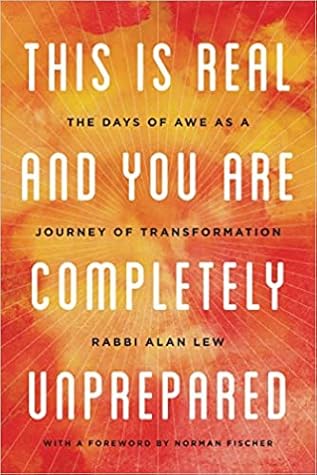
This is real. This is very real. This is absolutely inescapable. And we are utterly unprepared. And we have nothing to offer but each other and our broken hearts. And that will be enough.
we have such an exaggerated belief in the force of our own effort that we never stop trying.
Holiness is the great nothing that appears in all the religious traditions of the world in various poetic guises. It is an ineffable intensity, an oceanic sense, a warm flash of light, a marriage of the soul, a mighty wind of resolution, a starry grace, a burning bush, a wide-stretching love, an abyss of pure simplicity, and as we have mentioned, it is the word the angels cry, the word that rings throughout heaven.
In short, holiness is an all-encompassing emptiness. In short, holiness is heaven.
What are we? What is our piety? What is our righteousness? What is our attainment, our power, our might? What can we say to You? All the mighty are as nothing; the famous, as if they didn’t exist; the wise, utterly lacking in wisdom.
And the answer would not come through effort. It would not come through exertion. It would not come through filling the mind up with reasons and arguments. It would only come when his mind was empty. It would only come from heaven. It would only come after his question was cast into the void—the great nothingness at the core of this young man’s being. It would only come if he asked God for it. And it might have to hang suspended between heaven and earth for a long time before it began to take form.
I was sitting in my living room alone one Saturday afternoon, when I heard the sound of a basketball bouncing on the sidewalk outside. Before I knew it, big, wet tears started rolling down my cheeks. The sound of the ball took me back to when I used to shoot hoops with my father, now dead fourteen years. We played on the little asphalt court he built for me down the hill from our house. I was an American kid. I lived for sports. I was captain of my high school football team, and I had all the moves in basketball. I could dribble behind my back. I could shoot the J. But my father was born in
...more
This highlight has been truncated due to consecutive passage length restrictions.
Though self-forgiveness may end with God, it begins with us. Self-forgiveness is difficult largely because we hold ourselves to such high standards, higher than it is possible to live up to. And it is precisely when we are hardest on ourselves that we are most tempted to bury our misdeeds—to hide from our reality, to deny weakness, to deny that we’ve done anything wrong.
These days create a context of holiness, and if we pay close attention, we begin to notice that everything in our lives is suffused with holiness, even those “faults” we thought we had to forgive ourselves for. Even that behavior we took to be wrongful, we now realize, has a holy spark at its center waiting to be released. This is the essence of self-forgiveness.
When all we see and feel is negativity, we must search within ourselves for an aspect of goodness, what he called a white dot within the black, and then find another and another until these dots form musical notes. Our task, he said, is to find enough white notes to form a melody—a melody that will define our core and affirm our fundamental goodness.
The things we desire—the desires themselves—are sacred. Who put them in our hearts if not God? But we have been taught to be ashamed of what we want; our desires become horribly distorted and cause us to do terribly hurtful things. Even a betrayal as painful as adultery might turn out to have its roots in a perfectly innocent desire—in the desire to be loved, to have our experience be intense and exciting—and if we could acknowledge these innocent desires, we might not feel compelled to act them out in such hurtful ways.
accurately? My great-grandfather Reb
Our families record our real lives with an unflinching precision. This is a tape that never stops rolling. We may look lovely in that snapshot, that picture of kindliness and good cheer we present to the world at large, but when we come home and take out our frustrations on our wives and children, the tape is still running. Our behavior is stored forever in our children’s hearts. A good question to ask ourselves as we plunge into the process of Teshuvah on Rosh Hashanah is this: What would we read about ourselves if our own children wrote a book about who we were? How does our family see us?
...more
And every once in a while, that motorist to whom we have just given the finger, or that woman whom we have just ogled, catches our eye, and we freeze. We see ourselves in their gaze, our rage and our lust. We probably don’t like what we see in those moments, but they have a kind of power nevertheless. They remind us that we are being watched. We can see ourselves in the eyes of these strangers.
At my synagogue, I am often shocked to discover that people who always speak to me with unfailing consideration and the utmost respect regularly berate the synagogue secretaries mercilessly when they call for appointments or for better seating arrangements for the High Holidays. I think they must imagine that since I am God’s agent on earth, God only pays attention to their interactions with me and doesn’t register their conversations with the secretaries. Why, after all, would God be interested in unimportant people like my secretaries? But the annoying thing about God is that God seems to be
...more
At Rosh Hashanah we begin to acknowledge the truth of our lives. This truth is written wherever we look. It is written on the streets of our city; it is written in our bodies; it is written in our lives and in our hearts. We have a deep need to know this truth—our lives quite literally depend on it. But we can’t seem to get outside ourselves long enough to see it. And besides, we are terrified of the truth. But this is a needless terror. What is there is already so. It’s on the tape. Owning up to it doesn’t make it worse. Not being open about it doesn’t make it go away. And we know we can
...more
First of all, we learn that Teshuvah can arise in the most hopeless circumstances. In fact it often seems to begin that way.
Transformation is just too hard for us to volunteer for. Interestingly, God is depicted as the one who is doing the pushing here. We are in the predicament that has brought us to the point of transformation because God has driven us there. In other words, that predicament is part of the process. It is a gift, the agent of our turning.
Transformation is not something that happens once and for all time. The people turn three different times in this passage, and as it closes, they are promised a great blessing, but only if they continue to turn in the future.
We never reach the end of Teshuvah. It is always going on. We are awake for a moment, and then we are asleep again. Teshuvah seems to proceed in a circular motion...
This highlight has been truncated due to consecutive passage length restrictions.
Profound transformation only manifests itself over time.
So the process of Teshuvah is neither clear nor linear. And who is the principal actor in all this? Is it us or is it God? In the passage from Netzavim, sometimes we are the subject of the turning, and sometimes God is the subject, all of which seems to suggest that Teshuvah—transformation—is a reciprocal process that depends on both God and us. No one else can do transformation for us, but on the other hand we can’t do it by ourselves either.
Because this commandment [to do Teshuvah] is not too wonderful for you and is not distant from you either. It is not in heaven, so you can’t say, “Who can go up to heaven and bring it to us and cause us to hear it so that we can do it?” And it is not beyond the sea, so you can’t say, “Who can go across the sea and bring it to us and cause us to hear it so that we can do it?” But the word is very near to you, in your mouth and in your heart, so you can do it.
In the chapter on Elul, we reviewed the role prayer and meditation play in this process. Both of these activities sneak up on the heart. They disarm the heart by focusing on something else—the breath or the body or the words of the prayer book—and then the heart, which has always craved our attention anyway, unwittingly discloses itself by stealing our attention away from our breathing or our prayers with a continuous stream of thoughts and feelings and impulses.
In either case we are not inclined to look at it. We live in a culture that conditions us to avoid suffering, and the consequence of this is that we live at some distance from our heart. We are not in the habit of looking at it, but of distracting ourselves from its content. As we begin the process of Teshuvah, we need to make a conscious effort to overcome the momentum of this denial and avoidance.
