
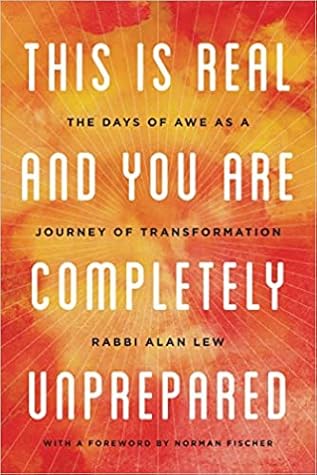
More on this book
Community


Kindle Notes & Highlights

by
Alan Lew
Read between
September 28 - October 23, 2019

The nature of our pain points us to the nature of the transformation we need to make. If we are angry, we need to move toward inhabiting our anger and then letting go of it. If we are in despair, we need to move toward hope. But the intensity of our pain is even more helpful in this process than its particular cast. As we sit in the boundless field of mind during the ten days of transformation, impulses and feelings rise up and fall away all around us. Those impulses and feelings that assert themselves with particular force are the ones we are most likely to follow. This is the great gift of
...more
We can see that they are just impulses, arising for a moment, the way wind and rain and snow arise for a moment in the world. They are wind and rain and snow, but they are not the world. They are not us. They only become us by our own choice, by our choosing to see them that way, by our choosing to cling to them so tenaciously. We can make another choice if we wish to. We can choose to allow these feelings to rise up and then let them fall away again like a hot breeze. And this is the simplest and most frightening truth about all this business. Anger is a choice. Boredom is a choice. Fear is a
...more
We form our intention and then we let heaven and earth bear witness. Opening to forgiveness, we begin to see it all around us.
As civilization advances, the sense of wonder declines. Such decline is an alarming symptom of our state of mind. Mankind will not perish for want of information, but only for want of appreciation. The beginning of our happiness lies in the understanding that life without wonder is not worth living. What we lack is not a will to believe, but a will to wonder.
Heschel writes that the greatest hindrance to awareness of the divine is our adjustment to conventional notions and mental clichés. Wonder, or radical amazement, he suggests, is a state of maladjustment to words and notions. Moshe Cordovero, the great medieval Kabalist, also recommends a kind of intentional maladjustment as a strategy for returning to God. “It is a good idea to make some sort of alteration in your food and drink and in your clothing,” he writes. “For example, one week do not eat fruit; another week, do not eat meat or drink wine, or do not eat hot food.”
Spiritual deadness is a habit. Something in us wants to be dead—wants to escape our reality—and we’ve expressed this desire in a hundred little patterns and habits. So a physical shaking up of our stale routines might actually serve to loosen us up inside and lead the way to inner change.
Renewal often begins when we turn toward this place even when it seems utterly distant. In
So while we defy the meaninglessness of our life, the act of defiance consists in our refusal to run away and our resolve instead to fill it with our consciousness. We live it, and then we dare it to remain dull and meaningless.
When we feel dead inside, it is often because there are old ideas we no longer believe in or haven’t challenged in far too long, old feelings we really don’t feel anymore but cling to desperately, afraid of what might happen if we admit we don’t feel them. Without our realizing it, these things have suffocated us, crowding the life out of our soul. Sometimes they can be reinvigorated, refreshed, or reimagined. But sometimes they must be removed. We must simply let go of them. The altar must be emptied so that the light may keep burning.
The soul is pushed down and then the soul rises up again. The salmon leaps. This is precisely the struggle Kol Nidre depicts.
Kol Nidre is about speaking true—about the power of speech. It is a gift to us from a time far back in our tribal consciousness when we seemed to understand these things better than we do now, when we seemed to understand the biblical warning that we are absolutely accountable for everything that comes out of our mouths.
The Kol Nidre is calling us. It is saying, Speak. Speak the shadow, as much as you know is spread around you midnight to midday to midnight. Speak and let go. Speak and be human. Speak and be healed.
Since each of us is imperfect by nature—since each of us is incomplete—it is only in community that we begin to find a sense of wholeness, a sense of completion. So not only is it permissible, not only is it required, for us to pray with the Avaryonim—the imperfect ones—we have a desperate need to do so. In praying with them we begin to find the answer to our own imperfection. None of us is whole by ourselves. A spiritual community is one in which we find wholeness, completion with others. What we lack is provided by somebody else. Now I know, this is a positively un-American idea. The John
...more
We are all Avaryonim, incomplete in ourselves. It takes the presence of other people to make us whole—to give credence and integrity to our experience. According to Rabbi Abraham Joshua Heschel, even God had that need—even God needed a witness to lend integrity and credence to the creation—and that, apparently, is why God created us. So if God has this need, how can we be ashamed of it—how can we see ourselves as being above it?
But whether we live or we die, we will only have one soul to do it with, one precious soul to inhabit for our brief moment on this mortal coil. Why have we chosen to torment this soul, to fill it with anger and hatred, to hold on to the hot coal of self-righteousness with all our might, in the foolish hope that it may someday hurt the person we imagine to be our enemy, while all the while, it’s only hurting us, while all the while it is our own soul—the only soul we have—that is writhing in torment. What have we been thinking of?
Is this the fast I have chosen? Is this your affliction of the soul? Is it to droop your head like a bullrush, to grovel in sackcloth and ashes? Is this what you call fasting, a fast that the Lord would accept? Is not this my chosen fast: Loosen all the bonds that bind men unfairly, let the oppressed go free, break every yoke. Share your bread with the hungry, take the homeless into your home. Clothe the naked when you see him, do not turn away from people in need. Then cleansing light shall break forth like the dawn, and your wounds shall soon be healed.
