
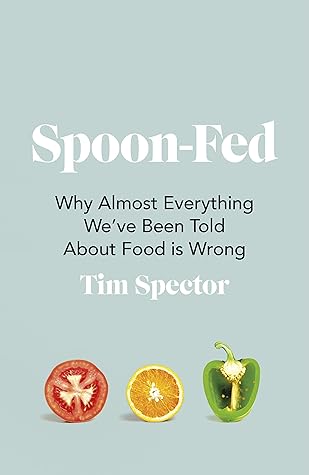
More on this book
Community


Kindle Notes & Highlights

by
Tim Spector
Read between
July 9 - July 30, 2022

In other words, healthy eating is not something we can do solely on our own. It is something that we need to do as a society.
In the UK and US we currently consume over half our daily food calories in UPF form, compared with under 10 per cent in Mediterranean countries.
After a gap of four to six hours without food, certain species start replicating and feed off the carbohydrates in the mucus of the gut lining, effectively tidying it up and making the gut barrier more efficient and healthier.
Walnuts, for example, spent years with their calorie content inflated by 20 per cent on food packaging until it was discovered that much of the fat they contain is not released when we eat them. Almonds have been similarly over-estimated in calorie content by about 31 per cent.
Differences in our genes or the number of copies of genes we carry can make some of us extract more energy (in the form of sugar) from starchy carbohydrates like potatoes or pasta. Some people produce up to three times more starch-digesting enzymes (amylase) than other people, allowing them to break down starch and release more sugar far quicker.
Vitamin D isn’t actually a vitamin, since our body can make it naturally from chemicals in the skin on exposure to sunlight. It should be called ‘steroid hormone D’, although presumably this would make it much less popular.
Remember that virtually no vitamin or mineral supplement has been shown to have any benefit in proper randomised trials in normal people, and increasingly they are being shown to risk causing harm.
artificially sweetened drinks and foods will trick you into gaining weight.15
regardless of body fat, junk-food diets with few vegetables lead to less microbial diversity and more inflammation markers in the blood, which increases the risk of multiple diseases.
All the evidence shows that regular eating of junk food leads to the greatest increases in weight and ill health compared to other foods.
Reducing your meat consumption, especially poor-quality, low-sustainable versions such as grain-fed beef, could be the most important thing you can do for the planet.
Aquaculture is under pressure to be more sustainable and in 2015 you had to kill 1.3 kg of wild fish to feed 1 kg of farmed fish like salmon.
A substantial systematic review found there to be no evidence that increasing dietary calcium intake prevents fracture risk.14 While some calcium is needed for strong bones, we need much less than previously thought, and most of us can get enough from loading up on vegetables (pak choi, broccoli) and other foods (tofu, nuts and seeds).
Moderate coffee drinking (three to four cups per day) was associated with reduced risk of death by 8 per cent and heart disease by 20 per cent.
those who drank four or more cups of coffee per day were half as likely to commit suicide.
Unless you have a medically confirmed diagnosis of coeliac disease or a rare wheat allergy, avoiding gluten is likely ‘on average’ to do you more harm than good.
The 10,000-step goal, which is a nice round number, was invented by a Japanese pedometer company before the 1964 Tokyo Olympics to stop people being lazy and has no scientific basis.
Below three hours of exercise, under-hydration has never been shown to be a problem, and as runners are urged to drink as much as tolerable, deaths from over-hydration are now sadly fairly frequent, as opposed to deaths from dehydration, which are non-existent.
Unbiased studies have shown that you don’t need any special drinks or supplements unless you are a professional athlete or exercising hard for over three hours.
To the surprise of the investigators, a 2014 study investigating behavioural psychotherapy and dietary advice in preventing major depression in 247 older people with mild depression found that both methods worked equally well in reducing depressive episodes over two years.
It is now clear the complex community of gut microbes that produce thousands of chemicals is key to the link between food and mood.
On average, patients with depression have a less diverse set of microbe species, especially in those with the commonest form of depression associated with anxiety. A large recent Flemish-Dutch population study of over 2,000 people showed mood and depression were affected by gut diversity, and the microbes that were missing in depressed people were those producing the key dopamine brain chemicals.7
Poor diet consistently comes out clearly as the main risk factor following populations who develop dementia.
A study of 457 British civil servants over ten years found that those who had the healthiest diets had the least loss in size of key parts of the brain such as the hippocampus, key to emotions and long-term memory.
Most components of food, except for some polyunsaturated fats, can’t cross from the blood into the brain, so much of this effect is likely to be indirect via other chemicals produced in the gut.
A study in 2019 showed that patients having psychotic thoughts had abnormal gut microbes that when transplanted into lab mice could make them also behave psychotically and altered brain chemicals (such as glutamates and GABA).13 This
diverse Mediterranean-style diet with a range of fermented foods to keep your microbes happy is looking like the best present you can offer your brain, both to cheer it up and keep it working well.
We should all turn our attention to the environmental impact of bottled-water production. Producing bottled water uses 2,000 times more energy than the equivalent volume of tap water. Worse still, it takes around 4 litres of water to purify a single litre of water and over 10 litres to make the plastic to carry it.
The world produces nearly 20,000 bottles per second and they are piling up everywhere.
Contrary to popular belief, buying local strawberries or tomatoes out of season uses similar amounts of energy per kilo compared with importing goods from abroad and isn’t any better for the environment.
In fact, a UK study comparing farm shops and mass distribution methods found that driving yourself to the local farm shop is worse than having your vegetables delivered in a van to your door in terms of carbon emissions, though cycling is better than both options.1
If everyone in the world drank like the Germans, 32 million acres of land would be needed (equivalent to the size of Greece) just to grow oranges.
If you enjoy breakfast but don’t like the thought of going organic, you may be interested to know that US and UK government agencies have independently found common breakfast foods to have particularly high levels. Porridge oats
Perhaps the most important message that tends to get forgotten is that we should avoid highly or ultra-processed foods as much as possible.
Eat diverse foods, mainly plants, without added chemicals Question the science and don’t believe quick-fix single solutions Don’t be fooled by labels or marketing Understand you are not average when it comes to food Don’t get into food ruts: diversify and experiment Experiment with meal timings and skipping meals Use real food, not supplements Avoid ultra-processed foods with over ten ingredients Eat foods to improve gut microbe diversity Reduce regular blood glucose and blood fat spikes Reduce meat and fish consumption and check its sustainability Educate yourself and the next generation in
...more
