
More on this book
Community


Kindle Notes & Highlights
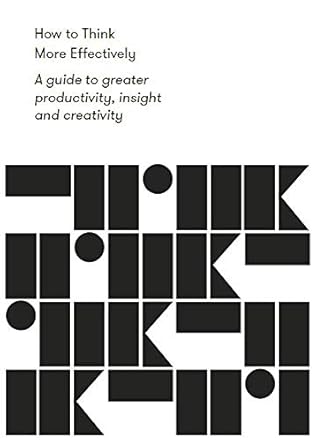
How to Think More Effectively: A guide to greater productivity, insight and creativity (Work series)
Read between
February 13 - April 17, 2020

The suggestion on offer is that we can learn systematically to harvest rather than sporadically to forage our most satisfying and necessary thoughts.
There is a fundamental distinction to be made between two kinds of thinking: figuring out what we would like to achieve, and working out how to achieve it.
our minds do not disclose their more elaborate and best thoughts in one go.
we should pay special attention not to the books but to the manuscripts of great thinkers.
In every office or above every desk there should be an image from the messy early stages of a masterpiece to keep this basic, consoling and encouraging truth where it belongs:
On the notebook’s pages, an idea from Monday morning in November will meet its logical counterpart, which will come to us only in January in the middle of a turbulent night. A vital parenthesis will enter the mind a year after an initial sentence.
We should not be surprised that thinking is so often interrupted by anxiety. New ideas threaten the mental status quo and are often sharply at odds with our existing commitments and habits.
The primary obstacle to good thinking is not a cramped desk or an uninteresting horizon. It is, first and foremost, anxiety.
A talented artist is, first and foremost, someone who takes us into the specifics of valuable experiences.
What am I anxious about?
Life, properly felt, is an infinitely alarming process even in its apparently calmer stretches.
Only by being listened to in generous, almost pedantic detail will anxieties lose their hold on us.
What am I upset about?
You must change your life
We might spend more time looking after our children, if we knew this wouldn’t prevent advancement in our working life.
Changes in personal life and in society and business rarely begin with practical steps: they start as a leap of the imagination, with a heightened sense of a need for something new,
What is the biggest version of your current ambitions?
We are so much the poorer if all we can do is agree with the books we read.
we’re taught that the best thing we can do with envious feelings is never to experience them in the first place. Envy hasn’t yet made its way into our register of experiences that we imagine could teach us anything. However, if we could learn to handle our envy correctly, if we think it through with sympathy and skill, then it could play a key role in alerting us to what we genuinely want. Envious thinking can be the gateway to deeper self-knowledge and a profound understanding of our underlying ambitions.
It might not be the whole of the café owner’s life we want, just their skill at creating spaces in which people feel welcome.
The benefits of analogy form an argument for keeping our minds well stocked with knowledge from other disciplines, whatever domain we happen to be in. Engineers should spend time reading poetry, poets cookery books, cookery writers economics manuals and so on.
The best way to unearth the secrets of complete strangers is to look honestly into our own hearts.
Empathising with an unfaithful person will mean accepting our own buried promiscuous desires.
to ask ourselves with generosity but also rigour and impatience what we are trying to achieve in our careers or what kind of relationships we feel we should be in.
Moralistic thinking identifies people closely with their worst moments. Love thinking pushes us in another direction: it bids us to use our imaginations to picture why someone might have done a regrettable deed and yet could remain a fitting target for understanding and sympathy.
The loving interpreter holds on to the idea that sweetness must remain beneath the surface, along with the possibility of remorse and growth.

But what if growth is not possible.
Moralistic thinking likes headlines; love thinking goes in search of stories.
One of the stranger moves we all have to practise if we are to learn to think effectively is more regularly to imagine that we might be wrong. The good thinker is, to a large extent, first and foremost a sceptic.
it may be judging a situation in the present according to a bias unconsciously picked up in childhood.
Thinking well means trying to put in place measures that can mitigate for the worst of our tendencies: always sleeping on a major decision; always ensuring that we have had enough food and water when we are reflecting hard; always trying to make a case for the opposite point of view to the one we’re initially and emotionally attracted to; always questioning our feelings rather than submitting to their excitements.
