
 Must be signed in and friends with that member to view that page.
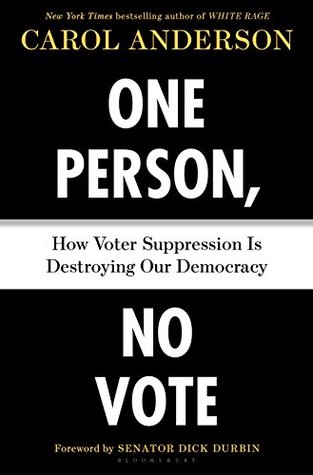
More on this book
Community


Kindle Notes & Highlights

Read between
August 30 - September 8, 2025

Under the specious banner of combating “voter fraud,” the Republican Party has launched a nationwide voter suppression effort. Using voter ID laws, reduced voting opportunities, gerrymandering, and even the national census, Republicans clearly believe their future success depends more on constricting rather than convincing the electorate.
In 2012, as chairman of the U.S. Senate Judiciary Committee’s Subcommittee on the Constitution, Civil Rights, and Human Rights, I chaired national hearings on barriers to the ballot in Ohio and Florida, states that had recently passed restrictive voting laws. We called election officials of both parties, put them under oath, and asked a simple question: What was the incidence of voter fraud or voter irregularity in your state which gave rise to these state laws restricting voters’ rights? Their answer was the same in both states: There were few incidents, and virtually none was worthy of
...more
This highlight has been truncated due to consecutive passage length restrictions.
The Republican-dominated Supreme Court gave a green light to the “No Vote” Republican strategy—and the Voting Rights Act, which had enjoyed virtually unanimous bipartisan support in Congress as recently as 2006, became a casualty of the GOP voter suppression campaign.
Evidence suggests that their plan is working. A recent study found that in the 2016 election, Wisconsin’s voter ID law deterred nearly 17,000—and perhaps as many as 23,000—eligible voters in two counties from casting ballots. President Trump’s margin of victory in Wisconsin was only 22,748 votes.
As Carol Anderson makes clear in One Person, No Vote, the right to vote is under even greater assault today. For the sake of those who fought and died for it, it is up to all of us to insist that this most basic American right be protected.
The tide of African American, Hispanic, and Asian voters that had previously carried Barack Obama into the White House and kept him there had now visibly ebbed. Journalist Ari Berman called it the most underreported story of the 2016 campaign.5 But it’s more than that. The disappearing minority voter is the campaign’s most misunderstood story.
Minority voters did not just refuse to show up; Republican legislatures and governors systematically blocked African Americans, Hispanics, and Asian Americans from the polls.
The GOP, therefore, enacted a range of undemocratic and desperate measures to block the access of African American, Latino, and other minority voters to the ballot box.6 Using a series of voter suppression tactics, the GOP harassed, obstructed, frustrated, and purged American citizens from having a say in their own democracy.
They target the socioeconomic characteristics of a people (poverty, lack of mobility, illiteracy, etc.) and then soak the new laws in “racially neutral justifications—such as administrative efficiency” or “fiscal responsibility”—to cover the discriminatory intent. Republican lawmakers then act aggrieved, shocked, and wounded that anyone would question their stated purpose for excluding millions of American citizens from the ballot box.
The decisions to purposely disfranchise African Americans, in particular, can be best understood by going back to the close of the Civil War. As a southerner explained, “Many Texans refused to accept the fact that the Negro was ‘free and equal,’ and stopped at nothing to prevent him from enjoying civic and political rights.”
The last point resonated. Reconstruction had brought a number of blacks into government. And despite their helping to craft “the laws relative to finance, the building of penal and charitable institutions, and, greatest of all, the establishment of the public school system,” the myth of incompetent, disastrous “black rule” dominated. Or, as one newspaper editor summarized it: “No negro is fit to make laws for white people.”
That became most apparent in 1890 when the Magnolia State passed the Mississippi Plan, a dizzying array of poll taxes, literacy tests, understanding clauses, newfangled voter registration rules, and “good character” clauses—all intentionally racially discriminatory but dressed up in the genteel garb of bringing “integrity” to the voting booth. This feigned legal innocence was legislative evil genius.
One delegate questioned him: “Will it not be done by fraud and discrimination?” “By fraud, no. By discrimination, yes,” Glass retorted. “Discrimination! Why, that is precisely what we propose … to discriminate to the very extremity … permissible … under … the Federal Constitution, with a view to the elimination of every negro voter who can be gotten rid of, legally, without materially impairing the numerical strength of the white electorate.”
The resulting “voter mortality rate” was staggering. Throughout the South after the widespread adoption of the Mississippi Plan, voter turnout plummeted to less than half of age-eligible whites, after it had peaked in 1896 at 79.6 percent.
In Louisiana, where “more than 130,000 blacks had been registered to vote in 1896, the figure dropped to a bleak 1,342 by 1904.”
As historian C. Vann Woodward concluded, “The restrictions imposed by these devices [in the Mississippi Plan] were enormously effective in decimating the Negro vote.”
Indeed, by 1940, shortly before the United States entered the war against the Nazis, only 3 percent of age-eligible blacks were registered to vote in the South.
Bilbo was pointing to the power of the literacy test and understanding clause, which were tailor-made for societies that systematically refused to educate millions of their citizens and ensured that the bulk of the population remained functionally illiterate. By 1940, more than half of all African American adults in Mississippi had fewer than five years of formal education; almost 12 percent had no schooling whatsoever. The figures were even more dismal in South Carolina, Louisiana, Georgia, and Alabama.
Deliberate underfunding of black schools was critical to the literacy test’s disfranchising success. During World War II, for example, Louisiana spent almost four times as much per capita on white elementary schoolchildren as on African American students.22 Amite County in Mississippi scraped together $3.51 per black child but nearly ten times that amount to educate its white students.
In addition, for most of the twentieth century, many Jim Crow school systems did not have high schools for African Americans. That set the stage for states such as Alabama—where more than 54 percent of black adults had fewer than five years of formal education—to require those who came through resource-deprived school systems an...
This highlight has been truncated due to consecutive passage length restrictions.
And the registrar’s decision on whether the would-be voter passed through this maze of legal gobbledygook was final. Non-appealable.25 Black coal miner Leon Alexander knew this firsthand. He recalled the moment, shortly after World War II, when he tried to register to vote in Alabama. He stood there at the counter waiting and waiting while the registrar made a big show of deliberately ignoring him. Finally, when whites came into the office, the registrar greeted them, provided the paperwork, and promptly registered them to vote. Alexander nevertheless remained standing there, refusing to
...more
Despite the fact that this scene played out over and over in registrars’ offices across the South—where a registrar in Mississippi could even ask African Americans, “How many bubbles in a bar of soap?”—the law itself was just race-neutral enough to withstand judicial scrutiny.27 Not only did literacy tests appear nondiscriminatory; they also carried the aura of plausibility. Voters, everyone could agree, ought to be able to understand their state’s laws. Yet when that device was made operational, it had nothing to do with the law, of course, nothing to do with an engaged citizenry, and
...more
And then there was the poll tax, which all eleven states of the former Confederacy had adopted.
As a revenue producer, it was “a flop,” however; Arkansas, for example, raised “only 5 percent of [its] total school budget by the poll tax, a tax that [kept] a good 80 percent of [the state’s] adult citizens from voting.”
“Negroes would again be an important factor in southern politics.” One man in Arkansas put it succinctly enough: “Do you want to see niggers in the state capital with their feet on the desk?”
And, as it was law enforcement that collected the poll tax, the intimidation factor was very real in many locales. Sheriffs, notorious in the black community for their racism and brutality, were now the gatekeepers to the franchise.
Second, the tax was cumulative, a feature that alone would prove virtually insurmountable. For every year the resident was eligible to vote, a payment was due. For example, if after twenty years of not voting or having been unable to vote, an African American in Alabama in 1944 was finally able to pay, he or she would need not $1.50 to do so but rather $30, which is the equivalent of $722 in 2016.37 By design, then, those back taxes “effectively depressed the black turnout.”
In Mississippi, the average farm family’s income was “less than $100 a year.” The state was, therefore, requiring that the impoverished give up 2 percent of their annual income “to cast a ballot.” In households with three adults, this demand on limited resources could require them “giv[ing] up 6 percent of their income for the franchise.”
There was another built-in inequity in the system. Mississippi, for instance, required receipts for two years of poll taxes in order to vote. The tilt in the playing field was apparent when arch-segregationist Theodore Bilbo’s political operation worked with election officials to handle the difficulty of keeping track of multiyear receipts. His all-white constituency’s “receipts are not only bought for them but are kept on file, issued on election day, re-collected and saved for the next year.” The political machines in Texas did something similar. They would “buy up as many poll tax receipts
...more
Key to the white primary’s effectiveness was the fact that from Reconstruction until 1968 the South was a one-party system—only Democrats needed apply, so despised was the party of Lincoln.
“We already had the Negro eliminated from politics by the white primary,” he proudly asserted.49 And then a paper-thin aura of legality was achieved because blacks were welcome to vote in the irrelevant and perfunctory general election. Except black people fought back. Over the span of twenty years they launched four separate lawsuits that went all the way to the U.S. Supreme Court. Texas was the site of this battle, because while all eleven states of the Old Confederacy had the white primary, the Lone Star State did it in “a more brutally direct fashion.”
Texas was, however, undaunted. Satisfied that the court hadn’t questioned whether the white primary actually violated the Fifteenth Amendment right to vote, the legislature simply redrafted the statute to turn the Democratic Party into a private organization—one to which the state just happened to delegate the authority to hold a primary. The point of this ruse was perfectly clear. In the Cruikshank decision, almost fifty years earlier in 1875, the U.S. Supreme Court had established that private actors were “immune from the strictures of the Fourteenth and Fifteenth Amendments.”53 Again,
...more
Less than a month after the Supreme Court provided the roadmap to disfranchisement, then, the Democratic Party called a statewide convention and passed a resolution “restricting membership in the Party plus participation in party primaries to white citizens of Texas.”
Once again, the state had effectively eliminated African Americans and Mexican Americans (this was, after all, Texas) from having any real voice in determining their representatives in government or the policies that would affect their lives.
In an 8–1 decision, the Supreme Court affirmed that sentiment when it ruled that the white primary, although supposedly a private affair, was central to the election process and, therefore, fell under the domain of federal law and the U.S. Constitution. Marshall was overjoyed that the justices had finally “looked behind the law and ferreted out the trickery.”
South Carolina decided to maintain the white primary while at the same time purging its books of all election laws. The rationale was simple: With nothing written down, there was nothing that the courts could find in violation of the Fourteenth or Fifteenth Amendments.
What the states could not accomplish by law, they were more than willing to achieve by violence. The wholesale slaughter of African Americans in Colfax, Louisiana (1873), Wilmington, North Carolina (1898), and Ocoee, Florida (1920), resulted in the loss of hundreds of lives simply because whites were enraged that black people had voted.64 As states encouraged or winked at the murders, as killers stepped over the bodies and gobbled up the stolen land and property, black political power evaporated in a hail of gunfire and flames.
The 1946 primary was the first since the U.S. Supreme Court’s Smith v. Allwright decision, and Snipes, as an American citizen, believed that he actually had the right to participate in his state’s election. He was mistaken. Whites had already posted a sign on the black church in Taylor County, Georgia: “The first Negro to vote will never vote again.”69 Snipes was not deterred. In July 1946, he cast his ballot in Taylor County’s primary. In fact, he was the only black person to do so; and with that act of democratic bravery, Maceo Snipes signed his death warrant. A few days later four white men
...more
V. R. Collier, the president of the NAACP branch in Gulfport, was “physically assaulted.” When he turned to the Federal Bureau of Investigation for help, the agent told him that the bureau didn’t protect; it investigated. When he called the U.S. attorney in Jackson, Collier was directed to seek help from the FBI. The realization was wrenching: “We Negroes are without any protection at all,” he said.
Denying the vote to millions of American citizens was so deeply rooted in the fabric of the nation, twisted into the mechanics of government, and embedded in the political strategy and thinking of powerful government officials that this clear affront to democracy was not going to change on its own. Fortunately, local resistance and global condemnation combined to take America to the brink of democracy.
The Cold War also weaponized culture and propaganda.79 The Soviet Union prided itself on meeting the basic material needs—housing, employment, health care—of its people. There was, of course, a steep price to be paid in terms of individual freedom and liberty. The Soviet weakness, therefore, played directly into the Americans’ strength: democracy. But, given Jim Crow, those vaunted democratic ideals turned out to be the U.S.’s Achilles heel as well—a fundamental hypocrisy the Soviets set out to exploit at every turn.80 Each lynching, each bombing of a black home or business, each miscarriage
...more
The crisis “brought Jim Crow violence to vivid life in world media” and led Secretary of State John Foster Dulles to exclaim that “this situation was ruining our foreign policy.”82 The Soviets wanted to be sure of it as they published their exposé: “National guard soldiers and policemen armed to the teeth bar Negro children from entering the schools, threaten them with bayonets and tear-gas bombs and encourage hooligans to engage in violence with impunity.”
The U.S. ambassador to the United Nations Henry Cabot Lodge asserted, “I can see clearly the harm that [Little Rock is] doing … More than two-thirds of the world is non-white and the reactions of [their] representatives is easy to see.”
What ruined the U.S.’s credibility, the Soviets gleefully claimed, was that people who “dream of nooses and dynamite … who throw rocks at defenseless Negro children—these gentlemen have the audacity to talk about ‘democracy’ and speak as supporters of ‘freedom.’ ”86 Don’t be fooled, the Kremlin warned—the U.S. goal was to export Jim Crow, not democracy.
President Dwight Eisenhower’s “solution” to this Gordian knot, however, only pulled the rope tighter. In 1957, Attorney General Herbert Brownell, with a full assist from the wily junior senator from Texas, Lyndon Johnson, crafted and pushed through Congress the first civil rights bill in nearly ninety years. This was America taking care of the “unfinished business of democracy.” Except it wasn’t. The Civil Rights Act (1957), while seemingly a landmark piece of legislation, was actually a paper tiger that had no ability to protect the right to vote. The act did create the Civil Rights
...more
The “crime” had to occur, in other words, before the Department of Justice stepped in. Which meant that skewed election results, where a candidate assumed office because citizens had been systematically disfranchised, could affect years of policy and lawmaking while the long, drawn-out court process slowly unfolded.
Meanwhile, the black populations could and would continue to be terrorized and harassed for daring to vote, with little to no protection.
In Alabama’s Marion, Lowndes, and Dallas counties, years of nonviolent, direct-action protest led to a cinematic explosion in March 1965 on the Edmund Pettus Bridge in Selma. As peaceful marchers ran into the hailstorm of Alabama state troopers and Dallas County sheriff Jim Clark and his deputies, news cameras captured the horror of tear gas, barbed-wire bullwhips, and police on horseback trampling over the fallen. A nation sat in stunned silence, almost traumatized by the spectacle. And then the ensuing bludgeoning death in Selma of a white minister because he had the audacity to believe that
...more
President Lyndon Johnson demanded that the attorney general craft a law with teeth. The “goddamdest, toughest voting rights act that [attorney general] Nicholas Katzenbach and his aides could devise targeted southern jurisdictions that had a tradition of discrimination against African Americans.”
The VRA was nevertheless a seismic shift in thought, action, and execution for the U.S. government when compared with the Civil Rights Act of 1957 and its equally enfeebled companion legislation of 1960. Rather than passively waiting for locales to violate the rights of American citizens and then sitting still until those who had been routinely brutalized by this system made a formal complaint, the VRA put the responsibility for adhering to the Constitution onto state and local governments. In other words, the days of discriminatory laws and so-called race-neutral machinations were over; the
...more
